
 Recruit


A digital nomad visa, sometimes called a remote work visa, differs from a usual work or business visa. It allows the holder to temporarily live away from their primary country of residence while working remotely. They’re aimed at professionals who want to experience living in another country while maintaining their employment or other income sources from elsewhere.
Key Takeaways
- Digital nomadism has become increasingly popular since the Coronavirus pandemic.
- More than 50 countries around the world now issue visas for remote workers.
- Visas intended for digital nomads are different from work and business visas.
- The application process and requirements vary between different nations
- You may be able to work remotely in a country without a specialist remote worker visa.
The Coronavirus pandemic drastically affected the landscape for travel, with most countries shutting their borders to tourists and visitors. Since then, the increase in remote working and the desire to travel have led to significant growth in digital nomadism. Digital nomads eschew traditional working patterns and work remotely from their chosen location, typically traveling at will.
Although specific visas are often not required for working in this way, many countries are taking note of the movement and offering digital nomad visas to traveling professionals. This type of visa can benefit professionals who want to remain in one location for an extended period.
If you’re already living this lifestyle or interested in leaping, understanding digital nomad visas and how they can support you is vital. This helps you decide which countries and visa options best fit your work and travel goals and understand how to apply for the correct visas for your needs. Keep reading to discover more about digital nomad visas and how you can apply for one.
What is a Digital Nomad Visa?
A digital nomad visa is specifically designed for individuals who have remote employment from another country or are self-employed. They are not intended to allow you to find work locally, begin working remotely for a local company, or as a starting point for permanent residency in the country. It’s usually a requirement that your employer or your freelance clients are based outside the country you’re working from.
The duration of a digital nomad visa is also different from other types of work-related visas. Business visas are typically issued for short periods, similar to a tourist visa. A work visa may be valid for several years. Most countries that issue digital nomad visas allow you to work in the country for up to one yea. Still, thee regulations vary between different countries and some of these visas might allow you to stay for longer or shorter periods.
It should be noted that some digital nomad visas require that individuals have an overseas employer, while others allow individuals to earn income from other sources (such as freelancing).
Where Can I Get a Gigital Nomad Visa?
More than 50 countries around the world offer some form of digital nomad visa. Note, though, that if you’re a digital nomad, this doesn’t mean that you’re restricted to only working in these countries. In many countries, it’s possible to work as a digital nomad without requiring a specific ‘digital nomad’ visa. It’s important that you check the specific visa regulations of the countries that you want to visit to ensure that you’re compliant with the rules.
Many digital nomads choose to work remotely while staying in countries on tourist or visitor visas. It should be noted that this is generally against local immigration and tax laws.
Below we consider the countries that either offer a specific digital nomad visa, or offer other visa classes that make it straightforward to work in that country or territory as a digital nomad.
We survey the digital nomad schemes according to region through Europe, the Carribean, North, South and Central America, the Middle East, Asia-Pacific and Africa.
Why Are Digital Nomad Visas Created?
The growing trend of digital nomad visas has been driven by several key factors in recent years. One major catalyst was the COVID-19 pandemic, which caused a sharp decline in tourism revenue for many countries. In response, some nations began actively courting digital nomads, reasoning that having one long-term visitor staying for 12 months provides more economic benefit than 26 short-term tourists each staying 2 weeks, especially given travel restrictions.
The normalization of remote work during the pandemic also made it easier for people to relocate to different countries while maintaining their jobs. This gave rise to a new class of affluent “techpats” (technology expatriates) and digital nomads who became prime targets for specialized visas, which often include minimum income requirements.
Shifting attitudes toward home-schooling and online education in the wake of COVID-19 have allowed more families to be included in the digital nomad demographic as well. Governments also benefit from the tax revenue generated by high-spending digital nomads through VAT, import duties, and visa application fees, while incurring minimal health and social costs.
For some countries, digital nomad visas serve as a means to reverse long-standing “brain drain” issues, where highly skilled citizens leave to work abroad. By offering attractive visas and tax incentives, they hope to lure back this lost talent.
What Is the Income Tax Situation with Digital Nomad Visas?
The tax implications of digital nomad visas can be complex and vary widely between countries. Some impose full tax obligations, others provide deductions or special rates, and a few offer zero tax liability under the assumption that nomads continue paying taxes in their home country. Nearly all require private health insurance and exempt nomads from social security contributions.
Updates
As of April 16, 2024, Italy has officially launched its own digital nomad visa program, joining a growing list of nations across the globe that have embraced this concept. While the idea is still novel enough that some authorities are unsure how to implement it effectively or struggle with bureaucratic hurdles, the continued rise of remote work seems likely to drive further adoption of these visas in the years ahead.
List of Countries Offering Digital Nomad Visas
|
Digital nomad visas in Europe |
||
|---|---|---|
|
Digital nomad visas in the Caribbean |
||
|---|---|---|
|
Digital nomad visas in North, Central and South America |
||
|---|---|---|
|
Digital nomad visas in the Middle East and Asia-Pacific |
||
|---|---|---|
|
Digital nomad visas in Africa |
||
|---|---|---|
🇪🇪 Estonia

Detail | Information |
|---|---|
Cost of visa | €80 short stay, €100 long stay |
Visa length | 1 year |
Minimum income | €3,504 per month |
Personal income tax | Up to 20% |
Internet speed | 56.3 Mbps |
Average rental cost for a one-bedroom apartment | $500–$800 per month |
Obtaining time for a digital nomad visa | 15–30 days |
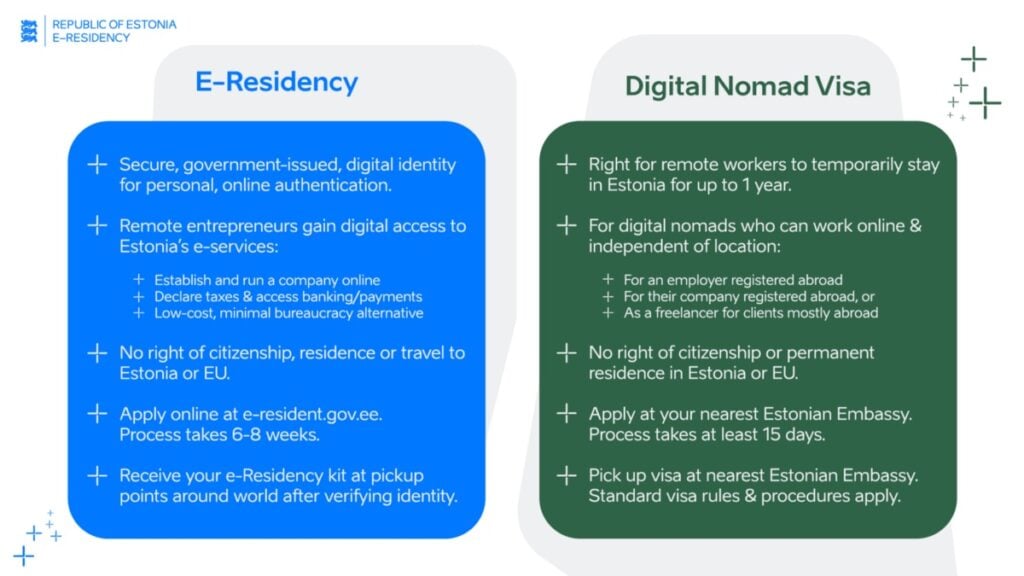
Estonia has gained a reputation for its innovative visa solutions. In 2014, it launched its e-Residency program that allows overseas professionals to start online businesses in Estonia (read more about e-Residency in our guide to Estonia work visas). In 2020 this was followed up with a digital nomad visa that allows foreign nationals to stay in the country for up to one year whilst they work remotely.
To be eligible you must work for a company registered outside of Estonia or as a freelancer for clients outside of Estonia.
The application process takes around one month to complete.
🇧🇬 Bulgaria

Detail | Information |
|---|---|
Cost of visa | €100–200, depending on nationality |
Visa length | 1 year |
Minimum income | Varies |
Personal income tax | Flat 10% |
Internet speed | 57.19 Mbps |
Average rental cost for a one-bedroom apartment | $300–$500 per month |
Obtaining time for a digital nomad visa | 14–30 days |
Digital nomads who are self-employed (whether as a freelancer, or as a director of their own company) may be eligible for a self-employment permit and a long-stay (Type D) visa in Bulgaria.
First, applicants must apply to the Bulgarian Employment Agency for a self-employment permit by detailing their intended activity, and specifying the expected economic benefits for the region and Bulgaria generally. If this is approved, the applicant can then apply for a Type D visa, and will need to provide:
- Proof of financial means to support yourself during the stay in Bulgaria
- Proof of accommodation in Bulgaria, such as a rental agreement or property ownership documents
- A valid reason for requesting a long-term stay, such as employment, self-employment, study, or family reunification
- Health insurance covering the stay in Bulgaria.
- A clean criminal record from your home country.
Note, there is currently no specific visa known as a “digital nomad visa” in Bulgaria that would cover workers employed by a foreign company.
🇭🇷 Croatia

Detail | Information |
|---|---|
Cost of visa | $200 |
Visa length | 2 years |
Minimum income | $2,000 per month |
Personal income tax | Up to 45% |
Internet speed | 70.3 Mbps |
Average rental cost for a one-bedroom apartment | $400–$700 per month |
Obtaining time for a digital nomad visa | 30–60 days |
To be eligible for the program, applicants must:
- Be a citizen of a country outside the European Union (EU) or the European Economic Area (EEA)
- Have a valid passport
- Have a job or income that allows them to work remotely
- Have health insurance that covers their stay in Croatia
- Have no criminal record
Applications may be made online and must include proof of income or employment, proof of health insurance, and a police clearance certificate from their country of origin. The application fee is 1,100 HRK (approximately $170 USD) and must be paid when submitting the application.
While there is no specific income requirement for the Croatia digital nomad visa, but applicants must have a job or income that allows them to work remotely. The Croatian government has stated that participants should have a stable source of income that is at least equivalent to the average salary in Croatia, which is around 6,500 HRK (approximately $1,000 USD) per month.
🇮🇹 Italy

Detail | Information |
|---|---|
Cost of visa | €116 |
Visa length | 1 year |
Minimum income | At least €31,000 p.a |
Personal income tax | Up to 43% |
Internet speed | 75.20 Mbps |
Average rental cost for a one-bedroom apartment | $600–$1,200 per month |
Obtaining time for a digital nomad visa | 30–90 days |
The Elective Residence Visa, also known as the “Residenza Elettiva” visa, is a type of Italian long-term visa (National visa or “D” visa) designed for foreign nationals who wish to live in Italy and can support themselves without working for an Italian employer. This visa could potentially be used by digital nomads, particularly if they have a substantial regular income from outside Italy.
You’ll need to demonstrate a stable and sufficient income to support yourself. The income can come from various sources such as pensions, annuities, properties, stable economic and commercial activities, or other sources apart from employment. The exact amount required can vary but expect it to be at least €31,000 per year for an individual, and more for couples or families.
🇪🇸 Spain

Detail | Information |
|---|---|
Cost of visa | $200 |
Visa length | 1 year |
Minimum income | €2,520 per month (2023) |
Personal income tax | Up to 47% |
Internet speed | 86.89 Mbps |
Average rental cost for a one-bedroom apartment | $600–$1,000 per month |
Obtaining time for a digital nomad visa | 20–30 days |
- A valid passport (at least 1 year validity).
- Criminal record certificate (no older than 6 months).
- Health insurance covering risks insured under Spain’s public health system.
- Proof of financial means (200% of Spain’s minimum wage, with additional amounts for family members).
- Documentation proving remote work, such as employment contracts or business ownership evidence.
Non-EU nationals are able to apply for the visa, including both self-employed workers and remote employees. Applicants must meet professional and income requirements.
🇨🇿 Czechia

Detail | Information |
|---|---|
Cost of visa | $110 |
Visa length | 1 year |
Minimum income | €5,587 per person |
Personal income tax | 15% and 23% |
Internet speed | 45.62 Mbps |
Average rental cost for a one-bedroom apartment | $400–$700 per month |
Obtaining time for a digital nomad visa | 30–60 days |
Czechia (Czech Republic) now offers a visa that lets you stay in the country for up to one year whilst you work remotely. Note, however, that the Czech Republic digital nomad visa is a freelancer visa, only supporting freelancers rather than applicants in regular employment.
This visa, also known as the ‘Zivno visa’ (short for Zivnotensky List), requires that applicants meet the following criteria:
- Being a citizen of a country outside the European Union (EU) or the European Economic Area (EEA)
- Being at least 18 years old
- Having a valid passport
- Having a business or self-employment activity that can be conducted remotely
- Having sufficient funds to support themselves during their stay in the Czech Republic
- Having health insurance that covers their stay in the Czech Republic
The application fee is 2,500 CZK (approximately $110 USD) and must be paid when submitting the application.
While there is no minimum income requirment, applicants should have a stable source of income that is at least equivalent to the minimum wage in the Czech Republic, which is currently around 14,600 CZK (approximately $640 USD) per month.
Unlike holders of a regular Czechia work visa, those with a Czechia digital nomad or freelance visa must also hold a Trade License. You need to apply for this license whilst you’re in Czechia so there is likely to be a short gap between your arrival in the country and when you’re able to start working.
🇵🇹 Portugal

Detail | Information |
|---|---|
Cost of visa | €75 |
Visa length | 1 year |
Minimum income | $3,000 per month |
Personal income tax | Residents: 48% / Non-residents: 25% |
Internet speed | 69.08 Mbps |
Average rental cost for a one-bedroom apartment | $500–$800 per month |
Obtaining time for a digital nomad visa | 30–60 days |
Portugal offers several different visas that are aimed at remote workers.
The Portugal D7 visa is a long-term residency visa that allows non-EU nationals to live in Portugal as passive income earners, retirees, or investors. The visa is suitable for individuals who want to retire or generate passive income through investment in Portugal, but is also suitable for digital nomads. While the D7 visa is initially granted for one year, it can be renewed for up to two years at a time. After five years of living in Portugal, visa holders can apply for permanent residency.
For some digital nomads, the D2 Entrepreneur Visa may be an option. This visa is for entrepreneurs from outside the European Union and is designed to encourage investment in local businesses: Applicants must have a company doing business in Portugal (whether via investment or incorporation), or have the resources to set up that kind of company. On application, a business plan is required to show the positive impact the investment will have on the Portuguese economy.
Initially issued for 120 days, the residency permit allows individuals to live in Portugal for up to 5 years.
🇫🇷 France

Detail | Information |
|---|---|
Cost of visa | €99 |
Visa length | 1 year |
Minimum income | $3,000 per month |
Personal income tax | Up to 45% |
Internet speed | 49.19 Mbps |
Average rental cost for a one-bedroom apartment | $800–$1,500 per month |
Obtaining time for a digital nomad visa | 30–60 days |
France does not have a specific visa for digital nomads or self-employed remote workers. However, non-EU citizens who wish to stay in France for longer than 90 days can apply for a long-stay visa, also known as a “Visa de long séjour” or a “D visa.”
For self-employed individuals or freelancers, the “Professional Purpose” long-stay visa or “visa long séjour valant titre de séjour” (VLS-TS) might be appropriate. This visa serves as both a visa and a residence permit for the first year. However, it requires you to demonstrate that your business or independent work will contribute to the French economy.
Applicants will need to provide a range of documents including:
- Proof of financial resources and health insurance
- A criminal record certificate.
- For the Professional Purpose visa, a business plan showing the ability to contribute to the regional and national economy in France, as well as proof of self-employment.
🇱🇻 Latvia

Detail | Information |
|---|---|
Cost of visa | €60 |
Visa length | 1 year |
Minimum income | $3,000 per month |
Personal income tax | Up to 31.4% |
Internet speed | 40.99 Mbps |
Average rental cost for a one-bedroom apartment | $300–$600 per month |
Obtaining time for a digital nomad visa | 30–60 days |
Latvia introduced a digital nomad visa in July 2022. It is valid for one year, renewable for another year, and allows visa-holders to live and work in Latvia either as a self-employed person, or for a company based overseas. Applicants must be either:
- Employed by a company that is registered in an OECD country, and have worked there for at least six months, or
- or self-employed with a business that is registered in an OECD country.
Applicants must prove that their work can be carried out remotely, that they earn at least 2.5 times the average salary (€2,875.50 on latest figures), and that they have health insurance to cover the period in question.
🇱🇹 Lithuania

Detail | Information |
|---|---|
Cost of visa | €120 |
Visa length | 1 year |
Minimum income | N/A |
Personal income tax | Up to 32% |
Internet speed | 80.54 Mbps |
Average rental cost for a one-bedroom apartment | $300–$600 per month |
Obtaining time for a digital nomad visa | 30–60 days |
Lithuania does not offer a specific digital nomad visa. However, non-EU residents who wish to stay in the country for a longer period may consider applying for a National (D) visa. The National (D) visa is a long-term visa that allows you to stay in Lithuania for up to one year. It is typically granted for reasons such as business or work, studies, or family reunification.
If you’re planning to work as a freelancer or self-employed individual, you could potentially apply for a D visa for the purpose of work.
To receive this visa, you’ll need to provide several documents, such as a valid passport, proof of sufficient financial resources, health insurance, and any documents that prove the purpose of your stay (for example, business registration documents if you’re a freelancer).
🇬🇪 Georgia

Detail | Information |
|---|---|
Cost of visa | Free |
Visa length | 1 year |
Minimum income | $2,000 per month |
Personal income tax | 20% |
Internet speed | 30.53 Mbps |
Average rental cost for a one-bedroom apartment | $200–$400 per month |
Obtaining time for a digital nomad visa | 10–20 days |
Georgia’s digital nomad or remote work visa scheme is known as the ‘Remote from Georgia’ scheme. This program is open to foreign citizens from 95 countries who are over 18 years old and intend to stay in Georgia for at least 180 days. Before applying, make sure you are eligible based on your citizenship and intended length of stay.
To participate in the program, applicants must have a job that allows them to work remotely from Georgia. Participants must also have health insurance that covers their stay in Georgia. Proof of insurance is required when when applying for the program.
The application process can be completed online, and requires providing the necessary documents, including proof of employment, health insurance, and a valid passport. The processing time for applications is estimated to be as little as 10 business days.
While there is no cost to apply for the scheme, applicants must ensure they have sufficient means to support their stay.
🇩🇪 Germany

Detail | Information |
|---|---|
Cost of visa | €100 |
Visa length | 3 years |
Minimum income | Proof of self-sustainability and an address in Germany |
Personal income tax | 45% |
Internet speed | 57.22 Mbps |
Average rental cost for a one-bedroom apartment | $700–$1,200 per month |
Obtaining time for a digital nomad visa | 60–90 days |
Germany’s digital nomad visa is a freelancer visa, also known as the German Freelance Residence Permit: It allows self-employed individuals to live and work in Germany for an extended period of time. The visa is intended for freelancers, artists, and other self-employed professionals who wish to work and live in Germany.
The Germany freelancer visa is initially issued for a period of up to 3 months to allow the individual to enter the country. Once in Germany, the Freelancer Resident Permit can be issued and will last for 6 months to 3 years, depending on the applicant’s circumstances and the length of the project.
The compulsory fee for the visa ranges from €60 to €110. In addition, applicants may also be required to pay for other fees, such as health insurance and language course fees.
To be eligible for the Germany freelancer visa, applicants must demonstrate that they have sufficient income to support themselves during their stay in Germany.
In addition to demonstrating sufficient income, applicants must meet several other requirements, including:
- Proof of health insurance that covers the applicant’s entire stay in Germany
- A clear criminal record
- A valid passport
Applicants must also provide proof of accommodation in Germany, such as a rental agreement or a hotel reservation.
🇮🇸 Iceland
Detail | Information |
|---|---|
Cost of visa | €50 or $61 |
Visa length | 6 months |
Minimum income | Single applicant: €6,460 or $7,777 / Couple applicant: €9,690 or $11,667 |
Personal income tax | 31.8% |
Internet speed | No data available |
Average rental cost for a one-bedroom apartment | $1,000–$1,500 per month |
Obtaining time for a digital nomad visa | 30–60 days |
Iceland introduced a new long-term visa for remote workers in 2020, aimed at attracting digital nomads and remote workers to live and work in Iceland for up to 6 months. This visa is known as the “Long-term visa for remote workers” and is issued by the Directorate of Immigration in Iceland.
Note, the visa can be extended for an additional 6 months, making the total length of stay up to 12 months.
The cost of the visa is currently 80,000 Icelandic krona (ISK), which is approximately $640 USD or €540 EUR. This fee is non-refundable and must be paid when submitting the visa application.
Applicants must demonstrate that they have a stable income that meets a certain threshold:
- If the applicant is single, they must show that they have a monthly income of at least 1,000,000 ISK (approximately $8,000 USD or €6,800 EUR)
- If the applicant is married or in a registered partnership, they must show that they have a monthly income of at least 1,500,000 ISK (approximately $12,000 USD or €10,200 EUR)
- If the applicant has dependent children, they must show an additional 250,000 ISK (approximately $2,000 USD or €1,700 EUR) per child.
Note, this required income can be from various sources, such as remote work, self-employment, investments, or savings. The income must be regular, stable, and sufficient to cover the applicant’s living expenses during their stay in Iceland.
In addition to demonstrating a stable income, applicants must also provide evidence of:
- Health insurance that covers the applicant’s entire stay in Iceland.
- A clear criminal record
- A valid passport.
- A signed declaration of good health.
Applicants must also provide proof of accommodation for their entire stay in Iceland, although this can be in the form of a hotel reservation or a rental contract for a furnished apartment.
🇳🇴 Norway

Detail | Information |
|---|---|
Cost of visa | €600 |
Visa length | 3 years |
Minimum income | €35,719 |
Personal income tax | 22% |
Internet speed | 131.23 Mbps |
Average rental cost for a one-bedroom apartment | $1,000–$1,500 per month |
Obtaining time for a digital nomad visa | 30–60 days |
The Norway digital nomad visa is an Independent Contractor visa, which allows self-employed individuals to work and live in Norway — ideal for professionals who want to work in Norway on a project or contract basis.
The Independent Contractor visa is initially granted for up to 6 months, but it can be extended for up to 4 years. The extension is dependent on the length of the contract, and the visa holder must renew the visa each year.
The fee for the visa is currently €600.
Applicants must demonstrate that they have sufficient income to support themselves during their stay in Norway. Currently, proof of income of at least €35,719 per year is required.
As part of their application, alongside the application form and application fee, applicants must provide:
- Passport, as well as two passport photos
- Proof of Accommodation in Norway
- Proof of Education
- A CV
- A Signed UDI Form demonstrating eligibility for the visa.
🇲🇹 Malta

Detail | Information |
|---|---|
Cost of visa | €300 |
Visa length | 1 year |
Minimum income | €2,700 |
Personal income tax | 35% |
Internet speed | 53.38 Mbps |
Average rental cost for a one-bedroom apartment | $700–$1,200 per month |
Obtaining time for a digital nomad visa | 30–60 days |
The Malta Nomad Residency Permit is a program designed for remote workers, freelancers, and digital nomads who want to work and live in Malta for an extended period. The program offers a one-year residency permit that can be renewed annually, allowing individuals to stay in Malta for up to two years.
The Malta Nomad Residency Permit is initially granted for one year, and it can be renewed for a second year. After two years, individuals may be eligible for other long-term residency options in Malta.
Currently, the cost of the Malta Nomad Residency Permit is €300 for the first year and €250 for each subsequent year.
To be eligible for the Malta Nomad Residency Permit, applicants must demonstrate that they have sufficient income to support themselves during their stay in Malta. Currently, this means an income of at least €2,700 per month.
In addition to demonstrating sufficient income, applicants for the Malta Nomad Residency Permit must meet several other requirements, including:
- Holding a valid passport
- Providing proof of health insurance that covers the applicant’s entire stay in Malta.
- Possessing a clean criminal record
- Showing evidence of remote work or freelance work that can be done from Malta
- Providing evidence of accommodation in Malta, such as a rental agreement or a hotel reservation.
🇷🇴 Romania

Detail | Information |
|---|---|
Cost of visa | €100 |
Visa length | 1 year |
Minimum income | €1,200 |
Personal income tax | 10% |
Internet speed | 47.02 Mbps |
Average rental cost for a one-bedroom apartment | $300–$500 per month |
Obtaining time for a digital nomad visa | 30–60 days |
The Romania Digital Nomad Visa is a new program that allows remote workers and digital nomads to live and work in Romania for up to one year. The program is designed to attract location-independent professionals who can contribute to the Romanian economy while enjoying the country’s rich culture, history, and natural beauty.
The Romania Digital Nomad Visa is initially granted for six months, and can be renewed for an additional six months, allowing individuals to stay in Romania for up to one year.
The Romania Digital Nomad Visa currently costs €100.
To be eligible for the Romania Digital Nomad Visa, applicants must demonstrate that they have sufficient income to support themselves during their stay in Romania. Currently, this requires an income of at least €1,200 per month.
On application, applicants must demonstrate that they have health insurance that covers the applicant’s entire stay in Romania, evidence that remote work or freelance work that can be done from Romania and evidence of accommodation in Romania, such as a rental agreement or a hotel reservation.
🇸🇰 Slovakia

Detail | Information |
|---|---|
Cost of visa | €232 |
Visa length | 1 year |
Minimum income | Varies |
Personal income tax | Up to 25% |
Internet speed | 90.2 Mbps |
Average rental cost for a one-bedroom apartment | $400–$700 per month |
Obtaining time for a digital nomad visa | 30–60 days |
Slovakia doesn’t have a specific visa designed for digital nomads or self-employed remote workers. However, one option for non-EU/EEA citizens who want to live and work independently in Slovakia could be to apply for a “Temporary Residence for the Purpose of Business.”
Here are the general steps and requirements:
- Establish a Business: To qualify, you typically need to establish a business entity in Slovakia. This involves registering the business with the Slovak Business Register.
- Application Form: Complete the relevant application form for a temporary residence permit.
- Documentation: You’ll need to provide several documents, including a valid passport, proof of health insurance, a criminal record certificate, proof of accommodation in Slovakia, and documents related to your business (such as a business license, tax documents, and a business plan).
🇬🇷 Greece

Detail | Information |
|---|---|
Cost of visa | €100 |
Visa length | 3 years |
Minimum income | €2,000 |
Personal income tax | 44% |
Internet speed | 63.6 Mbps |
Average rental cost for a one-bedroom apartment | $400–$700 per month |
Obtaining time for a digital nomad visa | 30–60 days |
The Greece digital nomad visa is a program that allows remote workers and digital nomads to live and work in Greece for up to one year. The program aims to attract location-independent professionals who can contribute to the Greek economy while enjoying the country’s beautiful scenery, rich culture, and warm climate.
The Greece digital nomad visa is initially granted for six months, and it can be renewed for an additional six months, allowing individuals to stay in Greece for up to one year.
The Greece digital nomad visa currently costs €100.
To be eligible for the Greece digital nomad visa, applicants must demonstrate that they have sufficient income to support themselves during their stay in Greece, which currently means an income of at least €2,000 per month.
On application, applicants must show that they have health insurance that covers the applicant’s entire stay in Greece, as well as evidence of remote work or freelance work that can be done from Greece and evidence of accommodation in Greece, such as a rental agreement or a hotel reservation.
🇨🇾 Cyprus

Detail | Information |
|---|---|
Cost of visa | Insurance & renewal fee: €70 / Registration to Alien’s Registry: €70 |
Visa length | 6 months |
Minimum income | €3,500 |
Personal income tax | 35% |
Internet speed | 60.42 Mbps |
Average rental cost for a one-bedroom apartment | $500–$800 per month |
Obtaining time for a digital nomad visa | 30–60 days |
The Cyprus digital nomad visa scheme is a program that allows remote workers and digital nomads to live and work in Cyprus for up to one year. The program aims to attract location-independent professionals who can contribute to the Cypriot economy while enjoying the country’s beautiful beaches, rich history, and Mediterranean climate.
The Cyprus digital nomad visa is initially granted for six months, and it can be renewed for an additional six months, allowing individuals to stay in Cyprus for up to one year. Currently, the Cyprus digital nomad visa costs €150.
To be eligible for the Cyprus digital nomad visa, applicants must demonstrate that they have sufficient income to support themselves during their stay in Cyprus, currently an income of at least €3,000 per month.
In addition to demonstrating sufficient income, applicants for the Cyprus digital nomad visa must meet demonstrate in their application that they have health insurance that covers their entire stay and that they have remote work or freelance work that can be done from Cyprus. They must also provide evidence of accommodation in Cyprus, such as a rental agreement or a hotel reservation.
🇭🇺 Hungary

Detail | Information |
|---|---|
Cost of visa | €165 |
Visa length | 1 year |
Minimum income | €1,740 monthly |
Personal income tax | 15% |
Internet speed | 44.17 Mbps |
Average rental cost for a one-bedroom apartment | $400–$700 per month |
Obtaining time for a digital nomad visa | 30–60 days |
The Hungary White Card work permit is a program designed to attract highly skilled workers from non-EU countries, including digital nomads. It allows foreigners to live and work in Hungary for up to three years.
The Hungary White Card work permit is initially granted for one year, and it can be renewed for an additional two years, allowing individuals to stay in Hungary for up to three years.
Currently, the cost of the Hungary White Card work permit is HUF 60,000 (approximately €165).
To be eligible for the Hungary White Card work permit, applicants must demonstrate that they meet an income threshold, currently set at at least three times the Hungarian minimum wage, which is HUF 210,600 per month (approximately €580).
In addition to demonstrating sufficient income, applicants for the Hungary White Card work permit must meet a range of other requirements, including demonstrating evidence of education or professional qualifications that are recognized in Hungary and evidence of a job offer from a Hungarian employer or evidence of self-employment.
🇦🇱 Albania

Detail | Information |
|---|---|
Cost of visa | $95 USD (approximately) |
Visa length | 1–5 years |
Minimum income | $9,800 p.a |
Personal income tax | 23% |
Internet speed | 41.85 Mbps |
Average rental cost for a one-bedroom apartment | $200–$400 per month |
Obtaining time for a digital nomad visa | 30–60 days |
Albania has recently introduced a Single Permit for Digital Nomads program, which allows remote workers to legally reside and work in the country for up to a year. The Single Permit for Digital Nomads, also known as the ‘Unique Permit’ combines a temporary residence permit with a work permit, allowing digital nomads to work remotely for clients or companies outside of Albania while living in the country.
Applicants will need to show that they meet minimum income requirements, and need to provide one of the following:
- A valid employment contract with an international employer (who has given permission for an individual to work remotely)
- A service contract with an overseas client
- A service contract with a client that will work without a specific headquarters.
All applicants must also provide documents demonstrating their professional capacity such as a diploma, certificate, or other qualification, as well as valid health insurance coverage.
Applications can be made through the Albania government’s e-portal.
🇦🇲 Armenia

Detail | Information |
|---|---|
Cost of visa | $270 |
Visa length | 5 years |
Minimum income | Sufficient |
Personal income tax | Up to 47% |
Internet speed | 86.89 Mbps |
Average rental cost for a one-bedroom apartment | $200–$400 per month |
Obtaining time for a digital nomad visa | 30–60 days |
Armenia offers several options for foreigners who wish to reside in the country for an extended period of time, including digital nomads. The most popular is the Foreigner’s Residence Permit (FRP). The FRP allows foreigners to legally reside in Armenia for a period of up to one year and can be renewed annually.
The cost of the FRP is ֏120,000 (approximately $240) for the first year, and the renewal fee is ֏60,000 (approximately $120) per year.
The FRP is valid for one year and can be renewed annually.
In addition to demonstrating that they can support themselves financially, applicants must provide a criminal record check from their home country and undergo a medical examination. They must also have a valid passport with at least six months of validity remaining and provide proof of accommodation in Armenia.
To apply for the FRP, applicants must submit their application and supporting documents to the Passport and Visa Department of the Armenian Police. The application process typically takes around 30 days, and applicants will receive their permit once their application is approved.
🇬🇧 The United Kingdom

Detail | Information |
|---|---|
Cost of visa | £152 |
Visa length | Up to 5 years and 4 months |
Minimum income | Varies |
Personal income tax | Up to 45% |
Internet speed | 62.71 Mbps |
Average rental cost for a one-bedroom apartment | $1,000–$1,500 per month |
Obtaining time for a digital nomad visa | 30–60 days |
The United Kingdom does not have a visa specifically for digital nomads. However, there are several visas that exceptionally qualified digital nomads (whether self-employed, starting a business, or employed by a foreign company) may be able to use. These include the:
- Global Talent Visa: This visa is intended for individuals who work in a qualifying field and have been endorsed as a recognized leader (exceptional talent) or an emerging leader (exceptional promise). The fields include academia or research, arts and culture, and digital technology.
- Innovator Visa: This visa is intended for individuals who want to set up or run a business in the UK. You need to have at least £50,000 in investment funds to apply for this visa.
- Start-up Visa: This is for individuals who are starting a business for the first time in the UK. You do not need funds to invest, but your business idea must be endorsed by an approved body.
🇷🇸 Serbia

Detail | Information |
|---|---|
Cost of visa | Approximately €116 for a temporary residence permit; additional fees may apply for other permits |
Visa length | Up to 12 months, with the possibility of renewal |
Minimum income | At least €3,500 over the past six months |
Personal income tax | 10% for self-employed individuals earning over €54,000 annually; 20% if no double-taxation treaty |
Internet speed | 50 Mbps; varies by location |
Average rental cost for a one-bedroom apartment | Approximately €300–€500 per month in city centers; lower in suburbs |
Obtaining time for a digital nomad visa | Typically around 30 days; advisable to apply at least three months before planned arrival |
While Serbia’s official Digital Nomad Visa program is still under development, the country currently offers pathways for remote workers to reside temporarily through existing visa options. Eligible applicants include remote workers employed by companies outside Serbia, as well as self-employed individuals or business owners operating internationally. Applications must be submitted in person at Serbian embassies or consulates abroad or upon arrival in Serbia.
For those seeking a longer stay, Serbia provides a clear pathway to permanent residency: after three years of continuous temporary residence, individuals are eligible to apply for permanent residency.
To obtain a temporary residence permit in Serbia, applicants must gather the necessary documents:
- completed visa application
- a valid passport
- proof of health insurance
- bank statements showing a stable monthly income of at least €3,500 over the past six months
- proof of accommodation
Once in Serbia, applicants are required to register at the local police station within 24 hours and apply for a temporary residence permit at the designated immigration office. The processing time typically takes around 30 days, after which successful applicants will receive a permit valid for up to 12 months with the option for renewal.
🇲🇪 Montenegro

Detail | Information |
|---|---|
Cost of visa | €65 for a temporary residence permit; additional administrative fees may apply |
Visa length | Up to 12 months, renewable annually |
Minimum income | €1,500–€2,000 monthly income |
Personal income tax | Flat rate of 9% for residents on personal income |
Internet speed | 40 Mbps; higher in urban areas |
Average rental cost for a one-bedroom apartment | €350–€550 per month in city centers; lower in rural areas |
Obtaining time for a digital nomad visa | Typically 30–45 days; advisable to start the process at least two months prior |
Digital nomads eligible for Montenegro’s temporary residence permit include remote workers employed by companies outside Montenegro, self-employed freelancers, and business owners who can demonstrate a stable monthly income of €1,500–€2,000. Applications must be submitted in person at a Montenegrin embassy or consulate abroad, or directly at the Ministry of Interior upon arrival in Montenegro.
For those seeking a longer stay, Montenegro provides a clear pathway to permanent residency: after five years of continuous temporary residence, digital nomads may apply for permanent residency status.
To obtain Montenegro’s temporary residence permit, applicants must submit:
- a completed application form
- a valid passport
- proof of accommodation
- health insurance
- bank statements showing the required monthly income.
Upon arrival, applicants are required to register with local authorities and complete the application process with the Ministry of Interior. The process typically takes 30–45 days, after which successful applicants will receive a residence permit valid for up to 12 months, with the option to renew annually.
🇲🇰 North Macedonia

Detail | Information |
|---|---|
Cost of visa | €65 for a temporary residence permit; additional administrative fees may apply |
Visa length | Up to 12 months, renewable annually |
Minimum income | €1,500–€2,000 monthly income |
Personal income tax | Flat rate of 9% for residents on personal income |
Internet speed | 28.91 Mbps |
Average rental cost for a one-bedroom apartment | €350–€550 per month in city centers; lower in rural areas |
Obtaining time for a digital nomad visa | Typically 30–45 days; advisable to start the process at least two months prior |
The country is actively developing initiatives to attract remote workers, including a digital nomad visa program that allows extended stays for those working remotely for international employers or businesses.
Digital nomads eligible for North Macedonia’s visa include remote workers employed by companies outside the country, as well as self-employed freelancers or business owners with a stable monthly income of at least €1,500. Applications are submitted at North Macedonian embassies or consulates abroad, or upon arrival through the relevant local government offices. For those interested in staying long-term, North Macedonia offers pathways to permanent residency after several consecutive years of temporary residence.
Digital nomads can apply for either a C-type short-term visa or a D-type long-term visa in North Macedonia.
- valid passport
- a clean criminal record
- valid travel insurance
- proof of sufficient income is required,
- accommodation arrangements
Upon approval, a temporary residence permit is issued alongside the digital nomad visa, allowing remote workers to live and work in North Macedonia. Applicants must adhere to the standard visa application procedures. For those interested in extending their stay and continuing remote business activities, a business visa provides an alternative pathway to participate in the country’s digital nomad program.
🇦🇩 Andorra

Detail | Information |
|---|---|
Cost of visa | Approximately €2,500, plus an additional €500 for a residence card |
Visa length | Valid for 2 years, with options to renew for another 2 years, then 3 years, and finally up to 10 years |
Minimum income | Around €4,000 per month |
Personal income tax | Low maximum personal income tax rate of 10% |
Internet speed | 100 Mbps |
Average rental cost for a one-bedroom apartment | €1,000–€1,500 per month in city centers |
Obtaining time for a digital nomad visa | Typically 30–45 days; advisable to start the process at least two months prior |
Andorra has introduced a Digital Nomad Visa, officially announced in December 2022 and opened for applications in mid-2023. This visa allows remote workers to reside in Andorra while working for companies or clients outside the country.
To obtain the digital nomad residence permit in Andorra, applicants must secure government approval, particularly from the Ministry of Economy, which aims to promote the digital economy through remote workers. The legal requirements are as follows:
- Approval from the Ministry of Economy that confirm that the applicant works remotely using telecommunications and technology.
- Completed Residence Authorization Application
- Clean Criminal Record
- Must demonstrate adequate funds for their stay
- Must own or lease housing that meets habitability standards
- Must reside in Andorra for at least 90 days per calendar year.
- Valid Health and Disability Insurance
- Applicants must undergo medical checks in Andorra.
To secure approval from the Ministry of Economy, applicants must provide a passport or ID, a sworn declaration that their work relies on telecommunications and does not require a fixed location, and supporting documents such as employer certificates verifying their ability to work remotely. This documentation can be complex, and professional assistance is strongly recommended to ensure a successful application.
🇫🇮 Finland

Detail | Information |
|---|---|
Cost of visa | $416 |
Visa length | 6 months |
Minimum income | Sufficient funds to support oneself; specific amount not publicly specified |
Personal income tax | Progressive tax rate ranging from 6% to 31.25% |
Internet speed | 100 Mbps |
Average rental cost for a one-bedroom apartment | €800–€1,200 per month in Helsinki; lower in other cities |
Obtaining time for a digital nomad visa | 30–60 days |
Finland offers a Self-Employment Visa suitable for digital nomads who wish to reside and work in the country. The Finnish self-employment visa is designed for individuals who are self-employed or operate an independent business. Applicants must meet a minimum monthly gross income of $1,283 to qualify.
- Gather all required documents and ensure non-English documents are translated.
A valid passport (minimum validity of 6 months)
Passport photographs
Completed application form
Bank statements proving a monthly income of $1,283.
Health insurance with international coverage, including Finland.
Proof of accommodation in Finland
Payment receipt for the application fee
- Fill out the application form and attach the necessary documents. Incomplete submissions may delay processing.
- Pay the application fee of $416 either online or at a Finnish embassy.
- Visit the nearest Finnish embassy or consulate to verify your identity, submit original documents, and provide fingerprints.
- Monitor your application status online after submission.
The Finnish self-employment visa is valid for 6 months. EU and EEA citizens can work in Finland for up to 3 months without a visa but must register their stay to continue working beyond this period.
🇮🇪 Ireland

Detail | Information |
|---|---|
Cost of visa | No visa required for stays up to 90 days |
Visa length | 90 days |
Minimum income | Not specified for short stays |
Personal income tax | Progressive tax rate ranging from 20% to 40% |
Internet speed | 70 Mbps |
Average rental cost for a one-bedroom apartment | €1,500–€2,500 per month in Dublin; lower in other areas |
Obtaining time for a digital nomad visa | Not applicable for stays up to 90 days |
Ireland does not currently offer a specific Digital Nomad Visa, but digital nomads can leverage alternative visa pathways to reside temporarily. A viable option is the Short Stay ‘C’ Business Visa, which allows individuals to stay in Ireland for up to 90 days for business-related purposes, such as attending meetings, negotiating contracts, or short-term work lasting no more than 14 consecutive days.
To apply, individuals must submit a completed visa application online through AVATS, pay the relevant fee (€60 for single entry or €100 for multiple entry), and provide supporting documents.
- valid passport
- application letter outlining the purpose and duration of the visit
- application summary sheet
- proof of sufficient funds
- details of accommodation
- Travel and medical insurance
Applications should be prepared at least 3 months before travel, and the processing time is typically around 8 weeks. Applications can be send in the ff office: Dublin visa office, an international visa office or an Irish Embassy or Consulate.
🇳🇱 Netherlands

Detail | Information |
|---|---|
Cost of visa | Approximately €1,350 |
Visa length | Valid for up to 2 years, with the possibility of renewal |
Minimum income | Must meet the standard income requirement for self-employed persons; specific amount varies |
Personal income tax | Progressive tax rate up to 49.5% |
Internet speed | 100 Mbps; excellent connectivity nationwide |
Average rental cost for a one-bedroom apartment | €1,000–€1,500 per month in Amsterdam; lower in other cities |
Obtaining time for a digital nomad visa | Typically 90 days |
Netherlands offers a Self-Employed Residence Permit suitable for digital nomads who wish to reside and work in the country.
To qualify for the Dutch Self-Employed Residence Permit, applicants must demonstrate that their business or profession provides essential interest to the Dutch economy. This is assessed through a scoring system by the Netherlands Enterprise Agency (RVO), which evaluates three key areas: personal experience, business plan, and added value to the Dutch economy.
Applicants must also meet the general requirements:
- Valid passport/travel documents
- Do not pose a danger to the public or national security
- Registered in the Trade Register of the Dutch Chamber of Commerce (Kamer van Koophandel)
- Necessary permits to practice profession/work as a self-employed person
- You meet the income requirements
- If applying as a freelancer, must have one or more commissions in the Netherlands.
Freelancers must provide evidence of commissions in the Netherlands, while independent professionals in specific sectors, such as healthcare, may require additional registrations like the BIG-register. The residence permit costs €380 and typically takes up to 90 days to process. Applications are submitted through Dutch embassies or consulates abroad, and supporting documents must be legalized and translated into Dutch, English, French, or German.
🇹🇷 Turkey
Detail | Information |
|---|---|
Cost of visa | Approximately $60, plus administrative fees |
Visa length | Valid for up to 12 months, with the possibility of renewal |
Minimum income | Proof of sufficient funds to support oneself; specific amount not specified |
Personal income tax | Progressive tax rate up to 40% |
Internet speed | 30 Mbps |
Average rental cost for a one-bedroom apartment | $400–$700 per month in Istanbul; lower in other regions |
Obtaining time for a digital nomad visa | Typically 1–2 months |
To apply for Türkiye’s Digital Nomad Visa, applicants must first obtain a Digital Nomad Identification Certificate by registering on the designated platform. The certificate confirms eligibility and is required for visa applications at Turkish consulates or visa centers. If already in Türkiye, applicants can apply for a residence permit online via the e-ikamet portal.
- A passport valid for at least 6 months from the arrival date
- A diploma or degree certification proving university graduation
- Proof of employment in a remote capacity:
Contract with a company (excluding companies based in Türkiye).
For self-employed individuals, a business contract with foreign companies.
- A biometric photo
- Proof of income showing a monthly income of $3,000 or $36,000 annually
Eligible applicants must be between 21–55 years old and citizens of specified countries, including the EU nations, the USA, Canada, the UK, and others. Applications for residence permits must also involve an in-person appointment at the Provincial Migration Management Offices.
Digital Nomad Visa Countries in the Caribbean
🇧🇧 Barbados

Detail | Information |
|---|---|
Cost of visa | $2,000 |
Visa length | 1 year |
Minimum income | $50,000 per year |
Personal income tax | Up to 28.05% |
Internet speed | 81.23 Mbps |
Average rental cost for a one-bedroom apartment | $500–$800 per month |
Obtaining time for a digital nomad visa | 5–7 days |
Barbados has introduced a remote work visa called the ‘Welcome Stamp’, which allows eligible individuals to work remotely from Barbados for up to 12 months. The program was introduced in response to the COVID-19 pandemic, which has led to an increase in remote work opportunities.
The Welcome Stamp offers several benefits to remote workers, including the ability to live and work in a beautiful Caribbean location with a high quality of life: Barbados is known for its excellent healthcare system, low crime rate, and excellent infrastructure, including high-speed internet connectivity.
The cost of the Welcome Stamp is $2,000 for individuals and $3,000 for families, which covers the application fee and the cost of processing the visa. The fee is non-refundable and must be paid in full at the time of application.
The Welcome Stamp is valid for 12 months from the date of entry into Barbados. It can be renewed for an additional 12 months if the applicant wishes to extend their stay.
There is no minimum income requirement for the Welcome Stamp, but applicants must demonstrate that they are able to support themselves financially while living in Barbados. This means providing proof of income or savings that are sufficient to cover living expenses such as rent, food, and healthcare.
In addition to the financial requirements, applicants must also have health insurance that covers them for the duration of their stay in Barbados.
To apply for the Welcome Stamp, applicants must submit their application and supporting documents to the Barbados Immigration Department. The application process typically takes around five working days, and applicants will receive their visa once their application is approved.
🇦🇬 Antigua & Barbuda

Detail | Information |
|---|---|
Cost of visa | Individual: $1,500 / Couple: $2,000 / Family: $3,000 |
Visa length | 2 years |
Minimum income | $50,000 per year |
Personal income tax | 0% |
Internet speed | No data available |
Average rental cost for a one-bedroom apartment | $500–$800 per month |
Obtaining time for a digital nomad visa | 30–60 days |
Antigua and Barbuda introduced a Digital Nomad Residence Visa in 2020, which allows eligible individuals to live and work remotely from Antigua and Barbuda for up to two years.
The Digital Nomad Residence Visa offers gives remote workers and digital nomads the ability to live and work in a beautiful Caribbean location with a high quality of life: Antigua and Barbuda is known for its excellent beaches, warm climate, and laid-back lifestyle. The visa also allows holders to bring their families with them, making it a great option for those who wish to work and live together.
The cost of the Digital Nomad Residence Visa is $1,500 per person or $2,000 for a family of up to three people. This fee is non-refundable and covers the cost of processing the visa application.
The Digital Nomad Residence Visa is valid for up to two years from the date of issue. However, holders of the visa are required to visit the country at least once every year to maintain their status.
In addition to the income requirement, applicants must also have health insurance that covers them for the duration of their stay in Antigua and Barbuda.
To apply for the Digital Nomad Residence Visa, applicants must submit their application and supporting documents to the Antigua and Barbuda Department of Immigration. The application process typically takes around two weeks, and applicants will receive their visa once their application is approved.
🇧🇲 Bermuda

Detail | Information |
|---|---|
Cost of visa | $263 |
Visa length | 1 year |
Minimum income | Enough to support yourself |
Personal income tax | N/A |
Internet speed | No data available |
Average rental cost for a one-bedroom apartment | $1,500–$2,500 per month |
Obtaining time for a digital nomad visa | 5–10 days |
The cost of the Work from Bermuda visa is $263 for individuals and $535 for families. This fee is non-refundable and covers the cost of processing the visa application.
The Work from Bermuda visa is valid for up to one year from the date of issue and holders can apply for an extension for up to a total of two years.
To apply for the Work from Bermuda visa, applicants must submit their application and supporting documents to the Bermuda Department of Immigration. The application process typically takes around five business days, and applicants will receive their visa once their application is approved.
🇦🇮 Anguilla

Detail | Information |
|---|---|
Cost of visa | $2,000 |
Visa length | 1 year |
Minimum income | N/A |
Personal income tax | N/A |
Internet speed | No data available |
Average rental cost for a one-bedroom apartment | $800–$1,200 per month |
Obtaining time for a digital nomad visa | 30–60 days |
Anguilla introduced the Anguilla Remote Work Stamp in 2020, which allows eligible individuals to live and work remotely from Anguilla for up to 12 months. Holders of the visa can apply for an extension for up to a total of two years. Applicants must demonstrate that they have health insurance that covers them for the duration of their stay in Anguilla.
To apply for the Anguilla Remote Work Stamp, applicants must submit their application and supporting documents to the Anguilla Tourist Board. The application process typically takes around three to five business days, and applicants will receive their visa once their application is approved.
🇲🇸 Montserrat

Detail | Information |
|---|---|
Cost of visa | Single: $500 / Family: $750 (up to 3 dependents) / $250 for each additional family member |
Visa length | 1 year |
Minimum income | N/A |
Personal income tax | N/A |
Internet speed | No data available |
Average rental cost for a one-bedroom apartment | $500–$800 per month |
Obtaining time for a digital nomad visa | 30–60 days |
The cost of the Montserrat Remote Work Stamp is $500 per person. This fee is non-refundable and covers the cost of processing the visa application.
To qualify for the Montserrat Remote Work Stamp, applicants must demonstrate that they have a steady income of at least $70,000 per year. This can be from a variety of sources, such as employment, self-employment, or investments. Applicants must provide evidence of their income, such as tax returns or bank statements..
In addition to satisfying the income requirement, applicants must also have health insurance that covers them for the duration of their stay in Montserrat.
To apply for the Montserrat Remote Work Stamp, applicants must submit their application and supporting documents to the Montserrat Immigration Department. The application process typically takes around five to seven business days, and applicants will receive their visa once their application is approved.
🇩🇲 Dominica

|
Detail |
Information |
|---|---|
Cost of visa |
Single: $800 / Family: $1,200 |
Visa length |
18 months |
Minimum income |
$70,000 per year |
Personal income tax |
N/A |
Internet speed |
No data available |
Average rental cost for a one-bedroom apartment |
$300–$500 per month |
Obtaining time for a digital nomad visa |
30–60 days |
The cost of the Work in Nature program depends on the length of stay. The fees are as follows:
- Up to 6 months: $500
- Up to 9 months: $800
- Up to 12 months: $1,000
- Up to 18 months: $1,500
To qualify for the Work in Nature program, applicants must demonstrate that they have a steady income of at least $50,000 per year, from any legitimate source. Applicants must provide evidence of their income, such as tax returns or bank statements.
To apply for the Work in Nature program, applicants must submit their application and supporting documents to the Discover Dominica Authority. The application process typically takes around five to seven business days, and applicants will receive their visa once their application is approved.
🇧🇸 The Bahamas

Detail | Information |
|---|---|
Cost of visa | $1,000 / $500 for each dependent |
Visa length | 36 months |
Minimum income | A letter from your current employer or proof of self-employment and income |
Personal income tax | N/A |
Internet speed | No data available |
Average rental cost for a one-bedroom apartment | $800–$1,200 per month |
Obtaining time for a digital nomad visa | 5–7 days |
The Bahamas Extended Access Stay Scheme also known as the Bahamas Extended Stay Visa, is a program launched in 2020 that allows eligible individuals to live and work remotely from the Bahamas for up to one year (With an extension of up to two years). Many digital nomads consider the Bahamas an ideal remote work location — especially for those who wish to remain close to the continental United States. It is a country known for its crystal-clear waters, white sand beaches, and water sports activities.
The cost of the Bahamas Extended Access Stay Scheme is $1,025 for individuals and $1,500 for families. This fee is non-refundable and covers the cost of processing the visa application.
To qualify for the Bahamas Extended Access Stay Scheme, applicants must demonstrate that they have a steady income of at least $40,000 per year. Applicants must provide evidence of their income, such as tax returns or bank statements.
To apply for the Bahamas Extended Access Stay Scheme, applicants must submit their application and supporting documents to the Bahamas Ministry of Tourism. The application process typically takes around five to seven business days, and applicants will receive their visa once their application is approved.
🇨🇼 Curaçao

Detail | Information |
|---|---|
Cost of visa | $294 |
Visa length | 6 months |
Minimum income | Proof of solvency |
Personal income tax | N/A |
Internet speed | No data available |
Average rental cost for a one-bedroom apartment | $500–$800 per month |
Obtaining time for a digital nomad visa | 30–60 days |
There are currently no minimum income requirements for this visa scheme, but applicants must have health insurance that covers them for the duration of their stay in Curacao.
To apply for the Home in Curacao program, applicants must submit their application and supporting documents to the Curacao Tourist Board. The application process typically takes around five to seven business days, and applicants will receive their visa once their application is approved.
🇱🇨 Saint Lucia

Detail | Information |
|---|---|
Cost of visa | EC$190 |
Visa length | 12 months |
Minimum income | N/A |
Personal income tax | 30% |
Internet speed | No data available |
Average rental cost for a one-bedroom apartment | $400–$700 per month |
Obtaining time for a digital nomad visa | 30–60 days |
🇬🇩 Grenada

Detail | Information |
|---|---|
Cost of visa | Single: $1,500 / Family: $2,000 (up to 3 dependents) / $200 for each additional dependent |
Visa length | 12 months |
Minimum income | N/A |
Personal income tax | N/A |
Internet speed | No data available |
Average rental cost for a one-bedroom apartment | $400–$700 per month |
Obtaining time for a digital nomad visa | 30–60 days |
The Grenada digital nomad visa, also known as the ‘Work from Grenada’ program, is a visa scheme launched in 2020 that allows eligible individuals to live and work remotely from Grenada for up to 12 months. A one-time extension is available of up to 12 months.
The cost of the Grenada digital nomad visa is $1,500 per person.
To qualify for the Grenada digital nomad visa, applicants must demonstrate that they have a steady income of at least $37,000 per year. Applicants must provide evidence of their income, such as tax returns or bank statements.
In addition to meeting the income requirement, applicants must also have health insurance that covers them for the duration of their stay in Grenada.
To apply for the Grenada digital nomad visa, applicants must submit their application and supporting documents to the Grenada Citizenship by Investment Unit. The application process typically takes around 14 business days, and applicants will receive their visa once their application is approved.
🇦🇼 Aruba

Detail | Information |
|---|---|
Cost of visa | Varies depending on the applicant’s country |
Visa length | Up to 90 days |
Minimum income | No specific income requirement |
Personal income tax | N/A |
Internet speed | 46 Mbps |
Average rental cost for a one-bedroom apartment | $1,500–$3,000 per month in tourist areas |
Obtaining time for a digital nomad visa | Immediate upon booking accommodation |
Aruba’s “One Happy Workation” program offers remote workers the chance to stay and work from Aruba for up to 90 days without needing a specific visa. The program is designed to attract digital nomads by providing discounted extended stays at resorts, hotels, and private rentals. While technically classified as tourism, it allows remote workers to enjoy Aruba’s relaxed lifestyle and stable infrastructure.
To participate, remote workers need to choose a package from Aruba’s “One Happy Workation” site, book their accommodation, and arrive with proof of their stay. There is no need for government-issued digital nomad visas, simplifying the process for U.S. travelers looking for a temporary remote work destination.
Digital Nomad Visa Countries in North, Central and South America
🇨🇷 Costa Rica

Detail | Information |
|---|---|
Cost of visa | $100 |
Visa length | 1 year |
Minimum income | $3,000–$4,000 |
Personal income tax | N/A |
Internet speed | 25.72 Mbps |
Average rental cost for a one-bedroom apartment | $400–$700 per month |
Obtaining time for a digital nomad visa | 30–60 days |
🇦🇷 Argentina

Detail | Information |
|---|---|
Cost of visa | €80 short stay, €100 long stay |
Visa length | 1 year |
Minimum income | $3,504 per month |
Personal income tax | Up to 20% |
Internet speed | 56.03 Mbps |
Average rental cost for a one-bedroom apartment | $300–$500 per month |
Obtaining time for a digital nomad visa | 30–60 days |
🇨🇴 Colombia

Detail | Information |
|---|---|
Cost of visa | $180 |
Visa length | 2 years |
Minimum income | $684 a month |
Personal income tax | 35% |
Internet speed | 26.11 Mbps |
Average rental cost for a one-bedroom apartment | $300–$500 per month |
Obtaining time for a digital nomad visa | 30–60 days |
🇲🇽 Mexico

|
Detail |
Information |
|---|---|
Cost of visa |
$190–$390 |
Visa length |
4 years |
Minimum income |
$1,620 a month or a bank balance of $27,000 |
Personal income tax |
35% |
Internet speed |
26.11 Mbps |
Average rental cost for a one-bedroom apartment |
$300–$500 per month |
Obtaining time for a digital nomad visa |
30–60 days |
- Visitor Visa with Permission to Engage in Remunerative Activities: This visa is designed for individuals who wish to engage in remunerative activities while in Mexico, including remote work and freelance work. To qualify, applicants must show proof of income or financial means to support themselves during their stay, as well as a letter from the employer or client detailing the nature of their work.
- Temporary Resident Visa for Work Activities: This visa is designed for individuals who wish to work for a Mexican employer or establish a business in Mexico. To qualify, applicants must show proof of a job offer or a business plan, as well as evidence of their qualifications and experience in their field.
🇵🇦 Panama

|
Detail |
Information |
|---|---|
Cost of visa |
$300 |
Visa length |
18 months |
Minimum income |
$36,000 a year |
Personal income tax |
25% |
Internet speed |
17.19 Mbps |
Average rental cost for a one-bedroom apartment |
$500–$800 per month |
Obtaining time for a digital nomad visa |
30–60 days |
Panama offers a Short Stay for Remote Workers visa program, which allows digital nomads and remote workers to live and work in the country for up to 18 months. This program is designed to attract professionals who are able to work remotely and contribute to Panama’s economy.
The cost of the Short Stay for Remote Workers visa program is $250 per person, which covers the application fee and processing costs.
The visa is valid for up to 18 months, with the option to renew for an additional 18 months.
Applicants are required to show proof of sufficient income to support themselves during their stay in Panama: The minimum monthly income required is $2,500, or $3,000 if accompanied by dependents. This income can come from a variety of sources, such as employment, self-employment, or investment income.
In addition to showing proof of income, applicants must provide a variety of documents, including a passport, a background check, and proof of health insurance. They must also provide a detailed description of their work, including the company or clients they work for and the nature of their work.
Upon approval of the visa, applicants will be required to undergo a medical exam and obtain a police certificate from their country of origin. They must also register with the National Immigration Service and obtain a work permit from the Ministry of Labor.
🇧🇿 Belize

Detail | Information |
|---|---|
Cost of visa | $250 |
Visa length | 180 days (can be extended) |
Minimum income | Single: $75,000 a year / Couple or family: $100,000 a year |
Personal income tax | N/A |
Internet speed | 9.73 Mbps |
Average rental cost for a one-bedroom apartment | $400–$700 per month |
Obtaining time for a digital nomad visa | 30–60 days |
Belize offers a Work Where You Vacation program, which is designed to attract digital nomads and remote workers to the country. This program allows individuals to work remotely from Belize for six months, while enjoying the country’s natural beauty and culture. There are no specific requirements about the type of work required, making this program suitable for those with remote employment, freelancing or independent business income alike.
The cost of the program is USD $250 per person.
Applicants are required to show proof of sufficient income to support themselves during their stay in Belize. Proof that the applicant has eared USD $75,000 in the previous year, or USD $100,000 for those with dependents ,is required.
In addition to showing proof of income, applicants must provide a variety of documents, including a passport, a background check, and proof of health insurance.
🇧🇷 Brazil

Detail | Information |
|---|---|
Cost of visa | Unknown |
Visa length | 1 year |
Minimum income | $1,500 a month |
Personal income tax | 27.05% |
Internet speed | 36.87 Mbps |
Average rental cost for a one-bedroom apartment | $300–$500 per month |
Obtaining time for a digital nomad visa | 30–60 days |
🇪🇨 Ecuador

Detail | Information |
|---|---|
Cost of visa | $400 |
Visa length | 2 years |
Minimum income | $1,275 a month |
Personal income tax | 37% |
Internet speed | 20.26 Mbps |
Average rental cost for a one-bedroom apartment | $300–$500 per month |
Obtaining time for a digital nomad visa | 30–60 days |
🇺🇾 Uruguay

Detail | Information |
|---|---|
Cost of visa | $10 |
Visa length | 21 year |
Minimum income | None |
Personal income tax | 37% |
Internet speed | 20.26 Mbps |
Average rental cost for a one-bedroom apartment | $400–$700 per month |
Obtaining time for a digital nomad visa | 30–60 days |
🇨🇦 Canada

Detail | Information |
|---|---|
Cost of visa | CAD 100 for a visitor visa; CAD 7 for an Electronic Travel Authorization (eTA) |
Visa length | 6 months per visit |
Minimum income | No specific income threshold; must demonstrate sufficient funds for the stay |
Personal income tax | Generally, non-residents are not subject to Canadian income tax for income earned from foreign sources |
Internet speed | 156 Mbps; varies by region |
Average rental cost for a one-bedroom apartment | Approximately CAD 1,500–2,500 per month in major cities |
Obtaining time for a digital nomad visa | Typically 12 days for a visitor visa; eTA approvals often within minutes |
The Canada Digital Nomad Visa, introduced in June 2023, allows remote workers to live and work in Canada for up to six months without requiring a specialized work permit. This visa operates as a visitor visa, providing an opportunity for individuals employed by foreign companies or running their own digital businesses to temporarily relocate to Canada while continuing their professional activities.
Designed to attract remote professionals, the program enables digital nomads to experience Canada’s high quality of life, world-class healthcare, and diverse natural beauty. By eliminating the need for a formal work permit, the initiative simplifies entry for those seeking a temporary stay while maintaining employment with international clients or employers.
- Determine Entry Requirement: Check if you need a visitor visa or eTA based on your nationality.
- Prepare Documentation: Gather a valid passport, proof of employment, evidence of sufficient funds, and travel insurance.
- Submit Application: Complete and submit the online application for a visitor visa or eTA via the IRCC website.
- Biometrics and Fees: Pay the applicable fees and, if required, provide biometric information.
- Await Approval: Processing times vary; monitor your application status online.
🇸🇻 El Salvador

Detail | Information |
|---|---|
Cost of visa | Approximately $2,825, covering taxes, legal fees, and necessary documentation |
Visa length | Valid for 2 years, with the possibility of renewal for an additional 2 years |
Minimum income | At least $1,460 per month, equating to four times the minimum wage in the commerce and services sector |
Personal income tax | Income earned from foreign sources is generally exempt from local taxation |
Internet speed | 17 Mbps; varies by region |
Average rental cost for a one-bedroom apartment | $300–$600 per month in city centers |
Obtaining time for a digital nomad visa | Approximately 45 days from the date of application submission |
El Salvador offers a Digital Nomad Visa designed for remote workers, freelancers, and entrepreneurs who wish to reside in the country while conducting business for foreign clients or employers. This initiative aims to attract global talent by providing a legal framework for extended stays.
- Document Preparation: Gather necessary documents, including a valid passport, proof of remote employment, financial statements, health insurance coverage, and a clean criminal record certificate.
- Submission: Apply through an El Salvadoran embassy or consulate in your home country, or submit the application while in El Salvador on a tourist visa.
- Processing: Await processing, which typically takes about 45 days.
- Registration: Upon approval, if the application was processed outside El Salvador, register with the General Directorate within five business days of entry.
The visa is initially valid for two years and can be renewed for an additional two years, allowing digital nomads to reside in El Salvador for up to four years.
Digital Nomad Visa Countries in the Middle-East and Asia-Pacific
🇦🇪 Dubai

Detail | Information |
|---|---|
Cost of visa | $287 |
Visa length | 1 year |
Minimum income | €5,000 per month (over the last 3 months) plus proof of employment or proof of company ownership |
Personal income tax | N/A |
Internet speed | 179.61 Mbps |
Average rental cost for a one-bedroom apartment | $1,000–$1,500 per month |
Obtaining time for a digital nomad visa | 5–10 days |
🇮🇳 Goa and India

Detail | Information |
|---|---|
Cost of visa | Information not yet available |
Visa length | 1 year |
Minimum income | USD $85,000 p.a |
Personal income tax | Up to 30% |
Internet speed | 38.74 Mbps |
Average rental cost for a one-bedroom apartment | $200–$400 per month |
Obtaining time for a digital nomad visa | 30–60 days |
🇱🇦 Laos

Detail | Information |
|---|---|
Cost of visa | Varies |
Visa length | 1 year |
Minimum income | Varies |
Personal income tax | 28% |
Internet speed | 28.84 Mbps |
Average rental cost for a one-bedroom apartment | $200–$400 per month |
Obtaining time for a digital nomad visa | 30–60 days |
- Sponsorship: A business visa application typically requires sponsorship from a registered Laotian company, organization or government agency. This sponsor may need to provide supporting documents, such as a letter of invitation explaining the purpose of your visit.
- Completed Visa Application Form: This form usually requires information such as your personal details, travel plans, and details about your sponsor in Laos.
- Proof of Travel Arrangements: Depending on the specific requirements at the time of your application, you may also need to provide proof of your travel arrangements, such as a return flight ticket.
🇹🇭 Thailand

Detail | Information |
|---|---|
Cost of visa | 10,000 THB p.a |
Visa length | 1–4 years |
Minimum income | 600,000 THB initial capital for startup visa |
Personal income tax | Up to 35% |
Average rental cost for a one-bedroom apartment | $300–$500 per month |
Obtaining time for a digital nomad visa | 30–60 days |
- Talent (T): For highly-skilled professionals in targeted industries.
- Investor (I): For foreign investors in targeted industries.
- Executive (E): For high-level executives in targeted industries.
- Startup (S): For foreign startups who wish to start their business in Thailand.
For self-employed remote workers and digital nomads, the “S” (Startup) category will likely be the most applicable, although it’s designed for those who intend to establish a startup in Thailand rather than those who simply wish to live in Thailand while working remotely.
Note, the “S” category requires a clear business plan and access to at least 600,000 THB in funds.
🇹🇼 Taiwan

Detail | Information |
|---|---|
Cost of visa | $100–$310 (depending on nationality and duration) |
Visa length | Open-end |
Minimum income | $5,700 a month |
Personal income tax | Residents: 40% / Non-residents: 20% |
Internet speed | 70.77 Mbps |
Average rental cost for a one-bedroom apartment | $400–$700 per month |
Obtaining time for a digital nomad visa | 30–60 days |
- They have an annual salary of at least NT\$2 million (approximately \$70,000 USD) from a Taiwanese employer
- They have a degree from a top 500 university and at least two years of work experience in a field of expertise identified as a key industry in Taiwan
- They have received special recognition or awards for their professional achievements.
In addition to meeting one of these criteria, applicants must also provide documentation to demonstrate their qualifications and expertise, such as educational degrees and work experience.
In addition to meeting the income and qualification requirements, applicants must also provide a police clearance certificate from their country of origin or residence, a health certificate, and a passport that is valid for at least six months. They must also sign a declaration affirming their willingness to abide by the laws of Taiwan.
🇻🇳 Vietnam

Detail | Information |
|---|---|
Cost of visa | Varies |
Visa length | 1 year |
Minimum income | Varies |
Personal income tax | Up to 35% |
Internet speed | 91.6 Mbps |
Average rental cost for a one-bedroom apartment | $300–$500 per month |
Obtaining time for a digital nomad visa | 30–60 days |
🇲🇾 Malaysia

Detail | Information |
|---|---|
Cost of visa | Single: $220 / Spouse or dependent: $110 |
Visa length | 2 years |
Minimum income | $24,000 per year |
Personal income tax | Residents: 30% / Non-residents: 30% |
Internet speed | 44.22 Mbps |
Average rental cost for a one-bedroom apartment | $300–$500 per month |
Obtaining time for a digital nomad visa | 30–60 days |
- Be at least 18 years old
- Have a valid passport with at least 18 months validity remaining
- Have a minimum monthly income of RM10,000 (approximately $2,400 USD) or a minimum of RM300,000 (approximately $71,000 USD) in savings
- Provide proof of travel and health insurance coverage for the duration of their stay in Malaysia
- Agree to abide by the laws and regulations of Malaysia.
The cost of the De Rantau Nomad Pass is RM2,500 (approximately $600 USD) for the initial application and RM1,000 (approximately $240 USD) for the renewal.
In addition to the above requirements, De Rantau Nomad Pass holders must also comply with Malaysia’s immigration laws and regulations, including not engaging in any form of employment with a Malaysian employer or participating in any business activities within Malaysia.
🇦🇺 Australia

Detail | Information |
|---|---|
Cost of visa | Varies |
Visa length | 1–5 years depending on visa |
Minimum income | N/A |
Personal income tax | Up to 45% |
Internet speed | 59.76 Mbps |
Average rental cost for a one-bedroom apartment | $1,000–$1,500 per month |
Obtaining time for a digital nomad visa | 30–60 days |
The Business Innovation Stream visa (technically known as the Business Innovation & Investment (Provisional) Visa (Subclass 188)) is a visa specifically targeted at some entrepreneurs and business owners.
The Business Innovation Stream visa can last for up to five years as a provisional visa, be converted to a a permanent visa, and allows the applicant to bring their family with them.
The eligibility criteria is strict: It is only available to those with an ownership stake in a company with a significant turnover (starting at $500,000 per annum), and requires applicants to contact sponsoring agencies for nomination.
The cost for this visa is AUD 6,270 per applicant, with an additional charge for each family member.
An alternative option for younger digital nomads is the Australia working holiday visa.
The Working Holiday visa (subclass 417) is designed to allow people between the ages of 18 and 30 (35 for some countries) to travel and work in Australia for up to 12 months. Note, Applicants must be between 18 and 30 years old (35 for some countries) and they must hold a passport from an eligible country.
Note, the visa can be extended for up to two additional years for those willing to work in rural Australia.
🇳🇿 New Zealand

Detail | Information |
|---|---|
Cost of visa | Varies depending on visa |
Visa length | 12–30 months depending on visa |
Minimum income | Varies |
Personal income tax | Up to 39% |
Internet speed | 141.57 Mbps |
Average rental cost for a one-bedroom apartment | $1,000–$1,500 per month |
Obtaining time for a digital nomad visa | 30–60 days |
While there is no visa known as the “New Zealand Digital Nomad Visa”, there are several options available for digital nomads who wish to work in New Zealand.
One option is the Working Holiday/Youth Mobility Visa which is available for applicants from eligible countries up to the age of 30 or 35 (depending on the country).
The Talent (Arts, Culture, Sports) Work Visa is another option, for those who can demonstrate exceptional talent in a specific field. It is valid for up to 30 months and can be converted to permanent residence.
Another possibility is the Entrepreneur Work Visa, though this is only available for those willing to make a capital contribution of $100,000 into their NZ business, or who can otherwise attain a waiver.
Digital Nomad Visa Countries in Africa
🇲🇺 Mauritius

Detail | Information |
|---|---|
Cost of visa | Free |
Visa length | Own your location independent business or work remotely for a company outside Mauritius |
Minimum income | N/A |
Personal income tax | 15% |
Internet speed | 23.15 Mbps |
Average rental cost for a one-bedroom apartment | $400–$700 per month |
Obtaining time for a digital nomad visa | 30–60 days |
- Be at least 18 years old
- Have a valid passport with at least 1 year validity remaining
- Provide a bank statement showing a minimum balance of $18,000 USD or its equivalent in another currency
- Provide proof of travel and health insurance coverage for the duration of their stay in Mauritius
- Have no criminal record
- Agree to undergo a medical examination in Mauritius if required
The Mauritius Premium Visa is valid for a period of up to one year, with the option to renew for another year. The program allows foreign nationals to work remotely for their overseas employer or their own business while residing in Mauritius.
In addition to the above requirements, Mauritius Premium Visa holders must also comply with the immigration laws and regulations of Mauritius, including not engaging in any form of employment with a Mauritian employer or participating in any business activities within Mauritius.
🇨🇻 Cabo Verde (Cape Verde)

Detail | Information |
|---|---|
Cost of visa | €45 + €75 |
Visa length | 6 months |
Minimum income | Single: €1,500 / Family: €2,700 |
Personal income tax | N/A |
Internet speed | No data available |
Average rental cost for a one-bedroom apartment | $300–$500 per month |
Obtaining time for a digital nomad visa | 30–60 days |
- Applicants must be at least 18 years old
- Applicants must have health insurance that covers them in Cabo Verde
- Applicants must have a passport that is valid for at least six months beyond their intended stay in Cabo Verde
- Applicants must provide proof of accommodation for the duration of their stay in Cabo Verde
- Applicants must not have a criminal record.
🇸🇨 The Seychelles

Detail | Information |
|---|---|
Cost of visa | €45 |
Visa length | 1 year |
Minimum income | Unknown |
Personal income tax | N/A |
Internet speed | No data available |
Average rental cost for a one-bedroom apartment | $800–$1,200 per month |
Obtaining time for a digital nomad visa | 30–60 days |
- The program has a non-refundable application fee of $50 USD.
- Applicants are required to book and pay for their accommodation for the duration of their stay in the Seychelles, either in a licensed self-catering establishment or a licensed hotel.
- A fee of $50 USD per person is charged for every entry into the Seychelles.
The key eligibility requirements are:
- Applicants must be at least 18 years old
- Applicants must have health insurance that covers COVID-19
- Applicants must provide proof of employment or self-employment, with a minimum monthly income of $1,500 USD
- Applicants must have a return or onward ticket, and sufficient funds to support themselves for the duration of their stay in the Seychelles.
🇳🇦 Namibia

|
Detail |
Information |
|---|---|
|
Cost of visa |
€45 |
|
Visa length |
1 year |
|
Minimum income |
Unknown |
|
Personal income tax |
N/A |
|
Internet speed |
No data available |
|
Average rental cost for a one-bedroom apartment |
$800–$1,200 per month |
|
Obtaining time for a digital nomad visa |
30–60 days |
What is the Digital Nomad Visa Application Process?
As can be seen in the application processes outlined above, the visa application steps for digital nomads vary somewhat between different countries. Wherever you want to apply for a visa, it’s always important to thoroughly research the application process and requirements for that specific destination. If you don’t follow the process correctly there’s a risk that your application may be rejected. You can contact the relevant embassy in your country if you have any doubts about the correct way to apply for a visa.
In most cases the first steps are completing a visa application form, getting all of the necessary documentation together, and making an appointment with the relevant local embassy to submit your application. Depending on the documentation you need and the regulations of the country you want to travel to, you might need official translations or certifications for your documents. Some countries will also require you to pay a fee to submit your application.
Where the applicant is an employee, they will usually need to show evidence of their overseas employment, as well as proof that their employer agrees to remote work. Those applying as freelancers, independent contractors, or business owners may need to submit business plans and proof of income related to their business.
What Are the Required Documents for Digital Nomad Visas?
Much like the application process for a visa, the documentation you need to provide might vary between different countries. Although different countries have their own regulations, there are some common criteria for most destinations. In virtually every case you will need to provide:
- A passport valid for at least six months at the time of your application
- Your visa application form
- Proof of your income
- Proof of your work circumstances, for example a valid work contract
- Identity photos against a plain white background
- Civil documents like your birth certificate
- Proof of payment of any visa application fees
To ensure that your application goes smoothly and that you get a timely response, it’s important to carefully research what documentation is required and make sure that you have this for your application. Missing documents can cause delays and might mean that your application is rejected. A rejected application can sometimes affect your ability to apply for another visa. Online resources and your local embassy or consulate can be useful for checking what you need to include with your application.
How Much Does a Digital Nomad Visa Cost?
The cost of a digital nomad visa varies significantly by country. For example, it can range from around $75 in some countries to as much as $2,000 in others. For specific countries like Spain, the fee is approximately €80, while in Argentina, it is around $200. For more detailed information, it’s best to check the specific requirements and fees of the country you are interested in.
|
Country |
Digital nomad visa estimated cost (USD) |
|---|---|
Antigua and Barbuda |
$1,500 |
Argentina |
$200 |
Aruba |
$300 |
Bahamas |
$1,000 |
Barbados |
$2,000 |
Belize |
$250 |
Bermuda |
$263 |
Brazil |
$100 |
Cabo Verde |
$54 |
Cayman Islands |
$1,469 |
Croatia |
$75 |
Cyprus |
$300 |
Czech Republic |
$200 |
Dominica |
$100 |
Dubai (UAE) |
$287 |
Estonia |
$85 |
Georgia |
Free |
Germany |
$75 |
Greece |
$75 |
Hungary |
$110 |
Iceland |
$100 |
$50 |
|
Italy |
$100 |
Latvia |
$80 |
Malta |
$300 |
Mauritius |
Free |
Mexico |
$295 |
Montenegro |
$70 |
Norway |
$600 |
Portugal |
$90 |
Romania |
$125 |
Seychelles |
$50 |
Spain |
€80 (approx. $90) |
Sri Lanka |
$200 |
Taiwan |
$100 |
Thailand |
$600 |
Turkey |
$50 |
Note: The costs are approximate and can vary based on additional fees, processing charges, and other country-specific requirements. Always verify the latest information from official government sources or consulates.
What Are the Key Alternatives to a Digital Nomad Visa?
Whether the country you want to travel to offers a visa for remote workers or not, in some circumstances you may be able to enter the country with a different type of visa or no visa at all. Digital nomad visas are an ideal solution if you want to stay in a country for a longer period. If you’re only interested in a brief stay in the country, a tourist visa may allow you to work remotely for a shorter amount of time. In some countries you might not require a visa for short-term stays. It’s important that you understand the entry requirements of wherever you want to travel and understand what the different visa options are, and their restrictions. This helps you to choose the solution that’s most appropriate for your needs.
Digital Nomad Visas — Our Take
Digital nomadism is on the rise and countries around the world are taking note of this. Specific visas for freelancers and remote workers are making it more straightforward for professionals to work remotely whilst they travel. If you’re a remote employee who is interested in the digital nomad lifestyle, applying for a specialised visa might be beneficial for you. It’s always important to thoroughly research the countries you’re interested in working from and find out about their digital nomad visa requirements. Getting this type of visa could increase your travel opportunities whilst also letting you continue with your employment.
For support through the digital nomad application process get in touch with RemotePeople about their global mobility services.
Frequently Asked Questions
At present the US does not offer a specific visa for digital nomads. The US offers a range of different visas and there are visa categories that might be suitable for some remote workers. The country also has a visa waiver program that allows foreign nationals, mainly from countries in Europe and Asia, to stay in the country for up to 90 days without a visa. This might also be a suitable option for some digital nomads.
The cost of a visa can vary significantly between different countries. Regardless of where you want to travel, you can expect to pay fees for applying for this type of visa. Showing proof that you have paid the correct fees is often a requirement of the visa application process. Visas for some locations can cost around $200 whilst in others the expense can run to thousands of dollars. Checking the cost of making an application is important before making a decision about where to apply.
However, it's important to note that not all PEOs will be classified as co-employers. In order to make this determination, you'll need to look at the specific arrangement that you have with your PEO.
To qualify for a Digital Nomad Visa, you typically need to demonstrate that you have a stable source of income, such as freelance work or remote employment, sufficient to support yourself during your stay in the host country.
The benefits of a Digital Nomad Visa include the ability to live and work in a foreign country legally, access to local services and infrastructure, and the opportunity to experience new cultures while maintaining your career.
The duration of a Digital Nomad Visa varies depending on the country. It can range from a few months to a year or more. Some countries may also offer the option to extend the visa under certain conditions.
While the specific requirements vary, common documents needed for a Digital Nomad Visa application include a valid passport, proof of income, a detailed itinerary, health insurance coverage, and a clean criminal record.
It depends on the country's regulations. Some countries may allow dependents to accompany the visa holder, while others may require separate visa applications for family members.
Tax obligations while on a Digital Nomad Visa depend on your home country's tax laws and the tax regulations of the host country. It's advisable to consult with a tax professional to fully understand your tax obligations.
In most cases, it is not possible to switch to a different visa category while on a Digital Nomad Visa. If you wish to stay in the host country for a longer period or pursue other activities, you may need to explore alternative visa options.
If your Digital Nomad Visa expires, you may be required to leave the host country. It's essential to adhere to the visa regulations and apply for extensions or other applicable visas if you wish to continue your stay legally.




