
 Recruit
Recruitment Agency in Burundi
-
 Drew Donnelly
- Published
- July 7, 2026
Read our in-depth guide to the Burundian recruitment industry and discover how RemotePeople, a leading recruitment agency in Burundi, connects you remotely with top talent.
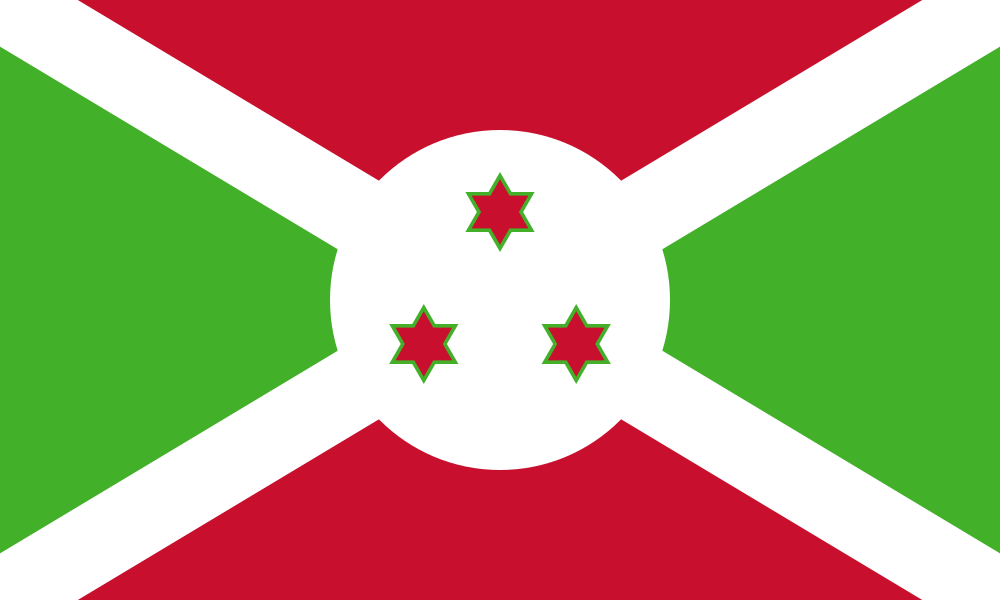
Key facts about hiring talent in Burundi
6.5M+
Kirundi, French, English
~US$80/mo
0.9% (2023)
~8% on salary
BIF 48,000/mo
Agriculture · Mining · Manufacturing
47.5% Secondary
Year-round
Job in Burundi · Esoko.bi








- Burundi Services
- Your Trusted Partner for Recruitment in Burundi
- Overview of Burundi’s Recruitment Industry
- Recruit in Burundi
- What are the Benefits of Recruiting in Burundi?
- What Legal Considerations Apply when Recruiting in Burundi?
- How to Choose a Recruitment Agency in Burundi
- Recruit Burundi Employees, with RemotePeople
- Recruit Top Talent Across Africa with Our Recruitment Expertise
- Ready to find your next star performer or build a leadership team in Burundi? Contact RemotePeople today
- Related Recruitment Destinations

Let RemotePeople handle payroll, compliance, and HR admin worldwide so you can focus on building your team.
Your Trusted Partner for Recruitment in Burundi
To better fulfill your recruitment needs, we at RemotePeople are here to help you find top talent in Burundi more effectively than recruiting on your own. Our team understands the local language, customs, and the intricacies of the Burundi talent market, giving you a significant advantage in securing the right candidates.
We know where to advertise your job openings to ensure maximum exposure and attract the best talent. Additionally, we assist in designing competitive, locally-appropriate compensation packages that not only appeal to top candidates but also help you optimize costs.
Get in touch with us to navigate Burundi’s recruitment landscape with confidence and ease.
Key Takeaways
- Burundi is a small, landlocked country in Central Africa with a small but growing economy.
- While over three-quarters of people are engaged in agriculture, industry and services are both growing sectors.
- Both English and French are official languages in Burundi, adding to the ease of communication with international employers.
- Recruitment agencies and EORs that also offer recruitment can be engaged to help foreign organizations source Burundian talent, whether or not they own entities in the country.
Burundi is a small Central African country in the African Great Lakes region with a current population of around 13.365 million people. It had previously been a German and then Belgian possession but achieved independence in 1962. Surrounded by Tanzania, the Democratic Republic of the Congo, and Rwanda, the country is without seaport access.
Since then, Burundi’s economy has still been able to grow impressively in the past few decades, from a GDP of $0.79 billion in 2003 to $4.29 billion in 2024. Growth is expected to continue at a more moderate 2.2% in 2025. This economy is primarily based on agriculture, which is the sector that employs most Burundians.
Burundi’s workforce is, therefore, generally located in rural areas, with only 12% living in urban areas. Local income levels are low, and workers here can be highly affordable for foreign-based employers.
If you’re thinking about hiring Burundian workers for your team, this review will give you information on how to source them, what kinds of service providers to partner with, and how to employ them compliantly.
Overview of Burundi’s Recruitment Industry
Burundi’s largely rural population is also very young, with over 40% of the population under the age of 15. While the population is 13.365 million, the labor force of Burundi is only around 6 million, creating a 44% participation rate of workers.
In addition, the informal sector may also contribute to this low rate. Around 85.6% of workers are engaged in the agricultural sector, 3.6% in industry, and 10.5% in services. At the same time, much of the country’s agriculture is subsistence-based.
Tea and coffee are major crops that contribute greatly to GDP but also depend heavily on rain and international prices. Burundi produces cassava, bananas, sweet potatoes, vegetables, beans, maize, and sugarcane in addition to these beverage products. Its industrial production is centered around mining, and the country has significant deposits of petroleum, uranium, nickel, cobalt, copper, and platinum.
However, more investment in these industries is needed to help the country benefit from these resources. Burundi’s main export partners include Germany, Pakistan, Kenya, China, and Sweden, while it imports goods mainly from Saudi Arabia, China, Uganda, Belgium, Kenya, and Zambia. While Burundi has a literacy rate of over 75%, worker education continues to be a challenge for this country.
In 2020, 59% of the working age had some form of tertiary education, but this actually represents a decrease from 75% in 2014. More workers in urban areas are highly educated. Workers in Burundi can be highly affordable. In the main urban areas of Bujumbura and Gitega, workers must be paid a minimum of 160 BIF (Burundi francs)/day (around 0.054 USD), and the minimum wage for rural workers is only 105 BIF /day (around 0.036 USD).
These wages are some of the lowest in the world, though workers can make more with an average range of 150,000 to 500,000 BIF/month (around 50 to 170 USD). In addition, employers have to pay just 6% of workers’ salaries toward social security schemes. These low contributions don’t significantly add to the price of Burundian workers.
If you want to recruit talent in Burundi on your own, you’re in for a challenge. People here have limited access to the internet, and if you don’t have local networks and contacts, you’ll likely find it very hard to source workers. You can still try posting your vacancies on the most popular job search site in the country.
You can also use social media platforms like Facebook, X (Twitter), and LinkedIn to build your brand and get the word out about your open positions. The alternative to going it alone is to engage professional recruiters through a recruitment agency or an Employer of Record (EOR) that also offers this service. These professionals use their talent pools and knowledge of the local recruitment industry to find you top candidates far more quickly than you could on your own.
Recruit in Burundi
Burundi offers a French and Kirundi-speaking workforce, with talent in agriculture, coffee and tea production, mining, and construction sectors.
We source pre-vetted candidates across industries, handling local salary structures and Burundian labor requirements.
No local entity needed. Your team can start in days.
What are the Benefits of Recruiting in Burundi?
Burundi is a small, landlocked, low-income country. At the same time, there are clear benefits to recruiting workers in this part of the world, including:
Language Skills
In Burundi, nearly 98% of the population speaks Kirundi as a first language. However, French and English also have official language status and are highly important for education and trade. Swahili is also widely understood, making Burundian workers valuable for business in the region and globally.
Highly Affordable Workers
Wages in Burundi are some of the lowest in the world, and employers pay only 6% of these salaries as additional contributions to social security. This makes Burundians extremely affordable compared to workers in other nations.
Economic Growth
Growth has been impressive in the past two decades, and the size of the Burundian economy is expected to grow annually. This leads to the development of larger domestic markets.
Young and Literate
This country has a very young population and a relatively high literacy rate. These factors combine to produce attractive workers for more employers.
What Legal Considerations Apply when Recruiting in Burundi?
Workers’ rights, as well as those of their employers, are enshrined in several pieces of important legislation, including the Constitution of the Republic of Burundi 2018, the Burundi Labour Code 2020, and the Social Security Code 1999. Some of the most important points of law you’ll need to know to compliantly recruit and employ Burundian workers include:
Contracts
Contracts in Burundi may be oral but new regulations encourage them to be written. They can be for indefinite periods or fixed terms. Fixed-term contracts can only be made for temporary, non-durable work, though new companies can use fixed-term contracts of up to one year in duration.
Probationary periods must be agreed on in writing. They can last up to six months for regular workers and up to 12 months for supervisors and managers. During these periods, either party can terminate the contract at will with three days’ notice.
Working Hours & Overtime
Burundian employees work a maximum of eight hours a day and 45 hours per week. Any additional hours are considered overtime and must be compensated as such. Workers must receive 135% of their normal wages for the first two hours per week they work overtime and 160% for hours after that. They can work a maximum of 15 hours of overtime a week or 150 hours per year.
Breaks and Rest
Burkinabe workers are entitled to weekly rest days of 24 consecutive hours. Employers are strictly prohibited from employing workers on these days. Break times and durations are agreed upon in workers’ contracts. However, nursing mothers are entitled to one hour’s worth of paid breaks each day to breastfeed.
Leaves
Workers in Burundi are entitled to 20 working days of paid leave for each 12-month period of the work. They can accumulate this leave for up to two years. They also receive full pay on the normally 13 public holidays that take place each year.
Expecting mothers are entitled to fully paid maternity leaves of 12 weeks, six of these before the birth of a child. Maternity leave is paid 50% by the employer and 50% by social security. Fathers receive four days of paid paternity leave.
Social Security Contributions
Employees are deducted 4% of their salaries to make contributions to social security schemes. Employers must also contribute an additional 6% of their workers’ salaries. These contributions support schemes for old age and disability, health and long-term care, sickness and maternity, accidents at work and occupational diseases, unemployment, and family and household benefits.
Terminations
In the case of gross negligence at work, an employee can be terminated without notice. However, in other cases, notice and severance are given as follows:
- less than three years’ service: one month’s notice, half a month’s wages in severance
- 3-5 years: one-and-a-half months’ notice, one month’s wages in severance
- 5-10 years: two months’ notice, two months’ wages in severance
- over ten years: three months’ notice, three months’ wages in severance
How to Choose a Recruitment Agency in Burundi
If you’re sure you want to source the best talent in Burundi, you may need some assistance. By working with a reputable recruitment agency or a Burundi Employer of Record that also offers recruitment, your chances of finding great candidates in much less time improve significantly. When choosing a partner, consider the following criteria:
Price
To start your recruitment process, you should first assess your hiring needs and create an appropriate budget that includes recruiter fees. If a provider’s fees are outside of your budget, they can be eliminated from the competition. However, be sure to ask for clear, complete quotes from other contenders to help you avoid surprises.
Experience
Many providers offer recruitment services around the world, but some have never actually recruited employees in Burundi. These recruiters will likely be unable to avoid problems and manage the recruitment process as adeptly as providers with relevant local experience.
Reviews
It’s worth your time to look outside of providers’ websites and look at trustworthy review sites to learn more about them. Though it’s likely you’ll encounter complaints about all providers, serious issues with past clients and recruits should show up in these reviews and warn you away.
Services
Not all providers offer the same range of services. Some simply source talent and put forward the names of candidates. Others will take the process much further, helping with interviews, selection, contract preparation, onboarding, and even training for their clients. Make sure the provider you choose offers the complete package of services you require, and check how they’re included in their prices.
Recruit Burundi Employees, with RemotePeople
Burundi is a small country with a small, agriculture-based economy. Despite being a low-income country, it has a young, literate, and vibrant labor force that can provide value for employers from around the world. These employees are also highly affordable for foreign-based employers who can work with recruitment agencies and EORs to source them.
If you’re looking for Burundian employees, contact RemotePeople today to leverage the experience of this reputable recruiter and get them on your team quickly.
Recruit Top Talent Across Africa with Our Recruitment Expertise
Navigating the complexities of hiring and workforce management across different countries can be challenging. Partnering with a reliable recruitment agency ensures you stay compliant with local labor laws, streamline the hiring process, and secure top talent. Learn how RemotePeople can help you recruit in the following countries:
| Recruitment coverage in Africa | ||
|---|---|---|
| Algeria | Angola | Benin |
| Botswana | Burkina Faso | Burundi |
| Cabo Verde | Cameroon | Central African Republic |
| Chad | Comoros | Democratic Republic of Congo |
| Djibouti | Equatorial Guinea | Eritrea |
| Ethiopia | Eswatini | Gabon |
| Gambia | Ghana | Guinea |
| Guinea-Bissau | Ivory Coast | Kenya |
| Lesotho | Liberia | Madagascar |
| Malawi | Mali | Mauritania |
| Mauritius | Morocco | Mozambique |
| Namibia | Niger | Nigeria |
| Republic of the Congo | Rwanda | Sao Tome and Principe |
| Senegal | Seychelles | Sierra Leone |
| Somalia | South Africa | South Sudan |
| Sudan | Tanzania | Togo |
| Tunisia | Uganda | Zambia |
| Zimbabwe | ||
Ready to find your next star performer or build a leadership team in Burundi? Contact RemotePeople today
Ready to expand in Burundi? RemotePeople can connect you with skilled local talent. Contact us today to discuss your hiring needs and reach your recruitment objectives.
Recruitment Agency in
Recruitment Agency in
Recruitment Agency in
Recruitment Agency in
Recruitment Agency in
Recruitment Agency in
Recruitment Agency in
Recruitment Agency in
Recruitment Agency in
Recruitment Agency in




