
 Recruit
Recruitment Agency in Ivory Coast
-
 Drew Donnelly
- Published
- September 21, 2026
Read our in-depth guide to the Ivorian recruitment industry and discover how RemotePeople, a leading recruitment agency in Ivory Coast, connects you remotely with top talent.
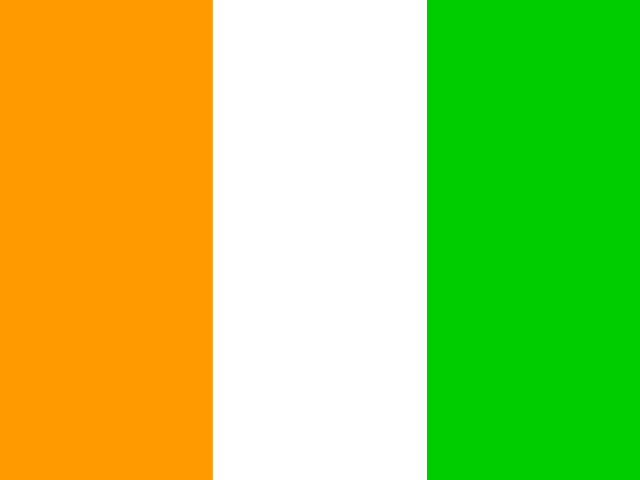
Recruiting talent in Ivory Coast at a glance
10M+
French
~US$300/mo
3.4% (2024)
~15.75% on salary
XOF 75,000/mo
Agriculture · Mining · Manufacturing · Services
12% Tertiary
September - November
Emploi.ci · LinkedIn








- Ivory Coast Services
- Your Trusted Partner for Recruitment in Ivory Coast
- Overview of Ivory Coast's Recruitment Industry
- Recruit in Ivory Coast
- What are the Benefits of Recruiting in Ivory Coast?
- What Legal Considerations Apply when Recruiting in Ivory Coast?
- How to Choose a Recruitment Agency in Ivory Coast
- Recruit Top Talent Across Africa with Our Recruitment Expertise
- Related Recruitment Destinations

Let RemotePeople handle payroll, compliance, and HR admin worldwide so you can focus on building your team.
Your Trusted Partner for Recruitment in Ivory Coast
To better fulfill your recruitment needs, we at RemotePeople are here to help you find top talent in Ivory Coast more effectively than recruiting on your own. Our team understands the local language, customs, and the intricacies of the Ivorian talent market, giving you a significant advantage in securing the right candidates.
We know where to advertise your job openings to ensure maximum exposure and attract the best talent. Additionally, we assist in designing competitive, locally-appropriate compensation packages that not only appeal to top candidates but also help you optimize costs.
Get in touch with us to navigate Ivory Coast’s recruitment landscape with confidence and ease.
Key Takeaways
- The country’s GDP has quadrupled in the past 20 years, and impressive growth is expected to continue.
- Ivory Coast is a low-middle-income country, and workers here are highly affordable for foreign enterprises.
- Many Ivorians work in agriculture, but services and manufacturing are up-and-coming sectors.
- Recruitment agencies and Employers of Record are effective partners in helping source staff in Ivory Coast.
Ivory Coast, also known as the Republic of Côte d’Ivoire, is a medium-sized country in West Africa that borders Ghana, Liberia, Mali, Burkina-Faso, and Guinea. With a population of 31.983 million, it’s a significant nation in West Africa, though dwarfed by its neighbor, Nigeria.
As a past colony of France, French is the country’s official language, but people also speak over 70 other local languages. Ivory Coast achieved independence in 1960, and since then, it has struggled to build itself into the stable presidential republic that it is today. Its economy has also grown considerably in the past few decades.
In 2004, Ivory Coast’s GDP was $22.92 billion, and has nearly quadrupled to $86.99 billion in 2024. The IMF predicts the GDP to grow by another 50% to $133.76 billion in five years’ time. This growth is fueled largely by the country’s exports of things like nuts, cocoa, coffee, rubber, gold, and hydrocarbons, plus the increase in global prices for these commodities.
Ivory Coast has a significant population but a comparably small workforce. In 2019, it was estimated that only 63.1% of the working-age population, or 8.825 million people worked. However, this doesn’t take into account the many people who work in the informal sector, performing occasional work with little job security. Ivorians are resilient people with a creative and playful spirit.
If you’re considering hiring Ivorian workers, this article will give you a lot of in-depth information about how you can recruit them, how they can benefit your organization, and how to keep them happily and compliantly employed.
Overview of Ivory Coast's Recruitment Industry
Unemployment data in Ivory Coast is not easy to access, and it is suggested that only roughly 60% of the working-age population is formally employed. For organizations looking into hiring Ivorian workers, this represents a very loose labor market with lots of opportunities.
The country’s workforce is relatively young and generally looking for secure, reliable employment to support their families and improve their quality of life. Employers can offer compensation packages with moderate salaries and benefits and still attract a lot of interest from Ivory Coast’s workers. This is a country rich in natural resources and with a climate ideal for agricultural production.
Indeed, roughly 45% of Ivorian workers work in agriculture, producing coffee, mangoes, nuts, pineapples, timber, and other products. Ivory Coast is also the world’s leading producer of cocoa.
At the same time, agriculture represents only about 17% of GDP. Industry contributes more at 22%, and services dominate at 54%. These include tourism, transportation, education, healthcare, and financial services. Mining for gold, aluminum, and manganese is a growing sector, as is electricity production.
Manufacturing produces food products, textiles, beverages, wood products, building materials, and fertilizers. Ivory Coast’s main export partners include Switzerland ($1.6 billion), Mali ($1.46 billion), the Netherlands ($1.43 billion), the United States ($1.08 billion), and France ($940 million in 2022).
Ivory Coast also benefits from increasing foreign direct investment, with FDI coming from Burkina Faso (11% of investments), Turkey (7%), China, France, and Togo (5% each). Investments were focused on industry (52.20%) and services (46.90%).
In 2023, Ivory Coast received $1.75 billion in FDI and had stocks of over $13.68 billion. The country has also produced a new Investment Code and established an online complaints facility with its commercial court to improve conditions for international investors. Ivory Coast is classed as a low-middle-income country by the World Bank, but it is one of the wealthiest countries in West Africa in its region.
Regardless, it’s still an affordable place to hire workers. The minimum wage in Ivory Coast is only 39,960 XOF (West African CFA francs)/month (66 USD) for agricultural workers and 75,000 XOF/month (125 USD) for all other workers. If you want to recruit highly skilled workers in larger urban centers, however, you should expect to pay salaries from 350,000 to 650,000 XOF per month (575-1,075 USD).
Employers also need to contribute 15.45% of workers’ salaries to old age, invalidity, survivors’, maternity, sickness, occupational accident and illness, and family benefits through social security programs. However, even with these contributions, Ivorian workers can be highly affordable for foreign firms. Recruiting in Ivory Coast presents unique nuances and challenges for foreign firms.
As a more traditional society, Ivorian culture places a high value on personal recommendations and personal relationships. Local connections are, therefore, of the utmost importance when recruiting talent in this country. Many job openings are simply not advertised at all or are filled internally or through personal networks.
At the same time, many larger companies working in the country have begun to focus on inbound recruiting and use social media to build their brands and advertise their vacancies. Opening positions can also be successfully filled by advertising on the country’s top job sites which include Educarriere, Novojob Cote d’Ivoire, Abidjan.net, and Emploi.
Organizations looking for assistance and those without the resources to hire on their own in Ivory Coast can work with recruitment agencies or Employers of Record (EORs) that offer recruitment services. These service providers use their local knowledge, networks, and talent pools to help clients fill their vacancies quickly and easily.
Recruit in Ivory Coast
Ivory Coast offers West Africa’s largest economy with a workforce strong in agriculture, cocoa production, fintech, and services, with professionals fluent in French and English.
We source pre-vetted candidates across industries, handling local recruitment processes and Ivorian labor compliance requirements.
No local entity needed. Your team can start in days.
What are the Benefits of Recruiting in Ivory Coast?
There are several advantages to hiring Ivorians, either for remote jobs or permanent positions with a new venture in the Ivory Coast. New employers in the country can gain the following benefits from their Ivorian staff:
Affordable Workforce
Employing Ivorians can be very affordable for foreign organizations. The general minimum wage of 75,000 XOF/month (125 USD) applies to many manufacturing, industrial, and service workers, and even high-level management positions would rarely exceed 650,000 XOF/month (1,075 USD).
While employers must pay an additional 2.8% of each worker’s salary in payroll taxes, Ivorian workers cost far less than in other countries.
Language Skills and Diversity
Ivory Coast is a surprisingly diverse country with mixed religious (Christian, Islamic, and animistic faiths) and ethnic groups (Akan, Gur, Mandes, French, and Lebanese).
People in this country use French as a lingua franca but speak 78 different languages. This cultural and linguistic diversity can help to facilitate regional trade and produce value for any organization.
Strong Work Culture
Employees in Ivory Coast can lead to a work culture that’s dedicated and well-organized. At the same time, Ivorians like to enjoy themselves and therefore make sure that they maintain a positive energy in the office or with their colleagues anywhere.
Gateway to West Africa
Setting up a business or simply hiring employees on the Ivory Coast is an excellent way to gain a foothold in the ECOWAS (Economic Community of West African States) market, with a combined population estimated at over 425 million.
What Legal Considerations Apply when Recruiting in Ivory Coast?
Ivory Coast is still a developing country, and with that development comes advances in legislation to protect the rights of both workers and their employers. These rights are largely enshrined in the Ivorian Constitution (amended 2020) and Law No. 2015-532 (2015) on the Labour Code. Many other Laws, decrees, and orders have been made in the past two decades to enhance and clarify these rights.
If you’re thinking of hiring Ivorian workers, here are some of the main points of law for you to consider:
Contracts
Contracts in Ivory Coast must be written and have to include the following details:
- name, profession, and domicile of the employer
- name, sex, date and place of birth, parentage, domicile, and nationality of the worker
- worker’s trade or profession
- nature and duration of the contract
- worker’s professional classification
- salary and other benefits
- worker’s job description or responsibilities
- reference to relevant collective agreements
Contracts can be permanent or for fixed terms not longer than two years. However, fixed-term contracts can be renewed without limit.
Probationary periods can last eight days for hourly workers, one month for monthly salaried workers, two months for supervisors, and three months for engineers and managers. These periods can also be renewed once for new workers.
Working Hours & Overtime
Ivorians work 40 regular hours a week in most professions and a maximum of 48 regular hours per week in agricultural establishments. These working hours are normally distributed as eight hours a day, five days per week, or six hours and 40 minutes per day, six days per week. Work days cannot last longer than 13 hours.
Any additional hours are considered overtime and must be paid at the following rates:
| Overtime Condition | Rate |
|---|---|
| First 6 overtime hours per week | 125% of normal wages |
| Additional hours beyond the first 6 | 150% of normal wages |
| Overtime hours worked at night (18:00–06:00), or daytime hours on Sundays and public holidays | 175% of normal wages |
| Hours worked at night on Sundays and public holidays | 200% of normal wages |
Paid Time Off (PTO)
Workers must receive one day of rest each week, and it is forbidden to give workers their salaries on this day. Night workers’ shifts should not normally exceed eight hours of work and should include one to two 15-minute breaks. Workers should receive 2.2 working days per month of annual leave entitlements and this leave must be paid in full by the employer.
This annual leave allowance increases according to seniority by the following amounts:
| Years of Service | Additional Leave Days |
|---|---|
| 5 years | 1 additional day |
| 10 years | 2 additional days |
| 15 years | 3 additional days |
| 20 years | 5 additional days |
| 25 years | 7 additional days |
| 30 years | 8 additional days |
Ivorians receive two public holidays per year for which they must receive time off and full pay (National Day and Labor Day) and 16 unpaid national holidays. Workers are entitled to sick leave of up to 12 months.
Sick leave is paid by the employer as a portion of the worker’s salary and for a set number of months depending on the worker’s period of service with the company.
Parental Leave
General parental leave for childcare is not provided for under Ivory Coast law. Fathers receive an allowance of two days of paternity leave paid by the employer upon the birth of a child. Expecting mothers receive 14 weeks of maternity leave, six taken before the birth.
This leave is extended by two post-partum weeks in the case of multiple births. Mothers are compensated with a maternity allowance and daily allowance equal to their daily wages, which are paid by Social Security. An expecting mother may also terminate her contract without notice or penalty.
Notice and Severance
Ivory Coast employees can be terminated for gross misconduct or the provision of more favorable contract or collective bargaining terms. In other cases, they must be provided with notice, the amount of which depends on their status and years of service to the employer.
Workers paid weekly must receive between eight days and four months of notice. Workers paid monthly must receive one to four months of notice, depending on their seniority. Disabled employees must receive 40% more notice.
Terminated workers must receive severance pay equal to 30% of a year’s salary if they’ve worked for five years, 35% if they’ve worked for six to ten years, and 40% for over ten years of service.
Anti-discrimination Law
The Labor Code prohibits the employer from discriminating on the basis of age, disability, membership in a trade union, political and religious opinion, race, religion, sex, or social origin. This applies to all recruiting, hiring, and employment practices.
How to Choose a Recruitment Agency in Ivory Coast
Partnering with a recruitment agency is one of the best ways to source workers in Ivory Coast. You can also work with an Employer of Record (EOR) that offers recruitment which can find you workers and then hire them legally on your behalf.
However, you’ll find hundreds of service providers offering services in this country. Before you select one to partner with, consider the following factors to help you make an informed choice:
Services
Do you need simple recruiting for a few permanent jobs, temporary staffing solutions, or complete outsourcing of your recruitment function? Think about the services you need and then use this as the basis to find an effective partner.
Fees
Comparing fees can be difficult since some providers don’t post theirs online and instead require that potential clients contact them for quotes. However, even providers that do post their pricing may leave out certain additional or extra service fees. Ensure that you have clear and complete pricing before you agree to engage any recruitment agency.
Experience
While newer agencies may be excellent at marketing their services, they may not yet have the experience to recruit effectively in the Ivory Coast. Look for service providers who have not only worked for years in this industry but also have specific experience recruiting Ivorians.
Reviews and Ratings
To compare providers effectively, read their ratings and reviews on several trustworthy sites. If they’ve performed poorly or not treated recruits well, you’ll likely find evidence of this and know which providers to avoid.
While Ivory Coast is still a developing country, its laws, workforce, and economy are continually growing and improving. This is a country with excellent opportunities for employers whether they want to hire remote workers, expand their services, or open up new ventures in West Africa.
Working with experienced recruitment agencies can help them find the talent they need to fulfill the needs of their growing organizations.
Recruit Top Talent Across Africa with Our Recruitment Expertise
Navigating the complexities of hiring and workforce management across different countries can be challenging. Partnering with a reliable recruitment agency ensures you stay compliant with local labor laws, streamline the hiring process, and secure top talent.
Learn how RemotePeople can help you recruit in the following countries:
| Recruitment coverage in Africa | ||
|---|---|---|
| Algeria | Angola | Benin |
| Botswana | Burkina Faso | Burundi |
| Cabo Verde | Cameroon | Central African Republic |
| Chad | Comoros | Democratic Republic of Congo |
| Djibouti | Equatorial Guinea | Eritrea |
| Ethiopia | Eswatini | Gabon |
| Gambia | Ghana | Guinea |
| Guinea-Bissau | Ivory Coast | Kenya |
| Lesotho | Liberia | Madagascar |
| Malawi | Mali | Mauritania |
| Mauritius | Morocco | Mozambique |
| Namibia | Niger | Nigeria |
| Republic of the Congo | Rwanda | Sao Tome and Principe |
| Senegal | Seychelles | Sierra Leone |
| Somalia | South Africa | South Sudan |
| Sudan | Tanzania | Togo |
| Tunisia | Uganda | Zambia |
| Zimbabwe | ||
Ready to expand in Ivory Coast? RemotePeople can connect you with skilled local talent. Contact us today to discuss your hiring needs and reach your recruitment objectives.