
 Recruit
Average Salary in the Central African Republic
-
 Drew Donnelly
- Published
- September 21, 2026
Curious about salaries in Central African Republic? This guide breaks down the average wages, compares professions, highlights minimum wage figures, and explores how Central African Republic’s earnings measure up internationally.
- 5 ★ on G2








- Central African Republic Services
- What is the Average Salary in the Central African Republic?
- Salary Comparisons in the Central African Republic
- How Much is Minimum Wage in the Central African Republic?
- Average Salary in the Central African Republic vs. the Rest of the World
- What are the Most Common Outsourced Industries in Central African Republic?
- Conclusion

Let RemotePeople handle payroll, compliance, and HR admin worldwide so you can focus on building your team.
The Central African Republic’s low-cost labor and youthful workforce make it an ideal outsourcing destination. Employers seeking remote partnerships in the country may wonder, What is the average salary in the Central African Republic? This information will help them develop a competitive hiring offer.
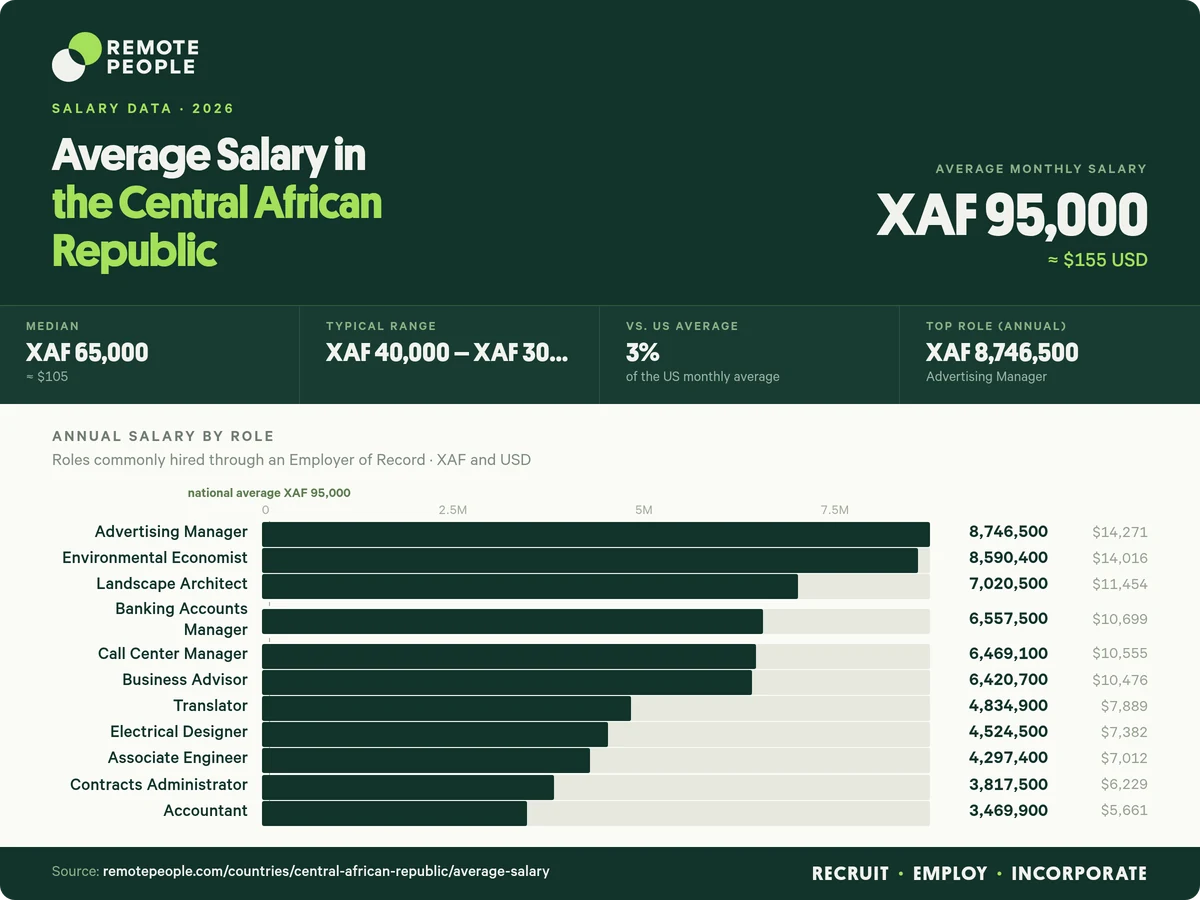
The average salary in the Central African Republic is approximately 95,000 Central African Francs (XAF), about USD 155. However, wages vary by experience, education, location, position, and industry. Comparing salaries to earnings in other countries provides additional insight.
This guide will explore all aspects of salaries in the Central African Republic, preparing you for your hiring journey.
What is the Average Salary in the Central African Republic?
The average salary in the Central African Republic is approximately 95,000 XAF, about $155. Wages in the country are low due to poverty, which limits the government’s ability to invest in its infrastructure. CAR has also been plagued by political instability and conflict, which negatively impacts economic growth.
Median Income
CAR’s median monthly income is approximately 65,000 XAF, about $105. Half the country earns lower wages; the other half earns more.
Salary Range
The salary range spans from the lowest to the highest wages in the country. In CAR, low earners make around 40,000 XAF, about $65 per month. High earners earn approximately 300,000 XAF, equivalent to about $500 per month.
Salary Comparisons in the Central African Republic
Average salary provides some insight, but you must also consider how wages vary by education, experience, location, position, and industry. The following sections will explore how these factors impact earnings.
Salary by Position
This salary comparison chart illustrates the variation in wages by position.
Position | Average Annual Salary (XAF) |
|---|---|
Accountant | 3,469,900 |
Administrative Assistant | 2,688,800 |
Advertising Manager | 8,746,500 |
Landscape Architect | 7,020,500 |
Banking Accounts Manager | 6,557,500 |
Translator | 4,834,900 |
Business Advisor | 6,420,700 |
Construction Building Administrator | 2,146,100 |
Delivery Driver | 1,537,500 |
Call Center Manager | 6,469,100 |
Electrical Designer | 4,524,500 |
Associate Engineer | 4,297,400 |
Environmental Economist | 8,590,400 |
Contracts Administrator | 3,817,500 |
Laborer | 1,380,400 |
Assembly Line Worker | 1,380,400 |
Fashion Merchandiser | 3,312,100 |
Chef | 3,359,900 |
Agricultural Inspector | 4,618,200 |
Average Wage in the Central African Republic Based on Education
Education significantly impacts salaries, as workers in Sub-Saharan Africa, including those in the Central African Republic (CAR), can expect to earn 12.4% more for each additional year of schooling. However, many workers don’t have access to education. Experts believe that increased access to education would help alleviate many of the country’s poverty issues.
Salary Comparison by Experience
Experience also impacts salaries as experienced workers earn more than entry-level workers, and employees become eligible for raises with tenure in their field. This rings true in CAR, especially among lucrative industries. Here are some statistics to consider:
Industry | Average Annual Raise |
|---|---|
Finance | 5% |
Energy | 1% |
Information Technology (IT) | 6% |
Healthcare | 2% |
Travel | 7% |
Construction | 3% |
Education | 8% |
Raises also vary by experience as follows:
Experience Level | Average Annual Raise |
|---|---|
Junior-Level Workers | 3–5% |
Mid-Level Workers | 6–9% |
Senior-Level Workers | 15–20% |
Top Management | 15–20% |
Additionally, 35% of CAR employees reported receiving bonuses in the last 12 months, typically ranging from 3% to 6% of their annual salary.
Salary Comparison by Location
Location is also considered in wage determination. Workers in urban areas, such as the capital city of Bangui, tend to earn the highest salaries due to high living costs and proximity to large companies offering high-paying job opportunities. Rural workers are typically reliant on subsistence agriculture.
How Much is Minimum Wage in the Central African Republic?
The minimum wage in CAR is 40,000 XAF, equivalent to approximately $65 per month. It has been in effect since 2023. While there have been some adjustments, such as an increase to 40,000 XAF gross per month in August of 2023, there is no word on whether it will increase further.
Average Salary in the Central African Republic vs. the Rest of the World
The following charts will compare salaries in CAR to those in developed, developing, and least developed countries, providing more insight.
Central African Republic vs. Developed Countries
Country | Average Monthly Salary | Comparison to Average CAR Salary |
|---|---|---|
Japan | 340,000 JPY (approx. $2,300) | – 93% |
United Kingdom | £3,000 (approx. $4,100) | – 96% |
Norway | 50,000 NOK (approx. $4,700) | – 97% |
Germany | €4,300 (approx. $4,470) | – 97% |
Austria | €3,700 (approx. $4,050) | – 96% |
Central African Republic vs. Developing Countries
Country | Average Monthly Salary | Comparison to Average CAR Salary |
|---|---|---|
Romania | 4,000 RON (approx. $835) | – 81% |
Russia | 73,700 RUB (approx. $700) | – 78% |
Albania | 83,330 ALL (approx. $860) | – 455% |
Kazakhstan | 342,000 KZT (approx. $645) | – 76% |
Ukraine | 18,000 UAH (approx. $500) | – 69% |
Central African Republic vs. Undeveloped Countries
Country | Average Monthly Salary | Comparison to Average CAR Salary |
|---|---|---|
Afghanistan | 13,200 AFN (approx. $150) | 3% |
Philippines | 15,000 PHP (approx. $265) | −42% |
Cambodia | 1,150,000 KHR (approx. $280) | −45% |
Egypt | 3,900 EGP (approx. $125) | 24% |
Pakistan | 60,000 PKR (approx. $210) | −26% |
The Central African Republic is a least developed country with extremely high poverty rates. Its work economy heavily relies on subsistence farming. Timber and mining are significant sources of export revenue.
Although the country has internal issues, it shows promise in developing through outsourcing opportunities. It offers low-cost labor and a youthful workforce. CAR is also rich in natural resources that could drive the economy.
What are the Most Common Outsourced Industries in Central African Republic?
Employers who outsource to CAR will see the most significant benefits when focusing on the following industries.
Mining
CAR’s mining industry is a significant source of export revenue as the country is rich in gold, rough diamonds, uranium, iron ore, copper, and manganese. Artisanal and small-scale mining dominates the industry. However, it faces challenges in developing a legal and sustainable mining sector.
Agriculture
The country is heavily reliant on subsistence farming, with subsistence crops including cassava, peanuts, sorghum, and millet. However, CAR also generates revenue from export crops, including cotton, coffee, and tobacco. Though limited by a lack of infrastructure, the government aims to improve the industry by implementing programs to promote agricultural mechanization.
Forestry
CAR’s forestry industry contributes significantly to its GDP and offers a strong legal and regulatory framework in the industry. It is a significant source of jobs and revenue. However, the sector is plagued by instability linked to illegal logging, timber trafficking, climate change, deforestation, and export bans.
Conclusion
The Central African Republic’s low average salaries make it an affordable destination for outsourced labor. Although it faces developmental challenges, it offers a young and motivated workforce, as well as unique natural resources, that can help companies become industry leaders. International employers can also help workers overcome poverty, leading to positive outcomes for all parties involved.




