Recruit
Average Salary in the Ivory Coast
-
 Drew Donnelly
- Published
- September 6, 2026
- 5 ★ on G2








Let RemotePeople handle payroll, compliance, and HR admin worldwide so you can focus on building your team.
With its expanding workforce and competitive labor costs, the Ivory Coast has become an appealing destination for international hiring. Businesses hiring through an Employer of Record (EOR) in the Ivory Coast should understand local salary expectations to attract qualified professionals and remain competitive.
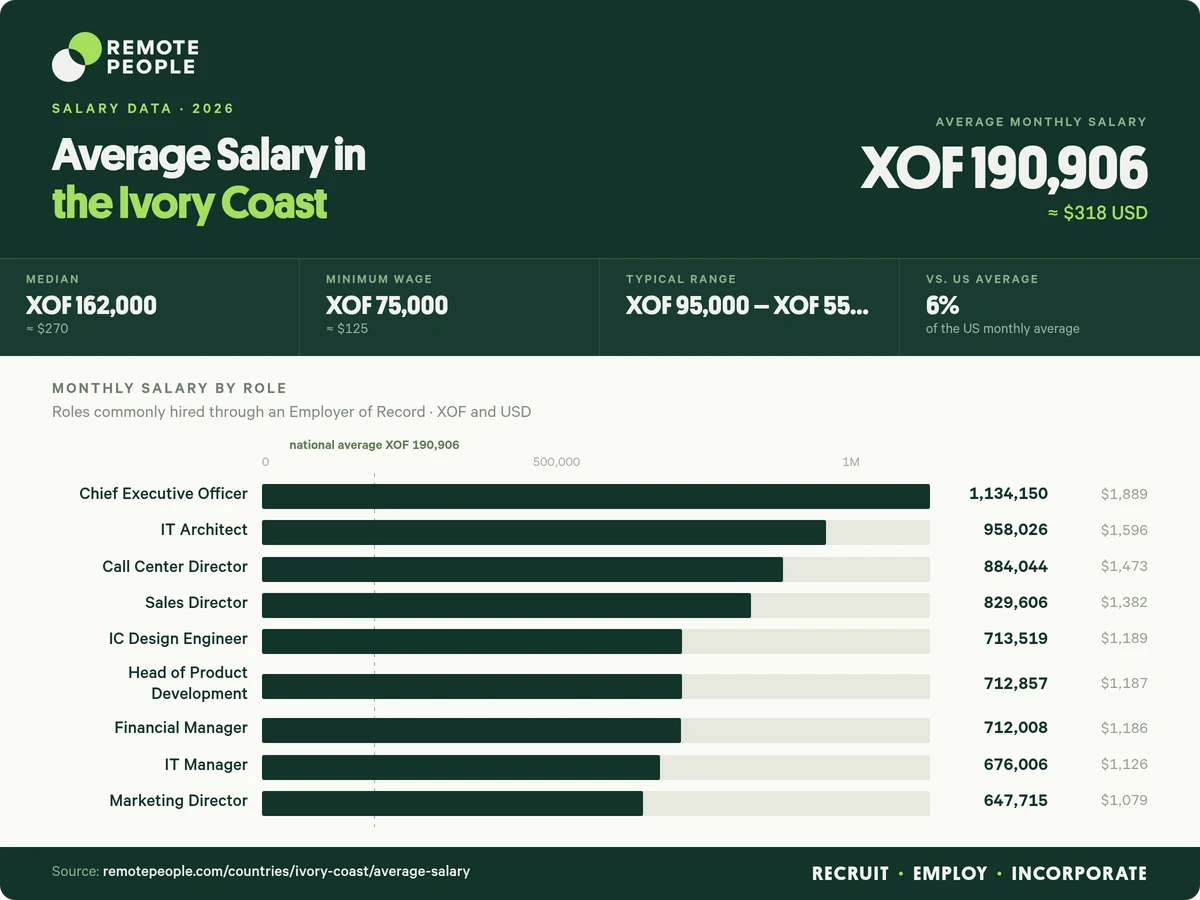
The average salary in the Ivory Coast is 190,906 XOF (West African CFA francs), or approximately USD 318. However, salaries vary by profession, industry, education, experience, and location. You must also consider how wages in the country compare to those in the rest of the world.
This article will explore several salary-related factors to provide additional insight and is part of our guide on Global Salaries.
What is the Average Salary in the Ivory Coast?
The average monthly salary in the Ivory Coast is 190,906 XOF, which translates to about $318. Wages are low due to an informal economy. Agriculture, which requires unskilled workers and pays minimal wages, is the dominant industry.
Median Income
The median salary can also be considered the ‘middle salary’. It differs from the average salary, the sum of salaries across the country divided by the total number of workers.
The median monthly income in the Ivory Coast is estimated at approximately 162,000 XOF, or about $270. Half the workers earn higher salaries, and the other half earn lower wages.
Salary Range
The salary range spans the lowest to the highest salaries in the country. Low earners in the Ivory Coast earn about 95,000 XOF (about $158) while high earners can earn close to 550,000 XOF (around $917) depending on industry and specialization.
Salary Comparison by Profession
Salaries vary by industry and profession. The following comparison chart lists salaries for various occupations in the Ivory Coast to help readers better understand the country’s wages.
Position | Average Monthly Salary (XOF) |
|---|---|
Chief Executive Officer | 1,134,150 |
IT Architect | 958,026 |
Call Center Director | 884,044 |
Sales Director | 829,606 |
IC Design Engineer | 713,519 |
Head of Product Development | 712,857 |
Financial Manager | 712,008 |
IT Manager | 676,006 |
Medical Advisor | 650,037 |
Marketing Director | 647,715 |
Banking Cashier | 181,859 |
Fabric Cutter | 180,801 |
Clothing Technologist | 180,013 |
General Laborer | 178,927 |
Packer | 176,313 |
Seamstress | 168,336 |
Social Counselor | 165,797 |
Porter | 162,633 |
Tailor | 160,902 |
Average Wage in the Ivory Coast by Education
Education is an issue in the Ivory Coast. Children often live in poverty and cannot attend school. The lack of education makes it difficult for the country to develop, so there aren’t many high-paying jobs.
Workers who are educated have an advantage. However, they are limited in the high-paying jobs they can find. Additionally, unemployment has been an issue, even among workers with advanced educations.
The government is addressing this issue and making education more accessible to its population. Unemployment rates have also dropped among workers with advanced educations. However, a lack of education is still an issue within the country.
Salary Comparison by Experience
Experience is a significant factor in salary determination, with experienced workers earning more than entry-level workers. Employees also become eligible for raises as they gain experience at their companies. This situation rings true in the Ivory Coast, where workers are entitled to the following pay raises:
Time at Company | Salary Raise |
|---|---|
5 years | 30% raise |
6–10 years | 35% raise |
10+ years | 40% raise |
However, these laws may not be enforced country-wide due to an informal work sector.
Salary Comparison by Location
Typically, workers in urban areas earn more than workers in rural areas due to the higher cost of living and proximity to big businesses with more job opportunities. In the Ivory Coast, the situation is a bit different.
Urban workers still earn more than rural workers, but this is because urban workers thrive in the informal work sector. They set up their businesses as street vendors, taxi drivers, metal workers, and repair people, making money off the population. While the attitude of entrepreneurship is commendable, these workers often lack protection regarding increased wages and stability.
Currently, there aren’t many job opportunities in the formal sector. However, even if these industries experience rapid growth, it will be challenging to outpace the informal sector, which has been a primary source of income for Ivory Coast workers for many years.
How Much is Minimum Wage in the Ivory Coast?
The last minimum wage for Ivory Coast increase for the Ivory Coast occurred on January 1, 2023. The minimum wage for the non-agricultural sector is 75,000 XOF (approximately $125) monthly, and the minimum wage for the agricultural industry is 36,000 XOF (roughly $60) monthly.
Average Salary in the Ivory Coast vs. the Rest of the World
You can gain more perspective on Ivory Coast salaries by comparing them to salaries in developed, undeveloped, and developing countries. The following charts will provide more perspective.
Ivory Coast vs. Developed Countries
Country | Average Salary | Comparison to Average Ivory Coast Salary |
|---|---|---|
United Kingdom | £3,000 (approx. $4,100) | 1189% |
United States | $5,220 | 1541% |
Norway | 50,000 NOK (approx. $4,700) | 1377% |
Germany | €4,300 (approx. $4,470) | 1306% |
Austria | €3,700 (approx. $4,050) | 1173% |
Ivory Coast vs. Developing Countries
Country | Average Salary | Comparison to Average Ivory Coast Salary |
|---|---|---|
Romania | 4,000 RON (approx. $835) | 162% |
Russia | 73,700 RUB (approx. $700) | 120% |
Albania | 83,330 ALL (approx. $860) | 170% |
Kazakhstan | 342,000 KZT (approx. $645) | 103% |
Ukraine | 18,000 UAH (approx. $500) | 57% |
Ivory Coast vs. Undeveloped Countries
Country | Average Salary | Comparison to Average Ivory Coast Salary |
|---|---|---|
Thailand | 15,000 Baht (approx. $420) | 32% |
Philippines | 15,000 PHP (approx. $265) | − 17% |
Vietnam | 7.5 million Dong (approx. $300) | − 6% |
Egypt | 14,317 EGP (approx. $284) | − 11% |
Pakistan | 60,000 PKR (approx. $210) | − 34% |
The Ivory Coast is a developing country with a rapidly growing economy, thanks to its position as a top exporter of cocoa beans. The agricultural sector dominates the economy, but growth also occurs in the services and industrial sectors. The country offers relatively well-developed infrastructure, including roads, ports, and telecommunications.
The country is ideal for outsourcing due to its young, dynamic workforce and low-cost labor. Although education is a factor, skilled professionals are increasingly available across various industries. However, employers should know about possible infrastructure challenges, political instability, and security issues.
What are the Most Common Outsourced Industries in the Ivory Coast?
Companies considering outsourcing to the Ivory Coast should focus on the following industries:
Agriculture
Agriculture is a key sector of the Ivory Coast’s economy, employing more than half the country’s workers. Major crops include cocoa, cashews, rubber, palm oil, and bananas. Companies can use Ivory Coast workers for farming processes or export crops directly.
Oil and Gas
The Ivory Coast is becoming a West African energy hub. It concentrates more on refining oils than producing them. The country is home to the most significant hydrocarbon discovery, and by 2028, it is expected to produce 200,000 barrels of oil and 450 million cubic feet of gas daily.
Telecommunications
The country has one of the most developed telecommunications industries in West Africa. It has high mobile penetration and mature growth compared to other African countries. The industry focuses on mobile data services such as 4G and fiber optics.
Telecommunication workers in the area typically earn between 211,000 XOF (approx. $352) and 560,000 XOF (about $933) monthly, compared to American workers who make more than $3,000 monthly. This variance could lead to significant cost savings for employers looking to outsource.
Conclusion
The Ivory Coast’s skilled and motivated workforce and low labor costs make it an ideal outsourcing destination. Employers who hire remote workers in the area can benefit from cost savings while helping workers overcome poverty. A partnership can have promising outcomes for all parties.