
 Recruit
Average Salary in Latvia
-
 Drew Donnelly
- Published
- September 21, 2026
Curious about salaries in Latvia? This guide breaks down the average wages, compares professions, highlights minimum wage figures, and explores how Latvia’s earnings measure up internationally. Partnering with an Employer of Record (EOR) in Latvia lets you employ staff there without establishing a legal entity of your own.
- 5 ★ on G2








Let RemotePeople handle payroll, compliance, and HR admin worldwide so you can focus on building your team.
Latvia’s strong digital infrastructure, low cost of living and growing market make it an ideal outsourcing destination. Employers looking to hire in the area may wonder, what is the average salary in Latvia? This information will help them prepare a fair job offer.
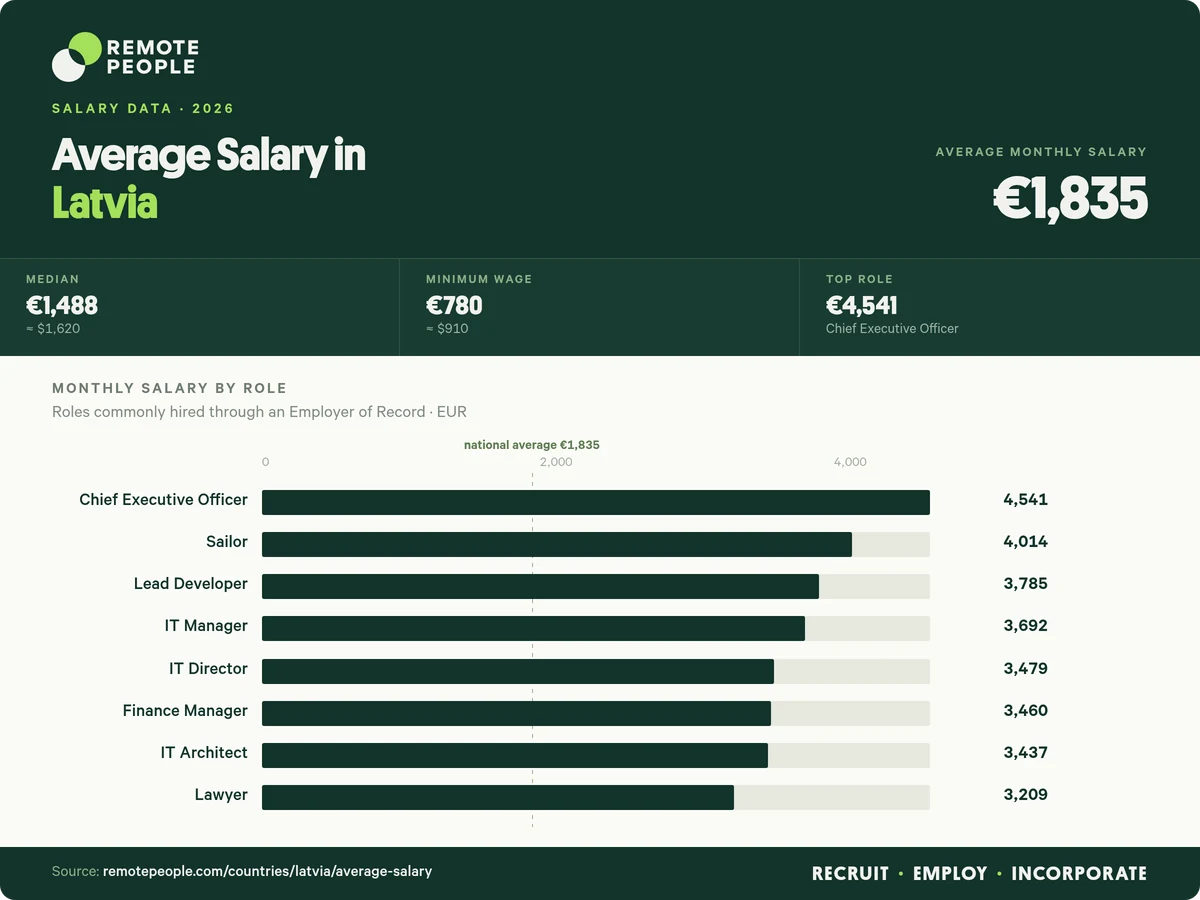
The average monthly salary in Latvia is €1,835 (about USD 2,000). However, you must consider how education, experience, location, position, and industry impact salaries. Comparing Latvian salaries to wages around the world will also provide additional insight.
This guide will explore all aspects of Latvian salaries, preparing employers for outsourcing partnerships.
What is the Average Salary in Latvia?
The average salary in Latvia is €1,835 per month, which translates to about $2,000. The low wages are primarily due to a low cost of living. However, the country’s work economy, which consists of low-wage earners, and its low minimum wage, also contribute to low incomes.
Median Income
The median salary can also be considered the ‘middle salary’. Latvia’s median monthly income is €1,488 (about $1,620). Half the country’s workers earn higher salaries, and the other half earn lower salaries.
Salary Range
The salary range spans the lowest to highest wages in the country. Low-earners in Latvia make around €1,100 monthly (about $1,200), while high-earners make €6,000 or more (about $6,540).
Salary Comparison by Profession
Average salaries provide insight, but you must consider how experience, education, location, profession, and industry impact salaries. The following sections will explore these factors for a more comprehensive understanding.
Profession | Average Monthly Salary (€) |
|---|---|
Pilot | 4,597 |
Chief Executive Officer | 4,541 |
Sailor | 4,014 |
Lead Developer | 3,785 |
IT Manager | 3,692 |
IT Director | 3,479 |
Finance Manager | 3,460 |
IT Architect | 3,437 |
Dentist | 3,389 |
Lawyer | 3,209 |
Average Wage in Latvia by Education
Education is a significant factor in wage determination and an individual’s ability to attain employment. A 2024 study reveals that 65% of 25- to 34-year-olds without an upper secondary qualification are employed, while 77% of those with a secondary education and 87% with a tertiary education are employed. Furthermore, the wages of 25 to 34 year olds without a secondary education are 13% lower than those with a secondary education or higher.
Salary Comparison by Experience
Experience also impacts earnings. Workers with experience tend to earn more than entry-level workers. Employees also become eligible for raises with tenure in their positions.
This situation rings true in Latvia, where there is a demand for experienced workers. When the labor market eases, individuals with minimal experience will likely become unemployed.
Salary Comparison by Location
Location is another factor to consider. Urban workers earn more than rural workers due to the higher cost of living and proximity to large companies offering more business opportunities. For example, Latvian workers who live near the capital city of Riga earn an average wage of €2,400, while workers in surrounding areas earn an average salary of €1,700.
How Much is Minimum Wage in Latvia?
Latvia’s minimum wage is €780 monthly (about $910 USD) as of January 1, 2026. The government updates the minimum wage periodically, and it is binding on all employers. Latvia has moved toward setting the minimum wage as a percentage of the national average wage, and the government reviews and adjusts it yearly based on economic conditions.
Average Salary in Latvia vs. the Rest of the World
The following charts show how Latvian salaries compare to earnings in developed, developing, and undeveloped countries.
Latvia vs. Developed Countries
Country | Average Salary | Comparison to Average Latvia Salary |
|---|---|---|
United Kingdom | £3,000 (approx. $4,100) | − 105% |
United States | $5,220 | − 161% |
Norway | 50,000 NOK (approx. $4,700) | − 135% |
Germany | €4,300 (approx. $4,470) | − 124% |
Austria | €3,700 (approx. $4,050) | − 103% |
Latvia vs. Developing Countries
Country | Average Salary | Comparison to Average Latvia Salary |
|---|---|---|
Romania | 4,000 RON (approx. $835) | 58% |
Russia | 73,700 RUB (approx. $700) | 65% |
Albania | 83,330 ALL (approx. $860) | 57% |
Kazakhstan | 342,000 KZT (approx. $645) | 68% |
Ukraine | 18,000 UAH (approx. $500) | 75% |
Latvia vs. Undeveloped Countries
Country | Average Salary | Comparison to Average Latvia Salary |
|---|---|---|
Thailand | 15,000 Baht (approx. $420) | 79% |
Philippines | 15,000 PHP (approx. $265) | 87% |
Vietnam | 7.5 million Dong (approx. $300) | 85% |
Egypt | 14,317 EGP (approx. $284) | 86% |
Pakistan | 60,000 PKR (approx. $210) | 90% |
Latvia is a developed country with an advanced economy and high income. It ranks high in the Human Development Index and offers a diverse work economy focused on agriculture, manufacturing, transit services, and timber. Although COVID and the economic crisis of 2008 have negatively impacted it, it has seen economic growth in the last few years.
The country is an ideal outsourcing destination due to its skilled workforce and low-cost labor. It offers a strong digital infrastructure focused on IT services. The government is known for its easy business environment and strategic location in the Baltic region.
What are the Most Common Outsourced Industries in Latvia?
Employers considering outsourcing to Latvia will benefit most when focusing on the following industries:
IT Services
Latvia’s IT industry has grown significantly over the last few years and is expected to continue on that trajectory, with a growth rate of 6.67% between 2025 and 2029. The country’s strong digital infrastructure makes it a desirable outsourcing destination.
A Latvian IT architect earns around €3,800 monthly (about $4,140) while their American counterpart earns close to $8,333 leading to significant cost savings for employers.
Financial Services
The Latvian financial market offers all institutions typical of a developed market including banks, pension funds, and leasing and insurance companies. It has been consolidating, making it an attractive resource for foreign investments. The market has also embraced AI with remarkable momentum, making its services more efficient.
A financial manager in Latvia earns an average monthly salary of €3,900, while their American counterparts earn close to $10,333. Employers who outsource to Latvia can save considerably on human resource expenses.
Manufacturing
Latvia is a prime source for manufacturing, with primary exports including wood products, food processing, textiles, chemicals and pharmaceuticals, electronics, and IT. Thanks to the low labor cost, companies can reduce expenses when outsourcing goods from the country. It also offers a strategic location and a stable political and economic environment.
Conclusion
Latvia’s low labor costs and highly skilled workforce make it an ideal outsourcing destination. Employers who outsource to the country can benefit from reduced expenses and high-quality products and services while allowing workers to improve their economic standing. This situation is advantageous for everyone involved.