
 Recruit
Employer of Record (EOR) in Latvia
-
 Drew Donnelly
- Published
- September 22, 2026
RemotePeople’s employer of record in Latvia lets you hire employees in Latvia with full statutory compliance. We handle social insurance contributions at 34.09% (23.59% employer, 10.5% employee), mandatory unemployment and maternity benefits, and all registrations with the tax authority and social security system.
Hire in Latvia — book a free 30-minute demo
Tell us what you need. You'll get a tailored, transparent proposal within 24 hours, plus a free call to walk through it.
Tell us about your company
So we can match you with a specialist who knows your market — and unlock volume pricing tiers.
* All fields are required.
Where and when are you hiring?
Tell us the geography and timing and we'll quote each country line by line, with onboarding timelines.
* All fields are required.
Help us beat your current setup
We'll benchmark your current deal and send a line-by-line proposal in 24 hours — showing exactly where we cut cost, time, or risk. After you submit, you can book a call to walk through it together.
* All fields are required.
Thanks! Your proposal is on its way.
Expect a tailored, line-by-line proposal in your inbox within 24 hours. In the meantime…
Want to walk through it together?
Book a free 30-minute call with one of our specialists. We'll explain every line, answer your questions, and tailor the proposal further if you need.
No obligation. Pick a time that works for you.








- Hire in Latvia — book a free 30-minute demo
- Tell us about your company
- Where and when are you hiring?
- Help us beat your current setup
- Thanks! Your proposal is on its way.
- How an Employer of Record Works in Latvia
- Employment Laws and Regulations in Latvia
- Work Permits and Visas in Latvia
- Payroll, Taxes, and Social Security in Latvia
- Cost of Hiring Through an EOR in Latvia
- Benefits of Using an EOR in Latvia
- Termination and Offboarding in Latvia
- EOR vs. Other Hiring Models in Latvia
- Public Holidays in Latvia
- How to Get Started with an EOR in Latvia
- Frequently Asked Questions
- Related EOR Destinations

Start hiring in Latvia
Let RemotePeople handle payroll, compliance, and HR admin worldwide so you can focus on building your team.

Hiring employees in Latvia requires navigating complex tax structures, social security contributions, and labour regulations. An employer of record (EOR) in Latvia handles these obligations on your behalf, allowing you to employ staff without establishing a legal entity in the country. This guide covers everything you need to know about hiring through an employer of record in Latvia in 2026, from payroll and taxes to work permits and statutory benefits. Whether you’re a startup expanding into the Baltics or a multinational company adding Latvian talent to your team, using an EOR in Latvia simplifies the employment process while ensuring full compliance with Latvian law.
How an Employer of Record Works in Latvia
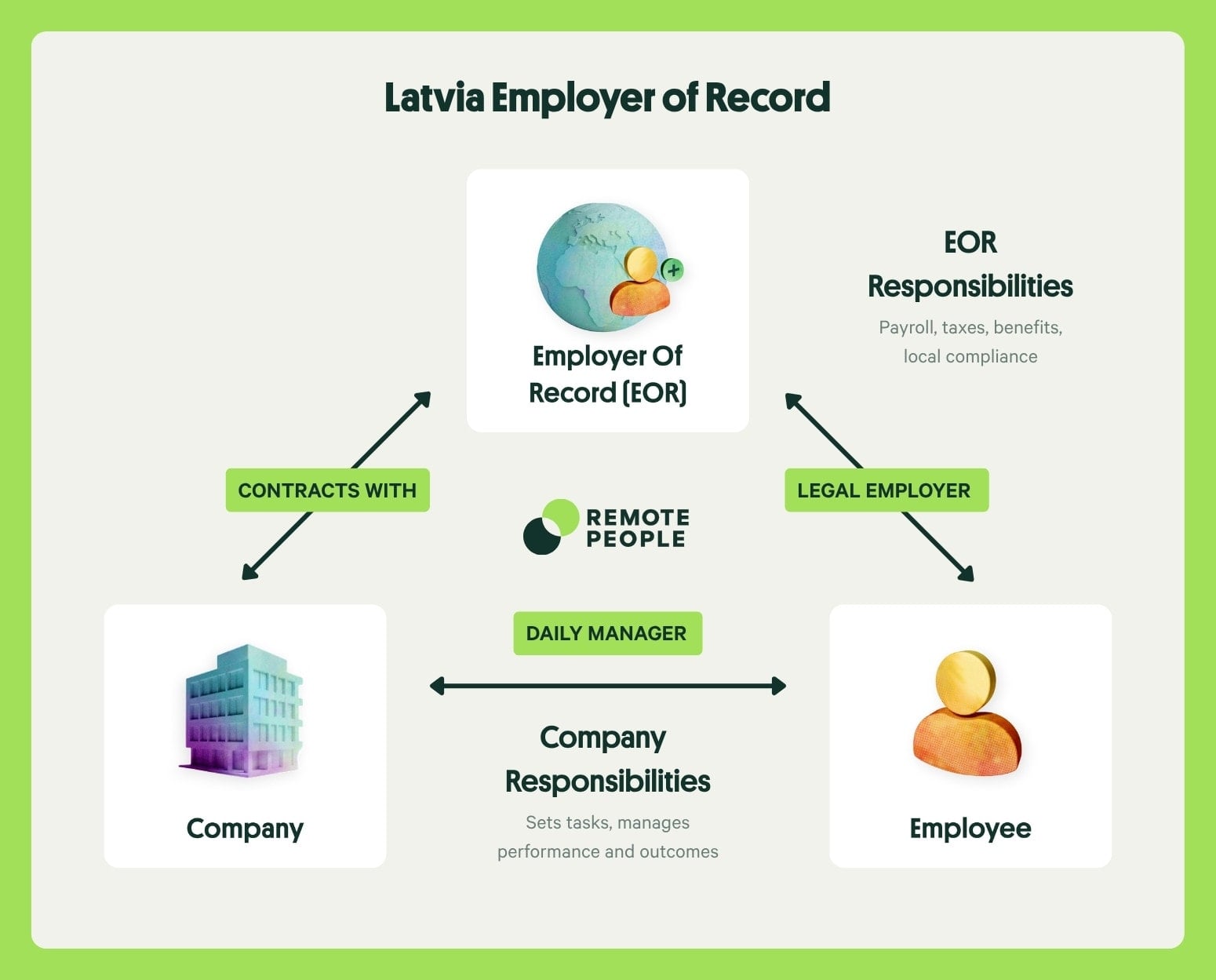
If you’d like to learn more about how Employer of Record (EOR) services work, read our What Is an Employer of Record (EOR)? guide for a complete overview of the model, its benefits, and when to use it.
If you’re comparing providers, our Best Employer of Record (EOR) Providers guide reviews the leading platforms to help you choose the right solution for your business.
Who Uses an EOR in Latvia?
Employers use EOR services in Latvia for several common scenarios:
- Early-stage companies entering the Latvian market without a local legal presence
- Large enterprises hiring remote Latvian workers while maintaining headquarters abroad
- Companies needing to hire quickly without the 8–12 week setup time for a subsidiary
- Organizations seeking to avoid the cost and complexity of operating a Latvian payroll function
Typical Onboarding Timeline
Once you engage an EOR provider, the hiring process typically unfolds as follows. Initial verification and document collection takes 2–3 business days, during which the EOR confirms employee identity and collects passport information for work permit applications if needed. Employment contract preparation and local labour law review takes 3–5 business days. Work permit filing (if applicable to non-EU/EEA citizens) takes 10–20 business days, depending on the specific visa type and State Office of Citizenship and Immigration Affairs (PMLP) processing times. Final onboarding and first payroll typically begins within 5–10 business days of contract signature. End-to-end, you can have a fully compliant Latvian employee on payroll within 3–4 weeks.
Hire in Latvia
Competitive employer costs at 23.59% social security, a highly educated workforce, EU membership with eurozone stability, and strong IT and engineering talent pools make Latvia an attractive market for international hiring.
We handle employment contracts, payroll, tax withholding, and full Latvia compliance.
No local entity needed. Your team can start in days.
Employment Laws and Regulations in Latvia
An employer of record in Latvia operates within strict legal frameworks governing employment relationships, wages, leave, and statutory benefits. Understanding Latvia’s labour law is critical for compliance whether you hire directly or through an EOR provider. Below are the key legal requirements affecting employment in Latvia.
Employment Contracts
Latvian labour law requires a written employment contract for every employee. When working with an employer of record in Latvia, the EOR prepares contracts that comply with all legal requirements. The contract must specify job title, place of work, salary, start date, and employment term (permanent, fixed-term, or probationary). The Darba likums (Labour Law) governs all employment relationships and sets minimum standards that override any less favourable contractual terms. Contracts must be in Latvian or translated into Latvian, though employers may provide a version in another language for reference. Any changes to employment terms require a written amendment signed by both parties.
Working Hours and Overtime
The standard working week in Latvia is 40 hours, typically spread across 8 hours per day. Employees are entitled to a minimum of 12 consecutive hours of rest between shifts and 42 hours of uninterrupted weekly rest (usually a weekend). Overtime is compensated at a 100% premium – meaning an hour of overtime is paid at 2x the regular hourly rate – under Article 68 of the Labour Law. Night work (10:00 PM to 6:00 AM) and work on public holidays also attract a 100% supplement. The law caps overtime at a maximum of 8 hours per 7 consecutive days, and 200 hours per calendar year.
Latvia overtime and premium pay rates · Per Darba likums (Labour Law) | |||
Hour Type | Rate Multiplier | Weekly/Daily Cap | Notes |
|---|---|---|---|
Overtime (beyond 40h/week) | 200% (2x base rate) | 8h per 7 days; 200h/year max | Article 68, Labour Law |
Night work (10 PM–6 AM) | 200% (2x base rate) | No statutory daily cap | Separate from standard overtime |
Public holiday work | 200% (2x base rate) | No daily cap | In addition to holiday recognition |
Weekend/weekly rest day | 200% (2x base rate) | Negotiated via contract | Employer/employee agreement required |
Source: Darba likums (Labour Law) and Ministry of Welfare | |||
Minimum Wage
As of 2026, the statutory minimum wage in Latvia is EUR 780 per month, set under Cabinet Regulation No. 680 (effective 21 November 2025). This rate applies to all employees aged 18 and over. Employers cannot pay less than this amount unless a collective agreement specifies otherwise. Some industries (agriculture, domestic work) may have lower sectoral rates, but the EUR 780 baseline is the national minimum for general employment.
Probation Period
Employers in Latvia may establish a probationary period of up to 3 months, as permitted under Article 46 of the Labour Law. During probation, either party may terminate the employment relationship with just 3 days’ written notice. Once probation ends, standard notice periods apply (typically 1 month for the employer, 1 month for the employee). Probation is optional but commonly used to assess employee fit before committing to permanent employment.
Leave Entitlements
Latvian labour law guarantees employees a comprehensive suite of paid and unpaid leave, from annual vacation to parental leave. Below is a detailed breakdown of statutory leave types and their eligibility rules.
Annual Leave
Every employee is entitled to a minimum of 20 working days of annual paid leave per year (Article 149, Labour Law). Employees under 18 years old receive one calendar month (approximately 22 working days) annually. Annual leave must be paid at the employee’s average salary. Employers must grant at least 2 consecutive weeks of leave in a single period each year. Unused leave may be carried over to the next calendar year, but no more than 2 weeks of carryover is permitted – excess days may be forfeited or paid out depending on the employment contract.
Sick Leave
Sick leave in Latvia is structured as follows: the first day of illness is unpaid. Days 2 and 3 are paid at 75% of average earnings by the employer. Days 4–10 are paid at 80% by the employer. From day 11 onwards, the State Social Insurance Agency (VSAA) covers 80% of salary for up to 26 calendar weeks. A medical certificate is typically required from day 4 onwards (or earlier if company policy dictates). This is governed by the Law on Maternity and Sickness Insurance (Article 36).
Maternity Leave
Maternity leave in Latvia spans 112 calendar days – 56 days before birth and 56 days after birth. If the pregnancy is complicated, it extends to 126 days. The state covers 80% of the employee’s average salary during maternity leave. These entitlements are governed by the Law on Maternity and Sickness Insurance.
Paternity Leave
Paternity leave provides 10 calendar days within 6 months of the child’s birth, paid at 80% by the state. These entitlements are governed by the Law on Maternity and Sickness Insurance.
Parental Leave
Parents may take parental leave until the child reaches 1.5 years of age. During this period, the employee receives 60% of their salary from their employer, or alternatively can opt for 43.75% paid by the state. Parents can split parental leave between them, and it does not count against seniority or service-related benefits.
Other Statutory Leave
Study leave grants employees up to 20 days per year for exam preparation and attendance, paid at average salary. Marriage and bereavement leave are not mandated by national law but may be covered by collective agreements or employer policy. Employees should check their employment contract or applicable collective agreement for these provisions.
Latvia statutory leave entitlements · Per Darba likums (Labour Law) | ||
Leave Type | Duration | Eligibility & Notes |
|---|---|---|
Annual Leave | 20 working days minimum | All employees. Under 18: 1 calendar month. Min 2 consecutive weeks mandatory. Max 2 weeks carry-over. |
Sick Leave (Days 2–3) | 75% of salary | Paid by employer. Day 1 unpaid. Medical cert. not required. |
Sick Leave (Days 4–10) | 80% of salary | Paid by employer. Medical certificate required from day 4. |
Sick Leave (Day 11+) | 80% of salary, up to 26 weeks | Paid by State Social Insurance Agency (VSAA). Requires ongoing medical documentation. |
Maternity Leave | 112 calendar days (56 pre, 56 post) | 80% paid by state. Extended to 126 days for complicated pregnancy. |
Paternity Leave | 10 calendar days | Within 6 months of birth. 80% paid by state. |
Parental Leave | Until child reaches 1.5 years | 60% by employer or 43.75% by state. Can be split between parents. |
Study Leave | Up to 20 days per year | For exam prep and attendance. Paid at average salary. |
Marriage Leave | Not mandated | Governed by collective agreement or employer policy. |
Bereavement Leave | Not mandated | Governed by collective agreement or employer policy. |
Source: Darba likums (Labour Law) and Ministry of Welfare | ||
Statutory Employee Benefits
Beyond wages and leave, Latvian employers are required to provide or arrange certain statutory benefits through an employer of record or direct payroll administration. Health insurance is the primary mandatory benefit – employers must either contribute to state social insurance (which covers healthcare) or provide equivalent private health insurance. This is built into the social security contribution system. Latvia’s pension system operates on three pillars: the first pillar is mandatory state pension contributions (10.50% of salary, capped at EUR 105,300/year), which funds the basic state pension. The second pillar involves voluntary occupational pension schemes with employer and employee contributions. The third pillar covers private voluntary pensions. When using an EOR provider in Latvia, the employer of record manages all first-pillar contributions automatically through payroll.
Occupational safety and accident insurance are covered through the VSAA (State Social Insurance Agency) contributions, with rates varying by industry sector (0.32–10.64% depending on occupational risk classification). An employer of record ensures correct sector classification and premium calculation. Some employers voluntarily offer additional benefits such as a 13th month bonus (year-end payment), pension contributions beyond the statutory minimum, or supplementary health coverage, though these are not legally mandated. Mandatory health insurance specifics in Latvia require that all employees have continuous coverage; any gaps can result in penalties for employers, making an EOR’s automated compliance handling a practical advantage.
Recent Regulatory Updates 2026
As of 2026, several regulations affecting employers in Latvia remain in force or have been updated. The personal income tax rates and brackets are unchanged from 2025, maintaining the 25.5% rate on earned income up to EUR 105,300. The EUR 780 minimum wage took effect in November 2025 and remains the standard for 2026 – a EUR 40 increase from the previous EUR 740 minimum. The non-taxable minimum income threshold increased from EUR 510 to EUR 550 in 2026, reducing tax burden slightly for lower-wage earners. The dividend tax rates changed from 20% to 25%, which may affect employer decisions on profit distribution for companies with multiple owner-beneficiaries.
An employer of record in Latvia automatically incorporates all these updates into payroll processing, ensuring wages meet the new EUR 780 minimum, correct tax calculations reflect the EUR 550 non-taxable threshold, and any dividend-related compliance is handled correctly. The EU Digital Services Act and other recent European regulations may indirectly affect employment practices (particularly around remote work data protection), but no major overhaul of core Latvian labour law has occurred in early 2026. Using an EOR simplifies staying compliant with these evolving regulations. Employers should monitor VID (the State Revenue Service) announcements for any mid-year updates to tax or social insurance rates. An EOR provider will track these changes and keep you informed of any further compliance adjustments throughout 2026.
Work Permits and Visas in Latvia
Work Permit Requirements
Non-EU/EEA citizens seeking employment in Latvia must obtain a work permit before beginning work. EU and EEA citizens have the right to work in Latvia without a permit, as do Swiss nationals. For all other nationalities, a valid work permit is a legal requirement. The permit is typically sponsored by the employer and filed through the State Office of Citizenship and Immigration Affairs (PMLP). Below are the main categories and requirements.
Highly Qualified Specialists (EU Blue Card)
Highly qualified workers – typically with a degree (Bachelor’s or higher) and at least 3 years of relevant work experience – can apply for an EU Blue Card. This permit allows employment in the applicant’s field and is valid for up to 2 years, renewable. The salary threshold is typically set above the national average. Processing time is 10–20 business days. More information is available from PMLP’s EU Blue Card page.
Other Foreign Workers
Non-EU/EEA citizens without a degree may still obtain a work permit through the employer’s sponsorship, though requirements are more stringent. The employer must demonstrate that the role cannot be filled by an EU/EEA citizen. Processing times range from 15–30 business days. These permits are typically tied to a specific employer and position.
Self-Employed Foreigners
Non-EU/EEA citizens starting a business or working as independent contractors must register with the State Revenue Service (VID) and hold a residence permit allowing self-employment. This process is separate from employment-based permits and may involve higher documentation requirements.
Renewal and Changes
Work permits must be renewed if employment terms change (new employer, new position, salary reduction above a threshold) or upon expiry. Renewal applications should be filed at least 30 days before the current permit expires to avoid gaps in work authorization. An EOR will manage all renewals and change notifications on your behalf.
Common Visa Types for Workers
While work permits are the primary employment authorization, several visa categories facilitate entry and residence in Latvia for foreign workers. The table below outlines the main visa types used by employers hiring internationally.
Latvia work visa types for foreign workers · 2026 | ||||
Visa Type | Duration | Best For | Leads to APT? | Processing |
|---|---|---|---|---|
EU Blue Card (Highly Qualified) | Up to 2 years, renewable | Degree-holders with 3+ years experience; specialists in high-demand fields | Yes, after 2+ years | 10–20 business days |
Work Permit (General) | 1 year, renewable | Non-EU/EEA workers in roles not filled by EU citizens | Yes, but longer track record required | 15–30 business days |
Residence Permit for Self-Employment | 2 years, renewable | Non-EU/EEA entrepreneurs and independent contractors | Yes, under self-employment category | 20–40 business days |
Intra-Company Transfer Permit | 1–3 years | Expatriate managers and specialists moving within a group | Possible, context-dependent | 10–20 business days |
D Visa (Long-Term Residence) | 3–12 months; leads to residence permit | Initial entry; precursor to work permit or APT | Only with separate work permit approval | Varies by Latvian embassy; 10–30 days |
Source: PMLP (Immigration Authority) and WIPO Lex Latvia | ||||
How an EOR Handles Work Permits
When you hire a foreign national through an EOR in Latvia, the EOR provider takes responsibility for the entire work permit and visa process. This includes preparing and submitting the application to PMLP, gathering required documentation from the employee, coordinating with the employee’s home country embassy (if a D visa is needed), and tracking application status. The EOR also handles permit renewals and updates when employment terms change. Processing costs (government fees) are typically passed through to you or bundled into the EOR service fee. By outsourcing these administrative tasks to an EOR, you avoid the delays and complexity of navigating Latvia’s immigration system yourself. For more information on hiring remote workers internationally, see our guide on hiring contractors.
Payroll, Taxes, and Social Security in Latvia
Payroll administration in Latvia is governed by the Labour Law and tax regulations enforced by the State Revenue Service (VID). Employers must calculate and remit both employer and employee contributions monthly, along with income tax withholding. An EOR handles all these obligations, ensuring compliance with Latvia’s multi-tiered tax system and contribution rates.
Employer Contributions
Latvia’s social security contributions from employers are among the highest in Europe. The employer bears the primary financial burden of funding Latvia’s public insurance system, including pensions, healthcare, and unemployment benefits. Effective 1 January 2026, the combined employer contribution rate is 23.59% of gross salary, calculated on earnings up to the annual ceiling of EUR 105,300.
Latvia employer contributions · 2026 | ||
Contribution | Rate | Notes |
|---|---|---|
State pension (employer share) | 10.50% | Mandatory first pillar; capped at EUR 105,300/year |
Disability, maternity, sickness | 8.00% | Covers temporary incapacity and family benefits |
Health insurance | 1.00% | Capped at EUR 105,300/year |
Unemployment insurance | 0.90% | Funded equally by employer and employee |
Work accident and occupational disease insurance | 0.67% | Variable range 0.32–10.64% by sector; office-based standard is 0.67% |
Guarantee fund | 0.10% | Protects employees if employer becomes insolvent |
Funded pension (2nd pillar) | 2.42% | Mandatory for employees born after 1971; redirected from VSAOI to private pension funds |
Total employer contribution | 23.59% | Combined rate for 2026 |
Source: State Social Insurance Agency and PwC Latvia | ||
Employee Contributions
Employees in Latvia contribute to the same social insurance schemes as employers, though at a lower combined rate. The total employee contribution rate is 10.50% of gross salary, deducted before income tax is calculated. These deductions are mandatory and fund the same pension, healthcare, unemployment, and work accident schemes.
Latvia employee contributions · 2026 | ||
Contribution | Rate | Notes |
|---|---|---|
State pension (employee share) | 4.50% | First pillar contribution; capped at EUR 105,300/year |
Disability, maternity, sickness | 3.00% | Temporary incapacity benefits |
Health insurance | 1.00% | State healthcare coverage |
Unemployment insurance | 0.90% | Shared equally with employer |
Work accident and occupational disease | 0.10% | Employee portion (employer pays majority) |
Funded pension (2nd pillar) | 1.00% | Mandatory for employees born after 1971; redirected from VSAOI to private pension funds |
Total employee contribution | 10.50% | Combined rate for 2026 |
Source: State Social Insurance Agency and PwC Other Taxes | ||
Income Tax
Latvia applies a progressive income tax system with three brackets as of 2026. Income tax is calculated on the earnings remaining after social insurance contributions are deducted. The non-taxable minimum of EUR 550 per month (or EUR 6,600 per year) reduces tax liability for lower-income employees.
Latvia income tax brackets · 2026 | |
Taxable Income | Rate |
|---|---|
Up to EUR 105,300 | 25.5% |
EUR 105,301 – EUR 200,000 | 33% |
Above EUR 200,000 | 36% |
Source: VID and PwC Latvia | |
Non-taxable minimum is EUR 550/month (EUR 6,600/year). Income above EUR 200,000 incurs an additional 3% solidarity tax.
Payroll Cycle and Processing
Latvia operates on a monthly payroll cycle. Employers must calculate all contributions and taxes, prepare pay slips, and remit payment to employees by the date specified in the employment contract (typically the last business day of the month). All transactions are processed in EUR via bank transfer. When using an employer of record in Latvia, the EOR automates these calculations, ensuring accurate deductions for the 23.59% employer contributions and correct employee tax withholding based on the EUR 550 non-taxable minimum.
Filing deadlines are critical in Latvia’s payroll compliance calendar. Employers must file contribution reports with the State Social Insurance Agency and income tax withholding declarations with the VID by the 10th of the following month. Detailed pay slips must be provided to employees and must show gross salary, each contribution deduction (pension, health, unemployment, work accident), income tax withheld, and net payment due. For an EOR provider managing payroll on behalf of employers in Latvia, these filings and pay slip generation happen automatically, reducing the risk of missed deadlines or calculation errors.
13th Month Salary and Bonus Pay
A 13th month salary or annual bonus is not legally mandated in Latvia but is a common voluntary practice, particularly in sectors competing for talent. When an employer provides a 13th month payment, it is treated as regular salary and subject to the same social insurance contributions and income tax. The decision to offer a 13th month bonus is typically negotiated individually or covered in a collective agreement, and must be clearly documented in the employment contract or policy.
Cost of Hiring Through an EOR in Latvia
Engaging an employer of record eliminates the need to establish a local legal entity, set up payroll infrastructure, and maintain ongoing compliance obligations. The total cost of hiring through an EOR in Latvia includes the employee’s salary, all statutory employer contributions (23.59%), and the EOR service fee. For international companies expanding into the Baltics, this EOR approach is often more cost-effective and faster than forming a SIA (limited liability company), which requires 8–12 weeks of setup, legal registration fees, and ongoing accounting costs.
EOR Service Fees
EOR service fees in Latvia typically range from USD 300 to USD 600 per employee per month, depending on the service level, volume of employees, and complexity of roles. Fees generally cover payroll processing, statutory compliance, benefits administration, HR support, and employee onboarding through the employer of record. Some EOR providers offer tiered pricing for higher volumes, while others charge flat fees per employee or per transaction. When comparing employer of record options, a comprehensive cost estimate should account for both the base salary and the full range of EOR fees when budgeting for remote hires in Latvia.
Total Employment Cost Breakdown
The table below illustrates the full cost structure for hiring one employee in Latvia through an EOR. The example assumes a gross monthly salary of USD 5,000, which converts to approximately EUR 4,630 at the April 2026 exchange rate. Employer social security contributions total 23.59% of the gross salary, plus the EOR service fee of approximately $499 per month.
Latvia EOR cost example · April 2026 | ||
Component | Amount (USD) | % of Gross |
|---|---|---|
Gross monthly salary | $5,000 | 100% |
Employer social insurance contributions (23.59%) | $1,179.50 | 23.59% |
EOR service fee | $499 | 9.98% |
Total monthly cost to employer | $6,678.50 | 133.57% |
Source: VSAA and PwC Latvia | ||
Employee receives net salary after deduction of 10.50% social contributions and income tax (approximate 18–22% at this salary level). EOR fee is illustrative; actual fees vary by provider. Exchange rate used: 1 EUR = 1.08 USD (April 2026).
For companies hiring multiple employees in Latvia, an EOR arrangement simplifies budget forecasting by consolidating all payroll costs into a single monthly invoice. This transparency helps finance teams plan headcount expansion without the overhead of maintaining a local entity. Learn more about EOR solutions and pricing to find the right fit for your team.
Benefits of Using an EOR in Latvia
An EOR partnership provides strategic advantages beyond simple payroll processing. Here are the primary benefits of using an EOR to hire in Latvia:
- No local entity required. An EOR assumes full legal employer status, eliminating the 2–4 month timeline and $3,000–$8,000 upfront cost of registering a branch or subsidiary with the Register of Enterprises.
- Instant onboarding. Employees can start work within days rather than weeks, accelerating your time-to-productivity in the market.
- Full compliance with labour law. The EOR ensures adherence to the Labour Law, working conditions standards, notice periods, severance requirements, and all tax filings.
- Accurate payroll and contributions. All calculations for social insurance, income tax, and statutory deductions are handled by compliance experts, reducing the risk of miscalculation and penalties.
- Flexible scaling. Add or remove employees without restructuring your entity or renegotiating vendor contracts; the EOR model scales with your hiring needs.
- Employee benefits administration. Many EORs offer access to local health insurance, pension plans, and other employee benefits without additional setup.
- Reduced HR overhead. The EOR assumes responsibility for leave management, payroll inquiries, statutory reporting, and HR documentation, freeing your team to focus on business strategy.
Termination and Offboarding in Latvia
Terminating an employment relationship in Latvia is subject to strict notice periods and severance requirements codified in the Labour Law. An EOR handles all termination procedures, ensuring compliance with statutory minimums and protecting both employer and employee from disputes.
Notice Periods
Latvian law prescribes notice periods depending on the employment stage and who initiates termination. The default notice period for standard employment is one calendar month. During the probationary period (typically 3 months), either party may terminate with just 3 days’ notice. Collective dismissals triggered by redundancy may require additional notification to labour authorities.
Latvia notice periods for termination · Labour Law | |||
Scenario | Notice Period | Initiated By | Notes |
|---|---|---|---|
Standard employment | 1 month | Employer or employee | Calendar month; notice must be provided in writing |
Probationary period | 3 days | Employer or employee | Reduced notice for early-stage employment assessment |
Collective redundancy | 1 month minimum | Employer | May be longer; requires notification to labour authorities |
Gross misconduct (immediate) | None | Employer | Termination effective immediately; must document cause |
Source: Labour Law of Latvia and Ministry of Welfare | |||
Severance Pay
When an employer terminates an employee without cause, severance must be paid based on length of service. Severance is calculated as a multiple of the average monthly salary earned during the notice period or final month of employment, whichever is applicable. The amounts are fixed by Article 112 of the Labour Law and are non-negotiable.
Latvia severance pay by tenure · Labour Law Article 112 | |||
Tenure | Severance | Example (EUR 2,000/mo) | Notes |
|---|---|---|---|
Less than 5 years | 1 month | EUR 2,000 | Minimum severance regardless of tenure |
5 to less than 10 years | 2 months | EUR 4,000 | Increases with longer service |
10 to less than 20 years | 3 months | EUR 6,000 | Reflects significant tenure |
20 or more years | 4 months average earnings | EUR 8,000 | Long-service employees receive maximum protection |
Source: Labour Law of Latvia, Article 112 and Ministry of Welfare | |||
Calculation Method
Severance is calculated as a multiple of the employee’s average monthly salary. This average is determined from the salary paid during the notice period (typically one month) or the final month of employment. All regular compensation components are included, but discretionary bonuses and benefits paid less frequently than monthly are not automatically included. An EOR calculates severance accurately based on the employee’s tenure and ensures timely payment during the notice period or immediately upon termination for cause.
Caps and Exceptions
Severance is not owed if the employee resigns voluntarily, terminates during the probationary period (except if the employer terminates), or is dismissed for gross misconduct or breach of contract that poses a safety or legal risk. In cases of employee-initiated termination, no severance is payable, though the employee must observe the one-month notice period. The employer may also waive severance by mutual written agreement, but this is uncommon and may invite legal challenge.
Grounds for Termination
Latvian law recognizes several valid grounds for termination. Redundancy due to business downsizing or closure is permitted with notice and severance. Disciplinary termination is allowed for gross misconduct, such as theft, violence, intoxication at work, or repeated breaches of safety rules. Performance-based termination is also permissible, but requires documented warnings and an opportunity for the employee to improve. The employer must provide written notice stating the reason and effective date. An EOR partner ensures all documentation is properly drafted and legally compliant to minimize the risk of wrongful termination disputes.
EOR vs. Other Hiring Models in Latvia
When planning to hire in Latvia, employers typically evaluate three main models: establishing a local entity (SIA), engaging an employer of record (EOR), or hiring contractors. Each approach has distinct cost, timeline, and compliance implications. An EOR in Latvia is particularly attractive for companies seeking rapid market entry and minimal setup burden. The right choice depends on the scale of your operation, budget constraints, and desired level of local control. Understanding the differences between EOR, local entity, and contractor models is essential for making an informed hiring decision.
EOR vs. Local Entity
Setting up a local limited liability company (SIA) in Latvia offers direct control and brand presence but requires significant time and capital investment. The Register of Enterprises processes entity formation, but the process typically takes 2–4 months and involves legal, accounting, and administrative fees ranging from $3,000 to $8,000 upfront, plus $5,000–$15,000 annually for compliance and accounting services. By contrast, an EOR requires no entity registration and can be operational within days.
Latvia EOR vs. local entity comparison · 2026 | ||
Comparison | Own Local Entity | Employer of Record |
|---|---|---|
Time to hire | 2–4 months | 1–5 days |
Setup costs | $3,000–$8,000 | None |
Annual overhead | $5,000–$15,000 | Per-employee fee ($300–$600/month) |
Payroll management | In-house or outsourced | Fully managed by EOR |
Tax compliance | Entity and individual returns | Handled by EOR |
Legal liability | Your company | EOR assumes employer status |
Scalability | Built once; scales easily | Pay-per-employee model |
Local control | Full | Shared with EOR partner |
Best for | Large, long-term operations (10+ employees) | Rapid market entry, test-and-learn, up to mid-scale |
Source: Register of Enterprises Latvia and Ministry of Welfare | ||
For companies testing a new market or scaling gradually, an EOR is the preferred option. You avoid the overhead of entity maintenance and can redeploy those resources to business development. If you plan to establish a significant on-the-ground presence (10+ employees) or enter into partnerships that require a local legal entity, forming an SIA becomes economically justified. An EOR can serve as a bridge; you hire your first few employees through an EOR, validate the market, and later transition to a local entity if volumes justify it.
EOR vs. Contractors
Hiring independent contractors offers maximum flexibility and lower upfront administrative costs, but carries substantial legal and financial risks in Latvia. Misclassification of employees as contractors can result in back taxes, penalties, and reputational damage. Latvia’s labour courts are increasingly skeptical of contractor arrangements for full-time, on-site, or management-level positions, as these typically signal an employment relationship under the Labour Law.
Latvia EOR employees vs. contractors · Labour Law | ||
Comparison | Employee (via EOR) | Independent Contractor |
|---|---|---|
Cost structure | Salary + EOR fee + benefits | Project fee; no benefits or payroll |
Taxes | Employer and employee SSC; PIT | Individual contractor; self-remit |
Work arrangement | Full-time; ongoing; under direction | Project-based; flexible; independent control |
Benefits | Statutory entitlements (sick leave, holidays) | None |
Notice period | 1 month | Per contract terms |
Severance | 1–4 months (by tenure) | None |
Misclassification risk | None; legal protections | High if work pattern mimics employment |
Best for | Ongoing roles; team members | Specific projects; specialized skills; short-term needs |
Source: Labour Law and WIPO Lex Latvia | ||
Latvia’s Labour Law contains bright-line rules about what constitutes employment. Contractors should be truly independent: setting their own hours, working for multiple clients, owning their tools, and assuming business risk.
If a contractor works under your direction, maintains a regular schedule, uses company tools or infrastructure, or performs the role of a permanent team member, Latvian tax authorities and labour courts will likely classify them as an employee, regardless of contract language. An EOR-employed structure eliminates this risk entirely by establishing a clear, legally compliant employment relationship from day one. For genuinely independent projects – such as freelance design, marketing consultation, or short-term specialist assignments – a contractor model can be appropriate. Learn more about contractor hiring and the associated trade-offs.
EOR vs. PEO
A Professional Employer Organization (PEO) is a third-party provider that assumes payroll and HR responsibilities while the client company retains day-to-day control over workers. PEOs operate legally in Latvia under cooperative or service agreements and can be suitable for companies seeking more direct management control than an EOR offers. However, PEO arrangements typically require a longer commitment and may involve higher setup or minimum employee thresholds.
Latvia EOR vs. PEO comparison · 2026 | ||
Feature | EOR | PEO |
|---|---|---|
Employer status | EOR is legal employer | Co-employment; shared liability |
Setup timeline | 1–5 days | 1–3 weeks |
Minimum employee requirement | None | Often 5–10 employees |
Commitment period | Month-to-month flexibility | Often 12–24 month contracts |
Day-to-day control | Limited; EOR directs employment | Greater client control over workers |
Pricing | $300–$600/employee/month | Typically 1–3% of payroll + setup |
Best for | Global expansion; test-and-learn; solo hires | Larger teams; established operations; direct management preference |
Source: Ministry of Welfare Latvia and WIPO Lex Latvia | ||
Both EOR and PEO are legal in Latvia. PEO is often chosen by companies that already have an on-the-ground presence and want to add payroll capacity without establishing a new entity.
For most international companies entering Latvia with one to five employees, an EOR is the optimal choice because it offers simplicity, cost efficiency, and rapid market entry. A PEO becomes relevant when you have larger headcount and want to transition toward a more direct operational presence while still outsourcing payroll administration. The decision often depends on your long-term strategy: if you plan to build a substantial local operation, a PEO or local entity may be preferable; if you are testing the market or maintaining a small satellite team, an EOR is the right fit.
Public Holidays in Latvia
Latvia recognizes 13 public holidays per calendar year, during which employees are entitled to paid time off. Employees who work on a public holiday are typically compensated with additional pay or lieu days. Public holidays affect payroll processing, as the days off do not reduce the total wages due unless the holiday falls on a weekend or an employee takes unpaid leave. For EOR clients, holiday management is handled automatically, with the EOR ensuring correct pay and time tracking for each statutory holiday.
Latvia public holidays · 2026 | ||
Date | Holiday | Type |
|---|---|---|
1 January | New Year’s Day | National |
3 April 2026 | Good Friday | Religious |
5 April 2026 | Easter Sunday | Religious |
6 April 2026 | Easter Monday | Religious |
1 May | Labour Day | National |
4 May | Independence Restoration Day | National |
23 June | Midsummer Eve (Jāņu ģimenes svētki) | National/Cultural |
24 June | Midsummer Day (Jāņi) | National/Cultural |
18 November | Independence Day | National |
24 December | Christmas Eve | Religious |
25 December | Christmas Day | Religious |
26 December | Second Day of Christmas | Religious |
31 December | New Year’s Eve | National |
How to Get Started with an EOR in Latvia
Hiring your first employee in Latvia through an employer of record is straightforward and can be completed in a matter of days. Here are the key steps to onboard staff through an EOR provider:
- First: Define your hiring needs. Determine the role, salary range, start date, and employment duration. Review the average salary data for Latvia to ensure your offer is competitive and compliant with the local minimum wage of EUR 780/month. Consider whether the candidate is an EU/EEA citizen (no work permit required) or a third-country national (work visa may be needed). An EOR in Latvia can advise on hiring timelines for each scenario.
- Second: Select an EOR provider. Compare features such as payroll speed, local HR support, employee benefits access, compliance reporting, and pricing to find an employer of record partner that aligns with your team’s size and needs. Ensure the EOR has local registration with Latvian authorities and experience with the country’s unique three-pillar pension system and 23.59% employer contribution rates.
- Third: Provide employee information. Supply the EOR with the employee’s name, personal identification number (if available), residential address, bank account details for salary payments, tax residency status, and passport information for verification and onboarding. The EOR will verify these details with Latvian authorities and prepare all necessary documentation.
- Fourth: Execute the employment contract. The EOR drafts an employment contract fully compliant with Latvia’s Darba likums (Labour Law), including specific terms on salary, probation period, notice period, annual leave (20 working days minimum), and statutory benefits. Both you and the employee must sign the contract before work commences. An EOR ensures all contractual terms meet Latvian legal requirements.
- Fifth: Process payroll and submit returns. Once the employee starts work, the EOR manages monthly payroll processing, withholds personal income taxes and social contributions (automatically calculating the 10.50% employee and 23.59% employer rates), remits all payments to state authorities by the 10th of the following month, and provides detailed pay slips and compliance documentation for your records. Using an EOR Latvia eliminates the need to set up local payroll infrastructure.
Ready to expand your team in Latvia? Contact us to discuss your hiring goals and get a customized quote.
Frequently Asked Questions
The total monthly cost depends on the salary and the employer of record's service fee. For a USD 5,000 gross monthly salary, the employer's cost is approximately USD 6,678.50, which includes the salary, 23.59% employer social insurance contributions (VSAA), and a typical EOR fee of USD 499. When comparing EOR providers in Latvia, service fees generally range from USD 300 to USD 600 per employee per month depending on the provider and service tier. Using an employer of record is typically more cost-effective than establishing a local SIA subsidiary.
An employer of record in Latvia can typically onboard an employee within 1–5 business days, provided all documentation (passport, tax residency, bank details) is supplied promptly. This rapid onboarding is one of the key advantages of using an EOR versus forming a local entity, which takes 2–4 months and involves significant setup costs. For companies seeking fast market entry in Latvia, an EOR is substantially faster and more efficient.
Yes. An employer of record in Latvia calculates and remits all mandatory payroll taxes and social security contributions, including the 23.59% employer rate, 10.50% employee rate (VSAA), and income tax withholding. Your EOR provider files all required reports with the State Revenue Service (VID) and the State Social Insurance Agency (VSAA) on your behalf, ensuring full compliance with Latvia's regulatory requirements.
Many employer of record providers in Latvia offer access to local health insurance, voluntary pension schemes, and other employee benefits as add-on services beyond the mandatory statutory benefits. These are optional and can improve retention and employee satisfaction. An EOR's benefits administration service simplifies compliance with Latvia's three-pillar pension system and health insurance requirements.
You can transition to a local SIA entity at any time. Your employer of record will support the handover by providing all employment and payroll records, and the transition can be structured to avoid gaps in employment or legal liability. Many companies use an EOR in Latvia as a stepping stone while establishing a local entity, which allows them to validate the market with minimal risk before making a long-term commitment.
Latvia generally permits employment of foreign nationals from EU/EEA countries without a work permit. Non-EU nationals may require a residence permit and work visa, which typically takes 2–4 weeks to obtain through the State Office of Citizenship and Immigration Affairs (PMLP). An employer of record managing hiring in Latvia can advise on work visa requirements and handle the permit application process on your behalf.
The standard notice period is one calendar month under Latvia's Labour Law (Labour Law). Severance is mandatory when terminating without cause and is based on tenure: one month's salary for employees with less than 5 years of service, scaling up to four months for those with 20 or more years. Your employer of record ensures all calculations and documentation comply with Latvia's Labour Law and manages the entire offboarding process.
Employer of Record in
Employer of Record in
Employer of Record in
Employer of Record in
Employer of Record in
Employer of Record in
Employer of Record in
Employer of Record in