
 Recruit
Average Salary in Nepal
-
 Drew Donnelly
- Published
- September 21, 2026
- 5 ★ on G2








Let RemotePeople handle payroll, compliance, and HR admin worldwide so you can focus on building your team.
Nepal offers businesses access to a skilled workforce at relatively competitive labor costs, while its time zone can also work well for international teams. If you’re planning to hire through an Employer of Record (EOR) in Nepal, knowing the local salary landscape can help you set realistic compensation expectations.
This guide looks at what employees in Nepal typically earn, how salaries differ across roles, and the factors that can affect pay.
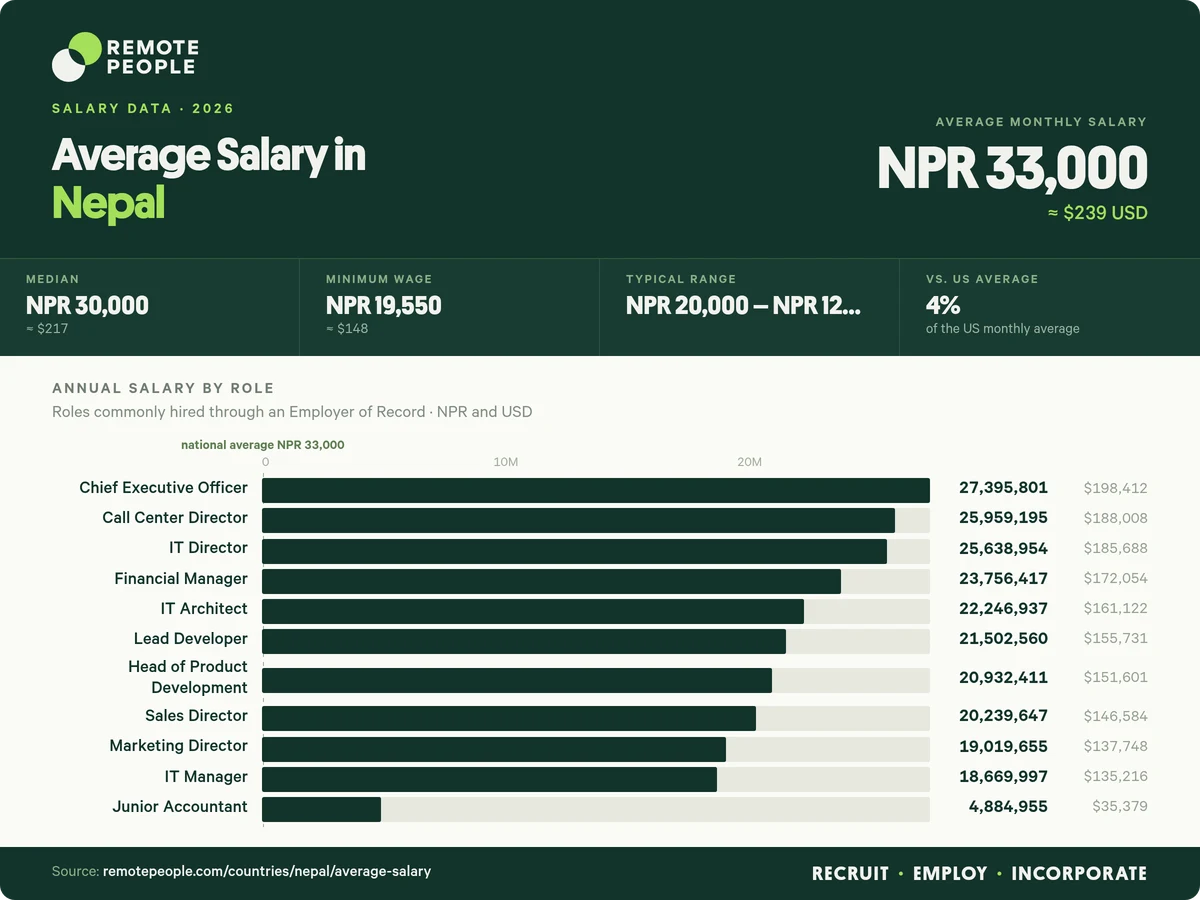
The average salary in Nepal is 33,000 Nepalese rupees (NPR), about USD 239. However, wages vary by experience, education, location, position, and industry. Comparing salaries in the country to wages worldwide provides additional insight.
This article will explore all aspects of salaries in Nepal, preparing you for your hiring journey.
What is the Average Salary in Nepal?
The average salary in Nepal is approximately 33,000 NPR, equivalent to around $239. Wages in the country are low due to a large informal sector with few regulations. There is also low productivity, which can discourage investments.
Median Income
The median salary in Nepal is approximately 30,000 NPR, equivalent to around $217. Half the people in the country earn higher wages, and the other half earn less.
Salary Range
The salary range spans from the lowest to the highest wages in the country. In Nepal, low earners earn around 20,000 NPR, approximately $145 per month, while high earners earn closer to 125,538 NPR, roughly $911 per month.
Salary Comparisons in Nepal
The average salary provides some insight, but you must also consider how wages vary by experience, education, location, position, and industry. These sections will explore how these factors impact earnings.
Salary by Position
This salary comparison chart reveals how wages vary by position.
Position | Average Yearly Salary (NPR) |
|---|---|
Chief Executive Officer | 27,395,801 |
Call Center Director | 25,959,195 |
IT Director | 25,638,954 |
Financial Manager | 23,756,417 |
IT Architect | 22,246,937 |
Lead Developer | 21,502,560 |
Head of Product Development | 20,932,411 |
Sales Director | 20,239,647 |
Marketing Director | 19,019,655 |
IT Manager | 18,669,997 |
General Laborer | 5,254,042 |
Banking Cashier | 5,190,314 |
Packer | 5,177,291 |
Seamstress | 4,943,040 |
Junior Accountant | 4,884,955 |
Retail Cashier | 4,868,348 |
Porter | 4,775,579 |
Medical Records Clerk | 4,761,632 |
Tailor | 4,730,049 |
Average Wage in Nepal Based on Education
Statistics show that education can positively impact salaries in Nepal, producing an additional 16% in wages for every additional level of education. However, the country also suffers from a skills mismatch, and not every worker can secure the jobs for which they were trained.
Additionally, despite efforts to increase access to education, many individuals remain uneducated.
Salary Comparison by Experience
Experience also impacts salaries, yielding an approximate 11.57% increase in monthly earnings for each level of experience. For example, a mid-level executive may earn 11.57% more than an entry-level worker, and so on.
Additionally, workers qualify for a festival bonus each year before major festivals, which may increase with experience. Employees also earn a gratuity fund upon termination, which may be greater based on the number of years of employment.
However, skilled laborers working in the formal sector may see more significant returns than unskilled workers in the informal sector due to a lack of negotiating power.
Salary Comparison by Location
Location significantly impacts salaries in Nepal, as urban areas, such as Kathmandu, offer higher wages than rural regions due to higher living costs and proximity to large companies that provide higher-paying opportunities. However, even in urban areas, regional disparities persist.
How Much is Minimum Wage in Nepal?
The current minimum wage in Nepal is NPR 19,550 about $148 per month, effective since July 17, 2025. It differs only for tea estate workers who have a minimum salary of 15,699 per month.
Average Salary in Nepal vs. the Rest of the World
The following charts compare salaries in Nepal to those in developed, developing, and least developed countries, providing more in-depth insight.
Nepal vs. Developed Countries
Country | Average Salary | Comparison to Average Nepal Salary |
|---|---|---|
Japan | 379,434 Yen (approx. $2,635) | – 983% |
United Kingdom | 3,000 Euros (approx. $3,116) | – 1,191% |
Norway | 50,790 Kroner (approx. $4,700) | – 1,858% |
Germany | 4,300 Euros (approx. $4,467) | – 1,775% |
Austria | 3,500 Euros (approx. $3,636) | – 1,400% |
Nepal vs. Developing Countries
Country | Average Salary | Comparison to Average Nepal Salary |
|---|---|---|
Romania | 4,000 RON (approx. $835) | – 250% |
Russia | 73,709 Rubles (approx. $700) | – 191% |
Albania | 1,500 Euros (approx. $1,550) | – 541% |
Kazakhstan | 342,082 Tenge (approx. $645) | – 170% |
Ukraine | 18,000 Hryvnia (approx. $500) | – 108% |
Nepal vs. Undeveloped Countries
Country | Average Salary | Comparison to Average Nepal Salary |
|---|---|---|
Afghanistan | 30,000 Afghanis (approx. $419) | – 75% |
Philippines | 18,423 PHP (approx. $875) | – 266% |
Cambodia | 1,000,027 KHR (approx. $250) | – 4% |
Egypt | 13,244 EGP (approx. $263) | – 8% |
Pakistan | 45,000 PKR (approx. $150) | 60% |
Nepal is a least developed country, although it is on track to graduate from that category and is expected to complete the transition by November 2026. It has a low-income economy with heavy reliance on the agricultural and service sectors. The country faces challenges like a trade deficit, a weak regulatory environment, and political instability.
Despite internal challenges, Nepal is emerging as a strong contender in the global outsourcing market. It offers cost-effective labor and a skilled, English-proficient workforce. The government provides various policies and incentives to support growth and investment.
What are the Most Common Outsourced Industries in Nepal?
Employers seeking remote partnerships in Nepal will benefit most when focusing on the following industries.
Software Development
Nepal’s IT industry is experiencing significant growth with a strong focus on software development related to cloud solutions, FinTech, and AI. The government actively supports the sector through policies, tax incentives, and investments in IT parks. Major global companies are establishing operations in the country, drawn by the country’s emerging tech industry.
BPO
The BPO industry is also growing rapidly, with a focus on customer support, data entry, and IT services. Nepal is increasingly recognized as a competitive player in the market, alongside other South Asian countries. Its government supports the industry through policies aimed at attracting foreign investors and stimulating growth.
Customer Support
The service sector has long played a prominent role in the Nepalese economy, making an easy transition to customer support. The industry is characterized by a high level of service, supported by technology advancements including chatbots, apps, websites, and social media. Businesses are also utilizing data to create highly personalized experiences.
Conclusion
Nepal’s low average salaries and skilled workforce make it an ideal destination for outsourcing. Employers can reduce expenses while benefiting from exceptional products and services, thereby helping the country achieve its developmental goals and resulting in positive outcomes for all parties involved.