
 Recruit
Average Salary in the Philippines
-
 Drew Donnelly
- Published
- September 21, 2026
Curious about salaries in the Philippines? This guide breaks down the average wages, compares professions, highlights minimum wage figures, and explores how Philippines’ earnings measure up internationally.
- 5 ★ on G2








Let RemotePeople handle payroll, compliance, and HR admin worldwide so you can focus on building your team.
The Philippines is often called the “BPO Capital of the World” due to its cost-effective labor and skilled workforce. Employers considering hiring in the area may wonder, “What is the average salary in the Philippines?” This information will help them create a competitive job offer.
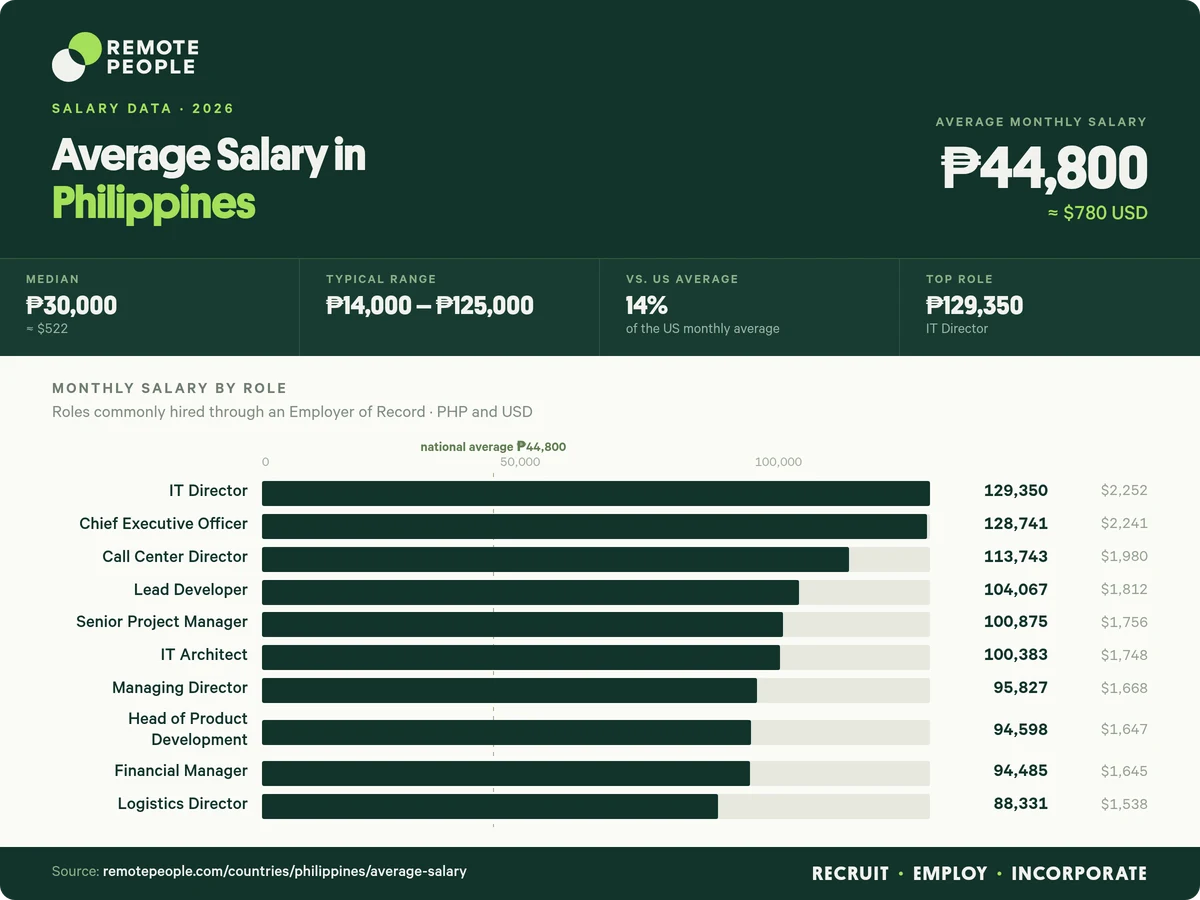
The average monthly salary in the Philippines is PHP 44,800, about USD 780. However, you must also consider how wages are affected by education, experience, location, position, and industry. Comparing wages in the country to earnings worldwide will provide additional insight.
This guide will explore all aspects of Philippine salaries to prepare you for your hiring journey.
What is the Average Salary in the Philippines?
The average salary in the Philippines is PHP 44,800, about $780. Wages in the country are low due to a large young population of job seekers, which increases competition. A low cost of living and a limited industrial base are also contributing factors.
Median Income
The Philippines’ median monthly income is PHP 30,000, about $522. Half the population earns higher salaries; the other half earns lower wages. When comparing average vs. median salary, the median salary is much lower, likely due to wage inequalities in the country.
Salary Range
The salary range spans from the lowest to the highest in the country. In the Philippines, low earners make around PHP 14,000 (about $244), while high earners make closer to PHP 125,000 monthly (about $2178).
Salary Comparisons in the Philippines
Average salary provides insight into Philippine wages, but you must also consider how earnings are impacted by education, experience, location, position, and industry. The following sections will explore those factors and their impact on salaries.
Salary by Profession
Position | Average Monthly Wages (PHP) |
|---|---|
IT Director | 129,350 |
Chief Executive Officer | 128,741 |
Call Center Director | 113,743 |
Lead Developer | 104,067 |
Senior Project Manager | 100,875 |
IT Architect | 100,383 |
Managing Director | 95,827 |
Head of Product Development | 94,598 |
Financial Manager | 94,485 |
Logistics Director | 88,331 |
Fabric Cutter | 23,992 |
Clothing Technologist | 23,888 |
Banking Cashier | 23,766 |
General Laborer | 23,744 |
Packer | 23,397 |
Seamstress | 22,338 |
Porter | 21,582 |
Medical Records Clerk | 21,518 |
Tailor | 21,352 |
Average Wage in the Philippines by Education
Education plays a huge role in wage determination in the Philippines, accounting for much of the country’s wage inequality. Workers with minimal education are often employed in the low-paying agricultural sector. Tertiary education is a critical prerequisite for most high-paying jobs.
Studies show education accounts for a 30% difference in wages, with a high percentage among female workers (37%) and a somewhat lower percentage among male workers (24%).
Salary Comparison by Experience
Experience is also considered when determining salaries in the Philippines. The following statistics reveal the range of salaries based on experience.
Position Level | Salary Range (Monthly) |
|---|---|
Entry Level (0–2 years) | PHP 15,000 – 30,000 |
Mid-Level (3–5 years) | PHP 30,000 – 60,000 |
Senior Roles | PHP 60,000 – 150,000 |
Executive and C-Level | PHP 150,000+ |
Salary by Location
Location is another factor impacting salaries. Workers in urban areas tend to earn more than workers in rural areas due to a higher cost of living and proximity to large companies offering high-paying salaries. This situation especially rings true in the Philippines, where various regions have different minimum wages.
What is the Minimum Wage in the Philippines?
Here is a breakdown of the minimum wages in the Philippines by region.
Region | Daily Minimum Wage (PHP) |
|---|---|
National Capital Region | 645 |
Cordillera Administrative Region | 470 |
Region I (Ilocos Region) | 435 – 468 |
Region II (Cagayan Region) | 460 – 480 |
Region III (Central Luzon) | 410 – 435 |
Region IV-A (CALABARZON) | 420 – 560 |
Region IV-B (MIMAROPA) | 404 – 430 |
Region V (Bicol) | 395 |
Region VI (Western Visayas) | 480 – 513 |
Region VII (Central Visayas) | 453 – 501 |
Region VIII (Eastern Visayas) | 390 – 420 |
Region IX (Zamboanga Peninsula) | 401 – 414 |
The discrepancies in wages apply to skilled and unskilled labor. Each local government sets its salaries and determines when increases are necessary.
Average Salary in the Philippines vs. the Rest of the World
The following charts compare wages in the Philippines to salaries in developed, developing, and undeveloped countries to provide more insight.
Philippines vs. Developed Countries
Country | Average Salary | Comparison to Average Philippines Salary |
|---|---|---|
United Kingdom | 3000 euros (approx. $3116) | – 297% |
United States | $5677 | – 630% |
Norway | 50,790 kroner (approx. $4700) | – 502% |
Germany | 4300 euros (approx. $4467) | – 476% |
Austria | 3500 euros (approx. $3636) | – 361% |
Philippines vs. Developing Countries
Country | Average Salary | Comparison to Average Philippines Salary |
|---|---|---|
Romania | 4000 RON (approx. $835) | – 7% |
Russia | 73,709 Rubles (approx. $700) | 11% |
Albania | 1500 Euros (approx. $1550) | – 98% |
Kazakhstan | 342,082 Tenge (approx. $645) | 20% |
Ukraine | 18,000 Hryvnia (approx. $500) | 56% |
Philippines vs. Undeveloped Countries
Country | Average Salary | Comparison to Average Philippines Salary |
|---|---|---|
Thailand | 97,500 Baht (approx. $2772) | – 259% |
Philippines | 18,423 PHP (approx. $875) | 0% |
Vietnam | 8.5 million dong (approx. $360) | 116% |
Egypt | 13,244 EGP (approx. $263) | 200% |
Pakistan | 45,000 PKR (approx. $150) | 420% |
The Philippines is a developing country with a lower-middle-income economy. It offers a rapidly emerging market with a dominant service sector. The government has also seen notable growth in business process outsourcing, real estate, and the finance and insurance industries.
The country is often called the BPO Capital of the World due to its cost-effective labor, strong English proficiency, and cultural affinity with Western countries. The government supports outsourcing through policies and initiatives, supporting a business-friendly environment. Its time zone allows for 24/7 operations for many organizations.
Top 3 Industries Outsourced to the Philippines
Companies that wish to outsource to the Philippines will see the most significant benefits when focusing on the following BPO industries:
IT Services
The Philippines’ thriving IT industry focuses on software development, data science, and cybersecurity. The government actively supports the industry through initiatives that improve infrastructure, support skills development, and attract investments.
IT workers in the country earn salaries that range from PHP 25,000 (about $435) to PHP 150,000 (about $2614). Meanwhile, workers in the United States make starting salaries close to $5000, leading to significant savings for outsourcing companies.
Customer Support
Filipinos are hospitable, which translates well in the customer service sector. Their large talent pool of skilled workers has a high level of English proficiency. They are known for their strong work ethic and dedication.
Customer service reps in the Philippines typically earn between PHP 15,000 (about $261) and PHP 26,000 (about $453) monthly. Workers in America earn closer to $3,000 monthly, meaning outsourcing can lead to significant cost savings.
Finance
The Philippines’ banking sector is a key driver of its economy, and the country provides financial services to millions of individuals and businesses. The industry is transforming digitally based on the growing demand for online transactions and mobile banking. Fintech is playing an increasingly important role in the country’s financial landscape.
Financial advisors in the country typically earn between PHP 22,000 (about $383) and PHP 60,000 (around $1045) monthly, while their American counterparts earn between $5833 and $125,000.
Conclusion
The low average salary in the Philippines, combined with the skilled workforce and time zone benefits, makes it a prime outsourcing destination. Employers partnering with the country for remote opportunities can see significant cost savings while taking advantage of quality products and services and helping the country overcome poverty.