
 Recruit
Employer of Record in Sierra Leone
-
 Drew Donnelly
- Published
- September 22, 2026
RemotePeople’s employer of record in Sierra Leone lets you hire employees in Sierra Leone with NASSIT compliance. We handle NASSIT social security contributions at 10 percent employer share, mandatory paid annual leave, and maternity leave administration.
Hire in Sierra Leone — book a free 30-minute demo
Tell us what you need. You'll get a tailored, transparent proposal within 24 hours, plus a free call to walk through it.
Tell us about your company
So we can match you with a specialist who knows your market — and unlock volume pricing tiers.
* All fields are required.
Where and when are you hiring?
Tell us the geography and timing and we'll quote each country line by line, with onboarding timelines.
* All fields are required.
Help us beat your current setup
We'll benchmark your current deal and send a line-by-line proposal in 24 hours — showing exactly where we cut cost, time, or risk. After you submit, you can book a call to walk through it together.
* All fields are required.
Thanks! Your proposal is on its way.
Expect a tailored, line-by-line proposal in your inbox within 24 hours. In the meantime…
Want to walk through it together?
Book a free 30-minute call with one of our specialists. We'll explain every line, answer your questions, and tailor the proposal further if you need.
No obligation. Pick a time that works for you.








- Hire in Sierra Leone — book a free 30-minute demo
- Tell us about your company
- Where and when are you hiring?
- Help us beat your current setup
- Thanks! Your proposal is on its way.
- How an Employer of Record Works in Sierra Leone
- Hire in Sierra Leone
- Employment Laws and Regulations in Sierra Leone
- Work Permits and Visas in Sierra Leone
- Employer Costs and Payroll Taxes in Sierra Leone
- Cost of Hiring Through an EOR in Sierra Leone
- Benefits of Using an EOR in Sierra Leone
- Termination and Offboarding in Sierra Leone
- EOR vs. Other Hiring Models in Sierra Leone
- Public Holidays in Sierra Leone
- How to Get Started with an EOR in Sierra Leone
- Frequently Asked Questions
- Related EOR Destinations

Start hiring in Sierra Leone
Let RemotePeople handle payroll, compliance, and HR admin worldwide so you can focus on building your team.

Sierra Leone is a West African economy of roughly 8.9 million people with a young, English-speaking workforce and growing demand for skilled labour in mining, agriculture, finance, telecommunications, and the ocean economy. For companies that want to hire in Freetown, Bo, or Kenema without opening a subsidiary, an employer of record offers a legal and compliant way to onboard full-time staff in one to two weeks.
An EOR becomes the official employer in Sierra Leone, issuing contracts under the Employment Act 2023 (Act 15 of 2023), running payroll in New Leone (SLE), withholding Personal Income Tax through the National Revenue Authority, and remitting social security contributions to the National Social Security and Insurance Trust (NASSIT). The EOR removes the need for local company registration, resident directors, and ongoing corporate filings, so your team can start work while the entity work runs in the background. This guide covers Sierra Leone’s employment laws, tax obligations, work permits, severance rules, and how to get started with EOR services.
How an Employer of Record Works in Sierra Leone
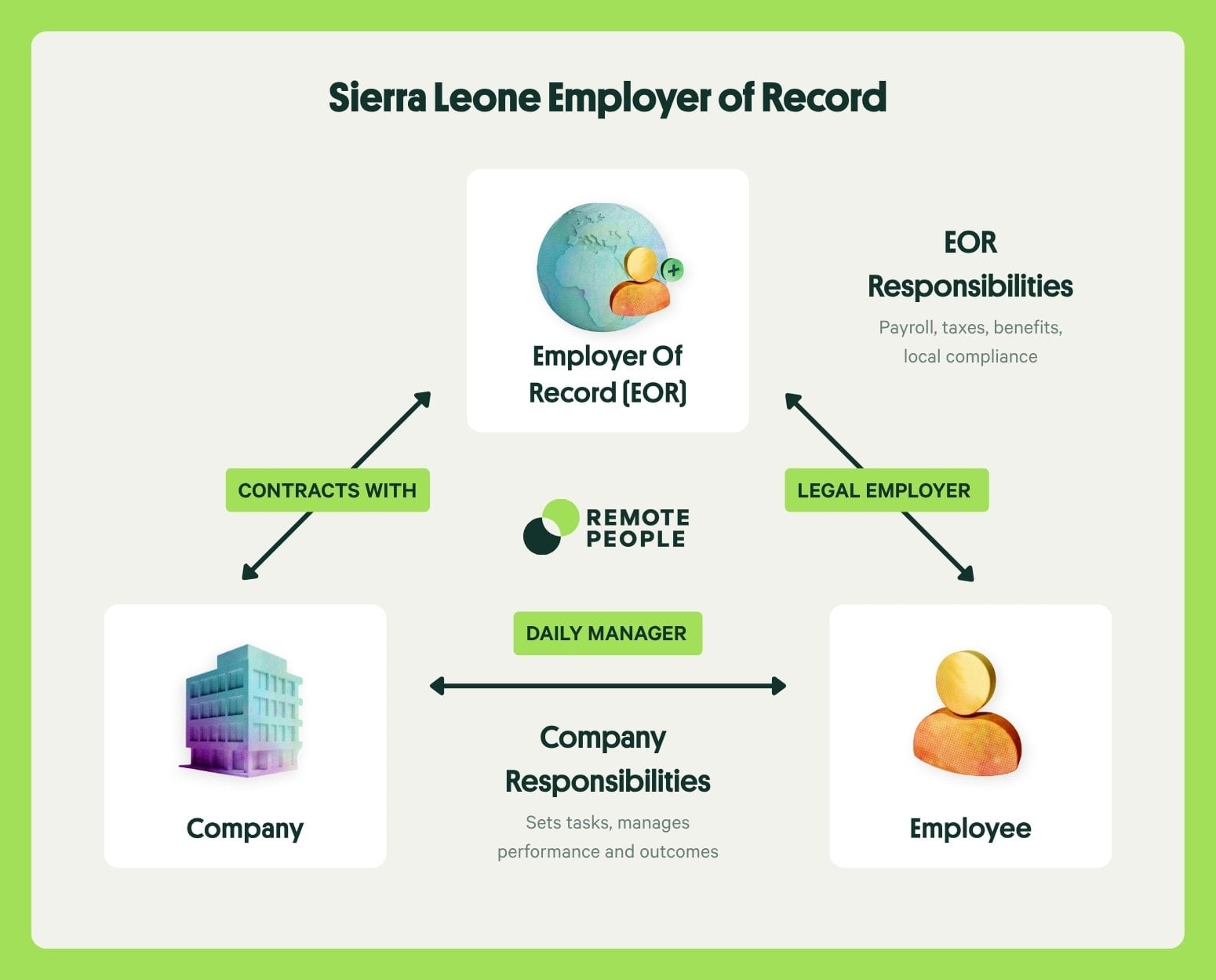
If you’d like to learn more about how Employer of Record (EOR) services work, read our What Is an Employer of Record (EOR)? guide for a complete overview of the model, its benefits, and when to use it.
If you’re comparing providers, our Best Employer of Record (EOR) Providers guide reviews the leading platforms to help you choose the right solution for your business.
Who Uses an EOR in Sierra Leone?
EOR arrangements suit several common business scenarios. Companies testing Sierra Leone’s mining, fintech, or agribusiness sectors often hire a small team through an EOR to validate demand and build local relationships before committing to company registration and office infrastructure. Organisations running small international teams of one to fifteen remote or office-based staff benefit from outsourcing employment administration, payroll, and statutory compliance so internal teams can focus on core operations.
Speed is another common driver. An EOR can onboard a Sierra Leonean national in roughly one to two weeks, compared with the two to four months typically required to register a limited company, obtain a Business Registration Certificate, open tax and NASSIT accounts, and begin hiring. EOR engagements also work well for foreign nationals requiring work permits, because non-Sierra Leonean hires need employer sponsorship through the Unified Permit portal; the EOR handles all submissions, Immigration interviews, and renewals, which typically adds four to ten weeks to onboarding.
EOR arrangements work best when you want cost efficiency, legal compliance, and speed to hire while retaining direct management of daily operations and strategy.
Typical Onboarding Timeline
Hiring a new employee through an EOR in Sierra Leone typically follows this sequence:
- First, EOR agreement and employee details (days 1–2): You provide employee information (name, address, qualifications, role, salary) and sign the service agreement with the EOR. The EOR verifies information and begins contract preparation.
- Second, employment contract drafting and review (days 3–5): The EOR prepares an employment contract compliant with the Employment Act 2023 and sends it to the candidate for signature. Both parties execute the contract.
- Third, NASSIT and tax registration (days 6–10): The EOR registers the employee with NASSIT, obtains the Taxpayer Identification Number (TIN) if the employee does not already have one, and configures the PAYE payroll record with the National Revenue Authority.
- Fourth, payroll setup and first payment (days 8–14): The EOR processes the first payroll run, withholds PAYE and NASSIT contributions, and issues a payslip showing gross salary, deductions, and net pay in New Leone.
- Fifth, employee onboarding and first day: The employee begins work. For non-Sierra Leonean staff, add 4–10 weeks for work permit processing through the Unified Permit portal.
Most EOR providers complete onboarding for Sierra Leonean nationals in 1–2 weeks. Work permits for foreign employees add 4–10 weeks, depending on processing times at the Ministry of Employment, Labour and Social Security and Sierra Leone Immigration.
Hire in Sierra Leone
Our Sierra Leone EOR service lets you hire employees in Freetown, Bo, Kenema, or anywhere in the country within 1–2 weeks without opening a local entity. We handle contracts under the Employment Act 2023, NASSIT registration, PAYE withholding, and work permit sponsorship so you can focus on building your team.
Employment Laws and Regulations in Sierra Leone
Employment Contracts
The Employment Act 2023 requires every employer to provide a written contract of employment for any engagement lasting longer than one month. The contract must be in English and specify the names and addresses of the parties, job title and duties, remuneration and payment method, hours of work, leave entitlements, duration (fixed term with end date or indefinite), probation period, notice period, and termination conditions. The employer must issue a signed copy to the employee within one month of the start date and keep a copy for the statutory record.
Employers may offer fixed-term contracts (with a defined end date, renewable by agreement) or indefinite contracts (continuing until terminated with notice). Both must state the probation period, which may run up to six months, during which shorter notice may apply by contract.
Working Hours and Overtime
Sierra Leone’s standard working week is 40 hours over five days, with an eight-hour daily ceiling, under the Employment Act 2023. Employees are entitled to at least one unbroken rest period of 24 hours in every seven-day period. Work performed beyond the standard hours is overtime. The Act sets premium rates for overtime, rest-day work, and public-holiday work that apply unless a more favourable rate is agreed in the employment contract or collective bargaining agreement.
Sierra Leone overtime and premium pay rates · Per Employment Act 2023 | |||
Hour Type | Rate Multiplier | Weekly/Daily Cap | Notes |
|---|---|---|---|
Weekday Overtime | 1.5x base hourly rate | Max 48 hours/week total | Hours worked beyond 40 per week or 8 per day on normal working days |
Night Work | As agreed in contract (typically 1.25x–1.5x) | No statutory cap | Hours between 10 pm and 6 am where agreed as part of the role |
Weekly Rest Day Work | 2.0x base hourly rate | No statutory cap | Work performed on the designated weekly rest day (usually Sunday) |
Public Holiday Work | 2.0x base hourly rate | No statutory cap | Work performed on a gazetted national public holiday |
Management and executive staff on salaried packages are generally exempt from overtime where the contract defines the role as non-operational and sets a gross remuneration that already accounts for extended hours. The Employment Act 2023 still requires a weekly rest period and public holiday compensation for all employees, regardless of grade.
Minimum Wage
Sierra Leone’s national minimum wage is SLE 1,200 per month, effective 1 April 2026, up from SLE 800 per month in force since April 2023. The new rate was announced by the Minister of Employment, Labour and Social Security and gazetted through the Ministry of Labour following tripartite consultation with employers and unions. The minimum wage applies to full-time employees in the private and public sectors, is reviewed against inflation and cost-of-living indicators, and may be supplemented by higher sectoral floors where a collective bargaining agreement is in force (for example, in mining and banking). See our minimum wage in Sierra Leone guide for the full history and sector-specific rates.
Probation Period
The Employment Act 2023 permits a probation period of up to six months, which must be stated in the written contract. During probation, either party may terminate on short notice as specified in the contract (commonly one week). Employees on probation still accrue statutory leave and are covered by NASSIT and PAYE from day one. Once probation ends, the employee moves to permanent status with full notice and severance protections. Our Sierra Leone probation period guide covers drafting and notice practice in more detail.
Leave Entitlements
The Employment Act 2023 mandates several categories of paid leave. These entitlements are enforceable across all sectors and cannot be reduced by contract. For a full operational view, see our employee benefits in Sierra Leone resource.
Annual Leave
Employees are entitled to a minimum of 24 working days of paid annual leave after 12 months of continuous service, accruing at roughly two working days per month. Leave is paid at the employee’s ordinary rate and is in addition to public holidays. Unused leave may be carried forward by agreement, though the Act encourages employers to let employees take leave within the year it accrues.
Sick Leave
Employees are entitled to up to 30 working days of paid sick leave in any 12-month period. The first 14 days are paid at full wages and the following 16 days at half wages. A certified medical practitioner’s note is required for absences longer than two consecutive working days. Sick leave is separate from annual leave and does not reduce the annual leave entitlement.
Maternity Leave
Female employees receive 14 weeks of maternity leave, with 12 weeks paid in full by the employer (subject to at least six months of continuous service at the start of leave). Leave is usually split into four to six weeks before the expected delivery date and the balance after birth. Dismissal of a pregnant employee or an employee on maternity leave is prohibited under the Employment Act 2023, and the employee has the right to return to the same or an equivalent post.
Paternity Leave
The Employment Act 2023 does not mandate paid paternity leave at the national level. Some employers, particularly in banking and telecoms, offer 5–10 days of paid paternity leave through internal policy or collective agreement. Where no contractual entitlement exists, fathers may apply for annual leave or unpaid leave to be present around childbirth.
Other Statutory Leave
Bereavement leave, marriage leave, and study leave are not mandated by statute and depend on the employment contract or company policy. Common practice is three days of paid bereavement leave for a close family member and three to five days of unpaid compassionate leave for more distant relatives. Time off for religious observance is accommodated through the national public holiday calendar and, where agreed, through annual leave.
Here is a summary of Sierra Leone’s statutory leave entitlements under the Employment Act 2023. Annual leave accrues during the first 12 months of service, while sick and maternity leave are available subject to the thresholds noted below.
Sierra Leone statutory leave entitlements · Per Employment Act 2023 | ||
Leave Type | Duration | Eligibility & Notes |
|---|---|---|
Annual Leave | 24 working days minimum | After 12 months continuous service; accrues at roughly 2 days per month; paid at ordinary rate |
Sick Leave | 30 working days per 12-month period | First 14 days at full pay; next 16 days at half pay; medical certificate required beyond 2 consecutive days |
Maternity Leave | 14 weeks (12 weeks paid) | Minimum 6 months service; dismissal protection during pregnancy and leave; right to return to equivalent post |
Paternity Leave | Not mandated | No statutory entitlement; some employers grant 5–10 days by policy or collective agreement |
Bereavement Leave | By contract | Not mandated; typical practice is 3 days paid for close family and unpaid compassionate leave for others |
Study Leave | By contract | Not mandated; common in banking and public sector by collective agreement |
Other Leave | By contract | Marriage, voting, and religious observance leave depend on policy or agreement |
Statutory Employee Benefits
Beyond leave, Sierra Leonean law requires several non-wage benefits. NASSIT social security, established under the National Social Security and Insurance Trust Act 2001, covers all employees through a defined-benefit pension scheme for retirement, invalidity, and survivors’ benefits. Employers contribute 10% of gross wages and employees contribute 5%, for a combined 15% remitted by the 15th of the following month. Under the Workmen’s Compensation Act (as amended) and related occupational safety rules, employers carry liability for workplace injuries and occupational illness, which is typically secured through a workers’ compensation insurance policy or self-insurance approved by the Ministry.
Health insurance is in transition. Sierra Leone has launched the Sierra Leone Social Health Insurance Scheme (SLeSHI) under the National Health Insurance Authority, but it remains in phased roll-out, so most formal employers provide private group medical cover through local insurers to ensure access to quality healthcare. Gratuity and end-of-service benefits are not mandated nationally but appear regularly in long-term contracts, collective agreements, and senior-level packages as a retention tool; instead, the Employment Act 2023 requires redundancy payments for dismissals due to operational reasons.
Transport and housing allowances are likewise not mandated by law, yet many employers include transport, meal, or housing allowances in a total compensation package, particularly in Freetown where commuting costs are significant. The Employment Act 2023 also encourages employers to invest in training and development, and a training levy applies to specific sectors under separate statutes rather than as a universal charge on private-sector payroll.
Recent Regulatory Updates (2026)
Sierra Leone’s most significant recent change was the passage of the Employment Act 2023 (Act 15 of 2023), which consolidated earlier labour statutes and modernised rules on written contracts, maternity leave, anti-discrimination, and redundancy. The Act came into force in late 2023 and is now the primary source of employment law.
In 2026, the Government increased the national minimum wage from SLE 800 to SLE 1,200 per month with effect from 1 April 2026. The Finance Act 2026 also reset the standard corporate income tax rate to 30% (from the 25% rate that had applied since 2022), though PAYE brackets for employees were left unchanged. The Work Permit Act 2023, together with the Unified Permit portal launched by the Ministry of Employment, Labour and Social Security and Sierra Leone Immigration, continues to streamline expatriate permit applications into a single online workflow.
Work Permits and Visas in Sierra Leone
Work Permit Requirements
Who Needs a Work Permit
All non-Sierra Leonean nationals who intend to take up paid employment in Sierra Leone require a work permit under the Work Permit Act 2023. ECOWAS nationals benefit from facilitated entry and residence under ECOWAS protocols but still need a work permit to be employed in the formal sector. Short business visits do not require a work permit, but employment beyond a visitor’s permit scope does.
Eligibility and Required Documents
The employer (or the EOR on the employer’s behalf) submits the application through the Unified Permit portal run by the Ministry of Employment, Labour and Social Security together with Sierra Leone Immigration. Required documents include: valid passport with at least six months remaining, signed employment contract, curriculum vitae, certified copies of qualifications, police clearance from the country of residence, medical fitness certificate, passport photographs, business registration certificate of the employer, and a justification letter demonstrating that the role cannot reasonably be filled by a Sierra Leonean national.
Processing Time and Validity
Work permits typically take 4–10 weeks from a complete submission to issuance. Once granted, the work permit is usually valid for 12 months and must be paired with a residence permit. Employees may begin work on a short-term basis with a temporary authorisation where permitted, but full compliance requires the work permit to be in place before long-term employment activity begins.
Renewal Process
Renewal applications should be filed through the Unified Permit portal at least 60 days before expiry, along with updated tax clearance, NASSIT confirmation, and a renewal fee. Delays in renewal can lead to penalty fees and, if the permit lapses, to a re-application process rather than a renewal.
Sierra Leone work permit and visa categories · 2026 | |||
Permit Type | Who It Is For | Validity | Notes |
|---|---|---|---|
Work Permit (Employed) | Foreign nationals with a local employment contract | 12 months, renewable | Issued via Unified Permit portal; employer or EOR sponsors the application |
Residence Permit | Work permit holders and accompanying dependants | 12 months, renewable | Required alongside the work permit for lawful stay |
Self-Employed / Investor Permit | Foreign owners or directors of a registered Sierra Leonean company | 12 months, renewable | Requires proof of business registration and capital investment |
ECOWAS Residence Card | Nationals of ECOWAS member states residing in Sierra Leone | Up to 5 years | Simplified residence under ECOWAS protocols; work permit still needed for formal employment |
Business Visa | Short business visitors (meetings, conferences) | Up to 90 days | Does not allow paid employment; convert to work permit for employment activity |
EOR as Work Permit Sponsor
An EOR that operates a compliant Sierra Leonean entity can act as the sponsoring employer for a foreign hire. The EOR files the Unified Permit application, pays government fees, attends Immigration interviews where required, tracks expiry dates, and manages renewals. This is particularly valuable for companies that do not yet have a local entity and want to deploy expatriate managers or engineers without establishing their own legal presence.
For a walk-through of documentation and fees, see our Sierra Leone work permit resource.
Employer Costs and Payroll Taxes in Sierra Leone
Employer Contributions
Employers in Sierra Leone pay social security contributions to NASSIT on top of the gross salary. There is no general payroll tax beyond NASSIT, though specific sectors (for example, the Goods and Services Tax regime and mining royalties) have additional obligations that fall outside wages. The table below covers the statutory employer wage costs for a standard private-sector role.
Sierra Leone employer social security contributions · 2026 rates | ||
Contribution | Rate | Notes |
|---|---|---|
NASSIT (Social Security) | 10% of gross wages | Mandatory; covers retirement, invalidity, and survivors’ benefits; remit by 15th of following month |
Workers’ Compensation Insurance | Premium-based (commonly 0.5%–1.5%) | Private insurance policy for workplace injury; rate depends on industry risk band |
Private Health Insurance | By policy (commonly 3%–6%) | Not mandatory nationally; most formal employers provide group cover ahead of full SLeSHI roll-out |
Total Employer Statutory | 10% (NASSIT only) | 10% NASSIT is the only national wage-based employer contribution; other lines are insurance premiums priced by policy |
Employee Contributions
Employees contribute to NASSIT through payroll deduction, and PAYE is withheld after the NASSIT deduction is applied to chargeable income. The deductions are shown on the monthly payslip along with gross pay and net pay in New Leone.
Sierra Leone employee payroll deductions · 2026 monthly withholdings | ||
Deduction | Rate | Notes |
|---|---|---|
NASSIT (Social Security) | 5% of gross wages | Mandatory employee contribution; deducted before PAYE is calculated |
Personal Income Tax (PAYE) | Progressive brackets | Calculated on chargeable income after NASSIT deduction (see bracket table below) |
Private Medical Scheme (optional) | By policy | Employee share of group medical premium, where the employer operates a contributory scheme |
Total Mandatory Employee Deduction | 5% NASSIT + PAYE | Combined deduction depends on the PAYE bracket; low-wage employees fall below the tax-free threshold |
Income Tax
Sierra Leone uses a progressive monthly PAYE schedule administered by the National Revenue Authority. PAYE is calculated on chargeable income, which is the gross monthly salary minus the 5% NASSIT employee contribution. The first SLE 600 of monthly chargeable income is tax-free and the top marginal rate of 30% applies to chargeable income above SLE 2,400. Non-residents are generally taxed at the top marginal rate on Sierra Leone-source employment income.
Sierra Leone PAYE brackets · 2026 monthly (New Leone, NLe/SLE) | |
Monthly Chargeable Income (SLE) | Tax Calculation |
|---|---|
0 – 600 | 0% (tax-free threshold) |
600.01 – 1,200 | 15% of amount above SLE 600 |
1,200.01 – 1,800 | SLE 90 + 20% of amount above SLE 1,200 |
1,800.01 – 2,400 | SLE 210 + 25% of amount above SLE 1,800 |
Above 2,400 | SLE 360 + 30% of amount above SLE 2,400 |
Payroll Cycle
Payroll in Sierra Leone runs monthly, with salaries usually paid by bank transfer on or before the last working day of the month in New Leone (SLE). The employer must remit PAYE to the National Revenue Authority by the 15th of the following month, along with the monthly PAYE return, and pay NASSIT contributions by the same date. Payslips must show gross wages, NASSIT, PAYE, other deductions, and net pay. Using an EOR means the provider handles all payroll processing, tax remittance, and statutory reporting on your behalf.
13th Month Salary and Bonus Pay
Sierra Leone does not require a 13th month salary or year-end bonus by law. Some employers, particularly in banking, telecoms, and mining, provide a discretionary year-end bonus or productivity bonus by policy or collective agreement. Where paid, bonuses are treated as regular earnings for PAYE and NASSIT and are included on the payslip for the month of payment.
Cost of Hiring Through an EOR in Sierra Leone
EOR Service Fees
EOR service fees in Sierra Leone typically range from $300 to $600 per employee per month, depending on the provider and scope of support. The flat fee covers employment contracts, payroll processing, PAYE and NASSIT remittance, statutory reporting, and ongoing compliance support. There are generally no upfront setup costs beyond the first monthly invoice.
Total Employment Cost Breakdown
Your total hiring cost includes the employee’s gross salary, all mandatory employer contributions, and the EOR monthly fee. The table below shows an example for a USD 500 monthly gross salary, reflecting a typical graduate-level role in Freetown after converting local currency at the April 2026 indicative rate.
Sierra Leone employer cost example · USD 500 gross monthly · 2026 | ||
Employer Cost | Amount (USD) | % of Gross |
|---|---|---|
Gross Salary | $500.00 | 100.00% |
NASSIT Employer Contribution – 10% | $50.00 | 10.00% |
Workers’ Compensation Insurance – 1% (indicative) | $5.00 | 1.00% |
Private Medical Scheme – 4% (indicative) | $20.00 | 4.00% |
EOR Service Fee | $400.00 | 80.00% |
Total Monthly Employer Cost | $975.00 | 195.00% |
Note: USD amounts converted at April 2026 indicative exchange rate (1 USD ≈ SLE 22). Workers’ compensation and medical are insurance premiums, not statutory wage contributions. Employee receives net pay after 5% NASSIT and PAYE per the brackets table. Source: NASSIT and National Revenue Authority | ||
Ready to hire in Sierra Leone? We handle employment contracts, payroll, tax withholding, and compliance so you can focus on business growth. Your team starts within days, not months.
Benefits of Using an EOR in Sierra Leone
An EOR in Sierra Leone delivers speed, compliance, cost control, and a professional employee experience under a single contract. On speed to market, companies onboard employees in one to two weeks without registering a Sierra Leonean limited company, obtaining a Business Registration Certificate, or setting up tax and NASSIT accounts, because the EOR handles every statutory filing and issues employment contracts immediately. On compliance, the EOR ensures adherence to the Employment Act 2023, the NASSIT Act 2001, PAYE rules under the National Revenue Authority, the Work Permit Act 2023, and any applicable collective bargaining terms, protecting your team from fines, back-tax assessments, and litigation before the Industrial Court.
Cost efficiency is substantial. An EOR runs roughly $300 to $600 per employee per month, compared with $8,000 to $20,000 per year in combined registration, accounting, legal, and HR costs to operate a local subsidiary, with no office lease, resident director, or dedicated HR staff required. The EOR also contributes local expertise, maintaining active relationships with the National Revenue Authority, NASSIT, the Ministry of Employment, Labour and Social Security, and Sierra Leone Immigration to reduce delays and disputes, while payroll and tax filings are handled by specialists who track regulatory changes in real time.
Flexibility, risk mitigation, and employee experience complete the picture. You can add, modify, or release employees without corporate restructuring, shareholder approvals, or entity wind-down costs, which is ideal for pilot markets, rapid team growth, or uncertain demand. The EOR assumes liability for wrongful dismissal claims, wage disputes, misclassification challenges, and labour proceedings under Sierra Leonean law, managing any Industrial Court claims on your behalf. Employees receive proper payslips, NASSIT registration, statutory leave tracking, and full compliance with the Employment Act 2023, which builds trust, reduces turnover, and strengthens your employer brand in Sierra Leone.
Learn how we can accelerate your Sierra Leone hiring and help you build a compliant, efficient team.
Termination and Offboarding in Sierra Leone
Notice Periods
The Employment Act 2023 sets statutory notice periods that apply to both employer-initiated and employee-initiated termination, calculated by length of continuous service. Longer notice may be agreed in the contract but shorter notice cannot be imposed on the employee. Either party may pay salary in lieu of working the notice period where both sides agree.
Sierra Leone statutory notice periods by tenure · Per Employment Act 2023 | |||
Contract Duration | Notice Period | During Probation | Notes |
|---|---|---|---|
Less than 1 month | 1 day | 1 day | Casual arrangements and daily-wage engagements |
1 month to less than 5 years | 2 weeks | 1 week (or contract term) | Standard notice for most indefinite and fixed-term contracts below five years’ tenure |
5 years or more | 1 month | Not applicable (probation has ended) | Extended notice recognising long service; written notice must state the effective date |
Fixed-term at end of term | None (expiry by time) | N/A | No notice required if the contract ends on its specified end date without renewal |
Summary dismissals for gross misconduct (theft, violence, fraud, or serious breach of contract) do not require notice if the employer follows a fair disciplinary process, documents the findings, and gives the employee a chance to respond. During notice, the employee remains entitled to full wages, benefits, and accrued leave.
Severance Pay
The Employment Act 2023 requires redundancy pay where the employer terminates employment due to operational reasons such as restructuring, downsizing, closure, or technological change. Redundancy pay is calculated based on length of service, and the employer must also consult with affected employees and notify the Ministry where the redundancy affects a group of workers.
Sierra Leone redundancy pay schedule by years of service · Per Employment Act 2023 | |||
Years of Service | Redundancy Amount | Base Salary | Notes |
|---|---|---|---|
Less than 1 year | Pro-rated at 2 weeks per year (subject to contract) | Last monthly gross wages | Short-service redundancy often handled by contract; statutory minimum applies once qualifying period is met |
1–4 years | 2 weeks’ pay per completed year of service | Last monthly gross wages | Statutory minimum redundancy pay for private-sector employees |
5–9 years | 2 weeks’ pay per completed year of service | Last monthly gross wages | Collective agreements in banking and mining often add a loyalty multiplier beyond the statutory minimum |
10+ years | 2 weeks’ pay per completed year, plus gratuity where contracted | Last monthly gross wages | Long-serving staff frequently negotiate enhanced packages, particularly at senior grades |
Summary dismissal (for cause) | None | N/A | No redundancy pay where termination is for proven gross misconduct following a fair process |
Calculation Method
Redundancy pay is calculated by multiplying the employee’s last monthly gross wages by the statutory factor (two weeks per year of completed service) and adding any contractual or collective-agreement enhancement. For example, an employee earning SLE 6,000 per month with 5 completed years of service would receive 5 × (SLE 6,000 ÷ 2) = SLE 15,000 in redundancy pay, in addition to accrued but untaken leave, pay in lieu of notice where applicable, and any contractual gratuity.
Caps and Exceptions
The Employment Act 2023 does not set a statutory upper cap on redundancy pay, though contracts and collective agreements may do so. Employees dismissed for gross misconduct following a fair disciplinary process are not entitled to redundancy pay. Where the employer fails to follow the correct procedure (consultation, notice to the Ministry, written reasons), the dismissal may be found unfair by the Industrial Court and additional compensation ordered.
Grounds for Termination
Employers may terminate on two broad grounds: for cause (misconduct, poor performance, or breach of contract, following a fair process) and for operational reasons (redundancy, restructuring, closure). The Employment Act 2023 protects employees from dismissal based on trade union membership, pregnancy, maternity leave, gender, ethnicity, disability, religion, and political opinion. Unfair dismissal claims are heard by the Industrial Court, which can order reinstatement, re-engagement, or compensation.
EOR vs. Other Hiring Models in Sierra Leone
EOR vs. Setting Up a Local Entity
An EOR provides legal employment and full compliance without a local company. A subsidiary requires months of corporate and tax work, local directors, a registered office, and ongoing overhead. Your choice depends on team size, timeline, and budget.
Sierra Leone EOR vs local entity comparison · Setup time, cost, risk and best-fit | ||
Comparison | Employer of Record | Own Entity (Subsidiary) |
|---|---|---|
Setup Time | 1–2 weeks | 2–4 months |
Upfront Cost | $0 | $5,000–$12,000 |
Ongoing Cost | $300–$600/employee/month | $8,000–$20,000/year in accounting, HR, and corporate fees |
Local Partner Required | No (EOR is the local entity) | Yes (resident director, accountant, registered address) |
NASSIT and Tax Setup | Handled by EOR | You manage or outsource |
Payroll & Tax Filing | Handled by EOR | You manage or hire an accounting firm |
Best for Team Size | 1–15 employees | 15+ employees |
Scale Down / Exit | Easy – no entity to unwind | Costly – legal dissolution and tax clearance required |
Government Contracts | Not eligible | Eligible (requires local registration and tax clearance) |
For 1–15 person teams or market entry, an EOR is much faster and cheaper. Setup is limited to employment agreements and NASSIT registration, completed within days. No upfront costs, no resident director needed, and no dissolution costs if plans change. A local subsidiary makes sense at 15+ employees or when pursuing government contracts or mining concessions that require local registration. You gain HR control and brand presence in exchange for ongoing compliance work and higher exit costs.
Many companies start with an EOR to test the Sierra Leone market, then move to a local subsidiary as the team grows. This phased approach reduces risk and preserves flexibility.
EOR vs. Hiring Independent Contractors
An EOR delivers full-time employment with statutory benefits and legal protections. Contractors are self-employed and handle their own taxes and social security. Misclassification is a real risk in Sierra Leone, with penalties for back tax and NASSIT.
Sierra Leone EOR vs independent contractors · Compliance, cost, and risk | ||
Comparison | EOR (Full-Time Employee) | Independent Contractor |
|---|---|---|
Legal Relationship | Employee of the EOR | Self-employed; no employment relationship |
Compliance Risk | Low – EOR ensures Employment Act 2023 compliance | High – misclassification risk if relationship resembles employment |
Payroll & Tax | EOR handles PAYE, NASSIT, and statutory filings | Contractor invoices you and pays their own tax and NASSIT |
Benefits & Leave | Statutory annual, sick, and maternity leave plus NASSIT | No entitlement to employee benefits |
IP Protection | Stronger – employment contract assigns IP by default | Weaker – requires explicit IP assignment clause in the services agreement |
Termination | Subject to Employment Act 2023 notice and redundancy rules | Contract can be ended per the agreed terms |
Best For | Long-term core team roles | Short-term projects, specialist consultancies, episodic work |
Cost Structure | Salary + NASSIT + insurance + EOR fee | Contractor invoice (typically higher gross, lower total on-cost) |
Misclassification is a meaningful risk. If the National Revenue Authority or the Industrial Court determines that a contractor should have been an employee based on factors such as exclusivity, supervision, integration into operations, and continuous engagement, the company faces back PAYE, NASSIT contributions, penalties, and interest. Use contractors only for defined projects with clear deliverables, fixed end dates, and genuine independence.
Our contractor solution simplifies engagement while keeping proper classification in place. For ongoing roles that need team integration and direct management, an EOR full-time hire is the compliant path.
EOR vs. PEO (Professional Employer Organization)
A PEO shares employment responsibilities with you in a co-employment model. An EOR is the sole legal employer. This structural difference changes liability, setup, and control.
Sierra Leone EOR vs PEO comparison · Legal employer, liability, and setup | ||
Comparison | Employer of Record (EOR) | PEO |
|---|---|---|
Legal Employer | EOR is the sole legal employer | You remain the legal employer (co-employment model) |
Local Entity Required | No – the EOR is the local entity | Yes – you must have your own Sierra Leonean entity |
Best For | Companies without a local entity | Companies that already operate in Sierra Leone |
Compliance Liability | EOR assumes compliance responsibility | Shared liability between you and the PEO |
Setup Time | 1–2 weeks | Depends on your entity setup (weeks to months) |
Control over HR Policies | EOR manages within Employment Act 2023 framework | More direct control; PEO advises and administers |
Typical Use Case | Market entry, small remote teams, testing new markets | Established local operations that want HR outsourcing |
Source: RemotePeople EOR Solutions and PwC Sierra Leone | ||
Sierra Leone does not have a formal PEO framework of the kind seen in the United States. Most providers in the market act as EORs or payroll bureaus rather than co-employers. An EOR is the preferred model for international companies hiring in Sierra Leone because it removes local entity setup, clarifies liability, and gives you operational control. A PEO-style arrangement only makes sense if you already run a registered Sierra Leonean company and want to outsource HR administration.
Public Holidays in Sierra Leone
Sierra Leone observes eleven national public holidays in 2026. Employers must grant these as paid days off under the Employment Act 2023. Employees are paid their ordinary rate even if they do not work. Work on a public holiday is paid at double the ordinary hourly rate or compensated with an equivalent rest day by agreement. Islamic holidays (Eid al-Fitr, Eid al-Adha, Mawlid) are announced on confirmation of the lunar sighting and the dates below are indicative.
Sierra Leone public holidays · 2026 calendar year | ||
Date | Holiday | Type |
|---|---|---|
January 1 | New Year’s Day | Fixed |
January 18 | National Remembrance Day | Fixed (proclaimed 2025) |
February 18 | Armed Forces Day | Fixed |
March 20 | Eid al-Fitr | Islamic (variable) |
April 3 | Good Friday | Christian (variable) |
April 6 | Easter Monday | Christian (variable) |
April 27 | Independence Day | Fixed |
May 27 | Eid al-Adha | Islamic (variable) |
August 26 | Mawlid (Prophet’s Birthday) | Islamic (variable) |
December 25 | Christmas Day | Fixed |
December 26 | Boxing Day | Fixed |
How to Get Started with an EOR in Sierra Leone
Hiring your first Sierra Leone employee through an EOR is straightforward and takes one to two weeks:
- First, define the role, job title, and salary for your Sierra Leone hire. Ensure the monthly gross meets or exceeds Sierra Leone’s minimum wage of SLE 1,200. Prepare a clear job description and compensation package in New Leone (SLE) or US dollars with a local conversion.
- Second, engage an EOR provider and share candidate information, including name, address, professional background, start date, and salary. The EOR prepares an employment agreement that complies with the Employment Act 2023 and collects the required documentation.
- Third, review and sign the employment agreement. The contract outlines salary, allowances, benefits, notice, grounds for termination, leave, and compliance with Sierra Leonean law. The candidate signs and keeps a copy.
- Fourth, coordinate the first payroll. Provide the EOR with bank details, salary amount, and any onboarding bonus. The EOR registers the employee with NASSIT, confirms the TIN with the National Revenue Authority, and starts payroll in New Leone.
- Fifth, monitor ongoing compliance through the EOR’s reporting dashboard. Communicate any salary changes, terminations, or leave requests to the EOR. The provider delivers monthly payslips, statutory reports, and ongoing HR support.
Contact us today to start your Sierra Leone team. We handle contracts, payroll, taxes, and compliance so you can focus on business growth. Your team starts within days.
Frequently Asked Questions
EOR services in Sierra Leone typically cost between $300 and $600 per employee per month as a flat fee, covering employment contracts, payroll processing, PAYE withholding, NASSIT registration, and statutory reporting. On top of the EOR fee, you pay the employee's gross salary plus the 10% NASSIT employer contribution and any workers' compensation or medical insurance premiums you choose to provide. Total employer cost is roughly 180%–200% of the base salary, depending on the benefits package.
Most EOR providers can onboard a Sierra Leonean national within 1–2 weeks, including contract preparation, NASSIT registration, and payroll setup. For non-Sierra Leonean employees who need a work permit, add 4–10 weeks for processing through the Unified Permit portal run by the Ministry of Employment, Labour and Social Security and Sierra Leone Immigration. This compares favourably with 2–4 months to register a local subsidiary, open corporate accounts, and set up PAYE and NASSIT accounts in your own name.
The EOR assumes full compliance responsibility, including employment contract drafting under the Employment Act 2023, NASSIT registration and monthly remittance, PAYE withholding and filing with the National Revenue Authority, statutory leave administration, public holiday tracking, maternity leave pay, termination and redundancy administration, and representation in Industrial Court disputes. The EOR is named as the employer on all statutory filings, which removes direct exposure for your company.
Intellectual property created during employment is assigned to the client company (you), not the EOR. The employment contract includes a clear IP assignment clause specifying that all work product, inventions, software, and creative output belong to the client company. The EOR does not claim any IP rights, and standard templates used in Sierra Leone reflect this allocation to match international practice. Confidentiality and post-employment non-disclosure clauses are also included so that business secrets, customer data, and proprietary methods remain protected.
Yes. Employees hired through an EOR receive all statutory protections under the Employment Act 2023, including 24 working days of paid annual leave after 12 months, up to 30 working days of paid sick leave, 14 weeks of maternity leave (12 weeks paid), NASSIT retirement savings, and professional payslips showing gross wages, deductions, and net pay in New Leone. Employees retain access to the Industrial Court and the Ministry of Employment, Labour and Social Security if any disputes arise.
RemotePeople's contractor management solution is the right path if you need to engage independent contractors in Sierra Leone rather than full employees. We handle contractor agreements, compliant invoicing, and cross-border payments so you avoid misclassification risk. Sierra Leonean law draws a clear line between employees (who are entitled to NASSIT contributions, paid leave, and redundancy payments under the Employment Act 2023) and genuine contractors (who invoice for deliverables and manage their own taxes). Contractor misclassification can trigger back-PAYE, back-NASSIT, and Industrial Court claims. For self-employed professionals with multiple clients and clear project scopes, contractors work well; for embedded team members, full EOR employment is the safer route. Learn more on our contractor hiring solution page.
Employer of Record in
Employer of Record in
Employer of Record in
Employer of Record in
Employer of Record in
Employer of Record in
Employer of Record in
Employer of Record in