
 Recruit
Employer of Record in Michigan
-
 Drew Donnelly
- Published
- September 22, 2026
Michigan’s employment law includes state unemployment insurance, workers’ comp, and paid medical leave, and a Michigan EOR handles full state compliance with no local entity needed.
Hire in Michigan — book a free 30-minute demo
Tell us what you need. You'll get a tailored, transparent proposal within 24 hours, plus a free call to walk through it.
Tell us about your company
So we can match you with a specialist who knows your market — and unlock volume pricing tiers.
* All fields are required.
Where and when are you hiring?
Tell us the geography and timing and we'll quote each country line by line, with onboarding timelines.
* All fields are required.
Help us beat your current setup
We'll benchmark your current deal and send a line-by-line proposal in 24 hours — showing exactly where we cut cost, time, or risk. After you submit, you can book a call to walk through it together.
* All fields are required.
Thanks! Your proposal is on its way.
Expect a tailored, line-by-line proposal in your inbox within 24 hours. In the meantime…
Want to walk through it together?
Book a free 30-minute call with one of our specialists. We'll explain every line, answer your questions, and tailor the proposal further if you need.
No obligation. Pick a time that works for you.








- Hire in Michigan — book a free 30-minute demo
- Tell us about your company
- Where and when are you hiring?
- Help us beat your current setup
- Thanks! Your proposal is on its way.
- Michigan Employer of Record
- What Is the Difference Between a Michigan Employer of Record and a Michigan PEO?
- How Does a Michigan Employer of Record Work?
- How Labor Laws Affect Hiring in Michigan?
- Payroll Taxes and Employer Cost in Michigan
- Employee Classification Rules in Michigan
- What Makes Hiring in Michigan Unique?
- What Are the Benefits of a Michigan Employer of Record?
- What Are the Downsides of a Michigan EOR?
- How to Choose a Michigan Employer of Record?
- Engage a Michigan Employer of Record with RemotePeople
- Related EOR Destinations

Let RemotePeople handle payroll, compliance, and HR admin worldwide so you can focus on building your team.
Key Takeaways
- Working with an EOR in Michigan can help companies hire locally without setting up a legal entity.
- Michigan offers a diversified economy with a moderate regulatory environment.
- Key industries include automotive, advanced manufacturing, healthcare, and technology.
- Labor costs are more competitive in Michigan than in major coastal states.
- An EOR can help reduce compliance risk and allow for more scalable hiring.
Michigan is a popular destination for employers expanding into the US, as it is one of the most industrially significant states in the country. It’s known as the centre of the American automotive industry, and has a strong, diversified economy with a GDP of 562 billion US dollars (2024).
Its key industries include automotive manufacturing, mobility technology, advanced manufacturing, healthcare, engineering, finance, and information technology, with a large, skilled workforce employed in these sectors. Its proximity to Canada also makes it a strategic area for those working in logistics and cross-border operations.
From a regulatory perspective, Michigan is not as regulated as states like California or New York, but it does have clear state-level requirements that employers must follow surrounding wages, unemployment insurance, and workers’ compensation.
It offers a competitive cost environment, with salaries typically being lower than in coastal tech-focused states, and commercial operating costs are moderate. Together with a moderate regulatory environment and strong economy, this makes Michigan a promising area for companies expanding across the US, particularly with the support of an EOR.
Michigan Employer of Record
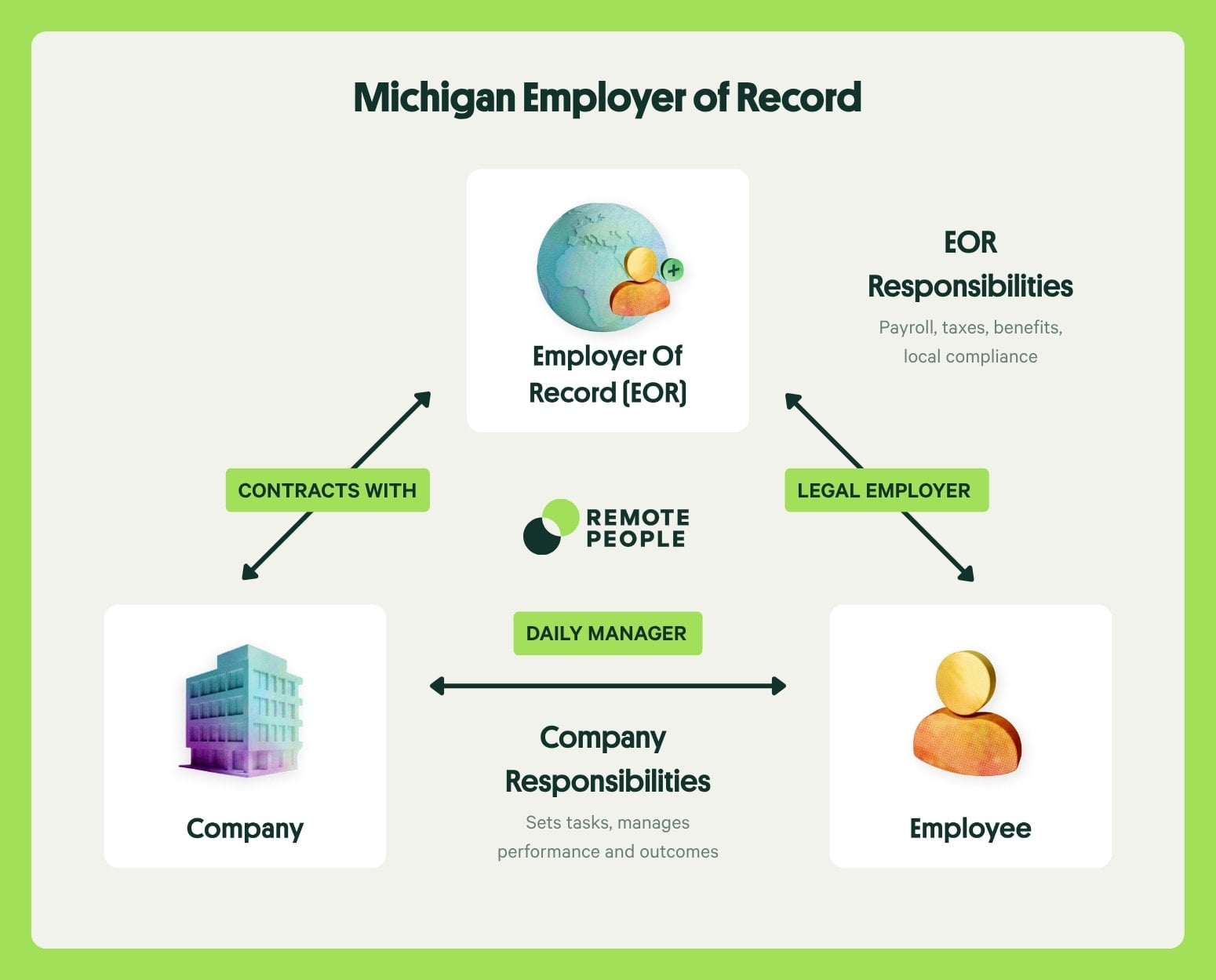
A Michigan Employer of Record (EOR) is a third-party organization that acts as the legal employer of workers in Michigan. They employ people on your behalf, ensuring they are hired compliantly and efficiently, while you handle day-to-day operations within your business.
What is an EOR can help explain how this employment model works in more detail.
EORs have a range of key responsibilities, including:
- Processing and issuing employee paychecks.
- Managing employee contracts and onboarding processes.
- Withholding and remitting filings for federal and state-level taxes.
- Ensuring strict compliance with federal and local labor laws.
- Administering employee benefits and workers’ compensation packages.
An EOR would cover the above tasks, allowing your company to control daily work, performance management, and strategic goals.
One of the primary advantages of instructing an EOR in Michigan is that it negates the need to set up a local entity. This process can be expensive and time-consuming due to the length of payroll registrations, company formation, and regulatory setup, so by shifting these responsibilities to the EOR, businesses can reduce compliance risk and hire new workers quickly and efficiently.
What Is the Difference Between a Michigan Employer of Record and a Michigan PEO?
Employers of Record and Professional Employer Organizations both play key roles in the support of payroll and HR administration for companies hiring abroad.
However, they operate under very different legal structures, which we’ll explain in detail below.
Professional Employer Organization (PEO)
A PEO works with a company via a co-employment agreement, whereby the company remains the legal employer of new workers.
This means that the company must have a registered, legal entity in Michigan, with employer responsibilities being shared between the company and the PEO. The company is liable for employment compliance and must ensure that workers are employed legally and in line with local labor laws.
PEOs tend to be used by domestic companies already operating in Michigan that are keen to outsource some of their HR administration while maintaining their legal employer status.
Employer of Record (EOR)
An EOR assumes legal employment liability as the legal employer of new workers, which means that the company is not required to set up its own legal entity.
EORs are most commonly used by international or out-of-state companies doing business in Michigan, or test the market before setting up their own legal status.
This allows companies to enter the market quickly, without needing to set up a corporate infrastructure or navigate complex labor regulations on their own.
Start hiring with a Michigan EOR
Let us handle the complexities of hiring, compliance, and payroll in Michigan while you focus on growing your team.
- Hire employees in Michigan with a Michigan EOR
- No local entity is needed
- Pricing starts at USD 199 per employee
- RemotePeople can also help you find the best talent in Michigan
How Does a Michigan Employer of Record Work?
A Michigan Employer of Record is responsible for managing the legal and administrative sides of employment, while the company oversees daily operations and targets.
The process typically works via the following steps:
Setting Up a Compliant Employment Contract
An EOR is responsible for preparing and issuing employment contracts that are compliant with Michigan labor laws. Contracts must include clear information on aspects such as compensation, benefits, working conditions, and termination regulations.
Contracts need to adhere to both state and federal laws, and clearly outline the working relationship between employer and employee.
Payroll Setup with Correct State Registrations
Before new employees can be welcomed onboard, an EOR will make the necessary payroll registrations, including:
- The Michigan Department of Treasury
- The Michigan Unemployment Insurance Agency (UIA)
- Workers’ Compensation Coverage
Registering with these departments before onboarding a new employee ensures that all wages and taxes are handled correctly.
Tax Withholding and Remittance
EORs must handle all payroll taxes, which include calculating, withholding, and remitting:
- Federal income tax
- Social Security contributions
- Medicare contributions
- Michigan state income tax
- State unemployment insurance contributions
Filings must be made correctly and on time according to Michigan reporting schedules.
Benefits Administration
All employees in Michigan are entitled to certain employee benefits, which will also be administered by an EOR.
This includes providing both statutory and supplementary benefits such as health insurance, retirement plans, and workers’ compensation, plus more basic entitlements such as overtime pay, sick leave, and the right to a minimum wage.
Ongoing Compliance Management
EORs are responsible for managing ongoing compliance, ensuring that any updates made to federal or local labor laws are reflected in company policies. They must maintain employee records, regularly manage payroll reporting, and support the employer in any disciplinary/termination processes.
Ensuring that the above steps are taken means that a Michigan EOR can help companies hire quickly and compliantly, while also providing the ability to scale without building an internal HR team or setting up a local entity.
How Labor Laws Affect Hiring in Michigan?
There are set labor laws in Michigan that employers must follow. They are not as heavily regulated as some coastal states, but they must still comply to avoid penalties or legal action.
Michigan’s labor laws provide a structured, but manageable compliance environment for employers, and EORs can help ensure these obligations are handled correctly and accurately by taking on the compliance risk and administrative burden.
Minimum Wage
Michigan operates under a minimum wage that sits above the federal level. As of 2026, this rate is $13.73 per hour, which is set to increase to $15 per hour on 1st January 2027.
Tipped Wages
Michigan allows for a lower tipped minimum wage, which currently sits at $5.49 per hour, provided that total earnings equal at least the state minimum wage. If tips fall short of this amount, the employer is responsible for making up the difference.
Overtime
The federal Fair Labor Standards Act (FLSA) is followed in Michigan regarding overtime, which sets out the following principles:
- Hours worked over 40 hours per week count as overtime.
- Overtime must be paid at 1.5 times an employee’s normal wages.
- There are no daily limits on overtime.
There may be exceptions to the above rules for workers in executive, administrative, or professional roles.
Income Tax
Michigan imposes a state income tax on its workers.
This is issued as a flat income tax rate of 4.25% of taxable income, alongside a 6% state sales tax rate and a 6% corporate income tax.
Employers are responsible for registering with the Michigan Department of Treasury and withholding state income tax from employee wages. They must also ensure that all reports and payment remittances are filed on required schedules and accurately calculated to avoid penalties or legal issues.
Unemployment Insurance (SUI)
Employers must make contributions to the state’s unemployment insurance program, which is run through the Michigan Unemployment Insurance Agency (UIA).
The UIA requires that new employers pay a rate starting at 2.7%, depending on industry, while established employers may pay a different rate based on experience and claims history.
This rate typically applies to the first $9.500 of an employee’s annual wages, and filings must be carried out quarterly.
Paid Leave
On the whole, Michigan provides more defined rules on paid leave than other nearby states.
Paid Sick Leave
Michigan’s Paid Medical Leave Act (PMLA) states that employees with over 50 employees must provide paid medical leave.
Employees accrue 1 hour of paid leave for every 35 hours they work, with annual usage being typically capped at 40 hours per year. This applies to all eligible employees under specific, defined criteria.
Paid Family Leave
Michigan does not currently have a state-mandated paid family leave program.
However, employers must comply with federal FMLA requirements where necessary.
Workers’ Compensation
Employers must ensure they have workers’ compensation coverage when hiring workers in Michigan. This is typically required from the first employee a company hires, and is operated via a private insurance system regulated at the state level.
Coverage may be obtained via authorized private insurers or approved self-insurance programs, and there is no monopolistic state fund in place for workers’ compensation.
It’s important to consider that insurance premiums will vary by industry, based on industry risk classification, payroll size, and an employer’s claim history.
High-risk sectors such as manufacturing, automotive production, and construction are likely to face higher premiums, while low-risk sectors like professional services and office roles tend to incur lower rates.
Termination and Final Pay
Employers need to familiarize themselves with termination requirements to minimize wage disputes and legal risk.
Is Michigan At-Will?
Michigan follows the ‘at-will’ employment method, which allows employers and employees to terminate employment at any time, provided that the reason is lawful.
Employers must still comply with anti-discrimination laws when terminating employment contracts, and notice periods/contractual regulations must be followed by both parties.
Final Paycheck Deadline
When an employee’s contract is terminated, Michigan requires that their final wages must be provided by the next regular scheduled payday.
All earned wages must be paid in full, including commissions and bonuses owed as per their employee contract.
PTO Payout Requirement
Michigan doesn’t require the payout of unused vacation or PTO unless stated in an employment contract, or if the employer has issued a separate written policy which promises a payout.
If a policy provides for PTO payout, this becomes legally binding and must be adhered to.
Notice Requirements
There are no state-level notice requirements for individual terminations.
However, employers must adhere to federal WARN Act requirements, particularly when issuing large layoffs or facility closures.
Payroll Taxes and Employer Cost in Michigan
Employers must ensure that federal and state payroll obligations are adhered to, in addition to benefit costs.
Michigan is more affordable than many coastal states in the US; however, there are still statutory employer contributions that must be accounted for.
Federal Payroll Taxes
All employers operating in the US are responsible for paying:
Income Tax Withholding
Michigan requires all employers to withhold a flat rate of income tax of 4.25% from employee wages. These payments must be remitted to the Michigan Department of Treasury.
While this is deducted from employees’ pay, it is the employer’s responsibility to calculate, file, and remit these payments.
State Unemployment Insurance (SUI)
Employers must contribute to Michigan’s unemployment insurance system, based on their assigned experience rate and the annual wage base (typically the first $9,500 of an employee’s annual wages).
New employers tend to begin at a lower rate, which will vary by industry.
Workers’ Compensation
Workers’ compensation is mandatory for employers in Michigan and is usually purchased through private companies.
Premiums will vary depending on industry, payroll volume, and claims history.
Example Cost Breakdown
You’ll find below an example cost breakdown based on employer costs of hiring a Michigan-based employee on a salary of $100,000 per year:
Cost Component | Estimated Range |
|---|---|
Federal Payroll Taxes | 7.65% |
FUTA | 0.6% (capped) |
Workers’ Compensation | 0.5% – 3%+ |
Michigan SUI | 1% – 6% (capped wage base) |
Benefits | 5% – 15% |
This equates to roughly 14% – 30% of an employee’s base salary, depending on industry and benefit structure.
This means that employers’ full costs will range between $114,000 – $130,000 annually, for an employee on a $100,000 salary.
An EOR can help to consolidate these costs and responsibilities into a predictable structure and schedule, helping companies manage budgets and avoid compliance/administrative risk
Employee Classification Rules in Michigan
When operating in Michigan, employers must ensure that workers are classified correctly to avoid payroll tax liability and wage claims.
Independent Contractor Test
Michigan follows the:
These frameworks assess the degree of independence in the working relationship and how a worker should be classified.
This includes considering who controls how the work is performed, whether the worker operates as an independent business or not, and the permanency of the relationship.
No single factor will determine the status of a worker, with classification depending on the overall primary facts of the relationship between employer and employee.
Classification Strictness
Michigan is considered moderately strict in terms of its misclassification policies. While they do issue misclassification penalties in cases of error, they do not apply California’s ABC test for general employment matters.
If an employee is misclassified, employers may face risks such as interest and penalties, potential civil litigation, and back wages/overtime liability.
State and federal agencies may also coordinate audits in severe cases, which can increase financial exposure for employers.
EORs are known for reducing classification risk for employers, as they act as the legal employer and therefore assume responsibility for worker classification. This can significantly reduce classification exposure, particularly for international companies unfamiliar with US labor standards.
What Makes Hiring in Michigan Unique?
Michigan offers employers a unique hiring environment shaped by its industrial history, engineering expertise, and evolving technology sector.
It’s a global hub for automotive manufacturing and mobility innovation, plus it offers a strong representation in advanced manufacturing, aerospace, healthcare, finance, and information technology.
It falls under a moderate regulation category, with clear wage, unemployment insurance, and paid leave requirements, but these requirements are not as strict as those in states like New York or California.
Wage trends tend to be competitive and lower than in major coastal states; however, skilled engineering, technology, and healthcare roles usually command higher salaries due to talent demand.
Michigan has a large talent pool, which is supported by major research universities and tech institutions, and the state’s strong engineering culture provides employees with easy access to specialized industrial/technical candidates.
Together with Michigan’s flat state income tax and low overall employer burdens, these factors make Michigan a unique, attractive location for employers expanding their US presence.
What Are the Benefits of a Michigan Employer of Record?
There are a range of benefits to using a Michigan EOR, including:
- The ability to hire employees without establishing a local entity.
- Quick onboarding in a matter of days instead of months.
- Centralized compliance for payroll, tax filings, benefits, and reporting.
- Reduced legal risk with employment liability shifting to the EOR.
- Easy scalability across different states beyond Michigan.
The EOR model is particularly useful for international companies looking to expand into the US, as well as high-growth businesses entering the US market.
What Are the Downsides of a Michigan EOR?
While the EOR model has many advantages, there are a few considerations employers must bear in mind.
EORs usually charge a monthly service fee, which is either a flat rate or a percentage of total payroll. While this is usually more affordable than setting up a local entity, it must still be factored into overall employment costs.
Employers must also consider that using an EOR will mean that their payroll will be handled externally, resulting in less direct payroll control.
However, compared to the cost and complexity of local entity formation, state registrations, and in-house HR/payroll teams, an EOR is usually more efficient and lower risk than independent compliance management.
How to Choose a Michigan Employer of Record?
Choosing the right EOR for your business is an important choice, and is critical to ensuring compliant and scalable hiring in Michigan.
Follow the checklist below to ensure your EOR provider of choice offers:
- Transparent pricing with a clear fee structure (no hidden charges).
- Responsibility as the legal employer, rather than a layered intermediary.
- Experience supporting hiring across the US states for future scalability.
- Dedicated support and access to knowledgeable HR and compliance specialists.
- A strong compliance track record, demonstrating success in managing payroll, labor law changes, and regulatory obligations.
The bottom line is that the right EOR would function as a long-term partner, rather than a payroll processor alone, to enable your business to expand across the US with a clear, compliant infrastructure.
Engage a Michigan Employer of Record with RemotePeople
RemotePeople can help your business hire in Michigan with our Employer of Record broker services.
We can connect you with the best Michigan EOR for your business, which would allow you to efficiently hire in this state without establishing a legal entity. They would handle responsibilities such as employment contracts, payroll, tax filings, and employee benefits, all while ensuring your workplace practices strictly adhere to local labor laws and compliance requirements.
Contact RemotePeople to start expanding your business into Michigan with the help of a well-suited, certified EOR provider.