Recruit


Let RemotePeople handle payroll, compliance, and HR admin worldwide so you can focus on building your team.
Are your teams scattered across various regions or even different countries? If so, you’re part of a growing trend. Employers around the world are leveraging new technologies and labor laws to hire top talent wherever they find it—whether it’s financial officers in Ireland, developers in Spain, or marketing professionals in Chile.
However, managing this global workforce comes with its own challenges. This is where Global Employment Platforms (GEPs) step in, providing a seamless way to hire, manage, and pay employees or contractors—no matter where they are—through a single, streamlined solution.
In this comparison, we’ll dive into two of the leading GEP providers: Papaya Global and Remote. Both companies offer powerful solutions, but they’re not identical. Each has its own strengths, features, and pricing models that make them suitable for different business needs.
What You’ll Discover:
- In-Depth Feature Analysis: A thorough breakdown of the features and usability of both platforms.
- Pricing Comparison: A detailed look at the costs associated with each service to assist with effective budgeting.
- Pros and Cons: Unbiased assessments of the strengths and limitations of Papaya Global and Remote.
Now that we’ve set the stage, let’s dig deeper into what sets these two platforms apart—and, more importantly, which one might be the best fit for your business.
Whether you’re seeking better global payroll management, more flexible contractor support, or reliable employee benefits administration, we’ll help you weigh the options.
Papaya Global vs Remote Overview
| Feature | Papaya Global | Remote | Explanation |
|---|---|---|---|
| User Reviews |
G2: 4.5/5 Trustpilot: 2.4/5 |
G2: 4.6/5 Trustpilot: 4.7/5 |
Remote has excellent user reviews. Papaya Global has a much lower score on Trustpilot. |
| Pricing |
$599/employee per month $30/contractor per month |
$599/employee per month $29/contractor per month |
Both service providers post their basic fees online, and their starting fees are essentially identical. |
| User-friendliness | Excellent | Excellent | Both platforms have excellent reviews for ease of use and support. |
| Customer Support | 24/7 live chat support | 24/5 live chat support | Papaya Global offers 24/7 live chat support, while Remote has live support just 24/5. |
| Integrations | Very good | Very good | Remote offers an API and 17 integrations. Both integrate with Zapier, which enables 5000+ tools. Papaya Global also has an API and can integrate with eight apps but also “connectors” that can help it integrate with many apps. |
| Data security | Excellent | Excellent | Papaya Global is compliant with GDPR and SOC 1 & 2 standards, ISO 27001 and ISO 22201 certified, and CSA Star Level 1 attested. Remote is GDPR and SOC2 compliant and ISO 27001 certified. |
| International hiring (EOR) | Excellent | Excellent | Remote supports hiring employees and contractors in 180+ countries. Papaya Global can help hire employees and contractors in 160+ countries. |
| Recruitment | Not offered | Good | Remote includes a job board to connect with employees and contractors. Papaya Global doesn’t have recruitment services. |
| Benefits administration | Very good | Very good | Both platforms help employers give their workers add-on benefits like health insurance and pensions. |
| Payroll | Very good | Very good | Both providers offer comprehensive global payroll services and somewhat limited payment methods. |
Main Differences: Papaya Global vs Remote
When comparing Papaya Global and Remote, it’s easy to spot the similarities at first glance. Both providers excel in offering global payroll services, contractor management, and Employer of Record (EOR) services.
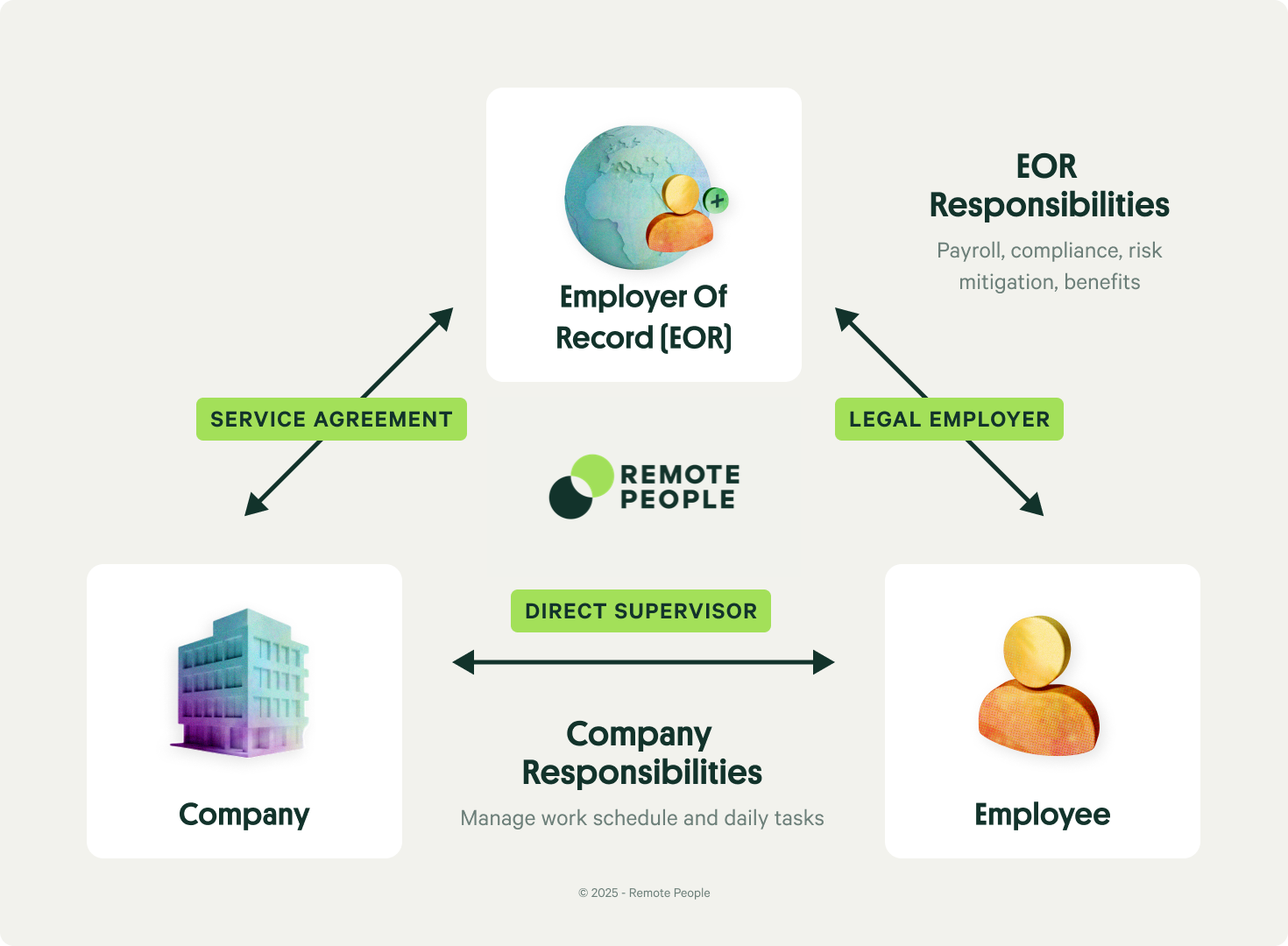
Through their networks of partners and subsidiaries, they legally hire employees in countries where clients don’t have their own business entities. Essentially, the EOR provider becomes the legal employer while the employees work directly for the client. Papaya Global provides this service in over 160 countries, while Remote covers 180+ countries.
However, the differences between these platforms become clear when we take a closer look:
Papaya Global
Papaya Global has positioned itself as a leading provider of global payroll and workforce management solutions. Operating in over 160 countries, Papaya Global leverages its platform to simplify payroll, compliance, and contractor management for companies looking to expand internationally. Its user-friendly platform is built to handle the complexities of managing a global workforce, all while ensuring local compliance.
Services offered by Papaya Global
- Employer of Record (EOR): Provides EOR services across 160+ countries to legally employ workers.
- Global Payroll: Manages payroll for businesses across multiple countries, ensuring compliance with local regulations.
- Contractor Management: Supports contractor hiring and payments in over 160 countries.
- Benefits Management: Helps companies offer competitive benefits packages to international employees.
- Compliance and Risk Management: Ensures adherence to local employment laws and mitigates risks.
- HR Analytics and Insights: Offers data-driven insights to optimize workforce management.
Remote
Remote has quickly risen as a trusted name in global employment solutions, boasting services in over 180 countries. Remote distinguishes itself by providing a more integrated approach, particularly when it comes to recruitment and intellectual property (IP) protection. This makes Remote an appealing option for businesses that need more than just payroll or contractor management.
Services offered by Remote
- Employer of Record (EOR): Provides legal hiring and compliance for global employees across 180+ countries.
- Global Payroll and Tax Compliance: Handles payroll and tax obligations worldwide, ensuring local compliance.
- Contractor Management: Manages contractors in over 200 countries with flexible hiring and payments.
- Remote Talent: Offers a built-in job board to help businesses recruit talent globally.
- IP Protection: Provides add-on services to secure and protect intellectual property.
- Equity Management: Simplifies the management of employee equity and stock options for global teams.
Papaya Global Pricing
| Plan | Price per employee/contractor per month |
|---|---|
| Papaya Global EOR | Starting at $599 per full-time employee per month |
| Papaya Global Contractor | $30 per contractor per month |
| Papaya Global PayrollPlus | Starting at $15 – $25 per full-time employee per month |
| Papaya Global Payments | Starting at $2.5 per transaction |
| Papaya Global Agent of Record | Starting at $200 per contractor per month |
Remote Pricing
| Plan | Price per employee/contractor per month |
|---|---|
| Remote EOR | Starting at $599 per full-time employee per month |
| Remote Contractor | $29 per contractor per month |
| Remote Payroll | $50 per full-time employee per month |
| Remote HR Management | Free |
| Remote Talent | Starting at $119 per contractor per month |
| Remote Contractor Management Plus | $99 per contractor per month |
Key Differences
Service Expansion
- Papaya Global: Offers comprehensive employee benefits management, allowing for tailored packages that can attract top talent.
- Remote: Provides employee benefits management, but with different options and regional variations.
Global Reach
- Papaya Global: Operates in 160+ countries, ensuring a wider geographical footprint for clients.
- Remote: Services are available in over 70 countries, providing less coverage but focusing on key markets.
Pricing Transparency
- Papaya Global: Maintains a competitive price of $30 per contractor per month for contractor management, making it more cost-effective for businesses.
- Remote: Pricing for contractor management is set at $49 per contractor per month, making it a more expensive option for managing contractors.
While both Papaya Global and Remote provide powerful EOR services, the differences in recruitment support, intellectual property protection, and contractor coverage can be pivotal depending on your business needs.
Papaya Global may be ideal for companies with straightforward contractor needs and existing recruitment processes, while Remote caters to businesses looking for an all-encompassing solution, especially with its emphasis on IP protection and recruitment support.
Papaya Global Pros and Cons

As a global employment platform service provider, Papaya Global has its own unique pros and cons to consider. These include:
- Pros
Basic contractor price
Payapa Global’s contractor management fee starts at just $30/contractor per month. This is one of the lowest prices in the industry.
Strict data security
Papaya Global is ISO 27001 and ISO 22201 certified, compliant with GDPR and SOC 1 &2 standards, and CSA Star Level 1 self-attested.
Benefits packages
In addition to mandatory benefits, Papaya Global also offers benefits packages that can be added to contractors’ and employees’ compensation. These include health insurance and pension benefits.
24/7 support
Website-based and WhatsApp live chat support is available 24/7. Each customer is also given a dedicated account manager to act as a go-to for any concerns.
- Cons
Limited integration
While many other platforms integrate with hundreds or even thousands of software packages, Papaya Global can integrate out-of-the-box with just eight. It does, however, include an API for building custom integrations. It also has “connectors” that can help it connect and share data with HCM, HRIS, and VMS software.
Invoicing issues
Users have indicated a lack of detail in Papaya Global’s invoices. Clients are provided with single invoices that don’t necessarily break down their costs as clearly as they might require for their own detailed bookkeeping.
No recruitment
Papaya Global is missing a step in human resource management by not providing any recruitment services or resources to help clients find the talent they need.
Remote Pros and Cons

Remote also has unique qualities that give it both advantages and disadvantages in the GEP space. These include:
- Pros
Starting contractor price
Remote’s basic price of $29/person per month for contractors is very affordable, even for small businesses.
Data security
Remote is both SOC 2 and GDPR compliant and ISO 27001 certified. It uses strict encryption protocols and 2FA (two-factor authentication) as well as using AWS cloud hosting to protect users’ data and privacy.
User-friendly interface
Remote’s user interface is intuitive and easy to learn.
Mobile app
Remote has developed a mobile app for iOS and Android devices. It helps contractors and employees access services on the go, such as making PTO requests and collecting payslips.
Extensive remote work tools
Remote’s platform can be used as a complete HR management system (HRMS). It includes time-tracking, recruitment, invoice and expenses management, and paid time off (PTO) management features that make it a full system, at least for smaller organizations.
Benefits packages
Remote helps companies provide pensions, mental health support, and health, dental, vision, disability, and life insurance for their employees. These packages are customized to the needs of employees in different countries where such benefits may be mandatory.
- Cons
Support limitations
While many of its competitors offer support 24/7, Remote only has 24/5 live support. It also doesn’t offer phone support to most clients, only live chat and email. However, it still receives very good user reviews for client support.
Complex pricing
Remote’s basic starting prices are posted online, and it guarantees no hidden fees. It even provides an employee cost calculator to help employers assess costs. However, add-on packages and additional features are not priced online and must be obtained through sales quotes.
Limited payment options
Payment options for clients are limited to 12 major international currencies. These payments are exchanged and paid to employees in local currencies and to contractors in 160 currencies worldwide. Wise payments for contractors are available but only seven billing currencies.
Head to Head Comparison: Papaya Global vs Remote Features
Each of these two service providers has been examined individually. Now it’s time to put Papaya Global vs Remote head-to-head across different criteria to see which comes out on top in each one. Rather than aiming to decide on a winner and tell you to use that company, we want to point out where each of these providers gives better service so you can choose what you need to fulfill your needs.
User-friendly platform: It’s a tie
Both of these platforms are designed to be highly intuitive and easy to use even for first-time users. According to reviews, implementation of both systems is relatively painless and comes with adequate support from the service providers. Remote offers a bit more complexity but users don’t find its learning curve too steep. Overall, we don’t think there’s much to distinguish these platforms in terms of use.
Resources: It’s a tie
Papaya Global gives its users a blog, resource library, cost calculator, decision tree, and an RFP template. Remote provides country guides, a misclassification risk tool, and a useful employee cost calculator. We think these resources are both useful and call it a tie for this criterion.
Integration with other software: Remote Wins
Neither of these platforms has the number of out-of-the-box integrations that other platforms offer (some in the hundreds). Papaya Global has just 8 direct integrations, including Bamboo, Namely, HiBob, and Expensify. Remote has 17 integrations, including Bamboo, HiBob, Gusto, Personio, and Slack. Both have APIs for custom integrations, and Papaya Global has built connectors that let it pull data from HR and financial software. However, Remote integrates with Zapier, which gives access to over 5000 other tools. We feel this gives it the advantage.

International hiring (EOR): Remote Wins
Both Papaya Global and take care of hiring, onboarding and offboarding, payroll, taxes, and benefits administration, letting clients hire where they don’t own entities. Since their services and starting prices are essentially the same, we give Remote a slight advantage as it services 180+ countries to Papaya Global’s 160+.

Contractor Solution: Remote Wins
The prices here are almost exactly the same once again between these competitors. Their services are also very similar. Papaya Global allows contractors to be hired in 160+ countries while Remote enables hiring in 200 countries. Remote also allows contractors to be paid through Wise which gives them added flexibility.
Employee Benefits: It’s a tie
Both service providers allow employers to add on benefits like pensions and health insurance. Neither posts its prices online, so we can’t compare prices directly. Therefore, we’ve got to call it another tie.
Payroll Management: Papaya Global Wins
Papaya Global lets clients pay in their “Workforce Wallet” using 15 currencies, while Remote lets clients choose to be invoiced in one of 12 international currencies. Both can pay out to employees in 160+ local currencies. However, Papaya’s global payment system is more reliable and easier to manage. It also has a much lower price, starting at $25/person per month for smaller companies and down to just $15/person per month for enterprises with over 1000 employees. Remote charges $50/person per month across the board. For these reasons, we’ll give Papaya Global the win.

Our Verdict: Papaya Global vs Remote
Papaya Global and Remote are both well-known platforms in the GEP space. They have a lot of similarities and even match prices in two of their three main services. At the same time, their differences make them more suited to slightly different uses. While we don’t have an overall winner, we can recommend using these providers in the following ways.
When to choose Papaya Global
This service provider is a good choice for payroll operations, whether you’re running a small business or an enterprise. The larger your business, the more affordable this service is. Papaya Global is also a good choice if you have a complex distributed team in multiple countries and need 24/7 support to help you stay on top of it.
When to choose Remote
Remote is a great choice for businesses that want to scale up by hiring talent around the world. It has a wide reach and can help you hire employees and contractors just about anywhere. You can also add benefits packages to ensure compliance with local laws or to simply provide more for your workers.