Recruit
China Company Registration
-
 Drew Donnelly
- Published
- June 5, 2026
- To ensure efficient company registration in China, explore the most suitable options for your business, including Wholly Foreign-Owned Enterprises (WFOEs), Joint Ventures (JVs), Representative Offices (ROs), and foreign limited partnerships (LPs).
- Learn the detailed requirements and procedures for registering a business in China, from obtaining licenses to navigating local regulations, making the process efficient and compliant.
- Establish your presence in one of the world’s fastest-growing economies with business structures tailored to support manufacturing, trading, consulting, and other key sectors.
- Choose a leading expansion partner to support your company registration. Our top picks are MSA, Deloitte and PWC.
- 5 ★ on G2








- China Services
- Why Register a Company in China?
- Choosing the Right Business Structure
- China’s Legal and Regulatory Requirements for Companies
- 3 Best Partners for China Company Registration
- Step-by-Step Process to Set Up a Company in China
- Hiring and Managing Employees
- Financial Management and Reporting
- Tips for Operating Successfully in China
- Common Mistakes to Avoid
- Why Now is the Right Time to Register a Company in China
- Frequently Asked Questions

Let RemotePeople handle payroll, compliance, and HR admin worldwide so you can focus on building your team.
China’s booming economy and vast consumer base make it an enticing destination for entrepreneurs looking to expand globally. With its robust manufacturing infrastructure and rapidly growing middle class, the country offers countless opportunities for many industries.
However, establishing a business in China comes with its own set of rules and complexities. From selecting the right company structure to complying with local tax requirements, understanding the process is a must for long-term success.
In this guide, we’ll look at the steps to set up a company, discuss legal and financial considerations, and provide tips on building strong business relationships in China.
Why Register a Company in China?
You may be wondering—why set up a business in China? Since the country began opening up and reforming its economy in 1978, its GDP growth has averaged over 9% annually, lifting nearly 800 million people out of poverty. In the first half of 2024, China’s economy grew by 5%, fueled by consumer spending on services, exports, and investments in manufacturing and public infrastructure.
One of the primary draws of doing business in China is its population of over 1.4 billion people, offering an immense potential customer base for entrepreneurs. As a global manufacturing hub, China also provides access to efficient supply chains, specialized labor, and advanced industrial zones that cater to a wide range of industries. Additionally, government policies often include incentives for foreign investors, particularly in technology, clean energy, and healthcare.
China’s investments in AI, 5G infrastructure, cloud computing, and e-commerce make it a forward-thinking environment for innovation. However, there are challenges to keep in mind. Entrepreneurs must work through some legal complexities, including strict regulatory compliance, and adapt to cultural differences that influence business practices and communication styles.
Choosing the Right Business Structure
Determining your business structure is one of the first steps you need to take. A business structure provides a legal framework for your operations, defines who owns the organization and who is liable for the decisions that are made, and determines how you will be taxed.
Here are the most common business structures in China.
Wholly Foreign-Owned Enterprise (WFOE)
Fully owned by foreign investors, offering complete control over operations and flexibility in business activities like manufacturing, trading, or consulting. Read more about this structure in our China WFOE Guide.
Joint Venture (JV)
A partnership between a foreign investor and a local Chinese company, combining local market expertise with foreign resources, often best for regulated industries.
Representative Office (RO)
A limited entity for non-commercial activities like market research or overseeing quality control. This structure is easier to set up and has few maintenance requirements.
Foreign Limited Partnership (LP)
A flexible structure for foreign entities partnering with Chinese organizations or individuals. This structure is often used for investment funds or cooperative projects.
Comparison of Common Business Structures in China
Structure | Common Purpose | Pros | Cons |
|---|---|---|---|
Wholly Foreign-Owned Enterprise (WFOE) | Fully owned by foreign investors to conduct activities like manufacturing, trading, or consulting. | A WFOE offers full operational control, flexibility in business scope, and profit retention. | It has a longer setup process, higher costs, and requires adherence to stringent regulations. |
Joint Venture (JV) | A partnership between foreign investors and local Chinese entities, typically for regulated industries. | A JV provides access to local market expertise, easier entry to restricted sectors, and shared resources. | It may lead to conflicts between partners, requires shared profits, and results in a loss of full control. |
Representative Office (RO) | A non-commercial entity for market research, liaison, or quality control activities. | An RO offers a simplified setup process, lower operational costs, and is good for initial market exploration. | It cannot engage in direct business activities and has a limited operational scope. |
Foreign Limited Partnership (LP) | Flexible structure for investment funds or collaborative projects with Chinese entities or individuals. | An LP offers a highly flexible structure, works well for investment funds, and allows diverse resources to be pooled. | It has limited application beyond investments and is less common, which may lead to complexities. |
So how do you choose? We’re glad you asked. Here are the factors to consider when deciding which structure is best for your business.
- Industry Regulations: Determine if your industry allows full foreign ownership or requires a local partnership.
- Control Over Operations: Decide if you need complete control (WFOE) or are open to shared decision-making (JV).
- Business Activities: Confirm the structure aligns with your goals, such as profit-generating activities (WFOE, JV) or non-commercial tasks (RO).
- Startup Complexity: Evaluate the time, cost, and paperwork involved in setting up each structure.
- Taxation and Compliance: Consider how each structure is taxed and the level of regulatory compliance required.
- Partnership Opportunities: Assess the benefits of partnering with local entities or operating independently.
China’s Legal and Regulatory Requirements for Companies
No matter where you set up your business, whether in China, Hong Kong, the United States, or otherwise, you need to understand the unique business regulations. In China specifically, your business must adhere to a specific set of legal and regulatory requirements.
Key Business Regulations in China
The primary permit required to operate in China is a business license, issued by the local Administration for Market Regulation (AMR). This license serves as official proof of your company’s legal status. In addition, businesses may need:
- Tax Registration Certificate: Required for handling tax obligations.
- Corporate Bank Account: Necessary for financial transactions within China.
- Industry-Specific Licenses: For example, food businesses need a food permit, and online operations require an ICP license.
Foreign investors must also consider specific laws, such as the PRC Company Law and sector-specific regulations, which govern how businesses can operate and invest. Certain industries, like telecommunications and media, have restrictions on foreign ownership or require joint ventures with local companies.
Tips for Staying Compliant with Chinese Laws
- Stay Updated on Regulations: Laws can change frequently; regularly review updates to business and tax policies.
- Work with Local Experts: Engage legal or consulting professionals familiar with the Chinese regulatory landscape.
- File Reports on Time: Submit financial, tax, and other required filings promptly to avoid penalties.
- Keep Accurate Records: Maintain clear documentation of all business activities and transactions.
- Understand Cultural Differences: Adapt to local business practices to build positive relationships with regulators and partners.
3 Best Partners for China Company Registration
If you are considering expanding into China, it is important to choose the right partner to support your China company registration and incorporation.
Below we set out the top three providers for China company incorporation and corporate services.
MSA
Headquartered in Shanghai, and a deep specialization in China expansion and company registration, MSA is the ideal partner for registering your company in China and ongoing corporate and accounting services.
Their affordable prices make them the ideal China expansion partner for SMEs and startups.
Deloitte

Renowned for their management consulting, assurance and audit functions, Deloitte can also register your company in China and in most international locations. With it’s deep expertise in international corporate affairs, Deloitte is a good company registration partner for large multi-nationals.
PWC

PwC offers deep expertise in navigating Chinese regulations, ensuring your company registration process is efficient and compliant. Their extensive network in China provides valuable market insights and support for ongoing business needs. With a dedicated team of bilingual professionals, PwC can handle both local requirements and global considerations for a seamless setup.
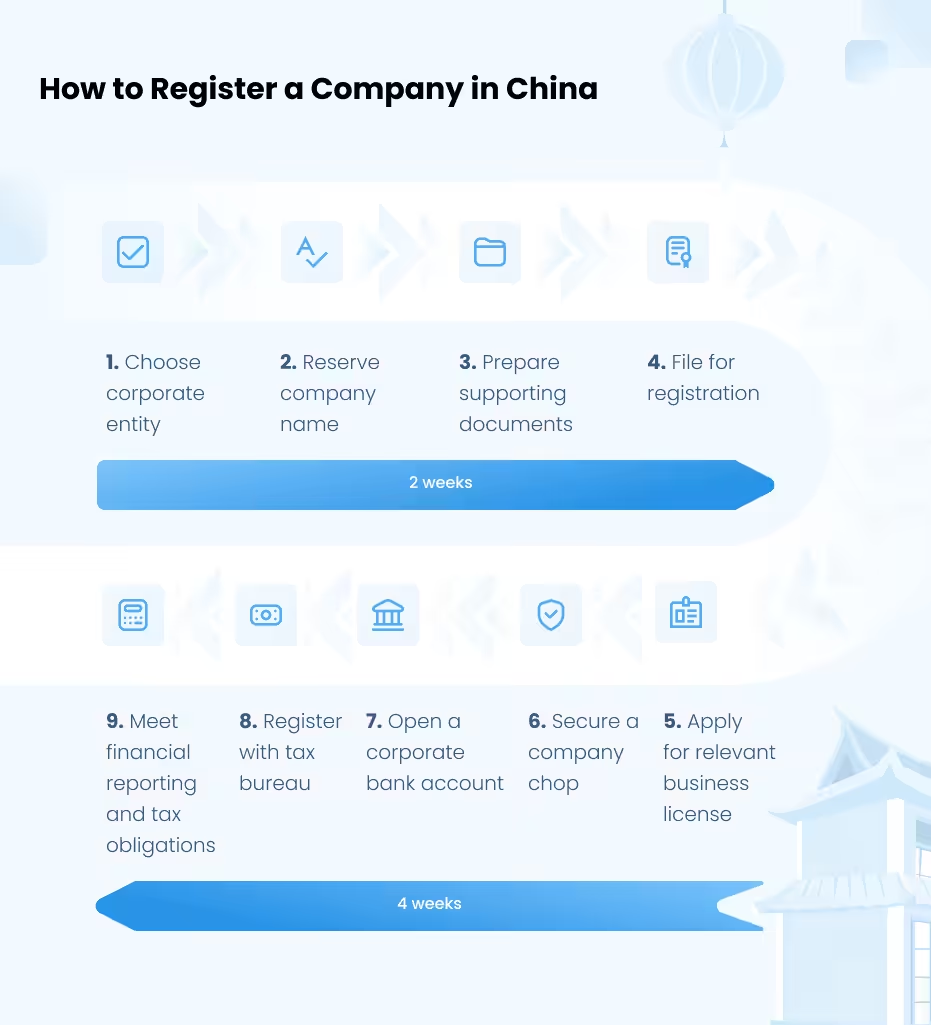
Step-by-Step Process to Set Up a Company in China
One of the best things you can do when setting up a business is to create a robust and well-documented business plan. While this is not something you can simply whip up in a few hours, the time you take will be well worth it in the long run. A business plan effectively summaries the products or services you plan to sell, your target audience, how you will approach the market and your target audience, projected revenue, marketing strategies, etc.
With your business plan in place and research conducted, the following steps will be far easier to tackle.
1
Define Your Business Scope
Clearly outlining your business scope is essential for regulatory approval and operational clarity. It specifies the nature of your business activities, such as manufacturing, trading, or consulting. Align your business scope with local regulations to avoid complications during the approval process, and make sure you operate within legal boundaries.
2
Choose a Location
China’s major business hubs, including Shanghai, Beijing, Shenzhen, and Guangzhou, offer some big-time advantages depending on your industry. Consider factors like proximity to suppliers, availability of talent, and government incentives. Logistics and access to infrastructure also play a super important role in selecting the most suitable location for your operations.
3
Register Your Company Name
Your company name must comply with Chinese naming regulations, including specific requirements on language and format. And, it should be reflective of the products and services that you sell but should not duplicate existing businesses.
Submit your proposed name to the Administration for Market Regulation (AMR) for approval. This step is non-negotiable and should not be underestimated, as the name will be used throughout the registration process.
4
Prepare and Submit Required Documents
Prepare documents such as the Articles of Association, identification of legal representatives, and a lease agreement for your business premises. Each document must be accurate and translated into Chinese where required. Mistakes in documentation can cause delays, so double-check all submissions to avoid setbacks.
5
Open a Bank Account
A corporate bank account is required for handling daily business transactions and fulfilling tax obligations. Choose between local banks or international banks operating in China. Consider the services offered, such as multi-currency accounts, which may benefit foreign investors.
6
Capital Contribution
Determine the registered capital amount for your company, as specified in your Articles of Association. The capital contribution can be made in installments, depending on the agreement. This amount demonstrates your company’s financial capability to operate in China and is subject to approval by regulatory authorities.
Investment to Capital Ratios in China
Total Investment (US$) | Minimum Registered Capital |
|---|---|
3 million or less | 7/10 of the total investment |
3 million – 4.2 million | US$2.1 million |
4.2 million – 10 million | 1/2 of the total investment |
10 million – 12.5 million | US$5 million |
12.5 million – 30 million | 2/5 of the total investment |
30 million – 36 million | US$12 million |
36 million or greater | 1/3 of the total investment |
7
Obtain Business Licenses and Permits
Apply for your business license through the local AMR, which serves as proof of your company’s legal status. Depending on your industry, additional permits may be required, such as a food business permit or an ICP license for online operations. Processing times vary, so plan accordingly.
8
Register for Taxes
Obtain a tax identification number and register with the local tax bureau. Understand China’s tax system, including Value Added Tax (VAT)—currently 13%—and corporate income tax rates, which vary by industry.
Hiring and Managing Employees
Hiring the best talent in China is one of the most important things you will do for your organization. These are the people who will help your company not just get stuff done, but help it to grow. And while creating a safe and comfortable work environment, developing programs for employee engagement, and providing great leadership are foundational to your success, there are some other things to get on top of right away.
It all starts with understanding China’s labor laws. The standard workweek in China is five days, with employees working no more than eight hours per day and 44 hours per week. Overtime is limited to 36 hours per month, except in temporary emergencies. Overtime compensation is higher on rest days and public holidays.
Employers must also provide mandatory benefits, including social insurance and contributions to a housing fund. Social insurance covers pensions, medical care, unemployment, work-related injuries, and maternity leave. Individuals must contribute for at least 15 years for pensions to qualify. The basic pension amount is calculated as 1% of the average of the individual’s wage and province-wide earnings per year of coverage.
Recruiting foreign employees in China involves additional requirements, such as securing work permits, while hiring local talent requires familiarity with the local job market and expectations.
For businesses interested in China hiring, but unsure about registering an entity there, an Employer of Record (EOR) solution can be effective.
Tips for Recruiting and Retaining Local Talent
- Offer Competitive Salaries and Benefits: Align compensation packages with market standards.
- Build a Positive Workplace Culture: Foster strong communication and collaboration.
- Provide Career Development Opportunities: Support training and professional growth.
- Respect Cultural Norms: Adapt hiring and management practices to align with local traditions.
- Focus on Long-Term Relationships: Engage employees with programs that build loyalty.
Financial Management and Reporting
Proper financial management is a cornerstone of successful business operations in China. After completing your company registration in China, setting up an accounting system becomes one of your first financial tasks. This system must comply with Chinese Accounting Standards (CAS) to accurately track revenue, expenses, and taxes.
Businesses in China are required to submit regular financial reports, including monthly tax filings and annual financial statements. Additionally, an annual audit by a certified Chinese accountant is mandatory. Companies must also undergo an annual inspection by the Administration for Market Regulation (AMR) to confirm compliance with local laws and regulations.
Common Pitfalls to Avoid
- Incorrect Tax Filing: Misreporting tax information or failing to submit on time can result in penalties.
- Non-Compliant Accounting Practices: Using accounting methods that don’t align with CAS may lead to fines or audit issues.
- Lack of Documentation: Not keeping detailed records of transactions can complicate audits and inspections.
- Overlooking Currency Rules: Mismanaging foreign currency exchange regulations can disrupt financial operations.
- Inadequate Financial Planning: Underestimating startup costs or operational expenses can create cash flow issues.
Tips for Operating Successfully in China
One of the biggest mistakes you can make with China company registration and setting up shop is ignoring the culture. As can be expected, Chinese workers won’t take well to organizations that don’t take time to understand the country and what is most important to those who live and work there.
To start, focus on building relationships. One of the most significant aspects of operating in China is understanding the concept of guanxi, which refers to the network of relationships that underpin business and social interactions. Building strong guanxi helps you to earn trust and gain support. Start by attending industry events, maintaining regular communication, and respecting cultural norms.
Managing cultural and language barriers is also a non-negotiable. Hiring bilingual staff or working with professional translators can help bridge communication gaps. Demonstrating cultural sensitivity, such as observing local customs during meetings or negotiations, will further solidify your reputation as a respectful and committed partner.
Local partners and consultants can help with foreign company registration and China operations as well. They offer valuable insights into regulatory requirements, market trends, and cultural nuances, making them indispensable allies as you adapt to the Chinese market.
Common Mistakes to Avoid
We’ve talked about guanxi and the importance of relationships, but there are other things to be aware of. Here are some of the other mistakes that the team at RemotePeople has seen with other foreign investors looking to enter China.
- Underestimating Regulatory Complexity: Many foreign investors fail to fully research China’s legal and business regulations, leading to compliance issues during or after foreign company registration and operations.
- Skipping Market Research: Entering the Chinese market without thoroughly understanding local consumer behavior, competition, and demand can result in misaligned strategies and poor business performance.
- Ignoring Cultural Nuances: Disregarding Chinese business etiquette, such as meeting protocols or gift-giving customs, can damage relationships and hinder negotiations.
- Relying Solely on Remote Management: Attempting to manage operations without a physical presence or local team often results in missed opportunities and logistical challenges.
- Overlooking Intellectual Property Protection: Failing to register trademarks and patents early can leave businesses vulnerable to infringement.
- Poor Selection of Local Partners: Choosing unvetted or incompatible local partners can lead to miscommunication and operational inefficiencies.
- Neglecting Tax Obligations: Misunderstanding China’s tax system or failing to meet filing deadlines can result in fines and other penalties.
- Assuming a One-Size-Fits-All Approach: Treating China as a single market, rather than considering regional differences, may limit a business’s ability to succeed across diverse provinces.
Why Now is the Right Time to Register a Company in China
China offers exceptional opportunities for businesses, with its thriving economy, extensive infrastructure, and status as one of the largest consumer markets globally. Acting as a hub for innovation and manufacturing, China provides unrivaled access to Asia-Pacific markets and significant opportunities for growth in industries like technology, e-commerce, and green energy.
With a large and skilled workforce, government incentives for foreign investment, and a growing focus on technological advancement, China is an ideal location for international entrepreneurs aiming to expand their global footprint.
Want to learn more about global expansion strategies? Follow the RemotePeople blog for expert insights on scaling your business internationally.
Frequently Asked Questions
The timeline varies but generally takes 2-3 months. This includes submitting your application, obtaining a business license, and completing tax registration. The process can take longer if additional industry-specific permits are required.
Not necessarily. A Wholly Foreign-Owned Enterprise (WFOE) allows foreign investors to operate independently. However, certain industries require a joint venture with a local partner due to regulatory restrictions.
The minimum registered capital depends on the business type and industry. While some industries have no minimum requirement, others may require a significant investment to meet local regulations and establish operational credibility.
Some steps, like preparing documentation, can be handled remotely, but significant stages, such as opening a bank account or verifying legal documents, may require in-person involvement or the assistance of a trusted local representative.