
 Recruit
Employer of Record (EOR) in Croatia
-
 Drew Donnelly
- Published
- September 27, 2026
An Employer of Record (EOR) in Croatia is a locally registered entity that legally hires workers on your behalf, managing HZMO pension contributions, HZZO health insurance, income tax withholding, and Croatian Labour Act compliance. A Croatia EOR lets you onboard local employees in under two weeks without registering a d.o.o. or branch.
Hire in Croatia — book a free 30-minute demo
Tell us what you need. You'll get a tailored, transparent proposal within 24 hours, plus a free call to walk through it.
Tell us about your company
So we can match you with a specialist who knows your market — and unlock volume pricing tiers.
* All fields are required.
Where and when are you hiring?
Tell us the geography and timing and we'll quote each country line by line, with onboarding timelines.
* All fields are required.
Help us beat your current setup
We'll benchmark your current deal and send a line-by-line proposal in 24 hours — showing exactly where we cut cost, time, or risk. After you submit, you can book a call to walk through it together.
* All fields are required.
Thanks! Your proposal is on its way.
Expect a tailored, line-by-line proposal in your inbox within 24 hours. In the meantime…
Want to walk through it together?
Book a free 30-minute call with one of our specialists. We'll explain every line, answer your questions, and tailor the proposal further if you need.
No obligation. Pick a time that works for you.








- Hire in Croatia — book a free 30-minute demo
- Tell us about your company
- Where and when are you hiring?
- Help us beat your current setup
- Thanks! Your proposal is on its way.
- How an Employer of Record Works in Croatia
- Employment Laws and Regulations in Croatia
- Work Permits and Visas in Croatia
- Payroll, Taxes, and Social Security in Croatia
- Cost of Hiring Through an EOR in Croatia
- Benefits of Using an EOR in Croatia
- Termination and Offboarding in Croatia
- EOR vs. Other Hiring Models in Croatia
- Public Holidays in Croatia
- How to Get Started with an EOR in Croatia
- Where companies hiring in Croatia expand next
- Frequently Asked Questions
- Related EOR Destinations
Start hiring in Croatia
Let RemotePeople handle payroll, compliance, and HR admin worldwide so you can focus on building your team.

Croatia offers competitive hiring economics in the European Union, with employer social security contributions limited to health insurance at 16.5% and no employer pension obligations. The country benefits from a modern Labour Code, well-established payroll systems following the euro adoption in 2023, and a labour force with strong technical and service-sector skills. For companies looking to hire employees in Croatia, however, compliance requires navigating progressive income tax brackets that vary by municipality, mandatory statutory leave entitlements, and monthly social security filings with the Croatian Pension Insurance Institute and Health Insurance Fund. An employer of record in Croatia removes those frictions. RemotePeople acts as the legal employer on paper, runs local payroll, withholds tax at source, and keeps the contract compliant with Croatian labour law, while the client manages day-to-day work. The result is a hire live in one to two weeks instead of the three to six months a greenfield entity typically needs.
How an Employer of Record Works in Croatia
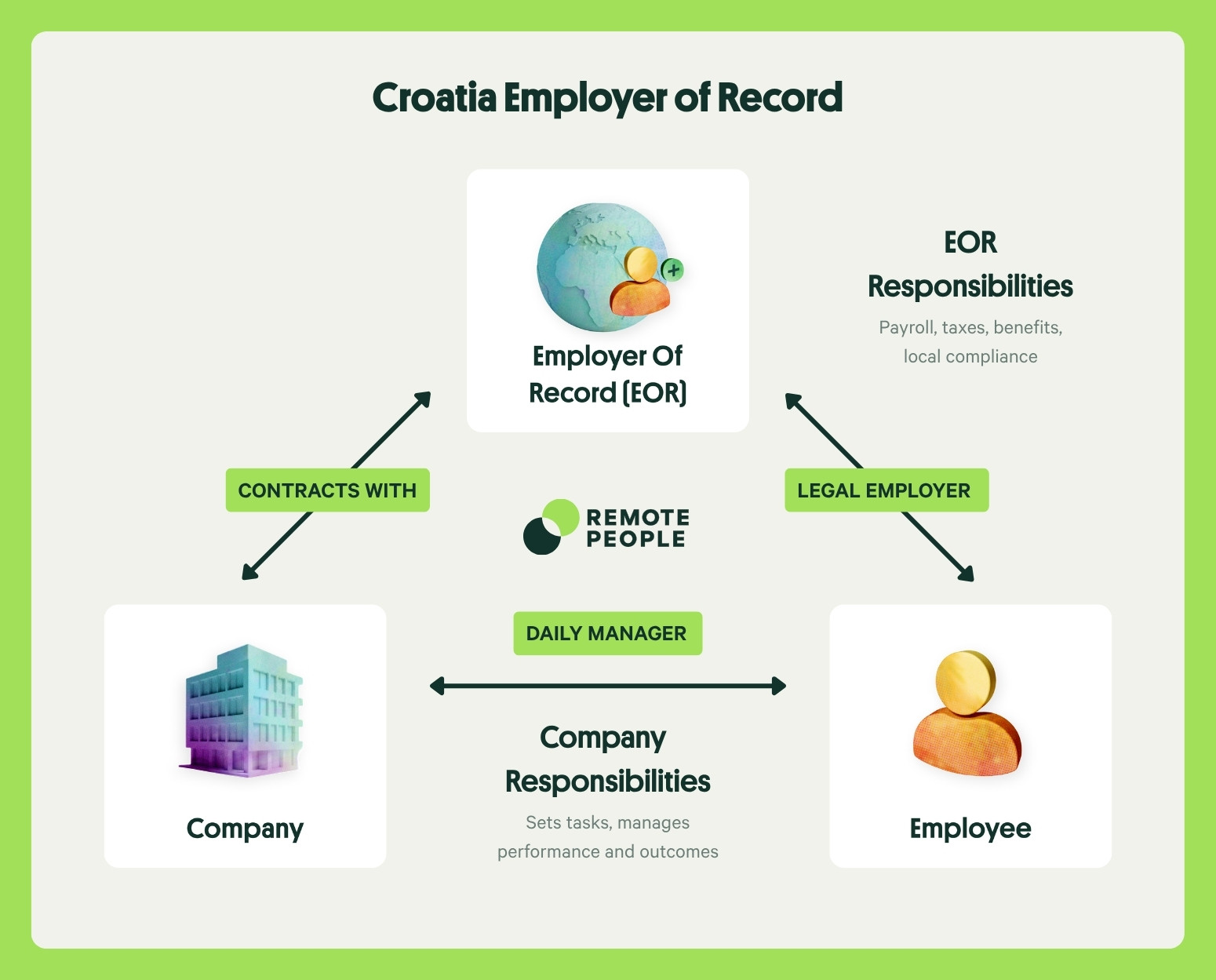
If you’d like to learn more about how Employer of Record (EOR) services work, read our What Is an Employer of Record (EOR)? guide for a complete overview of the model, its benefits, and when to use it.
If you’re comparing providers, our Best Employer of Record (EOR) Providers guide reviews the leading platforms to help you choose the right solution for your business.
Who Uses an EOR in Croatia?
An EOR fits companies that need a compliant Croatian hire without the overhead of incorporating a subsidiary. Common situations include testing the Croatian talent market before committing to an entity, bringing on one to fifteen employees where incorporation is not cost-effective, hiring remote workers already living in Croatia, converting a long-running contractor to a compliant employee, and sponsoring third-country nationals who need work permit backing. The model is also popular with firms that want to onboard in days rather than the three to six months a full entity setup typically takes.
Typical Onboarding Timeline
Most employer of record providers can onboard a new hire in Croatia within one to two weeks. The steps below cover a standard onboarding for an EU national; work permit sponsorship for non-EU hires adds two to three months to the timeline.
- First, the client signs the EOR service agreement and shares the employee’s details, start date, and salary (1–2 days).
- Second, the EOR drafts a Croatian-language employment contract that meets Labour Act requirements and sends it for signature (2–3 days).
- Third, the EOR registers the contract with the tax authority and enrols the employee with the Croatian Pension Insurance Institute and Health Insurance Fund (1–3 days).
- Fourth, payroll is configured, the bank account is linked, and tax and social security withholding are activated (2–3 days).
- Fifth, the employee starts on the agreed date and first payroll runs at month-end.
Hire in Croatia
The EU’s Adriatic gateway with HZZO/HZMO social contributions, mandatory collective agreements in key sectors, and Croatian Labor Act compliance.
We handle employment contracts, payroll, social contributions, and full Croatian compliance.
No local entity needed. Your team can start in days.
Employment Laws and Regulations in Croatia
Employment Contracts
Croatian employment is governed by the Labour Act (Zakon o radu), with the Ministry of Labour, Pension System, Family and Social Policy as the principal regulator. Every contract must be in writing and include the job title and description, place of work, start date, contract duration, annual leave entitlement, notice period, and gross remuneration.
Indefinite contracts are the default. Fixed-term contracts are allowed for defined grounds such as project completion, temporary replacement, or seasonal work, and may not exceed three years without objective justification. Croatian-language contracts are the standard, though bilingual Croatian-English versions are common and enforceable provided the Croatian version controls in case of dispute.
Working Hours and Overtime
The standard workweek in Croatia is 40 hours, normally arranged as eight hours per day across five days, under Article 60 of the Labour Act. Overtime is permitted only in exceptional, justified cases and is capped at 180 hours per calendar year, or up to 250 hours per year if a collective agreement allows.
Overtime compensation is not fixed by a single statutory percentage: the Labour Act sets a minimum premium of 50% for work on Sundays and public holidays, while weekday overtime and night work rates are left to collective agreements, employment contracts, and staff rules. Detailed overtime rules and records must be maintained and are available in our Croatia payroll and tax page.
Overtime work in Croatia is governed by the Labour Act (Narodne novine 151/22), which sets strict limits on how much overtime an employer can require and defines the minimum premiums for Sunday, public holiday, and night work. The standard working week is 40 hours, and overtime is permitted only in exceptional cases of urgent, unforeseen need.
Croatia overtime and premium pay rates · Per Labour Act (NN 151/22) | |||
Hour Type | Rate Multiplier | Weekly or Daily Cap | Notes |
|---|---|---|---|
Standard weekday hours | 100% (base pay) | 40 hours per week | Regular contract rate; no premium applies |
Weekday overtime | Set by collective agreement or contract | 10 hours/week; 180 hours/year (up to 250 with CBA) | Labour Act does not fix a statutory minimum premium |
Sunday work | At least 150% (50% premium) | Subject to 50-hour weekly ceiling | Minimum premium set by statute; must be justified by business need |
Public holiday work | At least 150% (50% premium) | Subject to 50-hour weekly ceiling | Same minimum premium as Sunday work |
Night work (22:00–06:00) | Increased rate (set by CBA or contract) | 8 hours per night maximum | Labour Act mandates a premium but leaves the percentage to agreement |
Minimum Wage
The Croatian minimum wage rose to €1,050 per month (approximately $1,135) on January 1, 2026, an €80 increase from the 2025 level of €970, per the 2026 Minimum Wage Decree. The hourly minimum is €6.30 (approximately $6.81).
The new rate was set by Government Decree for the Minimum Wage 2026 and applies to all sectors and all employees regardless of nationality, and serves as the floor for calculating most social security benefits. Historical minimum wage data and sector-specific rates are tracked on our Croatia minimum wage page.
Probation Period
Croatia allows a probationary clause of up to six months under the Labour Act, which cannot be extended unless the employee was absent for objective reasons such as sick leave or parental leave. For fixed-term contracts shorter than one year, the probation cap drops to three months.
The probation must be stated in the written contract; if no probation is mentioned, the employment is permanent from day one. During probation either side may terminate with seven days’ written notice and without cause, a flexibility that makes it widely used in Croatian hiring. More details on trial period rules are on our Croatia probation period page.
Leave Entitlements
Croatia’s statutory leave framework is set out in the Labour Act and includes paid annual leave, employer-paid sick leave for the first three days, and one of Europe’s most generous maternity leave entitlements at 6 months fully paid plus additional parental leave.
Annual Leave
Croatian employees are entitled to a minimum of 4 weeks (20 working days) of paid annual leave per calendar year under Article 81 of the Labour Act. The right to use leave accrues after six months of employment.
Certain categories such as minors and workers exposed to harmful conditions receive enhanced allowances of up to 5 weeks (25 days). Unused leave must be utilised within 30 June of the following year; any leave remaining after that date is forfeited unless the employer prevented the employee from taking it.
Sick Leave
Sick leave in Croatia is covered jointly by the employer and the Croatian Health Insurance Fund. For the first three working days of each sick spell, the employer pays 70% of the employee’s average daily gross salary.
From day four onward, the Health Insurance Fund pays 70% of the average net wage over the prior 6 months, up to a maximum of 6 months cumulative paid sick leave. For work accidents and occupational illnesses the fund rate rises to full wage compensation. A medical certificate is required for every absence.
Maternity Leave
Croatian maternity leave is 6 months (180 calendar days) of fully paid leave at 100% of average net wage, funded by the Health Insurance Fund. Eligibility requires at least 12 months of prior social security contributions, though reduced contribution histories may qualify for partial benefits.
Mothers can extend their leave through parental leave, which can be transferred to the father or other parent with the mother’s written consent. Employers cannot dismiss a pregnant employee or a mother on maternity leave except in cases of company liquidation, and the employee has the right to return to the same position or an equivalent role at the end of the leave.
Paternity Leave
Fathers are entitled to 20 working days of paid paternity leave starting from the birth of the child, paid at 100% of net wage by the Health Insurance Fund. A 2025 reform increased paternity leave from 10 to 20 working days for a single child, and from 15 to 30 working days for twins or multiple births. Additional parental leave can be transferred to fathers and is available until the child reaches 8 years of age.
Other Statutory Leave
Croatian law provides several additional paid leave categories that an EOR will track alongside annual and sick leave.
- Marriage leave: 8 working days on the employee’s own marriage.
- Bereavement leave: 3 working days on the death of a close family member.
- Parental leave: Can be taken until the child reaches age 8, with flexibility for both parents to share the leave.
- Care leave: Unpaid leave to care for a family member with a serious illness.
- Childcare leave: Until age 2 or 3 if a younger sibling is born, paid at 50% of minimum wage by the Health Insurance Fund.
Croatia statutory leave entitlements · Per Labour Act 2023 as amended | ||
Leave Type | Duration | Eligibility & Notes |
|---|---|---|
Annual leave | 20 working days | Accrues after 6 months of service. Article 81. Minors and exposed workers receive 25 days. |
Sick leave | Up to 6 months | Days 1–3 paid by employer at 70%; day 4+ by Health Insurance Fund at 70% of net wage. |
Maternity leave | 6 months | 100% of average net wage paid by Health Insurance Fund. 12-month contribution history required. |
Paternity leave | 20 days + parental | 20 working days at 100% net wage from birth. Additional parental leave until child age 8. |
Childcare leave | Until age 2 | Paid at 50% minimum wage by Health Insurance Fund. Can extend to age 3 if younger sibling is born. |
Marriage leave | 8 working days | Paid by employer. Granted on the employee’s own marriage. |
Bereavement leave | 3 working days | Paid by employer. Death of spouse, parent, child, or sibling. |
Statutory Employee Benefits
Croatia’s mandatory benefits sit on top of the social security system and are mostly funded through payroll contributions rather than direct employer payments. Health insurance through the Health Insurance Fund provides universal public healthcare at a combined 8% contribution rate (8% employer on the full salary, no cap, plus employee pension contributions), giving employees full access to primary care, hospital treatment, and prescription drugs at state-negotiated prices. The pension system is split between a mandatory state pillar (15% employee contribution) and an optional supplementary pillar (5% employee contribution), together delivering a defined retirement benefit from age 65 for men and 61 for women in 2026.
Beyond the contribution-funded benefits, employers are responsible for the first three days of sick leave at 70% pay, and employees enjoy strong statutory protection for maternity, paternity, and childcare leave funded by the Health Insurance Fund. Croatia does not require employers to provide private medical insurance, meal vouchers, or transport allowances by statute, though all three are popular voluntary benefits in competitive talent segments. A full breakdown of mandatory and voluntary benefits is available on our Croatia employee benefits page, and detailed contribution rates are in the payroll tables in the next section and on our Croatia payroll and tax page.
Recent Regulatory Updates (2026)
The most significant recent updates to Croatian employment law came from the 2025 amendments to the Foreign Workers Act, which took effect on January 1, 2026. Foreign workers from outside the EU/EEA now face a mandatory Croatian language exam at A1.1 level after one year of residence to renew their work permit, and employers must maintain at least a 10% workforce ratio of Croatian or EU citizens relative to third-country nationals.
Additionally, the government raised the statutory minimum wage by 8.2% to €1,050 per month, effective January 1, 2026. The Croatian Pension Insurance Institute and Health Insurance Fund also updated their contribution bases and ceilings. These changes build on the Labour Act reforms of 2023, which modernised probation rules, notice period calculations, and parental leave entitlements.
Work Permits and Visas in Croatia
Work Permit Requirements
Who Needs a Work Permit
EU, EEA, and Swiss citizens enjoy full free movement and can work in Croatia without any permit; they only need to register their residence with local authorities if they stay longer than three months. All other nationals, including UK citizens post-Brexit, need a work permit before starting employment. Certain categories are exempt, such as accredited journalists and holders of permanent residence permits.
Eligibility and Required Documents
For non-EU hires, the employer applies for a residence and work permit through the Ministry of Interior. The standard documentation set includes a signed employment contract, a detailed job description, proof that the role was advertised to the Croatian and EU labour market for at least 15 days (the labour market test), the employee’s passport, notarised diploma or professional qualification, a clean criminal record certificate from the country of origin, and medical insurance coverage. All foreign-language documents must be translated into Croatian and notarised.
Processing Time and Validity
A standard work permit typically takes one to three months from application to issuance, including the labour market test. As of 2026, the deadline for issuing residence and work permits has been extended to 90 days from the previous standard.
Initial permits are valid for the duration of the employment contract up to a maximum of one year for standard workers and up to four years for highly skilled professionals. Delays most often come from missing apostilles, incomplete qualification documents, or missing labour market test documentation. Employees can change employers after six months with their first employer without requiring a new work permit.
Renewal Process
Renewal applications must be filed before the current permit expires. The employee can continue working while the application is pending, provided the employer has filed the renewal request on time.
Documentation mirrors the initial application, with an updated contract, confirmation of ongoing employment, and refreshed medical insurance coverage. After five years of continuous lawful residence, the employee becomes eligible for long-term EU resident status and exemption from the labour market test.
Common Visa Types for Foreign Workers
Croatia offers several work-authorising permits managed by the Ministry of the Interior (MUP). The right category depends on the role, the employee’s qualifications, and whether the employer already has a Croatian legal entity. The table below compares the five permit types most commonly used by EOR providers in 2026.
Croatia work visa types for foreign workers · 2026 | ||||
Visa Type | Duration | Best For | Leads to Long-Term Residence? | Processing |
|---|---|---|---|---|
Employed worker permit | Up to 1 year (renewable) | Non-EU hires on a standard Croatian employment contract | Yes, after 5 years of continuous lawful residence | 30–60 days |
EU Blue Card | Up to 2 years (extendable) | Highly qualified professionals earning above the salary threshold | Yes, 5 years (2 years if prior EU stay) | 30–60 days |
Intra-company transfer (ICT) | Up to 3 years for managers and specialists | Employees moved from a parent or affiliated company abroad | Yes, after 5 years of continuous residence | 30–60 days |
Digital nomad residence permit | Up to 1 year (non-renewable consecutively) | Remote workers earning foreign-source income | No; 6-month exit required before reapplying | 8–15 weeks |
Seasonal worker permit | Up to 6 months in any 12-month period | Agriculture, forestry, hospitality, and tourism roles | No long-term residency path | 15–30 days |
How an EOR Handles Work Permits
Because Croatian work permit sponsorship must be filed by a registered local employer, the EOR is well positioned to handle work permit and residence applications on behalf of client companies. The provider prepares the labour market test documentation, compiles the application package, liaises with the Ministry of Interior, and tracks renewal deadlines.
Work permit sponsorship typically extends the one to two week EOR onboarding window by two to three months, so clients should plan accordingly when hiring third-country nationals. RemotePeople supports full sponsorship for employed worker permits and residence permits in Croatia, with complete details available on our Croatia work visa and permit page.
Payroll, Taxes, and Social Security in Croatia
Employer Contributions
Croatian employers contribute 16.5% of gross salary to health insurance, with no employer pension contributions required, according to the PwC Worldwide Tax Summaries for Croatia. The entire pension system burden falls on the employee. The health insurance contribution is uncapped and applies to the full gross salary amount.
Unemployment insurance and work accident insurance contributions are embedded in the overall employer burden through the health insurance and social security system, with no separate employer-only line items. This makes Croatia one of the lowest-burden EU countries for employer social security costs.
Croatia employer social security contributions · 2026 rates | ||
Contribution | Rate | Notes |
|---|---|---|
Health insurance (HZZO) | 16.5% | Universal public healthcare coverage. No cap on monthly salary. Applies to full gross. |
Total employer contributions | 16.5% | No employer pension contributions in Croatia. Employee-only: Pillar I 15% + Pillar II 5%. |
Employee Contributions
Croatian employees contribute a combined 20% of gross salary to pension insurance: 15% to the mandatory state pillar (Pillar I) and 5% to the supplementary capitalized pillar (Pillar II), as confirmed by the Croatian government pension insurance system. These contributions are capped at a monthly maximum insurance base of €11,958 (€970 maximum monthly contribution). Together with progressive income tax, a typical Croatian worker sees a combined payroll deduction of roughly 35% to 40% depending on municipality and income level.
Croatia employee payroll deductions · 2026 monthly withholdings | ||
Deduction | Rate | Notes |
|---|---|---|
Pillar I pension (state) | 15% | Mandatory state-run defined benefit pension. Capped at €11,958 monthly insurance base. |
Pillar II pension (supplementary) | 5% | Capitalised pension fund. Optional for workers born before 1960; mandatory for younger employees. |
Total pension deductions | 20% | Capped monthly. Plus progressive income tax on net salary after deductions. |
Income Tax
Croatia applies progressive income tax with two brackets and a €600 monthly personal allowance (€7,200 annually), according to the Croatian Tax Authority (Porezna uprava). The lower rate applies to annual income up to €60,000, and the higher rate applies to income above that threshold.
Tax rates vary by municipality: the lower bracket ranges from 15% to 23% (default 20%), and the higher bracket ranges from 25% to 33% (default 30%). Zagreb residents typically pay 23% on lower income and 33% on higher income, while smaller municipalities may pay 15% and 25% respectively.
Croatia income tax brackets · 2026 | |
Annual Taxable Income (USD) | Tax Calculation |
|---|---|
$0–$64,900 (€60,000) | Lower rate: 15–23% depending on municipality (default 20%) |
Above $64,900 (€60,000) | Higher rate: 25–33% depending on municipality (default 30%) |
All income levels | Personal allowance: €600/month (€7,200 annually). Applied before tax calculation. |
Ages 15–25 or 26–30 | 100% tax reduction (ages 15–25) or 50% reduction (ages 26–30) on income up to €60,000 annually |
Payroll Cycle
Croatian payroll is paid monthly, typically by the last working day of the month or within the first five days of the following month, by bank transfer to a local account. Cash payments are legal but uncommon in formal employment.
Employers must issue an itemised payslip each month showing gross salary, pension contributions, income tax withholding, and net pay. All monthly payroll data must be reported to the tax authority and social security funds by the 15th of the following month. Annual reconciliation statements and tax reporting are due by March 31 each year.
13th Month Salary and Bonus Pay
A 13th month salary is not mandatory in Croatia. Employers have no statutory obligation to pay an annual bonus, vacation bonus, or profit share.
Where 13th month pay is offered, it is a contractual benefit that sits alongside standard salary, is fully subject to progressive income tax and pension contributions, and is usually paid in December or at year-end. Employers may offer non-taxable bonuses of up to €700 annually without triggering tax or social security withholding. Discretionary performance bonuses and holiday bonuses (Božićnica) are common in private-sector roles but remain entirely voluntary.
Cost of Hiring Through an EOR in Croatia
EOR Service Fees
EOR pricing in Croatia ranges from $300 to $600 per employee per month, billed as a flat USD amount regardless of salary level. This fee covers contract drafting, monthly payroll processing, tax withholding and remittance, social security administration, statutory leave tracking, and full labour-code compliance. Full details on Croatian payroll mechanics are available on our Croatia payroll and tax page.
Total Employment Cost Breakdown
The real cost of hiring in Croatia is the gross salary plus the employer’s 16.5% health insurance contribution plus the EOR service fee. On a $2,500/month gross salary, the total monthly employer cost is approximately $3,313, or roughly 32.5% above the gross figure. All USD amounts are approximate conversions at $1 = €0.93 (April 2026 rate).
Croatia employer cost example · $2,500/month gross · 2026 | ||
Employer Cost | Amount (USD) | % of Gross |
|---|---|---|
Gross monthly salary | $2,500.00 | 100.00% |
Health insurance (HZZO) | $412.50 | 16.50% |
EOR service fee | $400.00 | 16.00% |
Total monthly employer cost | $3,312.50 | 132.50% |
Ready to hire in Croatia? Get started with RemotePeople and we will handle employment contracts, payroll, tax withholding, and full Croatia compliance. No local entity needed.
Benefits of Using an EOR in Croatia
Using employer of record services in Croatia cuts the time between signing a candidate and having them on the books from months to days. A greenfield Croatian entity typically takes three to six months to incorporate, register with the tax authority, obtain VAT numbers, and set up local banking and payroll, while an EOR can onboard the same hire in one to two weeks because the legal infrastructure is already in place.
The compliance dividend is just as important. Croatia’s Labour Act has been extensively modernised, monthly payroll filings are due by the 15th of each month, social security contribution bases reset every January, and the country’s 2023 transition to the euro brought new denomination rules for all salaries and benefits.
An EOR that specialises in Croatia keeps on top of each change, indemnifies the client against employer-side liability, and typically carries employers’ liability insurance as a backstop. For companies hiring one to fifteen people, that is almost always cheaper than paying an in-country CFO, labour lawyer, and local accountant.
The model also scales in both directions. Need a second hire in Zagreb or Split next month? Add them to the same EOR contract.
Need to close the Croatia operation after a market pivot? Give statutory notice and exit; there is no entity to wind down, no tax clearance queue, and no minority shareholder negotiations.
That flexibility is why EORs are the default route for cross-border hiring in Croatia’s one-to-fifteen-employee band, and increasingly for larger teams managing subsidiaries elsewhere.
Termination and Offboarding in Croatia
Notice Periods
Statutory notice periods in Croatia vary by tenure, as set out in Article 122 of the Labour Act. The minimum is two weeks for employees with less than one year of service, one month for those with one to twenty years of service, and two months for those with twenty or more years of service.
Employees aged 50 and older receive an additional two weeks of notice, and those aged 55 and older receive an additional four weeks.
Probation period terminations require only seven days’ written notice and can be without cause. Notice must be given in writing and can be paid in lieu at the employer’s discretion only if allowed by collective agreement or employment contract.
Statutory notice periods in Croatia are regulated by Article 122 of the Labour Act (Narodne novine 151/22) and depend on the employee’s length of continuous service with the current employer. Employees aged 50 or older receive an additional two weeks of notice, and those aged 55 or older receive an additional four weeks, as confirmed in the Eurofound European Restructuring Monitor database.
Croatia statutory notice periods by years of service · Per Labour Act (NN 151/22) | |||
Years of Service | Notice Period | During Probation | Notes |
|---|---|---|---|
Less than 1 year | 2 weeks | 7 days | Minimum statutory notice for new hires |
1 to 2 years | 1 month | 7 days | Standard notice tier |
2 to 5 years | 1 month and 2 weeks (6 weeks) | 7 days | Increases with each completed tenure bracket |
5 to 10 years | 2 months | 7 days | Common tier for tenured staff |
10 to 20 years | 2 months and 2 weeks (10 weeks) | 7 days | Applies to long-service employees |
20 years or more | 3 months | 7 days | Maximum statutory notice; age supplements apply on top |
Severance Pay
Calculation Method
Severance pay in Croatia is calculated as one-third of the average monthly salary multiplied by the number of complete years of service, applying only if the employee has worked for at least two years, per Article 126 of the Labour Act. The average salary is calculated based on the three months prior to the termination date.
The severance formula creates a predictable cost: an employee with five years of service receives approximately 1.67 months of gross salary; one with ten years receives approximately 3.33 months. There is no statutory maximum cap, though most dismissals stay within reasonable brackets given the formula.
Severance pay in Croatia is governed by Article 126 of the Labour Act (Narodne novine 151/22) and becomes mandatory once an employee has completed two years of continuous service with the same employer. The statutory formula is one-third of the average monthly salary (calculated over the last three months before dismissal) multiplied by the number of completed years of service, capped at six times the average monthly salary. Severance is not owed when dismissal results from employee misconduct, nor on expiry of a fixed-term contract.
Croatia severance pay schedule by years of service · Per Labour Act (NN 151/22) | |||
Years of Service | Severance Amount | Base Salary (monthly average) | Notes |
|---|---|---|---|
1 year | Not eligible | €1,500 | Minimum 2 years of continuous service required |
3 years | €1,500 | €1,500 | (1,500 ÷ 3) × 3 = 1,500 |
5 years | €2,500 | €1,500 | (1,500 ÷ 3) × 5 = 2,500 |
10 years | €5,000 | €1,500 | (1,500 ÷ 3) × 10 = 5,000 |
18 years or more | €9,000 | €1,500 | Capped at 6 × average monthly salary |
Caps and Exceptions
Employees dismissed for cause (gross misconduct, theft, repeated absence without authorisation, or breach of confidentiality) receive no severance. Fixed-term contracts that expire naturally carry no severance obligation. Protected categories such as pregnant employees, mothers on maternity leave, and employees on sick leave can only be dismissed in very limited circumstances and with prior approval from the labour inspectorate.
Grounds for Termination
Croatian law recognises both termination with cause (disciplinary dismissal) and termination without cause (economic or organisational grounds). Disciplinary dismissal requires documented warnings, an internal investigation, and the employee’s written explanation before the decision is issued.
Economic dismissals must be supported by organisational documentation showing the role is genuinely being eliminated. Mutual agreement terminations are common in practice because they let both sides avoid procedure and usually come with an uplifted severance package.
EOR vs. Other Hiring Models in Croatia
EOR vs. Setting Up a Local Entity
Choosing between an Employer of Record and setting up your own legal entity in Croatia comes down to timeline, upfront cost, ongoing administrative burden, and how quickly you can scale up or wind down. The table below lays out both paths side by side across setup time, cost, compliance risk, and flexibility so you can match the right model to the size and duration of your Croatia hiring plan.
Croatia EOR vs local entity comparison · Setup time, cost, risk and best-fit | ||
Comparison | Employer of Record | Own Entity (d.o.o. / j.d.o.o.) |
|---|---|---|
Setup time | 1–2 weeks | 3–6 months |
Upfront cost | $0 | $3,000–$10,000 |
Ongoing cost | $300–$600/employee/month | $8,000–$20,000/year maintenance |
Local partner required | No (EOR is the local entity) | Yes, one authorized representative |
Social insurance registration | Handled by EOR | You manage it |
Payroll & tax filing | Handled by EOR | You manage it (or outsource) |
Best for team size | 1–15 employees | 15+ employees |
Scale down / exit | Easy. No entity to unwind | Costly. Legal dissolution required |
Government contracts | Not eligible | Eligible (requires local entity) |
For most companies hiring their first handful of people in Croatia, the EOR is the better economic choice. A limited liability company (d.o.o.) can cost $3,000–$10,000 to set up properly once legal fees, notary costs, and minimum capital deposit are included, with another $8,000–$20,000 per year to maintain the accounting, payroll, and compliance function that any entity in the EU requires.
The break-even point against an EOR typically sits around 15 employees. Below that, the monthly EOR fee is lower than the fixed cost of running an in-country finance and HR function; above it, the per-head savings of owning the entity start to compound.
Companies that plan to bid on Croatian government tenders or need a local entity for regulatory reasons (financial services licensing, pharmaceutical distribution) will need their own d.o.o. regardless of team size.
The exit story is just as important as the setup story. Closing a Croatian entity is a multi-month affair involving tax clearance, asset liquidation, and Commercial Register filings. Closing out an EOR relationship takes a single notice period.
EOR vs. Hiring Independent Contractors
Classifying a Croatia-based worker as an independent contractor rather than an employee can expose you to back-taxes, unpaid social contributions, and reclassification penalties if the working relationship looks like employment in practice. The table below contrasts EOR employment with contractor engagement across legal relationship, tax and benefits treatment, IP ownership, and misclassification risk so you can pick the right model role by role.
Croatia EOR vs independent contractors · Compliance, cost, and risk | ||
Comparison | EOR (Full-Time Employee) | Independent Contractor |
|---|---|---|
Legal relationship | Employee of the EOR | Self-employed, no employment relationship |
Compliance risk | Low. EOR ensures local labour law compliance | High. Misclassification risk if relationship resembles employment |
Payroll & tax | EOR handles withholding, contributions, filings | Contractor invoices you; they handle their own taxes |
Benefits & leave | Statutory benefits, paid leave, social security | No entitlement to employee benefits |
IP protection | Stronger. Employment contract assigns IP by default | Weaker. Requires explicit IP assignment clause |
Termination | Subject to local notice periods and severance | Contract can be ended per agreement terms |
Best for | Long-term, core team roles | Short-term projects, specialized tasks |
Cost structure | Salary + employer contributions + EOR fee | Contractor fee (typically higher gross, lower total cost) |
Hiring independent contractors in Croatia carries significant compliance risk. The labour inspectorate regularly reviews contractor relationships, and if the contractor’s work resembles a permanent employment role with set hours, benefits eligibility, or company direction, the authority can reclassify the relationship as an employment contract retroactively. This triggers back-payment of payroll taxes, social security contributions, and severance obligations at rates set by the Labour Act.
Contractor arrangements work well for genuinely short-term projects, specialist consulting work, or roles with clear independence: the contractor controls their schedule, retains clients, and bears commercial risk. For core team members or ongoing roles, an EOR employment arrangement is both legally cleaner and typically more cost-effective once misclassification risk is factored in. RemotePeople offers contractor payment solutions for clients who need both EOR employees and contractors.
EOR vs. PEO (Professional Employer Organization)
EORs and PEOs both simplify international hiring, but only an EOR becomes the legal employer of record in Croatia — a critical distinction when you don’t have a local entity of your own. The table below maps the practical differences across legal employer status, entity requirement, liability allocation, and scope of coverage.
Croatia EOR vs PEO comparison · Legal employer, liability, and setup | ||
Comparison | Employer of Record (EOR) | PEO |
|---|---|---|
Legal employer | EOR is the legal employer | You remain the legal employer (co-employment) |
Local entity required | No. EOR is the local entity | Yes. You must have your own entity in Croatia |
Best for | Companies without a local entity | Companies that already have a local entity |
Compliance liability | EOR assumes compliance responsibility | Shared liability between you and the PEO |
Setup time | 1–2 weeks | Depends on your entity setup (weeks to months) |
Control over HR policies | EOR manages within local law framework | More direct control; PEO advises |
Typical use case | Market entry, small remote teams, testing new markets | Established local operations needing HR outsourcing |
The EOR vs. PEO choice in Croatia hinges on whether you already have a local entity. If you do not, an EOR is the fastest route to hiring because the EOR becomes your legal employer and handles all compliance.
If you already have a Croatian d.o.o. or other entity, a PEO can take over HR and payroll functions while you remain the legal employer, offering more control over company policies and culture.
For most companies entering the Croatian market, the EOR model wins because it requires no entity setup and carries clear liability boundaries. A PEO makes sense once you have a local subsidiary and want to outsource HR operations to a specialist while retaining direct control. Neither model is inherently better; the right choice depends on your corporate structure and market entry strategy.
Public Holidays in Croatia
Croatia observes a defined set of official public holidays on which most private-sector employers must give staff a paid day off (timeanddate.com: Croatia 2026 Holidays). The table below lists the statutory holidays employers need to build into payroll calendars and leave planning for the year, along with the date rule for each.
Croatia public holidays · 2026 calendar year | ||
Date | Holiday | Type |
|---|---|---|
January 1 | New Year | Fixed |
January 6 | Epiphany (Three Kings’ Day) | Fixed |
April 5 | Easter Sunday | Movable |
April 6 | Easter Monday | Movable |
May 1 | Labour Day | Fixed |
May 30 | Statehood Day | Fixed |
June 4 | Corpus Christi | Movable |
August 5 | Victory and Homeland Thanksgiving Day | Fixed |
August 15 | Assumption of Mary | Fixed |
October 8 | Independence Day | Fixed |
November 1 | All Saints’ Day | Fixed |
December 25 | Christmas (Božić) | Fixed |
December 26 | St. Stephen’s Day (Sveti Stjepan) | Fixed |
Croatia recognises 13 public holidays in 2026, split between fixed calendar dates and movable Christian observances, as published by timeanddate.com. Employees who work on public holidays typically receive additional compensation, commonly 50% above the regular rate, though this is determined by contract or collective agreement rather than statute. If a public holiday falls on a weekend, no compensating day off is granted in Croatia; the holiday is observed on that date only.
How to Get Started with an EOR in Croatia
Getting started with an EOR in Croatia follows a straightforward process that takes one to two weeks for most hires. Follow these steps:
- First, identify the employees you want to hire and confirm their basic details: full name, date of birth, residence address, desired salary, and start date.
- Second, sign the EOR service agreement with RemotePeople and provide the employee information and role description.
- Third, the EOR drafts a Croatian-language employment contract compliant with the Labour Act and sends it for signature by both parties.
- Fourth, the EOR registers the contract with the tax authority and enrols the employee with the Croatian Pension Insurance Institute and Health Insurance Fund.
- Fifth, payroll is configured, bank account details are linked, and the first paycheck is processed at month-end.
If you’re hiring non-EU citizens, add two to three months to this timeline for work permit processing and labour market testing. For EU and EEA citizens, the timeline remains one to two weeks.
Contact RemotePeople today to discuss your Croatia hiring plans and get a cost estimate based on your specific roles and salaries.
Where companies hiring in Croatia expand next
Teams hiring in Croatia commonly expand across Central and Eastern Europe, where competitive labor costs and EU market access anchor regional growth. Common expansion paths include the Czech Republic (aligned compensation ranges and delivery speed) and hiring in Romania (matching cost-to-quality tier). Teams scaling further usually add an EOR partner in Hungary for similar cost profile and comparable hiring speed, with Poland extending coverage through parallel labor-cost tier and talent supply.
Frequently Asked Questions
The total cost is the employee's gross salary plus 16.5% for employer health insurance contributions plus the EOR service fee of $300 to $600 per month. On a $2,500/month gross salary, total employer cost is approximately $3,313/month or 32.5% above gross. The EOR fee is a flat USD amount, not a percentage of salary.
An EOR employee relationship gives you a legally compliant worker with full statutory benefits, paid leave, and social security coverage, managed by the EOR with all compliance risk on the EOR. Independent contractors carry high misclassification risk in Croatia if the work relationship resembles employment, and you're responsible for paying back taxes and penalties if reclassified. For core team roles, an EOR employee is cleaner and lower-risk. For short-term projects or specialist work, RemotePeople also offers contractor solutions that handle compliant contractor payments.
The employment contract assigns IP to the client company (you), not the EOR. The EOR makes sure the contract has proper IP assignment language so all intellectual property flows directly to your business. This is standard practice in Croatian EOR agreements.
For EU/EEA citizens, one to two weeks. For non-EU citizens requiring work permits, add two to three months for the labour market test and Ministry of Interior approval.
No, 13th month salaries are not mandatory by law in Croatia. Employers may offer non-taxable bonuses up to €700 annually or discretionary year-end bonuses, but neither is legally required.
Notice periods depend on tenure: two weeks for under one year, one month for 1–20 years, two months for over 20 years. Employees with two or more years of service are entitled to severance calculated as one-third of their average monthly salary per year of service. Probation terminations require only seven days' notice.
Yes. Non-EU workers need a residence and work permit. The EOR handles the application through the Ministry of Interior, including the labour market test. Processing typically takes one to three months. As of 2026, foreign workers must pass a Croatian A1.1 language exam after one year of residence to renew their permit, and employers must maintain at least 10% Croatian or EU citizens relative to third-country nationals employed.
EOR pricing in Croatia ranges from $300 to $600 per employee per month as a flat fee. On top of the service fee, employers pay mandatory health insurance contributions of 16.5% of gross salary. For a $2,500/month gross salary, total monthly employer cost including the EOR fee is approximately $3,313, or about 32.5% above the gross figure.
The average gross salary in Croatia is approximately $1,700 per month ($20,400 annually). Salaries vary significantly by industry and region, with Zagreb commanding the highest wages. The national minimum wage for 2026 is €970 gross per month. For detailed salary data by role, see our Croatia average salary guide.
No. An employer of record (EOR) in Croatia acts as the legal employer on your behalf, eliminating the need to register a local subsidiary or branch office. The EOR handles employment contracts, payroll, tax filings, and social security contributions while you retain day-to-day management of the employee. This is the fastest route to hiring in Croatia, typically taking 5 to 10 business days from contract signing to the employee's first working day.
Employer of Record in
Employer of Record in
Employer of Record in
Employer of Record in
Employer of Record in
Employer of Record in
Employer of Record in
Employer of Record in