
 Recruit
Employer of Record (EOR) in Kosovo
-
 Drew Donnelly
- Published
- September 22, 2026
RemotePeople’s employer of record in Kosovo lets you hire employees in Kosovo with pension system compliance. We handle 5% employer pension contributions, 5% social security contributions, and mandatory benefit coverage.
Hire in Kosovo — book a free 30-minute demo
Tell us what you need. You'll get a tailored, transparent proposal within 24 hours, plus a free call to walk through it.
Tell us about your company
So we can match you with a specialist who knows your market — and unlock volume pricing tiers.
* All fields are required.
Where and when are you hiring?
Tell us the geography and timing and we'll quote each country line by line, with onboarding timelines.
* All fields are required.
Help us beat your current setup
We'll benchmark your current deal and send a line-by-line proposal in 24 hours — showing exactly where we cut cost, time, or risk. After you submit, you can book a call to walk through it together.
* All fields are required.
Thanks! Your proposal is on its way.
Expect a tailored, line-by-line proposal in your inbox within 24 hours. In the meantime…
Want to walk through it together?
Book a free 30-minute call with one of our specialists. We'll explain every line, answer your questions, and tailor the proposal further if you need.
No obligation. Pick a time that works for you.








- Hire in Kosovo — book a free 30-minute demo
- Tell us about your company
- Where and when are you hiring?
- Help us beat your current setup
- Thanks! Your proposal is on its way.
- How an Employer of Record Works in Kosovo
- Employment Laws and Regulations in Kosovo
- Work Permits and Visas in Kosovo
- Payroll, Taxes, and Social Security in Kosovo
- Cost of Hiring Through an EOR in Kosovo
- Benefits of Using an EOR in Kosovo
- Termination and Offboarding in Kosovo
- EOR vs. Other Hiring Models in Kosovo
- Public Holidays in Kosovo
- How to Get Started with an EOR in Kosovo
- Where companies hiring in Kosovo expand next
- Frequently Asked Questions
- Related EOR Destinations

Start hiring in Kosovo
Let RemotePeople handle payroll, compliance, and HR admin worldwide so you can focus on building your team.

Kosovo is a growing market for tech, business services, and emerging industries, with a young workforce and relatively affordable employment costs. But hiring without setting up a legal entity means navigating Kosovo’s labor laws, payroll systems, and tax requirements, which can be complex. That’s where an employer of record (EOR) comes in.
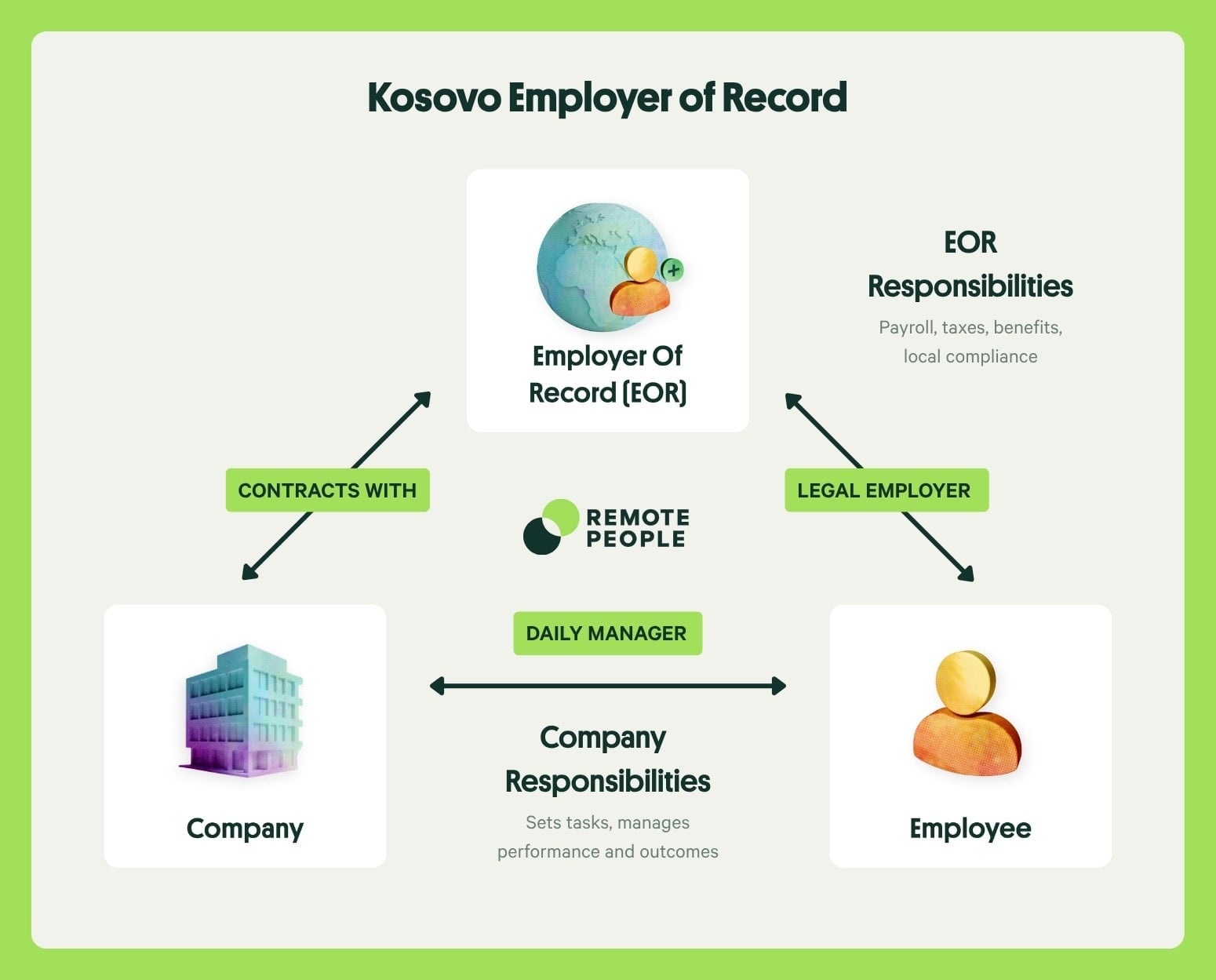
It becomes your official employer of record in Kosovo, handling all the compliance, payroll, benefits, and statutory obligations under Kosovo labor law while you focus on running the business.
The guide below covers everything you need to know about hiring through an EOR in Kosovo in 2026: employment regulations, tax structures, work permits, leave entitlements, termination rules, and actual costs. Whether you’re entering Kosovo for the first time or scaling an existing team, this will help you choose the right hiring path for your situation.
How an Employer of Record Works in Kosovo
Who Uses an EOR in Kosovo?
EOR services are a great fit for startups and scale-ups moving into Kosovo for the first time use EOR services to avoid the costs and delays of entity registration. Remote-first companies building small teams of 1–10 people find it practical since no physical office is needed. Businesses piloting operations in Kosovo before committing to a permanent entity can scale or exit quickly through the EOR model.
Global enterprises with operations across multiple countries also use EOR services to outsource local payroll and compliance while keeping central control of hiring decisions and strategy.
Typical Onboarding Timeline
Here’s how the EOR onboarding process works in Kosovo:
- First, You and the EOR agree on contract terms, and you provide employee details: full name, address, banking info, and tax ID if you have it.
- Second, The EOR applies for work permits (if your hire is a foreign national) and registers the employee with TAK and the Kosovo Pension Savings Trust (KPST).
- Third, Once approvals come through, the employment contract gets executed. Your employee completes onboarding and system setup.
- Fourth, The first payroll runs: salary, pension contributions, and taxes. Then it’s ongoing support and compliance from there on.
If you’re hiring a foreign national, add 1–3 months for work and residence permits, depending on how backed up the Ministry of Internal Affairs is.
Hire in Kosovo
One of Europe’s youngest nations with its own Labor Law, pension trust contributions, and rapidly developing employment regulations.
We handle employment contracts, payroll, social contributions, and full Kosovar compliance.
No local entity needed. Your team can start in days.
Employment Laws and Regulations in Kosovo
Employment Contracts
All employment contracts in Kosovo must be written and follow Law No. 03/L-212 on Labour. They need to cover the job title, duties, salary, benefits, hours, and probation period if there is one. Contracts can be open-ended or fixed-term.
By law, you must explain the key terms to the employee before they sign, and give them a copy within 7 days of start. An EOR drafts and maintains these contracts, making sure they include all the mandatory stuff: minimum leave, overtime rules, notice periods, and so on.
Any changes to a contract need to be in writing and signed by both sides. Kosovo courts don’t recognize verbal changes. The EOR makes sure contract updates are documented properly, whether it’s a role change, raise, or benefit shift, and keeps records for tax and labor inspectorate audits.
Working Hours and Overtime
The standard working week in Kosovo is 40 hours across 5 days (8 hours per day). You can go up to 48 hours total including overtime. Overtime is capped at 8 hours per week and 200 hours per year.
The rates depend on when the work happens:
Kosovo overtime and premium pay rates · Per Law No. 03/L-212 on Labour | |||
Hour Type | Rate Multiplier | Weekly/Daily Cap | Notes |
|---|---|---|---|
Weekday Overtime | 120% of hourly rate | 8 hours | 200 hours |
Night Shift Overtime | 130% of hourly rate | 8 hours | 200 hours |
Weekends & Public Holidays | 150% of hourly rate | 8 hours | 200 hours |
Minimum Wage
As of January 1, 2026, Kosovo’s minimum wage is EUR 425 per month, and it’ll jump to EUR 500 per month on July 1, 2026. That’s a big jump from the EUR 350 rate that was in place until late 2024. The minimum wage applies across all employment contracts and is set by the Ministry of Finance working with employers and unions.
An EOR makes sure your salary numbers always meet or beat the statutory minimum for that period.
Probation Period
Probation periods can’t exceed 6 months in Kosovo. During probation, either party can end the contract with just 7 days’ notice, no reason needed, and there’s no severance. After probation ends, the notice period rules change based on how long the person has worked there (see the section on Termination).
Probation has to be spelled out in the employment contract up front. An EOR includes the right probation language and tracks when it ends so the employee automatically moves into the standard notice-period rules.
Leave Entitlements
Annual Leave
Every employee in Kosovo gets annual leave per year. After 5 years with the company, they get an extra day for every additional 5-year period. Leave is paid at their regular rate and must be taken.
You can’t just cancel unused leave, it carries over or gets paid out when they leave. The EOR tracks leave requests, makes sure nobody goes over their balance, and calculates any payout owed for unused days when someone departs.
Sick Leave
Employees in Kosovo get 20 paid sick leave days per year at 100% salary, paid by you. A doctor’s note is needed if someone’s out for more than 3 consecutive days. Sick leave is tracked separately from annual leave.
The EOR handles sick leave requests, checks the medical docs, and makes sure your employees get paid their full salary while they’re out.
Maternity Leave
Maternity leave in Kosovo is 12 months total: 6 months you pay at 70% salary, 3 months the government pays at 50%, and 3 months unpaid. The employee is protected throughout, you can’t fire them while they’re on maternity leave. The EOR coordinates with social security on the government-funded parts and adjusts the salary for the part you’re paying.
Paternity Leave
paternity leave from you, plus 2 weeks unpaid that can be used before the child turns 3. The paid 10 days have to be taken within 3 months of birth. The EOR handles paternity leave requests and makes sure the employee gets their full salary for those paid days.
Other Statutory Leave
Your employees also get bereavement leave, plus all public holidays off. Marriage and bereavement leave are paid in full. Public holidays are non-working days, no pay reduction. (Though if someone wants to work on a public holiday, overtime rates kick in.)
Kosovo has 15 public holidays in 2026, mixing religious observances like Orthodox Christmas, Easter, and Islamic holidays with national celebrations like Independence Day and Constitution Day. The EOR keeps a holiday calendar updated and makes sure payroll gets the holiday pay right.
Here’s a full breakdown of all the leave types and what employees get:
Kosovo statutory leave entitlements · Per Law No. 03/L-212 on Labour | ||
Leave Type | Duration | Pay Rate |
|---|---|---|
Annual Leave | 20 working days/year, +1 day per 5 years tenure | 100% of regular salary |
Sick Leave | 20 days/year | 100% of salary |
Maternity Leave | 12 months (6 mo. employer-paid, 3 mo. govt-paid, 3 mo. unpaid) | 70% (employer), 50% (govt), 0% (unpaid) |
Paternity Leave | 10 days paid + 2 weeks unpaid before child age 3 | 100% paid, 0% unpaid |
Bereavement Leave | 5 days | 100% of salary |
Marriage Leave | 5 days | 100% of salary |
Public Holidays | 15 days/year (non-working) | 100% of salary (no deduction) |
Source: Law No. 03/L-212 on Labour and Kosovo Tax Administration | ||
Statutory Employee Benefits
Kosovo requires pension contributions to KPST (Kosovo Pension Savings Trust) totaling 10% of gross salary, 5% from the employer and 5% from the employee. There’s no separate health insurance or unemployment insurance deducted from pay; health care is funded through general taxes. You’re required by law to provide a safe workplace, safety training, and injury prevention.
Some companies go beyond what’s mandatory and offer things like health insurance, meal vouchers, or transportation allowances, but those are optional.
Recent Regulatory Updates (2026)
The big change in 2026 is the minimum wage jump to EUR 425 in January and EUR 500 in July, that affects every employment contract. TAK (Kosovo Tax Administration) is also cracking down on working hour compliance, overtime records, and getting payroll taxes filed on time. No major Labour Law overhaul is coming; earlier reform proposals from 2018 and 2021–2025 didn’t go anywhere.
Keep an eye on TAK guidance for any interpretation updates and make sure you’re documenting compliance with hour limits and overtime caps to stay out of trouble.
Work Permits and Visas in Kosovo
Work Permit Requirements
Who Needs a Work Permit
Any foreign national wanting to work in Kosovo for more than 90 days needs a work permit from the Kosovo Ministry of Internal Affairs. Kosovo isn’t in the EU or Schengen Area, and doesn’t have work-freedom agreements with most countries. EU citizens and a few others may not need a permit for short stays, but it is worth confirming with the Ministry before you hire.
To be safe: assume anyone who’s not a Kosovo citizen needs both a work permit and a temporary residence permit if they’re staying longer than 90 days.
Eligibility and Required Documents
It depends on which permit type you need. Kosovo has five main categories: Type A for highly skilled workers in short-supply fields, Type B for workers with specific qualifications, Type C for temporary or seasonal work, Type D for self-employed people, and short-term (up to 90 days) or long-term (over 90 days) permits. You’ll typically need a valid passport, employment contract, proof the employer is registered, a medical certificate, background clearance, proof of where they’ll live, and bank statements showing they have financial resources.
The EOR gathers all that and deals with the Ministry for you.
Processing Time and Validity
1–3 months to process depending on the permit type and how busy the Ministry is. They’re typically issued for up to 1 year and can be renewed. A temporary residence permit comes at the same time and lasts up to 1 year, also renewable.
Delays happen regularly, so the EOR should plan ahead when you’re bringing on foreign hires. Want to dig deeper on work permits and your options? Check out our guides on minimum wage in Kosovo and hiring contractors in Kosovo.
Renewal Process
Start renewal 30–60 days before the permit expires. The employee or EOR files renewal docs with the Ministry of Internal Affairs. It usually takes 2–6 weeks.
If the renewal application is submitted on time, the employee can keep working even after the old permit technically expires. The EOR keeps track of expiration dates and submits renewals so there’s no gap in legal authorization.
Common Visa Types for Foreign Workers
Kosovo has several visa and work permit categories for foreign workers. Here’s what’s available:
Kosovo work visa types for foreign workers · 2026 | ||||
Permit Type | Eligibility | Processing Time | Validity | Renewal |
|---|---|---|---|---|
Type A (Highly Skilled) | Professionals in shortage sectors (IT, management, engineering) | 1–3 months | 1 year | Renewable |
Type B (Specific Skills) | Workers with specific qualifications for vacant positions | 1–3 months | 1 year | Renewable |
Type C (Temporary/Seasonal) | Temporary projects, seasonal agriculture, construction | 2–4 weeks | Up to 6 months | May require new application |
Type D (Self-Employment) | Business owners or freelancers establishing operations | 2–4 weeks | 1 year | Renewable |
Short-term (≤90 days) | Short-term assignments, training, consulting visits | Few days to 2 weeks | Up to 90 days | Not applicable |
How an EOR Handles Work Permits
Your EOR takes the entire work permit and residence permit process off your hands. They prepare the application package, get employer certifications, submit everything to the Ministry of Internal Affairs, track where it stands, and tell both the employee and you when it’s approved. They also manage renewals 30–60 days before expiration so there’s never a gap in legal work authorization.
That saves your company a ton of admin work and kills the risk of visa lapses that could shut down someone’s employment or create legal penalties.
Payroll, Taxes, and Social Security in Kosovo
Employer Contributions
You’re required to contribute 5% to KPST (gross salary) (Kosovo Pension Savings Trust). That’s your main statutory obligation, no separate health insurance, unemployment, or disability deductions. The 5% applies to gross salary regardless of tax bracket.
The EOR includes this in your overall benefits costs, builds it into payroll, and sends it to KPST monthly.
Kosovo employer social security contributions · 2026 rates | ||
Contribution Type | Rate | Basis |
|---|---|---|
Pension (KPST) | 5% | Gross salary |
Source: PwC Kosovo Tax Summaries and Kosovo Tax Administration | ||
Employee Contributions
Employees contribute 5% to KPST, withheld from gross pay. It’s mandatory and shows as its own line on paychecks. Plus they pay progressive income tax (next section).
The EOR handles payroll and taxes, they calculate both pension and income tax, withhold both, and remit pension to KPST and tax to TAK by the deadline.
Kosovo employee payroll deductions · 2026 monthly withholdings | ||
Deduction Type | Rate | Basis |
|---|---|---|
Pension (KPST) | 5% | Gross salary |
Income Tax | 0–10% (progressive) | Gross salary, less basic deduction (EUR 30/month) |
Source: PwC Kosovo Tax Summaries and Kosovo Tax Administration | ||
Income Tax
Kosovo uses progressive income tax for wages from a main employer. The tax is on gross salary minus a EUR 30 monthly deduction (EUR 360 a year). If someone has a second job, they pay a flat 10% on that income with no deduction.
An EOR does this math for you. Here’s how the progressive brackets work for the primary employer:
Kosovo income tax brackets · 2026 | |
Annual Income (EUR) | Tax Rate |
|---|---|
Up to EUR 3,000 | 0% |
EUR 3,001–EUR 5,400 | 8% |
EUR 5,401 and above | 10% |
Source: PwC Kosovo Tax Summaries and Kosovo Tax Administration | |
Here’s an example: an employee making EUR 6,000 gross annually from their main employer. Take EUR 6,000 minus EUR 360 basic deduction = EUR 5,640 taxable. On the first EUR 3,000: 0% = EUR 0.
On the next EUR 2,400 (between EUR 3,001–EUR 5,400): 8% = EUR 192. On the remaining EUR 240 (above EUR 5,400): 10% = EUR 24. Total tax for the year: EUR 216 (3.6% average).
The EOR runs this automatically and withholds tax each payroll cycle. Want the details? Check out our guide on payroll and tax compliance in Kosovo.
Payroll Cycle
Most Kosovo employers pay once a month. You pay for the work done that month by the last day of the month. The EOR calculates gross salary, deducts the 5% pension and income tax, deposits net pay to the employee’s bank, and files tax and social security reports with TAK and KPST by the monthly deadline (usually the 10th).
Some places do advance payments or every two weeks, but monthly is standard and cleanest for taxes and social security.
13th Month Salary and Bonus Pay
Kosovo doesn’t require a 13th month bonus. But some companies, especially larger ones or those competing for talent, do offer an extra month’s pay or a year-end bonus in December. If you do it, it’s taxed and has pension contributions just like regular salary.
You have to document it and tell your employee beforehand. An EOR will process 13th month bonuses or performance bonuses however your employment contract and company policy say to do it.
Cost of Hiring Through an EOR in Kosovo
EOR Service Fees
EOR fees in Kosovo run EUR 250–500 per employee monthly (about USD 270–540), depending on employment complexity, headcount, and service level. The fee typically covers payroll, tax, benefits, work permits, and basic HR. Add-ons like recruitment support, training coordination, or executive payroll cost extra.
The EOR fee is separate from salary and contributions. For context: hiring your own accountant, HR person, and legal counsel in-house would cost you EUR 3,000–5,000+ monthly for a small admin team.
Total Employment Cost Breakdown
Your total monthly cost has three parts: the employee’s gross salary, your 5% pension contribution, and the EOR fee. Here’s what it looks like for a typical hire:
Kosovo employer cost example · USD 5,000 gross · 2026 | ||
Cost Component | Amount (USD) | Notes |
|---|---|---|
Gross Monthly Salary | $5,000 | Employee’s stated salary |
Employer Pension Contribution (5%) | $250 | Mandatory to KPST |
EOR Service Fee | $450 | Estimated payroll, tax, benefits administration |
Total Monthly Cost | $5,700 | 14.0% above gross salary |
In that example, you’re paying $5,700 a month total for a $5,000 salary, a 14% markup to cover the pension contribution and EOR overhead. That’s way cheaper than setting up and running your own Kosovo company, which needs registration, office space, and ongoing tax and HR compliance costs. Want salary benchmarks?
Our guide on average salary in Kosovo has the details.
Benefits of Using an EOR in Kosovo
Speed is the biggest draw. You can have someone on payroll in Kosovo within 1–2 weeks through an EOR, compared to 3–6 months if you’re registering your own company. There are no company registration fees, no office lease, and no ongoing admin overhead because the EOR is the legal employer and takes on all compliance liability.
On the compliance side, the EOR makes sure you follow Kosovo’s Labour Law (Law No. 03/L-212), the Tax Code, and social security rules, which means less audit risk and no surprise penalties. They handle monthly payroll, income tax withholding, pension contributions, and all filings with TAK and KPST, so you don’t need to hire a local accountant or learn the Kosovo tax calendar.
For companies hiring foreign nationals, the EOR manages the entire work permit and residence permit process, including applications to MLSW and the Kosovo Police. And because you’re not locked into a local entity, you can scale your Kosovo team up or down without the legal headaches of dissolving a company. The EOR also keeps you current on any changes to Kosovo employment law, tax rates, or social security rules, so you’re never caught off guard by a regulatory update.
Ready to hire in Kosovo? Contact our team today to learn how an EOR can streamline your expansion.
Termination and Offboarding in Kosovo
Notice Periods
Notice periods depend on how long someone’s worked there and are counted in calendar days, not working days. Here’s what the law requires:
Kosovo statutory notice periods by position level · Per Law No. 03/L-212 on Labour | |||
Employment Status/Period | Notice Period (Calendar Days) | Who Can Terminate | Severance Obligation |
|---|---|---|---|
During Probation (max 6 months) | 7 days | Either party | None |
6 months – 2 years tenure | 30 days | Either party | None (individual termination) |
2–10 years tenure | 45 days | Either party | Only if part of collective dismissal (10%+ of workforce) |
Over 10 years tenure | 60 days | Either party | Only if part of collective dismissal (10%+ of workforce) |
Fixed-term contract | 30 days (before expiry) | Either party | None |
Source: Law No. 03/L-212 on Labour and Kosovo Tax Administration | |||
Severance Pay
Severance only applies if you’re doing a collective dismissal (when you’re letting go 10% of your workforce or at least 20 people). Individual terminations don’t trigger severance, even if they’re justified, unless they’re part of a bigger collective dismissal. Here’s what severance looks like when it applies:
Kosovo severance pay schedule by years of service · Per Law No. 03/L-212 on Labour | |||
Years of Tenure | Severance Amount | Calculation | Notes |
|---|---|---|---|
2–4 years | 1 month salary | Last gross monthly salary × 1 | Applies only in collective dismissal |
5–9 years | 2 months salary | Last gross monthly salary × 2 | Applies only in collective dismissal |
10–19 years | 3 months salary | Last gross monthly salary × 3 | Applies only in collective dismissal |
20–29 years | 6 months salary | Last gross monthly salary × 6 | Applies only in collective dismissal |
30+ years | 7 months salary | Last gross monthly salary × 7 | Applies only in collective dismissal |
Source: Law No. 03/L-212 on Labour and Kosovo Tax Administration | |||
Calculation Method
Severance is the employee’s last gross monthly salary (regular pay and allowances, but not bonuses or one-time payments) times the number of months they’re owed based on their tenure band. Simple math: if someone with 8 years tenure earning EUR 1,500/month is in a qualifying collective dismissal, they get EUR 1,500 × 2 = EUR 3,000.
Caps and Exceptions
collective dismissal threshold of 10% of your workforce (minimum 20 people) in a set timeframe. Single terminations don’t trigger it no matter the reason. Also, no severance if someone was fired for serious misconduct like theft, violence, or gross insubordination.
The EOR figures out who qualifies for severance and calculates the right amounts when you’re offboarding people.
Grounds for Termination
You can terminate under several grounds: (1) lack of skills or poor performance (with written warnings), (2) redundancy or business closure, (3) serious misconduct or breach of the employment agreement, (4) being unable to work due to illness or injury, and (5) mutual agreement. During probation, either side can terminate without cause and with just 7 days’ notice, no severance. After probation, terminating without a valid reason could get you hit with an unfair dismissal claim.
That said, Kosovo’s labour courts tend to side with employers if you’ve done the basics, documenting the issue, giving warnings, and respecting notice periods. The EOR makes sure terminations are documented right and notice periods are followed so you’re protected.
EOR vs. Other Hiring Models in Kosovo
EOR vs. Setting Up a Local Entity
It comes down to your team size, how long you plan to stay, and how much you expect to grow in Kosovo. Here’s how they compare:
Kosovo EOR vs local entity comparison · Setup time, cost, risk and best-fit | ||
Comparison | Employer of Record (EOR) | Local Legal Entity (LLC) |
|---|---|---|
Setup Time | 1–2 weeks | 3–6 months |
Upfront Cost | EUR 0 | EUR 5,000–EUR 15,000 |
Ongoing Monthly Cost (per employee) | EUR 300–EUR 600 (EOR fee) | EUR 1,000–EUR 2,000 (accountant, compliance, admin overhead) |
Local Partner Required | No (EOR is the partner) | Yes (legal counsel, accountant, HR) |
Social Insurance Registration | EOR handles | You manage (or outsource) |
Payroll & Tax Filing | EOR handles | You manage (or outsource) |
Best for Team Size | 1–15 employees | 15+ employees |
Scale Down / Exit | Easy; no entity to unwind | Costly; legal dissolution required |
Government Contracts Eligible | No | Yes (with local registration) |
The EOR makes sense when you’re hiring fewer than 15 people and don’t plan to bid on Kosovo government contracts. Once your team grows past that, the per-employee EOR fee starts to add up and a local entity becomes more cost-effective. But for market entry, testing demand, or building a small distributed team, the EOR saves you months of setup time and thousands in upfront costs.
EOR vs. Hiring Independent Contractors
Some companies want to bring in contractors to sidestep payroll and benefits costs. But that’s risky. Kosovo’s Labour Law looks at what’s actually happening, not just what you call someone.
If a contractor works full-time under your control, uses your equipment, and is woven into your team, the tax authorities and courts will likely reclassify them as an employee, and then you’re on the hook for back taxes and penalties. Here’s what the trade-offs look like:
Kosovo EOR vs independent contractors · Compliance, cost, and risk | ||
Aspect | EOR (Employee) | Independent Contractor |
|---|---|---|
Legal Relationship | Employee of EOR; contractual relationship with your company | Self-employed; no employment relationship |
Compliance Risk | Low; EOR ensures labour law compliance | High; misclassification risk if work resembles employment |
Payroll & Tax | EOR withholds tax and contributions; you remit to authorities | Contractor invoices you; they handle own taxes (if compliant) |
Benefits & Leave | Statutory benefits, paid leave, social security coverage | No entitlement to employee benefits; no leave accrual |
IP Protection | Stronger; employment contract assigns IP by default | Weaker; requires explicit IP assignment clause |
Termination | Subject to notice periods and severance rules | Can be ended per agreement terms; more flexibility |
Best Use Case | Long-term roles, core team members, permanent positions | Project-based work, specialist tasks, short-term engagements |
Cost Structure | Salary + 5% pension + EOR fee | Invoice-based; no benefits overhead |
The contractor route looks cheaper on paper, but the misclassification risk in Kosovo is real. If someone works full-time under your direction, uses your tools, and is integrated into your team, the tax authorities will treat them as an employee regardless of what the contract says. The back taxes, penalties, and legal costs that follow usually dwarf whatever you saved on benefits.
For ongoing, core roles, the EOR path is safer and often cheaper in the long run.
EOR vs. PEO
EOR and PEO (Professional Employer Organization) sound the same but they’re different. A PEO requires you to have a local company already set up; then the PEO co-employs your staff and handles HR, payroll, and compliance while you keep control. An EOR is the sole legal employer, it’s what you use when you don’t have a local entity.
Kosovo doesn’t have formal PEO rules, so organizations calling themselves PEOs are usually just staffing agencies or HR consultants without real co-employment. For most companies entering Kosovo without local presence, the EOR model is what you’ll use. Here’s the breakdown:
Kosovo EOR vs PEO comparison · Legal employer, liability, and setup | ||
Feature | Employer of Record (EOR) | Professional Employer Organization (PEO) |
|---|---|---|
Legal Employer Status | EOR is the sole legal employer | PEO and client co-employ; client must have entity |
Local Entity Required | No; EOR is your local entity | Yes; client must be registered company |
Best For | Companies without local presence; market entry; testing | Companies with existing entity needing HR outsourcing |
Compliance Liability | EOR assumes full liability | Shared between PEO and client company |
Setup Time | 1–2 weeks | 2–4 weeks (entity already exists) |
HR Policy Control | EOR follows Kosovo law; client sets role/compensation | Client retains full HR policy control |
Typical Use Case | Rapid expansion, distributed teams, small groups | Established operations needing HR outsourcing |
Source: Kosovo Tax Administration and Law No. 03/L-212 on Labour | ||
For most companies entering Kosovo, the EOR model is the clear choice. PEOs require you to already have a registered entity, which defeats the purpose if you’re trying to avoid that setup cost and timeline. The EOR takes on full legal employer status, handles all filings, and lets you focus on managing your team rather than navigating Kosovo’s business registration process.
Public Holidays in Kosovo
Kosovo has 15 official public holidays in 2026, a mix of national observances, religious holidays (Orthodox Christian and Islamic), and international celebrations. On a public holiday, employees don’t work and get paid in full. If someone does work on a public holiday, they get overtime at 150% of their hourly rate.
The EOR keeps a current holiday calendar and makes sure payroll treats holidays correctly and tracks any overtime. Here’s the full 2026 list:
Kosovo public holidays · 2026 calendar year | ||
Date | Holiday Name | Type |
|---|---|---|
January 1 | New Year’s Day | National |
January 2 | Second Day of New Year | National |
January 7 | Orthodox Christmas | Religious |
February 17 | Independence Day | National |
March 20 | Eid al-Fitr | Religious |
April 5 | Easter (Catholic) | Religious |
April 6 | Easter Monday (Catholic) | Religious |
April 9 | Constitution Day | National |
April 12 | Orthodox Easter | Religious |
April 13 | Orthodox Easter Monday | Religious |
May 1 | International Labour Day | International |
May 9 | Europe Day | International |
May 11 | Day Off for Europe Day | Observed |
May 27 | Eid al-Adha (Kurban Bayrami) | Religious |
December 25 | Christmas Day | Religious |
How to Get Started with an EOR in Kosovo
Getting your first employee on board through an EOR is simple. Here are the five steps:
- First, assess your needs. Think about the role, salary, required skills, and whether you’re hiring a Kosovo citizen or someone from abroad (that changes the work permit timeline). Lock down the start date and rough team size.
- Second, pick an EOR provider. Look for EOR firms with Kosovo experience. Compare their fees, what they cover (payroll, benefits, work permits), and reviews from past clients. Get a quote and service agreement that fits your needs and budget.
- Third, hand over employee info. Give the EOR the candidate’s full name, date of birth, address, bank account details, and tax ID if you have it. For foreign nationals, add passport info and the visa type they’ll need.
- Fourth, sign contracts and file paperwork. The EOR drafts a Kosovo-compliant employment contract, you both sign it, and the EOR registers the employee with TAK and KPST. For foreign hires, they also submit the work and residence permit applications.
- Fifth, start payroll and keep going. On day one, the EOR runs the first payroll, deposits the salary, and starts monthly filings with tax and social security. You handle day-to-day management and performance; the EOR takes care of all the legal stuff.
Where companies hiring in Kosovo expand next
Teams hiring in Kosovo commonly expand across Central and Eastern Europe, where competitive labor costs and EU market access anchor regional growth. Most teams start with operations in Romania — aligned compensation ranges and delivery speed. Hungary typically follows, with matching cost-to-quality tier. Hiring in Poland is a natural addition for similar cost profile and comparable hiring speed, and an EOR partner in the Czech Republic completes the regional picture with parallel labor-cost tier and talent supply.
Frequently Asked Questions
EOR services in Kosovo typically cost between $300 and $600 per employee per month as a flat service fee. On top of that, you pay the employee's gross salary plus the 5% employer pension contribution to KPST (Kosovo Tax Administration). For a USD 5,000 gross salary, the total monthly cost comes to about USD 5,700, or 14% above gross.
For Kosovo citizens, you're looking at 1–2 weeks from signing the contract to the first paycheck. For foreign nationals who need a work permit, add 1–3 months depending on how fast the Ministry of Internal Affairs processes the application (Law No. 03/L-212 on Labour). A good EOR can help push things along.
Only if you're doing a collective dismissal (10% of your workforce or at least 20 people). Individual terminations don't come with severance, even if there's a valid reason, unless they're part of a bigger round of layoffs (Law No. 03/L-212 on Labour). You always have to pay out any unused vacation days when someone leaves.
You technically can for project-based or short-term work, but Kosovo's tax authorities will treat someone as an employee if they work full-time, follow your direction, and are embedded in your operations. Getting caught with a misclassified contractor means back taxes and penalties (Law No. 03/L-212). For anything ongoing, hiring through an EOR is the compliant route. RemotePeople also offers contractor management in Kosovo if you need a hybrid approach.
Yes. A full-service EOR takes the entire work and residence permit process off your hands, from application through approval and renewal. That includes filings with the Ministry of Internal Affairs and Kosovo Police (Government of Kosovo). No bureaucratic hassle for your company and faster turnaround.
Kosovo law requires 20 working days annual leave, 20 days paid sick leave, 12 months maternity leave (at different pay rates depending on the phase), and 10 paid days paternity leave, plus bereavement and marriage leave (Law No. 03/L-212 on Labour). You also contribute 5% of salary to KPST (Kosovo Tax Administration). An EOR tracks all of this for you.
Yes, it's optional but common in competitive industries. If you offer a 13th month salary, it gets taxed and has pension contributions just like regular pay under Kosovo's Tax Code (Kosovo Tax Administration). Document it in the employment contract or notify the employee in advance.
An EOR is the legal employer and is what you use when you have no local company in Kosovo. A PEO works alongside your existing local entity and co-employs your staff. Kosovo doesn't have formal PEO regulations, so most companies entering without a local presence use the EOR model (Law No. 03/L-212 on Labour).
Employer of Record in
Employer of Record in
Employer of Record in
Employer of Record in
Employer of Record in
Employer of Record in
Employer of Record in
Employer of Record in