
 Recruit
Employer of Record in Moldova
-
 Drew Donnelly
- Published
- September 22, 2026
Hire employees in Moldova without setting up a local entity. RemotePeople handles payroll, contracts, tax compliance, and benefits – so you can build your Moldova team in days, not months.
Hire in Moldova — book a free 30-minute demo
Tell us what you need. You'll get a tailored, transparent proposal within 24 hours, plus a free call to walk through it.
Tell us about your company
So we can match you with a specialist who knows your market — and unlock volume pricing tiers.
* All fields are required.
Where and when are you hiring?
Tell us the geography and timing and we'll quote each country line by line, with onboarding timelines.
* All fields are required.
Help us beat your current setup
We'll benchmark your current deal and send a line-by-line proposal in 24 hours — showing exactly where we cut cost, time, or risk. After you submit, you can book a call to walk through it together.
* All fields are required.
Thanks! Your proposal is on its way.
Expect a tailored, line-by-line proposal in your inbox within 24 hours. In the meantime…
Want to walk through it together?
Book a free 30-minute call with one of our specialists. We'll explain every line, answer your questions, and tailor the proposal further if you need.
No obligation. Pick a time that works for you.








- Hire in Moldova — book a free 30-minute demo
- Tell us about your company
- Where and when are you hiring?
- Help us beat your current setup
- Thanks! Your proposal is on its way.
- How an Employer of Record Works in Moldova
- Employment Laws and Regulations in Moldova
- Work Permits and Visas in Moldova
- Payroll, Taxes, and Social Security in Moldova
- Cost of Hiring Through an EOR in Moldova
- Benefits of Using an EOR in Moldova
- Termination and Offboarding in Moldova
- EOR vs. Other Hiring Models in Moldova
- Public Holidays in Moldova
- How to Get Started with an EOR in Moldova
- Where companies hiring in Moldova expand next
- Frequently Asked Questions
- Related EOR Destinations

Start hiring in Moldova
Let RemotePeople handle payroll, compliance, and HR admin worldwide so you can focus on building your team.

Hiring employees in Moldova requires navigating a multi-tiered tax structure, mandatory social insurance contributions, and labour regulations governed by the Labour Code No. 154-XV. An employer of record (EOR) in Moldova handles these obligations on your behalf, allowing you to employ staff without establishing a legal entity in the country. This guide covers everything you need to know about hiring through an employer of record in Moldova in 2026, from payroll and taxes to work permits and statutory benefits.
Whether you’re a startup expanding into Eastern Europe or a multinational company adding Moldovan talent to your team, using an EOR in Moldova simplifies the employment process while ensuring full compliance with Moldovan law.
How an Employer of Record Works in Moldova
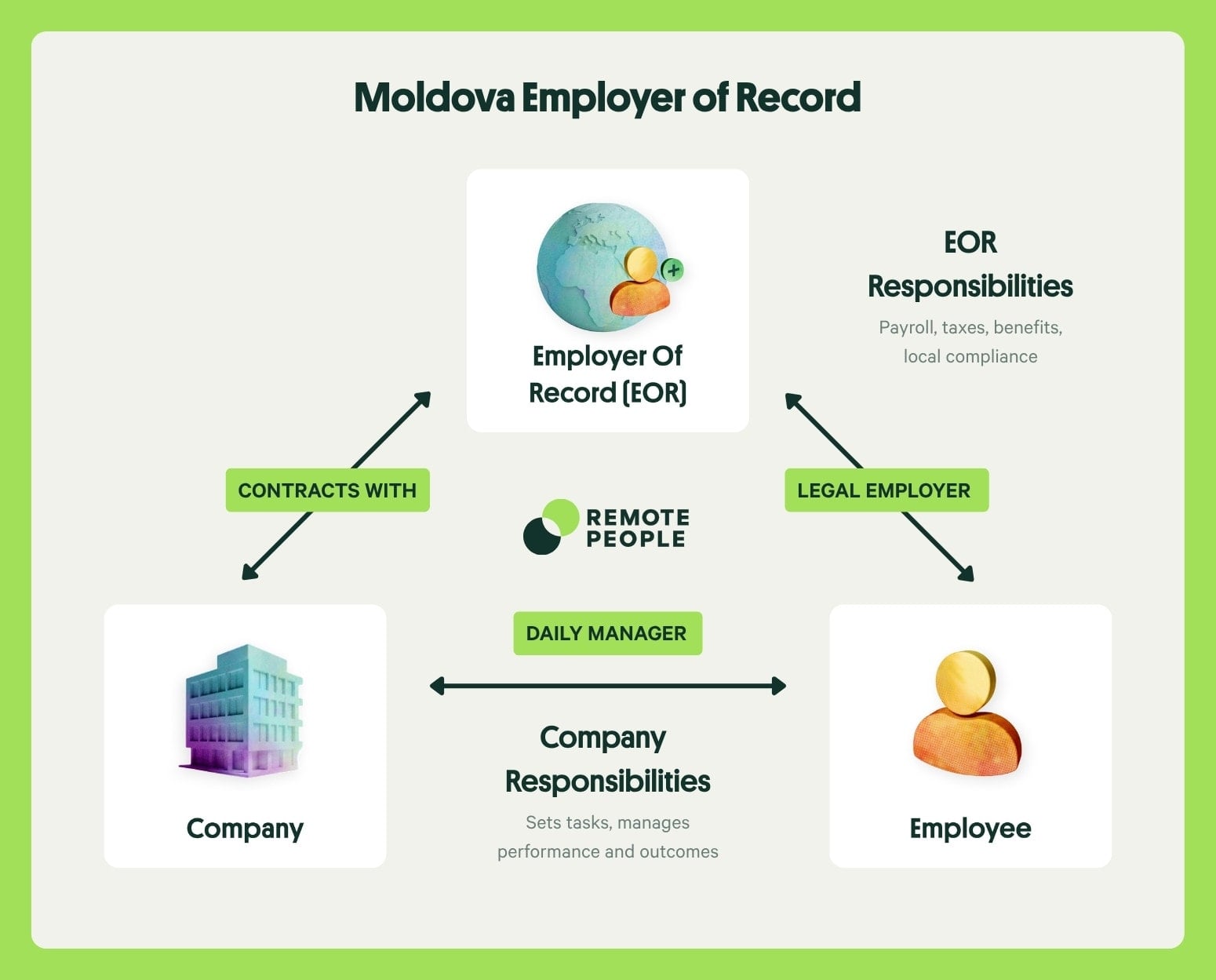
If you’d like to learn more about how Employer of Record (EOR) services work, read our What Is an Employer of Record (EOR)? guide for a complete overview of the model, its benefits, and when to use it.
If you’re comparing providers, our Best Employer of Record (EOR) Providers guide reviews the leading platforms to help you choose the right solution for your business.
Who Uses an EOR in Moldova?
Employers use EOR services in Moldova for several common scenarios:
- Market testing: Companies wanting to validate demand and build a small team in Moldova before committing to a permanent entity, avoiding months of setup overhead and compliance risk.
- Rapid hiring: Organizations needing to onboard talent quickly, within 1–2 weeks, without the 6–12 week timeline required to establish a local subsidiary and register with tax authorities.
- Foreign worker sponsorship: Employers hiring non-EU nationals who require work permit sponsorship, visa coordination, and ongoing immigration compliance that an EOR simplifies.
- Small distributed teams: Companies with fewer than 15 Moldovan employees who find the cost and complexity of maintaining a local payroll operation prohibitive compared to an EOR’s fixed monthly fee.
Typical Onboarding Timeline
Once you engage an EOR provider, the hiring process typically unfolds as follows:
- Initial verification and documentation: 1–2 days. The EOR confirms employee identity, collects passport copies, and gathers baseline employment information.
- Employment contract drafting and review: 2–3 days. The EOR prepares a contract compliant with the Moldovan Labour Code and local language requirements, and reviews the terms with the employee.
- Social security and tax registration: 3–7 days. The EOR registers the employee with CNAS for social insurance and CNAM for health insurance, and secures a tax registration reference (if not already on file).
- Payroll setup and benefits enrolment: 2–3 days. The EOR establishes the payroll record, sets up direct bank transfer for salary payment, and ensures benefits eligibility is documented.
- Employee onboarding and first day: 1 day. The employee receives their contract, bank account instructions, and any required compliance training, and begins work.
End-to-end, you can have a fully compliant Moldovan employee on payroll within 1–2 weeks. Non-EU nationals requiring work permits will extend this timeline by 2–4 weeks to allow for visa processing through Moldova’s immigration authority.
Hire in Moldova
Competitive employer costs at 24% social security, a well-educated multilingual workforce, EU candidate status opening the door to closer European integration, and a growing IT and engineering talent pool make Moldova an attractive market for international hiring.
We handle employment contracts, payroll, tax withholding, and full Moldova compliance.
No local entity needed. Your team can start in days.
Employment Laws and Regulations in Moldova
An employer of record in Moldova operates within strict legal frameworks governing employment relationships, wages, leave, and statutory benefits. Understanding Moldova’s labour law is critical for compliance whether you hire directly or through an EOR provider. The Labour Code No. 154-XV of March 28, 2003 (as amended), administered by the Ministry of Labour and Social Protection, governs all employment relationships and sets minimum standards that override any less favourable contractual terms. Below are the key legal requirements affecting employment in Moldova.
Employment Contracts
Moldovan labour law requires a written employment contract for every employee. The contract must specify job title, place of work, salary, start date, and employment term (permanent, fixed-term, or probationary). The contract must be written in a language accessible to the employee (typically Romanian or Russian). Any changes to employment terms require a written amendment signed by both parties. For a detailed breakdown of contract requirements, employers should reference the full Labour Code text.
Working Hours and Overtime
The standard working week in Moldova is 40 hours, typically spread across 8 hours per day, 5 days per week with 2 days of rest. Employees are entitled to a minimum of 12 consecutive hours of rest between shifts and 42 hours of uninterrupted weekly rest. Overtime is strictly regulated and capped at 120 hours per calendar year under normal conditions, or up to 240 hours per year with employee consent. On a daily basis, overtime should not regularly exceed 4 hours in a single day or 20 hours in a week. The Labour Code governs all overtime compensation and employers must track cumulative hours carefully to avoid exceeding annual caps.
Moldova overtime and premium pay rates · Per Labour Code No. 154-XV | |||
Hour Type | Rate Multiplier | Weekly/Daily Cap | Notes |
|---|---|---|---|
Overtime (first 2 hours beyond 40h/week) | 150% (1.5x base rate) | 120–240 hours/year max | Minimum pay; requires employee consent above 120h/year |
Overtime (beyond first 2 hours) | 200% (2x base rate) | 120–240 hours/year max | Tiered rate structure; double pay for extended overtime |
Work on weekly rest days or public holidays | 200% (2x base rate) | No statutory daily cap | Separate from standard weekly overtime cap |
Night work (22:00–06:00) | 125% minimum + overtime premium | No statutory daily cap | Additional 25% premium on base rate; stacks with overtime |
Source: Schoenherr Labour Code Analysis and CNAS Regulations | |||
Minimum Wage
As of January 1, 2026, the statutory minimum wage in Moldova is MDL 6,300 per month, a 15% increase from MDL 5,500 in 2025. This rate applies to all employees aged 18 and over. Employers cannot pay less than this amount unless a collective agreement (rare in Moldova) specifies otherwise. The minimum wage is reviewed annually by the government in consultation with employer and union representatives and published by the Ministry of Labour and Social Protection.
Probation Period
Employers in Moldova may establish a probationary period of up to 3 months for general positions, up to 6 months for managerial or specialized roles, or as little as 15 calendar days for unskilled workers. During probation, either party may terminate the employment relationship with just a few days’ notice (exact notice depends on the tenure tier and is outlined in H3 7.1 below). Once probation ends, standard notice periods apply. Probation is optional but commonly used to assess employee fit before committing to permanent employment.
Leave Entitlements
Moldovan labour law guarantees employees a comprehensive suite of paid and unpaid leave. The Labour Code defines each entitlement and eligibility rules. Below is a detailed breakdown of statutory leave types.
Annual Leave
Every employee is entitled to a minimum of 28 working days of annual paid leave per year per the Labour Code. Employees under 18 years old receive one calendar month (approximately 30 working days) annually. Mothers of more than two children under age 14 receive an additional 4 days of paid annual leave. Annual leave must be paid at the employee’s average salary. Employers must grant at least 2 consecutive weeks of leave in a single period each year. Unused leave may be carried over to the next calendar year, though entitlement to carryover is governed by contract or collective agreement.
Sick Leave
Sick leave in Moldova is structured as follows: the first day of illness is unpaid. Days 2 through 5 are paid at 75% of average earnings by the employer. Days 6 through 15 are paid at 100% of average earnings (with a maximum of 15 days per calendar year). Beyond 15 days, the State Social Insurance Agency (CNAS) may cover additional benefits depending on the underlying medical condition. A medical certificate is typically required from day 6 onwards.
Maternity Leave
Maternity leave in Moldova spans 126 calendar days total: 70 days before birth and 56 days after birth per the Labour Code. For complicated births or multiple births, post-natal leave extends to 70 days, totaling 140 calendar days. The state (via CNAS) covers approximately 80% of the employee’s average salary during maternity leave. Job protection is guaranteed during this period.
Paternity Leave
Paternity leave provides 14 calendar days of paid paternity leave per the Labour Code, which may be taken within the first 56 days after childbirth. Leave can be divided into up to three separate periods, each of at least 5 calendar days. The state covers payment during paternity leave.
Other Statutory Leave
Study leave grants employees up to 20 days per year for exam preparation and attendance, paid at average salary. Parental leave allows either parent to take leave until the child reaches 36 months of age, with partial state compensation. Marriage and bereavement leave are not mandated by national law but may be covered by collective agreements or employer policy.
Under the Labour Code No. 154-XV, the table below summarises every statutory leave entitlement and payment responsibility. The key takeaway is that annual leave accrues from the first working day of employment, not after the probation period ends.
Moldova statutory leave entitlements · Per Labour Code No. 154-XV | ||
Leave Type | Duration | Eligibility & Notes |
|---|---|---|
Annual Leave | 28 working days minimum | All employees. Under 18: 1 calendar month. Min 2 consecutive weeks mandatory. Mothers of 2+ children under 14: +4 days. |
Sick Leave (Days 2–5) | 75% of average salary | Paid by employer. Day 1 unpaid. No medical cert. required until day 6. |
Sick Leave (Days 6–15) | 100% of average salary | Paid by employer. Medical certificate required. Max 15 days/year at full pay. |
Sick Leave (Beyond 15 days) | Depends on condition | Paid by State Social Insurance Agency (CNAS) subject to medical evaluation. |
Maternity Leave | 126 calendar days (70 pre, 56 post) | Approx 80% paid by state. Extended to 140 days for complicated or multiple births. |
Paternity Leave | 14 calendar days | Within 56 days of birth. Can be split into up to 3 periods. Paid by state. |
Parental Leave | Until child reaches 36 months | Partial state compensation. Can be split between parents. Job protection guaranteed. |
Study Leave | Up to 20 days per year | For exam prep and attendance. Paid at average salary. |
Source: Schoenherr Labour Code Analysis and CNAS Regulations | ||
Statutory Employee Benefits
Beyond wages and leave, Moldovan employers are required to provide or arrange certain statutory benefits. Health insurance is the primary mandatory benefit, employees contribute 9% (CNAM) to the mandatory health insurance fund, which grants access to the public healthcare system. This contribution is withheld from the employee’s paycheck by the employer. Employers also contribute 18% to social insurance (CNAS), which funds pensions, disability benefits, and sickness allowances. Occupational safety and accident insurance are mandatory, with contribution rates varying by industry classification (typically 0.5–5% depending on occupational risk). When using an EOR provider in Moldova, the employer of record manages all mandatory contribution calculations and filings automatically through payroll. Some employers voluntarily offer additional benefits such as a 13th month bonus (year-end payment, though not legally mandated), supplementary health coverage, or transportation allowances, though these are negotiable and not required by law.
Recent Regulatory Updates 2026
As of January 1, 2026, Moldova’s Labour Code includes new provisions to prevent and combat workplace violence and harassment, aligning with ILO Convention 190. For the first time, the legislation explicitly defines workplace violence (physical assault, intimidation, coercion, verbal/psychological abuse, sexual violence, digital violence) and workplace harassment (unwelcome conduct that undermines dignity, health, or safety). Employers must establish policies and grievance mechanisms to prevent and address these behaviors. Additionally, the government approved a minimum wage increase to MDL 6,300 (effective January 1, 2026), and the average monthly salary in the economy increased from MDL 16,100 to MDL 17,400. These updates reflect Moldova’s continued alignment with international labour standards and its effort to attract and retain talent through improved working conditions.
Work Permits and Visas in Moldova
Non-EU/EEA citizens seeking employment in Moldova must obtain a work permit or visa before beginning work. EU and EEA citizens have the right to work in Moldova without a permit. For all other nationalities, a valid work authorization is a legal requirement and typically sponsored by the employer. Below are the main categories and requirements, administered by Moldova’s immigration authority.
Work Permit Requirements
Who Needs a Work Permit
Non-EU/EEA citizens must obtain a work permit or employment visa. EU and EEA citizens, as well as Swiss nationals, do not require a permit to work in Moldova and can begin employment immediately upon arrival. Citizens of countries with bilateral agreements with Moldova may have exemptions or simplified processes, check with Moldova’s Ministry of Foreign Affairs for country-specific rules.
Eligibility and Required Documents
Non-EU/EEA applicants must provide a valid passport, an employment contract, proof of professional qualifications (degree certificate or work experience letter), and a criminal background check (apostille-certified). Some positions may require medical examinations (especially healthcare, education, or childcare roles). Employers must be registered with Moldovan tax and social insurance authorities to sponsor foreign workers. The EOR takes responsibility for gathering documentation from the employee and submitting the application to Moldova’s immigration authority.
Processing Time and Validity
Work permit and employment visa processing typically takes 2–4 weeks, depending on the visa category and completeness of the application. Initial work permits are valid for 1 year and are renewable. Some visa types (e.g., digital nomad visa, discussed below) offer longer validity periods. Processing can be delayed if documents are incomplete or if additional security checks are required, expect 4–6 weeks in such cases.
Renewal Process
Work permits must be renewed before expiry. Renewal applications should be filed 30 days before the current permit expires to avoid work authorization gaps. If employment terms change significantly (new employer, substantial salary reduction, position change), a new permit may be required. An EOR will manage all renewals and change notifications on your behalf.
Common Visa Types for Foreign Workers
Moldova offers several visa pathways for foreign workers. The Ministry of Foreign Affairs administers these categories. Below is a detailed breakdown of the main visa types used by employers hiring internationally.
Moldova work visa types for foreign workers · 2026 | ||||
Visa Type | Duration | Best For | Leads to Residence? | Processing |
|---|---|---|---|---|
Employment Visa (Type D for Work) | 1 year, renewable | Standard employment; non-EU/EEA workers with valid job offer | Yes, to temporary residence permit | 2–4 weeks |
Highly Skilled Worker Visa | 1–2 years, renewable | IT, engineering, healthcare, education professionals with degree and 3+ years experience | Yes, after 2+ years | 2–3 weeks |
Digital Nomad Visa | Up to 2 years (1-year initial + 1-year renewal) | Remote workers employed by non-Moldovan companies; minimum USD 2,000/month income | Possible with continued eligibility | 10–20 business days |
Self-Employment Permit | 1–2 years, renewable | Non-EU/EEA entrepreneurs and independent contractors starting a business in Moldova | Yes, under self-employment category | 2–4 weeks |
Intra-Company Transfer (ICT) Permit | 1–3 years | Expatriate managers, specialists, trainees moving within a multinational group | Possible, context-dependent | 2–3 weeks |
How an EOR Handles Work Permits
When you hire a foreign national through an EOR in Moldova, the EOR provider takes responsibility for the entire work permit and visa process. This includes preparing and submitting the application to Moldova’s immigration authority, gathering required documentation from the employee, coordinating with the employee’s home country embassy (if a D visa is needed), and tracking application status. The EOR also handles permit renewals and updates when employment terms change. Processing costs (government fees and translation services) are typically passed through to you or bundled into the EOR service fee. By outsourcing these administrative tasks to an EOR, you avoid the delays and complexity of navigating Moldova’s immigration system yourself.
Payroll, Taxes, and Social Security in Moldova
Payroll administration in Moldova is governed by the Labour Code No. 154-XV and tax regulations enforced by the Serviciul Fiscal de Stat (State Tax Service). Employers must calculate and remit both employer and employee contributions monthly, along with income tax withholding. An EOR handles all these obligations, ensuring compliance with Moldova’s multi-tiered tax and contribution system.
Employer Contributions
Moldova’s employer contributions are among Europe’s highest, placing the primary financial burden on employers for funding the country’s public insurance system. The combined employer contribution rate is 18% of gross salary in 2026, calculated on all wages. This rate funds pensions, healthcare, disability benefits, and workplace accident insurance.
Moldova employer contributions · 2026 | ||
Contribution Component | Rate | Notes |
|---|---|---|
CNAS (State Social Insurance) | 18% | Covers pensions, disability, sickness, family benefits, and workplace safety |
Total employer contribution | 18% | Applied to all gross wages; no annual ceiling |
Employee Contributions
Employees in Moldova contribute to social insurance and health insurance schemes, which are deducted from their paycheck before income tax is calculated. The total employee contribution rate is 15% in 2026: 6% to CNAS (social insurance) and 9% to CNAM (mandatory health insurance). These deductions are mandatory.
Moldova employee payroll deductions · 2026 monthly withholdings | ||
Withholding Component | Rate | Notes |
|---|---|---|
CNAS (State Social Insurance) | 6% | Deducted pre-tax; funds pensions and disability |
CNAM (Health Insurance) | 9% | Deducted pre-tax; mandatory coverage |
Personal Income Tax (PIT) | 12% | Calculated on gross minus social contributions |
Total employee deductions | 27% | CNAS + CNAM + PIT combined |
Source: CNAS and PwC Moldova Tax Summary | ||
Income Tax
Moldova applies a flat 12% personal income tax rate on employment income for residents. The tax is calculated on earnings after social insurance contributions (CNAS 6% + CNAM 9%) are deducted. A personal allowance of MDL 29,700 per year (approximately MDL 2,475 per month) reduces taxable income for residents. Non-employment income (rental, dividends) may be taxed at different rates (e.g., 10% for non-working income, 3% for interest on bank deposits).
Moldova income tax brackets · 2026 | |
Income Type / Category | Tax Rate |
|---|---|
Employment income (salaries, wages, bonuses) | 12% flat rate |
Dividends from Moldovan companies | 6% |
Non-working nature income (rents, leases) | 10% |
Interest income from bank deposits | 3% |
Payroll Cycle
Payroll in Moldova is typically processed monthly. Salaries must be paid by the 25th of each month (or the last working day if the 25th falls on a weekend or holiday). Payment is made via bank transfer to the employee’s account; cash payments are rare and subject to withholding at source. Pay slips must be provided to employees showing gross salary, all deductions (CNAS, CNAM, PIT), and net pay. Tax filings (monthly PIT declarations) and social insurance contributions must be submitted to Serviciul Fiscal de Stat and CNAS by the 10th of the following month. An EOR manages all payroll deadlines and filings automatically.
13th Month Salary and Bonus Pay
A 13th month salary is not mandatory in Moldova. However, it is a common voluntary practice offered by employers, especially in competitive sectors like IT and professional services. When offered, the 13th month is typically paid as a year-end bonus in December or January and is calculated as one month’s base salary or a percentage thereof. If paid, the 13th month is subject to the same 12% personal income tax and social contributions as regular salary. Some employers offer holiday bonuses tied to national holidays (e.g., Orthodox Christmas in January) instead of or in addition to a 13th month payment. These are all negotiable and should be clearly outlined in the employment contract.
Cost of Hiring Through an EOR in Moldova
EOR Service Fees
EOR service fees in Moldova typically range from USD 300 to USD 600 per employee per month, depending on the provider and service level. This fee typically covers employment contract management, payroll processing, tax withholding and filing, social insurance administration, leave tracking, statutory reporting, and basic HR support. Additional services (such as benefits design, relocation support, work permit sponsorship, or multi-country payroll) may incur extra costs. The fee structure is usually all-inclusive, so there are no surprise charges for standard employment administration.
Total Employment Cost Breakdown
The total cost of employing someone through an EOR in Moldova includes the gross salary, employer social insurance contributions (18%), health insurance contributions managed through employee payroll (15%), and the EOR service fee. The example below illustrates a typical cost structure for a USD 2,000 gross monthly salary (approximately MDL 35,400 at current exchange rates).
Moldova employer cost example · USD 2,000 gross · 2026 | ||
Line Item | Amount (USD) | % of Gross Salary |
|---|---|---|
Gross monthly salary | $2,000.00 | 100% |
Employer CNAS contribution (18%) | $360.00 | 18% |
EOR service fee (mid-range estimate) | $450.00 | 22.5% |
Total monthly employer cost | $2,810.00 | 140.5% |
Source: Intelcont Salary Calculator and CNAS Contribution Rates | ||
Figures converted at 1 USD ≈ 17.70 MDL (April 2026). Employee deductions (CNAS 6%, CNAM 9%, PIT 12%) are withheld from the employee’s salary and are not part of the employer’s direct cost shown above.
Ready to hire in Moldova? Get started with RemotePeople. We handle employment contracts, payroll, tax withholding, and full Moldova compliance. No local entity needed. Contact us today.
Benefits of Using an EOR in Moldova
Hiring through an EOR in Moldova offers significant advantages over setting up a local entity or managing compliance independently. Here are the key benefits:
- Speed to market: Onboard employees in 1–2 weeks without the 6–12 week timeline required to establish a subsidiary, register with tax authorities, and set up a local payroll operation. This allows you to test market viability and build a team quickly.
- Compliance assurance: The EOR assumes legal responsibility for employment contract compliance, tax withholding, social insurance contributions, leave management, and adherence to Labour Code amendments (including the January 2026 workplace violence prevention rules). This minimizes your legal and financial risk.
- Cost efficiency: Avoid the expense and overhead of maintaining a local entity (office, local management, accounting staff, payroll software licenses). An all-inclusive EOR fee is typically 40–60% cheaper than running a small local subsidiary.
- Local expertise: The EOR’s team stays current with Moldova’s evolving tax regulations, minimum wage increases, and labour code amendments, ensuring your payroll is always accurate and compliant.
- Flexibility and scalability: Scale your team up or down without the overhead of hiring and firing local staff or the complexity of winding down a legal entity. An EOR makes it easy to adjust headcount in response to business needs.
- Work permit and visa support: The EOR handles all sponsorship, documentation, and renewal of work permits for foreign nationals, eliminating the administrative burden and reducing processing delays.
- Employee experience: The EOR manages benefits enrolment, leave tracking, and statutory compliance, so employees receive professional, consistent administration and payroll reliability.
Termination and Offboarding in Moldova
Notice Periods
Both employers and employees must provide notice before terminating employment. The notice period varies depending on tenure and the reason for termination, as governed by the Labour Code No. 154-XV. Notice may be provided in writing by either party and must be delivered to the other party in person or via registered mail. During the notice period, the employee continues to work and receive full salary and benefits. In some cases, the employer may elect to pay the employee in lieu of notice (pay them for the notice period without requiring continued work), though this is subject to the terms of the employment contract. Just-cause termination (for gross misconduct or criminal activity) may allow immediate dismissal without notice.
Moldova statutory notice periods by position level · Per Labour Code No. 154-XV | |||
Tenure / Position Category | Notice Period | During Probation | Notes |
|---|---|---|---|
During probation period | Minimal (per contract) | 1–5 calendar days | Either party can terminate; no severance due |
Less than 6 months employment | 14 calendar days | N/A | Applies after probation ends |
6 months to 2 years employment | 1 calendar month | N/A | Standard notice for ongoing roles |
2+ years employment | 2 calendar months (minimum) | N/A | Longer notice for longer-tenure employees |
Source: Schoenherr Labour Code Analysis and CNAS Regulations | |||
The notice periods shown above are statutory minimums; employment contracts may specify longer notice periods. Upon termination, the employee receives their final paycheck including any unused annual leave payout (valued at average salary) within the timeframe specified in the contract or by law.
Severance Pay
Severance is owed to employees who are terminated without just cause after completing their probation period. The Labour Code mandates severance for dismissals due to company restructuring, position elimination, or lack of suitability (with certain conditions). Severance is calculated based on the employee’s length of service and is paid in addition to any notice period payment.
Moldova severance pay schedule by years of service · Per Labour Code No. 154-XV | |||
Years of Service | Severance Amount | Base Salary Definition | Notes |
|---|---|---|---|
Less than 1 year | No severance (probation or minimal tenure) | N/A | Severance only applies after 1+ year of service |
1 year | 1 week’s wages (minimum 1 month) | Average monthly salary (last 1–3 months) | Restructuring or lack of suitability dismissal |
3 years | 3 weeks’ wages | Average monthly salary | Example: MDL 6,300 min wage × 3 = MDL 18,900 severance |
5 years | 1 month’s wages | Average monthly salary | Cumulative entitlement increases with tenure |
10 years | 2 months’ wages | Average monthly salary | Long-tenure employees receive higher severance |
Source: CNAS Guidelines and Schoenherr Labour Code Analysis | |||
Calculation Method
Severance is calculated as a multiple of the employee’s average monthly salary (typically the average of the last 1, 3, or 12 months, depending on the reason for termination and contract terms). The base salary includes gross pay but may exclude some bonuses or variable pay, check the contract and the Labour Code article governing the specific termination reason. For example, an employee with 5 years of service and an average monthly salary of MDL 8,000 would receive 1 month’s severance = MDL 8,000. An employee with 10 years would receive approximately 2 months’ severance = MDL 16,000.
Caps and Exceptions
Severance is capped in certain cases. For termination due to lack of suitability, severance may be limited to a lower amount (e.g., 2 weeks’ wages) if the employee was given adequate warning and opportunity to improve. For just-cause termination (gross misconduct, criminal conviction), no severance is owed. During probation, no severance is due upon termination by either party. Fixed-term contract employees may have different severance rules if the contract is terminated early without cause.
Grounds for Termination
The Labour Code distinguishes between termination with cause (just cause) and termination without cause. Just-cause termination can occur for gross misconduct (theft, violence, violation of health/safety rules, deliberate breach of contract), criminal conviction, or persistent underperformance after warning. Termination without cause (redundancy, restructuring, lack of suitability despite prior notice) requires notice and severance. The Labour Code also protects certain categories: pregnant women, parents on parental leave, and employees on sick leave cannot be terminated except in cases of company liquidation or gross misconduct (and even then, heightened procedures apply). Termination must follow the procedures outlined in the contract and Labour Code to be valid; improper termination can lead to claims for wrongful dismissal and damages.
EOR vs. Other Hiring Models in Moldova
EOR vs. Setting Up a Local Entity
For companies looking to establish a permanent presence in Moldova, opening a local subsidiary offers control and direct employment relationships but involves significant time and cost. The table below outlines the key trade-offs between using an EOR and setting up your own legal entity.
Moldova EOR vs local entity comparison · Setup time, cost, risk and best-fit | ||
Factor | Employer of Record | Local Subsidiary |
|---|---|---|
Setup time | 1–2 weeks | 6–12 weeks |
Upfront cost | $0 | $2,000–$5,000 (legal, registration, accounting setup) |
Ongoing cost | $300–$600/employee/month | $1,500–$3,000/month (minimum, for accounting & compliance) |
Local partner required | No (EOR is the local entity) | No (you own the entity, but need local accountant/lawyer) |
Social insurance registration | Handled by EOR | You manage with accountant support |
Payroll & tax filing | Handled by EOR | You manage with accountant support |
Best for team size | 1–15 employees | 15+ employees (economies of scale) |
Scale down / exit | Easy, no entity to unwind | Costly, legal dissolution, wind-down accounting required |
Government contracts | Not eligible (EOR is the contractor, not you) | Eligible (you hold the contract as a Moldovan entity) |
Source: Labour Code Analysis and Labour Code Analysis | ||
The EOR model is most cost-effective for companies with fewer than 15 employees or those testing a new market. A local subsidiary becomes advantageous when you have sustained headcount (15+ employees) or need to bid for government contracts that require local legal entity ownership.
EOR vs. Hiring Independent Contractors
Some companies consider hiring contractors instead of employees to reduce cost and administrative burden. However, there are significant compliance and risk trade-offs. The table below compares employment through an EOR with contractor arrangements.
Moldova EOR vs independent contractors · Compliance, cost, and risk | ||
Factor | EOR (Full-Time Employee) | Independent Contractor |
|---|---|---|
Legal relationship | Employee of the EOR; you control work | Self-employed; independent relationship |
Compliance risk | Low, EOR ensures labour law compliance | High, misclassification risk if relationship resembles employment |
Payroll & tax | EOR withholds and remits PIT, social contributions | Contractor invoices you; they handle their own taxes |
Benefits & leave | Statutory benefits, paid leave, social security | No entitlement to employee benefits |
IP protection | Stronger, employment contract assigns IP by default | Weaker, requires explicit IP assignment clause |
Termination | Subject to notice periods and severance | Contract can be ended per agreement terms; easier exit |
Best for | Long-term, core team roles | Short-term projects, specialized tasks |
Cost structure | Salary + 18% employer CNAS + EOR fee (~40.5% total cost) | Contractor fee (typically higher gross, can be lower total cost short-term) |
Source: Labour Code Analysis and Schoenherr Labour Code Analysis | ||
Misclassification of employees as contractors is a serious risk in Moldova. The Labour Code has strict tests for independent contractor status: if the contractor works on-site, on your schedule, under your direction, or in a role that mirrors an employee position, Moldova’s tax and labour authorities may reclassify the relationship as employment. Reclassification can result in back taxes, penalties, and mandatory employment status. For core team members and ongoing roles, an EOR-employed model is safer and more defensible.
EOR vs. PEO (Professional Employer Organization)
PEOs are less common in Moldova than in the United States, but some international PEO providers do offer co-employment models where you retain some employer responsibilities while the PEO handles payroll and compliance. The table below compares EOR and PEO arrangements.
Moldova EOR vs PEO comparison · Legal employer, liability, and setup | ||
Factor | Employer of Record (EOR) | PEO (Co-Employment) |
|---|---|---|
Legal employer | EOR is the legal employer; you direct the work | You remain the legal employer; PEO shares HR responsibility |
Local entity required | No, EOR is the local legal entity | Yes, you must have a registered entity in Moldova |
Best for | Companies without a local entity; rapid market entry | Companies that already have a local entity; outsourcing HR |
Compliance liability | EOR assumes compliance responsibility | Shared liability; you retain some compliance obligations |
Setup time | 1–2 weeks | Depends on your entity setup (weeks to months) |
Control over HR policies | EOR manages within local law framework; you have input | More direct control; you set policies, PEO advises |
Typical use case | Market entry, small remote teams, testing new markets | Established local operations needing HR outsourcing |
Source: Labour Code Analysis and Ministry of Foreign Affairs | ||
Moldova does not have a formal PEO regulatory framework like some Western European countries, so true PEO services are limited. An EOR is the more straightforward and common option for companies entering Moldova without a pre-existing entity.
Public Holidays in Moldova
Moldova recognizes a number of official public holidays throughout the year. Employees are entitled to paid time off on these days, and work performed on public holidays is subject to premium pay (2x the base rate, as outlined in H3 2.2). The table below lists all public holidays for 2026.
Moldova public holidays · 2026 calendar year | ||
Date | Holiday Name | Type |
|---|---|---|
January 1 | New Year’s Day | National holiday |
January 2 | New Year’s Day (observed) | National holiday |
January 7 | Orthodox Christmas Day | Religious holiday |
January 8 | Orthodox Christmas Day (observed) | Religious holiday |
March 8 | International Women’s Day | National holiday |
April 10 | Orthodox Good Friday | Religious holiday |
April 12 | Orthodox Easter Sunday | Religious holiday |
April 13 | Orthodox Easter Monday | Religious holiday |
May 1 | International Day of Solidarity of Workers | National holiday |
May 9 | Victory Day | National holiday |
June 1 | International Day of Protection of Children | National holiday |
August 27 | Independence Day | National holiday |
August 31 | National Language Day | National holiday |
When a public holiday falls on a Saturday or Sunday, the holiday is typically observed on the next working day or an equivalent day off is granted. Employees required to work on a public holiday are entitled to premium pay (2x their base rate) plus paid time off in lieu. An EOR ensures that public holiday payments and time-off tracking are managed correctly and compliant with labour law.
How to Get Started with an EOR in Moldova
Ready to hire your first employee in Moldova? Follow these five steps to get started with an EOR:
- Define your hiring need and role. Identify the position, job title, responsibilities, expected salary, and employment start date. Determine whether you need a Moldovan resident or will be hiring a foreign national (which adds 2–4 weeks for work permit processing). Share a job description with your EOR provider.
- Choose an EOR provider. Research and compare EOR services in Moldova. Evaluate service fees, compliance expertise, customer support, and whether they offer additional services like work permit sponsorship or benefits design. Request a proposal and clarify the scope of services, billing structure, and any add-on costs.
- Provide employee documentation. Collect passport, ID, resume, and any required certifications from your candidate. For non-EU nationals, ensure they have a valid passport valid for at least 6 months beyond the intended work start date. The EOR will use this documentation to prepare the employment contract and (if needed) initiate work permit applications.
- Finalize the employment contract. Work with the EOR to draft a contract compliant with the Moldovan Labour Code, specifying job title, salary, benefits, leave, notice periods, and any other terms. Have the employee and EOR representative sign the contract. Salary should meet the minimum wage (MDL 6,300 as of January 2026) and include a start date.
- Set up payroll and activate employment. Provide the EOR with bank account details for salary payment (the employee’s account) and your preferred payment method (invoice, bank transfer, etc.). The EOR will register the employee with CNAS for social insurance and CNAM for health insurance, set up payroll records, and prepare for the first salary payment. Your employee can begin work once the contract is signed and payroll is activated.
The entire process typically takes 1–2 weeks for a resident candidate, or 3–6 weeks if work permit sponsorship is required. An EOR provider will guide you through each step and handle all compliance and administrative details, so you can focus on onboarding and managing your new team member.
Ready to hire in Moldova? Get started with RemotePeople. We handle employment contracts, payroll, tax withholding, and full Moldova compliance. No local entity needed. Contact us today.
Where companies hiring in Moldova expand next
Teams hiring in Moldova commonly expand across Central and Eastern Europe, where competitive labor costs and EU market access anchor regional growth. After building a team in Moldova, employers often look to operations in Hungary for parallel labor-cost tier and talent supply, then Romania for aligned compensation ranges and delivery speed. Hiring in Ukraine follows with matching cost-to-quality tier, and an EOR partner in Bulgaria typically closes the regional footprint via shared Balkan workforce dynamics and near-EU access.
Frequently Asked Questions
Total monthly cost includes the employee's gross salary plus employer social insurance contribution (18% CNAS) plus the EOR service fee (typically USD 300, $600/month). For a USD 2,000 gross salary example, total cost is approximately USD 2,810/month (USD 2,000 + $360 employer CNAS + $450 EOR fee). Employee deductions (6% CNAS, 9% CNAM, 12% PIT = 27% total) are withheld from the employee's salary and are not part of your employer cost.
Onboarding a resident of Moldova typically takes 1–2 weeks. Non-EU nationals requiring work permits will take 3–6 weeks depending on visa processing times and documentation completeness.
An employee hired through an EOR receives statutory benefits (annual leave, sick leave, maternity/paternity leave, social security), is subject to notice periods and severance, and has strong IP assignment protections. A contractor is self-employed, receives no benefits, is easier to terminate, and has higher IP assignment risk. For long-term, core team roles, an EOR employee model is more secure and compliant in Moldova.
No, a 13th month salary is not legally mandatory in Moldova. However, it is a common voluntary practice offered by employers in competitive sectors. If offered, it is subject to the same 12% personal income tax and social contributions as regular salary and should be clearly outlined in the employment contract.
No. An EOR becomes the legal employer and registered entity in Moldova, so you can hire employees without establishing a subsidiary. This is one of the main advantages of using an EOR, as it avoids the 6–12 week setup time and the ongoing compliance overhead of maintaining a local entity.
Termination is subject to notice periods (14 days to 2+ months depending on tenure) and severance pay (varying by length of service) under the Labour Code. The EOR manages the entire termination process, including proper notice, final paycheck calculation, leave payout, and severance calculation to ensure compliance.
Yes. The EOR handles work permit sponsorship and visa applications on behalf of the employee. Processing typically takes 2–4 weeks for standard employment visas, or longer for specialized categories. The EOR manages all documentation and government coordination.
The statutory minimum wage as of January 1, 2026 is MDL 6,300 per month. This applies to all employees aged 18 and over. The minimum wage is reviewed annually and increased for inflation.
Annual leave is 28 working days minimum, sick leave is 15 days/year at full pay (with the first day unpaid), maternity leave is 126 days (70 pre-birth, 56 post-birth), paternity leave is 14 days, and parental leave extends until the child reaches 36 months. All are governed by the Labour Code and managed by the EOR.
Employer of Record in
Employer of Record in
Employer of Record in
Employer of Record in
Employer of Record in
Employer of Record in
Employer of Record in
Employer of Record in