
 Recruit
Employer of Record in North Macedonia
-
 Drew Donnelly
- Published
- September 22, 2026
RemotePeople’s employer of record in North Macedonia lets you hire employees in North Macedonia with complete statutory compliance. We handle Pension and Disability Insurance contributions of 18.8%, Health Insurance Fund contributions of 7.5%, Unemployment Fund contributions of 1.2%, and statutory contribution caps.
Hire in North Macedonia — book a free 30-minute demo
Tell us what you need. You'll get a tailored, transparent proposal within 24 hours, plus a free call to walk through it.
Tell us about your company
So we can match you with a specialist who knows your market — and unlock volume pricing tiers.
* All fields are required.
Where and when are you hiring?
Tell us the geography and timing and we'll quote each country line by line, with onboarding timelines.
* All fields are required.
Help us beat your current setup
We'll benchmark your current deal and send a line-by-line proposal in 24 hours — showing exactly where we cut cost, time, or risk. After you submit, you can book a call to walk through it together.
* All fields are required.
Thanks! Your proposal is on its way.
Expect a tailored, line-by-line proposal in your inbox within 24 hours. In the meantime…
Want to walk through it together?
Book a free 30-minute call with one of our specialists. We'll explain every line, answer your questions, and tailor the proposal further if you need.
No obligation. Pick a time that works for you.








- Hire in North Macedonia — book a free 30-minute demo
- Tell us about your company
- Where and when are you hiring?
- Help us beat your current setup
- Thanks! Your proposal is on its way.
- How an Employer of Record Works in North Macedonia
- Employment Laws and Regulations in North Macedonia
- Work Permits and Visas in North Macedonia
- Payroll, Taxes, and Social Security in North Macedonia
- Cost of Hiring Through an EOR in North Macedonia
- Benefits of Using an EOR in North Macedonia
- Termination and Offboarding in North Macedonia
- EOR vs Other Hiring Models in North Macedonia
- Public Holidays in North Macedonia 2026
- How to Get Started With an EOR in North Macedonia
- Where companies hiring in North Macedonia expand next
- Frequently Asked Questions
- Related EOR Destinations

Start hiring in North Macedonia
Let RemotePeople handle payroll, compliance, and HR admin worldwide so you can focus on building your team.

How an Employer of Record Works in North Macedonia
An employer of record (EOR) in North Macedonia assumes every statutory employer obligation under Macedonian law on behalf of a foreign client company, letting the client direct the employee’s day-to-day work without setting up a local drushtvo so ogranichena odgovornost (DOO). This section explains what the EOR does, who uses it, and the typical onboarding timeline for hiring in Skopje and across the country.
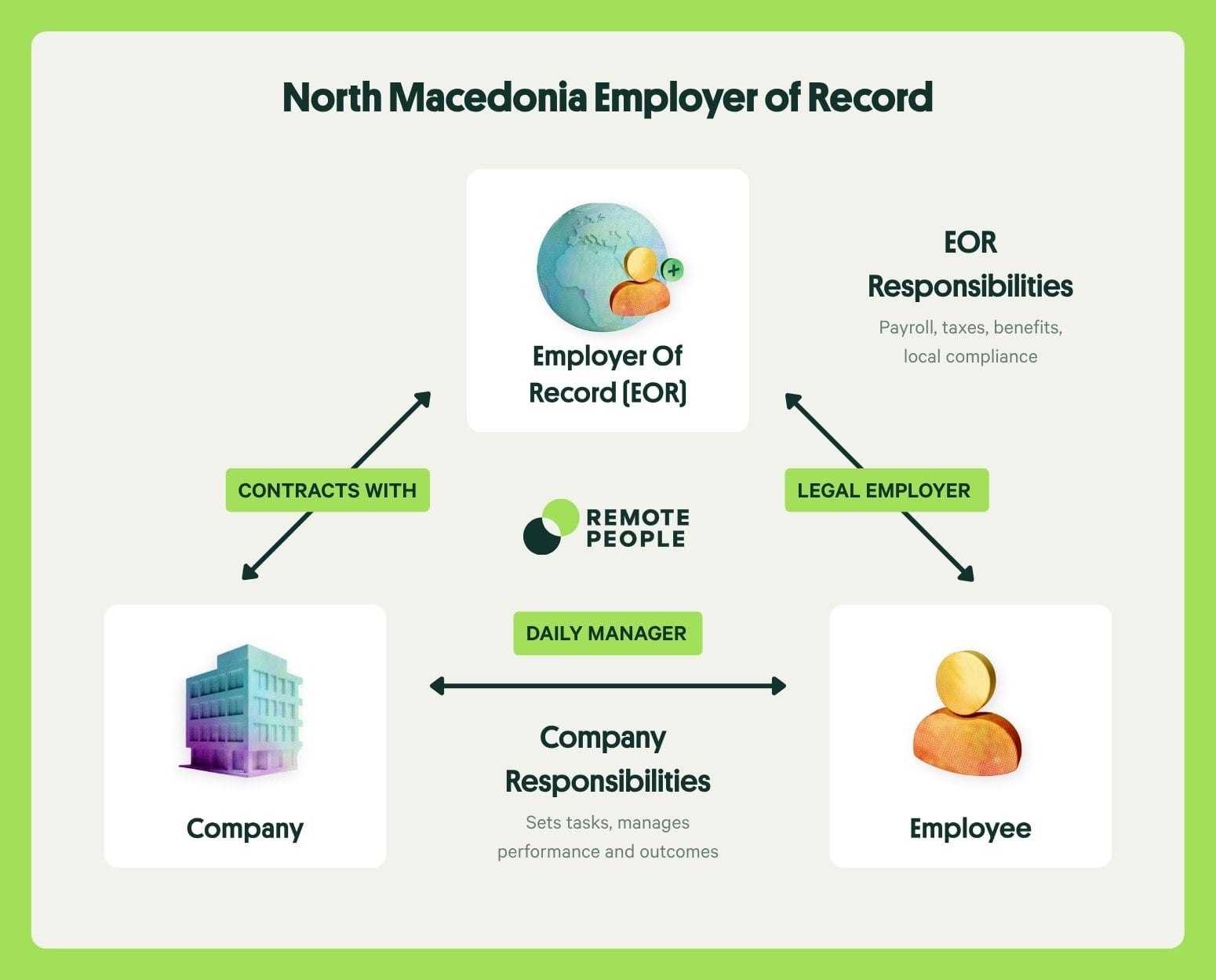
If you’d like to learn more about how Employer of Record (EOR) services work, read our What Is an Employer of Record (EOR)? guide for a complete overview of the model, its benefits, and when to use it.
If you’re comparing providers, our Best Employer of Record (EOR) Providers guide reviews the leading platforms to help you choose the right solution for your business.
Who Uses an EOR in North Macedonia?
An EOR in North Macedonia is typically the right fit for companies that need to hire quickly or at small scale without committing to the cost and timeline of a Macedonian subsidiary.
- Testing the Macedonian market: A company that wants to pilot one or two roles in Skopje before committing to a full subsidiary can use an EOR for a 12–24 month trial, then convert to its own entity if the unit economics justify it.
- Hiring a small team without entity overhead: For teams of one to fifteen employees, the fully loaded cost of an EOR is lower than operating a Macedonian drushtvo once entity setup, statutory audit, accounting and a resident director are priced in.
- Onboarding quickly: The Central Registry (Centralen registar) entity setup takes four to eight weeks before the first employee can be registered; an EOR can issue a compliant contract and register the employee with PIOM and FZO in under ten business days.
- Hiring foreign nationals who need a work permit: An EOR that already holds Macedonian labour-market standing can sponsor the work permit and Type D visa for a non-EU hire, without the client company needing its own presence in the country.
- Converting Macedonian contractors to employees: Companies that have misclassified independent contractors under the Public Revenue Office dependency tests can move those workers onto an EOR payroll without ever registering a local entity.
The common thread across these use cases is time pressure and team size. Companies with more than fifteen planned hires in North Macedonia generally run a break-even analysis between EOR fees and the fixed cost of a subsidiary, and often move to their own entity at that inflection point.
Typical Onboarding Timeline
- EOR agreement and employee details: 1–2 days to sign the master services agreement and collect the employee’s personal data, bank details and qualification documents.
- Employment contract drafting and review: 2–3 days to prepare the Macedonian-language contract, circulate the English translation for the client, and collect signatures.
- Social security and tax registration: 3–5 business days with PIOM, FZO and the Public Revenue Office; the EOR files the M1 registration on or before the employee’s first working day.
- Payroll setup and benefits enrollment: 2–3 days to load the employee into the payroll system, configure any supplemental benefits and prepare the first payslip.
- Employee onboarding and first day: 1 day for equipment delivery, system access and the statutory introductory briefing.
Most EOR providers can onboard a Macedonian national in seven to ten business days. A foreign national hire requiring a work permit extends the timeline by an additional four to six weeks because the Employment Agency and the Ministry of the Interior must issue the work permit and the Type D visa before the employee can legally start work.
Hire in North Macedonia
A cost-effective Balkans market with PIOM/FZO contributions, North Macedonian Labour Relations Law, and EU-candidate compliance standards.
We handle employment contracts, payroll, social contributions, and full North Macedonian compliance.
No local entity needed. Your team can start in days.
Employment Laws and Regulations in North Macedonia
North Macedonia’s employment framework is governed by the Labour Relations Law (Zakon za rabotnite odnosi), the Law on Health Insurance, the Law on Pension and Disability Insurance, and the Law on Employment and Insurance in Case of Unemployment. The Ministry of Labour and Social Policy and the State Labour Inspectorate enforce the framework, while the Public Revenue Office administers payroll tax filings. The sections below break down the core provisions an EOR applies to every Macedonian hire: contracts, working time and overtime, minimum wage, probation, leave, and statutory benefits.
Employment Contracts
Employment in North Macedonia is governed by the Labour Relations Act (Zakon za rabotnite odnosi, Official Gazette No. 62/2005 and subsequent amendments), administered by the Ministry of Labour and Social Policy (MTSP). Article 15 requires every employment relationship to be set out in a written contract signed before the employee starts work. The default contract type is indefinite; a fixed-term contract is permitted only for specific statutory reasons (replacement cover, seasonal work, project work) and cannot exceed five years for the same employee with the same employer. Contracts must be drafted in Macedonian; a bilingual version is common practice when the employer is a foreign-owned business.
Each contract must state the job title, gross monthly salary in denars, normal working hours, annual leave entitlement, probation period, notice period and the date the work relationship begins. A copy must be lodged with the employee before the first day and retained by the employer for at least six years after termination.
Working Hours and Overtime
Article 116 of the Labour Relations Act sets a standard workweek of 40 hours, normally worked over five days of eight hours each. Daily hours may be rearranged up to 10 hours per day without triggering overtime, provided the weekly average over a reference period of six months does not exceed 40 hours. Employees are entitled to a minimum rest of 12 consecutive hours between working days and 24 consecutive hours of weekly rest, typically on Sunday. Overtime is capped at 8 hours per week, 190 hours per year, and must be expressly ordered in writing; employees cannot be required to work more than 10 overtime hours in a single week except in documented emergencies.
North Macedonia overtime and premium pay rates · Per Labour Relations Act (Articles 116–119) | |||
Hour Type | Rate Multiplier | Weekly/Annual Cap | Notes |
|---|---|---|---|
Ordinary overtime (beyond 40 hours/week) | +35% | 8 hrs/week, 190 hrs/year | Minimum premium of 35% above base hourly rate under Article 117 |
Night work (22:00–06:00) | +35% | Max 8 hrs/day, 40 hrs/week | Applies to any regular hours falling between 22:00 and 06:00 |
Weekly rest day (Sunday) work | +50% | Employee must receive replacement rest day | Premium above base hourly rate per collective agreements |
Public holiday work | +50% | Limited to essential services | Premium applies in addition to the paid holiday rate |
Overtime bonus (>150 hrs/year) | One month’s national average salary | Requires ≤21 days absence in year | Lump-sum bonus tied to overtime volume per the Labour Relations Act |
Collective agreements, most notably the General Collective Agreement for the Private Sector, may set higher premium rates than the statutory floor, typically 135% for weekday overtime and 150% for weekend or holiday work. Managerial staff with unrestricted working time may be exempt from overtime premiums under Article 124, provided that status is expressly written into the employment contract. Overtime hours count as paid base salary for the purpose of 13th-month bonus calculations at companies that offer a discretionary year-end payment.
Minimum Wage
North Macedonia’s statutory minimum gross monthly wage was increased to MKD 36,037 effective 1 March 2026 under the Law on the Minimum Wage (Zakon za minimalnata plata), and the net minimum wage was further revised to MKD 26,046 from 1 March 2026 under the automatic indexation formula. The indexation rule sets the annual increase at 50% of the rise in the national average net wage plus 50% of the rise in the cost-of-living index from the prior year, as published by the State Statistical Office.
The minimum wage applies uniformly across sectors; there are no separate regional or industry-specific floors. A collective agreement may set a higher sectoral minimum, but no agreement may undercut the statutory figure. Employers that pay below the statutory minimum are liable for administrative fines of MKD 4,000 to MKD 8,000 per affected employee under the Labour Relations Act.
Probation Period
Article 60 of the Labour Relations Act allows a probation period of up to six months, which must be written expressly into the employment contract. During probation either party may terminate the relationship with seven days’ written notice and without severance. An employee whose probation is not extended or confirmed by the end of the sixth month is automatically deemed to have passed and continues on indefinite terms. Probation cannot be renewed for the same role with the same employer, and statutory annual-leave accrual begins from the first day of work rather than from the end of probation.
Leave Entitlements
North Macedonia’s statutory leave framework is set out in Chapter VI of the Labour Relations Act (Articles 137–167) and supplemented by the Law on Health Insurance for sick leave and maternity benefits. Leave types and durations are below the regional Balkan average in headline days but are supplemented by sector-specific collective agreement add-ons, particularly for tenure and family circumstances.
Annual Leave
Article 137 guarantees a statutory minimum of 20 working days of paid annual leave per calendar year, accruing pro-rata from the first day of work. Accrual continues during probation, sick leave, maternity leave and other statutory absences. Every additional five years of tenure adds one working day up to a cap of 26 days for employees with 30 or more years of service. Annual leave must be taken in the calendar year it is earned; up to eight days may be carried over with employer consent and must be used before 30 June of the following year. Unused leave at termination is paid out at the employee’s average salary from the prior 12 months.
Sick Leave
Sick leave requires a medical certificate issued by the treating physician on the first day of absence. The employer pays compensation for the first 30 calendar days of sickness in any given case, at 70% of the employee’s average salary for days 1–15 and 90% from day 16 onward, as set by the Health Insurance Fund. From day 31 the Health Insurance Fund reimburses the employer or pays the employee directly for continued sickness, subject to medical recertification every 30 days. There is no statutory cap on cumulative sick leave so long as medical recertification is maintained.
Maternity Leave
Article 165 grants working mothers nine months (270 calendar days) of paid maternity leave, extended to 15 months for multiple births. At least 28 days must be taken before the expected delivery date and 45 days are mandatory after birth. Compensation is paid by the Health Insurance Fund at 100% of the employee’s average salary from the 12 months preceding the leave, with no statutory cap. The employee’s job is protected during the entire leave period and for a further 12 months after the child’s first birthday.
Paternity Leave
Fathers are entitled to seven working days of paid leave on the birth of a child under Article 167 of the Labour Relations Act, funded by the employer at full pay. If the mother does not take the full maternity entitlement, the unused balance may be transferred to the father or to an adoptive parent and is then paid by the Health Insurance Fund at the same 100% replacement rate.
Other Statutory Leave
The Labour Relations Act and the General Collective Agreement together recognise several short-duration paid absences that every employer must grant.
- Marriage: 3 working days of paid leave, employer-funded.
- Death of a spouse, child or parent: 7 working days of paid bereavement leave, employer-funded.
- Death of a sibling, grandparent or in-law: 3 working days of paid bereavement leave.
- Blood donation: 1 paid working day per donation event.
- Study leave: Up to 7 working days per year for examinations when the employee’s study programme is in the employer’s interest.
- Relocation for employer’s reasons: 2 working days of paid leave.
Under the Labour Relations Act, the table below summarises every statutory leave entitlement in North Macedonia. The single most important point to note is that annual leave accrues from day one, not after the probation period – a departure from practice in several neighbouring Balkan markets.
North Macedonia statutory leave entitlements · Per Labour Relations Act | ||
Leave Type | Duration | Eligibility & Notes |
|---|---|---|
Annual leave | 20–26 working days | 20 days minimum; +1 day per 5 years of service, capped at 26 days. Employer-funded at full pay. |
Sick leave (days 1–30) | Up to 30 calendar days | Employer-paid. 70% of average salary days 1–15; 90% from day 16. |
Sick leave (day 31+) | Unlimited (recertification every 30 days) | Paid by Health Insurance Fund. Medical certificate required. |
Maternity leave | 9 months (15 months multiple births) | 100% salary paid by Health Insurance Fund. 45 days compulsory post-birth. |
Paternity leave | 7 working days | Employer-paid at 100%. Transferable from unused maternity entitlement. |
Marriage leave | 3 working days | Employer-paid at full salary. |
Bereavement (close family) | 7 working days | Spouse, child, parent. Employer-paid at full salary. |
Bereavement (extended family) | 3 working days | Sibling, grandparent, in-law. Employer-paid at full salary. |
Statutory Employee Benefits
Beyond paid leave, every employer in North Macedonia must fund a defined bundle of statutory benefits through mandatory contributions and direct coverage. The system is administered through three state funds – PIOM, FZO and the Employment Agency – financed by the four social-contribution line items deducted from gross salary and shown in the Employee Contributions table below.
- Health insurance: Universal coverage under the Health Insurance Fund, funded by the 7.5% basic and 0.5% supplemental contributions. Covers primary care, hospital care, prescription drugs on the positive list, maternity benefits and sick leave from day 31.
- Pension and disability insurance: Administered by the Pension and Disability Insurance Fund (PIOM) through a mandatory first-pillar pay-as-you-go scheme at 12.8% and a second-pillar fully funded individual account at 6%, funded from the 18.8% employee contribution.
- Unemployment insurance: 1.2% employee contribution funds the Employment Agency’s unemployment benefit, paid for up to 12 months depending on contribution history.
- Workplace accident and occupational disease: Covered within the pension and health insurance systems; there is no separate employer-paid workers’ compensation premium.
- Meal and transport allowances: Not statutorily required but tax-exempt up to defined limits (MKD 24,700 per month for meals and MKD 4,000 for transport in 2026), making them a common non-cash benefit in private-sector contracts.
Contributions are calculated on gross salary up to a maximum base of 16 times the published national average wage. Income above that threshold is not subject to social contributions but remains subject to the 10% personal income tax.
Recent Regulatory Updates (2026)
The most significant 2026 change is the minimum wage revision, which took effect on 1 March 2026 and lifted the statutory net minimum from MKD 24,379 to MKD 26,046 per month under the automatic indexation formula introduced in 2022. Government-level tripartite discussions between the Ministry of Labour and Social Policy, the Organisation of Employers and the Federation of Trade Unions continued through Q1 2026 on whether to index future increases to gross rather than net wages; no decision had been formally gazetted as of April 2026.
On tax policy, the 10% flat rate on employment income introduced in January 2023 remains in force, with the progressive 18% tier on income above MKD 1,080,000 that had been briefly announced in 2019 remaining suspended. Social-contribution rates for pension (18.8%), health (7.5%), additional health (0.5%) and unemployment (1.2%) are unchanged from 2020, though the maximum contribution base is updated annually in line with the prior year’s average wage.
On mobility, the single-permit regime introduced by the 2018 reform of the Foreigners Act continues to consolidate the residence and work authorisation into one application handled jointly by the Employment Agency and the Ministry of the Interior, cutting typical processing time to 30–45 days for most employer-sponsored hires.
Work Permits and Visas in North Macedonia
Foreign nationals who are not EU or EEA citizens require both a residence permit and a work authorisation to take up paid employment in North Macedonia. The Law on Foreigners (Official Gazette No. 82/2018, consolidated 2022) and the Law on Employment and Work of Foreigners govern both instruments, and the Employment Agency of the Republic of North Macedonia (AVRSM) together with the Ministry of the Interior (MVR) process most applications through a single-permit window introduced in 2018.
Single Work and Residence Permit
The single permit combines the work authorisation and the temporary residence permit into one application. The foreign national cannot apply directly; the Macedonian employer – which can be an EOR sponsoring the hire – files on the candidate’s behalf with the Employment Agency. The application must include a signed employment contract, a clean criminal-record extract legalised or apostilled for Macedonian use, proof of qualifications matching the role, medical-fitness certification and a copy of the passport with at least 18 months of remaining validity. Approved permits are issued for up to three years and are renewable; EU Blue Cards for highly qualified hires follow a separate track with a 24-month validity window and a salary floor of 1.6 times the national average gross wage.
Short-Stay Business Visa (C Visa)
The C visa authorises entry for up to 90 days in any 180-day period for business meetings, contract negotiations, site visits or training. It does not permit paid employment and cannot be converted to a residence permit from inside the country. North Macedonian visa policy grants visa-free entry of 90 days to nationals of the EU, the United States, the United Kingdom, Canada, Australia and around 80 further states; candidates from those countries attending interviews, kick-off meetings or short training with an EOR do not need a C visa. Other nationals must apply at the Macedonian embassy or consulate in their country of residence.
Long-Stay National Visa (D Visa)
The D visa is the entry instrument for holders of an approved single permit. Once the Employment Agency issues the work authorisation decision, the employee applies for a D visa at the Macedonian embassy in their country of residence, presenting the work authorisation, the employment contract, proof of accommodation and health insurance, and the passport. The D visa allows entry and stay for up to six months; inside the country the employee must convert it into the temporary residence permit at the Ministry of the Interior before it expires.
EU Blue Card
North Macedonia introduced the EU Blue Card in 2018 as an expedited track for third-country nationals with a university-level qualification, a binding offer of employment and a gross salary of at least 1.6 times the national average wage (approximately MKD 946,080 per year in 2026). The Blue Card is issued for 24 months and is renewable; holders can move to another EU candidate or member state under the Blue Card mobility provisions after 18 months of continuous employment in North Macedonia.
North Macedonia work permits and visa options for foreign hires · 2026 | |||
Visa / Permit Type | Duration | Eligibility | Processing Time |
|---|---|---|---|
Single Work and Residence Permit | Up to 3 years, renewable | Employer-sponsored; signed contract and approved job posting required | 30–45 days |
EU Blue Card | 24 months, renewable | University degree; salary ≥ 1.6× national average gross wage | 30–60 days |
Short-Stay Business Visa (C) | Up to 90 days in any 180-day period | Business meetings, training, negotiations; no paid work | 10–15 days |
Long-Stay National Visa (D) | Up to 6 months (entry instrument) | Required after single permit approval for non-visa-free nationals | 15–30 days |
Temporary Residence Permit | 1–3 years, renewable | Family reunification, study, other non-work grounds | 30–60 days |
An EOR that holds established standing with the Employment Agency can typically secure a single permit for a qualified hire in four to six weeks, provided the role has been correctly advertised to domestic candidates through the statutory 15-day priority window. The Employment Agency applies an annual national quota on work permits for third-country nationals, split across sectors and updated each December; quota exhaustion in specific sectors (primarily construction and seasonal tourism) can delay processing in Q3 and Q4.
Payroll, Taxes, and Social Security in North Macedonia
North Macedonia operates a monthly payroll system in which the employer is the sole withholding agent for personal income tax and the four mandatory social contributions. The Public Revenue Office (UJP) administers income tax through the electronic MPIN system; the Pension and Disability Insurance Fund (PIOM) and the Health Insurance Fund (FZO) receive contribution filings through the same electronic submission. Payroll must be processed and taxes remitted by the 10th calendar day of the month following the payroll month.
A distinguishing feature of Macedonian payroll is that all four mandatory social contributions – pension 18.8%, health 7.5%, additional health 0.5% and unemployment 1.2% – are formally classified as employee contributions and are deducted from gross salary. There is no separate employer-paid social contribution line item. In economic substance the employer still bears the cost, because salary is negotiated on a net or gross basis that reflects the 28% deduction, but for tax-return purposes every contribution appears on the employee side.
Employer Payroll Contributions
North Macedonia is one of the few European markets where employers have no separate statutory social-contribution liability on top of gross salary. The employer’s payroll obligation is limited to calculating, withholding and remitting employee-side contributions and personal income tax, together with the low-cost Employment Agency registration fee, which is recovered through general employer levies rather than as a payroll percentage. The table below shows the complete employer-side cost structure.
North Macedonia employer payroll contributions · 2026 | ||
Contribution Type | Rate | Notes |
|---|---|---|
Pension and disability | 0% | No separate employer share; full 18.8% is employee-side withholding |
Basic health insurance | 0% | No separate employer share; full 7.5% is employee-side withholding |
Additional health insurance | 0% | No separate employer share; full 0.5% is employee-side withholding |
Unemployment insurance | 0% | No separate employer share; full 1.2% is employee-side withholding |
Total statutory employer contribution | 0% of gross | All 28% of social contributions are classified as employee-side |
Although the statutory employer contribution is zero, employers must budget for meal and transport allowances (typically MKD 4,800–6,000 per month combined), supplemental private health insurance where offered, a one-time year-end bonus (13-ta plata, which is discretionary but offered by most private-sector employers) and any negotiated private-pension top-ups. These costs are not social contributions but are part of the fully loaded cost of hiring.
Employee Payroll Deductions
All four mandatory social contributions and personal income tax are withheld from the employee’s gross salary and remitted by the employer to the Public Revenue Office on the MPIN filing. Gross-to-net conversion for a monthly salary of MKD 50,000 typically yields approximately MKD 32,900 net after the 28% social contributions and the 10% personal income tax. The table below lists every statutory employee deduction together with the ceiling base.
North Macedonia employee payroll deductions · 2026 | ||
Deduction Type | Rate | Cap / Base |
|---|---|---|
Pension and disability (PIOM) | 18.8% | 16× national average monthly gross wage |
Basic health insurance (FZO) | 7.5% | 16× national average monthly gross wage |
Additional health insurance | 0.5% | 16× national average monthly gross wage |
Unemployment insurance | 1.2% | 16× national average monthly gross wage |
Personal income tax | 10% flat | On gross salary net of social contributions |
Total statutory employee deduction | ≈35.2% of gross | Combined social contributions and PIT on a typical salary |
Personal Income Tax
Personal income tax in North Macedonia has been levied at a single flat rate of 10% since 2023, after the brief 2019 progressive bracket announcement was suspended and then repealed. The flat rate applies to employment income, self-employment income, rental income and capital gains alike. Employment income is taxed after the statutory social-contribution deduction, so the effective marginal rate on a gross salary is approximately 7.2% (10% of the remaining 72% after the 28% social deduction).
North Macedonia personal income tax rate · 2026 | |
Annual Taxable Income (MKD) | Tax Rate |
|---|---|
All levels of employment and self-employment income | 10% (flat) |
Dividends, interest and capital gains | 10% (flat, withheld at source) |
Rental income | 10% (flat, after standard 10% deductible expenses) |
Residents are taxed on their worldwide income; non-residents are taxed only on Macedonian-source income. An individual is a Macedonian tax resident if they spend 183 days or more in the country in any 12-month period or if their centre of vital interests is in North Macedonia. The tax year follows the calendar year and annual returns are filed with the Public Revenue Office by 31 March of the following year, although most employees are fully reconciled through monthly employer withholding and do not need to file an annual return.
Statutory Bonuses and Allowances
North Macedonia does not impose a statutory 13th-month salary, but the practice is widespread in the private sector under the General Collective Agreement. Tax-exempt reimbursements for meals up to MKD 24,700 per month and for transport up to MKD 4,000 per month are common non-cash benefits. A one-off annual overtime bonus is paid to employees who work more than 150 overtime hours in the year, subject to fewer than 21 days of absence, and is calculated at one month’s national average net salary.
Cost of Hiring Through an EOR in North Macedonia
The fully loaded cost of an employee in North Macedonia is unusually transparent because there is no separate employer-side social contribution and the income tax is a single 10% flat rate. The main cost drivers are gross salary, the employee-side 28% social contributions that are economically borne by the employer through gross-salary negotiation, discretionary bonuses and allowances, and the EOR service fee. The example below illustrates the full cost build-up for a Skopje-based software engineer on a competitive gross salary.
Monthly cost example · Software engineer in Skopje · Gross salary USD 2,800 (MKD 157,500) | ||
Cost Component | Amount (USD) | Notes |
|---|---|---|
Gross salary | $2,800 | Mid-range software engineer salary in Skopje |
Employer statutory contributions | $0 | No separate employer-side social contribution line |
Meal and transport allowance | $110 | Typical tax-exempt non-cash benefit |
Supplemental health insurance | $45 | Optional private health cover; common in tech roles |
13th-month salary provision | $233 | Accrual of discretionary year-end bonus spread monthly |
EOR service fee | $399 | Typical RemotePeople flat monthly rate |
Total monthly cost | $3,587 | Full loaded cost before VAT on EOR fee |
Source: RemotePeople EOR North Macedonia pricing and PwC Worldwide Tax Summaries – North Macedonia | ||
The total fully loaded cost of approximately USD 3,587 per month compares with roughly USD 2,800 of gross pay that reaches the employee’s gross-salary line, yielding a payroll burden of about 28%, most of which is the employee’s own 28% social-contribution deduction routed through gross-salary negotiation. The employee’s take-home pay from the USD 2,800 gross line is approximately USD 1,800 after social contributions and personal income tax, before any tax-exempt allowances. The EOR service fee of USD 399 per month (or equivalent percentage of payroll) is deductible as a service expense in the client company’s home jurisdiction and is subject to 18% Macedonian VAT, which non-Macedonian clients can generally reclaim under the reverse-charge mechanism.
Benefits of Using an EOR in North Macedonia
- Fast market entry: A compliant Macedonian employment contract can be signed and the employee registered with PIOM and FZO within seven to ten business days, against four to eight weeks to incorporate a drushtvo, open a local bank account and complete Central Registry filings before the first employee can be hired.
- No local entity cost: Operating a Macedonian subsidiary requires a resident director, annual statutory audit above the accounting threshold, monthly bookkeeping, annual corporate income tax returns and mandatory VAT registration once the MKD 2 million turnover threshold is crossed. For teams under fifteen employees the fully loaded EOR cost is typically lower than these fixed overheads.
- Labour-law compliance out of the box: The Labour Relations Act has been amended more than twenty times since 2005; a Macedonian EOR maintains contracts, notice formulas, severance calculations and MPIN filings against the current consolidated text, removing the compliance burden from the client.
- Work-permit sponsorship: Foreign-national hires need an employer with standing before the Employment Agency. An EOR with an established sponsorship record can secure a single permit in four to six weeks without the client needing to incorporate a local entity first.
- Contractor-to-employee conversion: Many companies discover that their Macedonian independent contractors meet the Public Revenue Office dependency tests and risk reclassification. An EOR can convert those contractors onto a compliant payroll in days, ending the reclassification exposure.
- Predictable cost: The EOR absorbs every payroll, tax and social-security filing on a fixed-fee or payroll-percentage basis, converting variable compliance risk into a predictable operating cost that scales linearly with headcount.
- Single point of contact: The client interacts with one account manager who coordinates payroll, benefits, compliance questions and termination events, rather than with three state funds, a payroll bureau, an accountant and a labour lawyer.
Termination and Offboarding in North Macedonia
North Macedonia’s termination framework is tenure-based and closer to the Serbian-Montenegrin practice than to strict EU-style termination protections. Employers may dismiss an employee with statutory notice on grounds defined in Article 81 of the Labour Relations Act, which groups lawful grounds into business, personal and disciplinary categories. Every dismissal must be issued in a written decision (otkaz) delivered to the employee personally or by registered post, stating the legal ground, the effective date and the severance due.
Notice Periods
Article 88 sets statutory minimum notice periods that scale with continuous service with the same employer. Notice begins on the day the written dismissal decision is delivered and the employee is entitled to full salary and all benefits throughout the notice period. The employee is also entitled to paid time off during notice to look for new work, typically one paid day per week.
North Macedonia statutory notice periods · Per Labour Relations Act Article 88 | |
Length of Service | Minimum Notice (employer-initiated) |
|---|---|
Probation period (up to 6 months) | 7 days |
Less than 5 years of service | 1 month |
5 to 15 years of service | 2 months |
More than 15 years of service | 3 months |
Disciplinary dismissals for gross misconduct may be summary (no notice) provided the statutory procedure is followed: a written warning, an investigatory hearing with the employee’s right to defence, and a written dismissal decision issued within eight days of the offence being known to the employer. Employee-initiated resignations require the same notice periods as employer-initiated dismissals, though this may be reduced to 15 days by mutual consent.
Severance Pay
Statutory severance is mandatory for dismissals on business grounds (redundancy, reorganisation, closure) and is scaled to length of service. Article 97 sets the formula as a multiple of the employee’s average monthly salary over the prior six months. No statutory severance is due for dismissals on personal capability grounds (where the employee is unable to perform the role) or for disciplinary dismissals.
North Macedonia statutory severance pay · Per Labour Relations Act Article 97 | |
Length of Service | Severance Entitlement (business grounds) |
|---|---|
Up to 5 years | 1 month’s average salary |
5 to 10 years | 2 months’ average salary |
10 to 15 years | 3 months’ average salary |
15 to 20 years | 4 months’ average salary |
20 to 25 years | 5 months’ average salary |
More than 25 years | 6 months’ average salary |
Average salary for severance purposes includes base salary, regular allowances and the average of variable compensation paid in the prior six months. Severance is paid as a lump sum within 30 days of termination and is exempt from personal income tax up to two times the national average monthly salary per year of service; amounts above that ceiling are taxable at the 10% flat rate. Employers must also pay out any accrued but unused annual leave at the average daily salary from the prior 12 months.
Offboarding and Final Settlement
On the last working day the employer must deregister the employee with PIOM, FZO and the Employment Agency through the MPIN submission, pay the final salary, accrued leave and any severance within 30 days, and provide the employee with a work record certificate (potvrda za rabotno iskustvo) and the consolidated annual tax statement. The Employment Agency deregistration is the trigger for the employee to become eligible to claim unemployment benefit, provided they meet the nine-month cumulative contribution requirement in the prior 18 months.
EOR vs Other Hiring Models in North Macedonia
Companies entering the Macedonian market face a three-way choice between an EOR, a local subsidiary and independent contractors. Each model has a different risk profile, cost curve and time-to-hire. The tables below compare EOR with each of the main alternatives.
EOR vs Local Entity
A Macedonian subsidiary is almost always a limited liability company (drushtvo so ogranichena odgovornost) registered at the Central Registry. Incorporation takes four to eight weeks, requires a resident director and a registered address, and triggers ongoing statutory audit, annual corporate income tax filings, VAT registration above the MKD 2 million turnover threshold and mandatory bookkeeping.
EOR vs own entity in North Macedonia · 2026 | ||
Factor | EOR | Local Entity |
|---|---|---|
Setup time | 7–10 business days | 4–8 weeks |
Minimum capital | None | EUR 5,000 (MKD 307,500) for a drushtvo |
Resident director | Not required | Required, with registered address |
Ongoing compliance cost | Flat EOR fee or % of payroll | Audit, bookkeeping, CIT returns, VAT filings |
Corporate income tax exposure | None for the client | 10% CIT on Macedonian-source income |
Break-even headcount | Typically up to 15 employees | Economic above roughly 15–20 employees |
Exit cost | Terminate EOR agreement and employee contracts | 6–12 month liquidation with court involvement |
EOR vs Independent Contractors
Independent contractor engagement is attractive for short-term project work but carries significant reclassification risk. The Public Revenue Office applies a dependency test that considers integration into the client’s organisation, exclusivity, working hours direction, use of client equipment and whether the contractor bears commercial risk. Contractors who fail the test are reclassified as employees, triggering back-contributions, interest and administrative fines.
EOR vs independent contractors in North Macedonia · 2026 | ||
Factor | EOR | Independent Contractor |
|---|---|---|
Legal relationship | Permanent or fixed-term employment | Service contract under the Civil Code |
Direction of work | Full employer direction permitted | Must be deliverable-based, not time-based |
Social contributions | Mandatory 28% on gross salary | Contractor self-registers and self-pays |
Reclassification risk | None – compliant employment | High if UJP dependency test is failed |
Benefits and leave | Full statutory entitlement | None |
Termination process | Statutory notice and severance | End of contract term or convenience clause |
IP ownership | Vests with employer by operation of law | Must be transferred by explicit contract clause |
EOR vs PEO
Professional Employer Organisation (PEO) arrangements as understood in the United States do not exist in Macedonian employment law. A company that wishes to share employment responsibilities with a local partner must either run its own entity and outsource administration, or engage a full EOR. The table below clarifies the distinction for companies familiar with the US PEO model.
EOR vs PEO in North Macedonia · 2026 | ||
Factor | EOR | PEO (US-style) |
|---|---|---|
Legal employer | The EOR is the sole legal employer | Client entity remains legal employer; PEO is co-employer |
Requires local entity | No | Yes – client must have a Macedonian entity |
Labour-law liability | Borne by EOR | Shared, but primary liability remains with client entity |
Best for | Companies without a Macedonian entity | Companies with an existing entity seeking payroll outsourcing |
Macedonian availability | Widely available | Not available as a legal construct |
For companies that do have a Macedonian subsidiary but want to offload payroll, bookkeeping and tax filings, the correct term is payroll outsourcing (sometimes administrativno servisiranje na plati) rather than PEO, and this is provided by accounting firms and payroll bureaus rather than by an EOR.
Public Holidays in North Macedonia 2026
North Macedonia observes 11 statutory public holidays under the Law on Holidays of the Republic of North Macedonia (Zakon za praznicite na Republika Severna Makedonija). Religious holidays are observed for Orthodox, Catholic, Muslim and Jewish faiths, and employees belonging to a particular faith may take their own religious holiday instead of the default Orthodox date by prior notice to the employer. When a statutory holiday falls on a Sunday, the following Monday is not automatically declared a substitute day off; practice is governed by the specific decree issued each year by the Government.
North Macedonia public holidays 2026 · 11 statutory holidays | ||
Date | Holiday | Type |
|---|---|---|
1–2 January (Thu–Fri) | New Year’s Day | National |
7 January (Wed) | Orthodox Christmas Day | Religious (Orthodox) |
20 March (Fri) | Eid al-Fitr (Ramazan Bayram) | Religious (Muslim) |
10 April (Fri) | Good Friday (Catholic) | Religious (Catholic) |
13 April (Mon) | Orthodox Easter Monday | Religious (Orthodox) |
1 May (Fri) | Labour Day | National |
24 May (Sun) | Saints Cyril and Methodius Day | National / Cultural |
27 May (Wed) | Eid al-Adha (Kurban Bayram) | Religious (Muslim) |
2 August (Sun) | Republic Day (Ilinden) | National |
8 September (Tue) | Independence Day | National |
11 October (Sun) | Day of the Macedonian Uprising | National |
23 October (Fri) | Day of the Macedonian Revolutionary Struggle | National |
8 December (Tue) | Saint Clement of Ohrid Day | National / Cultural |
Source: Ministry of Labour and Social Policy of North Macedonia and Law on Holidays of the Republic of North Macedonia (Official Gazette No. 21/1998) | ||
Work performed on a public holiday attracts a 50% premium on top of the base rate and the employee must additionally receive paid time off in lieu on another working day. Employers in sectors required to operate on public holidays (healthcare, transport, hospitality, security) organise holiday rotas in advance under the internal work-time schedule, which must be filed with the State Labour Inspectorate at the start of each calendar year.
How to Get Started With an EOR in North Macedonia
Hiring your first employee through an EOR in North Macedonia is a five-step process that typically takes seven to ten business days from contract signature to first working day. Companies sponsoring a foreign-national hire should budget an additional four to six weeks for the single permit and Type D visa.
- First, define the role and compensation: Agree the job title, gross monthly salary in denars, working-time pattern, probation length, notice period and any allowances (meal, transport, remote-work stipend). An EOR can benchmark the salary against the Public Revenue Office’s published wage statistics for the specific occupation and region.
- Second, sign the EOR services agreement: Review and execute the master services agreement, which sets the EOR fee (flat per-employee or percentage of payroll), the scope of services, the data-protection addendum under the Macedonian GDPR-equivalent Personal Data Protection Law, and the termination protocol.
- Third, onboard the employee: Provide the employee’s full name, personal identification number (EMBG), bank account details, CV, qualification evidence and emergency contact. The EOR prepares the Macedonian-language employment contract with an English translation, circulates for signature and collects the signed contract before the start date.
- Fourth, complete social security and tax registration: The EOR files the M1 registration with PIOM and FZO on or before the first working day, and activates payroll in the MPIN system. This step is invisible to the client but is the core compliance event that makes the employment lawful.
- Fifth, go live and run payroll: The employee starts work, the EOR processes the first payslip, remits the 10% income tax and the 28% social contributions to the Public Revenue Office by the 10th of the following month, and provides the client with a monthly invoice and payroll report.
Most engagements with RemotePeople begin with a 30-minute scoping call to confirm that an EOR is the right fit, followed by a written quote within 24 hours and a signed services agreement within a week. A model employment contract is provided for client review ahead of the first hire, so terms can be negotiated once and reused for subsequent employees.
Where companies hiring in North Macedonia expand next
Teams hiring in North Macedonia commonly expand across Central and Eastern Europe, where competitive labor costs and EU market access anchor regional growth. Teams frequently add hiring in the Czech Republic for parallel labor-cost tier and talent supply; an EOR partner in Romania often follows for aligned compensation ranges and delivery speed; Hungary is a common next step, offering matching cost-to-quality tier; and a team in Poland rounds out the regional footprint with similar cost profile and comparable hiring speed.
Frequently Asked Questions
Seven to ten business days for a Macedonian national or an EU/EEA citizen with an existing right to work in North Macedonia. For a third-country national requiring a single work and residence permit, add four to six weeks for the Employment Agency and Ministry of the Interior to process the application.
MKD 36,037 gross per month and MKD 26,046 net per month from 1 March 2026, under the statutory indexation formula applied to the Law on the Minimum Wage. The same minimum applies across all sectors and regions, though collective agreements may set higher industry floors.
Zero percent as a separate employer line item. All four mandatory social contributions – pension 18.8%, health 7.5%, additional health 0.5% and unemployment 1.2%, totalling 28% – are formally classified as employee-side contributions and are withheld from gross salary. The employer bears the cost in economic substance through gross-salary negotiation but does not pay a separate employer contribution.
Flat. Personal income tax has been levied at a single 10% rate since January 2023. The rate applies to employment income, self-employment income, rental income and capital gains alike.
Seven days during probation; one month for employees with under five years of service; two months for five to fifteen years; and three months for more than fifteen years. Summary dismissal without notice is available only for gross misconduct and only if the statutory procedure (warning, hearing, decision within eight days) is followed.
Yes for dismissals on business grounds (redundancy, reorganisation, closure), scaled from one month's average salary for under five years of service up to six months' average salary for more than 25 years. No statutory severance is due for disciplinary dismissals or for dismissals on personal capability grounds.
Yes. An EOR with established standing before the Employment Agency of the Republic of North Macedonia can sponsor the single work and residence permit for a third-country national, typically issued within four to six weeks. Highly qualified hires with a university degree and a salary above 1.6 times the national average gross wage are eligible for the faster EU Blue Card track.
For a mid-range software engineer on a gross salary of USD 2,800 per month, the fully loaded cost is approximately USD 3,587 per month including the EOR service fee, tax-exempt allowances, a 13th-month bonus provision and optional supplemental health insurance. The EOR service fee is typically charged as a flat monthly amount or as a percentage of gross payroll. See RemotePeople pricing for a tailored quote.
Employer of Record in
Employer of Record in
Employer of Record in
Employer of Record in
Employer of Record in
Employer of Record in
Employer of Record in
Employer of Record in