
 Recruit
Employer of Record in San Marino
-
 Drew Donnelly
- Published
- September 22, 2026
RemotePeople’s employer of record in San Marino lets you hire employees in San Marino with complete ISS coverage. We handle Social Security Institute pension contributions, mandatory individual account contributions, and 13th-month salary payments.
Hire in San Marino — book a free 30-minute demo
Tell us what you need. You'll get a tailored, transparent proposal within 24 hours, plus a free call to walk through it.
Tell us about your company
So we can match you with a specialist who knows your market — and unlock volume pricing tiers.
* All fields are required.
Where and when are you hiring?
Tell us the geography and timing and we'll quote each country line by line, with onboarding timelines.
* All fields are required.
Help us beat your current setup
We'll benchmark your current deal and send a line-by-line proposal in 24 hours — showing exactly where we cut cost, time, or risk. After you submit, you can book a call to walk through it together.
* All fields are required.
Thanks! Your proposal is on its way.
Expect a tailored, line-by-line proposal in your inbox within 24 hours. In the meantime…
Want to walk through it together?
Book a free 30-minute call with one of our specialists. We'll explain every line, answer your questions, and tailor the proposal further if you need.
No obligation. Pick a time that works for you.








- Hire in San Marino — book a free 30-minute demo
- Tell us about your company
- Where and when are you hiring?
- Help us beat your current setup
- Thanks! Your proposal is on its way.
- How an Employer of Record Works in San Marino
- Employment Laws and Regulations in San Marino
- Work Permits and Visas in San Marino
- Payroll, Taxes, and Social Security in San Marino
- Cost of Hiring Through an EOR in San Marino
- Benefits of Using an EOR in San Marino
- Termination and Offboarding in San Marino
- EOR vs. Other Hiring Models in San Marino
- Public Holidays in San Marino
- How to Get Started with an EOR in San Marino
- Where companies hiring in San Marino expand next
- Frequently Asked Questions
- Related EOR Destinations

Start hiring in San Marino
Let RemotePeople handle payroll, compliance, and HR admin worldwide so you can focus on building your team.

The Republic of San Marino offers a small, stable European jurisdiction inside the Italian customs union, with EUR-denominated payroll, an Italian-influenced labour code, and a light-touch corporate regime.
For companies looking to hire employees in San Marino, the friction sits in the operational layer: the Sammarinese state requires every employer to be registered with the Istituto per la Sicurezza Sociale (ISS), every foreign hire needs a permesso di soggiorno per lavoro from the Ufficio del Lavoro, and the Imposta Generale sui Redditi (IGR) was overhauled by Law No. 141 of 24 July 2025, which converted the old deductions regime into a tax-credit system effective 1 January 2026.
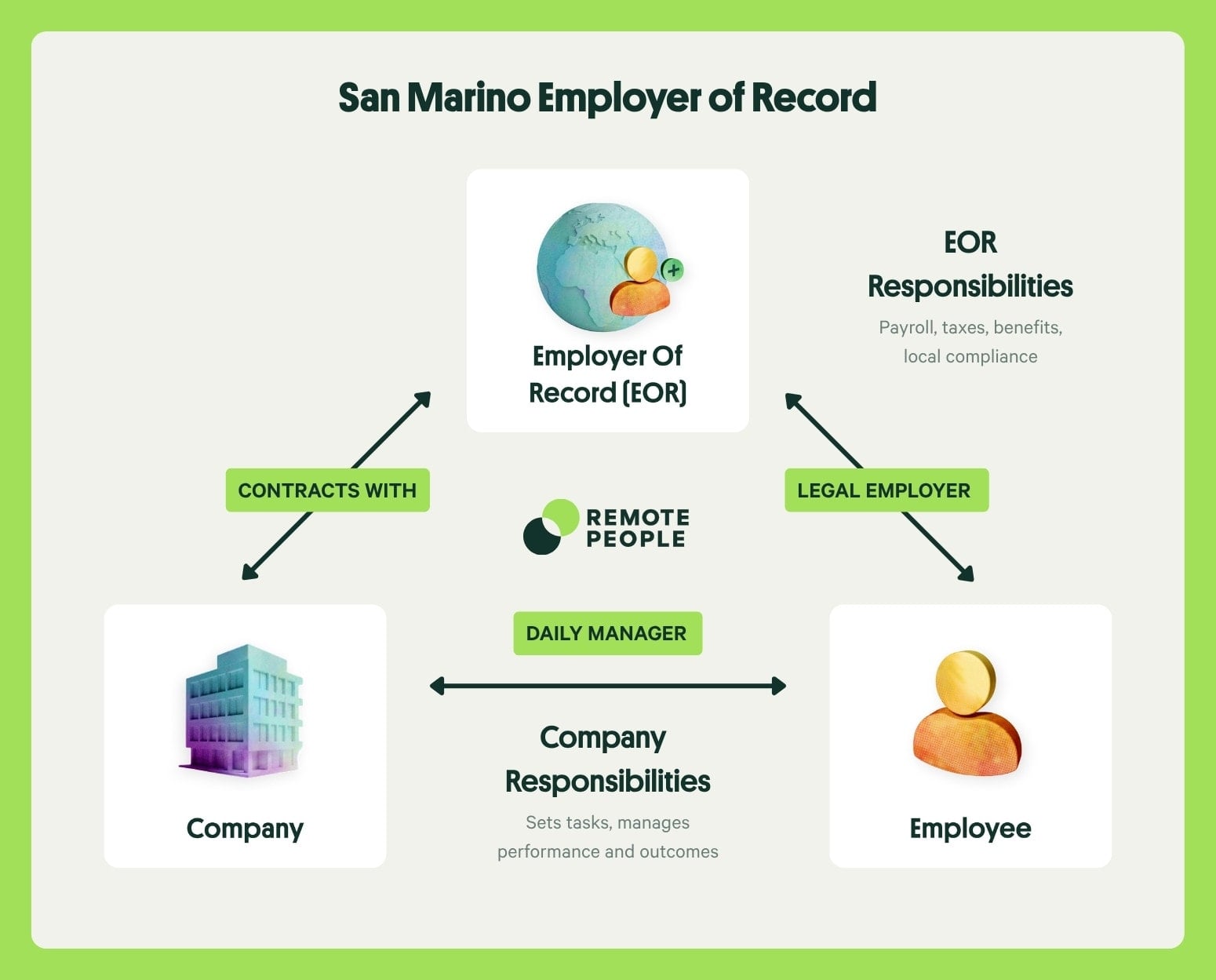
An employer of record in San Marino resolves this by acting as the legal employer on your behalf, issuing the Sammarinese employment contract, registering your hire with the ISS and the Ufficio del Lavoro, and managing payroll, contributions, and compliance from day one. This guide covers how an EOR works in San Marino, 2026 IGR brackets and ISS contribution rates, work-permit procedures, leave entitlements, dismissal rules, and the cost of hiring through an EOR versus incorporating your own Sammarinese company.
How an Employer of Record Works in San Marino
If you’d like to learn more about how Employer of Record (EOR) services work, read our What Is an Employer of Record (EOR)? guide for a complete overview of the model, its benefits, and when to use it.
If you’re comparing providers, our Best Employer of Record (EOR) Providers guide reviews the leading platforms to help you choose the right solution for your business.
Who Uses an EOR in San Marino?
San Marino’s EOR market is shaped by the Republic’s small geographic footprint (61 km²), tight labour-market access rules, and concentration of banking, manufacturing, and cross-border services activity with Italy. Companies typically use an EOR in San Marino for the following reasons:
- Testing the Sammarinese market: A company exploring whether to commit to San Marino can hire one or two employees through an EOR while assessing client demand, without the multi-month delay of incorporating an S.p.A. or S.r.l. Sammarinese.
- Hiring a small team without entity overhead: Forming a Sammarinese S.r.l. requires minimum capital of €25,500 fully paid at incorporation, registration with the Camera di Commercio, and business-licence authorisation under Law No. 40 of 23 February 2006. An EOR removes that gating step for headcounts under roughly 15.
- Onboarding quickly: An EOR can issue a Sammarinese employment contract within a week, while the work-permit step for non-EU nationals adds four to eight weeks before the employee can start lawful duties.
- Hiring foreign nationals needing work permits: Non-Sammarinese nationals require a permesso di soggiorno per motivi di lavoro issued by the Ufficio del Lavoro before starting any salaried activity. An EOR sponsors that permit on its own employer registration.
Any business hiring employees in San Marino needs a registered local employer to interact with the ISS and the Ufficio del Lavoro. The EOR satisfies that requirement on the client company’s behalf, allowing the client to focus on the work itself while the EOR handles every interaction with Sammarinese authorities.
Typical Onboarding Timeline
The San Marino onboarding sequence is dominated by the work-permit window for non-EU hires: contract drafting, ISS registration, and payroll setup move quickly, but the Ufficio del Lavoro authorisation for foreign nationals usually adds four to eight weeks. The steps below describe a typical onboarding for a non-Sammarinese hire:
- EOR agreement and employee details: 1–2 days to scope the assignment, agree the gross salary, and collect identity documents.
- Employment contract drafting and review: 2–4 days to issue the Italian-language contract referencing the Carta del Lavoro and the applicable CCNL.
- Labour-market authorisation via Ufficio del Lavoro: 5–10 working days, during which the Ufficio reviews resident-priority candidates on the mobility list before authorising a foreign hire.
- Work-permit and residence-permit issuance: 4–8 weeks for the Ufficio del Lavoro and the Gendarmeria to deliver the permesso di soggiorno per motivi di lavoro, depending on nationality and document completeness.
- ISS affiliation and payroll setup: 3–5 days to register the employee with the Istituto per la Sicurezza Sociale (FSS, FondISS, family allowance, unemployment) and to schedule the first busta paga.
- Employee start date: 1 day, after the permit is issued and the contract is countersigned.
Most EOR providers can onboard a Sammarinese or Italian cross-border employee within 1–2 weeks, while non-EU nationals typically require 6–10 weeks because of the permit timeline. Background checks, diploma legalisation, and seasonal Ufficio del Lavoro bottlenecks can extend that window.
Hire in San Marino
A stable European jurisdiction inside the Italian customs union, EUR-denominated payroll, and a skilled bilingual talent pool make San Marino a strategic base for companies hiring in central Europe without the cost of incorporating an S.r.l.
We handle employment contracts, payroll, tax withholding, and full San Marino compliance.
No local entity needed. Your team can start in days.
Employment Laws and Regulations in San Marino
Employment Contracts
Sammarinese employment is governed by Law No. 7 of 17 February 1961 (“Carta del Lavoro”), supplemented by sector-level contratti collettivi nazionali di lavoro (CCNL) negotiated between the Camera del Lavoro, the trade unions (CSdL and CDLS), and the employers’ association (ANIS). Contracts must be in Italian, state the role, gross salary, working time, and place of work, and reference the CCNL applicable to the activity. The default form is the contratto a tempo indeterminato (indefinite-term contract); fixed-term contracts (contratto a tempo determinato) are permitted only for defined cases such as seasonal work, replacement of an absent employee, or a temporary surge in workload, and may not exceed 36 months of cumulative duration with the same employer. Written contracts are required for all fixed-term roles, part-time work, and any agreement referring to specific clauses such as non-compete, mobility, or an extended probation period. The Carta del Lavoro is published on the official San Marino legal database (Consiglio Grande e Generale).
Working Hours and Overtime
The legal working week in San Marino is 40 hours, set by the Carta del Lavoro and implemented through the relevant CCNL, usually distributed over five or six days with a daily ceiling of 8 hours. Workers are entitled to a daily rest of at least 11 consecutive hours and a weekly rest of 24 hours, normally on Sunday. The absolute weekly ceiling including overtime is 48 hours averaged over a reference period set by the CCNL, typically 13 weeks. Managerial staff (dirigenti) on flat-rate salaries are excluded from the daily and weekly ceilings, but they remain covered by the rest-period rules. Overtime above 40 hours per week is paid at premium rates fixed by the CCNL and supervised by the Ufficio del Lavoro.
The table below summarises the statutory premium-pay schedule used as the default across most CCNLs, sourced from the Carta del Lavoro and the 2025 industry reference contracts.
San Marino overtime and premium pay rates · Per Carta del Lavoro and CCNL benchmarks | |||
Hour Type | Rate Multiplier | Daily / Weekly Cap | Notes |
|---|---|---|---|
Weekday overtime (hours 41–48) | 125% of base hourly rate | Up to 8 OT hours per week | First tier above the 40-hour legal week. |
Overtime beyond 48 hours per week | 130–135% of base hourly rate | Max 250 hours per year (CCNL) | Requires Ufficio del Lavoro authorisation beyond annual cap. |
Night work (22:00–06:00) | 130% of base rate (typical) | Subject to CCNL | Higher rates apply in manufacturing and hospitality. |
Sunday and weekly rest day work | 135% of base rate | Compensatory rest day required | Authorisation from the Ufficio del Lavoro required for regular Sunday work. |
Public holiday work | 150% of base rate | Plus paid day in lieu | Applies to the statutory public holidays listed in section 9. |
Overtime premiums are computed on the actual hourly rate, which excludes the end-of-service TFR accrual. Annual overtime is normally capped at 250 hours per employee under sector CCNLs; the Ufficio del Lavoro can authorise higher volumes for documented operational reasons. Dirigenti on a forfait arrangement are paid against an annual remuneration rather than hourly overtime.
Minimum Wage
San Marino does not have a single statutory minimum wage in the continental sense; minimum salaries are instead set by the applicable CCNL for each sector. The CCNL Industria and CCNL Commercio are the two most widely applied agreements and serve as the de facto floor referenced by the Ufficio del Lavoro when assessing the adequacy of an employment offer. From 1 January 2025, the CCNL Industria benchmark minimum is €1,728.38 gross per month at 40 hours for a livello C1 worker, with higher minima for C2, B, A, and quadri categories. Apprentice and youth salaries are set at a percentage of the category minimum under the CCNL apprendistato. The Ufficio del Lavoro publishes the applicable CCNL minima on its website (Ufficio del Lavoro). Employers cannot pay below the CCNL minimum for the category without exposure to retrospective claims and ISS contribution adjustments.
Probation Period
The probation period in San Marino is governed by the Carta del Lavoro and the applicable CCNL. The statutory maximum is six months for senior staff (impiegati direttivi and quadri) and three months for non-supervisory staff (operai and impiegati). The CCNL may specify shorter ceilings for specific livelli: typically 15 working days for the lowest operaio grade, one month for junior impiegati, three months for mid-grade impiegati, and six months for senior roles. During probation, either party may terminate the contract with reduced notice (typically 1–3 days in the first month, one week thereafter), with no severance payable. Annual leave and TFR continue to accrue during probation.
Leave Entitlements
Sammarinese statutory leave is centred on the Carta del Lavoro, Law No. 137 of 22 December 2003 (paid leave and rest), and the ISS benefit schedule. The framework distinguishes paid leave funded directly by the employer (annual leave, family events, tredicesima) from leave compensated by the ISS Fondo Servizi Sociali (sick leave, maternity, paternity, parental).
Annual Leave
Employees accrue a statutory minimum of 26 working days of paid annual leave per full calendar year (equivalent to roughly 4.33 weeks on a six-day week, or 5.2 weeks on a five-day week), with the exact entitlement set by the applicable CCNL. Accrual begins from the first day of employment, including during probation. Leave is paid at the ordinary daily salary rate, including fixed allowances but excluding overtime. At least two consecutive weeks of annual leave must be taken within the calendar year; the remaining days may be carried over by written agreement. Unused leave is paid out as an indennità sostitutiva at termination.
Sick Leave
Employees who are unable to work must produce a medical certificate issued by the Sammarinese public health service (ISS – Istituto Sicurezza Sociale also administers healthcare) within 48 hours of the onset of illness. Statutory sickness indemnity is paid by the ISS Fondo Servizi Sociali from the first day of incapacity at 86% of the daily reference salary for employees with at least three months of ISS affiliation, capped at the sectoral salary ceiling, rising to 100% for workplace accidents from day one. Many CCNLs oblige the employer to top up to 100% of net salary for an initial period, typically the first 30 to 180 days depending on tenure and category.
Maternity Leave
Maternity leave is five months in total: two months before the expected birth date and three months after, or one month before and four months after where a medical certificate allows the “flexible” option. Daily indemnity is paid by the ISS Fondo Servizi Sociali at 100% of the reference daily salary, without a cap for salaries within the ordinary ISS contribution base. The employee’s job is protected throughout the leave and until the child’s first birthday, and dismissal during this protected period is void except for the cessation of business or grave misconduct unrelated to pregnancy. Post-natal parental leave of up to six months per parent is available at a reduced indemnity, funded by the ISS.
Paternity Leave
Paternity leave in San Marino is 10 working days of mandatory paid paternity leave for the working father around the time of birth, indemnified by the ISS at 100% of the reference daily salary, to be taken within the first five months following the birth. Parental leave (congedo parentale) is available for a total of six months per parent up to the child’s eighth birthday, paid at 30% of the reference salary by the ISS. These entitlements are set out on the ISS benefits portal (Istituto per la Sicurezza Sociale).
Other Statutory Leave
San Marino’s labour framework also provides a number of short paid absences for family events and civic duties, summarised below:
- Marriage of the employee: 15 calendar days of paid leave (congedo matrimoniale).
- Death of a spouse, parent, or child: 3 working days of paid bereavement leave.
- Blood donation: Paid day off on the day of donation, up to four times per year.
- Civic duty (jury service, court witness): Time off without loss of pay against summons.
- Public office and trade-union representation: Paid leave for statutory meetings and duties.
- Study leave (150 ore): Up to 150 hours over three years for employees pursuing state-recognised qualifications, per the CCNL.
The table below summarises every statutory leave entitlement in San Marino, drawing on the Carta del Lavoro, Law No. 137/2003, and the ISS benefit schedule. The single most important takeaway is that paid annual leave and TFR both begin to accrue from day one, with no probation-period exclusion, while sick-leave indemnity from the ISS is paid from the first day of incapacity (not the fourth) for affiliated employees.
San Marino statutory leave entitlements · Per Carta del Lavoro and ISS benefit schedule | ||
Leave Type | Duration | Eligibility & Notes |
|---|---|---|
Annual paid leave | 26 working days/year (CCNL-dependent) | Accrues from day one. Paid by employer at the ordinary daily rate. |
Sick leave | Open-ended; indemnified by ISS from day 1 | ISS pays 86% of daily reference salary. CCNL may require employer top-up to 100%. |
Maternity leave | 5 months (2 pre + 3 post, or 1 + 4 flexible) | ISS pays 100% of reference daily salary. Job protected until child’s first birthday. |
Paternity leave | 10 working days (mandatory) | Taken within 5 months of birth. ISS pays 100% of reference daily salary. |
Parental leave (congedo parentale) | Up to 6 months per parent, until child’s 8th birthday | ISS pays 30% of reference salary. |
Marriage leave | 15 calendar days | Paid in full by employer on presentation of marriage certificate. |
Bereavement leave | 3 working days | Spouse, parent, or child. Paid in full by employer. |
Workplace accident or occupational illness | Open-ended, fully indemnified | 100% covered by ISS from day one; no waiting period. |
Statutory Employee Benefits
Beyond paid leave and the headline social-security contributions, Sammarinese law and sector CCNLs impose a layered package of mandatory benefits. The defining feature of the San Marino system is that the ISS administers both social security and public healthcare, so there is no separate health-insurance premium. Mandatory benefits include:
- Pension and healthcare (FSS): The Fondo Servizi Sociali funds state pensions, sickness and maternity indemnity, and public healthcare access, paid through combined employer and employee contributions to the ISS.
- Supplementary pension (FondISS): A mandatory second-pillar pension scheme introduced by Law No. 191 of 11 December 2007, contributed by both employer and employee at fixed percentages of gross salary.
- Family allowance (Assegno Familiare): Employer-funded contribution that finances the Sammarinese family-allowance scheme, paid to workers with dependent family members.
- Unemployment insurance (Cassa Integrazione Guadagni): Employer contribution to the Sammarinese unemployment fund, financing wage top-ups during authorised short-time work and indemnity during redundancy.
- Workplace-accident insurance: Funded entirely by the employer through the ISS workplace-accident scheme, with rates that depend on the sector risk classification.
- TFR (Trattamento di Fine Rapporto): End-of-service indemnity accrued at 7.4% of annual gross remuneration, payable to the employee at termination regardless of the reason for leaving.
- 13th month salary (tredicesima): Mandatory additional month of salary paid in December, funded directly by the employer and subject to ISS contributions.
Detailed contribution rates are set out in the payroll tables in section 4 below. The key practical point is that an employer in San Marino budgets roughly 27–28% of gross salary in mandatory employer contributions, plus the 7.4% annual TFR accrual and the one-month tredicesima, before sector-specific CCNL top-ups.
Recent Regulatory Updates (2026)
The most significant recent reform is Law No. 141 of 24 July 2025, the IGR reform, which converted the previous deductions regime into a tax-credit framework effective 1 January 2026. The new system replaces deductions from taxable income with direct credits against computed tax liability, simplifies the treatment of dependent family members, and adjusts the income thresholds for several categories of employment-related credits. The reform also rebalances the progressive bracket schedule so that the top rate remains at 35% but the intermediate bands move more gradually. The implementing circulars are published by the Ufficio Tributario on the San Marino government portal.
Two other operational updates affect 2026 hiring. First, the Ufficio del Lavoro continues to apply the resident-priority rule for all new foreign hires, with a mandatory pre-selection window on the Sammarinese mobility list. Second, from January 2026 the CCNL Industria benchmark salary scale has been renewed under the 2024–2027 agreement negotiated between ANIS and the trade unions, lifting most livelli by approximately 4% over the previous schedule. The ISS contribution base ceilings have also been indexed for 2026, and the FondISS contribution schedule remains at 2% employer / 2% employee per Law No. 191/2007.
Work Permits and Visas in San Marino
Work Permit Requirements
Who Needs a Work Permit
Every non-Sammarinese national who intends to work in San Marino requires authorisation from the Ufficio del Lavoro and, for non-EU nationals, a permesso di soggiorno per motivi di lavoro issued by the Gendarmeria. Sammarinese citizens are exempt. Italian citizens benefit from a bilateral labour-access regime under the long-standing Convention of Friendship and Good Neighbourliness with Italy, but they still require registration with the Ufficio del Lavoro and a declaration of activity. EU citizens other than Italians are processed under a simplified track but still require authorisation. The work permit is employer-specific: a change of employer or role triggers a new authorisation.
Eligibility and Required Documents
Eligibility for a foreign hire rests on the employer’s ability to demonstrate that no Sammarinese resident or Italian cross-border candidate on the mobility list is available for the role. Required documents typically include the candidate’s passport, a curriculum vitae, copies of qualifications (apostilled where issued outside the EU), a recent criminal-record extract (certificato penale) legalised in the country of origin, a medical certificate of fitness for the role, the signed employment offer, and proof of accommodation in San Marino or the adjacent Italian comuni. The employer also files the nulla osta al lavoro application with the Ufficio del Lavoro.
Processing Time and Validity
The standard processing window is four to eight weeks from a complete filing. Expect the upper end where the role is in a regulated sector (banking, insurance, gaming, pharmaceuticals) or where document legalisation is required from outside the EU. The initial permit is typically valid for one year and tied to the sponsoring employer; multi-year permits may be granted to senior hires after the first renewal. Delays are most commonly caused by incomplete criminal-record legalisation and by the resident-priority review window.
Renewal Process
Renewals must be filed at least 60 days before the permit expires. The employer files a continuation request with the Ufficio del Lavoro, supported by the most recent ISS declarations, the previous year’s busta paga, and proof that the employment relationship is ongoing. Employees may continue working during the renewal review provided the application was filed before expiry. Long-term residents may apply for a permesso di soggiorno ordinario after five years of continuous residence, which decouples the residence status from any single employer.
Common Visa Types for Foreign Workers
San Marino is not in the Schengen Area and does not issue its own short-stay visas; non-EU foreign nationals travel to the Republic on the basis of a Schengen visa issued by Italy or another Schengen state, then apply for the Sammarinese work and residence permit on arrival. The table below summarises the main work-authorisation pathways that the Ufficio del Lavoro issues in practice.
San Marino work authorisation pathways for foreign workers · 2026 | ||||
Visa Type | Duration | Best For | Leads to Long-Term Residency? | Processing |
|---|---|---|---|---|
Standard work and residence permit (Permesso di soggiorno per motivi di lavoro) | 1 year, renewable | Salaried roles with a San Marino-registered employer | Yes, after 5 years’ continuous residence | 4–8 weeks |
Cross-border worker permit (Lavoratore frontaliero) | 1 year, renewable | Italian residents of adjacent Emilia-Romagna and Marche comuni | No, residence remains in Italy | 2–4 weeks |
Italian-national employment (Convenzione di Amicizia) | Linked to employment contract | Italian citizens under the bilateral labour agreement | Yes, after 10 years’ Sammarinese residence | 1–2 weeks |
Intra-company transfer (Distacco) | Up to 3 years | Existing employees of an international group with a Sammarinese entity | Yes, on conversion to standard permit | 4–8 weeks |
Self-employment authorisation (Lavoro autonomo) | Linked to business licence | Independent professionals with a Sammarinese business licence | Yes, after 5 years’ residence | 8–16 weeks |
The following statuses are not work-eligible in San Marino: tourist entry on a Schengen C visa, short-stay permits for family visits, transit permits, and permessi di soggiorno per motivi di studio. Holders of these statuses cannot lawfully start work in San Marino even with a Sammarinese employment contract. A change of status from study or family to work requires a fresh nulla osta filing by the employer.
How an EOR Handles Work Permits
An EOR registered in San Marino can sponsor work permits on its own ISS employer registration, provided the role is genuinely managed by the client and the EOR pays salary and contributions in San Marino. The EOR files the nulla osta al lavoro with the Ufficio del Lavoro, prepares the residence-permit file with the Gendarmeria, and supports the employee with legalisation and apostille of personal documents. The employee is responsible for providing the passport, criminal-record extract, medical certificate, and proof of housing. The work-permit step adds four to eight weeks to the onboarding timeline described in section 1.4 above. San Marino’s small territory and tight housing market mean an EOR cannot guarantee accommodation, and a confirmed lease in San Marino or the immediate Italian border zone is often required before the residence permit is issued.
Payroll, Taxes, and Social Security in San Marino
Employer Contributions
Sammarinese employer contributions are administered by the Istituto per la Sicurezza Sociale. The schedule below reflects the rates effective from 1 January 2026, as published by the ISS and referenced in the 2025–2026 CCNL Industria payroll schedule. The figures below cover a standard operaio/impiegato on the CCNL Industria; higher workplace-accident rates apply in construction, chemical, and heavy-manufacturing activity.
San Marino employer social security contributions · 2026 rates | ||
Contribution | Rate | Notes |
|---|---|---|
FSS – pension, healthcare, sickness, maternity | 19.74% | Applied to gross salary; no ceiling for ordinary employees. |
FondISS – supplementary pension (employer share) | 2.00% | Per Law No. 191 of 11 December 2007. Applied to gross salary. |
Family allowance (Assegno familiare) | 3.60% | Funds the Sammarinese family-allowance scheme. |
Unemployment and short-time work fund | 1.00% | Finances the Cassa Integrazione Guadagni Sammarinese. |
Workplace-accident insurance | 1.00–3.00% | Sector-rated by ISS; office work typically near 1.00%, manufacturing 2–3%. |
Total employer (typical, office role) | ~27.34% | Excludes TFR (7.4% annual) and tredicesima (one month) booked as salary cost. |
Employee Contributions
Employee contributions in San Marino are lower than the employer share, reflecting the strong role of the ISS as the combined social-security and healthcare provider. The ISS withholds the employee shares of FSS and FondISS through the employer on the monthly busta paga.
San Marino employee payroll deductions · 2026 monthly withholdings | ||
Deduction | Rate | Notes |
|---|---|---|
FSS – pension, healthcare, sickness (employee share) | 6.30% | Applied to gross salary; no ceiling for ordinary employees. |
FondISS – supplementary pension (employee share) | 2.00% | Per Law No. 191 of 11 December 2007. Matched by employer. |
IGR (Imposta Generale sui Redditi) – personal income tax | 9–35% progressive | Withheld monthly against the 8-bracket schedule in section 4.3. |
Total employee social security (pre-tax) | 8.30% | IGR applies on top of these deductions. |
Income Tax
San Marino levies personal income tax through the Imposta Generale sui Redditi (IGR), introduced by Law No. 166 of 16 December 2013 and substantially amended by Law No. 141 of 24 July 2025 with effect from 1 January 2026. The IGR applies to worldwide income for Sammarinese residents and to Sammarinese-source income for non-residents. The schedule is progressive over eight brackets, ranging from 9% on the first €10,000 to 35% on income above €80,000. The 2025 reform replaced the old deductions regime with a system of tax credits applied directly to the computed tax; the bracket schedule itself is unchanged.
San Marino IGR personal income tax brackets · 2026 (annual) | |
Annual Taxable Income (EUR) | IGR Rate |
|---|---|
€0 – €10,000 | 9% |
€10,001 – €18,000 | 12% |
€18,001 – €28,000 | 17% |
€28,001 – €38,000 | 20% |
€38,001 – €50,000 | 23% |
€50,001 – €65,000 | 26% |
€65,001 – €80,000 | 30% |
Above €80,000 | 35% |
Cross-border Italian workers on a frontaliero permit are subject to a concessional regime under the 2002 tax convention between San Marino and Italy, with the IGR withheld at source and credited against Italian tax liability. The employer files the annual IGR declaration by the end of March of the following year and withholds monthly against the Ufficio Tributario’s published withholding tables. Sammarinese residents benefit from tax credits for dependent family members, study expenses, and health expenses under Law No. 141/2025.
Payroll Cycle
San Marino operates on a monthly payroll cycle. Salaries are paid by SEPA bank transfer in EUR, typically on the 27th of the month or the last working day, against an Italian-language busta paga that itemises gross pay, ISS contributions, IGR withholding, any supplementary deductions, and net pay. ISS contributions are due by the 25th of the month following the salary period, and IGR withholding is remitted to the Ufficio Tributario by the 20th of the same month. Late payment triggers interest at the legal rate plus a 5–30% administrative surcharge depending on the delay. The annual CUD-SMR (Certificazione Unica Sammarinese) is issued to the employee by the end of February, summarising the previous year’s income and IGR withheld.
13th Month Salary and Bonus Pay
The 13th month salary (tredicesima mensilità) is mandatory in San Marino, paid to every employee on an indefinite-term or fixed-term contract before 20 December of each year. The amount is equal to one month of gross base salary, computed on 1/12 of total annual gross remuneration accrued between 1 January and 30 November, and is fully subject to ISS contributions and IGR. A pro-rata payment is owed at the end of a partial year of service. The 14th month (quattordicesima) is not statutory but is common in commerce and hospitality under the CCNL Commercio and CCNL Turismo, paid in June or July. Profit-sharing schemes (premi di risultato) are permitted and common in medium-sized Sammarinese companies, with concessional IGR treatment under Law No. 166/2013.
Cost of Hiring Through an EOR in San Marino
EOR Service Fees
EOR fees in San Marino fall in the same range as elsewhere in Western Europe, typically $300–$600 per employee per month. The fee covers the Sammarinese employment contract, monthly busta paga, ISS declarations, work-permit sponsorship and renewals, leave and TFR tracking, IGR withholding, and ongoing compliance updates. Set-up fees, where applied, usually cover the nulla osta al lavoro filing for foreign hires; volume discounts apply above five employees.
Total Employment Cost Breakdown
The table below illustrates the all-in cost of hiring a mid-career office employee on a USD 96,000 gross annual salary (roughly €88,500 at April 2026 rates), with employer ISS contributions and the TFR accrual computed against the 2026 schedule. Figures are converted at 1 USD ≈ 0.92 EUR. The example assumes a standard office-risk workplace-accident rating of 1.00%.
San Marino employer cost example · USD 8,000 gross monthly · 2026 | ||
Employer Cost | Amount (USD) | % of Gross |
|---|---|---|
Gross monthly salary | $8,000.00 | 100.00% |
FSS contribution (19.74%) | $1,579.20 | 19.74% |
FondISS employer (2.00%) | $160.00 | 2.00% |
Family allowance (3.60%) | $288.00 | 3.60% |
Unemployment and short-time work (1.00%) | $80.00 | 1.00% |
Workplace-accident insurance (~1.00%) | $80.00 | 1.00% |
TFR accrual (7.40%) | $592.00 | 7.40% |
Tredicesima provision (1/12 monthly) | $666.67 | 8.33% |
EOR service fee | $500.00 | 6.25% |
Total monthly employer cost | $11,945.87 | 149.32% |
Exchange rate: 1 USD ≈ 0.92 EUR (April 2026). TFR and tredicesima are shown as monthly provisions; the TFR is paid as a lump sum at termination and the tredicesima is paid once per year in December.
Ready to hire in San Marino? Get started with RemotePeople. We handle Sammarinese employment contracts, ISS payroll, IGR withholding, work-permit filings, and full San Marino compliance, with no local entity required. Talk to our San Marino team.
Benefits of Using an EOR in San Marino
Hiring through an EOR in San Marino resolves the structural friction of the Republic’s small jurisdiction: tight entity-formation rules, mandatory work permits for every non-Sammarinese hire, and strict ISS and IGR deadlines. The benefits below are the ones most often cited by clients comparing the EOR model to a San Marino company set-up:
- Speed to market: An EOR can issue a Sammarinese employment contract in a week, while incorporating an S.r.l. Sammarinese requires Camera di Commercio registration, a €25,500 paid-in capital, and typically 8–12 weeks from filing to operational status under Law No. 40 of 23 February 2006.
- Compliance assurance: The EOR carries full responsibility for ISS affiliation, monthly contribution filings, IGR withholding, work-permit applications via the Ufficio del Lavoro, and adherence to the Carta del Lavoro and Law No. 141/2025, removing the most common sources of penalty exposure.
- Cost efficiency vs local entity: Avoiding the S.r.l. minimum capital, the annual Sammarinese corporate accounting and audit obligations, and the cost of an in-country general manager often saves USD 40,000–80,000 per year for a small headcount.
- Local expertise: An EOR’s payroll team handles the specifics of the CCNL salary scales, the ISS contribution base, the FondISS supplementary pension, TFR accrual, and the 2026 IGR tax-credit regime, including the particular treatment of frontalieri and Italian cross-border workers.
- Flexibility to scale up or down: Hiring or releasing employees follows the EOR’s contractual procedures; there is no S.r.l. to liquidate, no business licence to surrender, and no Camera di Commercio deregistration process.
- Risk mitigation: Misclassification risk in San Marino is significant because the Ufficio del Lavoro can re-characterise a contractor as an employee with retroactive ISS contributions and penalties; an EOR provides a clean salaried structure from day one.
- Employee experience: The employee receives an Italian-language Sammarinese contract, an ISS-recognised busta paga, full statutory leave, TFR accrual, and access to the ISS public healthcare and pension entitlements equivalent to those of a directly hired Sammarinese employee.
For organisations expanding into San Marino, the EOR model trades a small monthly fee for the elimination of fixed entity-formation costs, multi-week set-up timelines, and the ongoing operational burden of running a Sammarinese company. Speak to RemotePeople to scope your San Marino hiring plan.
Termination and Offboarding in San Marino
Notice Periods
Notice periods in San Marino are governed by the Carta del Lavoro and the applicable CCNL, with the latter generally setting more detailed scales. Notice may be served as worked time or paid in lieu where the employer chooses to release the employee from work. The minimum statutory notice scales with the employee category (operaio, impiegato, quadro, dirigente) and continuous service.
San Marino statutory notice periods by category and tenure · Per Carta del Lavoro and CCNL | |||
Category / Tenure | Notice Period | During Probation | Notes |
|---|---|---|---|
Operaio – less than 5 years’ service | 15 calendar days | 1–3 days | Lower CCNL categories follow the same scale. |
Operaio – 5 to 10 years’ service | 30 calendar days | N/A | Served from the 1st or 16th of the month. |
Operaio – more than 10 years’ service | 45 calendar days | N/A | CCNL may extend to 60 days. |
Impiegato – less than 5 years’ service | 1 month | 1 week | Served from the 1st of the following month. |
Impiegato – 5 to 10 years’ service | 2 months | N/A | Standard CCNL Industria benchmark. |
Impiegato – more than 10 years’ service | 3 months | N/A | CCNL may extend to 4 months for quadri. |
Dirigente (any tenure) | 6 months | Up to 6 months | Set by contract or CCNL dirigenti. |
Collective dismissal (5+ employees) | Statutory minimum + Ufficio del Lavoro consultation | N/A | Requires mobility-list filing and severance top-up. |
Just-cause dismissal (licenziamento per giusta causa) allows the employer to terminate without notice and without the supplementary dismissal indemnity, but the TFR remains payable. The burden of proof rests on the employer, and the Ufficio del Lavoro or a Sammarinese labour tribunal may be involved in disputed cases. Fixed-term contracts can only be terminated early for serious misconduct, force majeure, mutual agreement, or confirmed inability of the employee to perform the role.
Severance Pay
Severance in San Marino combines two distinct components: the Trattamento di Fine Rapporto (TFR), which is owed at termination regardless of reason, and the supplementary dismissal indemnity (indennità di licenziamento) where the contract ends at the employer’s initiative other than for just cause. The TFR is a statutory deferred-compensation accrual equal to 7.4% of annual gross remuneration, booked monthly and paid as a lump sum within 30 days of termination.
San Marino severance pay (TFR) schedule by years of service · Per Carta del Lavoro | |||
Years of Service | TFR Entitlement | Base Salary | Notes |
|---|---|---|---|
Less than 1 year | Pro-rata of 7.4% × annual gross | Actual gross earned | No minimum tenure requirement for TFR. |
1 year | ~0.89 month of gross salary | Annual gross × 7.4% | Revalued annually by a fixed rate plus 75% of inflation. |
3 years | ~2.66 months of gross salary | Accrued over 3 years | Payable within 30 days of contract end. |
5 years | ~4.44 months of gross salary | Accrued over 5 years | Partial advance available for home purchase or healthcare. |
10 years | ~8.88 months of gross salary | Accrued over 10 years | Plus indennità di licenziamento if dismissed without just cause. |
20 years | ~17.76 months of gross salary | Accrued over 20 years | TFR uncapped; revaluation compounds annually. |
Calculation Method
The TFR formula accrues 7.4% of the employee’s gross annual remuneration each year, with the resulting provision credited to the employee’s TFR account and revalued annually by a fixed rate of 1.5% plus 75% of the Sammarinese consumer-price index change. At termination, the employer pays the accumulated and revalued TFR balance as a lump sum within 30 days. For dismissals without just cause, an additional indennità di licenziamento may apply under the CCNL, typically computed as one month’s salary per year of service, capped at the CCNL ceiling. The 13th-month salary and regular bonuses are included in the annual gross used to calculate the TFR accrual.
Caps and Exceptions
The TFR itself is uncapped and accrues regardless of the reason for termination, including resignation, retirement, dismissal, and end of fixed-term contract. The supplementary indennità di licenziamento does not apply where the employer terminates for just cause (giusta causa) or where the contract ends by mutual agreement under a formal risoluzione consensuale. Partial advances on the TFR are permitted under Law No. 191/2007 for documented home-purchase, healthcare, or family-education expenses, subject to a minimum tenure of eight years and a cap of 70% of the accrued balance. TFR is taxed at a separate concessional IGR rate rather than added to ordinary annual income.
Grounds for Termination
An employer may terminate an indefinite-term contract in San Marino with notice and severance for any economic, organisational, or performance reason that does not amount to discrimination or retaliation, and without notice or indennità di licenziamento for giusta causa (serious misconduct). Protected categories include pregnant employees, employees on maternity or parental leave, workplace-accident victims during their incapacity, and trade-union representatives. Procedural steps require a written notification of the dismissal motive (licenziamento scritto con motivazione), observance of the applicable notice period, payment of the TFR and any accrued untaken leave, and filing of the termination with the Ufficio del Lavoro. Dismissal for economic reasons affecting five or more employees triggers the collective-dismissal procedure under Law No. 131 of 29 October 2005, which requires prior consultation with the Ufficio del Lavoro and the Sammarinese trade unions.
EOR vs. Other Hiring Models in San Marino
EOR vs. Setting Up a Local Entity
The choice between an EOR and a Sammarinese entity is more consequential than in larger European jurisdictions because San Marino entity formation requires Camera di Commercio registration, a paid-in capital deposit, and a business-licence authorisation under Law No. 40/2006. The table below compares the two paths on the operational dimensions that drive the decision.
San Marino EOR vs local entity comparison · Setup time, cost, risk and best-fit | ||
Comparison | Employer of Record | Own S.r.l. or S.p.A. Sammarinese |
|---|---|---|
Setup time | 1–2 weeks (Sammarinese or Italian hire); 6–10 weeks with non-EU work permit | 8–12 weeks (Camera di Commercio and business-licence approval) |
Upfront cost | $0 | €25,500 minimum capital for an S.r.l. + €8,000–€20,000 incorporation costs |
Ongoing cost | $300–$600/employee/month | €25,000–€60,000/year accounting, audit, managerial, and business-licence fees |
Local partner required | No (EOR is the local employer) | Registered office and a Sammarinese or Italian managing director typically required |
Social insurance registration | Handled by EOR | You manage ISS affiliation and monthly filings |
Payroll and tax filing | Handled by EOR | You manage it (or outsource to a Sammarinese commercialista) |
Best for team size | 1–15 employees | 15+ employees or strategic Sammarinese presence |
Scale down or exit | Easy – terminate the EOR services agreement | Costly – liquidator, Camera di Commercio deregistration, fiscal closure |
Banking and regulated sector contracts | Not eligible (requires a Sammarinese regulated entity) | Eligible (requires CBSM-supervised S.p.A. for banking and insurance) |
Source: Camera di Commercio – Republic of San Marino and Doing Business in San Marino (Government Portal) | ||
For headcounts under 15, the EOR model almost always wins on speed and total cost of ownership. The €25,500 minimum capital for an S.r.l., the business-licence approval under Law No. 40/2006, and the 8–12 week set-up window make a Sammarinese entity a strategic commitment rather than a pilot move. Above 15 employees, a Sammarinese entity becomes more attractive because the EOR’s per-head fee scales linearly while entity-running costs flatten.
Some activities require a Sammarinese-registered entity regardless of headcount: regulated banking and insurance (supervised by the Central Bank of the Republic of San Marino), fiduciary services, gaming, and any participation in government tenders. Where one of these activities is the substantive business, the EOR model is not a substitute for incorporation; it can however be used to bring early hires on board while incorporation runs in parallel.
EOR vs. Hiring Independent Contractors
Hiring contractors in San Marino is regulated closely. Independent activity (lavoro autonomo) requires a personal business licence from the Ufficio Industria, Artigianato e Commercio, registration with the ISS as a lavoratore autonomo, and genuine independence from any single client. Pure contractor relationships with a single client are routinely re-characterised by the Ufficio del Lavoro and the ISS as subordinated employment, with retroactive social-security contributions and penalties.
San Marino EOR vs independent contractors · Compliance, cost, and risk | ||
Comparison | EOR (Full-Time Employee) | Independent Contractor |
|---|---|---|
Legal relationship | Employee of the EOR under the Carta del Lavoro | Self-employed; requires a Sammarinese business licence under Law No. 40/2006 |
Compliance risk | Low – EOR ensures Sammarinese labour-law compliance | Higher – misclassification risk where the relationship resembles employment |
Payroll and tax | EOR handles ISS contributions and IGR withholding | Contractor invoices you; manages own ISS lavoratori autonomi contributions and IGR |
Benefits and leave | Statutory leave, TFR, tredicesima, FSS healthcare, FondISS pension | No entitlement to employee benefits, TFR, or paid leave |
IP protection | Stronger – the employment contract assigns IP by default under the Carta del Lavoro | Weaker – requires explicit IP assignment in the service contract |
Termination | Subject to Sammarinese notice and TFR rules | Per the service contract terms |
Best for | Long-term, core team roles | Short, defined-scope projects with a genuinely independent provider |
Cost structure | Salary + employer contributions + EOR fee | Contractor fee (typically higher gross, lower total cost in the short term) |
Misclassification in San Marino carries real consequences. The Ufficio del Lavoro and the ISS apply the standard tests of subordination, exclusivity of the working relationship, integration into the client’s organisation, and economic dependence. Where re-characterisation is ordered, the client company faces backdated employer contributions for up to five years, late-payment penalties, and possible criminal liability under Law No. 131/2005 and the Carta del Lavoro. For ongoing roles where you direct the work, the EOR route is normally appropriate and safer than a contractor arrangement. For defined-scope projects with a genuinely independent specialist, see RemotePeople’s contractor management solution for compliant onboarding and payment.
EOR vs. PEO (Professional Employer Organization)
The PEO model as understood in the United States, where the PEO co-employs staff alongside a client that already operates locally, has no formal equivalent in Sammarinese law. The closest local arrangement is the use of a commercialista or a payroll bureau to administer salaries for an existing S.r.l. Sammarinese. The table below clarifies the practical difference.
San Marino EOR vs PEO comparison · Legal employer, liability, and setup | ||
Comparison | Employer of Record (EOR) | PEO (US-style co-employment) |
|---|---|---|
Legal employer | EOR is the legal employer in San Marino | You remain the legal employer; PEO is administrative |
Local entity required | No – the EOR is the registered Sammarinese employer | Yes – you must already operate an S.r.l. or S.p.A. Sammarinese |
Best for | Companies without a San Marino entity | Companies that already have a San Marino entity |
Compliance liability | EOR assumes Sammarinese compliance responsibility | Liability rests with the client entity |
Setup time | 1–2 weeks for Sammarinese hires; 6–10 weeks with non-EU work permit | Depends on existing entity status |
Control over HR policies | EOR applies Sammarinese labour law; client sets operational policies | Client retains full HR control |
Typical use case | Market entry, small Sammarinese team, hiring before incorporating | Outsourced payroll administration for an established San Marino operation |
The practical difference is the entry condition: an EOR works when you do not have a Sammarinese entity, while a PEO-style arrangement only makes sense once you have already incorporated. For most international companies arriving in San Marino, an EOR is the natural model; once headcount and revenue justify incorporating, the relationship can transition to direct employment by the new S.r.l. or S.p.A. Sammarinese.
Public Holidays in San Marino
San Marino observes 18 statutory public holidays each year, reflecting both Catholic religious feasts and civic anniversaries unique to the Republic. Holidays falling on a Sunday do not trigger a substitute day off in most sectors, although some CCNLs provide compensation. Work performed on a public holiday triggers the premium pay schedule shown in the overtime table in section 2.2. The dates below cover the 2026 calendar year.
San Marino public holidays · 2026 calendar year | ||
Date | Holiday | Type |
|---|---|---|
Thursday, 1 January | New Year’s Day (Capodanno) | National |
Tuesday, 6 January | Epiphany (Epifania) | Religious |
Thursday, 5 February | Feast of Saint Agatha (Sant’Agata) | National (Liberation 1740) |
Wednesday, 25 March | Anniversary of the Arengo (Anniversario dell’Arengo) | National |
Wednesday, 1 April | Investiture of the Captains Regent (Investitura dei Capitani Reggenti) | National |
Monday, 6 April | Easter Monday (Lunedì dell’Angelo) | Religious (movable) |
Friday, 1 May | Labour Day (Festa del Lavoro) | National |
Thursday, 4 June | Corpus Christi (Corpus Domini) | Religious (movable) |
Tuesday, 28 July | Anniversary of the Fall of Fascism (Caduta del Fascismo) | National |
Saturday, 15 August | Assumption of Mary (Ferragosto) | Religious |
Thursday, 3 September | Feast of Saint Marinus and Founding of the Republic (San Marino e Fondazione della Repubblica) | National (principal) |
Thursday, 1 October | Investiture of the Captains Regent (Investitura dei Capitani Reggenti) | National |
Sunday, 1 November | All Saints’ Day (Ognissanti) | Religious |
Monday, 2 November | Commemoration of the Dead (Commemorazione dei Defunti) | National |
Tuesday, 8 December | Immaculate Conception (Immacolata Concezione) | Religious |
Thursday, 24 December | Christmas Eve (Vigilia di Natale) | National (half-day) |
Friday, 25 December | Christmas Day (Natale) | Religious |
Saturday, 26 December | Saint Stephen’s Day (Santo Stefano) | Religious |
Public holidays affect payroll and scheduling in two ways. First, the day is paid in full as if worked, with no deduction from the employee’s monthly salary. Second, work performed on the holiday is paid at a 150% premium, with a paid day off in lieu, save where the CCNL provides differently. Sammarinese payroll teams plan for the September cluster (Saint Marinus on 3 September as the Republic’s principal national day) and for the October Investiture of the new Captains Regent, which shortens several working weeks.
How to Get Started with an EOR in San Marino
Setting up a San Marino hire through an EOR follows a clear sequence. The steps below describe the process from first contact to the employee’s first paid day:
- First, scope the role and confirm fit: Share the role title, gross salary, working time, and proposed start date with the EOR. The EOR confirms whether the activity falls within the Ufficio del Lavoro’s standard authorisation envelope and whether the candidate’s nationality requires a non-EU work permit in parallel.
- Second, sign the EOR services agreement: The EOR issues a master services agreement covering pricing, indemnification, IP assignment to the client company, and the procedure for any future scope change. Most agreements take 2–4 days to negotiate.
- Third, draft and sign the Sammarinese employment contract: The EOR prepares an Italian-language contratto a tempo indeterminato (or contratto a tempo determinato where justified), references the Carta del Lavoro and the applicable CCNL, and obtains signatures from both the employee and the EOR’s authorised signatory.
- Fourth, file the work-permit and ISS registrations: The EOR files the nulla osta al lavoro with the Ufficio del Lavoro, submits the residence-permit file to the Gendarmeria for non-EU hires, and registers the employee with the ISS (FSS, FondISS, family allowance, unemployment) within statutory deadlines.
- Fifth, run payroll and onboard the employee: Once the work permit is issued, the employee starts work; the EOR runs the first busta paga, transfers net salary in EUR, and remits ISS contributions and IGR withholding by the 25th and 20th of the following month respectively. Ongoing administration includes leave tracking, annual CCNL salary adjustments, and the December tredicesima payment.
Need a faster route to a Sammarinese hire? Talk to RemotePeople for a no-obligation scope of your San Marino hiring plan, or compare the cost of an EOR with running your own S.r.l. via our pricing page.
Where companies hiring in San Marino expand next
Employers with operations in San Marino often extend across Southern Europe, leveraging EU portability and overlapping business culture. After building a team in San Marino, employers often look to a team in Italy for EU-level labor law alignment, then operations in Switzerland for adjacent EU market with harmonized labor directives. France follows with EU-wide worker mobility and portable social security, and hiring in Spain typically closes the regional footprint via shared EU compliance frameworks.
Frequently Asked Questions
EOR services in San Marino typically cost between $300 and $600 per employee per month, billed as a flat fee that covers the Sammarinese employment contract, monthly busta paga and ISS filings, IGR withholding, work-permit sponsorship and renewals, leave and TFR tracking, and ongoing labour-law compliance. On top of the EOR fee, employers budget for gross salary plus roughly 27% in employer social-security contributions to the ISS (FSS, FondISS, family allowance, unemployment, and workplace-accident insurance), plus the 7.4% annual TFR accrual and the one-month tredicesima paid in December.
A Sammarinese or Italian cross-border employee can typically be onboarded within 1–2 weeks: contract drafting, ISS registration, and payroll set-up move quickly. For non-EU foreign nationals, the work-permit window with the Ufficio del Lavoro and the Gendarmeria adds four to eight weeks, so 6–10 weeks from first scoping to start date is realistic. Italian nationals benefit from the bilateral Convention of Friendship with Italy, which simplifies labour-market access to 1–2 weeks.
The Imposta Generale sui Redditi (IGR) in 2026 is progressive over eight brackets, from 9% on the first €10,000 to 35% on income above €80,000, with intermediate rates of 12%, 17%, 20%, 23%, 26%, and 30%. Law No. 141 of 24 July 2025 kept the bracket schedule unchanged but replaced the previous deductions regime with tax credits applied directly to the computed tax liability (Ufficio Tributario).
Standard employer contributions to the ISS for 2026 are 19.74% to the Fondo Servizi Sociali (pension, healthcare, sickness, maternity), 2.00% to the FondISS supplementary pension, 3.60% to the family allowance, and 1.00% to the unemployment and short-time work fund. Workplace-accident insurance adds 1.00–3.00% depending on sector. Total typical employer contributions are 27–30% of gross, excluding the 7.4% annual TFR accrual and the one-month tredicesima (Istituto per la Sicurezza Sociale).
Yes. The tredicesima mensilità is mandatory in San Marino, paid to every employee before 20 December of each year and equal to one month of gross base salary computed on accruals from 1 January to 30 November. The tredicesima is fully subject to ISS contributions and IGR, and a pro-rata amount is owed for any partial year of service. The 14th month (quattordicesima), paid in June or July, is not statutory but is common in commerce and hospitality under the applicable CCNL (Carta del Lavoro – Legge 17 febbraio 1961 n.7).
Independent contractor work in San Marino is regulated closely: the contractor must hold a personal business licence under Law No. 40/2006, contribute to the ISS as a lavoratore autonomo, and demonstrate genuine independence. Pure contractor relationships with a single client are routinely re-characterised by the Ufficio del Lavoro and the ISS as disguised employment, with backdated employer contributions and penalties. For ongoing roles you direct, an EOR is safer; for short, defined-scope projects with a genuinely independent specialist, see RemotePeople's contractor management solution.
San Marino does not have a single statutory minimum wage. Instead, minimum salaries are set by the applicable CCNL for each sector. The CCNL Industria and CCNL Commercio are the two widest-applied agreements; the 2025 CCNL Industria benchmark minimum is €1,728.38 gross per month at 40 hours for a livello C1 worker, with higher minima for senior categories. The Ufficio del Lavoro references the applicable CCNL minimum when assessing the adequacy of an employment offer (Ufficio del Lavoro).
The Trattamento di Fine Rapporto is a statutory deferred-compensation accrual equal to 7.4% of annual gross remuneration, booked monthly by the employer and revalued annually by 1.5% plus 75% of the Sammarinese CPI change. The TFR is payable to the employee at termination regardless of reason, within 30 days of contract end. A partial advance is available after eight years of tenure for documented home-purchase, healthcare, or family-education expenses, up to 70% of the accrued balance. TFR is taxed at a separate concessional IGR rate (Istituto per la Sicurezza Sociale).
Employer of Record in
Employer of Record in
Employer of Record in
Employer of Record in
Employer of Record in
Employer of Record in
Employer of Record in
Employer of Record in