
 Recruit
Employer of Record in Serbia
-
 Drew Donnelly
- Published
- September 22, 2026
RemotePeople’s employer of record in Serbia lets you hire employees in Serbia with full social insurance coverage. We handle pension and disability insurance contributions, health insurance deductions, and unemployment insurance payments.
Hire in Serbia — book a free 30-minute demo
Tell us what you need. You'll get a tailored, transparent proposal within 24 hours, plus a free call to walk through it.
Tell us about your company
So we can match you with a specialist who knows your market — and unlock volume pricing tiers.
* All fields are required.
Where and when are you hiring?
Tell us the geography and timing and we'll quote each country line by line, with onboarding timelines.
* All fields are required.
Help us beat your current setup
We'll benchmark your current deal and send a line-by-line proposal in 24 hours — showing exactly where we cut cost, time, or risk. After you submit, you can book a call to walk through it together.
* All fields are required.
Thanks! Your proposal is on its way.
Expect a tailored, line-by-line proposal in your inbox within 24 hours. In the meantime…
Want to walk through it together?
Book a free 30-minute call with one of our specialists. We'll explain every line, answer your questions, and tailor the proposal further if you need.
No obligation. Pick a time that works for you.








- Hire in Serbia — book a free 30-minute demo
- Tell us about your company
- Where and when are you hiring?
- Help us beat your current setup
- Thanks! Your proposal is on its way.
- How to Hire Employees in Serbia
- Using an Employer of Record in Serbia
- Employment and Labor Laws in Serbia
- Payroll and Employment Taxes in Serbia
- Work Permits and Visas in Serbia
- Time Off and Leave in Serbia
- Termination and Severance in Serbia
- Why Hire in Serbia with an Employer of Record?
- How to Choose an Employer of Record in Serbia
- Expand into Serbia Easily with RemotePeople’s Employer of Record in Serbia
- Frequently Asked Questions
- Related EOR Destinations

Start hiring in Serbia
Let RemotePeople handle payroll, compliance, and HR admin worldwide so you can focus on building your team.

Serbia is a small country in Central Europe, landlocked by Hungary, Romania, Bulgaria, North Macedonia, Croatia, Bosnia and Herzegovina, Kosovo, and Montenegro. It’s home to 6.530 million people, making it the 107th-largest country in the world by population. However, Serbia has the world’s 76th-largest economy measured by GDP. This GDP has more than doubled in the past decade, already reaching $92.55 billion, with 3.5% growth expected in 2025. The country is known for producing fruits, berries, and grains, as well as machinery and automotive parts. Its top exports are insulated wire, electricity, copper ore, electric motors, and rubber tires, products it mostly trades with members of the European Union, though Serbia is not yet a member itself.
Serbia has a labor force of over 3.229 million workers, many of whom are well-educated and highly skilled. Around 19% of these workers are employed in the agricultural sector, with another 28% in the industrial sector. The other 53% are employed in services, especially ICT, trade, transport, and tourism. These workers can be highly attractive to employers because of their skills and relatively low wages.
In this guide, we’ll explain how hiring workers through a Serbia EOR can be beneficial for both them and the bottom line of your organization.
How to Hire Employees in Serbia
Despite a relatively mature population, Serbia has a somewhat low labor participation rate of just 56.2%. Except for a small pandemic-era increase, the country’s unemployment rate has been declining since peaking in 2013. However, this rate is still high at 8.5%. The average salary for Serbian workers is around 150,000 RSD (Serbian dinars) per month (around 1,500 USD), showing that wages in the country are relatively low. Together, these factors mean that the market is loose and benefits employers, who can attract top talent easily by offering compensation packages only slightly above market rates.
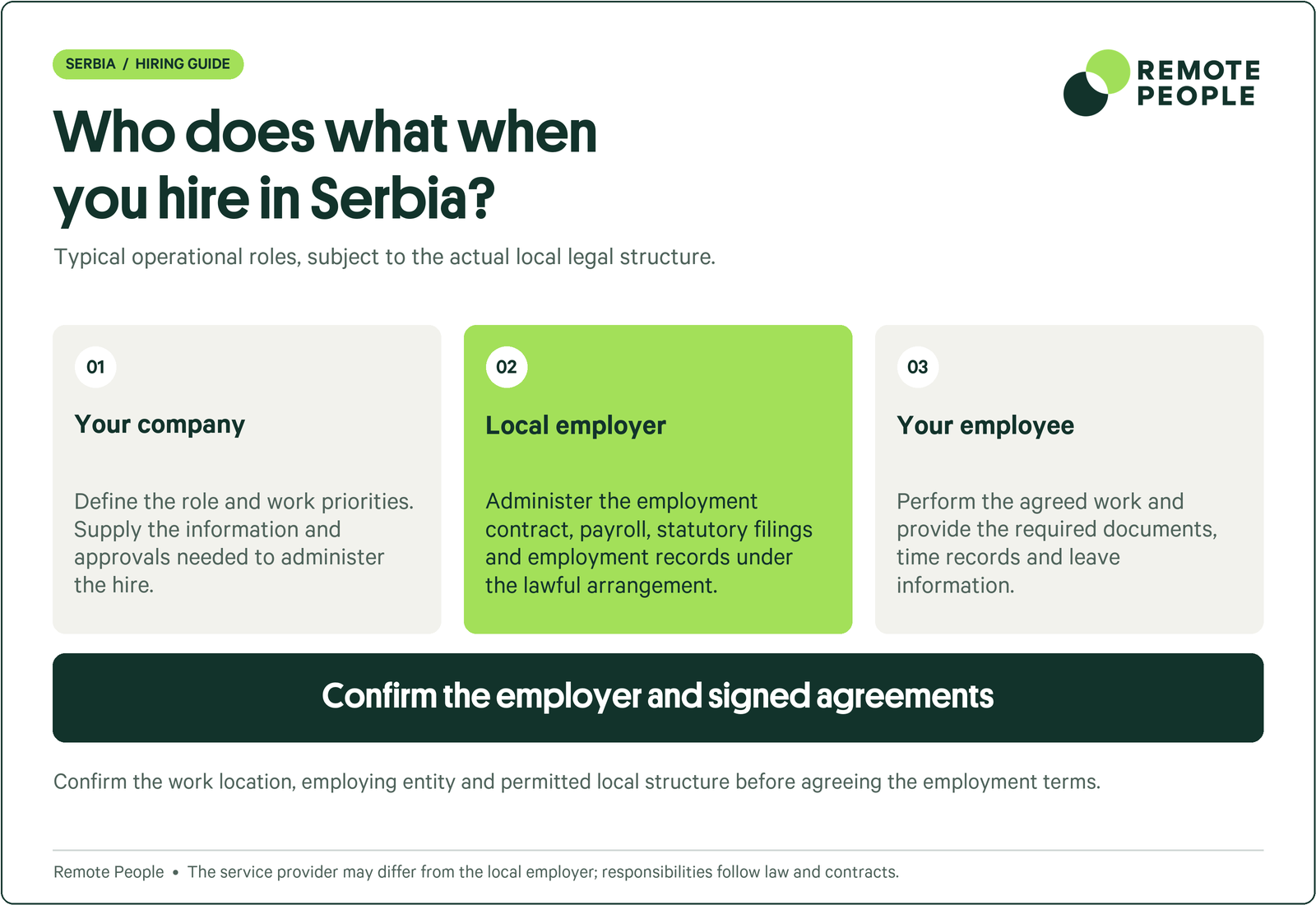
However, it can still be very challenging to connect with and hire Serbian workers because of the unfamiliar labor landscape, language, and culture in the country. Foreign employers, therefore, often use professional recruiters to help them find the talent they require. Once they have their employees selected, they can hire them through one of the following methods:
Entity Incorporation
If you expect to hire a significant number of workers and operate directly in the Serbian market for an extended period, it makes good business sense to incorporate a local entity. However, this may not be the best choice if you won’t work in the local market for a long time.
Investors typically choose to register limited liability companies (LLCs or društvo sa ograničenom odgovornošću), public limited companies (PLCs or akcionarsko društvo), or branch offices (podružnica). All three of these types of entities can be wholly foreign-owned in Serbia. The World Bank ranks Serbia 73rd out of over 180 countries for ease of starting a new business, as it can take just seven steps and seven days to do so. It’s also one of the easiest places in the world to procure construction permits and secure trade across international borders.
Once you’ve registered an entity, you can legally hire employees, but you’ll need to learn to handle HR for them, or hire an in-house HR team. You’ll likely also need to expend resources to work with tax and legal experts to ensure that you stay compliant with Serbia’s labor and tax laws.
Working with an EOR
If you want to hire real employees and have direct control over how and when they work, but you don’t want to register an entity, a Serbia Employer of Record, or EOR, is likely your best choice. When you partner with an EOR, it hires your workers for you and becomes their legal employer in Serbia. This also makes it responsible for legal compliance. EORs handle your employees’ HR concerns, so you won’t need to learn all the regulatory, cultural, and linguistic tools needed to manage Serbian workers. Instead, you can focus on how they can produce value for your business.
Hiring Independent Contractors
Instead of putting time and resources into the incorporation of a local entity, you can choose to work with independent contractors or freelancers in Serbia. You can hire them from abroad and manage their projects and payments remotely, without ever needing to visit Serbia. This can allow you to access special skills and knowledge that you may not be able to find in regular employees. While they may ask for higher fees than you might be able to pay in employee wages, you can often save money by only hiring them for limited times and specific projects. You also save on administration, as contractors take care of their own tax and social security payments.
There are, however, also negative aspects to consider when hiring contractors. One is that they may not always be available when you need them, as they work for multiple clients (even your competitors). Another is that their work may not be consistent. You’re unable to control their methods of production, and if you do, you can risk being penalized for misclassifying workers. The same is true for their working hours. Instead, you have to depend on them to produce quality work on schedule, which doesn’t always happen.
If you’d like to learn more about how Employer of Record (EOR) services work, read our What Is an Employer of Record (EOR)? guide for a complete overview of the model, its benefits, and when to use it.
If you’re comparing providers, our Best Employer of Record (EOR) Providers guide reviews the leading platforms to help you choose the right solution for your business.
Next, we’ll take an in-depth look at how EORs function in Serbia and how they benefit both employers and employees.
Using an Employer of Record in Serbia
If you don’t own an entity in Serbia, working with an EOR is one of your best options for hiring workers and managing their HR needs in full compliance with local laws. In addition to contracting your employees directly, an EOR partner will also manage the following core activities for you:

- Onboarding: You may have found employees on your own, or in conjunction with a recruitment agency, or even an EOR that also does recruitment. Regardless, your EOR will help you bring them on board quickly. Most EORs can onboard new workers in just a few hours to a few days. Their role includes collecting their personal and banking information, adding them to your payroll, and registering them with the appropriate authorities. At the same time, you’ll need to onboard them to your operation, often through orientations, job-specific training, and giving them access to the tools and systems they need to do their jobs.
- Payroll: Payroll management is a core function of EOR services. Your EOR partner will first add each new employee to your payroll on its platform, then set up a specific calculation for each of them, based on their salary, benefits, and tax obligations. As their worksite employer, you’ll need to supply the EOR with your employees’ time and attendance data for each pay period. Once it receives this, it can run payroll, calculating how much to deduct and how much to pay in net salary to each employee.
- Taxes: Workers in Serbia are required to pay income tax on their employment earnings, and their employers must calculate and withhold these taxes accordingly. As part of payroll processing, your EOR will handle these actions for you. It will also remit the funds collected to the Tax Administration (Poreska Uprava), Serbia’s tax authority.
- Benefits administration: Employees in Serbia are entitled to many mandatory benefits, including annual paid leave, maternity leave, public holidays, and social security benefits. Your EOR will manage the administration of these benefits for you by monitoring each employee’s entitlements and use of them. It will also deduct contributions to social programs as part of payroll and calculate our employer contributions as well. Many EORs also help you offer supplementary benefits to your team.
- Contracts: Your workers’ contracts must be fully compliant with all Serbian labor laws. Your EOR takes on this responsibility as the party that actually enters into agreements with your Serbian employees. Most EORs also manage employee signatures and store contracts for future reference.
- Terminations: Because of the EOR’s status as the legal employer of your employees in Serbia, it is also the party that can officially terminate them. If you want to dismiss workers, you’ll need to inform the EOR. It will look at your reasons for the dismissals, decide if any notice periods or severance pay are required, and provide these if they are.
- Compliance: Your EOR partner will work with its legal experts to maintain constant compliance with all of the country’s laws. Should any changes be made to legislation, it will adapt your contracts and conditions accordingly to ensure workers always receive the benefits and working conditions they’re entitled to.
- Recruitment: Not all EORs offer recruitment-related services. The ones that do may employ professional recruiters who will actively search out top talent to fill your open positions. Other EORs simply provide their clients with recruitment tools through their online platforms. These tools can include access to talent pools, connections to job sites in Serbia, and applicant tracking systems (ATSs).
Employment and Labor Laws in Serbia
Serbia’s legal system includes influences from German and French civil law, and is currently being adapted to EU standards as well. Important legal instruments that govern employment include the Constitution of the Republic of Serbia and the Labor Act.
While your EOR will handle compliance with these regulations, it’s still important that you’re aware of the main employment laws and your obligations to your employees.
Employment Contract Requirements
Employment contracts in Serbia must be written in Serbian. Verbal agreements are not valid. Contracts must cover both parties’ details, job description, workplace, contract type, start date, working hours, salary, and reference to any applicable collective agreements.
Fixed-term contracts are capped at 24 months including renewals, or 36 months for newly established employers. Once the limit is reached, the contract converts automatically to permanent employment. Exceptions apply for project-based, seasonal, and absence-cover arrangements. Employees within 5 years of retirement may also be engaged on a fixed-term basis for that remaining period.
Standard Working Hours
Employees normally work five days a week and eight hours a day in Serbia, for a regular workweek of 40 hours. They must receive at least one unpaid 30-minute break after working six hours. They must also be given at least one full day of rest per week.
Overtime
Overtime is limited to 4 hours per day and 8 hours per week and applies in cases of unexpected workload or emergencies. Premium rates are set as minimums under the Labour Law and are cumulative where multiple conditions apply.
Work Condition | Minimum Premium Rate |
|---|---|
Overtime | 126% of base salary |
Night work (10pm to 6am) | 126% of base salary |
Work on rest days (Sundays) | 110% of base salary |
Work on public holidays | 210% of base salary |
Where conditions overlap, such as overtime performed on a public holiday, both premiums apply simultaneously.
Probation Periods
Probation periods are legal and are widely used in Serbia to assess new employees. They can last as long as six months and cannot be extended or rewed. During probation, either party can choose to terminate their employment agreement at any time, but must provide the other party with at least five days’ notice. No justifications or compensation are required for these terminations.
Payroll and Employment Taxes in Serbia
Fiscal Year
The normal fiscal year in Serbia follows the calendar year. While most companies follow this year, they can obtain special permission from the Ministry of Finance to use a different fiscal year, which they must then stick to for at least five years.
Payroll Cycles
Employers must pay their employees monthly in Serbia. They have until the last business day of the following month to pay their workers for each pay period.
Minimum Wage
Serbia’s minimum wage is set as a net hourly rate, excluding taxes and social contributions, by the Socio-Economic Council and confirmed by government decision. Effective January 1, 2026, the minimum wage is RSD 371 per net working hour, a 10.09% increase from the October 2025 rate of RSD 337. This equates to approximately RSD 64,554 net per month based on standard working hours, or around €551.
The RSD 58,630 monthly figure referenced in the previous version applied only to the October to December 2025 period and is no longer current. All minimum wage figures in Serbia are quoted as net amounts before taxes and mandatory social contributions. The gross equivalent is higher once employer and employee contributions are applied.
Employer Tax Contributions
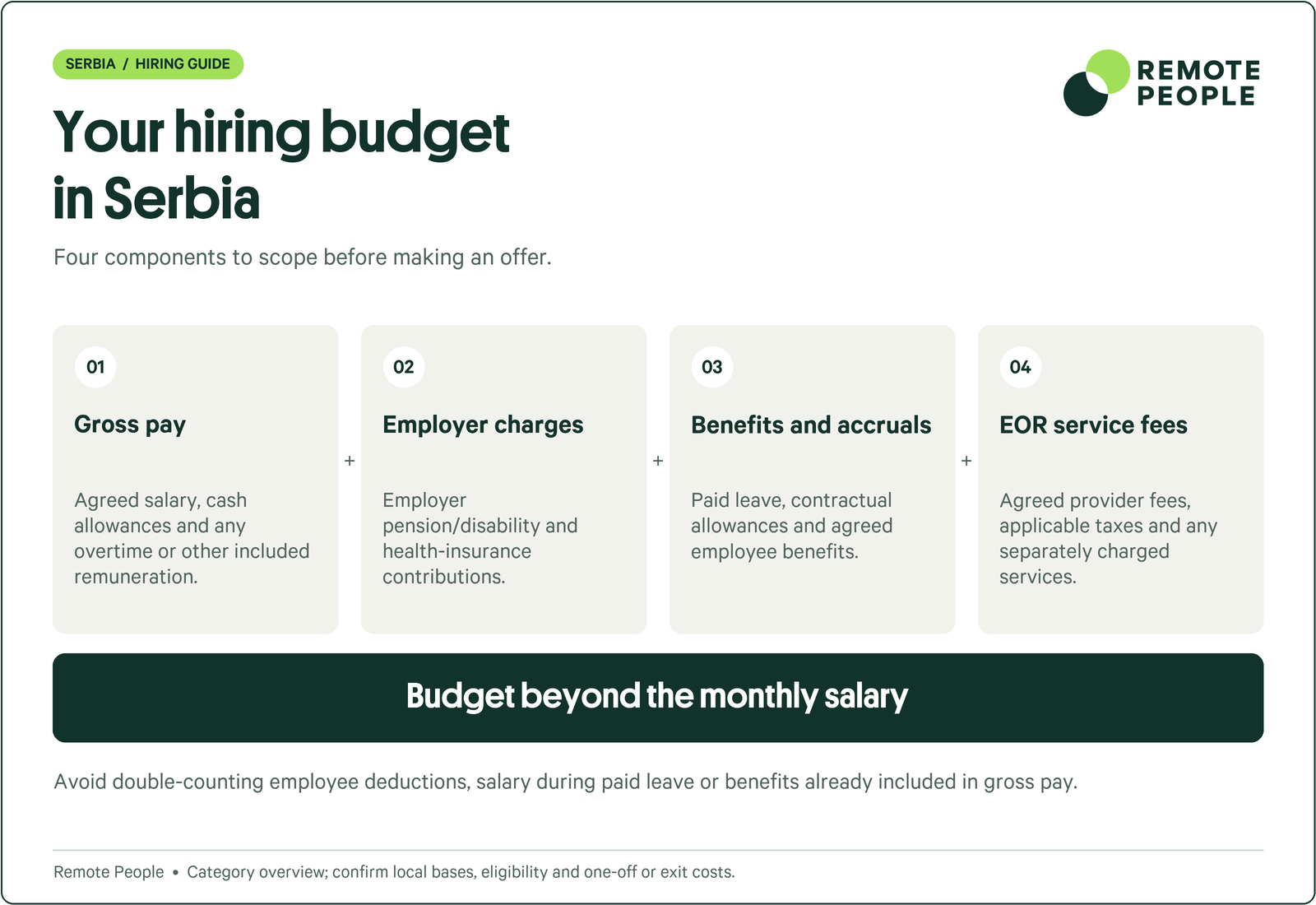
Employers in Serbia contribute a total of 15.15% of each employee’s gross salary to mandatory social insurance, paid to the Tax Authority for distribution across two programs.
Contribution Type |
Employer Rate |
|---|---|
Pension and Disability Insurance (PIO Fund) |
10% |
Health Insurance (RFZO) |
5.15% |
Total |
15.15% |
Employers do not contribute to unemployment insurance, which is an employee-only obligation. Contributions are calculated on gross salary up to a maximum monthly base of RSD 656,425, a figure adjusted annually.
Employer Hiring Incentives
Serbia offers meaningful tax incentives for employers who hire new employees. Qualifying employers can claim exemptions of 65% to 75% on salary taxes and social security contributions, depending on the number of newly hired staff. Additional incentives apply for hiring workers under 30 and other subsidised employment categories. These reliefs can meaningfully reduce the total cost of onboarding new staff and are worth factoring into workforce planning.
The incentives were extended through December 2025 and have since been confirmed for 2026. Employers should verify current eligibility conditions and applicable rates with a local tax adviser before applying them to payroll.
Employee Payroll Tax Contributions
Employees in Serbia contribute a total of 19.9% of gross salary to mandatory social insurance, withheld by the employer at source each month.
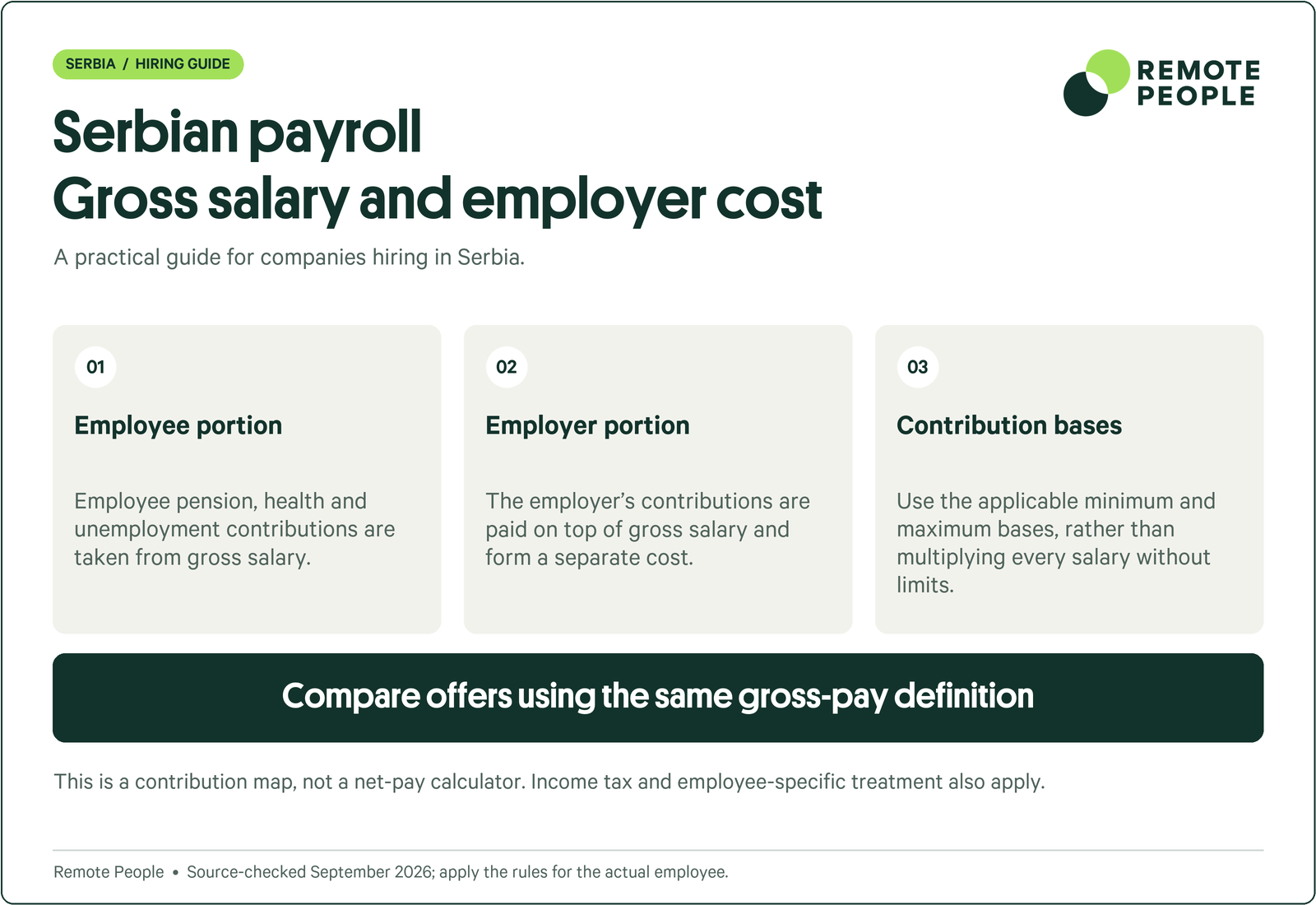
Contribution Type | Employee Rate |
|---|---|
Pension and Disability Insurance (PIO Fund) | 14% |
Health Insurance (RFZO) | 5.15% |
Unemployment Insurance | 0.75% |
Total | 19.9% |
Contributions are calculated on gross salary up to the maximum monthly base of RSD 656,425, adjusted annually. The minimum monthly contribution base is RSD 45,950 for 2025.
Individual Income Tax Contributions
Serbia applies a flat 10% income tax on employment income, withheld monthly by the employer. A non-taxable amount of RSD 28,423 per month (effective January 2025) is deducted before the rate applies.
Separately, Serbia levies an Annual Personal Income Tax (godišnji porez na dohodak građana) on higher earners. This is not a monthly withholding obligation but an annual filing requirement, due by May 15 of the following year. It applies to individuals whose total annual net income exceeds RSD 5,439,096 (three times the average annual salary for 2025). Income between that threshold and RSD 10,878,192 (six times the average annual salary) is taxed at 10%. Income above RSD 10,878,192 is taxed at 15%.
Taxpayers under 40 are entitled to an additional deduction equal to three average annual salaries when calculating this annual tax, which can significantly reduce or eliminate liability for younger high earners.
Bonus Payments
A 13th-month salary is neither mandatory nor traditional in Serbia, though employers may choose to offer this bonus at their discretion.
Employees are, however, entitled to raises in their pay each year. They must receive an increase of 0.4% of their basic pay annually.
Work Permits and Visas in Serbia
Foreign nationals who wish to work in Serbia legally must obtain both a work permit and a temporary residence permit. Since 2024, Serbia has simplified this through a Single Permit system, which combines temporary residence and work authorisation into one biometric document. The process is employer-driven, meaning the Serbian employer must sponsor and apply on behalf of the foreign employee.
- Visa D (Long-Stay Employment Visa): Required for nationals of countries subject to Serbia’s visa regime. This visa allows entry into Serbia for employment purposes and is the first step before applying for a temporary residence permit. It is valid for up to 180 days and is applied for at a Serbian embassy or consulate in the applicant’s home country.
- Single Permit (Temporary Residence and Work Permit): The primary authorisation for foreign employees working in Serbia. It combines residence rights and work authorisation into one document, valid for up to 3 years and renewable. Applications are submitted electronically through the Welcome to Serbia portal. EU citizens do not require a visa to enter Serbia but still need a work permit for long-term employment.
- Special Work Permit: Covers specific categories including intra-company transfers, project-based assignments, and seasonal work. Eligibility and duration vary depending on the nature of the engagement.
Processing times for the Single Permit typically range from 2 to 6 weeks depending on the completeness of documentation and the volume of applications at the time of submission. The Visa D can take 15 to 45 days depending on the consulate. Administrative fees for work permit applications are approximately RSD 12,530 (around €100), with additional fees for the temporary residence card.
Employers are responsible for covering application costs and must demonstrate through a labour market test that no suitable local candidate is available for the role, unless the position falls under an exempt category. Foreign employees must also register their address with local police within 24 hours of arrival in Serbia.
Time Off and Leave in Serbia
Mandatory Leave Entitlement
Employees become entitled to annual paid leave after 30 days of continuous service. The minimum entitlement is 20 working days per year, paid at the employee’s average salary over the preceding 12 months. Additional leave days may be granted based on years of service, working conditions, professional qualifications, disability status, or care responsibilities, up to a maximum of 30 working days per year under the Labour Act.
Leave can be split into two installments, with the first block being at least 10 consecutive working days. Any unused leave can be carried over until the end of June the following year.
Public Holidays
Employees required to work on a public holiday must be compensated at a minimum of 210% of their normal wage. Serbia observes 10 mandatory national public holidays for all employees, plus 1 to 2 additional religious holidays depending on the employee’s faith.
Orthodox Christians may observe Orthodox Christmas and a patron saint’s day, while Catholic, Protestant, Muslim, and Jewish employees are entitled to their own principal religious holidays under the same framework.
The national public holidays are as follows:
- New Year’s Day (January 1 and 2)
- Orthodox Christmas (January 7)
- Statehood Day (February 15 and 16)(February 17 observed as substitute day off)
- Orthodox Good Friday (varies)
- Orthodox Easter Sunday and Monday (varies)
- Labour Day (May 1 and 2)
- Armistice Day (November 11)
If a non-religious public holiday falls on a Sunday, the following Monday is observed as a non-working day in lieu.
Sick Leave
The first 30 days of sick leave are paid by the employer at 65% of the employee’s average salary. From day 31 onward, the Republic Health Insurance Fund (RFZO) takes over funding. For regular illness or injury, the benefit rate remains at 65% of average salary. For work-related injuries and occupational diseases, the rate increases to 100%.
Employees must notify their employer within the first 3 days of illness and present a medical certificate if the absence extends beyond 3 days.
Maternity Leave
Female employees are entitled to 365 days of paid maternity leave for their first and second child, beginning no later than 28 days before the expected due date. For the third and subsequent children, the total entitlement extends to two years. The employer covers the first 30 days at 100% of salary. From day 31 onward, the Republic Health Insurance Fund takes over, paying the employee’s average salary based on the preceding 18 months.
Paternity Leave
Fathers are entitled to 5 working days of paid paternity leave upon the birth of a child, funded by the employer at full salary. In specific circumstances where the mother is unable to care for the child, such as serious illness or abandonment, the father may assume the remaining maternity leave entitlement, up to the full 365 days or two years depending on the child’s birth order.
Bereavement Leave
Employees are entitled to five days of paid leave upon the death of an immediate family member.
Termination and Severance in Serbia
Termination
During probation, employees may be dismissed without cause if performance does not meet the employer’s standards.
After probation, lawful grounds for termination include underperformance, gross misconduct, and redundancy. Underperformance requires a written warning and a minimum 8-day improvement period. Gross misconduct under Article 179 of the Labour Act covers failure to perform duties, unauthorised absence of 3 or more consecutive days, alcohol or drug use at work, and criminal offences connected to employment.
In all cases, employers must issue a written notice of intent to terminate and give the employee the right to respond before proceeding.
Notice Periods
During probation periods, employees and employers must give each other five days’ notice if they wish to terminate their agreements. After probation, employees who are not dismissed for gross misconduct must generally be given notice. Workers receive one month’s notice if they’ve paid contributions to social security for less than ten years, two months if they’ve paid for 10- 20 years, and three months’ notice if they’ve paid for over 20 years. Employees must provide their employers with 15 days’ notice.
Severance Pay
Severance pay is mandatory when an employee is made redundant under Serbia’s technological surplus provisions. The minimum payment is one-third of the employee’s average monthly salary for each year of service, with the monthly salary calculated as the average of the preceding 3 months. Regardless of years of service, severance cannot fall below two-thirds of the employee’s monthly salary.
Different rules may apply for employees approaching retirement age, and employers should verify the applicable provisions with a local adviser before processing redundancy payments in those cases.
Why Hire in Serbia with an Employer of Record?
Serbia offers investors a growth economy and several other reasons to hire local workers, especially through an EOR. These reasons include:
- Reduced risk: When you hire with an EOR, it becomes the legal employer of your workers in Serbia. It uses its knowledge of local laws to stay compliant at all times, thus protecting you from penalties.
- Low costs: Relative to employees in neighboring EU countries and developed countries around the world, Serbian wages are more affordable, and this can help you save on labor costs. The efficiency and professionalism of EORs can also help you save money compared to opening and managing your own HR department.
- Language skills: While the official language of the country is Serbian, workers also speak regional languages like Croatian and Hungarian. They also have important skills in international languages like Russian and German. English is also widely spoken in urban areas, and this can make communication with your employees smooth and easy.
- Extensive opportunities: Serbia’s economy has been growing steadily for a decade, and this growth is predicted to continue. ICT, tourism, construction, and creative industries are all booming in this market, offering investors a multitude of opportunities for new business ventures.
Hire in Serbia
Belgrade’s fast-growing tech scene with PIO and health contributions, Serbian Labor Law, and evolving EU-aligned employment regulations.
We handle employment contracts, payroll, social contributions, and full Serbian compliance.
No local entity needed. Your team can start in days.
How to Choose an Employer of Record in Serbia
An increasing number of EORs are providing services in Serbia, thanks to the country’s economic growth and affordable and skilled labor. To help you choose from the dozens of options available, we suggest focusing on these criteria:
Price
Set your budget, then look at online prices and request quotes from service providers that interest you. Any EORs who can’t offer the services you need within your budget can be eliminated from your consideration.
Services
All EORs will provide core services like payroll, benefits administration, and leave management. If you need more support, you may need to look for providers that offer extra services like supplementary benefits administration or recruitment.
Reputation
If an EOR has excellent online ratings and reviews, it lets you know that you can rely on the provider to see to your employees’ needs well, keep you compliant, and deal effectively with the Serbian authorities.
Expand into Serbia Easily with RemotePeople’s Employer of Record in Serbia
Serbia has quietly become one of the more attractive hiring markets in Central Europe. A well-educated workforce, competitive salaries, strong IT and engineering talent, and a tax incentive structure that actively rewards employers for growing their teams. The fundamentals are there.
What trips up international employers is the compliance side. Social contributions across multiple funds, Labour Act procedures that must be followed precisely, and a minimum wage that has increased significantly over the past 12 months. Getting these right from day one matters.
RemotePeople manages the full employment relationship in Serbia on your behalf, from compliant contracts and payroll processing to social security registration and termination procedures, with no local entity required. Get in touch to find out how we can support your Serbia hiring.
Frequently Asked Questions
No. Serbia does not require a 13th month payment. Employers may offer discretionary bonuses, but there is no statutory obligation to do so.
Yes, but they must meet specific conditions to be enforceable. The clause must be justified by a legitimate business interest, limited in scope and geographic reach, and the employee must receive financial compensation during the restricted period. Overly broad non-competes are generally unenforceable.
Yes. Non-EU foreign nationals must obtain a combined residence and work permit before starting employment. Since 2024, Serbia simplified this process through a unified permit system, allowing applications to be initiated electronically before the employee arrives in the country. Permits are issued for up to three years and are renewable.
Salaries must be paid in Serbian Dinar (RSD). Contracts must state the gross salary amount, as the Labour Law requires gross-based agreements. Employers cannot contract on a net basis.
Yes. Both sector-level and company-level collective agreements exist in Serbia and can set terms above the statutory minimums for pay, leave, overtime premiums, and notice periods. Employers should identify whether a relevant collective agreement applies to their industry before finalising employment terms.
Yes. Employees are entitled to a minimum annual salary increase of at least 0.4% per year of service under the Labour Act, regardless of performance or company policy. This applies on top of any contractual or collective agreement increases.
Employer of Record in
Employer of Record in
Employer of Record in
Employer of Record in
Employer of Record in
Employer of Record in
Employer of Record in
Employer of Record in