
 Recruit
Employer of Record in Delaware
-
 Drew Donnelly
- Published
- September 22, 2026
Delaware’s employment law includes a $15/hr minimum wage, mandatory workers’ compensation for all employers, and specific meal break rules, and a Delaware EOR handles full state compliance with no local entity needed.
Hire in Delaware — book a free 30-minute demo
Tell us what you need. You'll get a tailored, transparent proposal within 24 hours, plus a free call to walk through it.
Tell us about your company
So we can match you with a specialist who knows your market — and unlock volume pricing tiers.
* All fields are required.
Where and when are you hiring?
Tell us the geography and timing and we'll quote each country line by line, with onboarding timelines.
* All fields are required.
Help us beat your current setup
We'll benchmark your current deal and send a line-by-line proposal in 24 hours — showing exactly where we cut cost, time, or risk. After you submit, you can book a call to walk through it together.
* All fields are required.
Thanks! Your proposal is on its way.
Expect a tailored, line-by-line proposal in your inbox within 24 hours. In the meantime…
Want to walk through it together?
Book a free 30-minute call with one of our specialists. We'll explain every line, answer your questions, and tailor the proposal further if you need.
No obligation. Pick a time that works for you.








- Hire in Delaware — book a free 30-minute demo
- Tell us about your company
- Where and when are you hiring?
- Help us beat your current setup
- Thanks! Your proposal is on its way.
- Delaware Employer of Record
- What is the Difference Between a Delaware EOR and a Delaware PEO?
- How Does a Delaware Employer of Record Work?
- What Labor Laws Apply to Hiring in Delaware?
- Payroll Taxes and Employer Cost in Delaware
- Employee Classification Rules in Delaware
- What Makes Hiring in Delaware Unique?
- What Are the Benefits of a Delaware EOR?
- What are the Downsides of a Delaware EOR
- How to Choose a Delaware EOR
- Engage a Delaware Employer of Record with RemotePeople
- Related EOR Destinations

Let RemotePeople handle payroll, compliance, and HR admin worldwide so you can focus on building your team.
Key Takeaways
- Delaware’s minimum wage reached $15.00 per hour on January 1, 2025, making it one of the highest state minimums in the Mid-Atlantic region.
- The state launched its Paid Family and Medical Leave program in two phases: employer contributions started in January 2025, and employee benefit claims began in January 2026.
- Delaware applies a strict ABC test for worker classification across most employment, with misclassification penalties reaching $20,000 per worker and criminal liability for repeat offenses.
- Unemployment insurance underwent an overhaul through HB 433, introducing rising taxable wage bases ($12,500 in 2025, $14,500 in 2026, $16,500 in 2027) and restructured rate schedules.
- Workers’ compensation is compulsory for every employer with even one employee, which is stricter than in most states.
Delaware punches well above its weight for a state of just under one million residents. The economy generated approximately $111 billion in GDP in 2024 (per the Bureau of Economic Analysis), powered by a financial services sector that earned Wilmington the title of “America’s credit card capital”. Key industries include banking and finance, healthcare and education, chemicals and pharmaceuticals, and agriculture.
The financial services sector alone employs more than 49,400 workers. Christiana Care Health System is the largest private employer in the state with roughly 13,000 employees. Other major employers include JPMorgan Chase, Bank of America, AstraZeneca, Incyte, the University of Delaware, and Bayhealth Medical Center. Government employment, including Dover Air Force Base, accounts for about 70,300 jobs. Delaware’s position along the I-95 corridor gives employers direct access to the Philadelphia, Baltimore, and Washington D.C. labor markets. About 60% of the U.S. population lives within a day’s drive of Delaware, and the state ranks 10th nationally in share of remote workers at nearly 30%. Sussex County ranks Delaware second nationally in agricultural value per acre.
The famous corporate law ecosystem defines Delaware’s business climate. Roughly 67.6% of Fortune 500 companies, and over 50% of all U.S. publicly traded companies, are incorporated in Delaware, drawn by the Court of Chancery and 200+ years of predictable business case law. The state is one of five states in the United States that charges no sales tax, going instead for a gross receipts tax on businesses. Property taxes are among the lowest nationally at a rough 0.50% effective rate.
The cost of living is about 8% above the national average, with wide variation between pricier northern Delaware (Wilmington/New Castle County) and more affordable central and southern regions. Delaware now mandates paid family leave, applies the ABC classification test statewide, and requires workers’ comp from the very first employee. Compared to a state like Idaho, Delaware demands more compliance, but it rewards employers with access to a skilled workforce, strong infrastructure, and a trusted legal environment.
As of August 2025, total nonfarm payroll employment stood at 493,800 jobs, growing 0.7% annually. The unemployment rate was 4.3% in August 2025, though it rose to 5.2% by December 2025, above the national rate of 4.4%. Corporation franchise taxes are roughly one-fifth of state revenue. Important employer incentives include the Blue Collar Jobs Act, the New Economy Jobs Program, and the EDGE Grant Competition.
Read our article on Doing Business in Delaware to learn more about the corporate environment in the state.
Delaware Employer of Record
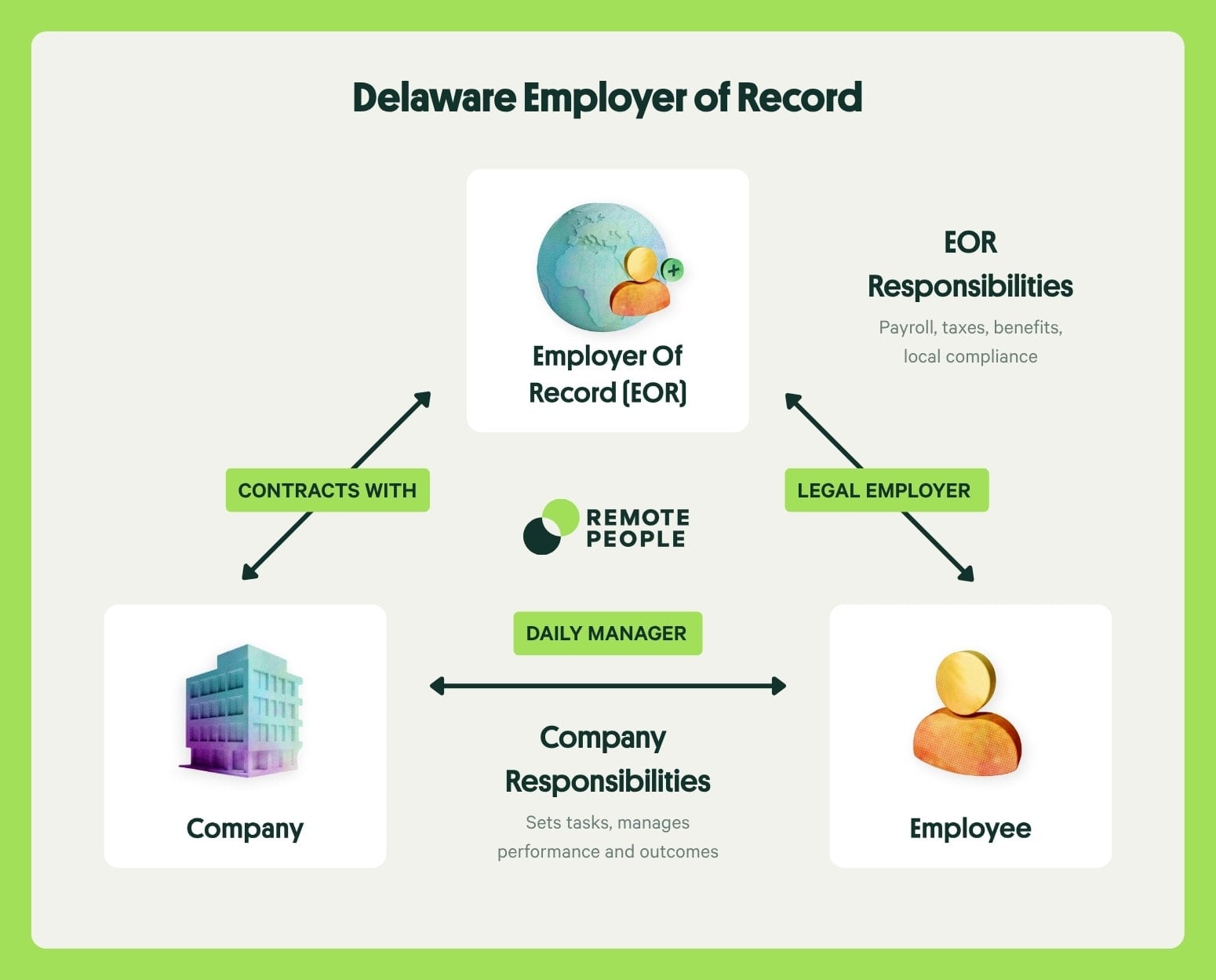
A Delaware Employer of Record (EOR) is a third-party company that becomes the legal employer of your workers in Delaware. The EOR handles payroll processing, state and federal tax filings, benefits administration, and compliance with Delaware labor laws. Your company keeps full control over day-to-day work assignments, schedules, and management decisions.
What is an EOR can help explain how this employment model works in more detail.
The EOR takes on the obligation to register with the Delaware Division of Revenue for withholding, the Division of Unemployment Insurance for SUI, and the Delaware Paid Leave program for PFML contributions. Your company does not need to set up a Delaware entity, open state tax accounts, or use a registered agent. This speeds up hiring from weeks or months to days, while reducing the risk of non-compliance penalties.
What is the Difference Between a Delaware EOR and a Delaware PEO?
A Delaware Professional Employer Organization (PEO) enters a co-employment arrangement. Your company remains a legal employer with the PEO. You must already have your own Delaware entity or a registered presence in the state. PEOs are usually used by domestic companies that already operate in Delaware and want to outsource HR administration while keeping shared liability.
A Delaware EOR is different. The EOR is the sole legal employer on record. Your company does not need a Delaware entity at all. International companies hiring their first U.S. employees in Delaware choose an EOR because it removes the need for a physical office and lets them start operations immediately. However, for EOR purposes, incorporation in Delaware is different from physical operations. Companies must still comply with employment laws in the state where employees work.
Start hiring with a Delaware EOR
Let us handle the complexities of hiring, compliance, and payroll in Delaware while you focus on growing your team.
- Hire employees in Delaware with a Delaware EOR
- No local entity is needed
- Pricing starts at USD 199 per employee
- RemotePeople can also help you find the best talent in Delaware
How Does a Delaware Employer of Record Work?
A Delaware EOR follows five steps to bring your employees into full compliance:
Compliant Employment Contract
The EOR drafts an employment agreement that meets Delaware requirements, including at-will employment, proper classification, anti-discrimination laws, and the correct minimum wage and overtime requirements.
Payroll Setup with Correct State Registrations
The EOR registers for (or already holds) a Delaware Withholding Account Number with the Division of Revenue, an Employer Account Number with the Division of Unemployment Insurance, a PFML account with the Delaware Paid Leave program, and a Federal EIN (Employer Identification Number). If employees work in Wilmington, the EOR also registers for the City of Wilmington wage tax.
Tax Withholding and Remittance
The EOR withholds Delaware state income tax using the Delaware W-4, Delaware does not accept the federal W-4 for state purposes. The EOR remits withholding on the correct schedule (monthly, quarterly, or eighth-monthly based on the lookback period), files quarterly SUI returns, and submits PFML contributions.
Benefits Administration
The EOR manages enrollment in health insurance, retirement plans, and the Delaware PFML program. The EOR also ensures employees receive proper notice of their paid leave rights and handles PFML claims coordination.
Ongoing Compliance Management
The EOR files annual W-2 reconciliation, reports new hires to the Delaware State Directory of New Hires within 20 days, maintains required workplace postings, and tracks any new Delaware regulations.
What Labor Laws Apply to Hiring in Delaware?
Minimum Wage & Overtime
Delaware’s state minimum wage since January 1, 2025 is $15.00 per hour. The tipped minimum wage is $2.23 per hour in cash wages, and employers must ensure total compensation (tips plus cash wage) reaches $15.00 per hour, and make up any shortfall. A training wage of $14.50 per hour applies to workers aged 18+ during their first 90 calendar days.
Delaware follows the federal FLSA for overtime. The state has no daily overtime and no double time law. Standard FLSA exemptions to executive, administrative, professional, and outside sales apply.
Income Tax
Delaware imposes a seven-bracket progressive income tax ranging from 0% on the first $2,000 to 6.6% on income above $60,000. Every employer doing business in Delaware must withhold state income tax. Delaware requires its own state W-4 form and has no reciprocity agreements with any other state. Wilmington also adds a 1.25% city wage tax on earned income of residents and nonresidents working within city limits.
State Unemployment Insurance (SUI)
Under the restructured system from House Bill 433, the 2025 taxable wage base is $12,500 rising to $14,500 in 2026. The new employer total rate is 1.2%; 1.0% basic + 0.2% supplemental operations and technology assessment. Experienced employer total rates range from 0.6% to 5.6%. Employers file quarterly on Form UC-8, due the last day of the month following each quarter. Late filings incur a $17.25 fine plus 1.5% monthly interest on unpaid amounts.
Employers who fail to file or pay on time are fined a delinquent employer total rate of 6.5% (6.3% basic plus 0.2% supplemental). A quarterly report must be filed even if the employer had zero payroll during the quarter. Starting in 2027, Delaware will transition to a benefit ratio method with new rate tables, a permanent taxable wage base of $16,500, and a reduced supplemental assessment of 0.175%. This change under HB 433 is designed to stabilize the unemployment trust fund and align employer rates more closely with actual claims experience.
Paid Leave
Delaware does not mandate paid sick leave. No city or county has implemented local paid sick leave. Delaware, however, mandates Paid Family and Medical Leave under the Healthy Delaware Families Act. Employers with 25+ Delaware employees must provide full coverage, including parental, medical, family caregiver, and military qualifying basis. Employers with 10–24 employees must cover parental leave only. Employers with fewer than 10 employees may voluntarily opt in.
The total contribution rate is 0.80% of covered wages capped at the Social Security wage base of $176,100 for 2025. Employers can pass up to 50% of the cost to employees. Eligible employees receive up to 80% of average weekly wages, capped at $900 per week, for up to 12 weeks per year. These claims became available January 1, 2026. The total contribution rates are: 0.32% for parental leave, 0.40% for medical leave, and 0.08% for family caregiver and qualifying exigency leave.
To qualify for benefits, employees must have at least 12 months of tenure and 1,250 hours worked, with 60% or more of those hours performed in Delaware. HB 128, signed July 30, 2025, amended the original law to clarify that employers may not require employees to exhaust accrued PTO before accessing PFML benefits. The state program is the primary payor.
Employers also have the option to apply for approved private plans, either self-insured or fully insured, as an alternative to the state program. If approved, the private plan must meet or exceed the benefits and protections of the state plan. Employers who voluntarily opt in with fewer than 10 employees are locked into participation for three years.
Other mandatory leave include unpaid jury duty leave and unpaid volunteer emergency responder leave. Delaware does not require paid voting leave or bereavement leave for private employers.
Workers' Compensation
Workers’ compensation is compulsory for all Delaware employers with one or more employees. Limited exemptions exist for farm laborers and household workers earning under $750 per quarter. Delaware’s competitive private insurance market is regulated by the Delaware Compensation Rating Bureau (DCRB).
Self-insurance is also available for qualified employers, and the rates have declined for nine consecutive years. Unlike most states, Delaware does not use the National Council on Compensation Insurance (NCCI) as its rating organization. The DCRB’s Amended Filing No. 2501, effective December 1, 2025, reduced voluntary market loss costs by 11.60% and residual market rates by 9.08%.
Employers unable to get voluntary market coverage can access the Delaware Workers’ Compensation Insurance Plan (DIP), the assigned-risk residual market, after showing two carrier rejections. The 2025 average weekly wage is $1,386.46, with maximum weekly compensation of $924.31.
SB 145, signed July 1, 2025, modernized payments by allowing direct deposit and increased some reimbursement to 100%. Uninsured employers face penalties of three times the last premium plus $10 per day per employee (minimum $250/day), and courts can shut down operations until they get coverage.
Termination and Final Pay
Delaware is an at-will employment state. Either the employer or employee may end the relationship at any time, with or without cause and with or without notice. Recognized exceptions include anti-discrimination protections, whistleblower protections, and contractual terms.
Final paycheck deadlines are the same for both discharge and resignation. Under 19 Del. C. §1103, wages are due on the next regular payday or three business days after the last day worked. Employers may not withhold final pay pending return of company property.
PTO and vacation payout depends on employer policy. Delaware does not require payout of accrued unused vacation. However, code §1109 requires that any employer party to an agreement providing vacation or separation pay must honor that commitment within 30 days. If a written policy promises payout, the employer must comply.
Employers without reasonable grounds for dispute owe liquidated damages of 10% of unpaid wages per day (excluding Sundays and holidays), capped at 100% of the unpaid amount. Under SB 35’s wage theft provisions, additional civil penalties of $2,000–$20,000 per violation may apply. Delaware is not a right-to-work state, and union security agreements are permitted.
Delaware also requires that wages be paid at least once per calendar month, within 7 days of the close of the pay period. Employees working shifts of 7.5 hours or more are entitled to a 30-minute unpaid meal break, which must be scheduled after the first 2 hours and before the last 2 hours of the shift. These are practical points that an EOR manages as part of its standard payroll and scheduling duties.
Payroll Taxes and Employer Cost in Delaware
Employers in Delaware pay federal payroll taxes:
Payroll Tax | Rate |
|---|---|
Social Security tax rate | 6.20% |
Medicare tax rate | 1.45% |
FUTA | 0.60% |
Delaware state income tax is employee-paid but the employer handles withholding and remittance.
Example Cost Breakdown on $75,000 Salary (employer with 25+ employees)
Tax/Contribution | Employer Cost |
|---|---|
Social Security (6.2%) | $4,650 |
Medicare (1.45%) | $1,088 |
FUTA (0.6% on $7,000) | $42 |
Delaware SUI (new employer 1.2% on $12,500) | $150 |
Delaware PFML (employer share 0.40% on $75,000) | $300 |
Workers’ comp (est. approx. $0.80/$100 payroll) | Approx. $600 |
Total estimated employer burden | Approx. $6,830 |
As percentage of salary | Approx. 9.1% |
The employer burden ranges from roughly 8.5% to 10.5% depending on SUI experience rating and workers’ comp classification. Experienced employers with clean claims histories pay less; high-risk industries or employers with poor SUI experience pay considerably more. For 2026, the SUI wage base rises to $14,500 and the Social Security cap increases to $184,500, slightly increasing maximum liability.
Employee Classification Rules in Delaware
Delaware applies the ABC test for worker classification across most employment contexts. Under the Workplace Fraud Act, every worker is assumed to be an employee unless the employer proves all three:
(A) the worker is free from the employer’s control and direction, (B) the worker is engaged in an independently established trade or business, and (C) the work falls outside the employer’s usual course of business. Failing any single one means the worker is an employee.
SB 35, signed October 2022, extended these classification standards to all industries by defining misclassification as wage theft. This makes Delaware one of the stricter states in the country, comparable to New Jersey or Massachusetts than to business-friendly states using the IRS common law test.
Under the Workplace Fraud Act, penalties are $5,000–$20,000 per misclassified worker, stop-work orders, and treble damages. Repeat offenders face $20,000 per worker plus five-year debarment from public contracts. Under SB 35, penalties are $2,000–$20,000 per violation, escalating to a Class E felony on third conviction. Delaware also participates in a tri-state enforcement agreement with New Jersey and Pennsylvania for joint investigations.
There is one exception to the ABC test. For workers’ compensation purposes, Delaware courts apply the common law “right to control” test rather than the ABC test, following precedent set in Falconi v. Coombs, Inc. (2006). Labeling a worker as an independent contractor does not shield an employer from workers’ comp liability. Separately, SB 63 made general contractors jointly and severally liable for subcontractor misclassification in the construction industry. The Workplace Fraud Act also requires joint data sharing among the Department of Labor, Division of Unemployment Insurance, Office of Workers’ Compensation, Department of Insurance, Attorney General, and Division of Revenue.
Using an EOR significantly reduces classification risks in Delaware. The EOR employs workers directly under proper W-2 arrangements, eliminating the risk of misclassification claims and the penalties.
What Makes Hiring in Delaware Unique?
Delaware’s financial services sector dominates the economy, with credit card operations from JPMorgan Chase, Bank of America, Capital One, and Citibank providing tens of thousands of jobs in Wilmington and New Castle County. This creates a deep talent pool in banking, compliance, legal, and fintech roles that few states outside New York can match.
Regulation intensity in the state can be classified as moderate-to-high. Rules like the ABC classification test, workers’ comp from employee one, new PFML obligations, and SB 35’s wage theft criminal penalties place Delaware among the more regulated states on the East Coast. The Wilmington wage tax also adds another focus point for employers with workers in the city.
The $15.00 minimum wage puts Delaware above the federal floor and most neighboring states except New Jersey. The state’s unemployment rate rose to 5.2% by December 2025, above the national average, which may ease hiring competition slightly compared to tighter labor markets.
Delaware also has tax advantages like no sales tax, low property taxes, and strong business incentive programs. The progressive income tax is higher than many southern states, but the overall tax burden is competitive for the Northeast corridor. Delaware’s location is also a hiring advantage and makes the state attractive for distribution, logistics, and customer service operations compared to the more expensive New York or New Jersey.
What Are the Benefits of a Delaware EOR?
- No Entity Setup Required: Hire in Delaware without forming a local LLC, registering with the Secretary of State, or appointing a resident agent.
- Faster Onboarding: Employees resume in their roles in days rather than the weeks or months required for entity formation and state registrations.
- Centralized Compliance: The EOR manages Delaware’s progressive income tax withholding, SUI filings, PFML contributions, workers’ comp, and new hire reporting in one place.
- Reduced Legal Risk: The EOR assumes liability for proper classification, timely wage payment, and compliance with Delaware’s ABC test and SB 35 wage theft law.
- Scalable Across Multiple States: Hire in Delaware and other states across the United States through a single EOR provider without needing to set up separate entities in each jurisdiction.
What are the Downsides of a Delaware EOR
No hiring model is perfect. An EOR arrangement has a few trade-offs:
- Service Fee: EOR providers charge a per-employee monthly fee or a percentage of payroll. This adds cost compared to running payroll in-house, though it eliminates the cost of entity formation, registered agents, and in-house compliance staff.
- Less Direct Payroll Control: The EOR processes payroll on your behalf, which means you rely on their systems and timelines for pay runs, tax filings, and benefits changes.
For most companies hiring a small or mid-sized Delaware team, especially those without an existing U.S. entity, the EOR model is more cost-effective and lower-risk than building standalone compliance from scratch. It is very important to choose a provider who has reliable, verifiable and reputable processes.
How to Choose a Delaware EOR
Use this checklist to compare providers:
Transparent Pricing
Look for clear per-employee fees with no hidden charges for state registrations, tax filings, or PFML administration.
Direct EOR Model
The provider should be the actual employer of record, not a broker using third-party partners between you and your employees.
US Multi-state Expertise
Delaware’s business environment require specialized knowledge. The provider should demonstrate current, accurate understanding of Delaware rules.
Dedicated Support
Use companies with expert account managers or compliance contacts, not generic support agents, who can answer questions about Delaware labor law and handle time-sensitive payroll and administrative issues.
Strong Compliance Track Record
Ask for references and proof of proper state registrations. Verify the provider holds active accounts with Delaware Division of Revenue, Division of Unemployment Insurance, and the Paid Leave program.
Engage a Delaware Employer of Record with RemotePeople
RemotePeople operates as a direct Employer of Record across all 50 U.S. states, including Delaware. Our team manages Delaware payroll registrations, state income tax withholding, all filings, contributions, compensation, and reporting so you can focus on your business instead of compliance.
You may be hiring your first Delaware employee or scaling an existing team, and RemotePeople will provide compliant employment contracts, accurate tax remittance, and continuous regulatory monitoring in one platform.
Speak with the RemotePeople team today and start hiring in Delaware.
Employer of Record in
Employer of Record in
Employer of Record in
Employer of Record in
Employer of Record in
Employer of Record in
Employer of Record in
Employer of Record in