
 Recruit
Employer of Record (EOR) in Texas
-
 Drew Donnelly
- Published
- August 29, 2026
Texas’ at-will framework still requires TWC unemployment insurance and federal FLSA compliance, and a Texas EOR handles payroll and full state compliance with no local entity needed.
Hire in Texas — book a free 30-minute demo
Tell us what you need. You'll get a tailored, transparent proposal within 24 hours, plus a free call to walk through it.
Tell us about your company
So we can match you with a specialist who knows your market — and unlock volume pricing tiers.
* All fields are required.
Where and when are you hiring?
Tell us the geography and timing and we'll quote each country line by line, with onboarding timelines.
* All fields are required.
Help us beat your current setup
We'll benchmark your current deal and send a line-by-line proposal in 24 hours — showing exactly where we cut cost, time, or risk. After you submit, you can book a call to walk through it together.
* All fields are required.
Thanks! Your proposal is on its way.
Expect a tailored, line-by-line proposal in your inbox within 24 hours. In the meantime…
Want to walk through it together?
Book a free 30-minute call with one of our specialists. We'll explain every line, answer your questions, and tailor the proposal further if you need.
No obligation. Pick a time that works for you.








- Hire in Texas — book a free 30-minute demo
- Tell us about your company
- Where and when are you hiring?
- Help us beat your current setup
- Thanks! Your proposal is on its way.
- Texas Employer of Record
- What Is the Difference Between a Texas Employer of Record and a Texas PEO?
- How Does a Texas Employer of Record Work?
- How Labor Laws Affect Hiring in Texas?
- Payroll Taxes and Employer Cost in Texas
- Employee Classification Rules in Texas
- What Makes Hiring in Texas Unique?
- What Are the Benefits of a Texas Employer of Record?
- What Are the Downsides of a Texas Employer of Record?
- How to Choose a Texas Employer of Record?
- Engage a Texas Employer of Record with RemotePeople
- Related EOR Destinations

Let RemotePeople handle payroll, compliance, and HR admin worldwide so you can focus on building your team.
Key Takeaways:
- An EOR in Texas is a third-party service provider that helps employers hire workers legally in the state without a local entity.
- The EOR handles all employment-related responsibilities, including onboarding, payroll, benefits administration, and even contract termination.
- There is no state income tax in Texas. This makes it one of the best places to do business in the United States.
- In Texas, employers pay a state unemployment tax (SUI).
- Employers have the responsibility to withhold and remit the Social Security contributions and Medicare taxes to the government.
Texas, or the Lone Star State, ranks as the second-best state in America for doing business, and it’s pretty easy to see why. This state has the second-largest economy in the United States and the 8th-largest in the world, with over $2.9 trillion in GDP and still growing. Their economy is powered by diverse industries, including manufacturing, energy, tech, aerospace, and petroleum refining.
The best part about doing business in Texas is its friendly business climate. Major companies such as Tesla Inc., Chevron, and Oracle Corporation relocated their headquarters to Texas because of its low overhead cost and pro-business policies. In fact, it’s one of the 6 states in the US to impose no state personal or corporate tax (except for franchise enterprise businesses). What’s more? As an industry-dense state, Texas attracts top talent from across the country seeking better job opportunities in areas with low cost of living.
In this article, we’ll share what you need to know before hiring workers in Texas, and how an EOR can help you stay compliant.
Texas Employer of Record
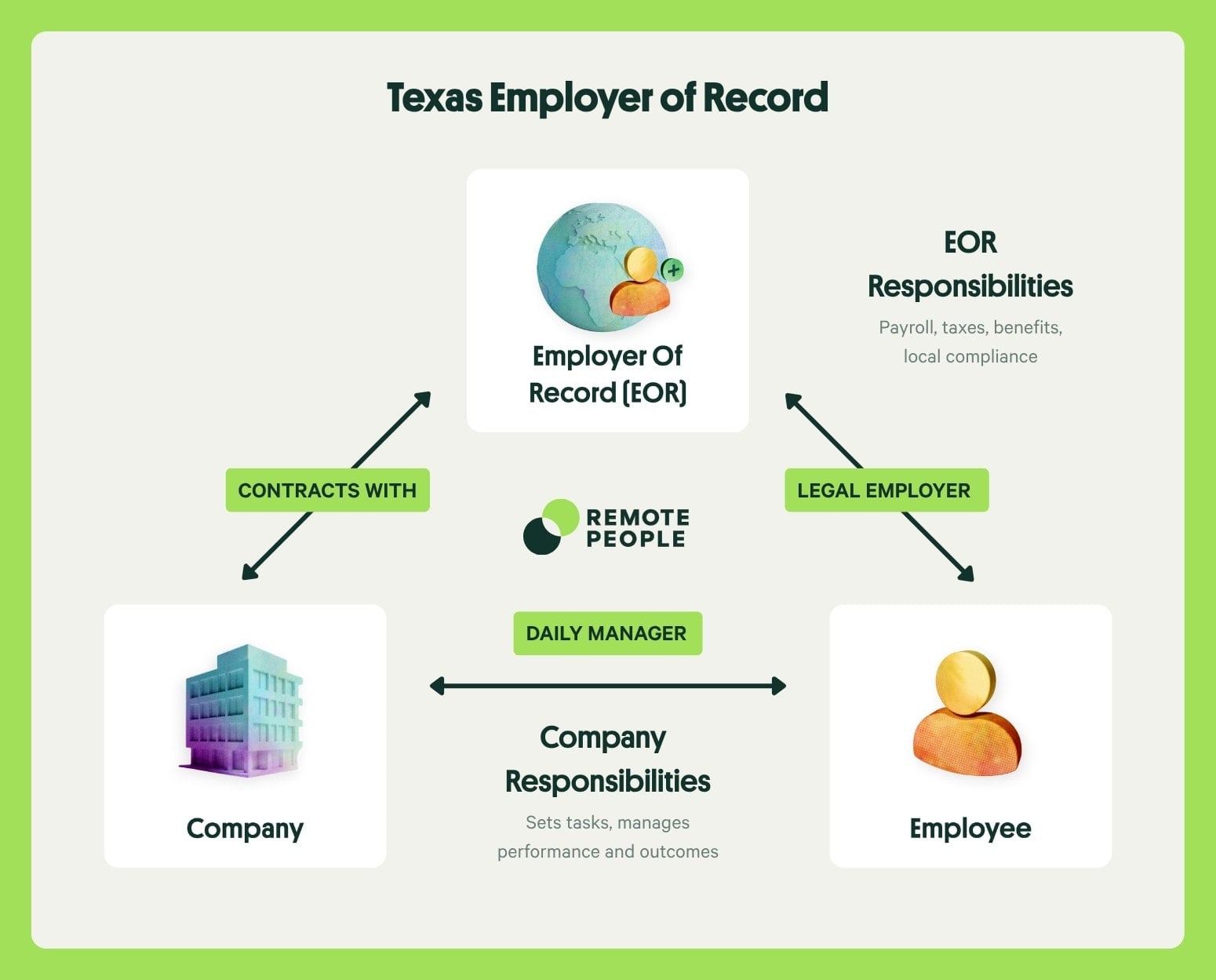
An employer of record in Texas is a third-party service provider that helps companies legally hire workers in Texas. In simple words, they assume your role as an employer and oversee all employee-related activities throughout their lifecycle, that is, from onboarding until the time they leave your organization.
What is an EOR can help explain how this employment model works in more detail.
Their roles also include helping you manage all state-specific payroll, tax, benefits, and other labor law specifics so that you can focus on running your business. This flexibility is a huge plus if you’re out of state or out of the country but need to expand your horizons fast in Texas without setting up a legal entity.
What Is the Difference Between a Texas Employer of Record and a Texas PEO?
A Texas employer of record, or EOR, acts as the legal employer of your company. Think of it as delegating your “rights” to them to help you onboard and manage employees in Texas without setting up a legal entity. This includes creating compliant contracts, setting up attractive benefits, handling payroll, and ensuring that all activities comply with the Texas Labor Code at both the state and federal levels.
Right on your EOR platform, you can review, interview, select candidates for the role, and create dedicated accounts for the new hires to fast-track their onboarding process. All of these can be completed in days, less than the typical weeks to months it takes for traditional hiring. The results? Your business experiences no downtime in staffing while you focus on growth.
A professional employer organization, however, works differently. They operate on a co-employment model where you retain control over your day-to-day activities, while they’ll handle tax compliance, payroll, and other employment management services you want to outsource.
So, say you already have an HR team but are not well-versed in the Texas payroll landscape, you can hire a Texas PEO to step in and handle payroll processing and tax so you remain compliant. This helps you save time and money, reduces administrative burdens, and, most importantly, fast track market entry. However, if you don’t already have a presence in Texas, you’ll need a legal entity to operate, which would add to the overall cost.
Start hiring with a Texas EOR
Let us handle the complexities of hiring, compliance, and payroll in Texas while you focus on growing your team.
- Hire employees in Texas with a Texas EOR
- No local entity is needed
- Pricing starts at USD 199 per employee
- RemotePeople can also help you find the best talent in Texas
How Does a Texas Employer of Record Work?
The way a Texas employer of record works is simple. Here’s a breakdown of the whole process:
Draft a compliant employment contract
The process starts when you find a candidate(s) in Texas who fits your role. If you’re hiring more than one, you can upload their records to the EOR platform to initiate onboarding. From here, the platform will create a Texas-complaint employment contract in line with the state’s labor code. There are two major types of employment contracts in Texas:
- Written contract: This is the formal type of contract that specifies terms of employment, benefits, duties, and termination clauses. Both the employer and employee are bound by the terms of the contract.
- At-will contract: Texas is a ‘work-at-will’ state, meaning either party (i.e., employer and employee) can modify the terms of the contract as they see fit. While this model is flexible, there are exceptions. For instance, you can only fire employees without cause or notice on legal grounds. We’ll share more details shortly.
Set up payroll with state registrations
Once your employee has signed the contract, you can move on to set up their payroll. In Texas, employees are required to pay the Federal Insurance Contributions Act (FICA), which is the mandatory Social Security contribution, and Medicare Tax. Texas doesn’t have a local or state income tax, so employees are only required to pay federal income tax.
You also need to perform the I-9 work authorization to prove that your employees are authorized to work in the United States. Set up E-Verify, a federal system managed by the US Department of Homeland Security, to mitigate the process.
Note: As an employer, you’re mandated to report your employees wages and also pay Unemployment tax per employee every year. To do this, create a tax account with the Texas Workforce Commission (TWC) via the Unemployment Tax Services (UTS) system.
Handle tax withholding and remittances
Next, the EOR platform handles all the tax withholding and remittances on your behalf. This includes calculating and withholding federal income tax, social security, and state unemployment tax contributions from each employee’s paycheck. The EOR ensures that the Form 941 and W-2 are filed and submitted to the US IRS (Internal Revenue Service) on time. For context, the Form 941 is used to report taxes deducted from employees’ paychecks each quarter, while the W-2 form is used to report employees’ earnings and the amount of tax withheld.
Administer benefits
The Texas EOR has in-state entities that are already familiar with the local labor code and can create compliant benefits packages. This includes statutory and supplementary benefits such as transportation stipends, workers comp, home office equipment, etc.
Oversees ongoing compliance management
Once you have all set up, the EOR also stays abreast of the local and federal regulatory environment and updates your system in real time. They also calculate and remit all mandatory withholdings as due to ensure you remain compliant with the labor law at the federal and state levels. And when you’re ready to dissolve your operations in Texas or dismiss employees, they guide you through the entire process to avoid penalties or even lawsuits.
How Labor Laws Affect Hiring in Texas?
Minimum Wage & Overtime
The minimum wage in Texas is $7.25 per hour, which is the same as the federal minimum wage. You can also decide to pay more to attract top talent. However, this law has some exemptions. For instance, employees who earn more than $20 per month in tips (referred to as tipped employees) can be paid $2.13 per hour. By law, both the tips and base wage must add up to $7.25 per hour in line with the federal minimum wage. If it’s not up to the specified rate, you’re mandated to make up the difference.
Texas operates a 40-hour work week, and any extension beyond this limit is counted as overtime. Your employees are allowed to work overtime, but they’re entitled to 1.5 times their regular pay for each extra time worked. That is, if you pay $10/hour for regular work hours, overtime workers will receive $15/hour. You can read more on the requirements here.
Income Tax
Texas doesn’t have a state income tax. But employees are mandated to pay social security contributions and federal taxes.
State Unemployment Insurance (SUI)
The Texas Workforce Commission manages the SUI. This fund is used to provide temporary income to employees who lost their jobs due to layoffs or any other reason that’s not their fault. SUI in Texas is calculated by multiplying taxable wages by the employer’s tax rate. For example, if your employee earns $20,000 per year and your tax rate is 3%, only $ 6,000 is taxable. So, the amount payable will be $9,000 × 3% = $270/year.
The tax rate for each employer varies and depends on the employer’s taxable wages paid, timely tax payments, and any unemployment claims paid.
Paid Leave
Currently, there are no federal or state laws that permit private employers to provide paid leave to employees, except in cases of disability, pregnancy, or other conditions that warrant it. However, some employers in Texas include it in their employee benefits package to attract top-tier talent. If you have one in your written policy, you’re mandated to fulfill the terms as specified in the employee’s contract.
Also, if you have 50 or more employees in your organization within 75 miles, you must provide up to 12 days of unpaid, job-protected leave as specified under the Family and Medical Leave Act (FMLA). This applies to pregnant employees (or those with expectant spouses), sick employees, including those who want to care for their families who have serious health conditions. But before your workers can be eligible, they must have worked in your organization for at least a year and have also recorded a minimum of 1,250 hours of service during the one year of employment.
Also, you’re not mandated to pay accrued leave unless it was stated in the employment contract from the get-go. To avoid legal issues, ensure you have a written, well-detailed leave policy for your organization and how it applies.
Unlike private-sector workers, all state agency employees are entitled to paid and job-protected leave. This means that if your work is in any part of the state agency or higher education, your employees are entitled to 8 hours of sick leave per month for full-time employment roles.
Workers' Compensation
In the US, most states mandates that employers provide workers comp for their employees. Texas offers a more flexible system. Here, private employers can choose to provide workers’ compensation insurance only if they want to. States in this category are referred to as an ‘opt-out’ or ‘non-subscriber’ state. However, not offering workers comp is sensitive and should be approached with caution. Here’s why:
Since Texas is a non-subscriber state, employees can decide to file a lawsuit against employers who provide no compensation when they get injured on the job. And more often than not, the employee stands at an advantage, as there’s no way to prove that the employee’s negligence caused the accident.
So, if your job role is technical and requires lots of physical activity, for instance, high-risk industries like manufacturing, industrial, and healthcare, it’s good practice to purchase coverage for your workers to avoid the possibilities of a lawsuit down the line. You can buy a workers’ compensation policy from a licensed insurance company, self-insure your workers’ compensation claims, or join a self-insurance group.
However, if your work is fully remote or you don’t want to provide coverage, you’ll need to file an annual notice with the DWC (Division of Workers’ Compensation) and inform your employees in writing that you’re not offering workers’ compensation.
Termination and Final Pay
Unless you use the “at will” contract type, you can only terminate employment in accordance with the terms outlined in the contract. However, you still have to tread carefully. Even if you’ve done everything right, an unhappy former employee may still find a way to file a lawsuit against you. To protect yourself, ensure you have written a termination policy and that your employee is well aware of its terms.
Also, the same applies if your employee decides to resign. Some employees voluntarily leave their workplace because they found a better offer than yours, no hard feelings. Some employees quit because they’re under pressure and can’t cope in the work environment. This is called “constructive termination.” If the resignation is related to any protected classification (color, religion, gender, disability, or active military status), the employee still has grounds to file a lawsuit even after leaving.
In this case, your best shot is to create an anti–harassment policy that encourages employees to report any form of harassment they may be facing at your workplace. You can also conduct an exit interview to understand why they want to leave, and ask them to leave a written review of their experience, just in case.
Under the Texas Payday Law, all terminated or laid-off employees must receive their paychecks within 6 calendar days. And if the said employee resigns, they are also entitled to payment, due on the next scheduled payday.
Payroll Taxes and Employer Cost in Texas
Currently, there’s no state income tax in Texas, which means workers have more take-home pay, while employers can re-invest their profits into their business. However, there are still some federal and state payroll-related obligations that apply:
Federal Payroll Taxes
The federal payroll tax in the US is the sum of the Social Security and Medicare taxes. This fund is used to finance healthcare, disability benefits, retirement, and survivor benefits. The total amount payable is 7.65% of the employee’s paycheck. Here’s a breakdown:
| Payroll Tax | Rate |
|---|---|
| Social Security tax rate | 6.20% |
| Medicare tax rate | 1.45% |
| Total | 7.65% |
Employers match the 6.2% social security contribution. The maximum amount taxable for both the employee and employer is $176,100.
Federal Income Tax
The federal income tax in the US finances social programs, foreign affairs, community development, and interest on national debt. As an employer, you’re required to withhold the FIT from your employees’ gross payment.
The US operates a progressive tax system, which means the total amount of income tax deductible depends on an individual’s income. The higher your employee’s income, the higher the income tax.
Here’s a breakdown of the tax rate:
| Tax Income Range | Tax Rate |
|---|---|
| $0 – $11,925 | 10% |
| $11,926 – $48,475 | 12% |
| $48,476 – $103,350 | 22% |
| $103,351 – $197,300 | 24% |
| $197,301 – $250,525 | 32% |
| $250,526 – $626,350 | 35% |
| $626,351+ | 37% |
However, some caveats apply. If your employee is married (filing jointly or separately) or the head of their household, the tax rates differ. You can check out the breakdown here.
State Income Tax Withholding
Texas does not have a state income tax, so the total deductible amount is $0.
SUI Contributions
Texas has a State Unemployment Insurance tax, and the amount payable is determined by multiplying taxable wages by the employer’s tax rate. It’s not added to your employee’s gross pay but paid directly to the state government.
There’s also the federal unemployment tax act (FUTA), which requires that you pay 6% of the first $7000 of your employees’ taxable income. Just as with the SUI, you’re fully responsible for this payment, as it is not deductible from your employee’s gross salary. However, if you’re faithful with Texas SUI contributions, you’re eligible for a tax credit of up to 5.4%.
Workers Compensation Premiums
Texas does not have a mandatory workers’ compensation premium. You can administer this benefit based on your industry and discretion.
Payroll Tax Example
Say your employee, Paul, earns $2000 a month. The total payroll tax deductible is calculated as:
| Payroll Item | Amount |
|---|---|
| Gross pay | $2000 |
| Social security tax (6.20%) | $124 |
| Medicare tax (1.45%) | $29 |
| Income tax (per Form W-4) | $237 |
| Total | $1,610 |
The employee’s net take-home pay is $1,610.
If your employees contribute to any other pre-tax withholdings, such as retirement plans, 401(k), or FSA (Flexible Spending Accounts), deduct those contributions before other payroll taxes. You can use the RemotePeople payroll tax calculator to know how much you’re expected to pay in total.
Employee Classification Rules in Texas
Misclassification of workers in Texas is a serious offence, and if you’re found guilty, it can incur class action lawsuit from misclassified workers and payment of back wages. You can also be fined up to $200 per misclassified employee.
By law, it’s your responsibility to define the working relationship between you and your worker. That is, whether the worker is an employee (hired with full-time pay) or an independent contractor. According to the Texas Workforce Commission, a worker is an employee if they provide service for your business, you pay them for the services rendered, and you control how, when, or where the work is done.
What Makes Hiring in Texas Unique?
As the second-largest economy in the US, Texas houses a large volume of high-quality talent with skills in a variety of fields. Austin, for example, is referred to as ‘Silicon Hills’ because it’s home to major Fortune 500 companies such as Tesla, Dell, Oracle, and other tech titans, and attracts skilled professionals from across the country.
Other benefits are:
Tax-Friendly State
Texas is one of the few states in the United States that doesn’t have a personal or corporate income tax. Instead, they impose a franchise tax only on enterprises with total revenue above $2.47 million. This is to encourage business growth in the state and to allow employees to have higher take-home pay.
Fast Growth and Low Unemployment Rate
Texas ranks among the fastest-growing states in the US in terms of population. The high concentration of companies in this area also creates a competitive job market that attracts top talent from across the country. This makes it easier and faster for you to find top-tier talent for your roles.
Business-Friendly Environment
Texas has been ranked the #1 best state for business for 20 consecutive years, thanks to its business-friendly environment. Because the state has a low-regulation structure and low taxes, most businesses are compelled to establish their roots there as they can operate freely with low overhead costs.
For instance, if your work is fully remote but only for workers in Texas, you don’t need to pay benefits such as workers’ compensation insurance or paid leave. The state government also offers several business incentives, including the Texas Enterprise Fund, to attract businesses and create more jobs in the region.
Favorable Legal Climate
Texas is popularly known for its “right to work” environment and flexible regulatory policies that protect both employee and employer rights, compared to other states. For instance, employers cannot require workers to join a union as a condition of employment. Also, the zero-state-income-tax makes it easy for employers to manage payroll at the state level without compliance issues.
What Are the Benefits of a Texas Employer of Record?
The main benefit of using a Texas employer of record is the speed to hire. Previously, to hire and successfully onboard an employee, you’d spend several weeks to months, especially if you don’t have a legal entity in the area. With an EOR, you can complete the process in 72 hours or at most a few weeks to get started. This makes it easier for you to hire employees in Texas and keep your business moving.
- Requires No Entity Set-Up: As a foreign entity, you need to register your business in the state and create Tax accounts before you’re allowed to hire employees. You must also appoint a registered agent with a physical street address in Texas that’ll stand as your representative and receive all documents on your behalf. This process is expensive, and you must understand the ropes before setting a foot forward.
With an EOR, you won’t have to worry about setting up an entity in the first place. They’ll act as the legal employer on your behalf and help you hire talent in Texas without a physical location or establishing a legal entity. - Fastracks Employee Onboarding Process: As we mentioned earlier, an EOR platform can help you fast-track your employee onboarding process. Right on the platform, you can create job-specific onboarding workflows for each of your new hires to help them integrate into your work culture faster. Here, they can sign contracts, submit documents (including the Form W4), and even submit weekly timesheets for approval.
- Makes It Easy To Oversee And Manage Compliance: To hire employees and operate successfully in Texas, you must comply with both state and federal labor laws. For instance, even if Texas is an ‘at-will’ state, you’re not allowed to terminate a contract based on a protected characteristic, such as Sex, disability, religion, or age.
An EOR helps you to oversee these clauses and ensure your practices are up to par both at the state and federal levels. They also keep track of regulatory changes and update your system accordingly. - Reduces The Possibilities of a Legal Risk: EORs in Texas also help mitigate the risk of lawsuits or claims that may tarnish your image. For example, they ensure employees are properly classified from the get-go to avoid misclassification risks. And when you’re ready to leave the Texas market, they guide you through a compliant termination process.
- Makes It Easy to Scale Across Multiple States: If you’re looking to expand your footprint into other US states, an EOR can make it easy. EORs like RemotePeople have legal entities in most states in the US, and can help you hire top talent from there without you lifting a finger. That’s not all. We have in-state experts who understand the regulatory landscape, including payroll, employee benefits, and more.
What Are the Downsides of a Texas Employer of Record?
Here are the disadvantages of using a Texas EOR:
- The Service Fee Might Be High For Small Business Owners: If you’re a start-up that needs to hire one or two employees in Texas, hiring an EOR may not be necessary. Better, you can go for EORs like RemotePeople that offer employee-based payment models instead of a fixed price.
- Gives You Less Control Over Payroll Management: Since the EOR is your legal employer, you have little control over your employee lifecycle. Some EORs may have used standard frameworks that make it hard to customize the benefits, structures, or employment terms to your company.
How to Choose a Texas Employer of Record?
Here are some features to look out for when sourcing an EOR in Texas:
Transparent Pricing Plans
The EOR must have clear pricing plans with no hidden fees. RemotePeople, for instance, charges $199/employee.
Direct EOR
The EOR must have directly owned entities in the state, and not partners. The last thing you want is to work with an EOR with partners you can’t even verify.
US Multi-State Expertise
Labor laws in the US differ across states. You need an EOR that is well-versed in Texas labor law and has entities in other states, in case you want to expand. This makes it easy to manage all your employees on one platform.
Dedicated Support
Also, your EOR must provide dedicated support that understands your company’s needs and is ready to address your concerns 24/7. For example, all RemotePeople’s clients have a dedicated human account manager who offers personalized support. We were ranked #1 on G2 for support because of our service quality!
Strong Compliance Track Record
Trust is key, and if you’re in a sensitive industry like healthcare, you need an EOR that understands the stakes. Ensure the EOR has a strong track record and relevant compliance certifications, such as SOC 2, ISO 27001, and GDPR.
Engage a Texas Employer of Record with RemotePeople
We hope you now understand what it takes to hire employees in Texas, and how an Employer of Record in the state can help you streamline the process. Not all EORs are the same, so be sure to do your due diligence before making any investments. Read user reviews and check out case studies for companies they’ve helped in Texas and other states of your interest.
RemotePeople Texas EOR solutions are designed to help you build your team in the state without any fuss. We handle all your employment-related responsibilities, so you can focus more on building your business. Find out what it takes to get started.
Employer of Record in
Employer of Record in
Employer of Record in
Employer of Record in
Employer of Record in
Employer of Record in
Employer of Record in
Employer of Record in




