
 Recruit
Employer of Record in New Mexico
-
 Drew Donnelly
- Published
- July 22, 2026
New Mexico’s employment law includes paid sick leave, state unemployment tax, and wage rules, and a New Mexico EOR handles payroll and full state compliance with no local entity needed.
Hire in New Mexico — book a free 30-minute demo
Tell us what you need. You'll get a tailored, transparent proposal within 24 hours, plus a free call to walk through it.
Tell us about your company
So we can match you with a specialist who knows your market — and unlock volume pricing tiers.
* All fields are required.
Where and when are you hiring?
Tell us the geography and timing and we'll quote each country line by line, with onboarding timelines.
* All fields are required.
Help us beat your current setup
We'll benchmark your current deal and send a line-by-line proposal in 24 hours — showing exactly where we cut cost, time, or risk. After you submit, you can book a call to walk through it together.
* All fields are required.
Thanks! Your proposal is on its way.
Expect a tailored, line-by-line proposal in your inbox within 24 hours. In the meantime…
Want to walk through it together?
Book a free 30-minute call with one of our specialists. We'll explain every line, answer your questions, and tailor the proposal further if you need.
No obligation. Pick a time that works for you.








- Hire in New Mexico — book a free 30-minute demo
- Tell us about your company
- Where and when are you hiring?
- Help us beat your current setup
- Thanks! Your proposal is on its way.
- New Mexico Employer of Record
- What Is the Difference Between a New Mexico Employer of Record and a New Mexico PEO?
- How Does a New Mexico Employer of Record Work?
- How Labor Laws Affect Hiring in New Mexico?
- Payroll Taxes and Employer Cost in New Mexico
- Employee Classification Rules in New Mexico
- What Makes Hiring in New Mexico Unique?
- What Are the Benefits of a New Mexico EOR?
- What Are the Downsides of a New Mexico EOR?
- How to Choose a New Mexico Employer of Record?
- Engage a New Mexico Employer of Record with RemotePeople
- Related EOR Destinations

Let RemotePeople handle payroll, compliance, and HR admin worldwide so you can focus on building your team.
Key Takeaways
- New Mexico’s economy thrives on energy and tourism, ranking second in U.S. oil production and investing in renewable energy.
- An Employer of Record (EOR) handles payroll, taxes, and compliance, allowing companies to hire locally without setting up a legal entity.
- EORs fully employ workers, while Professional Employer Organizations (PEOs) share employment responsibilities, requiring businesses to establish a legal presence.
- Businesses should evaluate pricing, compliance expertise, and industry knowledge when selecting an EOR to ensure smooth market entry.
New Mexico is emerging as a contender in the future of American industry. While oil and gas remain the economic heavyweights, it is pivoting toward a high-tech future.
Lawmakers are currently rewriting the rules to attract fusion energy and quantum computing giants. That’s offering stacked tax credits and incentives to turn federal research at Sandia and Los Alamos into a commercial reality.
Furthermore, the business climate is one of transition. Historically low-cost but regulation-conscious, the state is now leveraging its assets to lure innovators.
For employers, this means access to a workforce rooted in legacy industries but poised for a technological leap. That’s all within a cost environment that remains far more forgiving than coastal tech hubs. We’ll share how you can start hiring in New Mexico and why an Employer of Record is the best way to get started.
New Mexico Employer of Record
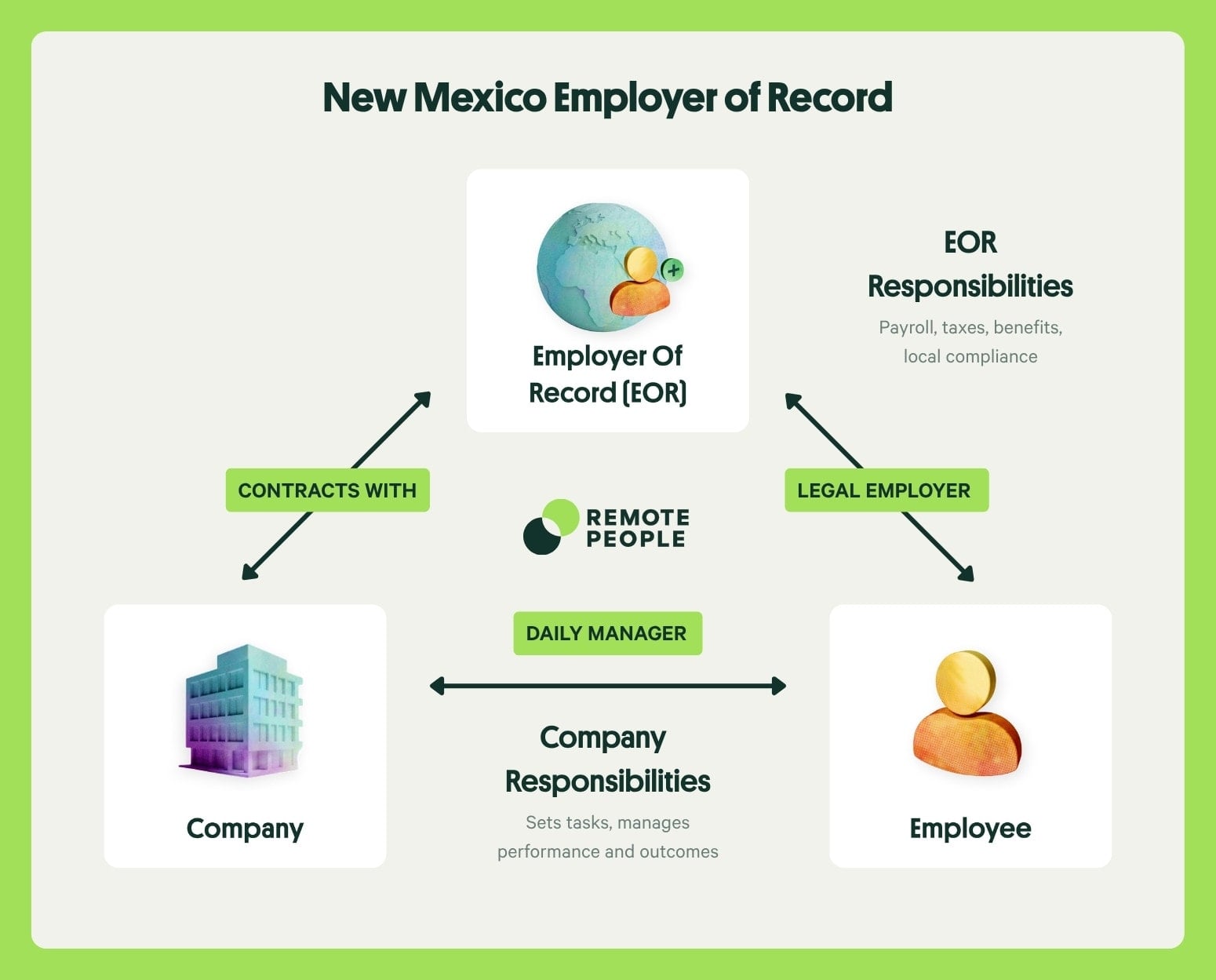
An Employer of Record (EOR) is your partner and the legal backbone that lets you hire without the headache of building a local entity. Here are the key tasks it performs:
What is an EOR can help explain how this employment model works in more detail.
- Your New Mexico team gains legal employer status protection because the EOR becomes the official Employer of Record. They hold all state registrations with the Taxation and Revenue Department. They also assume full legal responsibility for employment compliance as you direct daily operations without establishing your own entity.
- Every payroll cycle receives complete tax handling service through the EOR. It ensures accurate state income tax withholding and remittance to New Mexico authorities. That’s through mandated electronic filing systems with strict adherence to quarterly deadlines. This protects your company from costly penalty assessments and interest charges.
- You maintain absolute authority over daily work control, thereby directing all project assignments. Meanwhile, the EOR manages the legal infrastructure, providing operational freedom without the burden of employment liability or administrative complexity.
- Your expansion proceeds immediately without any entity required. This bypasses months of paperwork, legal fees, and bureaucratic delays. Instead, you launch your team through the EOR’s existing compliant infrastructure. That’s with zero upfront setup costs or ongoing maintenance headaches.
- The EOR assumes full responsibility, shifting liability and insulating your company from legal exposure. That includes wage violations, misclassification claims, improper termination disputes, and compliance failures.
What Is the Difference Between a New Mexico Employer of Record and a New Mexico PEO?
Understanding the difference between an EOR and a PEO is critical to your expansion strategy, since they are not interchangeable tools.
PEO
A Professional Employer Organization operates through a co-employment arrangement, meaning your company and the PEO share employer responsibilities. Crucially, to use a PEO in New Mexico, you must already have your own registered legal entity in the state.
The PEO provides HR support, benefits, and streamlined payroll for your existing setup. That makes it a popular choice for domestic companies looking to offload administrative grind.
EOR
In contrast, an EOR requires no such entity. For international companies or out-of-state businesses testing the New Mexico waters, the EOR is the sole legal employer. They assume 100% of the legal employment liability, allowing you to operate without the cost or complexity of a state registration.
Overall, if you are planting a flag permanently, a PEO might suffice. If you want to move fast, mitigate risk, or test the market, the EOR is your superior tactical advantage.
Here’s a table where you can compare the differences at a glance:
Aspect | PEO | EOR |
|---|---|---|
Legal Entity Required | Yes, your company must be registered in New Mexico. | No, EOR uses its own entity. |
Employment Liability | Shared (co-employment). | Assumed entirely by EOR. |
Best For | Domestic companies with existing New Mexico presence. | International companies or out-of-state businesses testing market. |
Compliance Responsibility | Your company retains ultimate liability. | EOR bears compliance risk. |
Speed to Hire | Slower (requires entity first). | Immediate. |
Start hiring with a New Mexico EOR
Let us handle the complexities of hiring, compliance, and payroll in New Mexico while you focus on growing your team.
- Hire employees in New Mexico with a New Mexico EOR
- No local entity is needed
- Pricing starts at USD 199 per employee
- RemotePeople can also help you find the best talent in New Mexico
How Does a New Mexico Employer of Record Work?
Compliant Employment Contract
The foundation begins with a compliant employment contract crafted for New Mexico’s legal system. You’ll want to avoid generic templates that might miss critical local requirements.
This document establishes the employment relationship with the EOR as the official employer. It also defines the employee’s:
- Role
- Compensation structure
- Adherence to state-specific provisions
Payroll Setup with State Registrations
Your employee appears on the payroll setup with state registrations immediately. That’s because the EOR maintains active accounts with the New Mexico Taxation and Revenue Department, and the Department of Workforce Solutions.
This bypasses the frustrating weeks or months required for new businesses to:
- Complete the CRS-1 Form registration
- Obtain unemployment insurance accounts
- Receive approval to begin withholding taxes
The EOR already possesses the necessary Federal Employer Identification Number and state tax identification numbers that trigger automatic compliance with reporting requirements. Your team member simply gets added to this existing compliant infrastructure.
Tax Withholding and Remittance
Every payroll cycle triggers precise tax withholding and remittance through the EOR’s established systems. They calculate New Mexico’s progressive income tax rates ranging from 1.7% to 5.9% based on employee earnings and filing status.
The EOR leverages the Taxpayer Access Point online system to file returns and submit payments by the 15th day of the month following each reporting period. This maintains strict adherence to deadlines that catch many new employers off guard.
Federal withholdings, including Social Security at 6.2% and Medicare at 1.45%, receive equal attention. Employer matching contributions must be calculated and remitted alongside employee withholdings.
Benefits Administration
Your New Mexico team accesses competitive benefits administration through the EOR’s pooled purchasing power. This would otherwise remain unavailable to small or mid-sized companies entering the state.
Additionally, the EOR handles:
- Premium collection through payroll deductions
- Ongoing management of health insurance
- Retirement plans
- Voluntary benefits that attract top talent in competitive markets
Employees receive dedicated support for claims questions and coverage changes while you maintain focus on business objectives. The arrangement mirrors the qualified employee benefit programs available to large state employers.
Ongoing Compliance Management
The true value emerges through ongoing compliance management as the EOR continuously monitors changes. This refers to New Mexico employment laws, tax rates, and reporting requirements that shift with each legislative session.
Furthermore, the service maintains meticulous records of hours worked, wages paid, and tax remittances for the mandatory three-year retention period. This ensures you remain prepared for any Department of Workforce Solutions audit.
How Labor Laws Affect Hiring in New Mexico?
Minimum Wage & Overtime
As of 2024, the New Mexico minimum wage sits at $12.00 per hour. However, legislative efforts have proposed raising the minimum wage, with annual inflation adjustments.
Employers must also be aware that cities like Santa Fe and Albuquerque enforce their own, higher minimum wages. Furthermore, overtime rules follow the federal standard, which is one and a half times the regular rate for all hours worked beyond 40 in a single workweek.
Income Tax
Unlike its neighbor Texas, New Mexico does levy a personal income tax. The rates are progressive, ranging from 1.7% to 5.9%, depending on income brackets. This isn’t a tax the employer pays directly, but it is a critical withholding obligation.
Your payroll system or EOR must accurately deduct these amounts from employee paychecks and remit them to the state. Meanwhile, adhering to the strict electronic filing schedules is now in effect.
State Unemployment Insurance (SUI)
New Mexico funds its unemployment benefits through employer taxes. New employers should prepare for a rate that varies based on industry and history, but the taxable wage base is a crucial number to track.
You’ll find that employers pay SUI tax on the first significant portion of each employee’s wages. These funds must be reported and paid to the New Mexico Department of Workforce Solutions. Note that delinquency here can lead to immediate penalties and holds on doing business in the state.
Paid Leaves
The Healthy Workplaces Act mandates that most private employers provide paid sick leave. Employees accrue at least one hour of paid sick leave for every 30 hours worked. Furthermore, they can use this leave for their own medical needs, to care for a family member, or for absences related to domestic abuse.
Employers must allow employees to use at least 64 hours of accrued leave per year. Also, the state does not mandate general paid vacation or parental leave for private employers.
Workers' Compensation
New Mexico law states that if you have three or more employees, you must carry workers compensation insurance. This mandatory coverage provides medical care and partial wage replacement for employees injured on the job. Employers can secure this through private insurers or the state fund, but proof of coverage is required.
Recent adjustments have increased the Workers Compensation fee to $4.80 per employee. This reflects a split between employer and employee portions that the employer must remit. Failing to carry coverage can result in severe penalties, including fines and even criminal charges.
Termination and Final Pay
New Mexico is an at-will employment state, meaning you or the employee can end the relationship at any time for any lawful reason. However, “at-will” does not mean no rules. The details are in the final paycheck. Upon termination, you must pay all earned wages by the next regular payday.
If you miss that deadline and the employee demands payment, you have just 10 days to comply or you risk significant wage penalties. When it comes to accrued & unused PTO, the law defers to your written policy.
When your handbook promises a payout, you must honor it. However, if it states that PTO is forfeited upon separation, that is generally enforceable. The risk of wage claims is high for employers who avoid these deadlines.
Payroll Taxes and Employer Cost in New Mexico
Building a team in New Mexico requires a clear-eyed view of the costs beyond the salary. On top of federal payroll taxes (FICA and FUTA), employers must budget for state-specific obligations.
Additionally, you are responsible for the full cost of workers compensation premiums and the employer portion of the state unemployment insurance (SUI) tax. Furthermore, state income tax is withheld from employee wages. This means the administrative burden of calculating and remitting it falls on you.
Example Cost Breakdown
Consider a salaried employee earning $75,000 per year in Albuquerque:
Category | Cost |
|---|---|
Social Security (Employer share) | $4,650 |
Medicare (Employer share) | $1,087.50 |
Federal Unemployment (FUTA) | $42 (assuming max credit) |
State Unemployment (SUI) | 0.5% to over 5% |
Workers Comp | Varies by industry |
Overall, you can expect to pay an additional 8% to 15% on top of base salary to cover these mandated costs and insurances. You’ll find that the variance is largely driven by industry risk classification and unemployment claims history.
Employee Classification Rules in New Mexico
Misclassifying an employee as an independent contractor can lead to a financial hit. New Mexico applies a strict test that often aligns with the federal economic realities test. This examines:
- The degree of control the company has over the work
- The worker’s opportunity for profit or loss
- The permanency of the relationship
Penalties for misclassification are severe and include back wages, unpaid taxes, interest, and civil penalties that can cripple a business. This is where an EOR reduces classification exposure.
That’s because it takes on the legal employer role, so it ensures that every worker is properly classified from day one. Using expert local knowledge to overcome the gray areas and keep your company safe from audits and lawsuits.
What Makes Hiring in New Mexico Unique?
It is a state with a resource-extraction economy that provides budget surpluses, yet it is aggressively legislating itself into a hub for the most futuristic industries on the planet. This includes fusion and quantum computing.
This creates a unique workforce dynamic where a talent pool accustomed to industrial rigor is now intersecting with cutting-edge science funded by federal labs. Additionally, regulatory intensity is moderate but growing, particularly with new paid sick leave laws and electronic filing mandates.
Finally, wage trends are upward, driven by both legislation and competition for specialized tech talent. The tax advantage is relative as income tax exists, but the overall cost of living and doing business remains lower than in traditional tech corridors. This offers a value proposition that is hard to ignore.
What Are the Benefits of a New Mexico EOR?
The EOR model transforms your New Mexico expansion through these five distinct advantages:
- No entity setup eliminates the months of paperwork and legal fees required for registration. That’s with the New Mexico Taxation and Revenue Department, and the Department of Workforce Solutions. It allows you to hire immediately through the EOR’s existing compliant infrastructure without establishing your own corporate entity in the state.
- Faster onboarding captures top talent before competitors complete their HR paperwork. That is because the EOR handles new hire reporting, payroll enrollment, and benefits setup within days. It ensures your employees start contributing to business goals without compliance delays slowing momentum.
- Centralized compliance manages every state requirement through one integrated system. It includes quarterly tax filings to the Taxation and Revenue Department, paid sick leave tracking under the Healthy Workplaces Act, and unemployment insurance reporting to the Department of Workforce Solutions.
- Reduced legal risk insulates your company from liability exposure. That relates to wage violations, worker misclassification claims, improper termination disputes, and state audit penalties. It’s because the EOR assumes full legal responsibility as the Employer of Record while you direct daily operations.
- Scalable multi-state reach expands your workforce easily. That’s because the EOR adds New Mexico employees alongside teams in other states through unified payroll and HR infrastructure. Overall, it eliminates the need to master fifty different employment laws or maintain separate compliance systems for each location.
What Are the Downsides of a New Mexico EOR?
While the EOR model is powerful, it is not without trade-offs. There is a service fee, which is a predictable cost for the convenience and security provided. Some business leaders also worry about the slight loss of direct control over payroll processing and benefits administration.
However, this friction is a matter of perspective. For most, the minimal fee and reduced hands-on control are a small price to pay compared to the monumental risk and administrative drag of going it alone. The EOR is simply a more efficient and secure engine than the DIY compliance machine most companies try to build.
How to Choose a New Mexico Employer of Record?
Here’s a table to assist you with choosing the best New Mexico Employer of Record:
Transparent Pricing
Clear upfront fees with no hidden charges for setup or termination, preventing budget surprises and maintaining trust in the partnership.
Direct EOR Structure
A provider that serves as the actual legal employer, not a broker, eliminating liability gaps and ensuring direct compliance accountability.
US Multi-State Expertise
Proven experience across multiple states, including New Mexico regulations, enabling seamless expansion without requalifying vendors.
Dedicated Support
A named contact in US time zones rather than an anonymous ticket system, guaranteeing a human response when payroll emergencies arise.
Compliance Track Record
Verifiable audit history, proper insurance, and client references, as your compliance safety depends entirely on their track record.
Engage a New Mexico Employer of Record with RemotePeople
You have the vision for your New Mexico team and RemotePeople provides the compliant foundation to make it real without the administrative weight. We eliminate the hurdles of state registrations, tax filings, and liability exposure. Therefore, you can focus entirely on building a successful business.
Our direct EOR solution combines local expertise with seamless execution, turning the complexity of New Mexico hiring into your competitive advantage. Stop wrestling with compliance and start leading your team.
Do you want to hire the best Employer of Record in New Mexico? Then contact us to get started with a proposal.
Employer of Record in
Employer of Record in
Employer of Record in
Employer of Record in
Employer of Record in
Employer of Record in
Employer of Record in
Employer of Record in




