
 Recruit
Employer of Record in Paraguay
-
 Drew Donnelly
- Published
- September 22, 2026
RemotePeople’s employer of record in Paraguay lets you hire employees in Paraguay with IPS registration and compliance. We handle IPS contributions of 16.5% from employers and 9% from employees, plus healthcare, pension, and family allowance benefits.
Hire in Paraguay — book a free 30-minute demo
Tell us what you need. You'll get a tailored, transparent proposal within 24 hours, plus a free call to walk through it.
Tell us about your company
So we can match you with a specialist who knows your market — and unlock volume pricing tiers.
* All fields are required.
Where and when are you hiring?
Tell us the geography and timing and we'll quote each country line by line, with onboarding timelines.
* All fields are required.
Help us beat your current setup
We'll benchmark your current deal and send a line-by-line proposal in 24 hours — showing exactly where we cut cost, time, or risk. After you submit, you can book a call to walk through it together.
* All fields are required.
Thanks! Your proposal is on its way.
Expect a tailored, line-by-line proposal in your inbox within 24 hours. In the meantime…
Want to walk through it together?
Book a free 30-minute call with one of our specialists. We'll explain every line, answer your questions, and tailor the proposal further if you need.
No obligation. Pick a time that works for you.








- Hire in Paraguay — book a free 30-minute demo
- Tell us about your company
- Where and when are you hiring?
- Help us beat your current setup
- Thanks! Your proposal is on its way.
- How an Employer of Record Works in Paraguay
- Employment Laws and Regulations in Paraguay
- Work Permits and Visas in Paraguay
- Payroll, Taxes, and Social Security in Paraguay
- Cost of Hiring Through an EOR in Paraguay
- Benefits of Using an EOR in Paraguay
- Termination and Offboarding in Paraguay
- EOR vs. Other Hiring Models in Paraguay
- Public Holidays in Paraguay
- How to Get Started with an EOR in Paraguay
- Where companies hiring in Paraguay expand next
- Frequently Asked Questions
- Related EOR Destinations

Start hiring in Paraguay
Let RemotePeople handle payroll, compliance, and HR admin worldwide so you can focus on building your team.

An employer of record in Paraguay lets a foreign company hire local staff in Asunción, Ciudad del Este, or anywhere in Paraguay for a flat service fee of roughly USD 500 to USD 800 per employee per month, without registering a Paraguayan SRL or SA and without opening a Guaraní-denominated bank account. The EOR becomes the legal employer on the ground: it holds the Spanish-language contrato de trabajo under the Labour Code (Law 213/1993), registers the employee with the Instituto de Previsión Social (IPS) at 16.5% employer plus 9% employee, withholds the graduated 8%/9%/10% IRP under Law 6380/2019 through the Subsecretaría de Estado de Tributación (SET), pays the mandatory Aguinaldo 13th-month bonus by 31 December, and sponsors any Temporary Residence work permit through the Dirección General de Migraciones. Using a Paraguay EOR, a foreign buyer can onboard a Paraguayan national in one to two weeks instead of the three to six months a local-entity incorporation would take, while inheriting one of the most attractive payroll loads in South America: a combined statutory employer burden of 17.5% on covered wages, a 10% top IRP band, and a dollar-friendly economy served by a young, Spanish- and Guaraní-speaking workforce.
How an Employer of Record Works in Paraguay
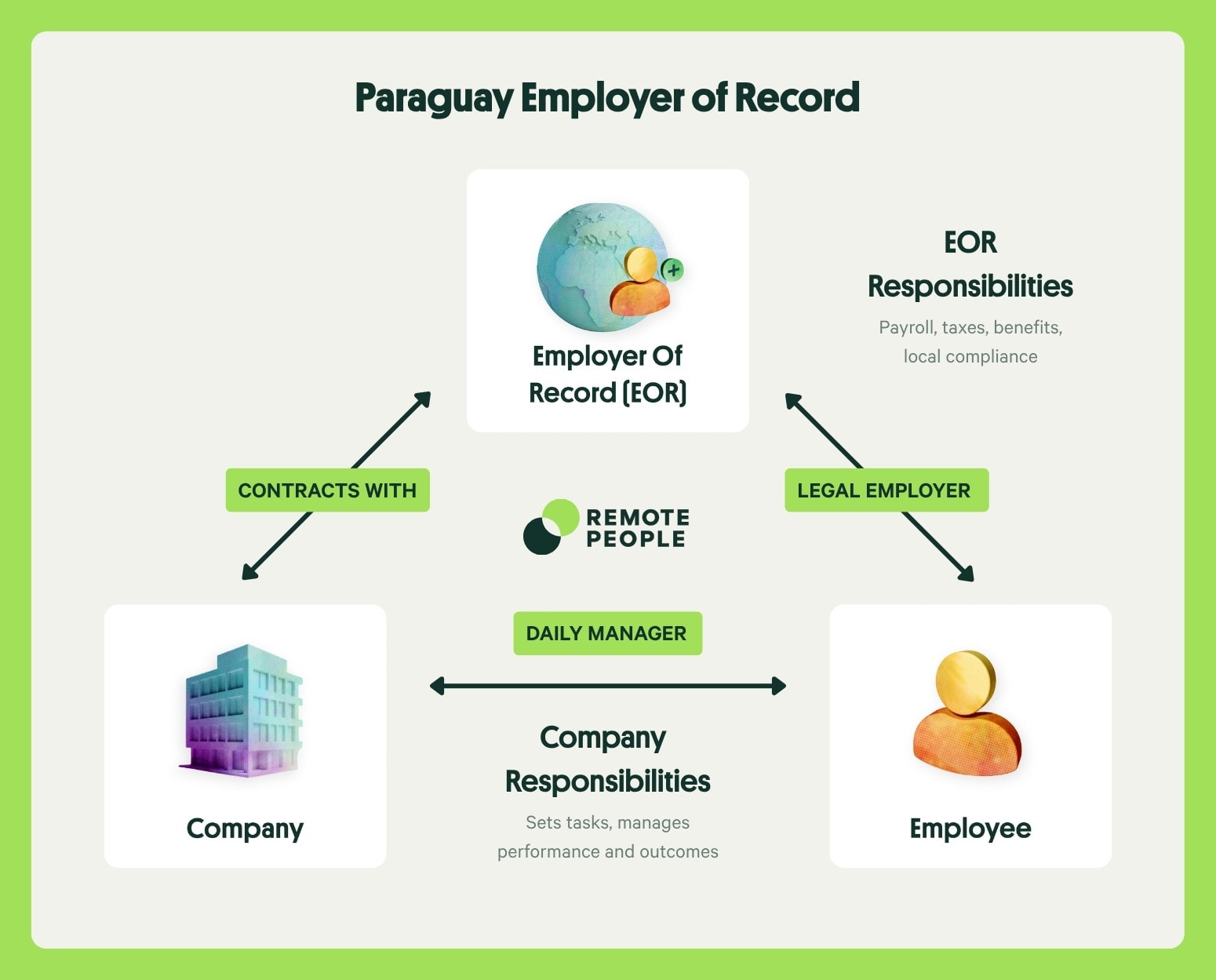
If you’d like to learn more about how Employer of Record (EOR) services work, read our What Is an Employer of Record (EOR)? guide for a complete overview of the model, its benefits, and when to use it.
If you’re comparing providers, our Best Employer of Record (EOR) Providers guide reviews the leading platforms to help you choose the right solution for your business.
Who Uses an EOR in Paraguay?
Because Paraguay’s employment framework requires direct engagement with IPS, SET, Migraciones, and in some cases MTESS, EOR demand comes from companies that want one Paraguayan legal entity handling every filing. Common situations include:
- Testing the Paraguayan market: A company expanding into the Southern Cone that wants a small team in Asunción or Ciudad del Este for six to twelve months before committing to a Paraguayan SRL or SA.
- Small remote teams: Businesses hiring one to five employees in Paraguay for back-office, customer support, software engineering, or bilingual support, where the cost of incorporating and maintaining a local entity outweighs the tax savings.
- Fast onboarding of Paraguayan nationals: Companies that need a Paraguayan developer, accountant, or bilingual analyst on payroll quickly with proper IPS enrolment and IRP withholding from day one, rather than treating them as an autonomo contractor.
- Relocating foreign specialists: Employers bringing in a Brazilian, Argentine, European, or U.S. specialist and sponsoring a Temporary Residence work permit, without first standing up a Paraguayan corporation authorised to hire foreign nationals.
- Maquila and regional shared services: Organisations that operate under Law 1064/1997 maquila arrangements or regional shared service centres for Latin America and need Paraguay-resident staff on compliant employment terms while the parent bills into the group from abroad.
In each case, the EOR absorbs the registration, filing, and advisory burden that would otherwise require the client to staff a full in-country HR, payroll, and tax function.
Typical Onboarding Timeline
Most EOR providers can onboard a Paraguay-resident employee within one to two weeks, assuming the candidate is already in Paraguay and authorised to work. The steps below are sequential but several overlap in practice:
- EOR agreement and employee details: One to two business days to sign the client-EOR service agreement and collect the new hire’s cédula de identidad, IPS number (if already registered from prior employment), bank details, and signed offer letter.
- Employment contract drafting and review: Two to three days to issue the Paraguay-compliant contrato de trabajo in Spanish, localise it for the employee’s work location, and incorporate the client’s specific benefits and IP-assignment clauses.
- IPS and SET registration: Three to five days for IPS to confirm or issue the employee’s cédula and for the EOR to add the employee to the planilla laboral filed with MTESS and the monthly SET IRP register.
- Payroll and benefits setup: Two to three days to load the employee into the payroll system, set up PYG direct deposit (or USD where contracted), and enrol them in any supplemental health or pension plan the client offers on top of IPS.
- First day of work: One day to deliver the signed contract, equipment, and client orientation.
When a foreign national is involved, the timeline extends by four to eight weeks for work-permit processing: the Dirección General de Migraciones typically needs one to two months from a complete file to issue a Temporary Residence card with work authorisation, plus apostilled police clearances and medical certification from the country of origin.
Hire in Paraguay
A flat 16.5% IPS employer contribution, a capped 10% IRP top bracket, and a bilingual workforce concentrated around Asunción make Paraguay one of the most cost-efficient payroll jurisdictions in South America.
We handle employment contracts, payroll, IPS and SET filings, Aguinaldo, and Migraciones work permits so your team is compliant from day one.
No Paraguayan SRL or SA needed. Your team can start in days.
Employment Laws and Regulations in Paraguay
Employment Contracts
Employment in Paraguay is governed primarily by the Labour Code (Law 213/1993) and the 1992 Constitution, supplemented by Law 5508/2015 on maternity protection and Law 6380/2019 on the modernisation of the tax system. Article 44 of the Labour Code requires that contracts for work of more than ninety days be in writing, and in practice every EOR contract is written and in Spanish. Both indefinido (indefinite-term) and plazo fijo (fixed-term) contracts are permitted, though Paraguayan courts will recharacterise successive fixed-term renewals as indefinite where the underlying role is permanent. A three-month probation period (período de prueba) is the default for general workers under Article 58, extendable to six months for technical and management roles. Contracts must identify the parties, the position, the base salary, the workplace, the start date, and the working-time schedule, and must reference the Labour Code where mandatory clauses apply.
Working Hours and Overtime
Paraguay sets a maximum working week of forty-eight hours under Article 194 of the Labour Code, spread over eight hours per day for day work, seven hours per day (forty-two per week) for night work, and seven-and-a-half hours per day (forty-five per week) for mixed day-and-night schedules. Overtime is governed by Articles 234–236: weekday overtime is paid at a 50% premium (1.5 times the base hourly rate), while night, Sunday, and public-holiday work is paid at a 100% premium (2.0 times). Total hours including overtime must not exceed fifty-seven per week, and no employee may be required to work more than three overtime hours per day. Managerial and supervisory roles that involve confidential decision-making or independent authority are generally excluded from the weekly cap under Article 198, though they remain entitled to holiday and Sunday-work premiums.
Paraguay overtime and premium pay rates · Per Labour Code (Law 213/1993) Articles 194–236 | |||
Hour Type | Rate Multiplier | Daily / Weekly Cap | Notes |
|---|---|---|---|
Day overtime (Mon–Sat, weekday) | 1.5x base hourly rate | Max 3 hrs/day, 9 hrs/week, 57 hrs total | Statutory minimum under Article 234. Must be paid no later than the next regular pay cycle. |
Night overtime (between 8 p.m. and 6 a.m.) | 2.0x base hourly rate | Night shift cap: 42 hrs/week | Night work itself is paid at a 30% premium; overtime at night is doubled under Article 235. |
Sunday and weekly rest-day work | 2.0x base hourly rate | No statutory weekly cap | Must grant compensatory rest day during the following week if worked on the weekly rest day. |
Public holiday work | 2.0x base hourly rate | Per holiday worked | Paid on top of the normal day’s wage. Codified in Article 235 and the public-holiday schedule. |
Managerial / confidential roles | Exempt from weekly cap | n/a | Article 198 excludes directors and senior managers from the 48-hour cap, but holiday and Sunday premiums still apply. |
Overtime pay forms part of the IPS contribution base and is treated as ordinary wages for IRP withholding. Employers should log overtime in the libro de sueldos y jornales and in monthly planilla laboral filings; MTESS inspectors treat missing overtime records as prima facie evidence of underpayment.
Minimum Wage
Paraguay’s national minimum wage is set annually by executive decree on the recommendation of the Consejo Nacional de Salarios Mínimos, and revised in line with inflation. For 2026 the minimum wage is PYG 2,899,408 per month for general workers on a full-time (48-hour) schedule, equivalent to approximately USD 390 at the April 2026 reference rate. The same floor applies across private-sector employment, with sector-specific minimums (for example, domestic work under Law 5407/2015) set as percentages of the general wage. Minors and apprentices under the age of eighteen receive at least 60% of the adult minimum during training periods. For a detailed breakdown of sectoral minimums and the IPS wage-base treatment, see our Paraguay minimum wage guide.
Probation Period
The Labour Code’s default probation period is thirty days for unskilled workers and up to sixty days for technical, specialised, and management roles under Article 58. During probation, either party may terminate the employment without cause and without the preaviso (notice) or indemnización (severance) that would otherwise apply, provided the probation clause is stated in the written contract. Probation does not extend IPS, IRP, or annual-leave accrual obligations; all of those begin from day one of employment. An EOR will ordinarily align the probation clause with the client’s internal policy while keeping it within the statutory limits.
Leave Entitlements
Paraguay’s statutory leave regime is set in Articles 218–237 of the Labour Code and in Law 5508/2015 on maternity. The Code ties annual-leave entitlement to tenure, gives maternity and paternity their own statutory minimums, and leaves sick leave largely to the IPS health-insurance system. EOR contracts should reference each entitlement explicitly to avoid disputes at termination, when unused annual leave must be paid out.
Annual Leave
Annual paid leave under Article 218 scales with tenure: twelve working days after one completed year of service, rising to eighteen working days after five years, and thirty working days after ten years. Accrual begins on the first day of employment, but the employee must complete twelve months of service before the first period can be taken. Leave must be scheduled by mutual agreement, usually during the low-activity season, and cannot be replaced by a cash payment except at termination. The annual-leave pay is based on the employee’s ordinary wage at the time leave is taken, including habitual bonuses but excluding the Aguinaldo.
Sick Leave
There is no employer-paid sick leave under the Labour Code. Instead, IPS-enrolled employees who have contributed for at least six months qualify for a subsidio por enfermedad (sick-leave subsidy) of 50% of average wages, payable from the fourth day of certified illness up to twenty-six weeks per episode, extendable to fifty-two weeks with medical justification. A certificado médico from an IPS-authorised physician is required, and the first three days are unpaid under the statute (though many employers and EOR contracts close that gap as a discretionary benefit). For long-term incapacity, IPS pays disability benefits under Law 98/1992.
Maternity Leave
Paraguay’s maternity regime is set in Law 5508/2015, which gives pregnant employees eighteen weeks of fully paid maternity leave: two weeks before the expected date of birth and sixteen weeks after. Pay is funded by IPS for enrolled employees who have contributed for at least six months; the employer tops up to 100% of ordinary wages where IPS benefit is capped. For non-enrolled employees, the employer carries the full paid-leave cost. Pregnant employees are protected from dismissal from the date pregnancy is notified to the employer until one year after the birth, under Article 136 of the Labour Code. Breastfeeding breaks of 90 minutes per working day are provided for the first six months after the employee’s return.
Paternity Leave
Law 5508/2015 also sets fourteen days of fully paid paternity leave, taken at the birth of a child or on the adoption of a child under three years old. The benefit is funded by the employer for all covered employees and cannot be replaced by monetary payment. Same-sex partners are not expressly covered by the statute, but EOR contracts often extend the same benefit to a non-birthing partner by policy.
Other Statutory Leave
The Labour Code provides several additional categories of statutory leave that apply alongside the headline categories above:
- Marriage leave: Three working days paid under Article 60(e).
- Bereavement leave: Four working days paid on the death of a spouse, child, or parent under Article 60(d).
- Study leave: Paid time off for university or equivalent examinations where the employee is enrolled in a recognised institution, limited to exam days.
- Voting and civic duty leave: Paid time off for national elections and jury-style civic duties.
- Union leave: Protected leave for recognised union representatives under the union’s statutes and Article 325 et seq.
The table below summarises the statutory leave framework applied by every EOR in Paraguay. The headline point for buyers is that annual leave accrues from day one (though it is first taken after twelve months), maternity is fully paid for 18 weeks, and paternity is 14 days, both among the more generous schedules in Latin America.
Paraguay statutory leave entitlements · Per Labour Code (Law 213/1993) and Law 5508/2015 | ||
Leave Type | Duration | Eligibility & Notes |
|---|---|---|
Annual leave (1–5 yrs) | 12 working days/year | After 1 completed year. Accrual from day one; first period taken after 12 months. Paid at ordinary wage. |
Annual leave (5–10 yrs) | 18 working days/year | Applies from the sixth year of service. Unused days paid out at termination. |
Annual leave (10+ yrs) | 30 working days/year | Applies from the eleventh year. Non-transferable to cash except at termination. |
Sick leave | Up to 26 weeks (extendable to 52) | Unpaid first 3 days. IPS pays 50% of wages from day 4 after 6 months of contributions. Medical certificate required. |
Maternity leave | 18 weeks fully paid (2 + 16) | Per Law 5508/2015. 2 weeks prenatal + 16 weeks postnatal. Funded by IPS for enrolled employees; employer tops up to 100%. |
Paternity leave | 14 days fully paid | Per Law 5508/2015. Employer-funded. Available on birth or adoption of a child under 3. |
Marriage leave | 3 working days | Article 60(e) of the Labour Code. Paid. |
Bereavement leave | 4 working days | Article 60(d). Paid. Covers death of spouse, child, or parent. |
Breastfeeding breaks | 90 minutes/day for 6 months | Article 134. Paid, taken in two 45-minute blocks, from return to work. |
Public holidays | ~12 paid days/year | National holidays listed in the public-holiday section below. Work on a public holiday is paid at 2x. |
Statutory Employee Benefits
Beyond leave, the mandatory benefits landscape in Paraguay is centred on the Instituto de Previsión Social, which covers pension, health, maternity, disability, and survivor benefits for private-sector employees. The EOR is responsible for every item below:
- IPS pension contributions: 12.5% employer and 9.0% employee of gross wages, funding the contributory pension under Law 98/1992 and the Social Security Institute’s long-term reserves. No wage cap applies.
- IPS health contributions: 4.0% employer of gross wages, funding the IPS health network of hospitals and clinics that provide primary care, specialist care, and hospitalisation for enrolled employees and their families.
- MTESS training levy: 1.0% employer of gross wages, funding the Servicio Nacional de Promoción Profesional (SNPP) and the Sistema Nacional de Formación y Capacitación Laboral (SINAFOCAL) vocational training system.
- Aguinaldo (13th-month salary): One-twelfth of total wages earned during the calendar year, paid by 31 December under Article 243 of the Labour Code. This is a statutory entitlement, not a discretionary bonus, and is subject to IPS and IRP like ordinary wages.
- Public holiday pay: Employers observe the approximately twelve national holidays codified in the Labour Code and sector decrees, with paid time off standard for full-time employees and 2x premium for holidays worked.
Paraguay does not operate a separate unemployment insurance scheme; there is no statutory housing fund or mandatory private pension on top of IPS; and there is no statutory lunch or transport allowance. All exact contribution rates are set out in the employer and employee contribution tables in the payroll section below.
Recent Regulatory Updates (2026)
Paraguay’s employment framework has seen three material changes over the last eighteen months. The first is the 2026 minimum-wage adjustment to PYG 2,899,408 per month, set by executive decree on the recommendation of the Consejo Nacional de Salarios Mínimos in line with 2025 inflation. The second is the Dirección General de Migraciones’ tightened verification workflow, in force from 1 January 2026, which requires employers sponsoring foreign nationals to provide justification for extended absences during permit renewals and border checks. The third is the continued stability of the Impuesto a la Renta Personal at its 2019 Law 6380 parameters: an 80 million PYG annual threshold, 8% on the first 50 million PYG bracket, 9% on the next 150 million PYG bracket, and 10% on amounts above that. No IPS rate changes have been enacted for 2026, and Paraguay remains a relatively stable jurisdiction on statutory employer burden (Ministerio de Trabajo, Empleo y Seguridad Social).
Work Permits and Visas in Paraguay
Work Permit Requirements
Who Needs a Work Permit
Paraguayan nationals and permanent residents (residentes permanentes) need no permit to work in Paraguay. Citizens of the Mercosur bloc (Argentina, Brazil, Uruguay, and associated states) and the Asociación Latinoamericana de Integración (ALADI) benefit from streamlined residence procedures under the Mercosur Residence Agreement, but still need a residence card before starting employment. All other foreign nationals, including citizens of the United States, Canada, the European Union, the United Kingdom, and Asian countries, require a Short-Term Residence (valid up to one year) or Temporary Residence (valid two years, renewable) permit from the Dirección General de Migraciones, with work authorisation annotated on the card, before starting employment.
Eligibility and Required Documents
A Temporary Residence application with work authorisation typically requires the following documents, apostilled or legalised by a Paraguayan consulate in the country of origin:
- Passport valid for at least six months beyond the intended period of stay
- Signed employment contract with a Paraguayan-registered employer (the EOR, in this structure)
- Birth certificate and marriage certificate (if applicable), apostilled
- Police clearance (antecedentes penales) from the country of origin and any country of residence in the previous five years, apostilled
- Paraguayan police clearance from the Policía Nacional once the applicant is in country
- Medical certificate confirming fitness to work and freedom from communicable disease
- Proof of solvency (bank statements or employer payroll letter), showing sufficient means of support
- Dirección General de Migraciones application form and tasa (filing fee) paid in advance
Processing Time and Validity
Dirección General de Migraciones processing typically takes four to eight weeks once a complete file is lodged, with a decision issued on the Temporary Residence card. The initial Temporary Residence is usually issued for two years, renewable once for a further two years; at that point the employee may be eligible for Permanent Residence if the employment relationship continues. The employee must collect the residence card in person and register it with the Identification Directorate (Departamento de Identificaciones) to obtain the Paraguayan cédula de identidad that is required for IPS registration. Delays most often come from missing apostilles, incomplete medical certification, or police-clearance gaps.
Renewal Process
Renewal applications are filed with the Dirección General de Migraciones at least 30 days before the current permit expires. Documentation includes an updated employment contract, current passport, fresh medical certificate, and a justification for any extended absences during the prior period (a requirement tightened as of 1 January 2026). Employees with a valid renewal application submitted before expiry may continue working while the renewal is in process. The EOR coordinates renewals on behalf of the employee and the client.
Common Visa Types for Foreign Workers
Paraguay’s Dirección General de Migraciones issues a short catalogue of residence categories, each paired with the cédula de identidad issued by the Departamento de Identificaciones once residence is confirmed. The table below summarises the permits most commonly sponsored by an EOR for foreign hires.
Paraguay work visa types for foreign workers · 2026 | ||||
Visa Type | Duration | Best For | Leads to PR? | Processing |
|---|---|---|---|---|
Short-Term Residence (work) | Up to 1 year, renewable once | Short assignments, project consultants, trial placements | No direct path | 3–6 weeks |
Temporary Residence (work) | 2 years, renewable once | Standard foreign hires with a Paraguayan employer contract | Yes, via Permanent Residence after the second term | 4–8 weeks |
Mercosur Residence (work) | 2 years, converts to Permanent | Citizens of Argentina, Brazil, Uruguay, Bolivia, Chile, Colombia, Ecuador, and Peru | Yes, converts to Permanent after 2 years | 4–8 weeks |
Permanent Residence | Indefinite | Applicants after temporary residence or with qualifying investment/family ties | Yes (is the PR status) | 8–12 weeks |
Mercosur Short-Stay Business | Up to 90 days | Short business trips; no local-payroll employment | No | On arrival |
The following non-employment permits also exist but do not authorise work:
- Tourist entry: For visits up to 90 days; no work rights attach.
- Student residence: For attendance at a Paraguayan university or post-graduate programme; part-time work rights require a separate authorisation.
- Independent Means / Rentista: For retirees and financially independent foreigners; does not authorise local employment.
- Transit entry: For passengers transiting Silvio Pettirossi International Airport; no work rights.
How an EOR Handles Work Permits
The EOR is the Paraguayan legal sponsor on the Temporary Residence application. It drafts the Spanish-language employment contract, prepares the solicitud de admisión with the Dirección General de Migraciones, liaises with the Identification Directorate to secure the cédula, and pays the filing tasas. The employee is responsible for collecting apostilled birth, marriage, and police-clearance documents from the country of origin, attending the Paraguayan medical examination, and presenting in person at the Migraciones office in Asunción. Because the Temporary Residence adds four to eight weeks before the employee can start, work-permit onboarding runs in parallel with contract drafting rather than after it. Mercosur citizens use an accelerated channel and can typically start work within three to four weeks.
Payroll, Taxes, and Social Security in Paraguay
Employer Contributions
Employer payroll burden in Paraguay is concentrated in the Instituto de Previsión Social (pension + health) and the MTESS training levy. There is no separate unemployment insurance contribution, no occupational-hazard surcharge, and no municipal wage surtax. The table below shows the statutory employer contributions that apply to all covered employees. For a deeper explanation of how each payroll tax component interacts with gross salary, see our Paraguay payroll tax guide.
Paraguay employer payroll contributions · 2026 rates | ||
Contribution | Rate | Notes |
|---|---|---|
IPS pension (old-age, disability, survivor) | 12.5% | Applied on gross wages. Funds the IPS contributory pension under Law 98/1992. No wage cap. |
IPS health | 4.0% | Funds the IPS hospital and clinic network for enrolled employees and their dependants. |
SNPP / SINAFOCAL training levy | 1.0% | Vocational training levy collected by MTESS to fund SNPP and SINAFOCAL programmes. |
Total employer contribution | 17.5% | Among the lower statutory employer loads in Latin America. Remitted monthly to IPS and MTESS. |
Source: Instituto de Previsión Social and MTESS – SNPP | ||
Employee Contributions
Employees pay a matching IPS contribution plus IRP withholding once annual gross income crosses the 80 million PYG threshold. There is no employee share of the SNPP/SINAFOCAL levy. The table below shows the statutory deductions that appear on a 2026 Paraguayan payslip.
Paraguay employee payroll deductions · 2026 withholdings | ||
Deduction | Rate | Notes |
|---|---|---|
IPS (pension + health) | 9.0% | Applied on gross wages. No wage cap. Deducted monthly and remitted to IPS alongside the employer 16.5% share. |
IRP (personal income tax) | 8% / 9% / 10% (progressive) | Applied only on annual gross income above PYG 80 million. Withheld monthly against the projected annual calculation. |
Total employee deduction | 9% to ~18% depending on income | 9% IPS alone for employees below the IRP threshold; up to ~18% for employees at the top of the 10% IRP bracket. |
Income Tax
Paraguay operates a three-bracket progressive IRP under Law 6380/2019, applied to net annual income above a PYG 80 million threshold. The Aguinaldo is exempt from IRP, and allowable deductions include health and education expenses, IPS contributions, and certain family-related expenses, subject to documentation. Capital-income sources (dividends, interest, rents, royalties) are taxed separately at a flat 8%. The thresholds are set in Guaraní because Paraguay’s official currency is the Guaraní.
Paraguay IRP income tax brackets · 2026 | |
Bracket (annual net income, PYG) | Tax Calculation |
|---|---|
Up to PYG 80,000,000 | 0% (below IRP threshold) |
PYG 80,000,001 – 130,000,000 (next PYG 50M) | 8% of the portion within this bracket |
PYG 130,000,001 – 280,000,000 (next PYG 150M) | PYG 4,000,000 + 9% of the portion over PYG 130M |
PYG 280,000,001 and above | PYG 17,500,000 + 10% of the portion over PYG 280M |
Payroll Cycle
Paraguayan payroll is paid in Guaraní by default, typically via direct deposit to a local bank or the Banco Nacional de Fomento network. Monthly payroll on the last business day of the month is by far the most common cycle; semi-monthly is permitted but rare. Payslips must itemise gross wages, IPS deductions, IRP withholding (where applicable), the Aguinaldo accrual, and net pay, and must be signed by the employee on receipt. The EOR files monthly IPS returns by the ninth business day of the following month, IRP withholding returns by the SET perpetual calendar schedule, and the planilla laboral with MTESS on the statutory annual submission date. USD-denominated salaries are permitted by contract in Paraguay, but IPS and IRP calculations must be performed in Guaraní at the BCP official reference rate, and wages must be paid in PYG equivalent.
13th Month Salary and Bonus Pay
Paraguay has a mandatory Aguinaldo (13th-month salary) under Article 243 of the Labour Code, equal to one-twelfth of all wages earned during the calendar year. It must be paid by 31 December each year; failure to pay triggers MTESS labour-inspection fines and opens a claim for payment plus interest. The Aguinaldo is subject to IPS (9% employee and 16.5% employer) but is exempt from IRP under Law 6380/2019, making it tax-efficient to employees near the 80 million PYG threshold. Discretionary 14th-month and performance bonuses are permitted and taxed as ordinary wages for both IPS and IRP. There is no statutory profit-sharing requirement.
Cost of Hiring Through an EOR in Paraguay
EOR Service Fees
EOR service fees in Paraguay typically fall in the USD 500 to USD 800 per employee per month range, billed as a flat monthly service fee. Included in that fee is the drafting of the Paraguay-compliant contrato de trabajo, monthly PYG payroll processing, IPS registration and contribution filing, IRP withholding and annual reconciliation, Aguinaldo accrual and 31 December payment, benefits administration, leave and overtime tracking, and ongoing HR advisory. Work-permit sponsorship for foreign nationals is usually billed separately as a one-time setup fee in the USD 1,500 to USD 3,000 range plus Dirección General de Migraciones tasas.
Total Employment Cost Breakdown
The example below shows the total cost to the client of placing a USD 40,000 annual salary employee in Paraguay through an EOR. Figures are shown in USD at a reference exchange rate of PYG 7,400 per USD for April 2026; all statutory contributions are calculated in PYG and converted for comparability. The statutory employer burden in Paraguay is 17.5% of gross wages (12.5% IPS pension + 4.0% IPS health + 1.0% SNPP), plus the Aguinaldo (approximately 8.33% of the annual wage), bringing the total mandatory on-cost to around 25.8% of gross salary before EOR fees.
Paraguay employer cost example · USD 40,000 gross · 2026 | ||
Employer Cost | Amount (USD) | % of Gross |
|---|---|---|
Annual gross salary | $40,000.00 | 100.00% |
IPS pension (12.5% of gross) | $5,000.00 | 12.50% |
IPS health (4.0% of gross) | $1,600.00 | 4.00% |
SNPP / SINAFOCAL (1.0% of gross) | $400.00 | 1.00% |
Aguinaldo (1/12 of annual wages) | $3,333.33 | 8.33% |
EOR service fee (est. $650/month × 12) | $7,800.00 | 19.50% |
Total annual employer cost | $58,133.33 | 145.33% |
Source: IPS and Paraguay Labour Code (Law 213/1993) | ||
At a USD 40,000 salary, the statutory employer burden (IPS + SNPP + Aguinaldo) is roughly 25.8% and the EOR service fee adds approximately 19.5% on top of gross salary. Because IPS contributions apply to gross wages without a statutory wage cap, the employer burden scales proportionally with salary: clients budgeting for senior hires at USD 80,000–USD 150,000 should assume the same 17.5% IPS + SNPP and 8.33% Aguinaldo applies to the full salary. Paraguay’s combined statutory load remains lower than that of Argentina, Brazil, or Uruguay at the same pay point, which is part of why the country is an attractive Southern Cone payroll destination.
Ready to hire in Paraguay? Get started with RemotePeople. We handle employment contracts, payroll, IPS contributions, IRP withholding, Aguinaldo, and full Paraguay compliance. No local entity needed.
Benefits of Using an EOR in Paraguay
Paraguay is an attractive jurisdiction for Latin American hiring because its statutory employer load is modest by regional standards, its top IRP rate is capped at 10%, and English-Spanish bilingual talent is well-supplied in Asunción and Ciudad del Este. The downside is that Paraguay’s compliance stack touches IPS, SET, Migraciones, and MTESS, with differing filing calendars and no single unified e-filing portal. An EOR collapses that complexity into a single monthly invoice:
- Speed to market: An EOR in Paraguay can have a Paraguay-resident employee on payroll in one to two weeks, compared with two to four months to register an SRL or SA, obtain a RUC (Registro Único del Contribuyente) number from SET, open a Guaraní bank account, and complete IPS patronal registration.
- Compliance assurance: The EOR is the legal employer and absorbs the risk of errors in IRP withholding, IPS remittance, MTESS planilla filing, and Dirección General de Migraciones permit renewal. Missing filings trigger interest plus fines of up to 10% of the underpayment and, in the case of IPS, exposure to employee benefit claims.
- Cost efficiency vs. local entity: For teams of fewer than ten employees, a monthly EOR fee of USD 500 to USD 800 per employee is far lower than the all-in cost of maintaining a Paraguayan corporation (formation fees, sworn-translator costs for the foreign-parent documents, annual MTESS and SET filings, and annual financial-statement preparation).
- Local expertise: An EOR in Paraguay knows the practical enforcement posture of the IPS and SET auditors, the grace periods available for late filings, and the market norms for salary benchmarking and probation clauses that a foreign HR team cannot easily replicate.
- Flexibility to scale up or down: The EOR relationship ends with a notice-period transition rather than a formal disolución y liquidación of a Paraguayan corporation, which in Paraguay can take six to twelve months and require newspaper publication.
- Risk mitigation: The EOR manages seguro de riesgo private cover for workplace injuries beyond the IPS contribution, ensures the Aguinaldo is paid on time, and handles the paternity, maternity, and annual-leave tracking that MTESS inspectors check during random audits.
- Employee experience: Employees receive a properly itemised PYG recibo de sueldo, IPS enrolment from day one, and access to the IPS hospital network for themselves and their dependants, which is a significant improvement over informal contractor arrangements and measurably improves retention.
For most buyers, the decision point is not whether an EOR is cheaper than hiring informally as a contractor; it is whether the compliance exposure of mis-classification, informal payment, or late IPS contributions is acceptable. In Paraguay, where MTESS and IPS routinely re-classify ongoing autonomo arrangements as employment and assess up to five years of back contributions with interest, the answer for any permanent or full-time role is almost always no.
Termination and Offboarding in Paraguay
Notice Periods
Paraguay’s statutory notice periods (preaviso) are codified in Article 88 of the Labour Code and scale with tenure. Notice must be given in writing and can be replaced by payment in lieu where the employer elects not to require the employee to work out the period. Notice is separate from, and additional to, severance indemnización. The same notice schedule applies to both employer and employee resignations once the employee has crossed the one-month threshold, though employees resigning before one year typically give fifteen days of notice by contract.
Paraguay notice periods by tenure · Per Labour Code Article 88 | |||
Tenure | Notice Period | During Probation | Notes |
|---|---|---|---|
Less than 1 month | None | None | Neither party owes notice; employment may end at will during the first month. |
1 month – 1 year | 30 days | None (if within 30/60-day probation) | Probation clause waives notice; after probation ends, 30 days applies. |
1 – 5 years | 45 days | n/a | Standard range for most EOR placements. Can be paid in lieu of working out the period. |
5 – 10 years | 60 days | n/a | Longer notice reflects accrued rights. Paid in lieu is common at senior levels. |
10+ years | 90 days | n/a | Employees at this tenure also have estabilidad laboral protection; see severance below. |
Source: Paraguay Labour Code (Law 213/1993), Article 88 and MTESS | |||
Exceptions to statutory notice include mutual agreement to shorter terms, justa causa summary dismissal for gross misconduct under Article 81 (theft, repeated insubordination, violence, intoxication at work), and the end of a fixed-term contract that expires on the agreed date. Where the employer fails to give notice, it must pay the indemnización sustitutiva de preaviso (severance in lieu of notice) equal to the wage for the notice period.
Severance Pay
Paraguay operates a statutory severance-pay regime (indemnización por despido injustificado) under Articles 91–94 of the Labour Code. The headline figure is fifteen days of wages per year of service, payable on dismissal without just cause, with fractions of a year over six months counting as a full year. The regime changes materially once the employee has completed ten years of continuous service, at which point the employee is protected by estabilidad laboral (stability of employment): dismissal without cause after ten years triggers double severance (30 days per year of service) or, at the employee’s election and subject to court approval, reinstatement with back pay.
Paraguay severance pay schedule by years of service · Per Labour Code Articles 91–94 | |||
Years of Service | Severance Amount | Base Salary | Notes |
|---|---|---|---|
1 year | 15 days’ wages | Average wage of last 6 months | Fractional years over 6 months round up to a full year. Less than 6 months is disregarded. |
3 years | 45 days’ wages | Average wage of last 6 months | Standard 15 days per year of service under Article 91. |
5 years | 75 days’ wages | Average wage of last 6 months | Paid as a lump sum in the final liquidación along with accrued leave and Aguinaldo. |
10 years (stability threshold) | 300 days’ wages (30 days × 10 yrs) | Average wage of last 6 months | Double severance under Article 94 once estabilidad laboral kicks in. Employee may also elect reinstatement. |
15 years | 450 days’ wages (30 days × 15 yrs) | Average wage of last 6 months | Double rate continues to apply year-on-year after the 10-year threshold. |
Calculation Method
Severance is calculated on the employee’s average monthly wage over the last six months of service, including habitual overtime, commissions, and bonuses that are paid regularly, but excluding one-off discretionary payments. For employees below the ten-year threshold, the formula is fifteen daily wages multiplied by each completed year of service, with fractions over six months counted as a full year. For employees at or above ten years, the daily-wage multiplier doubles to thirty. The lump sum is paid at termination as part of the final liquidación alongside accrued annual leave and the proportional Aguinaldo for the current year.
Caps and Exceptions
The Labour Code does not cap severance at a maximum number of years, meaning long-tenure cases can generate large severance awards. The Code excludes severance where termination is for justa causa under Article 81 (gross misconduct, theft, repeated disobedience, intoxication at work, revealing commercial secrets, or serious disrespect), for resignation by the employee, for expiration of a fixed-term contract, or for termination during the probation period. Termination due to force majeure or employer insolvency may reduce severance to 50% of the statutory amount, subject to labour-court approval. An EOR will document the grounds for dismissal in writing to preserve any applicable exception.
Grounds for Termination
Paraguay law recognises termination for justa causa (gross misconduct, breach of contract, theft, violence, repeated disobedience, absence without justification), termination without cause (requiring preaviso and indemnización), mutual agreement (mutuo acuerdo), expiration of a fixed-term contract, force majeure, and the death or permanent incapacity of the employee. Protected categories include pregnant employees (protected from notification of pregnancy until twelve months after birth under Law 5508/2015), employees on IPS sick or maternity leave, union representatives (fuero sindical), and employees with ten or more years of service (estabilidad laboral). The EOR drafts the carta de preaviso, runs the final liquidación calculation, deregisters the employee with IPS, closes the IRP year for the employee, and issues the constancia de servicios that the employee needs for pension purposes.
EOR vs. Other Hiring Models in Paraguay
EOR vs. Setting Up a Local Entity
For most companies hiring fewer than fifteen employees in Paraguay, an EOR wins on setup time, upfront cash, ongoing compliance cost, and exit cost. Registering a Paraguayan SRL or SA requires a notarised escritura pública, registration with the Dirección General de los Registros Públicos, issuance of a RUC by SET, IPS patronal registration, MTESS workforce declaration, and opening a local bank account with apostilled foreign-parent documentation. The end-to-end process typically runs eight to sixteen weeks, and the cash outlay for professional fees and government tasas usually falls between USD 5,000 and USD 15,000.
Paraguay EOR vs local entity comparison · Setup time, cost, risk, and best-fit | ||
Comparison | Employer of Record | Own Entity (SRL / SA) |
|---|---|---|
Setup time | 1–2 weeks | 8–16 weeks |
Upfront cost | $0 | $5,000–$15,000 |
Ongoing cost | $500–$800/employee/month | $15,000–$30,000/year maintenance |
Local partner required | No (EOR is the local entity) | No, but local director and address recommended |
IPS registration | Handled by EOR | You manage it (patronal + new hires) |
Payroll and SET filing | Handled by EOR | You manage it (or outsource) |
Best for team size | 1–15 employees | 15+ employees or maquila operations |
Scale down / exit | Easy: notice-period transition | Costly: 6–12 month disolución y liquidación required |
Government contracts | Not eligible | Eligible (local-entity RUC required) |
Source: SET and Paraguay Labour Code (Law 213/1993) | ||
The decisive factor for most buyers is the combination of setup time and exit cost. Eight to sixteen weeks before a new hire can be paid is rarely acceptable, and the Paraguayan dissolution process can run for more than half a year. The EOR model eliminates both friction points and is the right choice for engagements expected to last less than three years or involve fewer than fifteen hires. Buyers contemplating a maquila export operation under Law 1064/1997 or long-term manufacturing in Paraguay’s free zones will eventually outgrow the EOR; for everything else, the EOR is the better structure.
EOR vs. Hiring Independent Contractors
Hiring a Paraguayan worker as an autonomo (independent contractor) is appropriate for genuinely project-scoped work where the contractor sets their own hours, uses their own tools, and serves multiple clients. For full-time, ongoing, exclusive relationships, MTESS labour inspectors and SET tax auditors can (and regularly do) recharacterise the contractor arrangement as employment under the principio de primacía de la realidad, which prioritises the substance of the relationship over its form. Recharacterisation exposes the client to back IPS contributions, back IRP, MTESS fines, and potential severance claims for the entire historical period.
Paraguay EOR vs independent contractors · Compliance, cost, and risk | ||
Comparison | EOR (Full-Time Employee) | Independent Contractor |
|---|---|---|
Legal relationship | Employee of the EOR | Autonomo, no employment relationship |
Compliance risk | Low: EOR ensures Labour Code compliance | High: MTESS and SET recharacterisation risk under primacía de la realidad |
Payroll and tax | EOR handles IPS, IRP, and SNPP filings | Contractor invoices via RUC; they handle their own taxes |
Benefits and leave | Statutory leave, IPS pension and health, Aguinaldo | No statutory benefits |
IP protection | Strong: Labour Code assigns employee work product to the employer by default | Weaker: requires explicit IP-assignment clause in the service agreement |
Termination | Preaviso + indemnización under Labour Code | Ends per the service agreement; no statutory severance |
Best for | Long-term, core team roles | Short-term, clearly project-scoped engagements |
Cost structure | Salary + IPS 17.5% + SNPP + Aguinaldo + EOR fee | Contractor fee (often higher gross but lower on-cost) |
Source: Paraguay Labour Code and SET | ||
Paraguay’s misclassification risk is real and well-established in case law. For any role where the worker is exclusive to the client, follows the client’s schedule, uses the client’s tools, or is integrated into the client’s hierarchy, the EOR model is the appropriate structure. RemotePeople’s Paraguay contractor-of-record service is the right option for clearly project-scoped, non-exclusive engagements where the risk profile supports that structure.
EOR vs. PEO (Professional Employer Organization)
The Professional Employer Organization (PEO) model is well-established in the United States and depends on the client already operating its own entity in the relevant country. Paraguay has no formal PEO regulatory framework, but some domestic HR firms offer co-employment-style administration to foreign-parent groups that already have a Paraguayan SRL or SA. The practical distinction is simple: an EOR is the legal employer and does not require the client to have a Paraguayan entity; a PEO is a co-employment arrangement that only works if the client already has its own legal entity to co-employ with.
Paraguay EOR vs PEO comparison · Legal employer, liability, and setup | ||
Comparison | Employer of Record (EOR) | PEO |
|---|---|---|
Legal employer | EOR is the legal employer | You remain the legal employer (co-employment) |
Local entity required | No (EOR is the local entity) | Yes, you must have your own SRL or SA in Paraguay |
Best for | Companies without a Paraguayan entity | Companies that already have a Paraguayan entity |
Compliance liability | EOR assumes Labour Code, IPS, and SET responsibility | Shared liability between you and the PEO |
Setup time | 1–2 weeks | Depends on your entity setup (weeks to months) |
Control over HR policies | EOR manages within Labour Code framework | More direct control; PEO advises |
Typical use case | Market entry, small remote teams, testing Paraguay | Established local operations needing HR outsourcing |
Source: IPS and Paraguay Labour Code | ||
For a company entering Paraguay for the first time, the EOR is almost always the right structure because there is no local entity to co-employ with. PEO becomes a consideration only once the client has established a registered Paraguayan SRL or SA and wants to outsource day-to-day payroll and HR administration while retaining legal-employer status.
Public Holidays in Paraguay
Paraguay observes twelve national public holidays codified in the Labour Code and sector-specific decrees. When a holiday falls on a Tuesday or Thursday, the Executive commonly declares the intervening Monday or Friday a feriado puente (bridge day) by decree; EOR providers monitor the annual decree list to update the payroll calendar. Employers should calendar the holidays below for scheduling and factor public-holiday pay (2x base hourly rate if worked) into the monthly payroll run.
Paraguay public holidays · 2026 calendar year | ||
Date | Holiday | Type |
|---|---|---|
Jan 1 (Thu) | New Year’s Day (Año Nuevo) | National |
Mar 1 (Sun) | National Heroes’ Day (Día de los Héroes) | National |
Apr 2 (Thu) | Maundy Thursday (Jueves Santo) | National |
Apr 3 (Fri) | Good Friday (Viernes Santo) | National |
May 1 (Fri) | Labour Day (Día del Trabajador) | National |
May 14 (Thu) | Independence Day — Eve (Día de la Independencia) | National |
May 15 (Fri) | Independence Day (Día de la Independencia) | National |
Jun 12 (Fri) | Chaco Armistice Day (Paz del Chaco) | National |
Aug 15 (Sat) | Founding of Asunción (Fundación de Asunción) | National |
Sep 29 (Tue) | Battle of Boquerón (Batalla de Boquerón) | National |
Dec 8 (Tue) | Virgin of Caacupé Day (Vírgen de Caacupé) | National |
Dec 25 (Fri) | Christmas Day (Navidad) | National |
Source: MTESS and Paraguay Labour Code (Law 213/1993) | ||
Public holidays affect payroll scheduling in two ways. First, holidays worked attract a 2x base-hourly-rate premium under Article 235 of the Labour Code, which the EOR builds into the monthly payroll run. Second, pay days falling on a public holiday are advanced to the preceding business day under standard Paraguayan payroll practice, so the monthly cycle calendar should be set at the start of the year and communicated to employees. The Executive Branch may also declare additional feriados puente during the year by decree, typically around Semana Santa and the end-of-year holidays.
How to Get Started with an EOR in Paraguay
Setting up a Paraguay team through an EOR follows a predictable sequence. Each step below takes one to five business days, and several run in parallel.
- First, scope the hire: Define the role, salary in PYG or USD, work location (Asunción, Ciudad del Este, Encarnación, or remote), start date, and whether the candidate is a Paraguayan national, a Mercosur national, or a non-Mercosur foreign national. This determines whether a Temporary Residence permit is required and which processing track applies.
- Second, sign the EOR service agreement: Execute the EOR service contract, which sets the monthly service fee, work-permit setup fee if applicable, and the scope of HR services. The EOR typically requires the first month of fees plus a deposit at signing.
- Third, issue the Paraguay employment contract: The EOR drafts the Spanish-language contrato de trabajo, incorporates the client’s specific benefits and IP-assignment clauses, and sends it to the employee for signature. The signed contract is the basis for IPS and SET registration.
- Fourth, register payroll and sponsor immigration if needed: The EOR enrols the employee with IPS, loads them into the payroll system, adds them to the monthly MTESS planilla laboral and SET IRP register, and sets up PYG direct deposit. For foreign nationals, the EOR files the Temporary Residence application with the Dirección General de Migraciones in parallel.
- Fifth, run the first payroll cycle: The employee starts work, the EOR issues the first itemised PYG recibo de sueldo on the next monthly cycle, and monthly IPS, IRP, and SNPP filings follow the standard calendar.
Contact RemotePeople to hire in Paraguay. We operate as your employer of record in Paraguay, run PYG (or contractually USD) payroll, handle IPS pension and health contributions, SNPP training levy, IRP withholding, Aguinaldo, and Temporary Residence work-permit sponsorship, and have your team onboarded in one to two weeks.
Where companies hiring in Paraguay expand next
Companies hiring in Paraguay commonly expand across South America, leveraging Spanish and Portuguese talent pools and regional trade frameworks. Most teams start with a team in Peru — overlapping Andean hiring and cost tier. Operations in Brazil typically follows, with the Andean corridor’s Spanish-speaking talent. Chile is a natural addition for aligned Andean-region cost and talent profile, and hiring in Colombia completes the regional picture with shared Andean-market workforce norms.
Frequently Asked Questions
EOR services in Paraguay typically cost between USD 500 and USD 800 per employee per month as a flat service fee. That covers the Paraguay-compliant contrato de trabajo, PYG monthly payroll processing, IPS pension and health contributions (16.5% employer + 9% employee), SNPP training levy (1%), IRP withholding, Aguinaldo calculation and 31 December payment, benefits administration, and HR advisory. Temporary Residence work-permit sponsorship for foreign nationals is typically billed separately as a one-time setup fee (IPS).
For a Paraguayan national or Mercosur citizen with existing residence, one to two weeks from signed EOR agreement to first day of work. For a non-Mercosur foreign national requiring a Temporary Residence work permit under Dirección General de Migraciones, add four to eight weeks for the immigration process, including document apostille, medical certification, and collection of the residence card.
Employer payroll burden is 17.5% of gross wages, made up of 12.5% IPS pension contribution, 4.0% IPS health contribution, and 1.0% SNPP training levy. There is no separate unemployment insurance, no occupational-hazard surcharge, and no municipal wage surtax. The Aguinaldo (one-twelfth of annual wages, paid by 31 December) adds a further 8.33%, bringing the total mandatory on-cost to approximately 25.8% before EOR fees (IPS).
Under Law 6380/2019, the IRP is progressive: 0% on the first PYG 80 million of annual income, 8% on the next PYG 50 million, 9% on the next PYG 150 million, and 10% on amounts above PYG 280 million. Capital income (dividends, interest, rents, royalties) is taxed at a flat 8%. There is no municipal surtax on top, so most employees pay only IPS until they cross the PYG 80 million threshold (SET).
The 2026 statutory minimum wage is PYG 2,899,408 per month for a full-time (48-hour) schedule, set by executive decree on the recommendation of the Consejo Nacional de Salarios Mínimos. Minors and apprentices under eighteen receive at least 60% of the adult floor during training periods. For sectoral minimums and how the floor applies to part-time and piece-rate work, see our Paraguay minimum wage guide.
Yes. Under Articles 91–94 of the Labour Code, dismissal without just cause triggers severance of fifteen days of wages per year of service, with fractions over six months counting as a full year. After ten years of continuous service the employee enters estabilidad laboral, at which point severance doubles to thirty days per year and the employee may elect reinstatement instead of payment. Severance is exempt where dismissal is for justa causa, on resignation, on expiration of a fixed-term contract, or during the probation period (Paraguay Labour Code).
Yes, but through an accelerated channel. Mercosur bloc nationals (Argentina, Brazil, Uruguay, Bolivia, Chile, Colombia, Ecuador, and Peru) apply for Mercosur Residence under the bloc's Residence Agreement, which typically issues a two-year card within four to eight weeks and converts to Permanent Residence at the end of the term. The EOR handles the filing on behalf of the employee and the client.
You can, but MTESS and SET will recharacterise a contractor arrangement as employment if the relationship is exclusive, ongoing, and integrated into the client's operations, under the principio de primacía de la realidad. Recharacterisation exposes the client to back IPS contributions, back IRP, MTESS fines, and severance claims for the entire relationship. For genuinely project-scoped engagements, contractor status is appropriate; for core team roles, use the EOR.
Paraguay is a signatory to the WIPO Berne Convention, the TRIPS Agreement, and the Paris Convention, and recognises copyright, trademark, and patent rights through the WIPO Lex Paraguay profile. IP created by an employee in the course of employment is typically assigned to the employer (the EOR, with onward assignment to the client via the service agreement) under the standard IP-assignment clause in the contrato de trabajo. Every EOR-drafted contract should include an explicit IP clause naming the client company as the ultimate owner of work product.
No. An employer of record in Paraguay is a locally registered entity (typically an SRL) that legally employs workers on your behalf, so you do not need to incorporate your own Paraguayan SRL or SA, register a patronal account with the IPS, or open a Guaraní-denominated bank account to run payroll. The EOR handles the full compliance stack — contrato de trabajo, IPS at 16.5% employer plus 9% employee, SET IRP withholding, SNPP levy, Aguinaldo, and Temporary Residence work permits for foreign nationals — while you direct the day-to-day work of the employee. This is the fastest route into Paraguay: one to two weeks for a Paraguayan national, versus three to six months to stand up a local entity with the Ministerio de Hacienda and the IPS.