
 Recruit
Employer of Record (EOR) in Louisiana
-
 Drew Donnelly
- Published
- July 22, 2026
Louisiana’s employment law includes state unemployment tax, workers’ comp, and specific wage rules, and a Louisiana EOR handles payroll and full state compliance with no local entity needed.
Hire in Louisiana — book a free 30-minute demo
Tell us what you need. You'll get a tailored, transparent proposal within 24 hours, plus a free call to walk through it.
Tell us about your company
So we can match you with a specialist who knows your market — and unlock volume pricing tiers.
* All fields are required.
Where and when are you hiring?
Tell us the geography and timing and we'll quote each country line by line, with onboarding timelines.
* All fields are required.
Help us beat your current setup
We'll benchmark your current deal and send a line-by-line proposal in 24 hours — showing exactly where we cut cost, time, or risk. After you submit, you can book a call to walk through it together.
* All fields are required.
Thanks! Your proposal is on its way.
Expect a tailored, line-by-line proposal in your inbox within 24 hours. In the meantime…
Want to walk through it together?
Book a free 30-minute call with one of our specialists. We'll explain every line, answer your questions, and tailor the proposal further if you need.
No obligation. Pick a time that works for you.








- Hire in Louisiana — book a free 30-minute demo
- Tell us about your company
- Where and when are you hiring?
- Help us beat your current setup
- Thanks! Your proposal is on its way.
- Louisiana Employer of Record
- What Is the Difference Between a Louisiana Employer of Record and a Louisiana PEO?
- How Does a Louisiana Employer of Record Work?
- How Labor Laws Affect Hiring in Louisiana?
- Payroll Taxes and Employer Cost in Louisiana
- Employee Classification Rules in Louisiana
- What Makes Hiring in Louisiana Unique?
- What Are the Benefits of a Louisiana Employer of Record?
- What Are the Downsides of a Louisiana Employer of Record?
- How to Choose a Louisiana Employer of Record?
- Engage a Louisiana Employer of Record with RemotePeople
- Related EOR Destinations

Let RemotePeople handle payroll, compliance, and HR admin worldwide so you can focus on building your team.
Key Takeaways
- Louisiana is a business-friendly, at-will employment state with no state minimum wage, no compulsory paid leave, and a new flat 3% individual income tax, one of the lowest in the country.
- Employers must register with the Louisiana Department of Revenue for income tax withholding and the Louisiana Workforce Commission (LWC) for unemployment insurance before running payroll in the state.
- Workers’ compensation insurance is compulsory for all employers, even those with just one employee, and must be obtained through private or self-insurance.
- Employers who miss Final Pay laws deadline can owe up to 90 days’ wages in damages under LA R.S. 23:632.
- A Louisiana Employer of Record lets companies hire in the state quickly and compliantly, without setting up a local legal entity, and handles all payroll, tax, and regulatory duties on the client’s behalf.
Energy, petrochemicals, advanced manufacturing, healthcare, maritime logistics, and a growing technology sector drive Louisiana’s economy. Its five deep-draft ports along the lower Mississippi River form the largest port complex in the world, and Louisiana hosts four of the nation’s eight active LNG export facilities.
Area Development’s 2025 survey ranked Louisiana 9th among all U.S. states for doing business, and earned the top spot for energy costs. Louisiana’s 2024 tax reform introduced a flat 3% personal income tax and repealed the corporate franchise tax by Jan. 1, 2026, making the state competitive with low-tax states like Texas and Florida. Louisiana also has the second-lowest industrial electricity prices in the US, charges no local income taxes, and runs aggressive incentive programs through Louisiana Economic Development (LED).
Total nonfarm employment reached over 2 million in late 2025, with an unemployment rate of 4.2%, which is below the national average. The labor force participation rate is around 58%, behind the national average of approximately 62.6%. Job openings were at 115,000 in October 2025, with a 5.4% job openings rate compared with the national 4.5%. Companies that have dealt with low regulatory environments in states like Idaho will also find Louisiana to be employer-friendly.
Louisiana Employer of Record
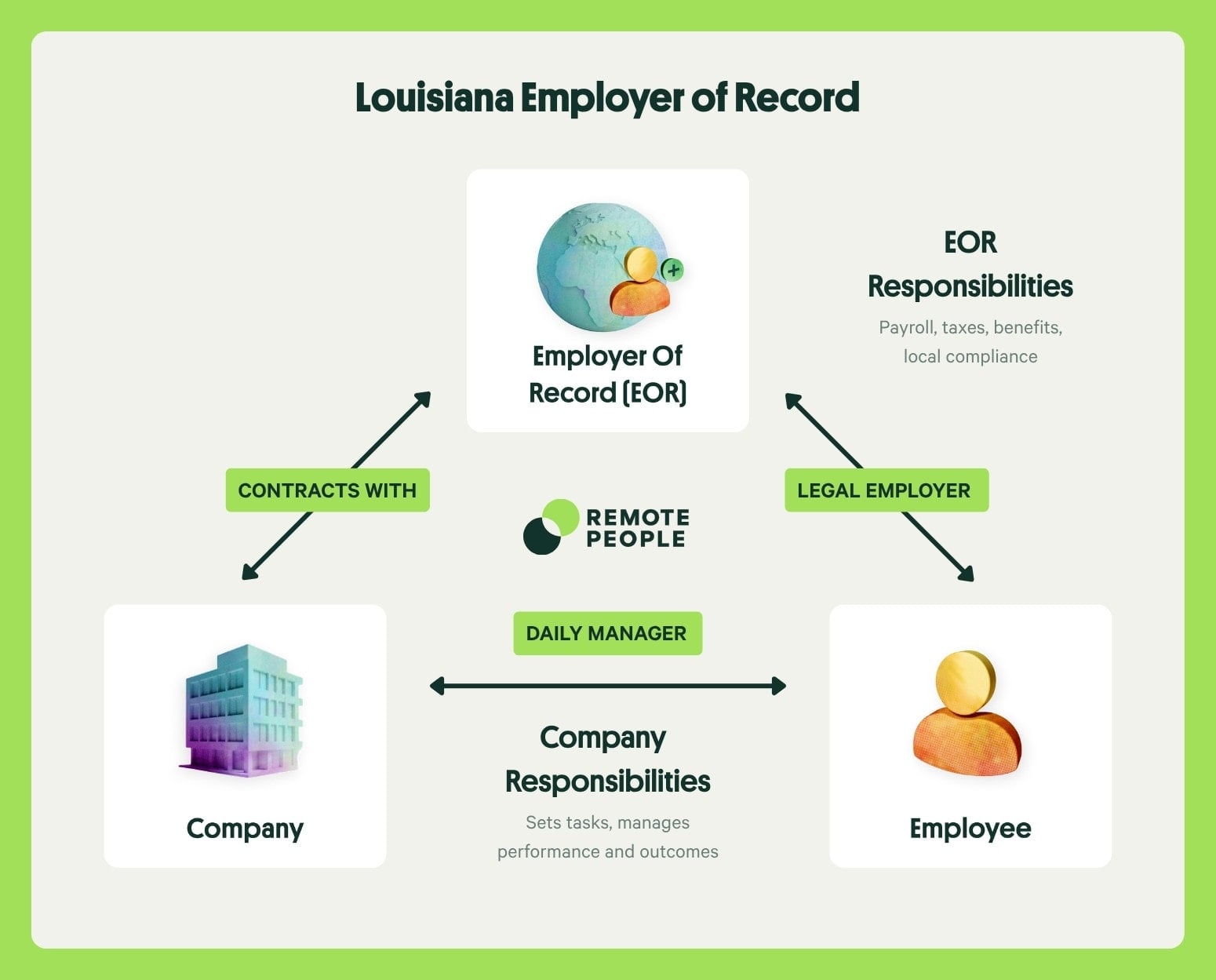
A Louisiana Employer of Record (EOR) is a third-party organization that becomes the legal employer of your workers in the state. The EOR takes on full responsibility for payroll processing, state and federal tax filings, employment tax remittance, benefits administration, and compliance with all Louisiana labor laws.
What is an EOR can help explain how this employment model works in more detail.
Your company keeps full control over the employee’s daily tasks, projects, schedule, and performance management. The EOR handles the legal and administrative side of the employment relationship. This arrangement totally shifts liability for employment compliance from your company to the EOR. But the biggest advantage of using an EOR is speed and simplicity.
A Louisiana EOR eliminates the need to set up a local legal entity, register with multiple state agencies, or build an in-house payroll team from scratch. You can hire in Louisiana within days instead of weeks or months. The EOR model is especially valuable for companies testing the Louisiana market, hiring remote workers in the state, or scaling a team quickly.
Start hiring with a Louisiana EOR
Let us handle the complexities of hiring, compliance, and payroll in Louisiana while you focus on growing your team.
- Hire employees in Louisiana with a Louisiana EOR
- No local entity is needed
- Pricing starts at USD 199 per employee
- RemotePeople can also help you find the best talent in Louisiana
What Is the Difference Between a Louisiana Employer of Record and a Louisiana PEO?
These two models sound similar, but they work very differently. The summary:
PEO (Professional Employer Organization)
- Operates under a co-employment model. Both the PEO and your company share responsibilities.
- Requires your company to have its own legal entity registered in Louisiana.
- Works best for domestic companies that have a presence in the state and want to outsource HR, payroll, and benefits paperwork.
EOR (Employer of Record)
- Does not require your company to have a legal entity in Louisiana at all.
- The EOR assumes full legal employment liability, including payroll taxes, workers’ compensation, and regulatory compliance.
- Commonly used by international companies or other US businesses hiring workers in Louisiana for the first time.
An EOR provides better liability separation. You control the work; the EOR owns the risk. The full employer liability by the EOR also allows you to scale and test business expansion with a protection that the co-owner model of a Louisiana PEO cannot match.
How Does a Louisiana Employer of Record Work?
A Louisiana EOR follows a structured process to onboard and manage employees on your behalf:
Compliant Employment Contract
Payroll Setup With Correct State Registrations
The EOR registers with the Louisiana Department of Revenue for income tax withholding (through the LaTAP portal) and with the Louisiana Workforce Commission for state unemployment insurance (through the LASTARS system). These registrations are required before any payroll can run in the state.
Tax Withholding and Remittance
The EOR withholds Louisiana’s 3% income tax, federal income tax, Social Security, and Medicare from each paycheck. It remits these amounts to the correct agencies on the required schedule; quarterly, monthly, or semi-monthly, depending on the volume.
Benefits Administration
The EOR enrolls employees in health insurance, retirement plans, and any additional benefits. Since Louisiana does not mandate paid sick leave or paid family leave, benefits are structured based on the client’s preferences and market competitiveness.
Ongoing Compliance Management
The EOR monitors changes to Louisiana employment law, manages workers’ compensation coverage, files quarterly wage and tax reports with the LWC, handles new hire reporting to the Louisiana Directory of New Hires within 20 days of each hire, and ensures compliance with the state’s Final Pay rules.
How Labor Laws Affect Hiring in Louisiana?
Minimum Wage & Overtime
Louisiana does not have its own state minimum wage law. The federal minimum wage of $7.25 per hour under the Fair Labor Standards Act (FLSA) applies to all covered employers in the state. Louisiana is one of only five states with no state-level minimum wage. The federal tipped minimum cash wage of $2.13 per hour also applies in Louisiana.
Employers should ensure that tips bring total compensation to at least $7.25 per hour. If they do not, they must make up the difference. Overtime follows federal FLSA rules only. Non-exempt employees earn 1.5 times their regular rate for all hours worked beyond 40 in a workweek. Louisiana has no daily overtime limit and no state overtime law.
Income Tax
Since January 1, 2025, Louisiana has replaced its former income tax brackets, which ranged from 1.85% to 4.25%, with a flat 3% individual income tax rate on all taxable income. This is the second-lowest rate among US states that collect income tax. The standard deduction doubled to $12,500 for single filers and to $25,000 for married filing jointly or head-of-household filers. Annual inflation adjustments to the standard deduction started in 2026.
On the corporate side, the corporate income tax, previously 3.5%–7.5%, was replaced with a flat 5.5% rate, and the corporate franchise tax has been fully repealed since January 1, 2026.
Every employer with employees working in Louisiana must withhold state income tax. The Louisiana Department of Revenue uses a withholding rate of 3.09% (slightly above the statutory rate to reduce the chance employees owe additional tax at filing time). Remittance frequency depends on monthly withholding amounts: quarterly if under $500, monthly if $500 to $4,999, or semi-monthly if $5,000 or more. Employers must file Form L-1 (Quarterly Return) even if no taxes were withheld that quarter, and Form L-3 (Annual Reconciliation) at year-end. Louisiana does not permit local or municipal income taxes. Employers manage only single state-level withholding duties.
State Unemployment Insurance (SUI)
The Louisiana Workforce Commission oversees the state’s unemployment insurance program. For 2026, the taxable wage base is $7,000 per employee, reduced from $7,700 in 2025 after the state’s unemployment trust fund surpassed $1.15 billion.
New employers receive a rate based on the average for their North American Industry Classification System (NAICS) classification, ranging from around 1.14% to 2.79%. Experienced employer rates range from 0.09% to 6.20%. All employers must file quarterly wage and tax reports electronically. Returns are due within 30 days after the end of each calendar quarter (April 30, July 31, October 31, and January 31).
Paid Leave
Louisiana has no state law requiring private-sector employers to provide paid sick leave, paid family leave, paid vacation, or PTO of any kind. All those benefits are entirely at the employer’s discretion. Louisiana also has a preemption law that blocks cities and parishes from implementing their own paid sick time rules, meaning no local government in the state can impose these requirements either.
The one important exception is jury duty leave. Under LA R.S. 23:965, employers must grant leave for jury service and pay the employee for one day’s wages. Employers cannot discharge or retaliate against employees serving on a jury. Violations carry fines of $100 to $1,000, and the employer must reinstate the employee. Federal Uniformed Services Employment and Reemployment Rights Act (USERRA) protection applies to military leave in Louisiana.
Workers’ Compensation
Workers’ compensation insurance is compulsory in Louisiana for all public and private employers, including those with just one employee. Coverage extends to full-time, part-time, temporary, and seasonal workers. Limited exemptions exist for some domestic employees, most real estate salespersons, and uncompensated officers of some nonprofits.
Louisiana operates a private insurance market with no state fund. Employers may buy a policy from a licensed private insurer, qualify for self-insurance through the Office of Workers’ Compensation, or join a group self-insurance fund. The Louisiana Workers’ Compensation Corporation (LWCC) is the state’s largest carrier. Premiums are paid wholly by the employer; deducting premium costs from employee wages is not allowed.
Workers’ compensation rates in Louisiana have been declining for over two decades. The Louisiana Department of Insurance approved a 9% rate reduction in May 2024. On average, it can cost roughly $0.20—$3.00 per $100 of payroll, depending on the NCCI classification code and employer experience modification rate, with office/clerical workers at the low end and construction/hazardous trades at the high end. Employers must report injuries within 10 days of knowledge for deaths or lost time of more than one week via Form WC IA-1.
Indemnity benefits equal 66.6% (or 2/3rds) of the employee’s average weekly wage, subject to annual limits set by the Office of Workers’ Compensation Administration (OWCA). Employers who fail to carry coverage face a 50% penalty increase on benefits owed to injured workers, plus potential fines up to $10,000 and imprisonment up to one year.
Termination and Final Pay
Louisiana is an at-will employment state. Either the employer or the employee can end the employment relationship at any time, for any lawful reason, without advance notice. Only the federal WARN Act applies, requiring 60 days’ notice for plant closings or mass layoffs affecting 100 or more employees.
Louisiana is also a right-to-work state, meaning employees cannot be forced to join or pay dues to a union as a condition of employment. On involuntary discharge, employers must pay all owed wages by the next regular payday or within 15 days of the discharge date, whichever comes first. The same deadline applies when an employee resigns voluntarily. Accrued vacation and PTO must be paid out on termination if the employer’s policy provides it. Louisiana law does not allow “use it or lose it” policies that allow companies to forfeit vacation time an employee has already earned.
Under LA R.S. 23:632, an employer who misses the deadline can be held liable for up to 90 days’ wages at the employee’s daily rate of pay, plus reasonable attorney fees. A limited exception exists, but only if the employer proves the dispute over the amount owed was made in good faith. Final Pay compliance is one of the highest-risk areas for Louisiana employers and a key reason many companies rely on an EOR to manage termination processes correctly.
Payroll Taxes and Employer Cost in Louisiana
Employers in Louisiana pay federal payroll taxes:
- Social Security at 6.2%
- Medicare at 1.45% on employee wages
- FUTA at 0.6% on the first $7,000 after the state credit
- State income tax withholding at 3.09%
- SUI contributions on the first $7,000 per employee, and
- Workers’ compensation premiums based on industry classification codes.
Table: Example Cost Breakdown: $75,000 Annual Salary
Cost Component | Calculation | Annual Cost |
|---|---|---|
Gross Salary | — | $75,000 |
Social Security | 6.2% of salary | $4,650 |
Medicare | 1.45% of salary | $1,088 |
FUTA (net after credit) | 0.6% of the first $7,000 | $42 |
Louisiana SUI (est.) | 1.5% of the first $7,000 | $105 |
Workers’ Comp (est.) | $1.00 per $100 payroll | $750 |
Total Employer Cost | — | $81,635 |
Employer Burden | — | $6,635 (8.8%) |
The estimated total employer burden on a $75,000 salary is approximately 8.8% above base wages. Actual costs will vary based on the employer’s SUI experience rate and workers’ compensation classification code. Industries like oil and gas, construction, or maritime work will see higher overall costs.
Employee Classification Rules in Louisiana
Louisiana uses an ABC-style test for unemployment insurance purposes under LA R.S. 23:1472(12)(E), known locally as the “Three-Fold Test.” The Louisiana Workforce Commission assumes that services constitute employment unless the employer can demonstrate all three of the following:
- A — Freedom from control: The worker is free from control or direction over how the work is performed, both under the contract and in practice.
- B — Outside usual course of business: The service is performed outside the usual course of the hiring entity’s business, or outside all of its places of business.
- C — Independently established trade: The worker is mainly engaged in an independently established trade, occupation, profession, or business.
Failing any single test means the worker is classified as an employee. Louisiana also enacted LA R.S. 23:1711.1 in 2021, which creates a safe assumption of independent contractor status for workers who control their performance methods and meet at least six specified criteria.
Misclassification penalties under LA R.S. 23:1711(G) start with a written warning for the first offense. Second and subsequent offenses carry fines of $100 to $1,000 per misclassified worker, plus potential imprisonment of 30 to 90 days. Willful misclassification to avoid unemployment insurance duties can result in fines up to $10,000 and criminal prosecution.
An EOR reduces classification exposure by placing workers on a compliant W-2 payroll from day one. This removes the confusion and risk that come with independent contractor arrangements, especially in Louisiana’s energy and construction sectors, where regulatory checks are highest.
What Makes Hiring in Louisiana Unique?
There are many reasons why employers like doing business in Louisiana:
Louisiana’s economy is deeply tied to energy, petrochemicals, LNG, maritime shipping, advanced manufacturing, and healthcare. Healthcare and social assistance lead private-sector employment, followed by trade, transportation, and utilities.
Louisiana takes a light-touch approach to employment regulation. It uses federal law on minimum wage, overtime, and most leave matters. Enforcement focuses mainly on Final Pay deadlines and workers’ compensation coverage. Wages are usually below the national average, though the energy, maritime, and skilled trades sectors pay better. The absence of a state minimum wage also keeps labor costs low.
Louisiana’s labor force participation rate is below the national average, and employers should plan for a smaller talent pool in some areas. LED FastStart, the state’s workforce training program, is ranked no. 1 in the US for 12 of the last 15 years. The program helps close the skills gap by recruiting, screening, and training workers for companies for free.
Louisiana’s flat 3% personal income tax is among the lowest in the nation. The corporate franchise tax has also been fully repealed. The zero local income taxes, Industrial Tax Exemption Program (up to 80% property tax abatement for manufacturers), and Quality Jobs Program (4–6% payroll rebates for up to 10 years) make Louisiana one of the most cost-effective states for employers to expand.
What Are the Benefits of a Louisiana Employer of Record?
- No Entity Setup Required: Hire in Louisiana without incorporating, registering with the Secretary of State, or establishing a physical presence.
- Faster Onboarding: An EOR can onboard Louisiana employees in days, compared to the weeks or months required to set up your own state registrations and payroll infrastructure.
- Centralized Compliance: The EOR stays current with Louisiana’s evolving tax code, workers’ compensation requirements, and final pay rules, so you do not have to track every change yourself.
- Reduced Legal Risk: The EOR assumes legal employer liability, protecting your company from penalties due to late tax filings, worker misclassification, missed final pay deadlines, and workers’ compensation errors.
- Scalable Across Multiple States: If you hire in Louisiana and other states simultaneously, a multi-state EOR manages the different regulations under one relationship, preventing any compliance gaps.
What Are the Downsides of a Louisiana Employer of Record?
No model is perfect. An EOR arrangement does come with some trade-offs:
- Service Fee: An EOR charges a per-employee fee for its services, an added cost you would not have if you handled everything in-house. That said, the fee is usually far less than the expense of creating a Louisiana entity, hiring internal HR and payroll staff, employing employment attorneys, and managing state filings yourself.
- Less Direct Payroll Control: The EOR runs the payroll, so you are one step removed from the day-to-day process. Reputable EOR providers address this concern with transparent reporting dashboards and clear communication. For most companies, the trade-off is well worth it because DIY compliance with Louisiana’s laws takes more time and less room for mistakes.
How to Choose a Louisiana Employer of Record?
Selecting the right EOR provider matters. Use this checklist to evaluate your options:
Transparent Pricing
The provider should offer clear, upfront per-employee pricing with no hidden fees for other services. Ensure the pricing structure also scales predictably as your team grows.
Direct EOR
Confirm the provider is the actual legal employer. EOR models that subcontract to third-party payroll vendors create gaps and slower resolution of problems. Working directly with the EOR reduces compliance risk and improves accountability.
U.S. Multi-state Expertise
Louisiana’s 2024 tax repeals, its ABC classification test, and its final pay penalties require a provider with deep, specific knowledge, not a generic payroll platform. This ensures consistent compliance as you expand into other states.
Dedicated Support
You should have a point of contact who is an actual state law expert, not a generic help desk. Responsive support can prevent small issues from becoming costly compliance problems.
Strong Compliance Track Record
Ask for references, client testimonials, or proof of experience managing Louisiana payroll and employment requirements. A proven track record indicates reliability and reduces your legal exposure.
Engage a Louisiana Employer of Record with RemotePeople
RemotePeople provides a direct Employer of Record service for companies hiring in Louisiana. We handle all Louisiana state registrations, payroll processing, tax withholding and remittance, workers’ compensation coverage, benefits administration, and compliance management, so your team can focus on the work, not the paperwork.
We’re a great fit if you are an international company making your first U.S. hire or even a domestic business expanding into Louisiana without physically setting up. RemotePeople gives you a fast, compliant path to building your Louisiana team.
Speak with our team and start hiring in Louisiana today.
Employer of Record in
Employer of Record in
Employer of Record in
Employer of Record in
Employer of Record in
Employer of Record in
Employer of Record in
Employer of Record in




