
 Recruit
Employer of Record in North Dakota
-
 Drew Donnelly
- Published
- September 22, 2026
North Dakota’s employment law includes state unemployment insurance and workers’ comp with no income tax, and an SD EOR handles payroll and full state compliance with no local entity needed.
Hire in North Dakota — book a free 30-minute demo
Tell us what you need. You'll get a tailored, transparent proposal within 24 hours, plus a free call to walk through it.
Tell us about your company
So we can match you with a specialist who knows your market — and unlock volume pricing tiers.
* All fields are required.
Where and when are you hiring?
Tell us the geography and timing and we'll quote each country line by line, with onboarding timelines.
* All fields are required.
Help us beat your current setup
We'll benchmark your current deal and send a line-by-line proposal in 24 hours — showing exactly where we cut cost, time, or risk. After you submit, you can book a call to walk through it together.
* All fields are required.
Thanks! Your proposal is on its way.
Expect a tailored, line-by-line proposal in your inbox within 24 hours. In the meantime…
Want to walk through it together?
Book a free 30-minute call with one of our specialists. We'll explain every line, answer your questions, and tailor the proposal further if you need.
No obligation. Pick a time that works for you.








- Hire in North Dakota — book a free 30-minute demo
- Tell us about your company
- Where and when are you hiring?
- Help us beat your current setup
- Thanks! Your proposal is on its way.
- North Dakota Employer of Record
- What Is the Difference Between a North Dakota EOR and a North Dakota PEO?
- How Does a North Dakota EOR Work?
- How Do Labor Laws Affect Hiring in North Dakota?
- Payroll Taxes and Employer Cost in North Dakota
- Employee Classification Rules in North Dakota
- What Makes Hiring in North Dakota Unique?
- What Are the Benefits of a North Dakota Employer of Record?
- What Are the Downsides of a North Dakota EOR?
- How to Choose a North Dakota Employer of Record?
- Engage a North Dakota Employer of Record with RemotePeople
- Related EOR Destinations

Let RemotePeople handle payroll, compliance, and HR admin worldwide so you can focus on building your team.
Key Takeaways
- North Dakota has a small but stable labour market driven by energy, agriculture, and manufacturing.
- The state follows the federal minimum wage, keeping baseline labour costs relatively low.
- Employers must manage state income tax, unemployment insurance, and a state-run workers’ compensation system.
- Labour shortages in specialised industries can increase competition for talent.
- An Employer of Record allows companies to hire quickly without establishing a local entity.
North Dakota offers a stable and business-friendly environment, particularly for companies operating in energy, agriculture, logistics, and manufacturing. The state’s economy is heavily influenced by oil production in the Bakken region, alongside a strong agricultural base.
The cost of doing business is generally lower than in larger US states, although wages can be higher in specialised industries due to labour shortages. North Dakota is considered moderately regulated. It follows many federal labour standards but has its own requirements for income tax, unemployment insurance, and workers’ compensation.
For companies expanding into the United States or hiring remote workers, North Dakota presents a practical entry point with fewer regulatory complexities than more heavily regulated states.
North Dakota Employer of Record
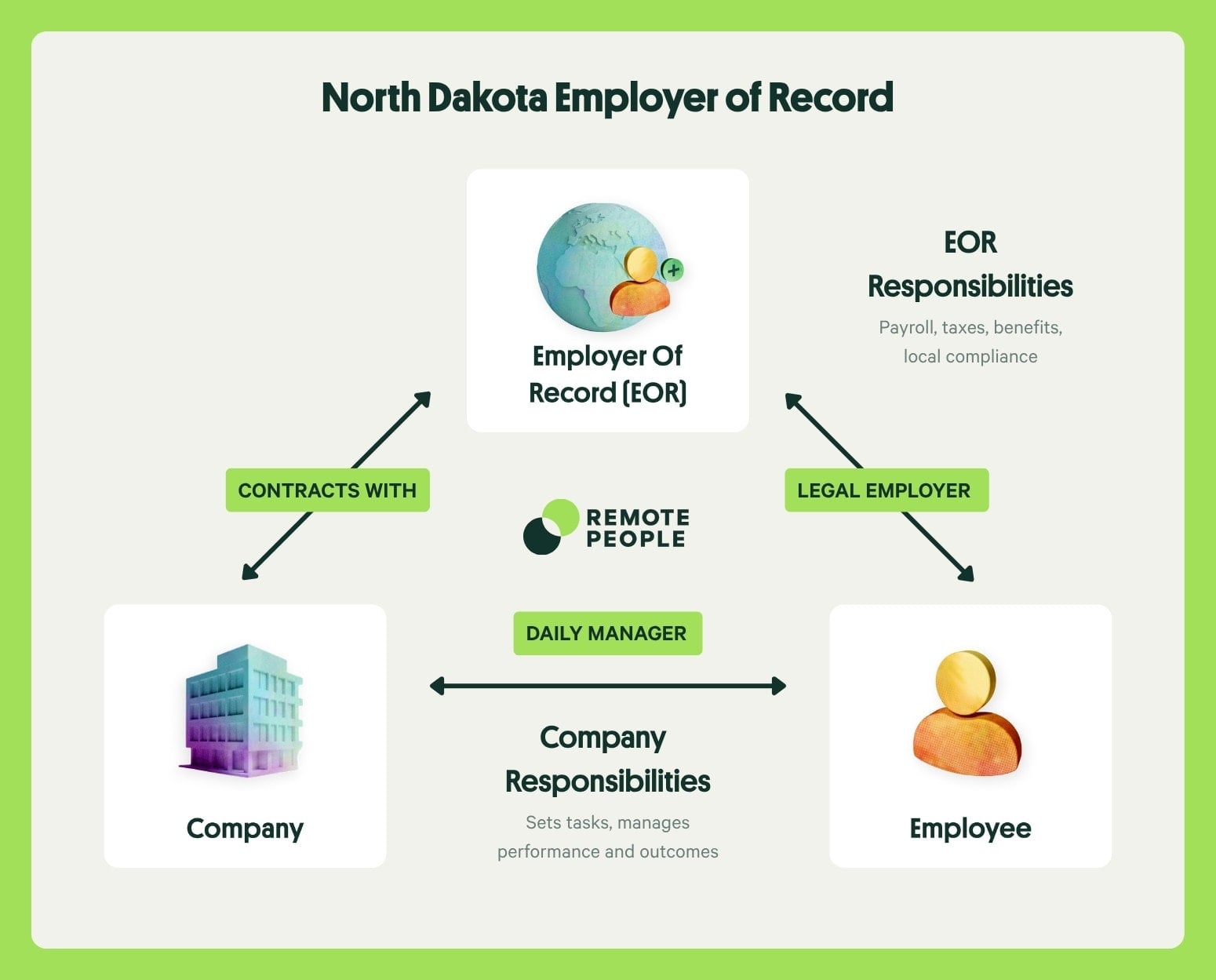
A North Dakota Employer of Record is a third-party provider that legally employs workers on your behalf in the state.
What is an EOR can help explain how this employment model works in more detail.
The EOR becomes the legal employer, taking full responsibility for payroll processing, tax filings, employment contracts, and ongoing compliance with both state and federal labour laws. This includes managing North Dakota state income tax withholding, unemployment insurance contributions, and workers’ compensation requirements.
While the EOR handles all legal and administrative employment responsibilities, your company retains full control over the employee’s day-to-day work, role, and performance. This allows you to operate as if the employee were hired directly, without taking on the associated compliance burden.
One of the main advantages of using an Employer of Record in North Dakota is that there is no need to establish a local legal entity. This significantly reduces setup time and cost, enabling companies to hire in a matter of days rather than months.
The EOR model also shifts a large portion of employment liability away from your business. This includes risks related to payroll errors, tax compliance, worker classification, and adherence to local labour laws. For companies unfamiliar with US state-level regulations, this provides an added layer of protection.
In addition, an Employer of Record supports faster and more scalable hiring across multiple US states. Instead of navigating different registration requirements and compliance frameworks in each state, businesses can rely on a single partner to standardise employment processes. In North Dakota, this is particularly valuable due to specific requirements such as the state-run workers’ compensation system, which must be set up correctly from the outset.
What Is the Difference Between a North Dakota EOR and a North Dakota PEO?
A Professional Employer Organization (PEO) operates under a co-employment model. This means your company must already have a registered legal entity in North Dakota. The PEO shares certain employer responsibilities, such as payroll and benefits administration, but your business remains legally responsible for the employee.
In contrast, an Employer of Record does not require you to have a local entity. The EOR becomes the legal employer and assumes responsibility for payroll, tax compliance, and employment law obligations.
PEOs are typically used by domestic companies already operating in the state. EORs are more suitable for international companies or businesses expanding into North Dakota without wanting to establish an entity, offering a faster and lower-risk route to hiring.
Start hiring with a North Dakota EOR
Let us handle the complexities of hiring, compliance, and payroll in North Dakota while you focus on growing your team.
- Hire employees in North Dakota with a North Dakota EOR
- No local entity is needed
- Pricing starts at USD 199 per employee
- RemotePeople can also help you find the best talent in North Dakota
How Does a North Dakota EOR Work?
An Employer of Record in North Dakota manages the full employment lifecycle on your behalf.
The process begins with issuing a compliant employment contract that aligns with both North Dakota and federal labour laws. The EOR then sets up payroll with the appropriate state registrations, ensuring all employer accounts are correctly established. This includes registering with the North Dakota Office of State Tax Commissioner for income tax withholding and Job Service North Dakota for unemployment insurance.
Payroll processing includes salary payments, tax withholding, and remittance to federal and state authorities. This covers North Dakota income tax and unemployment insurance contributions. The EOR also ensures correct classification of employees, applies relevant tax rates, and maintains payroll records in line with audit requirements.
The EOR also administers employee benefits and ensures workers’ compensation coverage is in place through the state fund, as required by law. This is particularly important in North Dakota, where private workers’ compensation insurance is not permitted.
Ongoing compliance management is handled by the EOR, including monitoring legal updates, maintaining accurate records, and ensuring all reporting obligations are met. This reduces the risk of penalties, missed filings, or incorrect payments, especially for companies hiring in the state for the first time.
How Do Labor Laws Affect Hiring in North Dakota?
Minimum Wage & Overtime
North Dakota follows the federal minimum wage of $7.25 per hour, with no separate state minimum.
Overtime is required at 1.5 times the regular rate for hours worked over 40 in a workweek. There are no daily overtime rules. Employers must ensure proper tracking of hours and correct classification of exempt and non-exempt employees to remain compliant.
Income Tax
North Dakota applies a progressive state income tax. Employers must withhold tax from employee wages and remit it to the state.
Accurate withholding is essential, as errors can lead to penalties and additional reporting obligations. Employers must also provide employees with the appropriate tax documentation at year-end.
State Unemployment Insurance (SUI)
Employers must contribute to the state unemployment insurance system. New employer rates typically start around 1 to 2 percent, with rates increasing based on experience.
The wage base is relatively high compared to other states, increasing the portion of wages subject to contributions. Employers are also required to file regular reports and maintain accurate payroll data for unemployment insurance purposes.
Paid Leave
There are no state-mandated paid sick leave or paid family leave requirements. Employers can offer these benefits voluntarily.
However, offering competitive leave policies can be important for attracting and retaining talent, particularly in industries facing labour shortages.
Workers’ Compensation
Workers’ compensation is mandatory and provided through a monopolistic state fund. Employers must register and maintain coverage through this system.
Premiums are based on industry classification and risk level, meaning higher-risk sectors may face increased costs.
Termination and Final Pay
North Dakota is an at-will employment state, allowing termination at any time for lawful reasons.
Final pay must generally be issued by the next regular payday. Employers should ensure that all outstanding wages, commissions, and bonuses are calculated correctly to avoid disputes or wage claims.
PTO payout is not required unless specified in company policy, but clear documentation is essential to avoid misunderstandings at termination.
Payroll Taxes and Employer Cost in North Dakota
Employers must account for federal payroll taxes, state income tax withholding, unemployment insurance contributions, and workers’ compensation premiums.
In addition to these core costs, employers should also consider indirect expenses such as benefits, administrative overhead, and compliance management.
Example Cost Breakdown
For a salary of $100,000, total employer costs typically range from 10 to 18 percent on top of base salary, depending on industry risk and insurance rates.
This range can vary based on unemployment insurance experience ratings and the specific workers’ compensation classification applied to the role.
Employee Classification Rules in North Dakota
North Dakota follows the federal common law test to determine worker classification.
While less strict than states like California, misclassification can still result in penalties, back taxes, and potential legal disputes. Employers must carefully assess the level of control, financial relationship, and independence when classifying workers.
Using an Employer of Record reduces classification risk by ensuring compliance with applicable rules and applying consistent standards across your workforce.
What Makes Hiring in North Dakota Unique?
North Dakota’s labour market is shaped by its small population and strong industry concentration. Labour shortages are common in sectors such as energy and agriculture, which can increase hiring competition.
The state offers a relatively straightforward regulatory environment, but employers must still manage specific requirements such as income tax and the state-run workers’ compensation system.
In addition, workforce availability can vary significantly by region, with more limited talent pools outside major cities. This makes strategic hiring and efficient onboarding processes particularly important for companies entering the state.
What Are the Benefits of a North Dakota Employer of Record?
Using an Employer of Record in North Dakota eliminates the need to set up a local entity, which removes one of the most time-consuming barriers to hiring quickly. Onboarding moves faster, compliance is managed centrally, and the legal and administrative risk that comes with navigating state-specific employment obligations is significantly reduced. For companies with plans to hire across multiple US states, an EOR provides a scalable foundation that grows with you without requiring a separate setup process in each new location.
What Are the Downsides of a North Dakota EOR?
Service fees add to the overall cost of employment, and handing payroll over to an EOR means your team is one step removed from the calculations and filings. For smaller teams, that fee can feel hard to justify against the complexity of what’s being managed in a state with a relatively lean regulatory environment like North Dakota.
That said, the alternative has its own costs. Managing employment compliance independently, across federal obligations, state unemployment insurance, and WSI enrolment, requires time, expertise, and ongoing attention to get right. For most companies without an established presence in North Dakota, an EOR remains the more efficient and lower-risk path.
How to Choose a North Dakota Employer of Record?
- Pricing transparency is the starting point. North Dakota’s employment obligations span federal payroll taxes, state unemployment insurance, and mandatory WSI enrolment, and some providers price these components separately in ways that aren’t obvious upfront. Get a full breakdown of fees before signing anything, including what happens if your headcount changes or you need to offboard an employee.
- The structure of the provider matters as much as the price. A direct EOR model, where the provider holds the actual employer of record status rather than routing through a third-party infrastructure, gives you cleaner accountability and faster resolution when something needs attention. Intermediary arrangements introduce delays and diffused responsibility that tend to surface at inconvenient times.
- Multi-state experience is worth probing specifically. North Dakota may be where you’re starting, but US hiring rarely stays in one state for long. A provider with established operations across multiple states will handle that expansion without treating each new location as a custom project.
- Support structure deserves more scrutiny than most buyers give it. Ask who your day-to-day contact will be, how queries are routed, and what the contractual response time looks like. A dedicated point of contact who knows your account is worth considerably more than a general support queue when a payroll issue needs a fast answer.
- Finally, ask for demonstrated compliance history rather than general assurances. References from companies with similar size and hiring patterns, particularly those operating across multiple US states, will give you a more accurate picture of what working with the provider actually looks like day to day.
Engage a North Dakota Employer of Record with RemotePeople
RemotePeople provides full-service Employer of Record solutions across North Dakota. We manage payroll registration, state income tax withholding, unemployment insurance contributions, and workers’ compensation coverage through the state fund, ensuring full compliance with local requirements.
Whether you are entering the US market or expanding your remote workforce, RemotePeople allows you to hire in North Dakota quickly and compliantly without setting up a local entity. Our team supports you throughout the employment lifecycle while you maintain full control of your workforce.
Contact RemotePeople to discuss your North Dakota hiring plans and timeline.