
 Recruit
Employer of Record (EOR) in Macau
-
 Drew Donnelly
- Published
- September 22, 2026
Discover how partnering with a Macau employer of record can simplify the hiring process and help you save on employment costs.
Hire in Macau — book a free 30-minute demo
Tell us what you need. You'll get a tailored, transparent proposal within 24 hours, plus a free call to walk through it.
Tell us about your company
So we can match you with a specialist who knows your market — and unlock volume pricing tiers.
* All fields are required.
Where and when are you hiring?
Tell us the geography and timing and we'll quote each country line by line, with onboarding timelines.
* All fields are required.
Help us beat your current setup
We'll benchmark your current deal and send a line-by-line proposal in 24 hours — showing exactly where we cut cost, time, or risk. After you submit, you can book a call to walk through it together.
* All fields are required.
Thanks! Your proposal is on its way.
Expect a tailored, line-by-line proposal in your inbox within 24 hours. In the meantime…
Want to walk through it together?
Book a free 30-minute call with one of our specialists. We'll explain every line, answer your questions, and tailor the proposal further if you need.
No obligation. Pick a time that works for you.








- Hire in Macau — book a free 30-minute demo
- Tell us about your company
- Where and when are you hiring?
- Help us beat your current setup
- Thanks! Your proposal is on its way.
- What is an Employer of Record in Macau?
- Employment Law & Compliance Essentials
- Hiring and Work Permits in Macau
- Payroll, Taxation and Social Security in Macau
- Employment Contracts and Probation
- Termination, Notice and Severance
- EOR vs Alternatives: Entity, Contractor, PEO
- Cost of Hiring in Macau: Sample Calculation
- How to Choose an EOR Provider in Macau
- Why Choose RemotePeople as Your EOR in Macau
- Where companies hiring in Macau expand next
- Frequently Asked Questions
- Related EOR Destinations

Start hiring in Macau
Let RemotePeople handle payroll, compliance, and HR admin worldwide so you can focus on building your team.

An employer of record in Macau (also spelled Macao) lets foreign companies hire local or non-resident staff without setting up a Macau SAR entity — typically for $300–$600 per employee per month. The EOR becomes the on-paper employer, handling Social Security Fund (FSS) registration, professional tax filing with the Financial Services Bureau (DSF), Blue Card sponsorship for non-resident workers, and Labour Affairs Bureau (DSAL) compliance, while your company keeps full day-to-day control of the role.
This 2026 guide covers everything U.S., European and APAC employers need to hire compliantly in Macau: the current minimum wage under Law 14/2025, FSS contribution rates for employer and employee, professional tax brackets after the 30% reduction and 60% rebate for 2026, mandatory holidays, maternity and paternity entitlements, probation and notice rules, the tiered severance schedule set out in Law 7/2008, and the Blue Card process for non-resident workers under Law 21/2009. A sample cost breakdown at the end shows exactly what a USD 5,000/month hire costs with and without an EOR.
What is an Employer of Record in Macau?
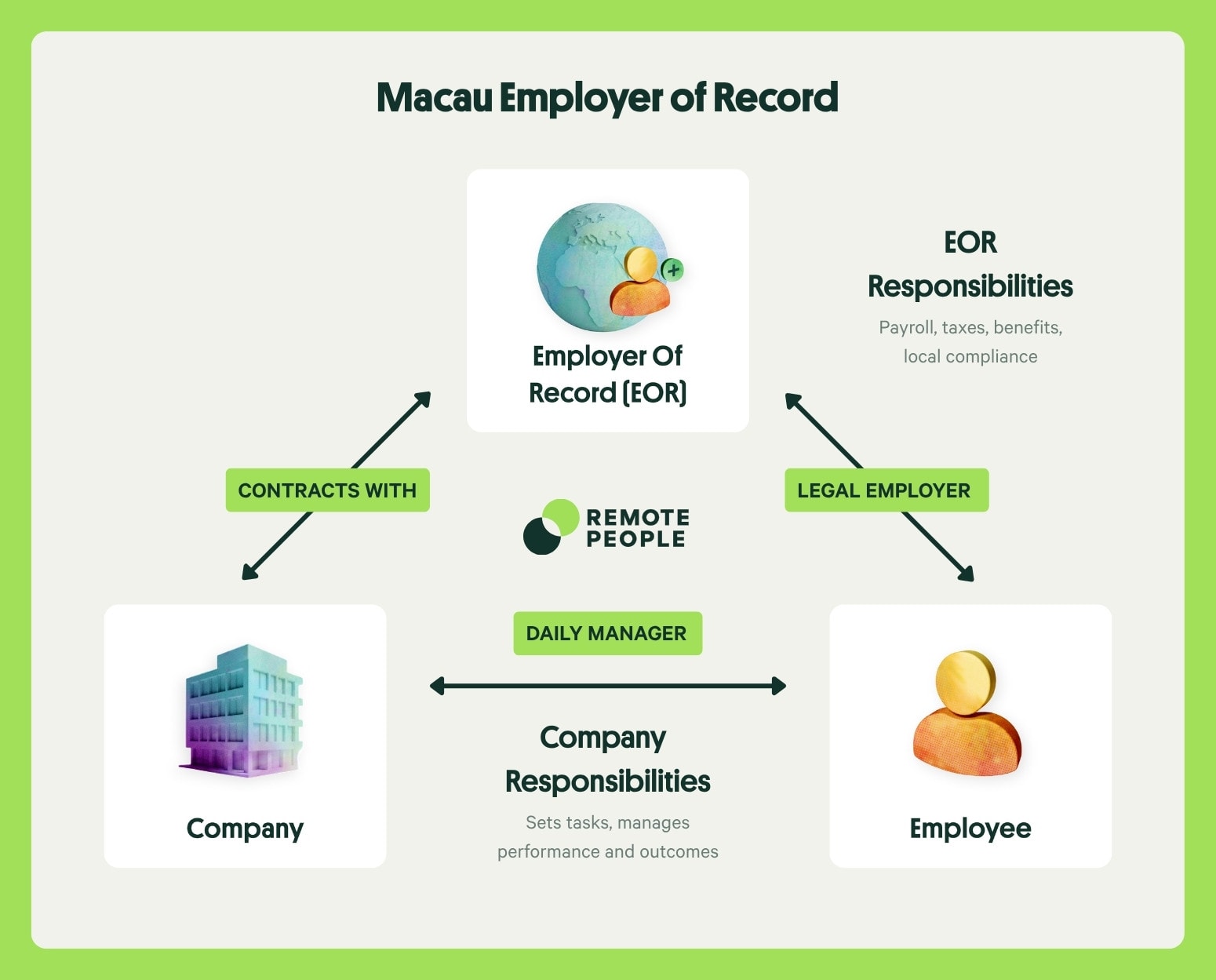
If you’d like to learn more about how Employer of Record (EOR) services work, read our What Is an Employer of Record (EOR)? guide for a complete overview of the model, its benefits, and when to use it.
If you’re comparing providers, our Best Employer of Record (EOR) Providers guide reviews the leading platforms to help you choose the right solution for your business.
Who Uses an EOR in Macau?
Companies of all sizes use EOR services in Macau, and for different reasons. What they have in common is a need to employ people locally without the cost and complexity of setting up a Macau entity.
Companies exploring the Macau market often hire one or two employees through an EOR to test opportunities in gaming, hospitality, or tourism-adjacent sectors before investing in a full subsidiary. This avoids the upfront cost and multi-month timeline of entity formation.
Organizations that need a handful of employees in Macau for sales, support, or operations roles can use an EOR to employ them compliantly without the overhead of maintaining a local entity. When speed matters, an EOR can have the employment contract signed and the employee onboarded in one to two weeks, compared to considerably longer for entity incorporation.
Non-resident workers require a work permit (blue card) sponsored by a locally registered employer to work legally in Macau. An EOR with a local entity can act as the sponsoring employer and manage this application process.
In each case, the EOR takes on the legal risk and administrative work, so the client company can focus on managing its team and growing its business in Macau.
Typical Onboarding Timeline
The EOR onboarding process in Macau follows a structured sequence. Here is what the timeline looks like for a standard hire who does not require a work permit:
- First: Sign the EOR service agreement and provide the new hire’s personal details, job description, compensation package, and start date. This takes one to two days.
- Second: The EOR drafts a compliant employment contract under Macau’s Labour Relations Law, reviews it with you, and sends it to the employee for signature. This typically takes two to three days.
- Third: The EOR registers the employee with Macau’s Social Security Fund (FSS) for social security contributions. Registration takes a few business days.
- Fourth: Payroll setup, benefits enrollment, and internal system configuration take two to three days.
- Fifth: The employee starts work on the agreed date. The EOR provides onboarding documentation and confirms all registrations are complete.
Most EOR providers can onboard an employee in Macau within one to two weeks. If the employee is a non-resident requiring a blue card work permit, the timeline extends further depending on nationality and processing volumes.
Hire in Macau
A low-tax environment, flat social security contributions, and a bilingual workforce with deep ties to mainland China and Portuguese-speaking markets make Macau a strategic base for companies expanding in Asia.
We handle employment contracts, payroll, professional tax withholding, and full Macau compliance under Law No. 7/2008.
No local entity needed. Your team can start in days.
Employment Law & Compliance Essentials
Macau labour rules are governed primarily by Law 7/2008 (the Labour Relations Law), which sets working time, leave, notice and severance, and by Law 8/2020 on maternity and paternity. The Labour Affairs Bureau (DSAL) enforces the code, handles complaints, and publishes official guidance.
Working hours, rest days and public holidays
Standard working time is 8 hours per day and 48 hours per week. Employees are entitled to one paid rest day every seven days, normally aligned with the weekly cycle. Rest breaks of at least 30 minutes apply after 5 consecutive hours of work. Managers and genuinely autonomous professionals can be exempt from the daily ceiling by written agreement, but are still entitled to the weekly rest day. Night work (typically 10pm–7am) does not trigger an automatic premium but is regulated more tightly for minors and pregnant employees. Work on a rest day, a “compulsory holiday” or a waived rest day triggers premium pay, the rates are summarised in the overtime table below.
Macau observes 10 mandatory (compulsory) public holidays under Law 7/2008. The table below lists the 2026 dates from the official Macau government holiday portal.
| Macau mandatory public holidays, 2026 | ||
Date | Day | Holiday |
|---|---|---|
1 January | Thursday | New Year’s Day |
17 February | Tuesday | Lunar New Year (Day 1) |
18 February | Wednesday | Lunar New Year (Day 2) |
19 February | Thursday | Lunar New Year (Day 3) |
4 April | Saturday | Ching Ming Festival |
1 May | Friday | Labour Day |
1 October | Thursday | National Day of the PRC |
19 October | Monday | Chung Yeung Festival |
20 December | Sunday | Macau SAR Establishment Day |
1 January 2027 | Friday | New Year’s Day (following year anchor) |
| Source: Government of Macao SAR, 2026 Public Holidays | ||
Macau also observes several “non-mandatory” holidays (including Easter, the Day of Portugal, and the Feast of All Saints) that apply to public-sector and some private employers. The 10 dates above are the compulsory minimum for private-sector employees.
Overtime rates
Overtime is only lawful where the employer has directed the work or where an emergency requires it, and, with limited exceptions, requires the employee’s consent. The premium rates set by Law 7/2008 are:
| Macau overtime and premium pay, 2026 | ||
Type of work | Pay rate | Legal basis |
|---|---|---|
Overtime on a normal working day (employer-directed, with consent) | 150% of hourly pay | Law 7/2008, art. 37 |
Overtime on a weekly rest day | 200% of hourly pay | Law 7/2008, art. 43 |
Work on a compulsory (mandatory) public holiday | Regular wage + additional 100% (effectively 200%) | Law 7/2008, art. 45 |
Non-compulsory work on compulsory holiday where employer requires it (limited cases) | Regular wage + 200% supplement | Law 7/2008, art. 45 |
| Source: Law 7/2008, Labour Relations Law; Labour Affairs Bureau (DSAL) | ||
Minimum wage
Macau’s statutory minimum wage for the general workforce (excluding domestic workers and persons with reduced working capacity) is set by Law 14/2025, which amends the 2020 general minimum-wage law. From 1 January 2026, the minimum wage is MOP 36 per hour, MOP 288 per day, or MOP 7,280 per month, up from MOP 34 / MOP 272 / MOP 6,656 in 2024–2025. The law is reviewed at least every two years, and EOR clients should budget for the next review in 2028.
Leave entitlements
Statutory paid leave under Law 7/2008 and Law 8/2020 falls into five main categories. The table below summarises each; detailed H4 sections follow.
| Macau statutory leave entitlements, 2026 | |||
Leave type | Minimum duration | Pay | Who pays |
|---|---|---|---|
Annual leave | 6 working days per year | 100% | Employer |
Sick leave | 6 days paid + up to 30 unpaid (protected) | 100% of basic wage for first 6 days | Employer |
Maternity leave | 70 days | 100% of basic wage | Employer |
Paternity leave | 5 working days | 100% of basic wage | Employer |
Marriage leave | 6 working days | 100% | Employer |
Bereavement leave | 2–6 working days (depending on relationship) | 100% | Employer |
| Source: Law 7/2008; Law 8/2020 (maternity & paternity) | |||
Annual leave
All employees are entitled to 6 working days of paid annual leave per year, accrued pro rata in the first year of service. Annual leave must be scheduled by agreement between employer and employee, with the employer having the final say if there is no agreement. Unused leave cannot be cashed out in lieu during active employment (except on termination) and does not automatically carry over, employers typically allow carry-over to the following Q1 by internal policy.
Sick leave
Employees on certified sick leave receive full wages for the first 6 days in any calendar year. Beyond 6 days, employment is protected for up to 30 days of additional certified absence but pay ceases, unless the employer has a more generous internal policy or private health insurance covering wage continuation.
Maternity leave
Under Law 8/2020, female employees are entitled to 70 days of paid maternity leave at 100% of basic wage, fully funded by the employer. At least 49 of those days must be taken after the birth. The government reimburses employers for a capped portion of the leave cost on application, EOR clients see this reflected as a net payroll reduction in the relevant month.
Paternity leave
Fathers are entitled to 5 working days of paid paternity leave, taken within 30 days of the child’s birth. Pay is 100% of basic wage and is borne by the employer.
Other family and civic leave
Employees also accrue 6 working days of marriage leave and 2–6 working days of bereavement leave (depending on the relationship to the deceased). These are paid at full wage by the employer.
Hiring and Work Permits in Macau
EOR clients in Macau fall into two broad cohorts: those hiring permanent residents or holders of the Macau ID card, who need no sponsorship, and those hiring non-resident workers, who must obtain a Blue Card. The Blue Card (authorisation to work for non-resident workers, sometimes called the “work ID”) is governed by Law 21/2009 and administered jointly by DSAL and the Public Security Police Force (CPSP).
Hiring Macau residents
If the candidate is a Macau permanent resident, a Macau resident ID holder, or a holder of certain special statuses, the EOR simply signs the employment contract, registers the hire with the FSS within 30 days, and begins withholding professional tax. No immigration filing is required.
Hiring non-resident workers (Blue Card)
Non-residents, including mainland Chinese, Hong Kong, Portuguese, and other nationals, require a Blue Card before lawfully starting work. The process has two stages:
- The employer (the EOR) files a manpower quota application with DSAL, justifying the number of non-resident workers needed and the reason local hiring cannot fill the role.
- Once the quota is approved, the employer files an individual authorisation application for each named worker, attaching the signed employment contract, the candidate’s CV and qualifications, and a police clearance.
DSAL splits the Blue Card into categories that the EOR must flag at quota stage. The main ones are summarised below.
| Macau Blue Card categories, 2026 | |||
Category | Typical roles | Minimum wage floor | Typical decision time |
|---|---|---|---|
Specialist worker (manager, professional) | Finance, tech, legal, medical, senior hospitality | Salary must be at or above local-market benchmark | ~15 working days after quota approval |
Non-specialist worker | Hospitality floor staff, retail, construction | Statutory minimum wage applies | Quota approval often 4–8 weeks; individual issuance ~15 days after |
Domestic worker | In-home household roles (separate quota) | Minimum wage law excludes this category | Varies |
Validity | Tied to contract; renewable up to 2 years at a time | – | – |
| Source: Law 21/2009, Non-resident Workers Regime; DSAL, Non-resident Worker Index | |||
Specialist (professional) workers
Specialist Blue Cards cover managers, technicians and professionals where the skill is scarce in the local market. DSAL expects salary to sit at or above a local-market benchmark and looks carefully at the evidence of recruitment difficulty. Renewals are more straightforward than first-time applications.
Non-specialist workers
Non-specialist quotas are scrutinised more closely, particularly in the gaming, construction and hospitality sectors where the government manages the ratio of resident to non-resident workers at a policy level. EOR clients recruiting in these areas should expect longer quota lead times and budget for that in the hiring plan.
Required documents
The employer/EOR will typically need to file: a job description and justification of local recruitment efforts (often a DSAL-posted vacancy), the signed employment contract, the worker’s passport and a recent photograph, academic and professional qualifications, and a police clearance from the country of residence. A medical check may also be required post-arrival.
Processing times
DSAL typically decides individual Blue Card applications within about 15 working days once quota is in place, though quota approval itself can take 4–8 weeks (longer in regulated sectors). Renewals are usually faster.
If you are moving staff from the Mainland or Hong Kong, compare the Macau route against a China EOR or Hong Kong EOR arrangement, each jurisdiction has its own tax, social-security and permit profile, and the right choice depends on where the work will actually be performed.
Payroll, Taxation and Social Security in Macau
Macau payroll combines a flat FSS contribution, monthly professional tax withholding (reconciled annually), and, where applicable, Blue Card stamp duty. There is no mandatory housing fund, no supplementary pension contribution in the general private sector, and no value-added tax to worry about on employment costs.
Social Security Fund (FSS)
The FSS operates a flat monthly contribution per employee, split between employer and employee. The 2026 rate structure (unchanged from 2024–2025) is:
| Employer contributions in Macau, 2026 | |||
Contribution | Rate / amount | Base | Notes |
|---|---|---|---|
FSS (Social Security Fund), employer share | MOP 60 per employee per month | Flat amount | Payable to FSS quarterly; unchanged since 2011 |
Professional tax, withholding & remittance | 7%–12% (progressive) | Employee’s gross salary | Employer deducts at source; net of 30% reduction and 60% rebate for 2026 |
Blue Card stamp duty (non-resident hires) | MOP 200 per worker per month | Flat per non-resident worker | Only for Blue Card holders; payable with payroll filing |
Industrial Tax (business registration) | MOP 300 per year (standard) | Per employer, not per employee | Carried by the EOR for its own registration |
Mandatory provident fund / occupational pension | None (private sector) | – | Voluntary Central Provident Fund exists; not a mandatory employer obligation |
Total employer statutory cost | ~MOP 60–260 / month + withheld tax | – | Plus EOR service fee on top of gross salary |
| Source: Macau Social Security Fund (FSS); Financial Services Bureau (DSF) | |||
Employees pay a complementary flat FSS contribution and, after the annual allowance, professional tax withheld at source by the employer.
| Employee contributions and deductions in Macau, 2026 | |||
Deduction | Rate / amount | Base | Notes |
|---|---|---|---|
FSS, employee share | MOP 30 per month | Flat amount | Withheld by employer; combined FSS total is MOP 90/month |
Professional tax, 1st tier | 0% up to MOP 144,000/year | Gross annual salary | 2026 threshold raised from MOP 95,000 (anti-inflation measure) |
Professional tax, progressive tiers | 7%–12% progressive | Income above MOP 144,000 | Capped at 12% on income above MOP 424,000 |
2026 tax relief | 30% rate reduction + 60% rebate (max MOP 14,000) | Applied annually | Confirmed in the 2026 Macau budget |
Health insurance | None mandatory | – | Private supplementary cover is common, not legally required |
| Source: FSS; DSF, Professional Tax | |||
Professional tax brackets (2026)
Professional tax is assessed annually on gross employment income, withheld monthly by the employer (via the EOR), and reconciled on the annual return. The 2026 tax schedule, after the MOP 144,000 allowance but before the 30% reduction and 60% rebate, is shown below.
| Macau professional tax brackets, 2026 (MOP) | ||
Annual taxable income (after MOP 144,000 allowance) | Marginal rate | Cumulative tax at top of bracket |
|---|---|---|
Up to MOP 20,000 | 7% | MOP 1,400 |
MOP 20,001 – 60,000 | 8% | MOP 4,600 |
MOP 60,001 – 120,000 | 9% | MOP 10,000 |
MOP 120,001 – 200,000 | 10% | MOP 18,000 |
MOP 200,001 – 280,000 | 11% | MOP 26,800 |
Above MOP 280,000 | 12% | – |
| Source: Financial Services Bureau (DSF), Professional Tax (Imposto Profissional). The 2026 Macau Budget also grants a 30% rate reduction and a 60% rebate capped at MOP 14,000. | ||
Once the 30% reduction and the 60% rebate are applied, the effective professional tax burden for most salaried employees in Macau is materially below the nominal rate, in many cases under 5% of gross income for middle-income hires.
Payroll cadence, payslips and filings
Salaries must be paid at least monthly and no later than the end of the following pay period; most Macau employers pay by bank transfer on or before the last working day of the month. Payslips must show gross salary, FSS deduction, professional tax withheld, overtime and any bonuses. The employer files an annual professional tax return (M/3, M/4) and quarterly FSS remittances.
Employment Contracts and Probation
Contract types
Macau law recognises two principal contract forms:
- Indefinite-term contracts, the default, with full statutory protection on termination.
- Fixed-term contracts, lawful only where the role is genuinely temporary (seasonal, project-based, replacement of an absent employee). Abusive use of fixed-term contracts is recharacterised as indefinite by DSAL, exposing the employer to severance.
Written contracts are not strictly mandatory for resident employees but are strongly recommended, DSAL has a template, and in a dispute the written document is the primary evidence. Blue Card workers must have a written, signed contract as part of the authorisation file. RemotePeople delivers every Macau contract bilingually in English and Portuguese (with Chinese on request), covering the statutory minimums and any client-specific clauses on IP assignment, non-solicitation, confidentiality and remote-working allowances.
Because Macau is a common-law-adjacent civil-law jurisdiction, contractual provisions that are lawful in the United States or the United Kingdom (e.g. broad non-competes, at-will termination, unlimited “garden leave”) will often be unenforceable locally. Non-compete clauses in particular must be narrow in scope, duration and geography, and are only enforceable where the employee received a genuine benefit in return. The EOR will flag and redraft any clauses that would expose the client to unpaid-damages claims on termination.
Probation periods
Probation (período experimental) under Law 7/2008 is not automatic, it must be expressly agreed in writing and cannot exceed the statutory caps:
- Indefinite-term contracts: up to 90 days, extendable to 180 days for technical or managerial roles.
- Fixed-term contracts of 6+ months: up to 30 days.
- Shorter fixed-term contracts: up to 15 days.
During probation either party may terminate the contract without cause and without severance, though notice of at least 7 days applies after the first 60 days. Probation only runs once, it cannot be “reset” by converting a fixed-term contract into an indefinite one with the same employee, or by signing successive short fixed-term contracts for effectively the same role.
Mandatory and optional contract clauses
Beyond the statutory minimums, Macau contracts typically include:
- The specific job title and duties (important if the contract is a Blue Card file attachment, DSAL checks the role against the approved quota).
- Place of work and any allowance for remote or hybrid working.
- Gross monthly salary in MOP, plus any 13th-month or performance bonus arrangement.
- Working hours, shift patterns and any on-call arrangements.
- Benefits beyond the statutory minimum (private medical insurance, meal allowances, travel).
- Confidentiality, IP assignment and, where justified, a narrow non-compete.
- Dispute-resolution language (Macau courts; Portuguese law as the governing law by default).
Termination, Notice and Severance
Termination is the area where Macau compliance matters most for EOR clients. The statute recognises three pathways:
- Termination by mutual agreement, always permissible, ideally in writing with a settlement note.
- Termination by the employer without just cause, lawful but triggers severance.
- Termination for just cause, no severance, but the grounds must be documented and serious (gross misconduct, repeated material breach). DSAL scrutinises “just cause” dismissals closely.
Examples of conduct that Macau courts and DSAL have accepted as “just cause” include repeated unexcused absence, theft or fraud against the employer, serious insubordination, physical violence at work, and material breach of confidentiality obligations. Poor performance, on its own, is typically not just cause, the employer is expected to put the employee on a structured improvement plan or terminate without cause and pay severance. Medical incapacity is also generally not just cause while the employee remains within their protected sick-leave window.
Special protections apply during pregnancy and the first year post-birth, during a certified period of sick leave, and during periods of union or workers’ representative activity. Dismissing a protected employee can trigger punitive reinstatement remedies, so the EOR will always run a protected-status check before any termination letter is issued.
Notice periods
| Macau notice periods, 2026 | ||
Trigger | Notice by employer | Notice by employee |
|---|---|---|
Termination without cause, indefinite contract | 15 days | 7 days |
Termination during probation (after first 60 days) | 7 days | 7 days |
Termination during probation (first 60 days) | No notice | No notice |
End of fixed-term contract (non-renewal) | 15 days before expiry | Optional |
Pay in lieu of notice | Permitted (full wage for notice period) | Permitted |
| Source: Law 7/2008, Labour Relations Law; DSAL | ||
Severance pay
Severance (compensação por rescisão) is owed when the employer terminates without just cause. Under Law 7/2008, as clarified by DSAL, the entitlement is calculated on a tiered per-year-of-service schedule, with daily pay capped at MOP 21,000/30 ≈ MOP 700 per day and a hard ceiling of 12 months’ pay total.
Calculation method
For each completed year of service, the employee receives a set number of “days of basic wage”, using the employee’s basic monthly wage ÷ 30. If monthly wage exceeds MOP 21,000, the calculation is capped at MOP 21,000 for severance purposes (but the underlying salary is paid in full).
Tiered schedule
| Macau severance schedule, Law 7/2008 (2026) | ||
Length of service | Days of basic wage per year of service | Example (MOP 20,000/month salary, 3 years) |
|---|---|---|
Up to 1 year | 7 days per year | – |
Over 1 year up to 3 years | 10 days per year | 30 days × (MOP 20,000/30) = MOP 20,000 |
Over 3 years up to 5 years | 13 days per year | – |
Over 5 years up to 7 years | 15 days per year | – |
Over 7 years up to 9 years | 16 days per year | – |
Over 9 years | 20 days per year | – |
Global cap | Maximum 12 months’ basic wage | Applies to all cases |
| Source: Law 7/2008 (arts. 70–71); DSAL severance guidance | ||
Severance is additional to pay in lieu of notice (if the employer chooses that route), untaken annual leave, and any contractual bonuses due up to the termination date. It is not owed on resignation, on genuine just-cause dismissal, or on the natural end of a fixed-term contract that was lawfully fixed-term.
Blue Card and termination
When a Blue Card worker is terminated, the EOR must notify DSAL within 10 days. The worker typically has a short window to leave Macau or to secure a new sponsor; this is worth flagging in the initial contract so the employee is not surprised.
EOR vs Alternatives: Entity, Contractor, PEO
EOR vs own Macau entity
Setting up a Macau subsidiary is feasible but slow and requires ongoing local presence (a registered office, resident director or representative, local bookkeeping). For a team of 1–10 people, an EOR is almost always faster and cheaper.
| Macau: EOR vs own entity, 2026 | ||
Dimension | Employer of Record | Own Macau entity |
|---|---|---|
Setup time | 1–3 weeks to first hire | 2–4 months (company formation, tax, FSS, bank) |
Upfront cost | Service fee only (no entity setup) | Incorporation, legal, notary, capital requirements |
Ongoing admin | Handled by EOR | Local bookkeeping, audit, FSS, DSF filings |
Best for | 1–15 employees, market testing, short-term projects | 15+ employees, licensed activities, long-term presence |
Commercial licences | Client cannot sign local revenue contracts through the EOR | Full commercial capacity |
Break-even (rule of thumb) | – | Typically ~15 FTEs before an entity beats EOR on cost |
| Source: RemotePeople comparative analysis based on DSAL, FSS and DSF filing requirements | ||
EOR vs independent contractors
Hiring a Macau resident as a contractor (prestador de serviços) is legitimate when the work is genuinely autonomous, project-based and billed on invoice. It becomes risky when the contractor works full-time for a single client, under the client’s direction, with company email and equipment, DSAL can recharacterise the relationship as employment and claim back-severance and FSS.
| Macau: EOR vs independent contractor | ||
Dimension | Employer of Record | Independent contractor |
|---|---|---|
Legal relationship | Employment (Law 7/2008) | Services contract (Civil Code) |
Social security | FSS registered, employee covered | Not covered; self-insurance only |
Tax | Professional tax withheld by EOR | Professional tax (Group II) self-assessed by contractor |
Severance & notice | Statutory protections apply | None beyond contract |
Misclassification risk | None | High for full-time, single-client roles |
Best fit | Core, ongoing roles | Short-term specialists, agencies |
| Source: RemotePeople analysis of Law 7/2008 and Macau Civil Code | ||
If you also hire contractors, review our global contractor-of-record guide, an Agent of Record (AoR) can sit alongside an EOR for mixed teams.
EOR vs PEO
Strictly speaking, a Professional Employer Organisation (PEO) requires a local entity and acts as a co-employer on payroll and HR. Outside the United States, “PEO” is often used loosely, and in Macau the useful comparison is between an EOR (global, no client entity needed) and a domestic outsourced-payroll or staffing agency (requires your Macau entity).
| Macau: EOR vs PEO / outsourced payroll | ||
Dimension | Employer of Record | PEO / payroll outsourcing |
|---|---|---|
Client entity required | No | Yes (you remain the employer of record) |
Legal employer | EOR | Client |
Liability for compliance errors | Primarily EOR | Primarily client |
Best for | Entering the market | Already incorporated, need admin help |
Typical fee model | % of salary or flat per employee | Flat fee per payslip |
| Source: RemotePeople comparative framework | ||
Cost of Hiring in Macau: Sample Calculation
The table below models the true landed cost of a mid-level professional hire with a USD 5,000 equivalent monthly gross salary (approximately MOP 40,000 at April 2026 FX). All figures are illustrative and rounded; currency shown in USD for cross-border comparability, with the underlying MOP where applicable.
| Sample Macau hire, monthly cost (USD 5,000 / MOP 40,000 gross) | ||
Item | Amount | Notes |
|---|---|---|
Gross salary | USD 5,000 | ~MOP 40,000 |
FSS, employer share | USD 7.50 | MOP 60 flat |
Blue Card stamp duty (if non-resident) | USD 25.00 | MOP 200 flat; $0 if hiring a Macau resident |
Mandatory employer statutory cost subtotal | USD 7.50–32.50 | ~0.2–0.7% of gross salary |
Optional: private medical insurance (typical) | USD 120 | Market-standard benefit, not mandatory |
Optional: 13th-month bonus accrual | USD 417 | Common in commerce & banking; not statutory |
EOR service fee (indicative) | USD 599 | RemotePeople flat fee per employee per month |
Estimated total employer cost | USD ~5,606–6,170 | Depending on benefit and bonus choices |
| Source: RemotePeople illustrative model, based on FSS and DSF 2026 rates. USD/MOP rate of 1 USD ≈ 8 MOP (April 2026). | ||
The striking point is how low Macau’s mandatory employer burden is, well under 1% of gross salary, compared with mainland China (often 30–40%) or most European jurisdictions. The headline employer cost is essentially *gross salary + EOR fee + whatever private benefits you choose to layer on*. For regional HQs comparing cost of employment across Greater China, Macau is consistently the cheapest structured option.
A second point worth modelling is severance accrual. Because Macau severance is capped at 12 months’ basic wage and starts at 7 days per year, the “worst-case termination cost” is predictable and comparatively modest. A three-year hire on MOP 20,000/month would cost roughly MOP 20,000 (about USD 2,500) in statutory severance, small enough that clients often prefer to restructure roles rather than attempt contested just-cause dismissals. On longer tenures, however, the tiered schedule compounds: a ten-year hire on the same salary would cross MOP 100,000 in severance. Planning for this at the hire stage (for instance, writing clear probation and performance-review clauses into the contract) is a meaningful part of the EOR’s compliance role.
How to Choose an EOR Provider in Macau
Not every “global EOR” actually runs its own payroll in Macau. Several route clients via a local partner, which adds a margin, a handoff, and often a communication lag. When evaluating providers, ask directly:
- Do you operate a Macau-registered entity, or do you partner? A direct entity means cleaner liability and faster answers.
- How do you handle Blue Card sponsorship? If you are hiring a non-resident, the EOR must be the sponsor of record on the Blue Card file.
- Who runs the DSAL and FSS filings? Confirm whether it is internal staff or an outsourced bookkeeper.
- What is the pricing model, and is it flat or a percentage of payroll? Flat fees are generally better for higher-paid hires.
- What is the offboarding process? Get specifics on severance calculation, notice, and Blue Card cancellation timing.
- How do you support Portuguese/Cantonese/English contracts? Macau contracts are bilingual by convention; the EOR should deliver both.
A shortlist of four to six providers, with one or two Macau-focused specialists alongside the larger globals, is the right starting point. Ask for references from comparable clients (same company size, same hiring volume, same sector).
It is also worth asking how the provider handles the edge cases that are common in Macau employment: mid-contract salary changes that affect FSS and tax reporting, Blue Card renewals where the employee’s role has evolved, transfer of employment between group companies inside Macau or cross-border into Hong Kong, and handling employees who relocate away from Macau mid-contract. A provider that has a clear, documented process for each of these will save weeks of back-and-forth over the life of a typical engagement.
Finally, make sure the data-protection posture is compatible with your own. Macau’s Personal Data Protection Act (Law 8/2005) broadly mirrors European standards; a good EOR will process payroll data under a signed data-processing agreement with the client, store records for the statutory retention period (typically five years for payroll), and cooperate with any audits or data-subject access requests the employee may raise.
Why Choose RemotePeople as Your EOR in Macau
RemotePeople operates a locally registered Macau entity, handles the full FSS, professional tax and Blue Card workflow in-house, and delivers bilingual (English/Portuguese, with Chinese on request) contracts and payslips. Our Macau payroll team works alongside our regional Hong Kong and mainland China teams, which is useful for clients moving staff across Greater China or structuring a mixed Macau–HK hire.
Clients choose us for four practical reasons:
- Flat, transparent fees per employee per month, no percentage take on salary, no hidden per-filing charges.
- Fast onboarding, 1–3 weeks from signature to first payroll, including Blue Card where needed.
- Direct local liability, we are the legal employer and carry the DSAL and FSS risk; you manage the work.
- Full regional coverage, if your Macau hire is part of a broader APAC build-out, the same account team supports hiring in Hong Kong, Taiwan, Japan, Korea and Southeast Asia.
If you are evaluating alternatives to Macau for cost or compliance reasons, our Hong Kong EOR guide and country pages set out the comparable regimes.
Talk to our Macau team for a tailored quote on salary + employer cost + service fee for your specific role, or start a hire directly from our EOR services page.
Where companies hiring in Macau expand next
Employers with teams in Macau often extend across Northeast Asia, where advanced manufacturing and deep tech ecosystems cluster together. Teams frequently add hiring in China for Asia-Pacific connectivity and English-proficient hires; an EOR partner in Japan often follows for the Asia-Pacific gateway with multilingual workforce; South Korea is a common next step, offering access to pan-Asian talent and supply-chain clusters; and a team in Taiwan rounds out the regional footprint with deep Asian tech and services talent.
Frequently Asked Questions
Yes. Macau recognises the employer-of-record model under its standard labour and commercial law framework — there is no specific EOR statute, but there is also nothing in Law 7/2008 or Law 21/2009 that prevents a locally registered company from employing staff on behalf of an offshore client. The EOR is the legal employer for all FSS, DSAL and tax purposes; the client manages the day-to-day work.
Yes. The EOR, as the legal employer, files the manpower quota and the individual Blue Card authorisation with DSAL and the Public Security Police Force under Law 21/2009. The worker's Blue Card is tied to the EOR, and must be cancelled (or transferred) on termination. The client cannot directly sponsor a Blue Card without its own Macau entity.
From 1 January 2026, the statutory minimum wage for the general workforce is MOP 36 per hour, MOP 288 per day, or MOP 7,280 per month, under Law 14/2025. Domestic workers and certain persons with reduced working capacity remain outside this minimum-wage regime.
The Social Security Fund charges a flat MOP 60 per employee per month on the employer and MOP 30 on the employee — MOP 90 per employee per month in total. The amount is flat regardless of salary.
Professional tax is a progressive schedule from 7% to 12%, assessed on annual gross employment income above an allowance of MOP 144,000 in 2026. After the allowance, the Macau government applies a 30% rate reduction and a 60% rebate (capped at MOP 14,000), so the effective rate is significantly lower than the nominal schedule for most hires.
70 days at full basic wage, paid by the employer, under Law 8/2020. At least 49 days must be taken after the birth. The government reimburses a capped portion of the leave cost on application.
Fathers working in Macau are entitled to 5 working days of paid paternity leave under Law 8/2020, which amended the Labour Relations Law to formally introduce this entitlement. The leave must be taken within 30 days of the child's birth, and pay is 100% of the basic wage. The cost is fully borne by the employer, with no government reimbursement scheme (unlike maternity leave, which benefits from partial Social Security support for qualifying employees).
Severance is calculated on a tiered per-year-of-service schedule: 7 days per year for the first year, rising to 10, 13, 15, 16 and 20 days per year of service in the longer brackets under Law 7/2008, with monthly basic wage capped at MOP 21,000 for calculation purposes and an overall ceiling of 12 months' pay. Severance is only owed on employer-initiated termination without just cause.
Under Law 7/2008, the employer must give at least 15 days' notice of termination without cause on an indefinite contract; the employee must give at least 7 days. Pay in lieu is permitted.
For a Macau resident with no immigration step, a signed contract and first payroll are typically possible within 1–2 weeks of client sign-off. For a Blue Card non-resident hire, plan for 4–10 weeks depending on DSAL quota status in the relevant sector.
Yes, and this is one of the most common EOR use cases. RemotePeople sets up the employment contract, registers the worker with FSS, handles any Blue Card requirement (for non-residents), and runs the first payroll — normally within three weeks.
No. RemotePeople invoices the client in USD, EUR or HKD and settles all local payments (salary, FSS, tax) in MOP from its own Macau accounts.
Macau employers must grant 10 mandatory public holidays each year under the Labour Relations Law (Law 7/2008), including New Year's Day, Chinese New Year (three days), Ching Ming, Labour Day (1 May), National Day (1 and 2 October), Chung Yeung, Macau SAR Establishment Day (20 December), and two further observances fixed by the government gazette. Work on a public holiday pays triple time (DSAL). Domestic helpers covered by Law 4/2014 receive the same statutory holidays as other employees.
A Macau employment contract must be in writing for non-resident hires (Blue Card holders) and can be oral for local staff, though written form is strongly recommended. Under Law 7/2008, it must state the employer and employee identity, job description, monthly wage in Macanese patacas (MOP), workplace, normal working hours (maximum 48 per week), probation period (up to 90 days), leave entitlements, and start date. Fixed-term contracts must specify the term and the reason for fixing it; otherwise they are treated as indefinite contracts by DSAL.
A Macau work permit — formally the Non-Resident Worker Identification Card, commonly called the Blue Card — is required for every foreign national who wants to work legally in Macau SAR. It is issued under Law 21/2009 and sponsored by the employer, which must first obtain a labour import quota from the Labour Affairs Bureau (DSAL). Processing typically takes 6–12 weeks and the card is tied to the sponsoring employer — changing jobs requires a new application. Macau permanent residents and Chinese mainland residents with approved permits are exempt.
Employer of Record in
Employer of Record in
Employer of Record in
Employer of Record in
Employer of Record in
Employer of Record in
Employer of Record in
Employer of Record in