Recruit
Employer of Record in Alabama
-
 Drew Donnelly
- Published
- July 22, 2026
Alabama’s employment law includes state unemployment insurance and workers’ comp rules, and an Alabama EOR handles payroll, taxes, and full state compliance with no local entity needed.
Hire in Alabama — book a free 30-minute demo
No sales call required. Free 30-minute expert call if you want one.
Tell us about your company
So we can match you with a specialist who knows your market — and unlock volume pricing tiers.
* All fields are required.
Where and when are you hiring?
Tell us the geography and timing and we'll quote each country line by line, with onboarding timelines.
* All fields are required.
Help us beat your current setup
We'll benchmark your current deal and send a line-by-line proposal in 24 hours — showing exactly where we cut cost, time, or risk. After you submit, you can book a call to walk through it together.
* All fields are required.
Thanks! Your proposal is on its way.
Expect a tailored, line-by-line proposal in your inbox within 24 hours. In the meantime…
Want to walk through it together?
Book a free 30-minute call with one of our specialists. We'll explain every line, answer your questions, and tailor the proposal further if you need.
No obligation. Pick a time that works for you.








- Hire in Alabama — book a free 30-minute demo
- Tell us about your company
- Where and when are you hiring?
- Help us beat your current setup
- Thanks! Your proposal is on its way.
- Alabama Employer of Record
- What Is the Difference Between a Alabama Employer of Record and a Alabama PEO?
- How Does a Alabama Employer of Record Work?
- How Labor Laws Affect Hiring in Alabama?
- Payroll Taxes and Employer Cost in Alabama
- Employee Classification Rules in Alabama
- What Makes Hiring in Alabama Unique?
- What Are the Benefits of a Alabama Employer of Record?
- What Are the Downsides of a Alabama EOR?
- How to Choose a Alabama Employer of Record?
- Engage an Alabama Employer of Record with RemotePeople
- Related EOR Destinations

Let RemotePeople handle payroll, compliance, and HR admin worldwide so you can focus on building your team.
Key Takeaways
- Alabama has a strong economy driven by agriculture, manufacturing, and aerospace industries, creating thousands of jobs.
- An Alabama Employer of Record (EOR) helps businesses hire employees legally without establishing a legal entity.
- EORs handle payroll, taxes, and benefits, ensuring compliance with Alabama’s labor laws for smooth expansion.
- Choosing the right EOR involves evaluating costs, services, and legal expertise to ensure business efficiency.
Alabama stands as a testament to industrial grit meeting modern innovation. The state’s economic system is dominated by automotive manufacturing (hosting giants like Mercedes-Benz, Honda, and Hyundai), a strong aerospace corridor, robust defense contracting, and advanced manufacturing.
The business climate here is aggressively welcoming, characterized by a business-friendly ethos that prioritizes growth and industrial recruitment. Also, there is a cost environment that remains one of the most competitive in the nation. That’s because it offers lower operational overheads and a favorable tax structure.
We’ll share the best practices for hiring in Alabama and why using an Employer of Record is the ideal way to get started.
Alabama Employer of Record
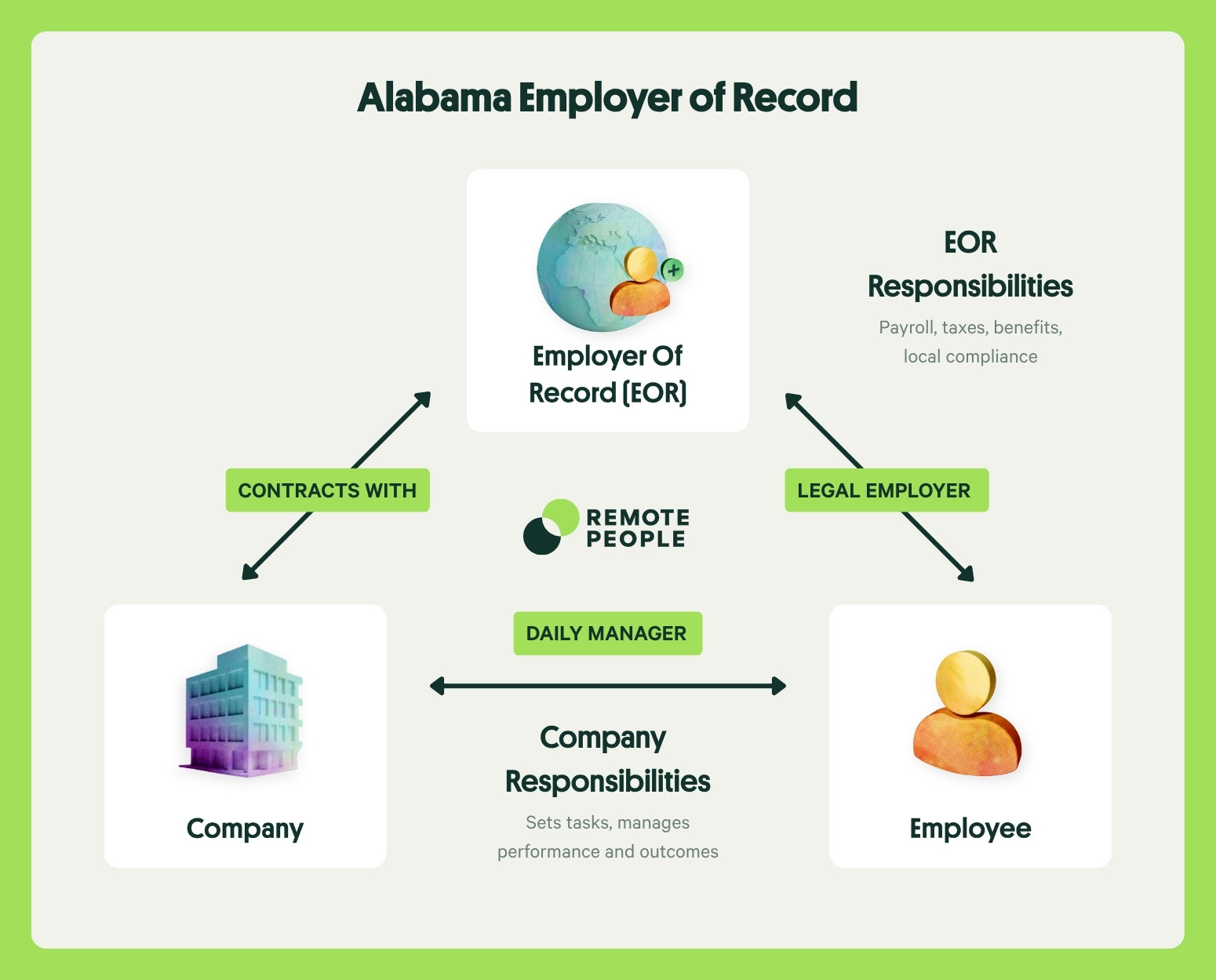
An Employer of Record (EOR) is your solution. In Alabama, an EOR functions as the legal employer for your workforce. What is an EOR can help explain how this employment model works in more detail.
- Establishes legal employment contracts that comply with Alabama state laws and federal regulations. Furthermore, they draft agreements that outline compensation, role expectations, and termination conditions. These contracts ensure every new hire has proper documentation from day one, protecting both the hiring company and the employee.
- Calculates and withholds payroll taxes for each pay period. They determine federal income tax, Social Security, Medicare, and Alabama’s flat 5.00% state income tax for every employee. Also, they process these deductions based on each worker’s W-4 elections and earnings. This ensures accurate withholdings that satisfy both the IRS and the Alabama Department of Revenue without requiring client oversight or intervention.
- Secures state registrations and identification numbers by registering with the Alabama Department of Revenue to obtain tax IDs required for payroll tax remittance. They also establish accounts with the Alabama Department of Labor for unemployment insurance purposes. It creates the necessary government infrastructure to operate as a compliant employer within the state’s regulatory system.
- Provides worker’s compensation coverage that meets Alabama’s mandatory requirements for employers with five or more employees. They secure policies through private carriers. Additionally, they manage premium payments, handle any claims that arise from workplace injuries, and ensure continuous compliance with state regulations.
- Files quarterly and annual tax reports with federal and state agencies, including Form 941 filings with the IRS and Alabama Form A-6 submissions to the state. Then, W-2 forms are generated and handed out to employees at year-end, and complete payroll records are maintained. Overall, they handle the full tax reporting cycle without requiring client involvement in administrative filing tasks.
What Is the Difference Between a Alabama Employer of Record and a Alabama PEO?
Knowing whether to deploy a PEO or an EOR is similar to choosing between a joint venture and a solo act. Both are good options, but they have important differences.
PEO
A Professional Employer Organization operates on a co-employment model, meaning your legally registered Alabama entity shares employer responsibilities with the PEO. They handle HR work so you can focus on the product. This includes payroll, benefits, and tax filings.
However, this requires you to already have a business entity in Alabama. You cannot use a PEO to enter Alabama if you are starting from scratch. Hence, it is a strategic partnership usually reserved for domestic companies looking to streamline, not to establish a foothold.
EOR
Do you lack an entity in Alabama? No problem, since the Employer of Record becomes the sole legal employer, assuming 100% of the employment liability. This is the vehicle of choice for international companies parachuting into the U.S. market or domestic firms leaping into Alabama without the drag of entity setup.
In conclusion, EORs are for the agile visionaries who want to test the Alabama market without signing a mortgage on a legal entity. In comparison, a PEO is for established businesses that need limited support to hire in Alabama.
Here is a table to help you compare PEO and EOR services at a glance:
Aspect |
PEO |
EOR |
|---|---|---|
| Legal Entity Required | Yes, your company must be registered in Alabama | No, EOR uses its own entity. |
| Employment Liability | Shared (co-employment) | Assumed entirely by EOR. |
| Best For | Domestic companies with existing Alabama presence. | International companies or out-of-state businesses testing market. |
| Compliance Responsibility | Your company retains ultimate liability. | EOR bears compliance risk. |
| Speed to Hire | Slower (requires entity first). | Immediate |
Start hiring with an Alabama EOR
Let us handle the complexities of hiring, compliance, and payroll in Alabama while you focus on growing your team.
- Hire employees in Alabama with an Alabama EOR
- No local entity is needed
- Pricing starts at USD 199 per employee
- RemotePeople can also help you find the best talent in Alabama
How Does a Alabama Employer of Record Work?
Compliant Employment Contract
It begins with a compliant employment contract drafted specifically for the Alabama workforce. The EOR creates legally binding agreements that adhere to state regulations and federal labor laws. That ensures offer letters and employment terms meet Alabama’s specific requirements.
These contracts establish clear role definitions, compensation structures, and termination conditions while protecting both the hiring company and the employee. By handling this foundational documentation, the EOR eliminates the risk of non-compliant agreements.
Otherwise, they could trigger future legal disputes or regulatory penalties. Hence, the contracts serve as the bedrock upon which the entire employment relationship stands.
Payroll Setup with Correct State Registrations
Once the contract is signed, the EOR handles payroll setup with the Alabama Department of Revenue. That’s by securing all necessary state registrations and tax identification numbers. They overcome the bureaucratic requirements to establish your company’s payroll presence without requiring you to form a legal entity.
This registration process ensures every paycheck processed carries the appropriate state authorizations, and every tax dollar withheld reaches the correct government accounts. Also, the EOR manages the paperwork, filings, and approvals needed to transform a foreign company into a recognized employer.
Tax Withholding and Remittance
The EOR then manages tax withholding and remittance for every pay cycle. This includes calculating federal deductions alongside Alabama’s flat 5.00% state income tax. They determine the precise amounts for Social Security and Medicare contributions based on current wage bases and rates. Each pay period, they remit these funds to the appropriate agencies by strict deadlines, maintaining detailed records of every transaction.
This systematic approach prevents the late fees, interest charges, and penalties that plague companies attempting to deal with multi-jurisdictional tax compliance alone.
Benefits Administration
Benefits administration falls to the EOR as they enroll your Alabama team in health insurance, retirement plans, and other voluntary programs. Leveraging their pooled buying power, they secure competitive rates and comprehensive coverage. That would cost significantly more for a standalone entity.
Furthermore, they manage open enrollment periods, handle life event changes, and process monthly premium payments to carriers. When employees have questions about their coverage or need to file claims, the EOR’s support team provides answers and assistance.
This arrangement gives your Alabama workforce the benefits package of an established corporation while you focus on business objectives.
Ongoing Compliance Management
Ongoing compliance management continues throughout the employment lifecycle. That’s as the EOR monitors changes in Alabama labor laws, unemployment tax rates, and federal mandates. Furthermore, they track legislative developments that could affect payroll practices, overtime calculations, or workers compensation requirements.
When laws change, they update internal processes automatically. This ensures your workforce remains compliant without requiring your attention. The EOR also:
- Maintains records for the required retention periods.
- Prepares for potential audits.
- Handles unemployment claims as they arise.
This continuous vigilance protects your company from the compliance surprises that disrupt operations and drain resources.
How Labor Laws Affect Hiring in Alabama?
Minimum Wage & Overtime
Alabama takes a streamlined approach to minimum wage by defaulting to the federal standard. The state has not established its own minimum wage law, so employers must follow the Fair Labor Standards Act rate of $7.25 per hour.
For tipped employees, the minimum cash wage sits at $2.13 per hour, provided tips bring the worker’s total earnings up to at least the $7.25 threshold.
Overtime calculations follow federal guidelines, so any hours worked beyond 40 in a single workweek require payment at one and a half times the employee’s regular rate. Also, Alabama does not impose daily overtime limits or unique state-specific overtime rules, making compliance straightforward for employers who understand federal requirements.
Income Tax
Alabama collects state income tax through a flat withholding rate that simplifies payroll calculations for employers. The state imposes a flat 5.00% tax on supplemental wages and bonuses, which provides predictability for payroll processing.
Furthermore, employers must register with the Alabama Department of Revenue to obtain the necessary tax identification numbers and withhold the appropriate amounts from each employee’s paycheck.
The withholding obligation applies to all wages paid to Alabama-based employees, and employers are responsible for remitting these taxes according to state filing schedules. This flat-rate structure eliminates the complexity of progressive brackets found in other states. Overall, it makes compliance more manageable for businesses operating within Alabama’s borders.
State Unemployment Insurance (SUI)
New employers entering Alabama enjoy a standard SUI rate of 2.70%, applied to the first $8,000 of each employee’s annual wages. This taxable wage base remains unchanged from previous years, offering consistency for payroll budgeting.
Established employers see rates ranging from 0.20% to 5.4% based on their experience rating and unemployment claim history. In addition to the base rate, employers pay a 0.06% employment security assessment.
Quarterly filings are required, and payments must reach the Alabama Department of Labor by established deadlines to avoid penalties. Understanding these rates helps employers accurately forecast the true cost of building an Alabama workforce.
Paid Leave
Alabama maintains a hands-off approach to paid leave, imposing no state mandates on private employers. There are no laws requiring paid sick leave, paid family leave, or vacation time accrual.
Employers retain complete discretion to design leave policies that suit their operational needs and company culture. The only leave protections available to Alabama workers come from federal law. Specifically, the Family and Medical Leave Act, which provides eligible employees with up to 12 weeks of job-protected leave for qualifying family and medical reasons.
This regulatory system gives businesses maximum flexibility in structuring time-off benefits while keeping compliance burdens minimal.
Workers' Compensation
Alabama law mandates workers compensation coverage for employers with five or more employees. This insurance protects both the business and its workforce by providing medical benefits and wage replacement. That’s for employees who suffer work-related injuries or illnesses.
Additionally, coverage must be secured through private insurance carriers, as Alabama does not operate a state fund. The system operates on a no-fault basis, meaning employees generally cannot sue their employers for negligence in exchange for guaranteed benefits.
Industries like manufacturing and construction, which dominate Alabama’s economy, face higher premiums due to increased risk profiles. Furthermore, employers must maintain continuous coverage and report any workplace injuries promptly to ensure compliance with state regulations.
Termination and Final Pay
The end of the employment relationship in Alabama is governed by a combination of at-will doctrine and practical payment guidelines. Therefore, an employer can terminate an employee at any time for any lawful reason, or no reason at all and without warning.
Likewise, an employee can walk out the door without cause. The exceptions include you cannot fire someone for discriminatory reasons (race, religion, gender) or in retaliation for filing a workers comp claim.
Final Paycheck
When it comes to the final paycheck, there is no specific statute dictating exactly when a terminated employee must receive their final wages. However, to avoid federal wage claim headaches, it is best practice to issue the final paycheck by the next regular payday.
Regarding accrued Paid Time Off (PTO), payout is not mandatory unless the employer has a written policy or contract promising to do so. Note that failing to pay wages on time invites wage penalties and legal action, making clarity in policy the best defense.
Payroll Taxes and Employer Cost in Alabama
The economics of hiring in Alabama are simple, but the costs add up beyond the base salary. Employers must budget for the mandatory extras that fund the social and labor safety nets.
The employer burden in Alabama is a blend of federal obligations and state requirements. Here is a snapshot of the financial architecture behind a payroll:
Category |
Cost |
|---|---|
| Federal Payroll Taxes (FICA) | Social Security (6.20% up to $184,500 wage base) and Medicare (1.45% on all wages). |
| State Income Tax Withholding | A flat 5.00% withheld from employee wages. |
| SUI Contributions | New employers pay 2.70% on the first $8,000 of wages. |
| Workers Compensation Premiums | Vary by industry classification. For example, high-risk roles (manufacturing) see higher rates than administrative staff. |
Example Cost Breakdown
Let’s assume a salaried executive earning $100,000 per year in Birmingham.
Cost Component |
Calculation |
Amount |
|---|---|---|
| Base Salary | Annual compensation | $100,000 |
| Social Security (Employer) | 6.20% of $184,500 wage base | $6,200 |
| Medicare (Employer) | 1.45% of total wages | $1,450 |
| SUI (New Employer) | 2.70% on first $8,000 | $216 |
| Workers Compensation (Estimate) | Industry-dependent | $150 |
| Total Employer Burden | Excluding benefits | $8,016 |
This estimated burden of around 8% represents the baseline compliance expense. Actual costs fluctuate based on industry risk classifications and specific benefits packages selected. However, you’ll find that the EOR structure absorbs these administrative complexities while providing transparent cost forecasting.
Employee Classification Rules in Alabama
Misclassifying a worker as an independent contractor rather than an employee is the kind of mistake that invites audits, back taxes, and legal problems. Alabama generally aligns with federal standards, primarily the IRS test, to determine classification.
This test examines the degree of control the business exerts over the worker. Does the company control how the work is done, or just the final result? If you dictate the schedule, provide the tools, and train the worker on your methods, they are likely to be an employee.
How an EOR Can Help Avoid Misclassification
Penalties for misclassification can include back taxes, interest, and fines for failing to provide unemployment insurance or workers comp coverage. This is where an EOR becomes your insurance policy.
By placing the worker on the EOR’s payroll, the classification exposure shifts. The EOR ensures the worker is properly documented as a W-2 employee, reducing the risk of a state or federal auditor questioning your workforce structure.
What Makes Hiring in Alabama Unique?
Hiring in Alabama is about tapping into a specific cultural and industrial vein. The workforce is deeply tied to the “Big Three” industries, which are automotive, aerospace, and bioscience. Additionally, the talent pool in Huntsville is skewed toward engineers and defense techs, while the I-20/59 corridor is rich with logistics and manufacturing expertise.
Furthermore, regulatory intensity is low compared to the coasts. There are fewer surprises, which allows for predictable budgeting. However, wage trends are shifting. As of 2026, the demand for specialized talent is driving wages up faster than the national average in those sectors.
Finally, workforce availability is high in urban centers, but rural areas present a challenge that requires creative sourcing.
What Are the Benefits of a Alabama Employer of Record?
Here are the essential benefits of engaging an Alabama Employer of Record:
- Eliminates entity registration requirements so you can hire Alabama talent immediately without forming a legal entity. That bypasses months of paperwork and legal fees that typically delay market entry. Your company engages the EOR and begins onboarding employees while competitors wait for government approvals.
- Assumes full legal employment liability for your Alabama workforce. This shields your company from direct exposure to wage claims, discrimination lawsuits, and termination disputes. The EOR absorbs compliance risks while your team focuses on business objectives rather than employment law navigation.
- Manages multi-jurisdictional tax compliance by handling federal payroll taxes alongside Alabama’s flat 5.00% state income tax. That ensures every dollar reaches the correct agency on time. The EOR also calculates SUI at 2.70% on the first $8,000 of wages and files all required quarterly reports.
- Secures workers compensation coverage that meets Alabama’s mandatory insurance requirements for employers with five or more employees. This protects your workforce from workplace injuries. Furthermore, the EOR manages premiums, handles any claims that arise, and ensures continuous compliance with state regulations governing employee protection.
- Provides instant market access to Alabama’s thriving automotive, aerospace, and manufacturing sectors. That’s without waiting for entity approval, allowing you to secure top engineers and logistics experts immediately. Your company retains daily operational control while the EOR handles the administrative burden behind the scenes.
What Are the Downsides of a Alabama EOR?
When using an EOR there is a service fee, typically a percentage of payroll or a flat monthly rate per employee. This can make it marginally more expensive than running payroll yourself—if you already have an in-house compliance team.
Additionally, you have less direct control over certain administrative payroll details. Some founders feel a slight disconnect when they cannot physically sign the paycheck.
However, frame this against the alternative, which is that the cost of a misclassification lawsuit or a state tax audit far exceeds any EOR fee. The downside is paying for a safety net that catches the risks you don’t see coming.
How to Choose a Alabama Employer of Record?
Here’s a table so you can figure out the best way to spot a trustworthy EOR in Alabama:
Transparent Pricing
Clear upfront fees with no hidden charges for setup or termination. Prevents budget surprises and maintains trust in the partnership.
Direct EOR Structure
A provider that serves as the actual legal employer, not a broker. Eliminates liability gaps and ensures direct compliance accountability.
US Multi-State Expertise
Proven experience across multiple states, including Alabama regulations. Enables seamless expansion beyond Alabama without requalifying vendors.
Dedicated Support
Named contact in US time zones, not an anonymous ticket system. Guarantees a human response when payroll emergencies arise.
Compliance Track Record
Verifiable audit history, proper insurance, and client references. Your compliance safety depends entirely on their track record.
Engage an Alabama Employer of Record with RemotePeople
When you choose RemotePeople as your Alabama Employer of Record, you gain more than a service provider. We understand that hiring in Alabama’s automotive corridors and aerospace hubs demands a local understanding.
Our infrastructure absorbs compliance complexities so your leadership team can focus on building. No compliance surprises, just efficient growth. Partner with RemotePeople and experience the confidence that comes from having true employment experts in your corner.
Do you want to hire the best Employer of Record in Alabama? Then contact us to get started with a proposal.
Employer of Record in
Employer of Record in
Employer of Record in
Employer of Record in
Employer of Record in
Employer of Record in
Employer of Record in
Employer of Record in