
 Recruit
Employer of Record in Oklahoma
-
 Drew Donnelly
- Published
- September 22, 2026
Oklahoma’s employment law includes state unemployment insurance, workers’ compensation, and wage and hour rules, and an Oklahoma EOR handles payroll, taxes, and full compliance with no local entity needed.
Hire in Oklahoma — book a free 30-minute demo
Tell us what you need. You'll get a tailored, transparent proposal within 24 hours, plus a free call to walk through it.
Tell us about your company
So we can match you with a specialist who knows your market — and unlock volume pricing tiers.
* All fields are required.
Where and when are you hiring?
Tell us the geography and timing and we'll quote each country line by line, with onboarding timelines.
* All fields are required.
Help us beat your current setup
We'll benchmark your current deal and send a line-by-line proposal in 24 hours — showing exactly where we cut cost, time, or risk. After you submit, you can book a call to walk through it together.
* All fields are required.
Thanks! Your proposal is on its way.
Expect a tailored, line-by-line proposal in your inbox within 24 hours. In the meantime…
Want to walk through it together?
Book a free 30-minute call with one of our specialists. We'll explain every line, answer your questions, and tailor the proposal further if you need.
No obligation. Pick a time that works for you.








- Hire in Oklahoma — book a free 30-minute demo
- Tell us about your company
- Where and when are you hiring?
- Help us beat your current setup
- Thanks! Your proposal is on its way.
- Oklahoma Employer of Record
- What Is the Difference Between an Oklahoma Employer of Record and an Oklahoma PEO?
- How Does an Oklahoma Employer of Record Work?
- How Do Labor Laws Affect Hiring in Oklahoma?
- Payroll Taxes and Employer Cost in Oklahoma
- Employee Classification Rules in Oklahoma
- Termination and Final Pay Laws in Oklahoma
- What Makes Hiring in Oklahoma Unique?
- What Are the Benefits of an Oklahoma Employer of Record?
- What Are the Downsides of an Oklahoma Employer of Record?
- How to Choose an Oklahoma Employer of Record?
- Engage RemotePeople as Your Oklahoma EOR
- Related EOR Destinations

Let RemotePeople handle payroll, compliance, and HR admin worldwide so you can focus on building your team.
Key Takeaways
- Oklahoma is a lower-regulation state with a business-friendly environment compared to coastal markets.
- The state minimum wage aligns with the federal rate and has not increased in recent years.
- Oklahoma does not mandate paid leave at the state level, reducing employer compliance requirements.
- Employer payroll costs typically range between 9% and 14% above base salary.
- An Oklahoma Employer of Record simplifies multi-state hiring and reduces administrative overhead while maintaining compliance with federal and state obligations.
Oklahoma offers a relatively straightforward environment for hiring compared to more heavily regulated US states. The state economy is supported by energy, agriculture, aerospace, manufacturing, and logistics, with Oklahoma City and Tulsa serving as the primary economic hubs.
From a workforce perspective, Oklahoma provides access to a stable labour pool with lower average wage expectations than many other US regions. This can make it an attractive option for companies looking to expand operations while managing employment costs.
Tennessee’s central location within the United States also makes it attractive for companies with distributed teams or logistics operations. Its infrastructure and connectivity support businesses operating across multiple states, which can influence hiring strategies, particularly for roles that require coordination across regions.
The regulatory landscape is considered employer-friendly. Oklahoma follows federal labour standards closely and does not impose many additional state-level requirements. There is no state-mandated paid leave, and minimum wage requirements remain aligned with federal law.
However, employers must still comply with federal employment regulations, including wage and hour laws, tax withholding, and worker classification rules. While the state itself is less complex, managing US payroll and compliance as a whole can still be challenging, particularly for international companies.
For organisations expanding into Oklahoma, an Employer of Record can simplify hiring while ensuring compliance with both state and federal obligations.
Oklahoma Employer of Record
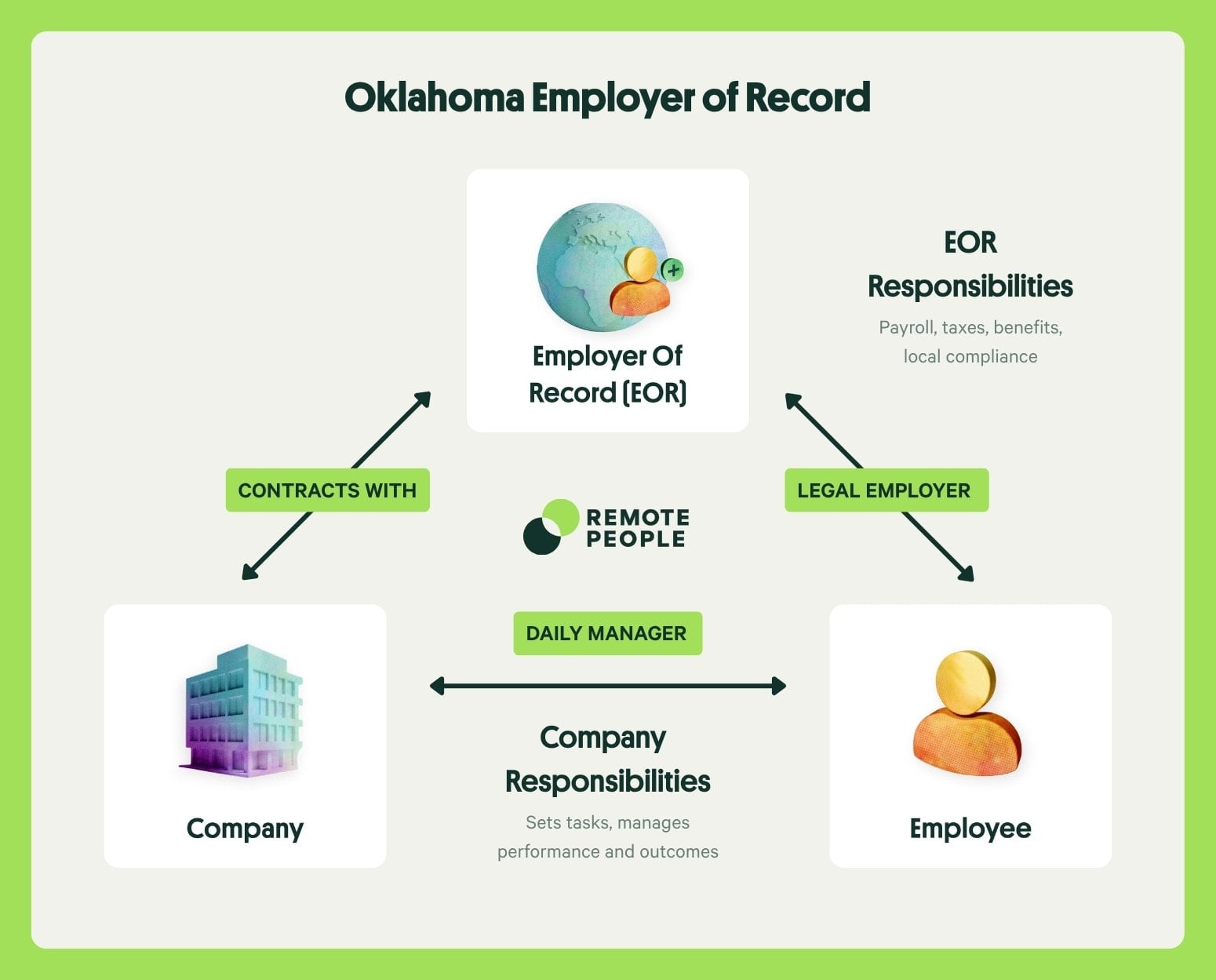
An Oklahoma Employer of Record is a third-party provider that legally employs workers on your behalf within the state.
What is an EOR can help explain how this employment model works in more detail.
The EOR becomes responsible for payroll processing, federal and state tax withholding, unemployment insurance registration, workers’ compensation coverage, and compliance with labour laws. This includes managing filings with the Internal Revenue Service and the Oklahoma Employment Security Commission.
Your company retains control over the employee’s daily responsibilities, performance management, and role within the organisation.
The main advantage in Oklahoma is operational simplicity. While the state itself is less regulated, US employment as a whole involves multiple layers of compliance. An EOR centralises these requirements and reduces the need for internal HR infrastructure.
Using an EOR also removes the requirement to establish a legal entity in Oklahoma before hiring employees. An EOR can also support onboarding processes by ensuring that new hires are properly registered for payroll, tax withholding, and any required documentation from day one. This helps avoid delays or compliance issues during the early stages of employment.
What Is the Difference Between an Oklahoma Employer of Record and an Oklahoma PEO?
Although both EORs and PEOs provide HR and payroll support, they operate under different legal structures.
Oklahoma PEO
A Professional Employer Organization works under a co-employment model. Your company must already have a registered entity in Oklahoma. The PEO shares employment responsibilities with your business, meaning liability is divided between both parties. PEOs are typically used by US-based companies with an existing local presence.
Oklahoma EOR
An Employer of Record acts as the legal employer. Your company does not need to establish a local entity, and the EOR assumes primary responsibility for compliance.
For companies entering Oklahoma for the first time, particularly international businesses, the EOR model reduces setup time and avoids entity formation requirements.
In a lower-regulation state like Oklahoma, the key benefit is administrative efficiency rather than navigating complex state laws.
Start hiring with an Oklahoma EOR
Let us handle the complexities of hiring, compliance, and payroll in Oklahoma while you focus on growing your team.
- Hire employees in Oklahoma with an Oklahoma EOR
- No local entity is needed
- Pricing starts at USD 199 per employee
- RemotePeople can also help you find the best talent in Oklahoma
How Does an Oklahoma Employer of Record Work?
An Oklahoma EOR arrangement generally follows a structured process:
Employment Agreement
The EOR prepares an employment agreement that aligns with US federal standards and Oklahoma’s at-will employment framework.
Payroll Registration
The EOR registers with relevant authorities, including federal tax agencies and the Oklahoma Employment Security Commission for unemployment insurance.
Payroll Processing
The EOR calculates wages and applies deductions for federal income tax, Social Security, Medicare, and state-level obligations where applicable.
Oklahoma does not impose additional local income taxes, which simplifies payroll compared to some other states.
Benefits and Insurance
The EOR arranges required coverage such as workers’ compensation and may facilitate optional employee benefits like health insurance.
Ongoing Compliance
The EOR monitors regulatory changes and ensures continued compliance with federal and state employment laws.
How Do Labor Laws Affect Hiring in Oklahoma?
Oklahoma’s labour laws are relatively straightforward and largely follow federal standards.
Minimum Wage & Overtime
The state minimum wage is aligned with the federal minimum wage of $7.25 per hour. Overtime is governed by the Fair Labor Standards Act, requiring payment of 1.5 times the regular rate for hours worked over 40 in a workweek. There are no additional state-specific overtime rules beyond federal requirements.
State Income Tax
Oklahoma applies a progressive state income tax system, with rates ranging from approximately 0.25% to 4.75%. Employers are responsible for withholding and remitting state income tax to the Oklahoma Tax Commission.
State Unemployment Insurance (SUI)
Employers must contribute to the Oklahoma unemployment insurance system. New employer rates typically range from 1.5% to 2.5%, applied to a wage base of approximately $25,000. Rates may change over time depending on claims history and regulatory updates.
Workers' Compensation
Workers’ compensation coverage is mandatory in Oklahoma. Policies are typically obtained through private insurers, and premiums vary based on job classification and payroll size. Failure to maintain coverage can result in penalties and legal exposure.
Payroll Taxes and Employer Cost in Oklahoma
Employers in Oklahoma must account for several payroll-related costs beyond base salary. These include Social Security and Medicare contributions, federal unemployment tax, state unemployment insurance, and workers’ compensation premiums.
Below is a sample breakdown with a $100,000 salary.
| Category | Details / Amount |
|---|---|
| Base Salary | $100,000 |
| FICA (Employer Share) | $7,650 |
| FUTA | Up to $420 |
| SUI (State Unemployment) | $375 – $625 depending on rate |
| Workers’ Compensation | $800 – $1,200 depending on industry classification |
| Total Additional Employment Cost | $9,000 – $14,000 |
| Total Annual Employer Cost | $109,000 – $114,000 |
Compared to higher-regulation states, Oklahoma presents a lower overall employer cost structure.
Employee Classification Rules in Oklahoma
Oklahoma follows federal IRS guidelines for determining employee versus independent contractor status.
Classification is based on factors such as:
- Level of control over work
- Financial relationship
- Nature of the working arrangement
Misclassification can lead to back taxes, penalties, and legal claims.
While Oklahoma does not impose significantly stricter rules than federal standards, compliance remains important, particularly for companies operating across multiple states.
An EOR ensures proper classification from the outset, reducing exposure to risk.
Termination and Final Pay Laws in Oklahoma
Oklahoma operates under an at-will employment framework. This means employers can terminate employment at any time, provided the reason is lawful. Final wages must typically be paid by the next regular payday.
Unlike some states, Oklahoma does not require payout of unused vacation unless specified in company policy. Employers must ensure compliance with wage payment rules to avoid disputes or penalties.
What Makes Hiring in Oklahoma Unique?
Oklahoma combines a relatively low regulatory burden with a cost-effective labour market.
Key characteristics include:
- Lower wage expectations
- No state-mandated paid leave
- Simplified compliance compared to coastal states
- Strong presence in energy and industrial sectors
This makes Oklahoma attractive for companies looking to scale operations efficiently within the United States.
However, the broader US regulatory framework still applies, which can introduce complexity for international employers.
What Are the Benefits of an Oklahoma Employer of Record?
- No need to establish a local entity
- Faster hiring and onboarding
- Centralised management of US payroll and compliance
- Reduced administrative workload
- Scalable hiring across multiple states
What Are the Downsides of an Oklahoma Employer of Record?
- Service fees increase total employment cost
- Less direct control over payroll systems
- Potential limitations in customising benefits
- Even in a lower-regulation state, companies should weigh cost against operational efficiency.
How to Choose an Oklahoma Employer of Record?
When selecting a provider, focus on:
- Transparent pricing
- Direct EOR model rather than intermediaries
- Strong understanding of US payroll and compliance
- Reliable customer support
- Proven experience managing multi-state employment
- Because US compliance operates at both federal and state levels, provider expertise is critical even in simpler states like Oklahoma.
Engage RemotePeople as Your Oklahoma EOR
RemotePeople provides Employer of Record services across Oklahoma. We manage payroll processing, tax withholding, unemployment insurance contributions, and workers’ compensation coverage while you maintain full control over your team’s day-to-day work.
Our service also includes support with employment contracts, onboarding, and ongoing HR administration, helping you bring new hires into your organisation quickly and efficiently. We ensure that all employment practices align with Oklahoma state laws and federal requirements, reducing the risk of compliance issues as your team grows.
If you are expanding into Oklahoma and want to hire without setting up a legal entity, RemotePeople offers a structured and compliant solution. This allows you to enter the market faster while avoiding the time and cost associated with entity setup. Contact us to learn more about how we can support your hiring plans in Oklahoma.