
 Recruit
Employer of Record (EOR) in Dubai
-
 Drew Donnelly
- Published
- September 21, 2026
An Employer of Record (EOR) in Dubai is a UAE-licensed company that legally employs staff on your behalf, sponsoring residence visas, running Wage Protection System (WPS) payroll, calculating end-of-service gratuity, and managing MOHRE compliance. A Dubai EOR lets you hire UAE talent in 5–10 days without opening a mainland or free zone entity.
Hire in Dubai — book a free 30-minute demo
Tell us what you need. You'll get a tailored, transparent proposal within 24 hours, plus a free call to walk through it.
Tell us about your company
So we can match you with a specialist who knows your market — and unlock volume pricing tiers.
* All fields are required.
Where and when are you hiring?
Tell us the geography and timing and we'll quote each country line by line, with onboarding timelines.
* All fields are required.
Help us beat your current setup
We'll benchmark your current deal and send a line-by-line proposal in 24 hours — showing exactly where we cut cost, time, or risk. After you submit, you can book a call to walk through it together.
* All fields are required.
Thanks! Your proposal is on its way.
Expect a tailored, line-by-line proposal in your inbox within 24 hours. In the meantime…
Want to walk through it together?
Book a free 30-minute call with one of our specialists. We'll explain every line, answer your questions, and tailor the proposal further if you need.
No obligation. Pick a time that works for you.








- Hire in Dubai — book a free 30-minute demo
- Tell us about your company
- Where and when are you hiring?
- Help us beat your current setup
- Thanks! Your proposal is on its way.
- How an Employer of Record Works in Dubai
- Employment Laws and Regulations in Dubai
- Work Permits and Visas in Dubai
- Payroll, Taxes, and Social Security in Dubai
- Cost of Hiring Through an EOR in Dubai
- Benefits of Using an EOR in Dubai
- Termination and Offboarding in Dubai
- EOR vs. Other Hiring Models in Dubai
- Public Holidays in Dubai
- How to Get Started with an EOR in Dubai
- Where companies hiring in Dubai expand next
- Frequently Asked Questions
- Related EOR Destinations
Start hiring in Dubai
Let RemotePeople handle payroll, compliance, and HR admin worldwide so you can focus on building your team.

Dubai is one of the easiest places in the Middle East to hire talent on paper: no personal income tax, a bilingual workforce drawn from more than 200 nationalities, and a government that publishes employment rules in English and Arabic. The friction comes from the operational side. Every private-sector hire in Dubai mainland sits under Federal Decree-Law No. 33 of 2021, the Wages Protection System, the Ministry of Human Resources and Emiratisation (MOHRE), mandatory health insurance under Dubai Health Insurance Law No. 11 of 2013, and a work permit and residence visa chain run by GDRFA. An employer of record in Dubai removes that friction by acting as the legal employer on your behalf, running payroll through WPS, obtaining work permits through MOHRE, enrolling employees in a compliant Dubai health plan, and tracking end-of-service gratuity accruals, while your employees report directly to you. See how RemotePeople’s EOR solution works across 150+ countries.
How an Employer of Record Works in Dubai
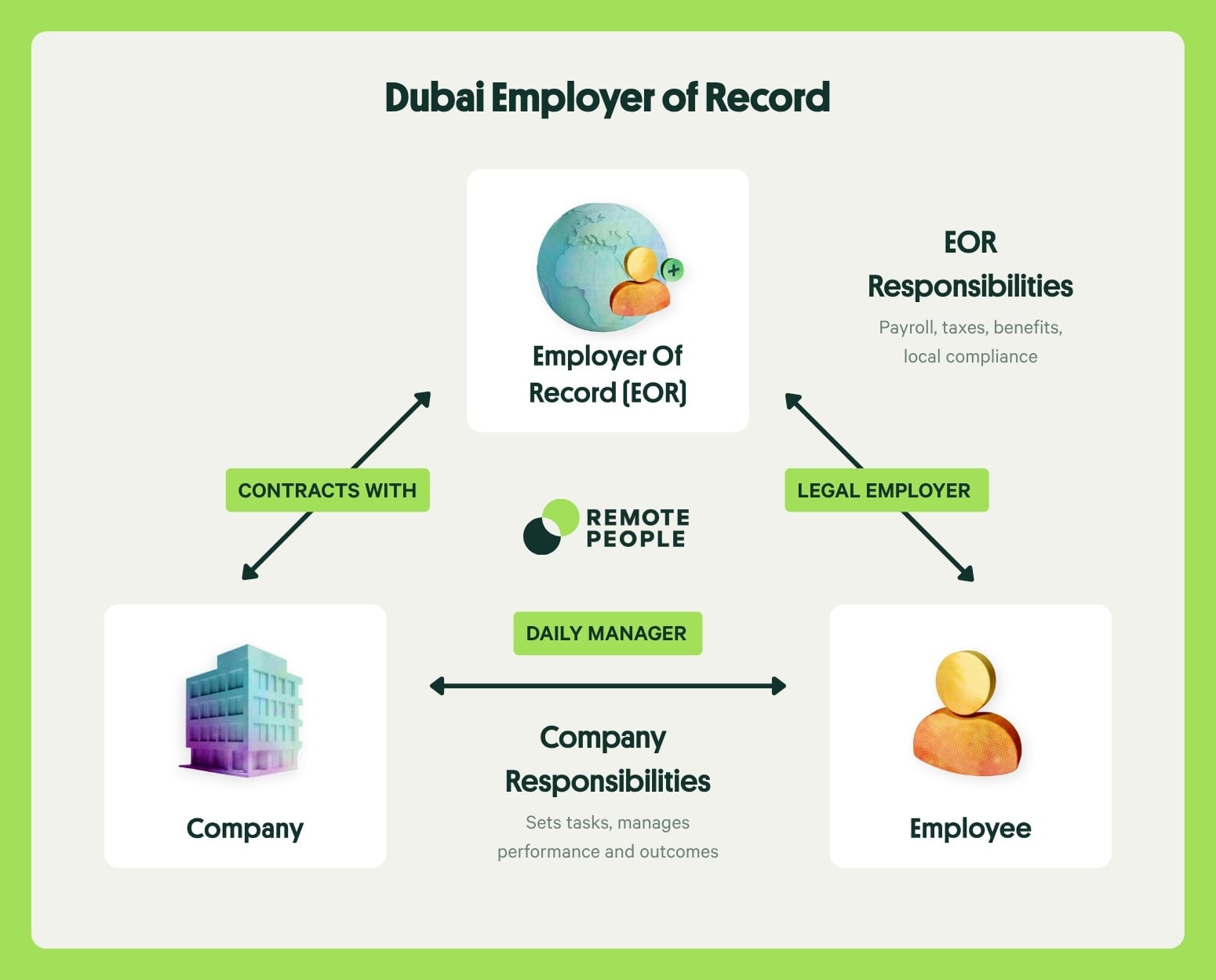
If you’d like to learn more about how Employer of Record (EOR) services work, read our What Is an Employer of Record (EOR)? guide for a complete overview of the model, its benefits, and when to use it.
If you’re comparing providers, our Best Employer of Record (EOR) Providers guide reviews the leading platforms to help you choose the right solution for your business.
Who Uses an EOR in Dubai?
EOR services in Dubai are typically used by companies that want a compliant hiring solution without setting up a trade license, leasing office space in a free zone, and funding capital requirements. Common scenarios include testing the Middle East market with one or two hires before opening an entity, employing a regional manager relocating to Dubai, retaining an employee who has relocated from Europe or Asia, and building a small Arabic-speaking support team to serve GCC customers. Teams hiring regionally often pair Dubai with an EOR in Saudi Arabia or a Bahrain EOR to cover the wider Gulf market under a single vendor.
The EOR model is also a practical fit for businesses hiring between one and fifteen employees in Dubai where entity setup would be slow and expensive, for companies that need to onboard in two or three weeks rather than three or four months, and for any organization that wants to reduce the compliance burden of running its own payroll, WPS file, MOHRE sponsorship, and Dubai health insurance policy.
Typical Onboarding Timeline
Most EOR providers can onboard an employee in Dubai within 2 to 3 weeks when the candidate is already a UAE resident and holds a valid Emirates ID. For expatriates arriving from abroad, the work permit and residence visa chain adds roughly 2 to 3 more weeks because the entry permit, medical fitness check, biometrics, and residence stamping must happen in sequence. The typical sequence runs like this:
- First, the client signs the EOR service agreement and shares employee details, job description, and compensation package (1-2 days).
- Second, the EOR drafts the MOHRE-compliant employment contract in English and Arabic and sends it for e-signature (2-3 days).
- Third, the EOR files the MOHRE work permit, and for expatriates initiates the entry permit and medical fitness booking through GDRFA (5-10 working days).
- Fourth, the employee completes the medical fitness test, Emirates ID biometrics, and residence visa stamping, then receives the labour card (5-10 working days for overseas hires).
- Fifth, payroll is configured in WPS, health insurance is activated with a Dubai-compliant plan, and the employee starts work on day one.
Background checks, attestation of foreign qualifications, and role-specific approvals from sector regulators can extend this timeline. A realistic planning assumption is 2 weeks for hires already living in the UAE and 4 to 6 weeks for candidates arriving from abroad.
Hire in Dubai
Zero income tax, a world-class business hub, and access to global talent make Dubai a standout destination for building international teams.
We handle MOHRE contracts, WPS payroll, work permits, and full UAE labour law compliance.
No local entity needed. Your team can start in days.
Employment Laws and Regulations in Dubai
Employment Contracts
Employment in Dubai’s private sector is governed by Federal Decree-Law No. 33 of 2021 on the Regulation of Labour Relations, which took effect on 2 February 2022 and is administered by the Ministry of Human Resources and Emiratisation (MOHRE). All mainland Dubai contracts must be in writing, use the MOHRE standard template, and be registered electronically through MOHRE’s online portal before the employee starts work.
Since the 2022 reforms, all private-sector contracts are fixed-term. The initial cap was 3 years, but Cabinet Resolution No. 1 of 2022 and later amendments removed the explicit ceiling, allowing fixed-term contracts to be renewed by mutual agreement (UAE Legislation Portal). Arabic is the official language of record and prevails in any dispute, so bilingual Arabic-English contracts are standard. Part-time, temporary, flexible, and job-sharing arrangements are now explicitly recognised under Article 7.
Working Hours and Overtime
The standard private-sector workweek in Dubai is 48 hours, normally arranged as 8 hours per day over 6 days (Article 17 of Federal Decree-Law No. 33 of 2021). Working hours are reduced by 2 hours per day during the holy month of Ramadan for all employees, not just Muslims, with no reduction in pay. Friday afternoon is the weekly rest day for most of the private sector, and the federal government moved to a Saturday and Sunday weekend in 2022, with many private employers following suit.
Overtime is paid at 125% of the basic hourly wage for additional hours worked on a normal day and 150% for hours worked between 10 pm and 4 am or on the weekly rest day (Article 19). Total overtime cannot normally exceed 2 extra hours per day, and daily working time, including overtime, cannot exceed 12 hours. Senior managers and some supervisory roles are exempt from overtime rules under implementing regulations.
The table below maps every premium pay rate defined in the UAE Labour Law to the hours it applies to, the daily cap, and the practical edge cases that catch out payroll teams. It covers weekday overtime, night-shift work, weekly rest day assignments, public holidays, and the Ramadan reduction, with every rate taken directly from Articles 17 to 20 of Federal Decree-Law No. 33 of 2021.
Dubai overtime and premium pay rates · Per Federal Decree-Law No. 33 of 2021 |
|||
Hour Type |
Rate Multiplier |
Daily or Weekly Cap |
Notes |
|---|---|---|---|
Weekday overtime, beyond 8 hours per day | 125% of basic hourly wage | 2 extra hours per day maximum | Applies to hours beyond the standard 8-hour day or 48-hour week, per Article 19 |
Night shift overtime, 10 pm to 4 am | 150% of basic hourly wage | 2 extra hours per day maximum | Shift workers on regular rotating rosters are exempt from the 50% night uplift |
Weekly rest day work | 150% of basic wage, or substitute rest day plus 50% uplift | Not capped by hours | Employee may elect a compensatory rest day in place of straight premium pay |
Public holiday work | 150% of basic wage, or substitute rest day plus 50% uplift | Not capped by hours | Same election as weekly rest day, per the public holiday provisions of the law |
Ramadan working hours | Standard basic rate, no premium | 6 hours per day, reduced from 8 | Reduction applies to all private-sector staff without salary deduction, per Article 17(4) |
Minimum Wage
Dubai has no statutory minimum wage for expatriate private-sector employees. Article 27 of Federal Decree-Law No. 33 of 2021 reserves the power for the Cabinet to set a minimum wage, but no Cabinet resolution has been issued as of 2026 (PwC Worldwide Tax Summaries: UAE). Emirati nationals have separate salary support thresholds under the NAFIS Emiratisation programme, but these apply to hiring incentives rather than a general wage floor. In practice, employers benchmark wages against MOHRE wage categories for visa purposes and the average salary in Dubai, with professional roles in Dubai typically starting well above the ranges used for entry-level visa categories.
Probation Period
The probation period in Dubai is capped at 6 months from the employee’s start date under Article 9 of Federal Decree-Law No. 33 of 2021, and it cannot be extended. During probation, the employer may terminate with 14 days’ written notice and the employee may resign with 14 days’ notice to leave the UAE or 30 days’ notice to join another UAE employer. If the employee moves to a new UAE employer during probation, the new employer reimburses the recruitment costs paid by the original sponsor unless otherwise agreed.
Leave Entitlements
Dubai’s statutory leave framework sits inside Articles 29 to 33 of Federal Decree-Law No. 33 of 2021 and covers annual, sick, maternity, parental, and several special leave categories. The rules apply to all private-sector employees on mainland Dubai contracts regardless of nationality.
Annual Leave
Employees in Dubai are entitled to 30 calendar days of paid annual leave after 1 year of continuous service, with employees between 6 and 12 months of service accruing 2 working days per month (Article 29). Leave pay is calculated on the employee’s basic salary plus the housing allowance if one is paid, and unused leave is paid out on termination. Employers can require up to half the leave balance to be taken within the leave year, and carryover is permitted only for the remainder.
Sick Leave
The annual sick leave entitlement under Article 31 is 90 days in total after the probation period, split as 15 days on full pay, the next 30 days on half pay, and the remaining 45 days unpaid, subject to a certified medical report. The employer is not required to pay sick leave during probation, and sick leave caused by wilful misconduct is not payable. The entitlement resets each calendar year.
Maternity Leave
Female employees in Dubai receive 60 days of maternity leave under Article 30, of which the first 45 days are paid at full salary and the following 15 days at half salary (UAE Government maternity leave guide). Up to 45 additional days of unpaid leave are available for medical complications certified by a doctor. Mothers of a child with a disability or serious illness receive an extra 30 days of fully paid leave, renewable once. Dismissal on grounds of pregnancy or maternity is prohibited, and nursing breaks of up to 1 hour per day apply for 6 months after the return to work.
Paternity Leave
Parents in Dubai are entitled to 5 working days of fully paid parental leave under Article 32, which can be taken at any time during the first 6 months after the child’s birth. The entitlement applies to both mothers and fathers, making the UAE one of the first Gulf countries to introduce a statutory parental leave benefit for fathers.
Other Statutory Leave
Federal Decree-Law No. 33 of 2021 also provides for several additional paid and unpaid leave categories for private-sector employees:
- Bereavement leave: 5 days on the death of a spouse and 3 days on the death of a parent, child, sibling, grandparent, or grandchild
- Study leave: 10 working days per year for UAE-citizen employees enrolled at an accredited UAE institution, after at least 2 years of service
- Hajj leave: up to 30 days of unpaid leave once during the period of service for Muslim employees
- Sabbatical leave: national service or study sabbaticals as set out in implementing regulations
- Public holiday leave: paid leave on all official UAE public holidays announced by the Cabinet
Dubai statutory leave entitlements · Per Federal Decree-Law No. 33 of 2021 | ||
Leave Type | Duration | Eligibility and Notes |
|---|---|---|
Annual leave | 30 days / year | Full entitlement after 1 year of service. 2 days per month between 6 and 12 months. Unused days paid out on exit. |
Sick leave | 90 days / year | 15 days full pay, 30 days half pay, 45 days unpaid. Available after probation. Medical certificate required. |
Maternity leave | 60 days (45 full + 15 half) | All female employees. Dismissal for pregnancy is prohibited. Up to 45 extra unpaid days for complications. |
Parental leave | 5 working days | Mothers and fathers. Fully paid. Taken within 6 months of the child’s birth. |
Bereavement leave | 3 to 5 days | 5 days for a spouse, 3 days for close relatives. Paid. |
Study leave | 10 days / year | UAE nationals enrolled at an accredited UAE institution with 2+ years of service. |
Hajj leave | Up to 30 days | Once in career. Unpaid. Muslim employees. |
Public holidays | 12 days / year (2026) | Fully paid for all employees per the Cabinet announcement. |
Source: WIPO Lex Federal Decree-Law 33 and UAE Government portal | ||
Statutory Employee Benefits
Mandatory employee benefits in Dubai revolve around health insurance, end-of-service gratuity, and a newer unemployment insurance scheme rather than the social security model common in Europe. Every employee working in Dubai must be covered by a health insurance policy that meets the Insurance System for Advancing Healthcare in Dubai standards, and the employer pays the full premium for the employee (ISAHD). Dependants must also be covered, typically by the sponsor of their residence visa.
End-of-service gratuity is the UAE equivalent of a pension for expatriates. Under Articles 51 and 52 of Federal Decree-Law No. 33 of 2021, an employee who completes at least 1 year of service receives 21 days of basic wage per year for the first 5 years and 30 days per year thereafter, capped at 2 years of basic wage in total. Pension contributions under the General Pension and Social Security Authority rules apply only to UAE and GCC nationals. Since October 2022, all employees also contribute to the federal Involuntary Loss of Employment (ILOE) insurance scheme, a low-cost policy that pays 60% of basic salary for up to 3 months if the employee is terminated for reasons other than resignation or disciplinary dismissal (ILOE scheme portal).
Recent Regulatory Updates 2026
The most material changes affecting Dubai hiring in 2025 and 2026 relate to Emiratisation, health insurance, and unemployment insurance. MOHRE continued its phased Emiratisation quota under Cabinet Resolution No. 18 of 2022, requiring private-sector establishments with 50 or more employees to increase the share of Emirati staff in skilled jobs by 2 percentage points per year, reaching a 10% target by the end of 2026 (MOHRE news centre). Non-compliant employers face fines of AED 96,000 per unfilled Emirati position per year.
Dubai health insurance rules tightened from 1 January 2025, when the ISAHD regime fully replaced the legacy Dubai Health Authority scheme. Employers must now provide coverage that includes emergency care, inpatient, outpatient, maternity, and prescription drugs, with penalties of AED 500 per employee per month of non-coverage. The ILOE scheme also reached full enforcement in 2024, with employees who failed to enrol by the original deadline subject to an AED 400 fine plus backdated subscription fees (ILOE scheme).
Work Permits and Visas in Dubai
Work Permit Requirements
Who Needs a Work Permit
All non-UAE nationals working in Dubai mainland need a MOHRE work permit and a residence visa sponsored by the employer before they can start employment. GCC nationals (Saudi Arabia, Kuwait, Bahrain, Oman, Qatar) are exempt from the work permit requirement under the Gulf Cooperation Council common market framework but still need a labour card and must be registered with MOHRE. UAE and GCC citizens employed in the private sector are also enrolled with the General Pension and Social Security Authority.
Eligibility and Required Documents
To qualify, the employer must hold a valid MOHRE establishment registration, be within its Emiratisation quota if applicable, and have no outstanding fines. The standard document bundle for the employee includes a passport valid for at least 6 months, a passport-sized photograph on a white background, a MOHRE-format employment contract, a medical fitness certificate from a government-approved clinic, and attested academic or professional qualifications for skilled categories. Emirates ID biometrics are captured in person at a GDRFA or ICP service centre.
Processing Time and Validity
MOHRE typically issues the initial work permit within 5 to 10 working days once the contract and documents are complete. For candidates outside the UAE, the entry permit, medical fitness test, biometrics, and residence visa stamping run in sequence and usually take another 2 to 3 weeks (UAE Government work permits guide). Standard employment visas are valid for 2 years, and the residence visa carries the same duration. Work permits for senior roles, self-sponsored professionals, and Golden Visa holders follow separate tracks.
Renewal Process
Renewals must be filed before the existing work permit and residence visa expire, and the employee can continue working during the renewal window provided the application is in progress. Renewal requires an updated medical fitness check, a new Emirates ID, and payment of MOHRE and GDRFA fees. Late renewals incur fines of AED 50 per day after the grace period and can block future applications for the establishment.
Common Visa Types for Foreign Workers
Dubai offers several residence and work permit categories, each designed for a different type of employment arrangement and duration. The table below summarises the five pathways most commonly used when hiring foreign talent through an employer of record, so you can quickly match each candidate to the right sponsor, validity period, and use case.
Dubai work visa types for foreign workers · 2026 |
||||
Visa Type |
Duration |
Best For |
Leads to Long-Term Residency? |
Processing Time |
|---|---|---|---|---|
Standard Employment Visa | 2 years, renewable | Foreign hires with a UAE employer on a standard work permit sponsored by the company | No, tied to employer; ends with employment | 2 to 4 weeks |
Green Visa for Work | 5 years, renewable | Skilled professionals, freelancers, and self-employed workers seeking self-sponsored residency | Yes, self-sponsored with family sponsorship allowed | 4 to 6 weeks |
Golden Visa | 10 years, renewable | Investors, entrepreneurs, scientists, outstanding specialists, doctors, and digital creators | Yes, long-term residency with no 6-month absence cancellation rule | 6 to 8 weeks |
Freelance Permit | 1 to 3 years, renewable | Self-employed consultants in approved free-zone or MOHRE-listed activities | No direct path, but renewable annually without employer sponsorship | 2 to 3 weeks for the licence plus visa processing |
Mission Work Permit | 90 days, renewable once for 90 more | Short-term project workers and technical specialists on time-bound assignments | No, strictly project-bound | 1 to 2 weeks |
Family dependents brought in under a sponsored employee’s residence visa have residence rights only and need their own work permit if they later take up employment.
How an EOR Handles Work Permits
An employer of record in Dubai acts as the legal sponsor for MOHRE purposes, which means the EOR files the work permit application, pays MOHRE and GDRFA fees, and assumes compliance obligations toward the labour, immigration, and health authorities. The EOR handles establishment registration, Emiratisation quota reporting, contract drafting, health insurance enrolment, and Emirates ID coordination. The employee still needs to provide personal documents, attend biometrics at a service centre in person, and complete the medical fitness check.
Because the overseas visa chain adds 2 to 3 weeks beyond a local hire, expatriate onboarding runs closer to 4 to 6 weeks end to end rather than the 2 to 3 weeks quoted for candidates already in the UAE. The EOR can only sponsor work permits within the employment relationship it controls, so clients who need Emiratisation credit recorded against their own establishment still require a locally licensed entity.
Payroll, Taxes, and Social Security in Dubai
Employer Contributions
Employer payroll costs in Dubai differ sharply depending on whether the employee is an expatriate or a UAE or GCC national. Expatriates, who make up the vast majority of EOR hires, generate no social security contributions at all, leaving health insurance and end-of-service gratuity as the main loaded-cost items. UAE and GCC nationals trigger a pension contribution to the General Pension and Social Security Authority that is significantly higher in the Emirate of Abu Dhabi than elsewhere. For a deeper breakdown, see our Dubai payroll tax guide.
Dubai employer social security contributions · 2026 rates | ||
Contribution | Rate | Notes |
|---|---|---|
GPSSA pension (UAE nationals) | 12.5% | Employer share for Emirati employees in Dubai. Applied to the pensionable salary, capped at AED 50,000 per month. |
GPSSA pension (expatriates) | 0% | Expatriates do not participate in the UAE pension scheme. End-of-service gratuity replaces the pension benefit. |
End-of-service gratuity accrual | ~5.83% (first 5 yrs) | 21 days of basic wage per year of service for the first 5 years, then 30 days per year, capped at 2 years of wages. |
Mandatory health insurance | ~2 to 4% | Employer pays the full premium for each employee. Annual cost typically AED 800 to AED 6,000 per person depending on plan tier. |
Personal income tax withholding | 0% | The UAE has no personal income tax, so there is no wage withholding. |
Total employer cost (expatriate) | ~8 to 10% | Gratuity accrual plus health insurance. No income tax or pension for expatriates. |
Source: PwC UAE Other Taxes and GPSSA pension authority | ||
Employee Contributions
Employee payroll deductions in Dubai are minimal for expatriates because the UAE levies no personal income tax and no wage-based social security on non-nationals. The only deduction for expatriate staff is the Involuntary Loss of Employment subscription, a symbolic amount designed to fund a federal unemployment insurance pool. UAE nationals pay a 5% pension contribution to GPSSA in addition to the ILOE fee.
Dubai employee payroll deductions · 2026 monthly withholdings | ||
Deduction | Rate | Notes |
|---|---|---|
Personal income tax | 0% | The UAE imposes no personal income tax on salary, wages, or allowances. |
GPSSA pension (UAE nationals) | 5% | Emirati employees only. Deducted from pensionable salary up to the AED 50,000 monthly cap. |
GPSSA pension (expatriates) | 0% | Expatriate employees are not enrolled in the pension scheme. |
ILOE subscription (salary under AED 16,000) | $1.36 / month | AED 5 per month flat fee for the basic category. |
ILOE subscription (salary over AED 16,000) | $2.72 / month | AED 10 per month flat fee for the premium category. |
Total expatriate deduction | Flat $1 to $3 / month | No income tax and no pension contribution. ILOE is the only wage-related deduction. |
Source: PwC UAE Personal Income Tax and ILOE unemployment scheme | ||
Income Tax
The UAE does not levy a personal income tax on employment income for residents or non-residents. Wages, allowances, bonuses, and most other employment benefits are paid gross, and there is no requirement to file a personal tax return. Corporate tax was introduced in June 2023 at 9% on business profits above AED 375,000, but it is paid by the employer entity and does not create any wage withholding (PwC UAE Personal Income Tax).
Dubai income tax brackets · 2026 | |
Annual Taxable Income (USD) | Tax Calculation |
|---|---|
Any amount | 0% personal income tax on all employment income for residents and non-residents of the UAE. |
Payroll Cycle
Private-sector wages in Dubai are paid monthly and must be transferred through the Wages Protection System operated by the UAE Central Bank, which routes salaries from the employer’s UAE bank account to the employee’s account at an approved financial institution. MOHRE requires wages to reach the employee within 15 days of the end of the wage period, and delays of more than 17 days are treated as non-compliance and can block new work permits for the establishment. Salaries are normally paid in AED, although the contract can specify a different currency.
Pay slips are required for every payroll run and must show gross salary, allowances, deductions, and net pay. MOHRE can audit WPS data at any time and cross-checks it against the electronic contract and Emiratisation records.
13th Month Salary and Bonus Pay
A 13th month salary is not mandatory in the UAE and is not a standard market practice in Dubai. Instead, the end-of-service gratuity serves as a form of deferred statutory bonus, paid in a lump sum when the employment ends. Many multinational employers in Dubai pay a discretionary performance bonus at the end of the fiscal year, and some industries such as professional services use target-linked bonuses, but there is no statutory requirement under Federal Decree-Law No. 33 of 2021. Ramadan allowances, housing allowances, and transport allowances are also discretionary and typically included in the contract as fixed monthly amounts rather than annual payments.
Cost of Hiring Through an EOR in Dubai
EOR Service Fees
EOR service fees in Dubai typically fall between $300 and $600 per employee per month, billed in USD regardless of the employee’s local pay package. The fee covers employment contract drafting in the MOHRE format, WPS payroll processing, end-of-service gratuity tracking, ILOE enrolment, health insurance administration under the Dubai rules, and work permit sponsorship through MOHRE and GDRFA. Some providers bundle Emirates ID coordination, visa stamping, and offboarding into the base fee, while others charge separately for visa renewals or off-cycle payroll runs.
Total Employment Cost Breakdown
The all-in cost of employing someone in Dubai goes well beyond gross salary. The table below walks through a realistic cost build-up for a typical hire, layering mandatory employer social contributions, statutory benefits, and payroll taxes on top of base pay so finance teams can budget accurately before an offer goes out.
Dubai employer cost example · $4,000/month gross · 2026 | ||
Employer Cost | Amount (USD) | % of Gross |
|---|---|---|
Gross salary (expatriate hire) | $4,000 | 100% |
End-of-service gratuity accrual | $233 | 5.83% |
Mandatory health insurance | $120 | 3.00% |
Work permit and visa amortization | $55 | 1.38% |
Personal income tax | $0 | 0.00% |
EOR service fee | $400 | 10.00% |
Total monthly cost | $4,808 | 120.20% |
Source: PwC UAE Other Taxes and MOHRE laws and regulations | ||
At a $4,000 monthly gross salary, the total employer cost for an expatriate hire in Dubai runs about 20% above gross, driven mainly by the EOR service fee and end-of-service gratuity accrual. Without the EOR fee, the native statutory loaded cost is only around 10%, one of the lowest in the Middle East because there is no personal income tax and no social security for expatriates. All USD amounts are approximate conversions at $1 = AED 3.67 (April 2026 rate, AED pegged).
Ready to hire in Dubai? RemotePeople handles employment contracts, WPS payroll, MOHRE work permits, Dubai health insurance, and full UAE Labour Law compliance. No local entity needed.
Benefits of Using an EOR in Dubai
The main reason companies use an EOR in Dubai is speed. A trade license, office lease, MOHRE establishment code, and bank account would normally take 6 to 12 weeks to set up and tie up significant capital, while an EOR can onboard an employee in as little as 2 weeks for a local hire. The EOR carries the legal weight of being the registered employer, so the client does not have to register with MOHRE, file Emiratisation reports, or maintain a Dubai bank account with operational balances for payroll.
Compliance is the second big reason. The UAE labour framework has moved quickly since 2022, with new rules on fixed-term contracts, unemployment insurance, Emiratisation quotas, and the Dubai health insurance regime all landing within a few years. A specialist EOR tracks those changes, updates contracts and payroll configurations in real time, and absorbs the fines and back-payments that a direct employer would otherwise face. That compliance layer becomes even more valuable when scaling across the Gulf, because the EOR can run consistent processes across Dubai, Abu Dhabi, Saudi Arabia, and Bahrain.
Cost predictability rounds out the case. Instead of capital-intensive entity setup and unpredictable legal fees, the client pays a flat EOR service fee plus a transparent breakdown of statutory costs. The client can scale the team up or down without unwinding a legal entity, and the EOR’s local expertise typically delivers faster dispute resolution, cleaner terminations, and a better employee experience through a tested payroll and benefits stack.
Termination and Offboarding in Dubai
Notice Periods
Notice periods in Dubai are set by the employment contract but must fall between 30 and 90 days under Article 43 of Federal Decree-Law No. 33 of 2021. The same period applies to both parties unless the contract specifies a longer period for the employer. During the notice period, the employee is entitled to continue working and to receive full pay, including any allowances. Either party can request pay in lieu of notice, in which case the employee receives full wages for the unworked notice period.
The table below breaks down the statutory notice regime in Dubai by employment stage, because the UAE Labour Law uses a two-track system rather than position-level tiers. Post-probation notice is set by the contract within a 30 to 90 day range under Article 43 of Federal Decree-Law No. 33 of 2021, while probation-period notice is set by Article 9 and varies depending on who initiates the separation.
Dubai statutory notice periods by employment stage · Per Federal Decree-Law No. 33 of 2021 |
|||
Employment Stage |
Notice Period |
During Probation |
Notes |
|---|---|---|---|
Post-probation, employer-initiated termination | 30 days minimum, up to 90 days maximum by contract | Not applicable | Notice must be in writing; notice period may be reduced by mutual agreement under Article 43 |
Post-probation, employee resignation | 30 days minimum, up to 90 days maximum by contract | Not applicable | Must equal the employer notice; employee entitled to one unpaid job-search day per week during notice |
Probation, employer-initiated termination | Not applicable | 14 days written notice | Probation cannot exceed 6 months under Article 9 of the UAE Labour Law |
Probation, employee resigning to leave the UAE | Not applicable | 14 days written notice | Reduced notice applies when the worker intends to exit the country within 3 months |
Probation, employee joining another UAE employer | Not applicable | 30 days written notice | New UAE employer must reimburse recruitment costs to the previous employer, per Article 9 |
Severance Pay
End-of-service gratuity in Dubai follows Article 51 of Federal Decree-Law No. 33 of 2021: a worker who completes at least one full year of continuous service earns 21 days of basic salary for every year of the first five years, and 30 days of basic salary for every year beyond that, with the total gratuity capped at two years of wages. Allowances for housing, transport, utilities, or furniture are excluded from the calculation, and final settlement must be paid within 14 days of termination.
Years of Service | Severance Amount | Base Salary | Notes |
|---|---|---|---|
Less than 1 year | Not eligible | Not applicable | Article 51 requires at least one full year of continuous service. |
1 year | 21 days | Last basic salary | Housing, transport, and other allowances excluded from the calculation. |
3 years | 63 days (21 × 3) | Last basic salary | 21 days per year applies for every year of the first five. |
5 years | 105 days (21 × 5) | Last basic salary | Marks the ceiling of the 21-day tier. |
10 years | 255 days (21 × 5 + 30 × 5) | Last basic salary | 30 days per year after year five; total gratuity capped at two years of wages. |
Calculation Method
End-of-service gratuity is the statutory severance payment for expatriate employees in Dubai. Under Articles 51 and 52 of Federal Decree-Law No. 33 of 2021, an employee who has completed at least 1 year of continuous service receives 21 days of basic wage for each of the first 5 years of service and 30 days of basic wage for each subsequent year. The calculation uses the basic wage only, excluding housing, transport, and other allowances, and the total cannot exceed 2 years of wages regardless of tenure.
Caps and Exceptions
The 2-year wage cap is the main ceiling on gratuity. Employees dismissed for serious misconduct under Article 44, such as disclosing company secrets or assault at work, forfeit their right to gratuity. Employees who resign before completing 1 year of service receive no gratuity, and those who resign during their first 5 years historically received a reduced amount, although the 2022 reforms harmonised the calculation regardless of resignation versus dismissal. Fixed-term contracts that are terminated early by the employer without just cause trigger compensation of at least 3 months’ gross wage or the balance of the contract, whichever is shorter (UAE Government end-of-service guide).
Grounds for Termination
The UAE Labour Law distinguishes between termination with notice, termination for cause, and arbitrary dismissal. With-notice termination requires a valid business reason and the agreed notice period. For-cause termination under Article 44 allows immediate dismissal in narrowly defined cases such as fraud, assault, or repeated violation of safety rules. Arbitrary dismissal, defined in Article 47 as termination unrelated to work performance or conduct, entitles the employee to compensation of up to 3 months’ gross wage in addition to gratuity and notice pay. Dismissal on grounds of pregnancy, filing a legitimate complaint, or trade union activity is void.
EOR vs. Other Hiring Models in Dubai
EOR vs. Setting Up a Local Entity
Choosing between an Employer of Record and setting up your own legal entity in Dubai comes down to timeline, upfront cost, ongoing administrative burden, and how quickly you can scale up or wind down. The table below lays out both paths side by side across setup time, cost, compliance risk, and flexibility so you can match the right model to the size and duration of your Dubai hiring plan.
Dubai EOR vs local entity comparison · Setup time, cost, risk and best-fit | ||
Comparison | Employer of Record | Own Dubai Entity |
|---|---|---|
Setup time | 2 to 3 weeks | 6 to 12 weeks for mainland or free zone |
Upfront cost | $0 | $8,000 to $25,000 including license, office, and capital |
Ongoing cost | $300 to $600 per employee per month | $15,000 to $40,000 per year maintenance |
Local partner required | No (EOR is the local entity) | No for most mainland activities since 2021, yes for a few restricted sectors |
Social insurance registration | Handled by EOR | You manage GPSSA and ILOE filings |
Payroll and tax filing | Handled by EOR via WPS | You manage WPS, MOHRE, and corporate tax filings |
Best for team size | 1 to 15 employees | 15+ employees |
Scale down or exit | Easy, no entity to unwind | Costly, license cancellation and liquidation required |
Government contracts | Not eligible | Eligible, requires local entity and classification |
The entity route makes sense when the Dubai team is large enough to amortise the $8,000 to $25,000 setup cost and the recurring compliance bill, usually when the headcount is 15 or more. It is also the only way to bid on government contracts, win Emiratisation incentives in the employer’s own name, or benefit from free zone tax holidays on export activities. For teams below that threshold, the math rarely works.
An EOR is the faster and cheaper route for one to fifteen hires. It removes the upfront license and capital cost, absorbs MOHRE and Emiratisation reporting, and lets the client redirect legal and operational time toward product and revenue. The tradeoff is less direct control over HR policies and no eligibility for government tenders, which for most expanding businesses is a reasonable price to pay for speed.
EOR vs. Hiring Independent Contractors
Classifying a Dubai-based worker as an independent contractor rather than an employee can expose you to back-taxes, unpaid social contributions, and reclassification penalties if the working relationship looks like employment in practice. The table below contrasts EOR employment with contractor engagement across legal relationship, tax and benefits treatment, IP ownership, and misclassification risk so you can pick the right model role by role.
Dubai EOR vs independent contractors · Compliance, cost, and risk | ||
Comparison | EOR (Full-Time Employee) | Independent Contractor |
|---|---|---|
Legal relationship | Employee of the EOR under a MOHRE contract | Self-employed, no employment relationship |
Compliance risk | Low, EOR ensures UAE Labour Law compliance | Higher, misclassification risk if the relationship resembles employment |
Payroll and tax | EOR handles WPS payments, gratuity, and ILOE | Contractor invoices directly and manages their own licensing |
Benefits and leave | Statutory leave, gratuity, and health insurance | No entitlement to employee benefits |
IP protection | Stronger, employment contract assigns IP by default | Weaker, requires explicit IP assignment clause |
Termination | Subject to UAE notice periods and gratuity | Contract can be ended per the agreement terms |
Best for | Long-term, core team roles | Short-term projects and specialised tasks |
Cost structure | Salary plus statutory costs plus EOR fee | Contractor invoice, typically higher gross, lower total loaded cost |
Independent contractor engagements in Dubai are only appropriate in some cases, typically short-term project work, specialised consulting, and genuinely autonomous roles where the contractor holds a valid UAE trade license or freelance permit. The UAE does not have a formal misclassification test equivalent to the common-law tests used in the UK or US, but MOHRE and the Ministry of Finance both review worker arrangements for substance when disputes arise.
If an authority concludes that a contractor is effectively an employee, the client can face back-payment of end-of-service gratuity, annual leave, and health insurance contributions, together with fines for operating without a MOHRE contract. For core, long-term roles, hiring through an EOR is the cleaner route. RemotePeople’s Dubai contractor solution can handle compliant contractor payments when a genuine freelance arrangement is the right fit.
EOR vs. PEO (Professional Employer Organization)
EORs and PEOs both simplify international hiring, but only an EOR becomes the legal employer of record in Dubai — a critical distinction when you don’t have a local entity of your own. The table below maps the practical differences across legal employer status, entity requirement, liability allocation, and scope of coverage.
Dubai EOR vs PEO comparison · Legal employer, liability, and setup | ||
Comparison | Employer of Record (EOR) | PEO |
|---|---|---|
Legal employer | EOR is the legal employer registered with MOHRE | Client remains the legal employer (co-employment model) |
Local entity required | No, the EOR is the local entity | Yes, a licensed Dubai entity is required |
Best for | Companies without a Dubai entity | Companies with an existing Dubai entity needing HR support |
Compliance liability | EOR assumes MOHRE and labour law liability | Shared liability between client and PEO |
Setup time | 2 to 3 weeks | Depends on the client’s entity setup |
Control over HR policies | EOR manages within UAE law framework | More direct control, PEO advises |
Typical use case | Market entry, small remote teams, testing Dubai | Established Dubai operations outsourcing HR |
The UAE does not have a formal PEO legal framework. MOHRE recognises only one legal employer per employment contract, so arrangements marketed as PEOs in Dubai are typically HR outsourcing services layered on top of the client’s own MOHRE establishment rather than a true co-employment model. A provider cannot legally share employment liability with a client in the way a US PEO would.
In practice, the choice between an EOR and a Dubai HR outsourcing partner comes down to whether the client already holds a MOHRE establishment code. If not, an EOR is the only compliant way to hire without setting up an entity. If the client already has an entity, a local HR outsourcing service can handle payroll, WPS, and Emiratisation reporting without changing the legal employment relationship. See Dubai PEO services for clients that already hold their own trade license.
Public Holidays in Dubai
Dubai observes a defined set of official public holidays on which most private-sector employers must give staff a paid day off (UAE Government official public holidays). The table below lists the statutory holidays employers need to build into payroll calendars and leave planning for the year, along with the date rule for each.
Dubai public holidays · 2026 calendar year | ||
Date | Holiday | Type |
|---|---|---|
1 January 2026 | New Year’s Day | Fixed |
19 March 2026 | Eid al-Fitr Eve | Islamic (moon sighting) |
20 March 2026 | Eid al-Fitr | Islamic (moon sighting) |
21 March 2026 | Eid al-Fitr Holiday | Islamic (moon sighting) |
22 March 2026 | Eid al-Fitr Holiday | Islamic (moon sighting) |
26 May 2026 | Arafat Day | Islamic (moon sighting) |
27 May 2026 | Eid al-Adha | Islamic (moon sighting) |
28 May 2026 | Eid al-Adha Holiday | Islamic (moon sighting) |
17 June 2026 | Islamic New Year (Al-Hijra) | Islamic (moon sighting) |
1 December 2026 | Commemoration Day | Fixed |
2 December 2026 | UAE National Day | Fixed |
3 December 2026 | UAE National Day Holiday | Fixed |
Dubai recognises around 12 paid public holidays each year under Cabinet announcements, depending on the number of Eid days confirmed by moon sighting. Employees required to work on a public holiday are entitled to a replacement day off or payment at 150% of the basic wage under Article 19. Payroll schedules for March and May are typically adjusted around Eid al-Fitr and Eid al-Adha, since banks and government offices close for the full run of Eid days.
How to Get Started with an EOR in Dubai
Engaging an employer of record in Dubai is a structured five-step process that normally runs in parallel with candidate selection so the onboarding timeline stays tight:
- First, scope the role, the target start date, and the compensation package, and decide whether the hire will be a local UAE resident or a candidate relocating from abroad.
- Second, sign the EOR service agreement with RemotePeople and share employee details, ID documents, and any attested qualifications needed for MOHRE.
- Third, the EOR drafts the MOHRE-compliant employment contract in English and Arabic, registers it with MOHRE, and initiates the work permit and entry permit where the candidate is arriving from abroad.
- Fourth, the employee completes medical fitness testing, Emirates ID biometrics, and residence visa stamping, while the EOR configures payroll through WPS and activates a Dubai-compliant health insurance policy.
- Fifth, the employee starts work on day one, fully payrolled, insured, and compliant with UAE labour law, while the EOR handles monthly payroll, gratuity accruals, and government filings on your behalf.
Contact our team to set up your first Dubai hire. RemotePeople handles MOHRE contracts, WPS payroll, work permits, health insurance, and end-of-service gratuity, so you can focus on building the team rather than navigating UAE paperwork.
Where companies hiring in Dubai expand next
Companies hiring in Dubai commonly expand across the GCC, where harmonized residency rules and aligned payroll practices make regional coverage straightforward. Teams frequently add Bahrain for GCC-aligned residency and payroll practices; hiring in the United Arab Emirates often follows for the parent jurisdiction’s framework extending to this market; an EOR partner in Saudi Arabia is a common next step, offering harmonized GCC labor rules and talent mobility; and Qatar rounds out the regional footprint with shared GCC employment frameworks.
Frequently Asked Questions
Beyond the gross salary, the main statutory costs in Dubai are end-of-service gratuity accrual (around 5.83% of basic wage for the first 5 years) and mandatory health insurance (typically $80 to $150 per employee per month). You will pay an EOR service fee of $300 to $600 per employee per month on top of that. Because the UAE has no personal income tax and no social security for expatriates, the total loaded cost is usually only 15% to 22% above gross, which is one of the lowest in the Gulf.
For a candidate already living in the UAE with a valid Emirates ID, an EOR can onboard in 2 to 3 weeks. For a candidate relocating from abroad, the work permit, entry permit, medical fitness test, Emirates ID biometrics, and residence visa stamping add another 2 to 3 weeks, so the realistic end-to-end timeline is 4 to 6 weeks.
The employment contract assigns IP to the client company (you), not the EOR. The EOR makes sure the MOHRE-registered contract contains proper IP assignment language so all work product, code, designs, and inventions flow directly to your business. The EOR is the legal employer for compliance purposes only.
No. The UAE imposes no personal income tax on employment income, and expatriates do not contribute to the UAE pension scheme. The only statutory wage-related deduction for expatriates is the Involuntary Loss of Employment insurance subscription of AED 5 or AED 10 per month, depending on salary band. End-of-service gratuity is a lump sum paid at the end of the contract instead of ongoing pension contributions.
Yes. An employer of record registered with MOHRE can sponsor standard 2-year employment visas and residence permits through GDRFA. The EOR files the work permit, pays the government fees, and arranges medical fitness and Emirates ID appointments. The employee still needs to provide personal documents, attend biometrics in person, and complete the medical fitness test.
Yes. RemotePeople offers a Dubai contractor solution that handles compliant payments, invoicing, and classification checks for independent professionals with a valid UAE freelance permit or trade license. For core, long-term roles, we recommend hiring through the EOR to avoid misclassification risk. The RemotePeople contractor service is the cleaner route when the relationship is genuinely project-based.
Probation in Dubai is capped at 6 months and cannot be extended. During probation, the employer can terminate with 14 days of written notice and the employee can resign with 14 days of notice to leave the UAE or 30 days to join another UAE employer. If the employee joins another UAE employer during probation, the new employer reimburses the original sponsor's recruitment costs unless agreed otherwise.
Yes. Under Dubai Health Insurance Law No. 11 of 2013 and the Insurance System for Advancing Healthcare in Dubai regime effective from 2025, employers must provide a health insurance plan that covers emergency, inpatient, outpatient, maternity, and prescription care for every employee. Non-compliance attracts a fine of AED 500 per employee per month and can block residence visa renewals. A compliant EOR bundles a certified health plan into its service.
Employer of Record in
Employer of Record in
Employer of Record in
Employer of Record in
Employer of Record in
Employer of Record in
Employer of Record in
Employer of Record in