
 Recruit
Employer of Record (EOR) in Eswatini
-
 Drew Donnelly
- Published
- September 21, 2026
Hire employees in Eswatini without setting up a local entity. RemotePeople handles payroll, contracts, tax compliance, and benefits, so you can build your Eswatini team in days, not months.
Hire in Eswatini — book a free 30-minute demo
Tell us what you need. You'll get a tailored, transparent proposal within 24 hours, plus a free call to walk through it.
Tell us about your company
So we can match you with a specialist who knows your market — and unlock volume pricing tiers.
* All fields are required.
Where and when are you hiring?
Tell us the geography and timing and we'll quote each country line by line, with onboarding timelines.
* All fields are required.
Help us beat your current setup
We'll benchmark your current deal and send a line-by-line proposal in 24 hours — showing exactly where we cut cost, time, or risk. After you submit, you can book a call to walk through it together.
* All fields are required.
Thanks! Your proposal is on its way.
Expect a tailored, line-by-line proposal in your inbox within 24 hours. In the meantime…
Want to walk through it together?
Book a free 30-minute call with one of our specialists. We'll explain every line, answer your questions, and tailor the proposal further if you need.
No obligation. Pick a time that works for you.








- Hire in Eswatini — book a free 30-minute demo
- Tell us about your company
- Where and when are you hiring?
- Help us beat your current setup
- Thanks! Your proposal is on its way.
- How an Employer of Record Works in Eswatini
- Employment Laws and Regulations in Eswatini
- Work Permits and Visas in Eswatini
- Payroll, Taxes, and Social Security in Eswatini
- Cost of Hiring Through an EOR in Eswatini
- Benefits of Using an EOR in Eswatini
- Termination and Offboarding in Eswatini
- EOR vs. Other Hiring Models in Eswatini
- Public Holidays in Eswatini
- How to Get Started with an EOR in Eswatini
- Frequently Asked Questions
- Related EOR Destinations

Start hiring in Eswatini
Let RemotePeople handle payroll, compliance, and HR admin worldwide so you can focus on building your team.

Eswatini, a small Southern African kingdom nestled between South Africa and Mozambique, offers a stable business environment, SACU membership, and an English-speaking workforce trained under common-law principles. For companies looking to hire employees in Eswatini, the hurdles begin immediately. Company registration, ENPF social security accounts, tax registration with the Eswatini Revenue Service, and local directors can take months to establish.
An employer of record in Eswatini removes that setup entirely by acting as the legal employer on paper while your team works for you day to day. The EOR runs payroll in Lilangeni, withholds PAYE under the Income Tax Act, administers leave under the Employment Act of 1980, and takes on compliance liability so you can focus on the work.
How an Employer of Record Works in Eswatini
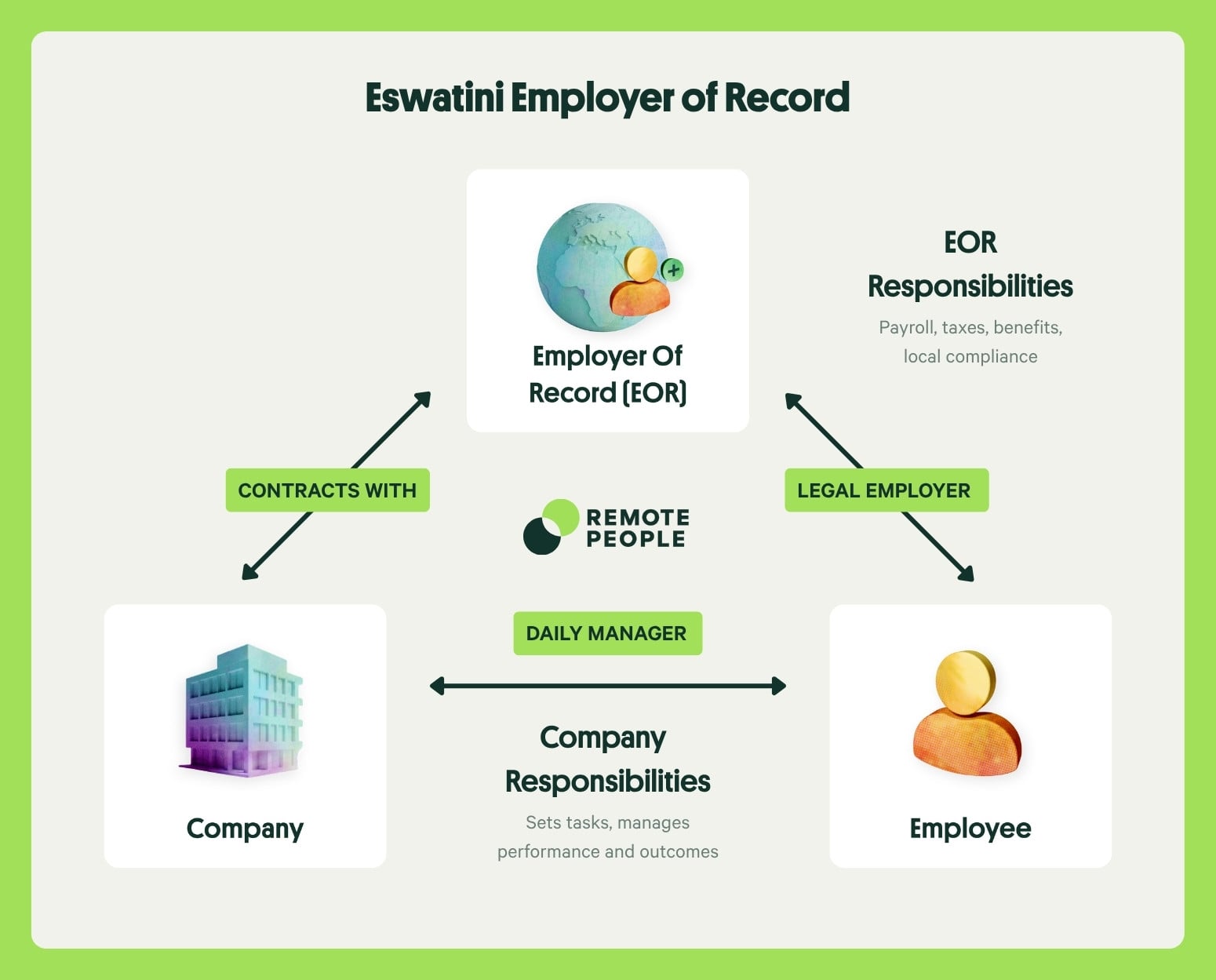
If you’d like to learn more about how Employer of Record (EOR) services work, read our What Is an Employer of Record (EOR)? guide for a complete overview of the model, its benefits, and when to use it.
If you’re comparing providers, our Best Employer of Record (EOR) Providers guide reviews the leading platforms to help you choose the right solution for your business.
Who Uses an EOR in Eswatini?
Any business that wants to hire in Eswatini without incorporating a local company benefits from an EOR. The model is built for teams that need speed and compliance without the cost of setting up a private company, opening ENPF and tax accounts, and running local HR.
Typical situations where an EOR makes sense include testing the Eswatini market with one or two hires before committing to a full entity, building a small team of 1 to 15 employees where incorporation is not yet cost-effective, onboarding quickly in weeks rather than the three to six months it takes to set up a local company, employing foreign nationals who need work permit sponsorship tied to an Eswatini-registered employer, and reducing exposure to labour disputes, wrongful dismissal claims, and PAYE penalties.
Typical Onboarding Timeline
Most EOR providers can onboard an Eswatini-based employee in 1 to 2 weeks. The sequence below reflects a local hire with no work permit required; a foreign hire adds 4 to 8 weeks for immigration processing.
- First, sign the EOR service agreement and share the employee’s full name, national ID, bank details, and offer terms (1 to 2 days).
- Second, the EOR drafts a compliant employment contract in English and sends it to the employee for signature (2 to 3 days).
- Third, ENPF registration and tax registration are arranged in parallel (3 to 5 days).
- Fourth, payroll is configured in Lilangeni, and voluntary benefits such as private medical aid are enrolled (2 to 3 days).
- Fifth, the employee starts work under the client’s day-to-day direction (1 day).
Work permit applications, credentials verification of foreign candidates, and background checks are the most common reasons the timeline stretches beyond two weeks.
Hire in Eswatini today
Competitive labour costs, a straightforward employment framework, access to regional markets through SACU and SADC, and a skilled workforce make Eswatini an attractive destination for international hiring.
We handle employment contracts, payroll, tax withholding, and full Eswatini compliance under the Employment Act and other applicable labour laws.
No local entity needed. Your team can start in days.
Employment Laws and Regulations in Eswatini
Employment Contracts
The Employment Act of 1980, supplemented by the Wages Act of 1964, is the principal labour statute in Eswatini. The Ministry of Labour and Social Security oversees enforcement, with the Commissioner of Labour handling disputes and inspections.
Written contracts are required for any employment expected to last more than six months, and they must be in English. The contract must specify the position, gross salary in Lilangeni, working hours, leave entitlements, probation period, notice period, and termination procedure.
Contracts can be for an unspecified period (indefinite) or for a fixed term tied to a specific task or project. Verbal contracts are still recognised for shorter or casual engagements, but they leave both sides exposed in a dispute.
Working Hours and Overtime
The standard workweek in Eswatini is 48 hours, typically arranged as 8 hours a day over 6 days or 9 hours a day over 5 days. Employees are entitled to at least 24 consecutive hours of rest per week, usually on Sunday. Overtime is paid at 150% of the normal hourly rate on weekdays and 200% on rest days and public holidays, and overtime work requires employee consent.
Overtime and premium pay rates in Eswatini are governed by the Employment Act 1980 and by sector-specific Wages Regulation Orders gazetted by the Ministry of Labour and Social Security. The table below summarises the premium multipliers typically applied by employers of record in Eswatini as of 2026.
Eswatini overtime and premium pay rates · Per Employment Act 1980 | |||
Hour Type | Rate Multiplier | Weekly or Daily Cap | Notes |
|---|---|---|---|
Standard workweek | Base rate (1.0x) | 48 hours per week | Typically 8 hours daily over 6 days, or 9 hours daily over 5 days, per the Employment Act 1980. |
Weekday overtime | 1.5x normal hourly rate | Beyond 48 hours per week | Applies to work outside the standard workweek on regular workdays. Employee consent is required. |
Rest day / Sunday work | 2.0x normal hourly rate | No statutory daily cap | Employees are entitled to at least 24 consecutive hours of rest each week, usually on Sunday. |
Public holiday work | 2.0x normal hourly rate | No statutory daily cap | Applies to the 12 gazetted public holidays recognised under the Public Holidays Act. |
Night work (11pm to 6am) | 1.5x normal hourly rate | No fixed statutory cap | Sector-specific rates may apply under the relevant Wages Regulation Order. |
Minimum Wage
Eswatini does not have a single statutory minimum wage but instead uses sector-specific Wages Regulation Orders set by the Wages Council and gazetted by the Minister of Labour. For 2026, fifteen sectors have published wage orders with increases ranging from 4% to 10%.
Key sectors include Domestic Employees (7% increase), Hotel and Catering (8.5% increase), Mining and Quarrying (8-10% increase), Retail and Wholesale (6% increase), and Schools (4.5% increase). The most recent orders became effective in January 2026.
Probation Period
Probation in Eswatini is tiered by role type under the Employment Act. Standard employees can be placed on probation for up to 3 months, while supervisory, technical, or confidential roles can extend to 6 months.
During probation, either party can terminate the contract without notice, and no reasons need to be given. The probation period, along with its length, must be stated in writing before employment begins or it will not apply.
Leave Entitlements
Eswatini’s statutory leave framework is set out in the Employment Act of 1980. Entitlements are modest compared with European standards but are enforced consistently by the Commissioner of Labour, and an EOR will track accrual monthly to keep the client compliant.
Annual Leave
Employees earn 12 working days of paid annual leave per year on completion of each 12-month period of continuous service. Employees who have completed more than 3 years of continuous service are entitled to 18 working days.
At least 8 days must be taken within 6 months of the end of the leave year, and any unused balance can be carried forward subject to agreement with the employer. Leave accrues during probation and is paid out in full on termination.
Sick Leave
After three months of continuous service, employees are entitled to 14 days of paid sick leave at full pay, followed by 14 days at half pay, provided the employee produces a medical certificate. Pay is at the employee’s full ordinary rate for the first 14 days, with the employer carrying the full cost.
Eswatini has no national social security scheme that reimburses sick pay. Extended absences beyond the statutory entitlement can be negotiated but are at the employer’s discretion.
Maternity Leave
Female employees are entitled to 12 weeks of maternity leave under the Employment Act, split as 6 weeks before delivery and 6 weeks after. The employer must pay at least 50% of the employee’s basic wage during the leave, with no contribution from the state.
A medical certificate confirming the expected date of delivery is required. On return to work, the mother is entitled to one hour of nursing leave per working day until the child is one year old.
Job protection is guaranteed, and the employee cannot be terminated during maternity leave except in case of operational necessity.
Paternity Leave
The Employment Act does not currently provide statutory paternity leave. Many employers offer 3 to 5 days of paid leave on a voluntary basis as part of their HR policy, but this is not legally mandated.
Other Statutory Leave
Beyond the core leave categories, the Employment Act allows for additional entitlements including public holidays (14 paid days per year), compassionate leave (at the employer’s discretion, commonly 3 to 5 days for immediate family bereavement), religious leave (unpaid, granted where reasonable), and study and examination leave (unpaid, granted at the employer’s discretion).
Eswatini statutory leave entitlements · Per Employment Act 1980 | ||
Leave Type | Duration | Eligibility and Notes |
|---|---|---|
Annual Leave | 12 working days/year (18 after 3 years) | Accrues upon 12 months continuous service. At least 8 days must be taken within 6 months of leave year-end. Paid out in full on termination. |
Sick Leave | 14 days full pay + 14 days half pay | After 3 months continuous service. Medical certificate required for absences over 1 day. Employer pays full cost. |
Maternity Leave | 12 weeks (6 pre, 6 post-delivery) | Employer pays minimum 50% of basic wage. Job protected. Plus 1 hour nursing leave per day until child age 1. |
Paternity Leave | None (statutory) | Not mandated by law. Some employers offer 3-5 days voluntarily as company policy. |
Public Holidays | 14 days per year | Paid days. Includes New Year, Good Friday, Easter Monday, King’s Birthday, Labour Day, Independence Day, Christmas, and others. |
Compassionate Leave | 3-5 days (discretionary) | For immediate family bereavement. Not statutory but customary. Terms set by employer. |
Religious Leave | Unpaid | Granted where reasonable. Duration and frequency determined by employer. |
Source: Employment Act 1980 and PwC Eswatini Other Taxes | ||
Statutory Employee Benefits
Mandatory benefits that employers must provide in Eswatini, beyond leave and social security contributions, are limited compared to some neighbouring countries. Health insurance is not formally mandated at the employer level; instead, employees and employers contribute to the ENPF (Eswatini National Provident Fund), which functions as a mandatory savings and provident scheme. The pension structure provides lump-sum benefits at retirement or withdrawal, with the fund administered by the National Board of Trustees.
Life and disability insurance is not separately mandated but is often bundled with ENPF benefits. Meal and transportation allowances are not statutory requirements.
However, employers often provide these benefits voluntarily to remain competitive in the labour market, particularly in Mbabane and Manzini. Distinguish between employer-funded and employee-funded benefits carefully, as ENPF is a shared contribution system where both employer and employee pay into the fund monthly.
Recent Regulatory Updates (2026)
In 2026, Eswatini published fifteen sector-specific Wages Regulation Orders with salary increases ranging from 4% to 10%, effective January 1, 2026. These orders updated minimum wages across domestic services, forestry, funeral services, hospitality, manufacturing, mining, retail, transport, and education sectors. The updates were gazetted by the Minister of Labour and Social Security in late 2025.
Additionally, the ENPF implemented a contribution rate increase effective January 1, 2026, with employee and employer contributions rising to approximately $13 per month each, and the gross wage ceiling for contributions increasing from around $242 to roughly $260 per month. This is part of a phased five-year adjustment plan (2025 to 2029) to gradually strengthen the social security system. No major employment law reforms have been enacted since 2024.
Work Permits and Visas in Eswatini
Work Permit Requirements
Who Needs a Work Permit
All foreign nationals seeking employment in Eswatini must obtain a work visa in Eswatini, also known as a work permit. This applies regardless of skill level or sector.
Citizens of SACU member countries (South Africa, Botswana, Namibia, and Lesotho) may have simplified processes, but a work permit is still required. The permit is job-specific, meaning applicants must have a job offer from a company registered in Eswatini before applying.
Eligibility and Required Documents
An employer may employ a foreigner provided that a suitable candidate among the local population has not been found. Documentation required typically includes a valid passport (with at least 6 months validity), an employment contract from the Eswatini employer specifying the role and salary, proof of professional qualifications or certificates (verified by the relevant ministry), a police clearance certificate from the applicant’s home country, a medical certificate (health screening), and evidence of the employer’s business registration and tax compliance. Some sectors may require additional certifications.
Processing Time and Validity
Work permit processing typically takes 4 to 8 weeks from the date of application submission. Initial permits are usually valid for 1 to 2 years depending on the employment contract term.
The Immigration Department processes applications, and delays can occur if documents are incomplete or if additional verification is required with the employer or sector regulator.
Renewal Process
Work permits must be renewed before expiry. The renewal process follows a similar timeline to the initial application, typically 4 to 6 weeks.
Renewal documentation includes the existing permit, a renewed employment contract, proof of continued tax compliance, and an updated medical certificate if required by the Immigration Department. The employee may continue working during the renewal period if the application is submitted before the permit expires.
Common Visa Types for Foreign Workers
Eswatini issues work permits in several categories. Standard work permits are issued for permanent or long-term employment and are the most common category.
Temporary work permits are available for project-based or contract employment lasting less than 2 years. Intra-company transfer permits cover employees of multinational companies being transferred to an Eswatini branch or subsidiary. Business owner permits are available for foreign nationals establishing or managing a business registered in Eswatini.
Eswatini does not currently offer a dedicated digital nomad visa or freelance work permit, so remote workers must secure an employment-based work permit. Special economic zone permits may be available for businesses in designated industrial zones, subject to the specific zone authority’s requirements.
Eswatini work visa types for foreign workers · 2026 | ||||
Visa Type | Duration | Best For | Leads to APT? | Processing |
|---|---|---|---|---|
Temporary Residence Permit (Work Permit) | Up to 2 years, renewable | Foreign employees with a confirmed job offer tied to a specific employer and role | No (separate Board application) | 4 to 6 weeks |
Intra-company Transfer Permit | Up to 2 years, renewable | Multinational employees relocating to an Eswatini branch, subsidiary, or affiliate | No (separate Board application) | 4 to 6 weeks |
Business Permit | Up to 2 years, renewable | Foreign investors, business owners, and self-employed professionals based in Eswatini | No (separate Board application) | 4 to 8 weeks |
Student or Internship Permit | Length of studies or assignment | Foreign students, interns, and researchers at accredited Eswatini institutions | No | 4 to 6 weeks |
Permanent Residence Permit | Indefinite, granted by the Board | Long-term residents who meet the Immigration Board’s eligibility criteria | Yes (this is the destination status) | Not publicly specified |
How an EOR Handles Work Permits
An EOR plays a critical role in the work permit sponsorship process. The EOR serves as the registered employer for visa sponsorship purposes, files the work permit application with the Immigration Department, prepares the labour market test advert demonstrating that no local candidate was suitable, gathers and verifies all required documentation from the employee, and tracks the application status and processing timeline.
The employee must provide personal documents such as a passport, police clearance, and medical certificate, and attend any required interviews at the Immigration Department. A work permit extends the onboarding timeline significantly, typically adding 4 to 8 weeks to the overall hiring process.
If the employer’s business is not yet registered in Eswatini, the EOR can typically arrange temporary registration or act as a sponsor. Clarification with your EOR provider is essential as this varies by provider and jurisdiction.
Payroll, Taxes, and Social Security in Eswatini
Employer Contributions
Employers hiring in Eswatini owe mandatory contributions on top of gross salary, funding social security, health, pensions, and other statutory schemes (ENPF Official Website). The table below lists the employer-side contribution rates so you can calculate the true all-in cost of each hire.
Eswatini employer social security contributions · 2026 rates | ||
Contribution | Rate | Notes |
|---|---|---|
ENPF (Provident Fund) | ~$13/month | Fixed monthly amount. Applies to employees earning up to approximately $260/month of insurable earnings. Increased from roughly $12 in 2025. No percentage cap. |
Workers Compensation Insurance | 0.75-2.5% | Industry-dependent. Risk classification determines rate. Construction and mining higher; office work lower. |
Total Employer Burden | 3.5-4.5% | ENPF contribution varies by salary level; insurance premium varies by sector. |
Source: ENPF Official Website and PwC Eswatini Tax Summaries | ||
Employee Contributions
Alongside income tax, employees in Eswatini pay statutory payroll deductions that fund social security, health cover, and other state schemes (ENPF Official Website). The table below summarises the employee-side contribution rates payroll must withhold from gross pay each month.
Eswatini employee payroll deductions · 2026 monthly withholdings | ||
Deduction | Rate | Notes |
|---|---|---|
ENPF (Provident Fund) | ~$13/month | Fixed monthly amount. Applies to employees earning up to approximately $260/month. Increased from roughly $12 in 2025. |
PAYE (Income Tax) | 0-33% | Progressive. Withheld monthly based on annual income brackets. Annual rebate of approximately $497 applies; $660 for age 60+. |
Total Employee Deduction | 5-35% | ENPF flat amount plus variable PAYE. Actual burden depends on salary level and age. |
Source: ENPF Official Website and Eswatini Revenue Service PAYE | ||
Income Tax
Personal income tax in Eswatini is levied on a progressive basis, with the rate rising as taxable income crosses statutory thresholds (PwC Eswatini Tax Summaries). The table below sets out the current income-tax brackets that apply to resident employees so you can model net-of-tax compensation before making an offer.
Eswatini income tax brackets · 2026 | |
Annual Taxable Income (USD) | Tax Calculation |
|---|---|
$0 – $2,400 | 0% (no tax) |
$2,400 – $5,900 | 20% on amount above $2,400 |
$5,900 – $8,800 | $700 + 26% on amount above $5,900 |
$8,800+ | $1,456 + 33% on amount above $8,800 |
Source: PwC Eswatini Tax Summaries and Eswatini Revenue Service | |
Payroll Cycle
Payroll in Eswatini is processed monthly by law, and an experienced global payroll provider handles the full cycle. Salaries must be paid by bank transfer to the employee’s registered bank account; cash payments are legal but uncommon in formal employment.
Net salary is calculated as gross salary minus PAYE and ENPF contributions, and the employer must remit PAYE to the Eswatini Revenue Service by the 7th of the following month. ENPF contributions are remitted on a schedule set by the fund trustees, typically within 7-10 days of month-end.
A compliant payslip must be provided to each employee showing gross pay, all deductions itemized, employer contributions, and net take-home. Pay slips must be issued no later than the date of payment.
13th Month Salary and Bonus Pay
Eswatini does not mandate a 13th month salary bonus by law. This discretionary benefit is sometimes offered as part of a remuneration package, often paid in December or tied to company performance.
If an employer chooses to provide a 13th month payment, it is typically calculated as one month’s ordinary salary and is taxable as ordinary income. There is no statutory requirement for a 14th month payment, vacation bonus, or profit-sharing arrangement, and any such payments are purely voluntary employer decisions.
Cost of Hiring Through an EOR in Eswatini
EOR Service Fees
EOR providers in Eswatini typically charge between $300 and $600 per employee per month, depending on the complexity of the role, the number of employees, and the level of support required. See our transparent EOR pricing page for the exact model. This flat fee covers employment contract drafting and management, monthly payroll processing and payment, PAYE withholding and remittance, ENPF administration and contributions, leave tracking and accrual, benefits enrollment, work permit sponsorship (if applicable), compliance monitoring, and termination and offboarding support.
Total Employment Cost Breakdown
The all-in cost of employing someone in Eswatini goes well beyond gross salary. The table below walks through a realistic cost build-up for a typical hire, layering mandatory employer social contributions, statutory benefits, and payroll taxes on top of base pay so finance teams can budget accurately before an offer goes out.
Eswatini employer cost example · $1,200/month gross · 2026 | ||
Employer Cost Component | Amount (USD) | % of Gross Salary |
|---|---|---|
Gross Salary (Employee) | $1,200 | 100% |
ENPF Employer Contribution | $12.70 | 1.1% |
Workers Compensation Insurance | $24 | 2.0% |
EOR Service Fee | $450 | 37.5% |
Total Monthly Cost | $1,686.70 | 140.6% |
Source: ENPF Employer Guidelines and PwC Eswatini Tax Summaries | ||
All USD amounts are approximate conversions at $1 = 16.50 SZL (April 2026 rate). The EOR fee shown reflects a mid-range provider; some providers charge at the lower end ($300 to $400/month) for simple roles, while others charge at the higher end ($500 to $600/month) for complex or multi-country management.
The ENPF contribution amount assumes a gross salary of $1,200, which sits within the monthly contribution ceiling of roughly $260 of insurable earnings. Worker compensation rates vary by sector from 0.75% to 2.5%; this example uses a 2% middle-ground rate typical for office and service roles.
Ready to hire in Eswatini? Get started with RemotePeople and we handle employment contracts, payroll, tax withholding, and full Eswatini compliance. No local entity needed.
Benefits of Using an EOR in Eswatini
Speed is the primary advantage of the EOR model. Rather than spending 3 to 6 months setting up a local company, opening ENPF and tax accounts, and hiring local HR staff, an EOR can have your first employee on payroll in 1 to 2 weeks. This speed-to-market is invaluable for companies that need to test the Eswatini market quickly or respond to immediate hiring needs.
Compliance assurance is the second major benefit. Employment law in Eswatini is enforced actively by the Commissioner of Labour, and penalties for PAYE non-payment and ENPF non-contribution are severe.
An EOR stays current with all regulatory changes, including wage order updates, tax bracket revisions, and social security rate increases. The EOR bears the compliance liability, protecting you from penalties, fines, and labour disputes.
This is especially valuable in 2026, when sector-specific wage orders and ENPF rate increases have just taken effect.
Cost efficiency is a third advantage. Incorporation, local accounting staff, and HR management add up quickly.
For teams under 15 employees, an EOR fee of $300-$600 per month per employee is typically lower than the cost of maintaining a local payroll operation. Flexibility to scale is built in; you can add or reduce headcount rapidly without restructuring a local entity or renegotiating fixed overhead costs.
An EOR also provides local expertise in a country where labour practices and compliance requirements differ from your home market. It reduces your legal and financial risk exposure by transferring employment liability to an established local provider.
Termination and Offboarding in Eswatini
Notice Periods
The required notice period for termination in Eswatini depends on length of service under the Employment Act. After the probationary period and one month of employment, one week’s notice is required.
For employees with 3 to 12 months of service, two days’ notice per completed month of continuous employment is required (so 3 months of service equals 6 days notice). For employees with more than 12 months of service, one month’s notice plus 4 days’ notice for each completed year is required (so 2 years of service equals 1 month and 8 days notice).
During probation, either party may terminate without notice.
Statutory notice periods are set out in Section 33 of the Employment Act 1980. Eswatini uses a tenure-based formula rather than position-based tiers, and pay in lieu of notice is permitted on both sides. The table below summarises the minimum notice an employer must give by length of service.
Eswatini statutory notice periods by position level · Per Employment Act 1980 | |||
Position Level | Notice Period | During Probation | Notes |
|---|---|---|---|
Under 3 months of continuous service | 1 week | No notice required (during probation) | Applies once the probation period is complete but continuous service is below three months. |
3 to 12 months of continuous service | 2 days per completed month of service | No notice required (during probation) | Maximum of 24 days of notice at 12 months of service. |
Over 12 months of continuous service | 1 month plus 4 days per completed year after year one | No notice required (during probation) | Example: 3 years of service equals 1 month plus 8 days of notice. |
Monthly-paid or fortnightly-paid employees | Not less than 1 month (or 1 fortnight) | No notice required (during probation) | Overrides the tenure-based formula where it would yield a shorter notice period. |
Employee resignation (3+ months of service) | 1 week minimum | Not applicable | Pay in lieu of notice is permitted on either side under Section 33. |
Severance Pay
Calculation Method
Employees terminated by their employer, other than for serious misconduct, are entitled to severance allowance. The formula is ten working days’ wages for each completed year of service in excess of one year.
For example, an employee with 3 years of service receives 20 working days’ wages (2 completed years × 10 days), while an employee with 1 year or less receives no severance. Severance is calculated based on the employee’s ordinary wage at the time of termination, excluding bonuses or commission.
Caps and Exceptions
Severance pay is not capped by law; the amount owed increases with tenure. However, severance is not owed in the following cases: dismissal due to serious misconduct, employees who unreasonably refuse suitable alternative employment offered by the employer, and employees who voluntarily resign. Employees on probation are not entitled to severance if terminated during the probationary period, even if notice is not given.
Severance allowance is set out in Section 34 of the Employment Act 1980. Eligible employees receive 10 working days of wages for each completed year of continuous service in excess of the first year. The table below shows worked examples at common tenure points and the main disqualifying conditions.
Eswatini severance pay schedule by years of service · Per Employment Act 1980 | |||
Years of Service | Severance Amount | Base Salary | Notes |
|---|---|---|---|
Under 1 year | None | Not applicable | No statutory severance is owed for the first completed year of continuous service. |
2 years of service | 10 working days of wages (1 completed year in excess of the first) | Wages at the time of termination | Formula: 10 working days per year completed beyond year one. |
5 years of service | 40 working days of wages | Wages at the time of termination | Calculated as 4 qualifying years multiplied by 10 working days. |
10 years of service | 90 working days of wages | Wages at the time of termination | Calculated as 9 qualifying years multiplied by 10 working days. |
Dismissal for just cause | None | Not applicable | Severance is forfeited where termination falls under Section 36(a) to (j) of the Employment Act. |
Grounds for Termination
Termination in Eswatini may be for just cause (serious misconduct, gross insubordination, theft, violation of safety rules, or repeated breaches of conduct) or without cause (redundancy, retrenchment, or business closure). Just-cause termination requires documentation of the misconduct and ideally a disciplinary hearing where the employee can respond.
Without-cause termination requires compliance with notice periods and severance obligations. Termination on grounds of race, colour, sex, religion, political opinion, nationality, or membership in a trade union is prohibited and may be considered unfair dismissal, entitling the employee to reinstatement or compensation.
EOR vs. Other Hiring Models in Eswatini
EOR vs. Setting Up a Local Entity
Choosing between an Employer of Record and setting up your own legal entity in Eswatini comes down to timeline, upfront cost, ongoing administrative burden, and how quickly you can scale up or wind down. The table below lays out both paths side by side across setup time, cost, compliance risk, and flexibility so you can match the right model to the size and duration of your Eswatini hiring plan.
Eswatini EOR vs local entity comparison · Setup time, cost, risk and best-fit | ||
Comparison | Employer of Record (EOR) | Own Local Entity |
|---|---|---|
Setup Time | 1-2 weeks | 3-6 months |
Upfront Cost | Minimal ($500-$2,000) | $5,000-$15,000 |
Ongoing Cost (per employee/month) | $300-$600 EOR fee | $800-$2,000 payroll staff + overhead |
Local Partner Required | No (EOR is the partner) | Yes (local director, accountant) |
ENPF and Tax Registration | EOR handles it | You manage directly |
Payroll and Tax Filing | EOR handles all | You handle or hire accountant |
Best for Team Size | 1-25 employees | 25+ employees |
Scale Down / Exit | No penalty; offboard immediately | Requires legal dissolution; 6+ months |
Government Contracts | Limited (EOR status may be issue) | Full eligibility |
Source: Government of Eswatini: Doing Business and PwC Eswatini Corporate Tax | ||
The EOR model is built for speed and cost-effectiveness when you’re hiring your first 1-25 employees in Eswatini. Setting up a local entity requires appointing local directors, registering the business with the Registrar of Companies, opening ENPF and tax accounts, and often engaging local accounting staff to manage payroll and compliance.
For companies with 25+ employees, a local entity becomes cost-justified because the ongoing overhead of hiring a payroll manager or accountant becomes cheaper than ongoing EOR fees.
The EOR model also offers flexibility; if you decide to exit Eswatini, you simply offboard employees immediately with no legal obligation to dissolve a company. With a local entity, dissolution takes 6 or more months and involves legal proceedings.
However, if your business plan includes bidding on government contracts or becoming a major employer, a local entity is necessary. Some government agencies prefer or require local companies, and an EOR-employed team may not be eligible for certain contracts. Also, EOR structures do not grant you direct control over HR policies; the EOR’s policies apply to your team, though typically these are compliant and competitive.
EOR vs. Hiring Independent Contractors
Classifying a Eswatini-based worker as an independent contractor rather than an employee can expose you to back-taxes, unpaid social contributions, and reclassification penalties if the working relationship looks like employment in practice. The table below contrasts EOR employment with contractor engagement across legal relationship, tax and benefits treatment, IP ownership, and misclassification risk so you can pick the right model role by role.
Eswatini EOR vs independent contractors · Compliance, cost, and risk | ||
Comparison | EOR (Full-Time Employee) | Independent Contractor |
|---|---|---|
Legal Relationship | Employment contract; EOR is legal employer | Service agreement; contractor is self-employed |
Compliance Risk | Low (EOR manages all obligations) | High (misclassification risk if worker looks like employee) |
Payroll and Tax | EOR withholds PAYE and ENPF; submits to authorities | Contractor files own tax return; may owe back taxes if misclassified |
Benefits and Leave | Statutory leave, ENPF, public holidays required | None; contractor provides own benefits |
IP Ownership | Flows to employer via contract assignment clause | Contractor retains IP unless contract explicitly assigns it |
Termination | Notice period and severance required | Contract end date; no severance |
Best For | Ongoing roles, full-time work, core team members | Short-term projects, specialized consulting, external experts |
Cost Structure | Fixed salary + EOR fee (~140% of gross) | Variable project fee; no ongoing employer burden |
Source: Employment Act 1980 and PwC Eswatini Individual Residence | ||
The key distinction is legal status and risk. An EOR-employed person is a full-time employee under the Employment Act, triggering all statutory obligations: leave accrual, ENPF contributions, PAYE withholding, and severance on termination. An independent contractor is self-employed, typically engaged for a discrete project or specialist role with a defined end date.
Misclassification risk is real in Eswatini. If the Labour Commissioner determines that a person you’ve classified as a contractor is actually functioning as an employee (regular hours, direction from your company, use of your tools or premises, full-time work), the contractor could challenge their status and demand employee benefits and severance.
You could face back-payment of PAYE, ENPF contributions, and penalties.
Hiring independent contractors is only appropriate in some cases such as genuinely short-term project work, specialized consulting, or roles with genuine autonomy. For ongoing roles requiring regular engagement and your direction, an employee arrangement via an EOR, or our contractor management solution, is the cleaner path.
EOR vs. PEO (Professional Employer Organization)
EORs and PEOs both simplify international hiring, but only an EOR becomes the legal employer of record in Eswatini — a critical distinction when you don’t have a local entity of your own. The table below maps the practical differences across legal employer status, entity requirement, liability allocation, and scope of coverage.
Eswatini EOR vs PEO comparison · Legal employer, liability, and setup | ||
Comparison | Employer of Record (EOR) | PEO |
|---|---|---|
Legal Employer | EOR (on employment contracts and tax filings) | Shared (co-employer relationship) |
Local Entity Required | No; EOR is your legal employer | Yes; you must incorporate in Eswatini first |
Best For | Companies with no local presence yet | Companies that already have a local company |
Compliance Liability | EOR bears full liability for payroll, tax, leave, severance | Shared; both PEO and client responsible for different areas |
Setup Time | 1-2 weeks | 3-6 months (company incorporation first) |
Control Over HR Policies | Limited; EOR policies apply | High; you set policies within PEO framework |
Typical Use Case | First international hire; market testing | Established local company; offloading HR admin |
The critical difference is that an EOR is the legal employer, whereas a PEO is a co-employer working alongside your local company. An EOR is used when you have no local Eswatini entity yet and want to hire quickly without incorporation.
A PEO is used when you already have a local company registered in Eswatini and want to outsource payroll and HR administration to a provider. Eswatini does not have a formal PEO regulatory framework like some jurisdictions do, so PEO arrangements are less common.
If you are hiring your first employee in Eswatini, an EOR is the right model. If you later expand to a point where you incorporate a local company, you could transition to a PEO or manage payroll internally.
For most foreign employers entering the market, the EOR route avoids the upfront cost and time of incorporation while still delivering full compliance with the Employment Act and the Income Tax Order. PEO conversations only become relevant once headcount and entity strategy in Eswatini are firmly established.
Public Holidays in Eswatini
Eswatini observes a defined set of official public holidays on which most private-sector employers must give staff a paid day off (TimeandDate Eswatini Calendar). The table below lists the statutory holidays employers need to build into payroll calendars and leave planning for the year, along with the date rule for each.
Eswatini public holidays · 2026 calendar year | ||
Date | Holiday | Type |
|---|---|---|
January 1 | New Year’s Day | National |
April 3 | Good Friday | Religious |
April 6 | Easter Monday | Religious |
April 19 | King’s Birthday | National |
April 25 | National Flag Day | National |
May 1 | Labour Day | National |
May 14 | Ascension Day | Religious |
July 22 | King Sobhuza II’s Birthday | National |
August 31 | Umhlanga (Reed Dance) Festival | Cultural |
September 6 | Independence Day | National |
December 25 | Christmas Day | Religious |
December 26 | Boxing Day | National |
Source: TimeandDate Eswatini Calendar and Government of Eswatini | ||
Eswatini observes 12 public holidays per year, a mix of national, religious, and cultural observances. When a public holiday falls on a Sunday, the following Monday is typically observed.
When it falls on a Saturday, the Friday before is observed, though this varies by employer policy. All public holidays are paid days, and employees receive their ordinary wage without working.
Payroll systems must account for these days when calculating monthly hours and overtime.
How to Get Started with an EOR in Eswatini
Getting started with an EOR to hire in Eswatini is straightforward and takes only a few steps. If you are still comparing providers, our guide to the best employer of record services is a useful starting point.
- First, define your hire. Clarify the role, salary range, start date, and whether the candidate is a local Eswatini national or a foreign national requiring a work permit. This information shapes the timeline and documentation needs.
- Second, sign an EOR service agreement with a reputable provider. The agreement should specify fees, responsibilities, support scope, and liability terms. Ensure the EOR is experienced with Eswatini labour law and ENPF/tax compliance.
- Third, provide candidate information. Share the candidate’s full name, national ID (or passport for foreigners), bank account details, employment history, and any special benefits or contract terms you want included.
- Fourth, review and sign the employment contract drafted by the EOR. The contract should comply with the Employment Act, specify all terms, and include IP assignment and confidentiality clauses as needed.
- Fifth, confirm payroll setup and tax registration. The EOR registers for ENPF and tax withholding, configures payroll processing, and enrolls the employee in benefits. Payroll goes live on the employee’s start date.
Contact RemotePeople today to discuss your Eswatini hiring needs, get a cost estimate, and begin the onboarding process. We’ll handle the entire employment setup, compliance, and ongoing payroll management so you can focus on building your team.
Frequently Asked Questions
Beyond the employer contributions (ENPF at approximately $13/month and workers compensation at 0.75% to 2.5% of salary), you'll pay an EOR service fee of $300 to $600 per employee per month, depending on the provider and complexity of the role. For a $1,200/month gross salary, the total monthly employer cost is approximately $1,687, which equals about 141% of the gross salary. The EOR fee is a flat USD amount, not a percentage of salary, so it's predictable and transparent.
For a local candidate (Eswatini national), onboarding through an EOR takes 1 to 2 weeks. For a foreign national, add 4 to 8 weeks for work permit processing. The EOR handles employment contract drafting, payroll setup, and tax/ENPF registration in parallel, which is why the timeline is fast compared to setting up a local company.
Yes, but with caution. Independent contractors are appropriate for genuinely short-term project work or specialist consulting. However, if the person works full-time, takes direction from you, or uses your tools, they may be classified as an employee by the Labour Commissioner, exposing you to back-pay claims and penalties. For ongoing roles, hiring through an EOR is safer and cleaner. RemotePeople also offers a dedicated service to hire contractors in Eswatini through compliant contractor management for payments, contracts, and classification risk.
The client company (you) owns the IP. The employment contract assigns all intellectual property created during the course of work to the client company, not the EOR. The EOR is the legal employer on paper, but your company owns the work product. The EOR ensures the contract has proper IP assignment language so all IP flows directly to your business.
An EOR gives you flexibility. You can offboard an employee immediately with no penalty, subject to standard notice periods and severance obligations. There is no legal cost to exit the EOR relationship itself; you simply stop paying the EOR fee. If you had incorporated a local company instead, you would face a 6+ month legal dissolution process. This flexibility is one of the biggest advantages of the EOR model for market testing and early-stage expansion.
No. The EOR is the registered employer, so you do not need a local company. The EOR handles all registration, tax compliance, and HR administration. You simply contract with the EOR and direct your employee's day-to-day work. This is the entire point of the EOR model: you avoid the 3-6 month incorporation process and the associated cost.
The EOR withholds PAYE (income tax) from the employee's salary each month based on progressive tax brackets. For 2026, the top rate is 33% on annual income over approximately $12,100. The EOR also deducts the employee's ENPF contribution of roughly $13/month and remits both to the relevant authorities by the due dates. You do not file a separate tax return for the EOR employee; the EOR files all returns and handles all tax compliance.
The EOR monitors regulatory changes and updates payroll and compliance practices accordingly. In 2026, for example, Eswatini increased ENPF contributions and published new sector-specific wage orders; a good EOR implemented these changes automatically for all clients. This is one of the major benefits of using an EOR: regulatory risk is transferred to the provider.
Employer of Record in
Employer of Record in
Employer of Record in
Employer of Record in
Employer of Record in
Employer of Record in
Employer of Record in
Employer of Record in