Recruit
Employer of Record (EOR) in Guyana
-
 Drew Donnelly
- Published
- September 21, 2026
RemotePeople’s employer of record in Guyana lets you hire employees in Guyana with NIS compliance. We handle National Insurance Scheme contributions, monthly contribution schedules, and statutory benefit administration.
Hire in Guyana — book a free 30-minute demo
Tell us what you need. You'll get a tailored, transparent proposal within 24 hours, plus a free call to walk through it.
Tell us about your company
So we can match you with a specialist who knows your market — and unlock volume pricing tiers.
* All fields are required.
Where and when are you hiring?
Tell us the geography and timing and we'll quote each country line by line, with onboarding timelines.
* All fields are required.
Help us beat your current setup
We'll benchmark your current deal and send a line-by-line proposal in 24 hours — showing exactly where we cut cost, time, or risk. After you submit, you can book a call to walk through it together.
* All fields are required.
Thanks! Your proposal is on its way.
Expect a tailored, line-by-line proposal in your inbox within 24 hours. In the meantime…
Want to walk through it together?
Book a free 30-minute call with one of our specialists. We'll explain every line, answer your questions, and tailor the proposal further if you need.
No obligation. Pick a time that works for you.








- Hire in Guyana — book a free 30-minute demo
- Tell us about your company
- Where and when are you hiring?
- Help us beat your current setup
- Thanks! Your proposal is on its way.
- How an Employer of Record Works in Guyana
- Employment Laws and Regulations in Guyana
- Work Permits and Visas in Guyana
- Payroll, Taxes, and Social Security in Guyana
- Cost of Hiring Through an Employer of Record in Guyana
- Benefits of Using an EOR in Guyana
- Termination and Offboarding in Guyana
- EOR vs. Other Hiring Models in Guyana
- Public Holidays in Guyana
- How to Get Started with an EOR in Guyana
- Where companies hiring in Guyana expand next
- Frequently Asked Questions
- Related EOR Destinations

Start hiring in Guyana
Let RemotePeople handle payroll, compliance, and HR admin worldwide so you can focus on building your team.

Guyana offers a fast-growing economy driven by oil and gas revenue, a young English-speaking workforce, and competitive labour costs across the Caribbean region. For companies looking to hire employees in Guyana, setting up a local entity involves registering with the Guyana Revenue Authority, the National Insurance Scheme, and several other regulatory bodies. An employer of record in Guyana removes that burden entirely, acting as the legal employer on your behalf while you retain day-to-day management of your team.
This guide covers everything you need to know about using an EOR in Guyana, from employment law and payroll taxes to work permits, termination rules, and total hiring costs in 2026.
How an Employer of Record Works in Guyana
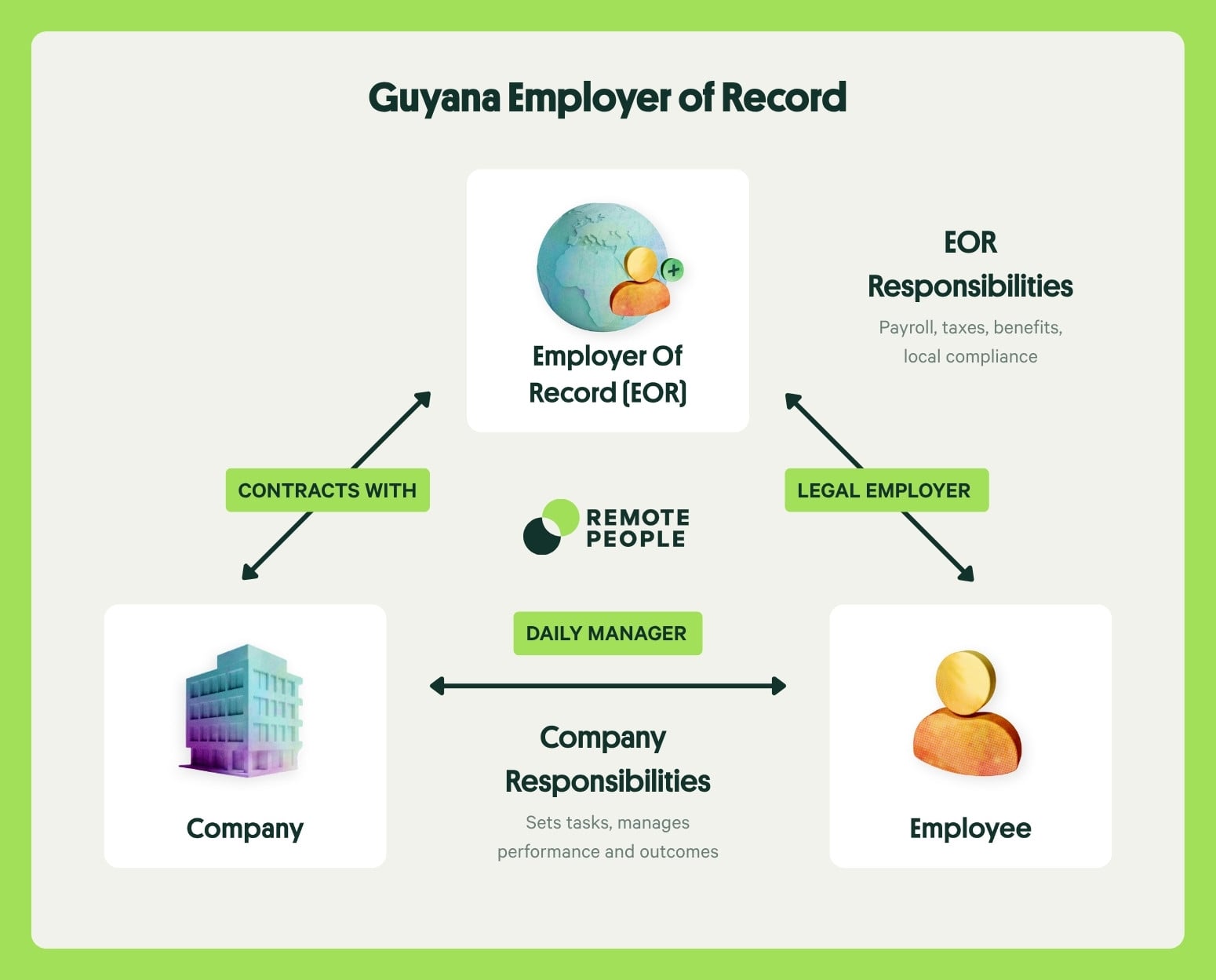
If you’d like to learn more about how Employer of Record (EOR) services work, read our What Is an Employer of Record (EOR)? guide for a complete overview of the model, its benefits, and when to use it.
If you’re comparing providers, our Best Employer of Record (EOR) Providers guide reviews the leading platforms to help you choose the right solution for your business.
Who Uses an EOR in Guyana?
Companies hire through an EOR in Guyana for a few recurring reasons, most of which come down to speed, cost, or compliance.
Companies exploring Guyana’s growing economy use an EOR to test the market before committing to entity registration. Startups and SMEs that lack the budget or headcount to justify a local subsidiary rely on the EOR’s existing infrastructure to hire compliantly from day one.
Project-based teams working on oil and gas, mining, or infrastructure projects with a defined timeline benefit from the EOR’s ability to scale up and wind down without entity obligations. Remote-first companies building distributed teams across the Caribbean use an EOR to add Guyana-based talent without establishing a physical office, while multinationals entering Guyana for the first time often use an EOR as a bridge solution while evaluating whether to register a permanent entity.
Regardless of the scenario, the EOR model lets companies hire compliantly in Guyana without handling the regulatory process independently.
Typical Onboarding Timeline
Onboarding through an EOR in Guyana is a step-by-step process with fairly predictable timelines, though work permit requirements for foreign nationals can add weeks.
- EOR agreement and employee details: 1–2 days to finalize the service agreement and collect employee information, identification documents, and Tax Identification Number (TIN).
- Employment contract drafting and review: 2–3 days to prepare a compliant employment contract under the Labour Act, incorporating probation terms, compensation, and leave entitlements.
- NIS and tax registration: 3–5 days to register the employee with the National Insurance Scheme and set up PAYE withholding with the Guyana Revenue Authority.
- Payroll setup and benefits enrollment: 2–3 days to configure monthly payroll, bank account details, and statutory benefit tracking.
- Employee onboarding and first day: 1 day for orientation, IT setup, and integration with your team.
Most EOR providers can onboard an employee in Guyana within 1–2 weeks. If the employee is a foreign national requiring a work permit, the process may take an additional 2–4 weeks depending on the Ministry of Home Affairs processing times and the applicant’s nationality.
Hire in Guyana
South America’s fastest-growing economy with NIS contributions, Guyanese Labour Act, and evolving employment regulations.
We handle employment contracts, payroll, social contributions, and full Guyanese compliance.
No local entity needed. Your team can start in days.
Employment Laws and Regulations in Guyana
Employment Contracts
Employment relationships in Guyana are governed by the Labour Act (Cap. 98:01), the Leave with Pay Act (Cap. 99:02), the Labour (Conditions of Employment of Certain Workers) Act (Cap. 99:03), and the Termination of Employment and Severance Pay Act (TESPA, Act No. 19 of 1997). The Ministry of Labour is the primary regulatory authority overseeing employment matters.
While Guyanese law permits both oral and written contracts, a written employment agreement is strongly recommended and considered best practice. The contract should specify the job title, duties, compensation, working hours, leave entitlements, probation period, notice requirements, and any applicable collective agreement terms.
Both fixed-term and indefinite contracts are recognized. Contracts are typically executed in English, which is Guyana’s official language.
Following the signing of the employment contract, the employer must register the employee’s information with the National Insurance Scheme and the Guyana Revenue Authority for PAYE purposes (Jack A. Alli & Sons).
Working Hours and Overtime
The standard workweek in Guyana is 40 hours spread over no more than five days, with a typical eight-hour workday. Employees are entitled to a meal break of at least one hour during each standard shift, and a minimum of 24 consecutive hours of rest in each seven-day period, typically on Sunday. The Labour Act (Cap. 98:01) and the Hours and Holidays Act govern these requirements (ILO).
Guyana overtime and premium pay rates · Per Labour Act (Cap. 98:01) | |||
Hour Type | Rate Multiplier | Weekly/Daily Cap | Notes |
|---|---|---|---|
Weekday overtime | 1.5x | 12 hrs/week recommended | Applies to hours exceeding 8 per day or 40 per week |
Night work | 1.5x | Per shift agreement | Applicable where shift work is arranged; higher rates may apply under collective agreements |
Weekly rest day work (Sunday) | 2.0x | No statutory cap | Applies when employee works on the designated weekly rest day |
Public holiday work | 2.0x | No statutory cap | Applies to any of Guyana’s 14 gazetted public holidays |
Senior managerial and supervisory employees with genuine authority over hiring, budgeting, and operational decisions may be exempt from certain overtime provisions. However, there is no blanket exemption from reasonable working-time protections.
Employers who fail to pay overtime correctly face fines starting at GYD 50,000 for a first offence, rising to GYD 100,000 and potential imprisonment for repeat violations. Overtime meal breaks of at least 15 minutes must be provided for every four hours of overtime worked.
Minimum Wage
The private sector minimum wage in Guyana is GYD 60,147 per month (GYD 2,776 per day, GYD 347 per hour), established by the National Minimum Wage Order effective 1 July 2022. This represents a 36% increase from the previous rate of GYD 44,200 per month (Ministry of Labour).
The public sector minimum wage has been increased to GYD 100,000 per month as part of the government’s 2025–2026 budgetary measures. Penalties for non-compliance range from GYD 50,000 to GYD 100,000, with the possibility of imprisonment.
Probation Period
The standard probation period in Guyana is three months, though the employer and employee may agree to a shorter or longer duration. During probation, either party may terminate the employment contract at any time, for any reason, without notice or severance pay. Once probation ends, the employee is confirmed and gains full statutory protections under the Labour Act and TESPA, including mandatory notice periods and severance eligibility (TESPA).
Leave Entitlements
Guyana’s statutory leave framework is governed primarily by the Leave with Pay Act (Cap. 99:02) and the National Insurance Scheme Act for maternity-related benefits. Employees are entitled to several categories of paid leave, each with specific accrual rules, pay rates, and eligibility conditions.
Annual Leave
Employees with one to ten years of continuous service earn one calendar day of paid leave per completed month, totalling 12 working days per year. After ten years of service, the entitlement doubles to two calendar days per month, or 24 working days per year. Daily-paid employees accrue one day of leave for every 20 days worked, while hourly employees earn one day per 160 hours worked.
Statutory annual leave cannot be forfeited, and a blanket “use-it-or-lose-it” policy is not lawful under Guyanese law. Unused leave may be carried over by agreement or must be paid out on termination (Leave with Pay Act).
Sick Leave
Private sector employees are entitled to up to 14 days of paid sick leave per year, subject to the presentation of a medical certificate from a qualified healthcare provider. Public service employees receive 28 days of sick leave annually, with possible extensions of up to six months at full pay and an additional three to six months at half pay, subject to approval. The National Insurance Scheme provides sickness benefits to insured employees who are temporarily unable to work, covering 70% of average insurable earnings after a three-day waiting period (NIS Guyana).
Maternity Leave
Female employees are entitled to 13 weeks of maternity leave, typically split as six weeks before and seven weeks after the expected date of delivery. Maternity benefits are paid at 70% of average insurable earnings through the National Insurance Scheme, not directly by the employer.
Many collective agreements require the employer to make up the difference to full salary. Job protection applies throughout the leave period, and additional leave may be granted for pregnancy-related complications with supporting medical documentation (NIS Guyana).
Paternity Leave
Guyana’s labour legislation does not include a statutory paternity leave entitlement. Some employers offer paternity leave voluntarily as part of their benefits package, and certain collective agreements may include provisions for fathers. In practice, fathers may use annual leave or unpaid leave following the birth of a child.
Other Statutory Leave
Guyanese law recognizes several additional leave categories beyond annual, sick, and maternity leave.
Bereavement leave is typically three to five days of paid leave following the death of an immediate family member, granted at the employer’s discretion under standard employment practice. Jury duty leave is unpaid unless the employment contract provides otherwise, with the employee’s job protected during the period of civic service.
Trade union leave allows employees who are elected union representatives to take reasonable time off for union activities under the Trade Union Act (Cap. 98:03). Study and examination leave is not a statutory entitlement but is commonly offered by employers in professional and technical sectors as a retention incentive.
Guyana statutory leave entitlements · Per Leave with Pay Act (Cap. 99:02) | ||
Leave Type | Duration | Eligibility & Notes |
|---|---|---|
Annual leave (1–10 yrs) | 12 days/year | 1 calendar day per completed month of service; cannot be forfeited |
Annual leave (10+ yrs) | 24 days/year | 2 calendar days per completed month after 10 years of continuous service |
Sick leave (private) | 14 days/year | Medical certificate required; NIS sickness benefit covers 70% of insurable earnings |
Sick leave (public) | 28 days/year | Extendable up to 6 months at full pay and 3–6 months at half pay with approval |
Maternity leave | 13 weeks | 70% of average insurable earnings paid by NIS; 6 weeks pre-delivery, 7 weeks post-delivery |
Paternity leave | Not statutory | No legal entitlement; some employers offer 1–2 weeks voluntarily |
Bereavement leave | 3–5 days | Immediate family; per employer policy or collective agreement |
Public holidays | 14 days/year | Paid time off; work on a public holiday is compensated at 2x the regular rate |
Source: Leave with Pay Act (Cap. 99:02) and NIS Guyana | ||
Statutory Employee Benefits
Beyond leave entitlements and social security contributions, employers in Guyana must provide several mandatory benefits as part of the employment relationship.
The National Insurance Scheme (NIS) is the primary social protection mechanism, funded by employer and employee contributions. NIS provides pension benefits, sickness and maternity cash benefits, industrial injury compensation, and a funeral grant.
Private health insurance is not legally required but is widely offered by EOR providers as a competitive benefit to attract talent. Employers typically offer group medical coverage, life and disability insurance, and additional wellness allowances depending on role seniority and industry norms.
Guyana does not mandate employer-provided private health insurance, meal or transportation allowances, or housing funds. However, many employers offer these as voluntary benefits to attract and retain talent, particularly in the competitive oil and gas sector. For exact contribution rates, see the employer and employee contribution tables in H2 4.
Recent Regulatory Updates (2026)
A few changes worth noting have taken effect in Guyana’s employment and tax rules for 2025–2026.
The most significant tax change for 2026 is the increase in the income tax threshold from GYD 130,000 to GYD 140,000 per month (GYD 1,680,000 per year), enacted through the Income Tax (Amendment) Act No. 3 of 2026. This measure removes approximately 5,000 workers from the tax net and increases take-home pay for all employed individuals. The 25% and 35% income tax rates remain unchanged from 2025 (GRA).
In 2025, the personal income tax rates were reduced from 28%/40% to 25%/35%, and the chargeable income bracket for the lower rate was expanded from GYD 2,400,000 to GYD 3,120,000 per year. An overtime tax exemption was also introduced, making the first GYD 50,000 of monthly overtime pay tax-free (Dept. of Public Information).
The private sector minimum wage has not been updated since July 2022 (GYD 60,147/month), though public sector wages received an 8% increase for 2025, and the government has signalled plans to bring the public sector minimum to GYD 100,000/month. Labour law reform discussions continue, including a proposed Industrial Tribunal Bill that would create a specialized body for resolving employment disputes.
Work Permits and Visas in Guyana
Work Permit Requirements
Who Needs a Work Permit
All foreign nationals who intend to work in Guyana must obtain a work permit from the Ministry of Home Affairs, with one key exception. CARICOM nationals who hold a Caribbean Single Market and Economy (CSME) Skills Certificate, approved by the Ministry of Foreign Affairs, are exempt from the work permit requirement and may work freely in Guyana along with their accompanying spouse (Fragomen). Citizens of countries with visa-free agreements (including the US, UK, Canada, and most EU nations) can enter Guyana without a visa for up to 90 days but must still obtain a work permit before starting employment.
Eligibility and Required Documents
The applicant must have a confirmed job offer from a registered employer in Guyana. The employer must demonstrate that a suitably qualified Guyanese national is not readily available for the role, though this requirement is often relaxed for positions requiring specialized skills that are scarce in the local labour market. Required documents include a valid passport (with at least six months remaining), the signed employment contract, academic and professional qualifications, a police clearance certificate, a medical examination report, and the employer’s business registration and NIS/GRA compliance certificates.
Processing Time and Validity
Standard work permit processing takes 2–4 weeks through the Ministry of Home Affairs, though timelines can vary based on the applicant’s nationality and the completeness of the application. The standard work permit is valid for three years and is tied to a specific employer.
Changing employers requires a new permit application. Guyana’s immigration authorities have become increasingly responsive to skilled labour demand driven by the oil and gas sector, and processing may be expedited for positions with known skills shortages.
Renewal Process
Work permits are renewable for additional three-year periods. The renewal application should be submitted before the current permit expires, and the employee can continue working during the renewal process. Required documentation is similar to the initial application, updated to reflect the current employment status and any changes to qualifications or employer details.
Common Visa Types for Foreign Workers
Guyana’s visa and work authorization framework is administered by the Ministry of Home Affairs and the Department of Immigration. The EOR can sponsor the standard work permit and assist with visa applications for most categories. The following table summarizes the main visa types available to foreign workers.
Guyana work visa types for foreign workers · 2026 | ||||
Visa Type | Duration | Best For | Leads to PR? | Processing |
|---|---|---|---|---|
Standard Work Permit | 3 years | Full-time employees hired by a Guyanese employer or EOR | Yes | 2–4 weeks |
Employment Visa on Arrival (EVOA) | 3 years | Visa nationals entering Guyana while their work permit is processed | Yes (with permit) | On arrival |
Business Visa | Up to 5 years | Short-term business activities, meetings, due diligence visits | No | 2–3 weeks |
Digital Nomad Visa | 1 year (renewable) | Remote workers employed by non-Guyanese companies; minimum $24,000/year income | No | 2–4 weeks |
CARICOM CSME Skills Certificate | Indefinite | Qualified CARICOM nationals in approved skill categories | Yes | Varies by issuing state |
Visa types that do not permit employment in Guyana include the following.
Guyana issues a Visitor Visa on Arrival for tourism and vacation purposes, which does not authorize any form of employment. A Business Visa allows short-term visits for meetings, conferences, and negotiations but does not permit the holder to earn a salary from a Guyanese employer.
The Work Permit is the only authorization that allows a foreign national to be employed in Guyana. It is issued by the Ministry of Home Affairs, typically valid for three years, and requires employer sponsorship through the EOR.
How an EOR Handles Work Permits
The EOR is the sponsoring employer for work permit applications in Guyana. This includes preparing and submitting the application to the Ministry of Home Affairs, providing proof of the company’s registration and compliance with NIS and GRA requirements, and coordinating with the employee on document collection and medical examinations.
The employee is responsible for obtaining the necessary personal documents (passport, police clearance, medical report, academic credentials) and attending any required in-person appointments. When a work permit is required, the total onboarding timeline referenced in H3 1.4 extends by 2–4 weeks to account for processing. Since 2024, the Ministry of Home Affairs requires visa nationals holding a work permit to also carry a valid Employment Visa on Arrival (EVOA) for re-entry purposes, which the EOR can arrange concurrently.
Payroll, Taxes, and Social Security in Guyana
Employer Contributions
Guyana has a single mandatory employer contribution under the National Insurance Scheme (NIS). The NIS rate applies to gross monthly earnings up to a defined insurable earnings ceiling.
Guyana employer social security contributions · 2026 rates | ||
Contribution | Rate | Notes |
|---|---|---|
National Insurance Scheme (NIS) | 8.4% | Calculated on gross monthly earnings up to the GYD 280,000 insurable earnings ceiling; covers pension, sickness, maternity, industrial injury, and funeral benefits |
Total employer contribution | 8.4% | Maximum monthly employer contribution: GYD 23,520 (8.4% of GYD 280,000 ceiling) |
Guyana has a simple social security system with a single mandatory employer contribution: the 8.4% NIS payment. Unlike many countries in the region, there is no separate employer-paid health insurance fund, unemployment insurance levy, or training tax. The NIS ceiling of GYD 280,000 per month has been in effect since January 2020, meaning the maximum monthly employer cost for NIS is GYD 23,520 regardless of how much the employee earns above that threshold.
Employee Contributions
Employees in Guyana face two mandatory payroll deductions each month: the NIS employee contribution and Pay-As-You-Earn (PAYE) income tax. The EOR withholds both from gross salary before disbursing net pay.
Guyana employee payroll deductions · 2026 monthly withholdings | ||
Deduction | Rate | Notes |
|---|---|---|
National Insurance Scheme (NIS) | 5.6% | Calculated on gross earnings up to the GYD 280,000 monthly ceiling; NIS contributions are tax-deductible |
PAYE income tax | 25% / 35% | 25% on first GYD 3,120,000/year above personal allowance; 35% on income above that threshold |
Total employee deductions | 5.6% + PAYE | Maximum monthly NIS deduction: GYD 15,680 (5.6% of GYD 280,000 ceiling); PAYE varies by income |
The employee’s NIS contribution of 5.6% is deducted from gross earnings before applying income tax, reducing the employee’s taxable income. The employer is responsible for deducting both the employee’s NIS share and PAYE income tax from each paycheck and remitting both amounts to the respective authorities by the 14th of the following month.
Income Tax
Guyana applies a two-rate personal income tax structure administered by the Guyana Revenue Authority (GRA). The personal allowance shelters the first GYD 1,680,000 of annual income from tax.
Guyana income tax brackets · 2026 | |
Bracket | Tax Calculation |
|---|---|
Up to GYD 1,680,000/year (GYD 140,000/month) | 0% (personal allowance, or 1/3 of total income if higher) |
Next GYD 3,120,000/year above allowance | 25% of chargeable income in this bracket |
All income above GYD 3,120,000/year beyond allowance | 35% of chargeable income in this bracket |
The personal allowance for 2026 is GYD 1,680,000 per year (GYD 140,000/month) or one-third of the individual’s total income from all sources, whichever is greater. NIS contributions are deducted from gross income before calculating the taxable amount.
The first GYD 50,000 of monthly overtime earnings is also exempt from income tax. Dividends paid by resident companies to resident individuals are exempt from income tax, while dividends to non-residents are subject to a 20% withholding tax (PwC).
Payroll Cycle
The standard payroll cycle in Guyana is monthly, with salaries paid by the last working day of each month via bank transfer. Cash payments are discouraged for audit and compliance purposes, though not explicitly prohibited for all sectors. Employers must provide each employee with a detailed payslip showing gross salary, NIS deductions, PAYE income tax withheld, and net pay.
Tax and NIS remittance deadlines fall on the 14th of the month following payment. Employers must file monthly PAYE returns with the GRA and NIS contribution schedules with the National Insurance Scheme.
Annual income tax returns must be filed by 30 April of the following year for employed individuals. Late filing or payment attracts penalties and interest from both the GRA and NIS.
13th Month Salary and Bonus Pay
Guyana does not legally require employers to pay a 13th month salary, a 14th month salary, or any mandatory annual bonus. There is no statutory profit-sharing obligation. Any year-end bonus, performance incentive, or additional salary payment is entirely at the employer’s discretion and should be documented in the employment contract or company policy.
That sets Guyana apart from many Latin American neighbours where 13th month payments are compulsory (Jack A. Alli & Sons).
Cost of Hiring Through an Employer of Record in Guyana
EOR Service Fees
EOR service fees for Guyana typically range from $300 to $600 per employee per month. This fee covers employment contract management, payroll processing, NIS and PAYE remittance, statutory leave tracking, compliance monitoring, and ongoing HR support.
The exact fee depends on the number of employees, the complexity of the role (local hire versus foreign national requiring work permit support), and the service level selected. Some providers offer volume discounts for teams of five or more employees.
Total Employment Cost Breakdown
The table below shows the total monthly cost of employing one worker in Guyana through an EOR, using a USD 1,500 gross salary as the baseline. Guyana’s low employer contribution rate keeps total costs well below regional averages.
Guyana employer cost example · $1,500 gross · 2026 | ||
Employer Cost | Amount (USD) | % of Gross |
|---|---|---|
Gross monthly salary | $1,500 | 100% |
NIS employer contribution (8.4%) | $126 | 8.4% |
EOR service fee (est.) | $450 | 30% |
Total monthly employer cost | $2,076 | 138.4% |
Source: NIS Guyana and PwC Tax Summaries: Guyana | ||
At a $1,500 gross monthly salary, the total employer cost with NIS contributions and EOR service fee comes to $2,076 per month, or 38.4% above gross. That 8.4% single-rate employer contribution makes Guyana one of the most cost-effective hiring destinations in the Caribbean and South American region. And because of the NIS ceiling, the employer contribution as a percentage of salary drops further for higher-paid employees.
Ready to hire in Guyana? Get started with RemotePeople. We handle employment contracts, payroll, tax withholding, and full Guyana compliance.
No local entity needed.
Benefits of Using an EOR in Guyana
Hiring through an employer of record in Guyana has clear practical advantages over setting up your own entity or trying to manage employment from abroad. Here is what the EOR model gets you in Guyana specifically.
An EOR can onboard employees in Guyana within one to two weeks, compared to the two to four months needed to register a local entity. This speed to market is paired with full legal compliance: the EOR stays current with every amendment to the Labour Act, NIS regulations, and GRA filing requirements so you do not have to.
Cost efficiency is another advantage, since the EOR’s flat monthly fee replaces the fixed overhead of maintaining a local office, in-house payroll staff, and legal counsel. The EOR also handles multi-currency payroll, converting your USD funding into GYD salary payments at competitive exchange rates.
Scalability is built in: you can add or reduce headcount without entity restructuring or deregistration. The EOR manages all termination procedures under TESPA, reducing your legal exposure. Finally, an EOR with local HR expertise provides cultural and regulatory guidance that helps foreign companies navigate Guyana’s business environment effectively.
Termination and Offboarding in Guyana
Notice Periods
Statutory notice periods in Guyana are governed by the Termination of Employment and Severance Pay Act (TESPA, Act No. 19 of 1997). Both employer and employee must provide written notice before terminating an employment relationship, unless termination occurs during the probation period or for serious misconduct.
Either party may pay wages in lieu of the notice period. An employer cannot give notice of termination while an employee is on authorized leave (TESPA).
Guyana statutory notice periods by position level · Per TESPA (Act No. 19 of 1997) | |||
Length of Service | Notice Period | During Probation | Notes |
|---|---|---|---|
During probation (first 3 months) | None required | N/A | Either party may terminate at any time without notice or severance |
Less than 1 year | 2 weeks | None | Written notice required; payment in lieu permitted |
1 year or more | 1 month | None | Written notice required; employer cannot give notice while employee is on authorized leave |
Contractual override | As per contract | As per contract | Employment contracts may stipulate longer notice periods than the statutory minimum; the longer period applies |
Source: TESPA (Act No. 19 of 1997) and Ministry of Labour Guyana | |||
Fixed-term contracts expire on their stated end date without a separate notice requirement, unless the contract provides otherwise. Mutual agreement between employer and employee can also end the employment relationship without notice. In cases of just-cause summary dismissal for serious misconduct, no notice period or severance pay is required.
Severance Pay
Severance pay in Guyana is mandatory for eligible employees under the Termination of Employment and Severance Pay Act (TESPA). An employee who has completed at least one year of continuous service and is terminated for reasons other than serious misconduct is entitled to severance payment. This includes redundancy, business closure, technological changes that eliminate the role, and incapacity due to illness or injury (TESPA).
Guyana severance pay schedule by years of service · Per TESPA (Act No. 19 of 1997) | |||
Years of Service | Severance Amount | Base Salary | Notes |
|---|---|---|---|
1 year | 1 week’s wages | Last weekly wage | 1 week per completed year for years 1–5 |
3 years | 3 weeks’ wages | Last weekly wage | 1 week × 3 completed years |
5 years | 5 weeks’ wages | Last weekly wage | 1 week × 5 completed years |
7 years | 14 weeks’ wages | Last weekly wage | 5 weeks (years 1–5) + 2 weeks × 2 (years 6–7) + previous tiers |
10 years | 20 weeks’ wages | Last weekly wage | 5 weeks (years 1–5) + 10 weeks (years 6–10) |
15 years | 35 weeks’ wages | Last weekly wage | 5 + 10 + 15 weeks (years 11–15 at 3 weeks/year); max 52 weeks total |
Source: TESPA (Act No. 19 of 1997) and Ministry of Labour Guyana | |||
Calculation Method
The severance formula under TESPA uses a tiered structure. For the first five completed years of service, the employee receives one week’s wages for each year. From the sixth to the tenth year, the rate increases to two weeks’ wages per year.
From the eleventh year onwards, the rate is three weeks’ wages per year. The base for calculation is the employee’s last weekly wage.
The total severance payment is capped at a maximum of 52 weeks’ wages. See the table above for worked examples at different service lengths.
Caps and Exceptions
The 52-week cap means that even very long-tenured employees cannot receive more than one year’s wages in severance. Severance is not payable when the employee is terminated for serious misconduct, including gross negligence, theft, fraud, insubordination, or habitual neglect of duties. Employees who resign voluntarily are not entitled to severance, except in cases of constructive dismissal where the employer has fundamentally breached the employment contract.
During the probation period, no severance is owed regardless of the reason for termination. Fixed-term contracts that expire on their stated end date do not trigger a severance obligation unless the employee has been continuously employed on successive fixed-term contracts for the qualifying period.
Grounds for Termination
An employer in Guyana may terminate an employment contract on several grounds. Redundancy (business closure, downsizing, or technological change) requires advance notice and severance payment. Termination for good and sufficient cause includes serious misconduct, habitual neglect of duties, willful disobedience of lawful orders, or inability to perform duties satisfactorily after reasonable opportunity to improve.
Summary dismissal without notice is permitted only for serious misconduct. Mutual agreement between employer and employee can end the relationship at any time. The employer bears the burden of proving just cause if the dismissal is challenged before the Ministry of Labour or the courts.
EOR vs. Other Hiring Models in Guyana
EOR vs. Setting Up a Local Entity
Setting up a local entity in Guyana requires registration with the Deeds Registry, the GRA, and the NIS, a process that typically takes two to four months. An EOR eliminates this setup entirely and lets you hire within days.
Guyana EOR vs local entity comparison · Setup time, cost, risk and best-fit | ||
Comparison | Employer of Record | Own Entity |
|---|---|---|
Setup time | 1–2 weeks | 2–4 months |
Upfront cost | $0 | $10,000–$25,000 |
Ongoing cost | $300–$600/employee/month | $15,000–$30,000/year maintenance |
Local partner required | No (EOR is the local entity) | No |
Social insurance registration | Handled by EOR | You manage it |
Payroll & tax filing | Handled by EOR | You manage it (or outsource) |
Best for team size | 1–15 employees | 15+ employees |
Scale down / exit | Easy, no entity to unwind | Costly, legal dissolution required |
Government contracts | Not eligible | Eligible (requires local entity) |
Source: NIS Guyana and PwC Tax Summaries: Guyana | ||
For companies entering Guyana with a small team, the EOR model eliminates the upfront investment and ongoing overhead of local incorporation. Entity setup in Guyana requires registration with the Deeds Registry, the GRA, the NIS, and potentially the Investment Unit of the Ministry of Finance, depending on the industry.
The breakeven point where entity setup becomes more economical than EOR fees typically falls around 15 employees. Below that threshold, the EOR’s per-employee fee is lower than the fixed costs of maintaining a local entity, local accounting, annual compliance filings, and dedicated HR staff.
Companies that need to bid on government contracts or secure government procurement work in Guyana will require a local entity, as EOR-employed workers are not eligible for government contracting purposes.
EOR vs. Hiring Independent Contractors
Hiring contractors in Guyana is only appropriate for genuinely project-based engagements where the worker controls their own schedule and tools. The Ministry of Labour may reclassify a contractor as an employee if the relationship resembles employment.
Guyana EOR vs independent contractors · Compliance, cost, and risk | ||
Comparison | EOR (Full-Time Employee) | Independent Contractor |
|---|---|---|
Legal relationship | Employee of the EOR | Self-employed, no employment relationship |
Compliance risk | Low, EOR ensures local labor law compliance | High, misclassification risk if relationship resembles employment |
Payroll & tax | EOR handles withholding, contributions, filings | Contractor invoices you; they handle their own taxes |
Benefits & leave | Statutory benefits, paid leave, social security | No entitlement to employee benefits |
IP protection | Stronger, employment contract assigns IP by default | Weaker, requires explicit IP assignment clause |
Termination | Subject to local notice periods and severance | Contract can be ended per agreement terms |
Best for | Long-term, core team roles | Short-term projects, specialized tasks |
Cost structure | Salary + employer contributions + EOR fee | Contractor fee (typically higher gross, lower total cost) |
Misclassifying workers is a growing risk in Guyana, especially as the oil and gas sector brings in foreign companies that use contractor arrangements for what are really employment relationships. The Ministry of Labour looks at the substance of the working relationship, not just the contract label, when deciding whether someone should be classified as an employee.
Key indicators that a contractor arrangement may be reclassified as employment include fixed working hours set by the company, exclusive engagement (the worker only serves one client), use of company equipment and premises, and integration into the company’s organizational structure. If reclassified, the company faces liability for unpaid NIS contributions, back taxes, accrued leave, and potential severance.
For ongoing, core team roles in Guyana, hiring through an EOR is the more compliant approach. For genuinely independent, project-based work with defined deliverables, RemotePeople’s contractor management solution can help structure the engagement compliantly.
EOR vs. PEO (Professional Employer Organization)
A PEO co-employs workers alongside your existing local entity, while an EOR becomes the sole legal employer. In Guyana, where most foreign companies lack a registered entity, the EOR model is the practical choice.
Guyana EOR vs PEO comparison · Legal employer, liability, and setup | ||
Comparison | Employer of Record (EOR) | PEO |
|---|---|---|
Legal employer | EOR is the legal employer | You remain the legal employer (co-employment) |
Local entity required | No, the EOR is the local entity | Yes, you must have your own entity in Guyana |
Best for | Companies without a local entity | Companies that already have a local entity |
Compliance liability | EOR assumes compliance responsibility | Shared liability between you and the PEO |
Setup time | 1–2 weeks | Depends on your entity setup (weeks to months) |
Control over HR policies | EOR manages within local law framework | More direct control, PEO advises |
Typical use case | Market entry, small remote teams, testing new markets | Established local operations needing HR outsourcing |
Source: NIS Guyana and PwC Tax Summaries: Guyana | ||
Guyana has no formal regulatory framework for PEO services. Co-employment is not codified in Guyanese labour law, so PEO arrangements sit in a legal grey area with no explicit statutory recognition.
For companies that do not have a local entity in Guyana, the EOR model is the only compliant option for hiring full-time employees. The EOR becomes the registered employer with NIS and GRA, holds the employment contracts, and assumes compliance obligations.
Companies that already have a Guyanese entity and are looking for HR outsourcing support (payroll processing, benefits administration, compliance advisory) may find a PEO-style arrangement useful. However, the employer retains full legal liability for employment compliance, and that is the main difference from the EOR model.
Public Holidays in Guyana
Guyana observes 14 public holidays each year, reflecting the country’s diverse cultural and religious heritage. Employees who work on a public holiday are entitled to double-time pay under the Labour Act.
Guyana public holidays · 2026 calendar year | ||
Date | Holiday | Type |
|---|---|---|
1 January | New Year’s Day | Fixed |
23 February | Mashramani (Republic Day) | Fixed |
3 March | Phagwah (Holi) | Variable (Hindu) |
3 April | Good Friday | Variable (Christian) |
6 April | Easter Monday | Variable (Christian) |
1 May | Labour Day | Fixed |
5 May | Indian Arrival Day | Fixed |
26 May | Independence Day | Fixed |
27 May (tentative) | Eid al-Adha | Variable (Islamic) |
6 July | CARICOM Day | Fixed |
1 August | Emancipation Day | Fixed |
24 August (tentative) | Youman-Nabi (Mawlid) | Variable (Islamic) |
25 December | Christmas Day | Fixed |
26 December | Boxing Day | Fixed |
Source: Ministry of Home Affairs Guyana and timeanddate.com | ||
Guyana observes 14 gazetted public holidays in 2026, a schedule shaped by the country’s Hindu, Muslim, Christian, and national commemorative traditions. Islamic holidays (Eid al-Adha and Youman-Nabi) are determined by the lunar calendar and confirmed by the Central Islamic Organisation of Guyana shortly before each date.
When a public holiday falls on a Sunday, the following Monday is typically observed as the day off. Employees who work on a public holiday are entitled to double pay (2x their regular rate) under the Labour Act.
How to Get Started with an EOR in Guyana
- First, define your hiring needs: Determine the number of employees you plan to hire in Guyana, their roles, compensation expectations, and whether any positions require foreign nationals who will need work permits. This scoping step shapes the EOR agreement and timeline.
- Second, select an EOR provider: Evaluate providers based on their in-country presence in Guyana, familiarity with the Labour Act and TESPA, NIS registration status, and experience with CARICOM labour mobility rules. Request references from other companies hiring in the Caribbean region.
- Third, finalize the service agreement: The EOR agreement should specify the service fee structure, scope of employment administration services, liability allocation, data protection measures, and termination procedures. Confirm that the EOR will handle NIS registration, PAYE filing, and work permit support as part of the standard service.
- Fourth, onboard your employees: Provide the EOR with employee details, and the EOR drafts compliant employment contracts, registers each employee with NIS and the GRA, sets up payroll, and coordinates the first day of work. For local hires, this process takes 1–2 weeks. For foreign nationals requiring work permits, allow 3–6 weeks total.
- Fifth, manage and scale your team: With the administrative burden handled by the EOR, your company retains full day-to-day management of employees. As your Guyana team grows or contracts, the EOR adjusts without the fixed overhead of entity maintenance.
Ready to hire in Guyana? Contact RemotePeople to get started. We handle employment contracts, payroll, NIS contributions, tax filing, and full compliance under Guyanese law, so you can build your team without a local entity.
Where companies hiring in Guyana expand next
Companies hiring in Guyana commonly expand across South America, leveraging Spanish and Portuguese talent pools and regional trade frameworks. Teams frequently add Brazil for shared Southern Cone workforce dynamics; a team in Barbados often follows for CARICOM mobility and shared Caribbean business practices; operations in Trinidad and Tobago is a common next step, offering aligned CARICOM employment frameworks; and Suriname rounds out the regional footprint with a regional sibling with matching labor profile.
Frequently Asked Questions
EOR services in Guyana typically cost between $300 and $600 per employee per month as a flat USD fee. This covers employment contract management, monthly payroll processing, NIS and PAYE tax remittance, statutory leave tracking, and compliance monitoring. The total employment cost for a $1,500/month employee, including the 8.4% NIS employer contribution and EOR fee, is approximately $2,076 per month (NIS Guyana).
Most EOR providers can fully onboard a local employee in Guyana within 1–2 weeks. This includes finalizing the employment contract, registering with the National Insurance Scheme and Guyana Revenue Authority, setting up payroll, and completing the first-day onboarding. For foreign nationals who need a work permit, the process takes 3–6 weeks due to Ministry of Home Affairs processing times (MOHA Guyana).
Yes, the EOR acts as the sponsoring employer for work permit applications in Guyana. The EOR handles the application to the Ministry of Home Affairs, provides required employer documentation (NIS and GRA compliance certificates, business registration), and coordinates with the employee on personal documents. The standard work permit is valid for three years and is renewable (Ministry of Home Affairs).
The only mandatory employer contribution in Guyana is the 8.4% National Insurance Scheme (NIS) payment, calculated on gross monthly earnings up to the GYD 280,000 ceiling. There is no separate employer health insurance, unemployment, or training tax. The maximum monthly NIS employer contribution is GYD 23,520 regardless of how much the employee earns above the ceiling (NIS Guyana).
Intellectual property created by employees in the course of their employment is assigned to the client company (you), not the EOR. The EOR employment contract includes standard IP assignment clauses that ensure all work product, inventions, and creative output belong to your company. For additional protection, the EOR can include specific confidentiality and IP provisions tailored to your requirements.
Independent contractors are only appropriate in some cases, such as genuinely project-based engagements with defined deliverables where the worker sets their own hours, uses their own equipment, and serves multiple clients. If the working relationship resembles employment (fixed hours, exclusive engagement, company integration), Guyana’s Ministry of Labour may reclassify the contractor as an employee, resulting in liability for back NIS contributions, taxes, accrued leave, and severance. For ongoing roles, RemotePeople’s contractor management solution can help structure compliant engagements.
Termination in Guyana is governed by the Termination of Employment and Severance Pay Act (TESPA). Employees with less than one year of service require two weeks’ written notice; those with one year or more require one month’s notice. Severance pay is mandatory for employees with at least one year of service who are terminated for reasons other than serious misconduct. The severance formula is tiered: one week’s wages per year for years 1–5, two weeks per year for years 6–10, and three weeks per year from year 11 onward, capped at 52 weeks. The EOR manages the entire process to ensure compliance (ILO: Guyana Labour Law).
Mandatory benefits in Guyana include National Insurance Scheme coverage (employer 8.4%, employee 5.6%), which provides pension, sickness, maternity, industrial injury, and funeral benefits. Employees are also entitled to 12 days of annual leave per year (24 days after 10 years), 14 days of sick leave, 13 weeks of maternity leave (70% pay through NIS), and 14 public holidays. There is no mandatory private health insurance, 13th month salary, or employer-funded housing allowance (NIS Guyana; Leave with Pay Act).