Recruit
Employer of Record (EOR) in Mauritania
-
 Drew Donnelly
- Published
- September 22, 2026
RemotePeople’s employer of record in Mauritania lets you hire employees in Mauritania with full CNSS compliance. We handle National Social Security Fund (CNSS) contributions of 15% from employers and 1% from employees, and quarterly contribution remittance requirements.
Hire in Mauritania — book a free 30-minute demo
Tell us what you need. You'll get a tailored, transparent proposal within 24 hours, plus a free call to walk through it.
Tell us about your company
So we can match you with a specialist who knows your market — and unlock volume pricing tiers.
* All fields are required.
Where and when are you hiring?
Tell us the geography and timing and we'll quote each country line by line, with onboarding timelines.
* All fields are required.
Help us beat your current setup
We'll benchmark your current deal and send a line-by-line proposal in 24 hours — showing exactly where we cut cost, time, or risk. After you submit, you can book a call to walk through it together.
* All fields are required.
Thanks! Your proposal is on its way.
Expect a tailored, line-by-line proposal in your inbox within 24 hours. In the meantime…
Want to walk through it together?
Book a free 30-minute call with one of our specialists. We'll explain every line, answer your questions, and tailor the proposal further if you need.
No obligation. Pick a time that works for you.








- Hire in Mauritania — book a free 30-minute demo
- Tell us about your company
- Where and when are you hiring?
- Help us beat your current setup
- Thanks! Your proposal is on its way.
- How an Employer of Record Works in Mauritania
- Employment Laws and Regulations in Mauritania
- Work Permits and Visas in Mauritania
- Payroll, Taxes, and Social Security in Mauritania
- Cost of Hiring Through an EOR in Mauritania
- Benefits of Using an EOR in Mauritania
- Termination and Offboarding in Mauritania
- EOR vs. Other Hiring Models in Mauritania
- Public Holidays in Mauritania
- How to Get Started with an EOR in Mauritania
- Frequently Asked Questions
- Related EOR Destinations

Start hiring in Mauritania
Let RemotePeople handle payroll, compliance, and HR admin worldwide so you can focus on building your team.

Mauritania is a West African gateway between the Maghreb and sub-Saharan Africa, with a workforce concentrated in Nouakchott, Nouadhibou, and the expanding mining and fisheries corridors along the Atlantic coast. For companies looking to hire employees in Mauritania, the regulatory framework is set by the Labour Code (Law No. 2004-017) and administered by the Ministry of Public Service, Labour and Modernisation together with the national social security fund, the Caisse Nationale de Sécurité Sociale (CNSS). The 2025 Finance Law (Law No. 2025-001) kept the country’s three-bracket personal income tax structure in place, the statutory minimum wage (SMIG) sits at MRU 45,000 per month, and CNSS contributions total 16% of gross pay (15% employer plus 1% employee, capped at MRU 15,000). An employer of record in Mauritania takes on all of those obligations as the legal employer of your staff, so you can hire, pay, and manage a team without incorporating a local entity.
This guide walks through how an employer of record in Mauritania works, what the Labour Code requires in 2026, what hiring through an EOR actually costs, and how the model compares with incorporating your own entity, hiring contractors, or partnering with a PEO. All figures are verified against the current Labour Code, CNSS rules, and the 2026 income tax brackets published by the Mauritanian Directorate General of Taxes.
How an Employer of Record Works in Mauritania
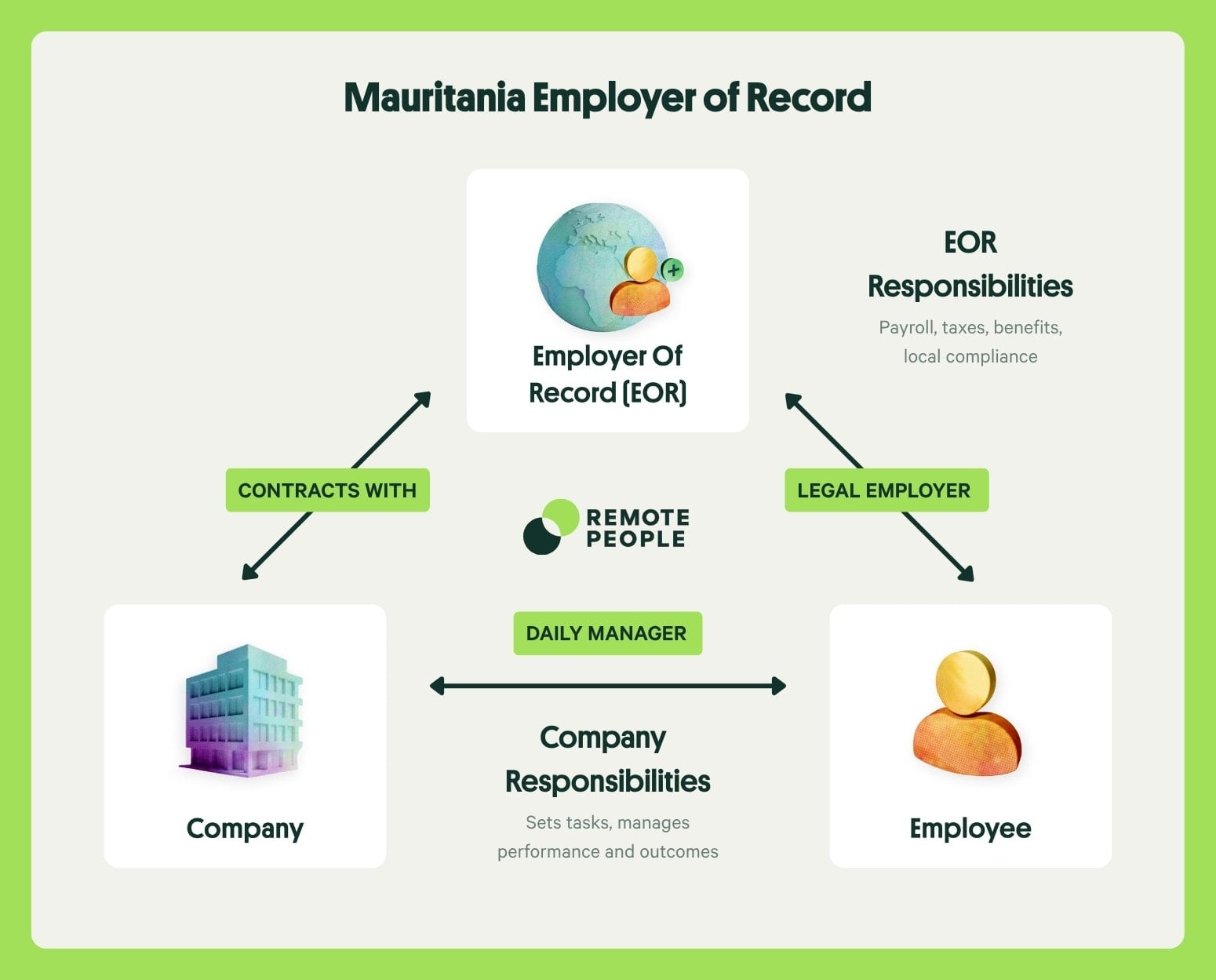
If you’d like to learn more about how Employer of Record (EOR) services work, read our What Is an Employer of Record (EOR)? guide for a complete overview of the model, its benefits, and when to use it.
If you’re comparing providers, our Best Employer of Record (EOR) Providers guide reviews the leading platforms to help you choose the right solution for your business.
Who Uses an EOR in Mauritania?
An employer of record in Mauritania is typically used by companies that want a compliant hire without committing to a full entity setup. The model is especially common for businesses expanding into West Africa from Europe, the Gulf, or other African markets where setting up a local branch or subsidiary would take months and lock in recurring compliance costs.
- Testing the market before committing: A company evaluating Mauritania’s extractive, logistics, or fisheries sectors can hire one or two local staff through an EOR while deciding whether to incorporate.
- Hiring a small team without entity overhead: For a team of one to fifteen employees, the EOR model is faster and cheaper than registering a Mauritanian company and maintaining statutory bookkeeping.
- Onboarding quickly: An EOR can have an employment contract signed and payroll running within two weeks, versus several months for a new local entity to clear all registrations.
- Hiring foreign nationals who need work permits: Because the EOR is already a registered Mauritanian employer, it can sponsor work and residence permits on your behalf without you setting up a subsidiary.
The EOR arrangement also suits short-term project work tied to mining, port infrastructure, or NGO programmes funded on a multi-year cycle, where the client cannot justify the overhead of a permanent Mauritanian presence.
Typical Onboarding Timeline
Most EOR providers can onboard an employee in Mauritania within 1–2 weeks if no work permit is required. The stages are sequential but short:
- First, sign the EOR service agreement and share the employee’s details, proposed salary, role, and start date (1–2 days).
- Second, the EOR drafts a compliant Labour Code contract in French and sends it for employer and employee signature (2–3 days).
- Third, CNSS registration, tax identification setup, and bank account collection run in parallel (3–7 days).
- Fourth, payroll is configured, statutory benefits are enrolled, and the employee is onboarded into your systems (2–3 days).
- Fifth, the employee begins work on the agreed start date.
Timelines extend when a work permit is required (add 2–6 weeks for processing through the rokhsa.emploi.gov.mr portal plus consular visa issuance), when documents must be legalised at a Mauritanian embassy abroad, or when the hire needs a regulated professional licence.
Hire in Mauritania
Low employer social costs (15% total, with pension capped at MRU 15,000), a bilingual French-Arabic workforce, and a strategic gateway to Francophone West Africa and the green hydrogen economy make Mauritania a compelling expansion market.
We handle employment contracts, payroll, tax withholding, and full Mauritania compliance.
No local entity needed. Your team can start in days.
Employment Laws and Regulations in Mauritania
Employment Contracts
Employment relationships in Mauritania are governed by the Labour Code (Law No. 2004-017 of 6 July 2004), which replaced the earlier 1963 code and remains the binding framework in 2026. The Ministry of Public Service, Labour and Modernisation is the primary regulator, and CNSS administers social security benefits. Written contracts are required for all formal employment relationships, and the working language for employment documentation is French, the administrative language of Mauritania.
Contracts may be indefinite (contrat à durée indéterminée, or CDI) or fixed-term (contrat à durée déterminée, or CDD). Fixed-term contracts are capped at two years in total duration, renewals included, after which the contract is legally recharacterised as indefinite. Every contract must specify the job title, salary, place of work, working hours, probation period (if any), and start date. The General Tax Code (Law No. 2019-018), as amended by the 2025 Finance Law (Law No. 2025-001), governs the tax treatment of employment income (PwC Mauritania – Significant developments).
Working Hours and Overtime
The standard workweek in Mauritania is 40 hours, typically arranged as eight hours per day over five days, though six-day arrangements are permitted in some sectors by collective agreement. The Labour Code caps the legal workday at eight hours and requires at least one full rest day per week, customarily observed on Friday in line with Mauritania’s Islamic calendar. Overtime is permitted only for defined operational needs and must be compensated at the premium rates set by the Labour Code and implementing decrees.
Overtime pay is tiered by the type of hour worked. The first block of overtime on a normal workday is paid at 125% of the normal hourly rate, with higher multipliers applying to night work, rest days, and public holidays. The specific tiers are set by decree and confirmed in the Mauritanian labour ministry’s published guidance on overtime.
Mauritania overtime and premium pay rates · Per the Labour Code (Law No. 2004-017) | |||
Hour Type | Rate Multiplier | Daily or Weekly Cap | Notes |
|---|---|---|---|
Standard hours | 100% (base) | 8 hours/day, 40 hours/week | Five-day week typical; six-day permitted under collective agreement |
Weekday overtime (first tier) | 125% | First overtime hours above 40/week | Applies to daytime overtime worked on a normal workday |
Weekday overtime (second tier) | 140% | Extended overtime on same workday | Applies once the first tier of overtime is exhausted |
Night work | 150% | Hours between 10 PM and 5 AM | Applies to scheduled night shifts and night overtime |
Weekly rest day work | 200% | Friday rest day by default | Employee is entitled to a compensatory rest day the following week |
Public holiday work | 200% | Applies to the full holiday | Covers both fixed and movable Islamic public holidays |
Managerial staff on a true cadre status are generally excluded from the overtime regime and paid on an annualised basis. Total overtime hours for rank-and-file employees are capped by implementing decree, and employers must seek prior authorisation from the labour inspectorate for sustained overtime beyond the monthly cap. Overtime pay is treated as ordinary taxable salary and is included in the base for CNSS contributions, though it is excluded from the base used to calculate indemnity of leave.
Minimum Wage
The statutory minimum wage in Mauritania is MRU 45,000 per month, set by Decree 2022-187 of 20 December 2022 and effective from 1 January 2023. This replaced the previous floor of MRU 30,000, a 50% uplift that the UN Committee on Economic, Social and Cultural Rights noted in its 2024 review of Mauritania (UN OHCHR review, February 2024). The SMIG applies to all sectors across Mauritania and forms the statutory floor for collective bargaining. No further increase had been announced by April 2026. See our minimum wage in Mauritania guide for the latest position.
Probation Period
The Labour Code allows a probation period (période d’essai) of up to three months for ordinary workers and up to six months for supervisors and managers. Probation must be agreed in writing and begins on the first day of employment. During probation, either party may terminate the contract with short written notice and without triggering severance. Probation can be renewed once, for the same maximum duration, if the written contract provides for it and the employee accepts. A worker re-hired by the same employer into the same role is not subject to a fresh probation period. See our probation period in Mauritania guide for further detail.
Leave Entitlements
The Labour Code sets statutory minimums for annual leave, sick leave, maternity leave, and other family-related absences. Most entitlements accrue from the first day of employment and continue through the probation period, though unused annual leave generally cannot be postponed beyond one or two years depending on sector.
Annual Leave
Employees in Mauritania are entitled to 1.5 working days of paid annual leave per month of service, equivalent to 18 working days per full year of service. Leave accrues from day one of employment and continues during probation. Long-serving employees receive a seniority bonus of 2 additional days after every five years of service, with the statutory entitlement capped at 30 working days per year. Leave must be taken within 12 months of accrual in most cases, though collective agreements may authorise a longer carry-over.
Sick Leave
An employee who falls ill must notify the employer and provide a medical certificate within 48 hours. During sick leave, the employer pays the employee’s salary for a short initial period, after which CNSS may take over daily cash benefits for insured workers who meet contribution conditions. The total duration of protected sick leave depends on length of service, with longer-tenured employees enjoying longer guaranteed income replacement before the contract can be terminated for prolonged absence.
Maternity Leave
Mauritanian employees are entitled to 14 weeks of paid maternity leave (six weeks before the expected birth date and eight weeks after). Pay during maternity leave is maintained at 100% of the normal salary, with the employer advancing the amount and CNSS reimbursing the employer for the covered portion under the social security regime. Dismissal of an employee on maternity leave is prohibited except for gross misconduct unrelated to the pregnancy.
Paternity Leave
Mauritanian law does not currently provide a dedicated statutory paternity leave. Fathers may, however, be entitled to short paid leave for family events such as the birth of a child under the general “special leave” provisions of the Labour Code, commonly three days of paid leave. Some collective agreements and employer policies extend this further, but there is no nationwide paternity leave mandate as of 2026.
Other Statutory Leave
The Labour Code also recognises a number of short paid leaves for family and civic events. These include:
- Marriage of the employee: typically 3 working days of paid leave.
- Marriage of a child: typically 1 working day of paid leave.
- Death of a spouse, parent, or child: typically 3 working days of paid leave.
- Death of another close relative (sibling, grandparent): typically 1–2 working days of paid leave.
- Civic obligations: time off to fulfil summons as a juror or witness, generally unpaid beyond any CNSS or court indemnity.
Under the Mauritania Labour Code (Law No. 2004-017), the table below summarises the full set of statutory leave entitlements that an employer of record must administer on the client’s behalf. The most important practical point is that annual leave accrues at 1.5 working days per month from day one of employment, so even an employee still on probation is already building leave entitlement.
Mauritania statutory leave entitlements · Per the Labour Code (Law No. 2004-017) | ||
Leave Type | Duration | Eligibility and Notes |
|---|---|---|
Annual leave | 1.5 working days/month (18 days/year) | Accrues from first day of employment; +2 days every 5 years, capped at 30 days/year |
Sick leave | Up to 6 months (tenure-dependent) | Medical certificate required within 48 hours; employer pays initial period, CNSS cash benefits thereafter |
Maternity leave | 14 weeks | 6 weeks pre-birth + 8 weeks post-birth; 100% pay; employer advances, CNSS reimburses |
Paternity / birth leave | 3 working days (customary) | Treated as “special leave”; no dedicated statutory paternity regime |
Marriage of employee | 3 working days | Paid special leave; must be taken around the event |
Bereavement (spouse / parent / child) | 3 working days | Paid special leave; reduced to 1–2 days for more distant relatives |
Public holidays | 9 fixed and movable days | Paid day off; work on a public holiday attracts a 200% premium |
Statutory Employee Benefits
Beyond leave, Mauritanian law requires employers to provide a specific package of statutory benefits, most of which run through CNSS. The employer of record funds and administers these on the client’s behalf:
- Old-age, invalidity, and survivors’ pension: Administered by CNSS on a capped base of MRU 15,000 per month. Funded jointly by the employer (4% of capped pay) and the employee (1% of capped pay).
- Family allowances: Employer-funded at 4% of pay, with CNSS paying monthly allowances to eligible employees with dependent children.
- Occupational injury insurance: Employer-funded at 5% of pay, covering medical treatment, temporary incapacity pay, and permanent disability pensions for work-related injuries.
- Industrial health: Employer-funded at 2% of pay, covering mandatory workplace medical services.
- Maternity cover: Funded through the broader CNSS regime; CNSS reimburses the employer for maternity wages advanced during the 14-week leave.
Private supplementary health insurance is common in Mauritania for senior or expatriate hires, though it is not required by law. The EOR can arrange private health cover on request. Exact rates and how each line shows up on the monthly payroll are covered in the contribution tables in H2 4 below.
Recent Regulatory Updates (2026)
Mauritania’s employment framework has seen incremental rather than wholesale change over the last two years. The most significant developments are on the tax side and in the digitisation of work permit processing.
On the tax side, the 2025 Finance Law (Law No. 2025-001 of 16 January 2025) preserved the three-bracket personal income tax structure at 15%, 25%, and 40%, adjusted certain corporate provisions, and continued to provide specific incentives for start-ups created under Law No. 2024-002 of 30 January 2024 covering innovative technology companies. Law No. 2024-037 of 8 October 2024 also introduced the Green Hydrogen Code, which carries its own set of employment and tax provisions for workers at qualifying green hydrogen projects (PwC Mauritania – Significant developments).
On the immigration side, the Ministry of Public Service, Labour and Modernisation completed the rollout of its secure digital work-permit system (rokhsa.emploi.gov.mr) in late 2024, shortening processing times for foreign-worker applications. On the wage side, no statutory minimum wage increase had been announced by April 2026, and the SMIG of MRU 45,000 set in December 2022 remains the legal floor.
Work Permits and Visas in Mauritania
Work Permit Requirements
Who Needs a Work Permit
All non-Mauritanian nationals who intend to work in Mauritania for a Mauritanian employer need a work permit (autorisation de travail) issued by the Ministry of Public Service, Labour and Modernisation, followed by a residence permit (carte de séjour) issued by the Directorate General of National Security. Nationals of ECOWAS member states continue to enjoy freedom of movement within the sub-region, but employment still requires a valid work authorisation and residence permit. Short-term business visits on a standard visa do not permit employment.
Eligibility and Required Documents
The employer must file the work-permit application through the national employment portal at emploi.gov.mr. Standard supporting documents include a signed employment contract, a copy of the employee’s passport valid for at least six months beyond the intended stay, diplomas and work history evidencing the required qualifications, a medical certificate, and a clean criminal background check. The Labour Code requires the employer to show that the role could not reasonably be filled by a Mauritanian candidate, which typically involves advertising the role locally and registering the vacancy with the national employment office.
Processing Time and Validity
Processing time for a standard work permit is 2–6 weeks from the date of a complete filing, with the consular visa step adding another 4–8 weeks depending on the employee’s country of residence. The initial work permit is typically valid for one year and is aligned with the duration of the underlying employment contract. Delays are most common when academic diplomas must be legalised at a Mauritanian embassy or when the labour market test requires additional evidence.
Renewal Process
Work permits may be renewed by the employer before the existing permit expires, usually two months ahead of the expiry date. The employee may continue to work during the renewal window provided the application was filed in good time and the old permit has not been formally revoked. Renewal requires an updated employment contract, proof of CNSS and tax compliance, and confirmation that the role continues to meet the labour-market criteria of the original authorisation.
Common Visa Types for Foreign Workers
Mauritania’s foreign-worker framework distinguishes between short-term visitor visas and long-stay work authorisations. Work permits are issued by the Ministry of Public Service, Labour and Modernisation, while long-stay and residence visas are managed by the Ministry of the Interior. An employer of record that is itself a registered Mauritanian company can sponsor each of the common work-permit categories below on behalf of a client.
Mauritania work visa types for foreign workers · 2026 | ||||
Visa Type | Duration | Best For | Leads to APT? | Processing |
|---|---|---|---|---|
Standard work permit (autorisation de travail) | 1 year, renewable | Foreign employees with a local employer (EOR or direct) | Yes (after continuous renewals) | 2–6 weeks |
Intra-company transfer | Up to 2 years, renewable | Employees of a foreign parent moving to a Mauritanian branch or subsidiary | Yes (with ongoing employment) | 4–8 weeks |
Investor / entrepreneur permit | 1–2 years, renewable | Founders of a Mauritanian company making a qualifying investment | Yes | 6–10 weeks |
Green hydrogen project permit | Aligned with project contract | Technical and specialist roles on qualifying green hydrogen projects | Yes (subject to project duration) | 4–8 weeks |
Long-stay residence permit (carte de séjour) | 1–2 years, renewable | Companion to a work permit or intra-company transfer | Yes | 2–4 weeks after work permit issuance |
Other visa categories not listed above do not permit employment, including:
- Short-stay tourist visa: up to 30 days; permits business meetings but not paid work.
- Business visitor visa: up to 90 days; permits meetings, negotiations, and site visits but not salaried work.
- Transit visa: up to 72 hours; no work rights.
- Student visa: for full-time studies at a Mauritanian institution; limited part-time work rights only where expressly allowed.
How an EOR Handles Work Permits
Because an employer of record is already a registered Mauritanian company with an active employer file, it can act as the local sponsor for a foreign hire’s work permit and residence permit without you setting up a subsidiary. The EOR prepares the employer-side paperwork (employment contract, labour market test, vacancy posting, payroll registration) and submits the application through the digital work-permit portal. The employee remains responsible for providing personal documents, completing the medical examination, and attending consular appointments. When a work permit is required, onboarding takes longer than the baseline 1–2 weeks described in section 1.4 – add 4–10 weeks for the full work-permit plus consular visa cycle. The EOR model is limited where a specific regulatory licence (for example in finance or mining operations) requires the employee to be sponsored by a licensed local entity. In those cases the client generally needs a local branch or subsidiary rather than an EOR.
Payroll, Taxes, and Social Security in Mauritania
Employer Contributions
Mauritanian employers must register with CNSS as soon as they hire their first employee and file monthly contribution declarations. Total employer social contributions are 15% of gross pay, of which the pension contribution is capped at a base of MRU 15,000 per month while family allowances, occupational injury, and industrial health are calculated on uncapped gross pay. The table below shows the breakdown from the employer’s side, with rates verified against the PwC Mauritania – Other taxes summary.
Mauritania employer social security contributions · 2026 rates | ||
Contribution Type | Rate | Notes |
|---|---|---|
CNSS retirement (pension) | 4% | On capped base of MRU 15,000 per month |
Family allowances | 4% | On uncapped gross pay |
Occupational injury | 5% | On uncapped gross pay; covers work accidents and occupational diseases |
Industrial health | 2% | On uncapped gross pay; mandatory workplace medical services |
Total employer | 15% | Pension 4% capped at MRU 15,000; remaining 11% on uncapped pay |
Employee Contributions
From the employee’s side, Mauritanian payroll has a single CNSS line item – the 1% pension contribution on the capped MRU 15,000 base – plus progressive personal income tax withheld at source. The table below shows the monthly withholding applied to a typical employee salary.
Mauritania employee payroll deductions · 2026 monthly withholdings | ||
Deduction Type | Rate | Notes |
|---|---|---|
CNSS pension | 1% | On capped base of MRU 15,000 per month; maximum MRU 150/month |
Personal income tax (ITS) | 15% / 25% / 40% progressive | Withheld monthly on taxable pay after CNSS deduction; see brackets below |
Total employee | 1% + progressive ITS | Effective rate depends on gross salary and bracket |
Income Tax
Personal income tax in Mauritania is the Impôt sur les Traitements et Salaires (ITS). It is levied at progressive rates on employment income and withheld at source by the employer every month. The 2025 Finance Law retained the three-bracket structure, with the tax base calculated on gross salary after deduction of the mandatory CNSS employee contribution.
Mauritania income tax brackets · 2026 | |
Monthly Taxable Remuneration (MRU) | Tax Calculation |
|---|---|
6,000 to 9,000 | 15% of the amount above 6,000 |
9,001 to 21,000 | MRU 450 + 25% of the amount above 9,000 |
Above 21,000 | MRU 3,450 + 40% of the amount above 21,000 |
Payroll Cycle
Mauritanian payroll is run on a monthly cycle. Salaries must be paid no later than the 8th day of the month following the work month, by bank transfer into the employee’s Mauritanian bank account or, exceptionally and for smaller amounts, in cash against a signed receipt. Every pay slip must show the gross salary, the CNSS pension deduction on the capped base, the ITS withholding, and the net amount paid. Employer CNSS contributions are declared and remitted monthly to CNSS, with ITS withholding remitted to the Directorate General of Taxes by the 15th of the following month. Annual reconciliation filings are due in the first quarter of the following year.
13th Month Salary and Bonus Pay
A 13th month salary is not mandatory in Mauritania. The Labour Code does not require a statutory end-of-year bonus, and there is no equivalent of the Latin American aguinaldo or the French “prime de treizième mois” as a legal entitlement. Some collective bargaining agreements in specific sectors (notably banking and telecommunications) provide for an end-of-year bonus calibrated to the employee’s salary, and many employers voluntarily pay a discretionary bonus around Eid al-Fitr or Independence Day. When paid, such bonuses are treated as ordinary taxable salary and are fully included in the base for ITS withholding and CNSS contributions.
Cost of Hiring Through an EOR in Mauritania
EOR Service Fees
EOR service fees in Mauritania typically range from $300 to $600 per employee per month, depending on the provider, the employee’s seniority, and the scope of add-on services (private health insurance, expatriate relocation, equipment logistics). The fee covers employment contract drafting, monthly payroll, statutory withholdings, CNSS filings, benefits administration, and compliance support. It does not cover the employee’s gross salary, employer CNSS contributions, or optional private benefits.
Total Employment Cost Breakdown
The table below shows the fully loaded monthly cost of hiring an employee in Mauritania at a gross salary of USD 2,000 per month, using the CNSS contribution structure described in section 4.1. Figures are converted at an indicative rate of USD 1 ≈ MRU 40, applicable in April 2026.
Mauritania employer cost example · USD 2,000 gross · 2026 | ||
Employer Cost | Amount (USD) | % of Gross |
|---|---|---|
Gross monthly salary | $2,000.00 | 100.0% |
CNSS retirement (4% of capped MRU 15,000 ≈ USD 375) | $15.00 | 0.8% |
Family allowances (4% of gross) | $80.00 | 4.0% |
Occupational injury (5% of gross) | $100.00 | 5.0% |
Industrial health (2% of gross) | $40.00 | 2.0% |
EOR service fee | $499.00 | 25.0% |
Total monthly employer cost | $2,734.00 | 136.7% |
Figures converted at an indicative rate of 1 USD ≈ 40 MRU, April 2026. The MRU 15,000 pension cap means that CNSS retirement is essentially fixed in absolute terms once salary exceeds that threshold, so the marginal employer cost on each additional dollar of salary above the cap is driven by the 11% uncapped portion (family allowances, occupational injury, industrial health). Ready to hire in Mauritania? Get started with RemotePeople – we handle employment contracts, payroll, tax withholding, and full Mauritania compliance. No local entity needed. Visit our contact page to speak with our team.
Benefits of Using an EOR in Mauritania
Hiring through an employer of record in Mauritania turns a multi-month entity setup into a two-week onboarding, without compromising on compliance. For most companies hiring one to fifteen employees, the EOR route delivers a better cost, risk, and timeline profile than incorporating a local company. The main benefits are:
- Speed to market: An EOR can onboard a Mauritanian employee in 1–2 weeks, versus 3–6 months to register a company, open a bank account, and register with CNSS and the tax authority.
- Compliance assurance: The EOR ensures contracts, payroll, CNSS filings, and ITS withholdings meet the Labour Code, the 2025 Finance Law, and CNSS rules – so misclassification, late filings, and under-withholding stay off the client’s risk register.
- Cost efficiency vs a local entity: A Mauritanian subsidiary carries recurring legal, accounting, and office costs in the range of several thousand dollars per year; the EOR fee of $300–$600 per employee per month is materially lower for small teams.
- Local expertise: The EOR handles French-language contracts, CNSS declarations, labour inspectorate interactions, and the nuances of how Islamic holidays and the Friday rest day interact with the workweek.
- Flexibility to scale up or down: Hiring one additional employee through an EOR is a contract amendment, not a corporate action. Ending the engagement is similarly straightforward, versus the cost of dissolving a Mauritanian entity.
- Risk mitigation: The EOR assumes the legal employer role, which means the Labour Code liabilities (termination process, severance exposure where applicable, occupational injury claims) sit on the EOR’s balance sheet, not the client’s.
- Employee experience: Workers benefit from locally compliant contracts in French, CNSS enrolment, and payroll in Mauritanian ouguiya, which makes the role more attractive to qualified Mauritanian candidates than an informal international arrangement.
For most early-stage Mauritania operations, the EOR model pays for itself in the first quarter by avoiding setup costs and compliance missteps. Ready to scale into Mauritania? Contact RemotePeople to get a quote tailored to your headcount and role profile.
Termination and Offboarding in Mauritania
Notice Periods
Notice of termination (préavis) in Mauritania is required for indefinite contracts and runs from the date the written notice is served. Both employer and employee must observe the statutory notice period unless termination is for gross misconduct or during the probation period, in which case no notice is required. The minimum notice is one month for employees with up to one year of service and two months for employees with more than one year of service, with longer periods possible by contract or collective agreement. Notice may be paid in lieu by the employer.
Mauritania statutory notice periods by position level · Per the Labour Code (Law No. 2004-017) | |||
Position Level / Tenure | Notice Period | During Probation | Notes |
|---|---|---|---|
Less than 1 year of service | 1 month (calendar) | Short or none (days) | Applies to workers and employees on CDI |
1 to 5 years of service | 2 months (calendar) | Not applicable | Standard period for tenured employees |
More than 5 years of service | 2 months (calendar), extendable by contract | Not applicable | Collective agreements often extend to 3 months |
Managerial staff (cadres) | 3 months (calendar) | Up to 6 months probation, short notice during | By custom and frequently by contract |
Collective dismissal (économic) | As above + prior labour inspectorate authorisation | Not applicable | Employer must consult staff representatives and notify the ministry |
Exceptions to these notice requirements include dismissal for gross misconduct (faute lourde), which allows immediate termination without notice or severance; mutual agreement (rupture d’un commun accord); and expiry of a fixed-term contract, which ends automatically on the stated date without notice. Collective dismissal on economic grounds requires prior consultation with staff representatives and authorisation from the labour inspectorate.
Severance Pay
Severance pay (indemnité de licenciement) is owed to employees on indefinite contracts who are dismissed for reasons other than gross misconduct, once they have completed the probation period. The Labour Code does not set a single mandatory statutory formula for severance; rather, severance is governed by the employment contract, any applicable collective bargaining agreement, and long-standing practice benchmarked against neighbouring Francophone African codes. In practice, severance of one month’s salary per year of service is a common contractual benchmark for ordinary employees on indefinite contracts.
Mauritania severance pay schedule by years of service · Per the Labour Code (Law No. 2004-017) | |||
Years of Service | Severance Amount | Base Salary | Notes |
|---|---|---|---|
1 year | 1 month of base salary | Average gross monthly salary over last 12 months | Payable on dismissal without cause after probation |
3 years | 3 months of base salary | Average gross monthly salary over last 12 months | Linear benchmark; often improved by collective agreement |
5 years | 5 months of base salary | Average gross monthly salary over last 12 months | Standard benchmark for mid-career employees |
10 years | 10 months of base salary | Average gross monthly salary over last 12 months | Collective agreements may cap or uplift the figure |
Gross misconduct (faute lourde) | None | Not applicable | No severance; immediate termination permitted |
Calculation Method
The standard calculation benchmark for severance in Mauritania is one month of average gross salary per completed year of service, calculated on the average of the last twelve months’ gross monthly pay. Regular overtime and 13th month or bonus payments are typically excluded from the base unless the contract or collective agreement includes them. Refer to Table 13 for worked examples at 1, 3, 5, and 10 years of service.
Caps and Exceptions
There is no single universal statutory cap on severance, but caps are commonly set by sectoral collective agreements (for example, banking and telecommunications). Severance is not payable in the case of dismissal for gross misconduct (faute lourde) properly documented, termination during probation, or expiry of a fixed-term contract at its scheduled end date. Mutual termination agreements frequently negotiate a departure package against a release of claims.
Grounds for Termination
Mauritanian law recognises several grounds for terminating an indefinite contract: mutual agreement between the parties, dismissal for personal reasons (poor performance, repeated minor misconduct), dismissal for gross misconduct (which allows immediate termination without notice or severance), and economic dismissal on collective grounds. Dismissal must always be documented in writing, state the reasons, and give the employee at least 48 hours to respond before the decision becomes final. Protected categories include employees on maternity leave, on certified medical leave, and staff representatives, all of whom benefit from enhanced procedural safeguards. An EOR running a termination will prepare the written notice, compute final pay and any applicable severance, and file the CNSS deregistration on the client’s behalf.
EOR vs. Other Hiring Models in Mauritania
EOR vs. Setting Up a Local Entity
Mauritania EOR vs local entity comparison · Setup time, cost, risk and best-fit | ||
Comparison | Employer of Record (Faster) | Own Entity |
|---|---|---|
Setup time | 1–2 weeks | 3–6 months |
Upfront cost | $0 | $5,000–$15,000 |
Ongoing cost | $300–$600/employee/month | $8,000–$20,000/year maintenance |
Local partner required | No (EOR is the local entity) | No for most sectors; yes for regulated activities |
Social insurance registration (CNSS) | Handled by EOR | You manage it |
Payroll and tax filing | Handled by EOR | You manage it (or outsource) |
Best for team size | 1–15 employees | 15+ employees |
Scale down / exit | Easy – no entity to unwind | Costly – legal dissolution required |
Government contracts | Not eligible | Eligible (requires local entity) |
For most foreign companies entering Mauritania, the choice between an EOR and a local entity boils down to headcount, regulatory requirements, and time horizon. Below 10–15 employees, the EOR model is almost always cheaper and faster – the client avoids company registration, CNSS employer registration, tax identification, annual accounts, and statutory audit thresholds, while still benefiting from compliant employment relationships. A local entity becomes more attractive once the business scales beyond that headcount, plans to bid for government contracts, or operates in a regulated sector (mining concessions, banking, telecoms) where a licensed Mauritanian entity is mandatory. Many companies use the EOR as a stepping stone: hire the first five to ten people through an EOR, validate the market, and incorporate only when volumes justify the ongoing entity overhead.
EOR vs. Hiring Independent Contractors
Mauritania EOR vs independent contractors · Compliance, cost, and risk | ||
Comparison | EOR (Full-Time Employee) | Independent Contractor |
|---|---|---|
Legal relationship | Employee of the EOR | Self-employed, no employment relationship |
Compliance risk | Low – EOR ensures Labour Code compliance | High – misclassification risk if relationship resembles employment |
Payroll and tax | EOR handles withholding, contributions, filings | Contractor invoices you; they handle their own taxes |
Benefits and leave | Statutory benefits, paid leave, CNSS pension | No entitlement to employee benefits |
IP protection | Stronger – employment contract assigns IP by default | Weaker – requires explicit IP assignment clause |
Termination | Subject to local notice periods and severance | Contract can be ended per agreement terms |
Best for | Long-term, core team roles | Short-term projects, specialised tasks |
Cost structure | Salary + employer contributions + EOR fee | Contractor fee (typically higher gross, lower total cost) |
Misclassification is the main risk when hiring contractors in Mauritania. The courts and the labour inspectorate look at the substance of the relationship rather than the label on the contract, considering factors such as exclusivity, control over work hours, use of the company’s tools, and integration into the team structure. If a contractor relationship is requalified as employment, the client is exposed to retroactive CNSS contributions, ITS under-withholdings, unpaid leave, and potential severance claims. For a long-term, full-time worker integrated into the client’s organisation, the EOR model is a substantially safer choice. Contractor arrangements make sense where the worker is genuinely independent, serves multiple clients, uses their own equipment, and is engaged for a specific deliverable or project.
EOR vs. PEO (Professional Employer Organization)
Mauritania EOR vs PEO comparison · Legal employer, liability, and setup | ||
Comparison | Employer of Record (EOR) | PEO |
|---|---|---|
Legal employer | EOR is the legal employer | You remain the legal employer (co-employment) |
Local entity required | No – the EOR is the local entity | Yes – you must have your own entity in Mauritania |
Best for | Companies without a local entity | Companies that already have a Mauritanian entity |
Compliance liability | EOR assumes compliance responsibility | Shared liability between you and the PEO |
Setup time | 1–2 weeks | Depends on your entity setup (weeks to months) |
Control over HR policies | EOR manages within Labour Code framework | More direct control, PEO advises |
Typical use case | Market entry, small remote teams, testing new markets | Established local operations needing HR outsourcing |
Mauritania does not currently have a specific statutory PEO framework. The Labour Code contemplates a single legal employer, so the “co-employment” concept used by US-style PEOs does not map cleanly onto local law. In practice, companies that already have a Mauritanian subsidiary may outsource payroll, CNSS filings, and HR administration to a specialist provider that functions like a PEO, while remaining the employer of record themselves. Companies without a Mauritanian entity should use a full EOR rather than a PEO, since a PEO model pre-supposes that the client is the legal employer. The distinction matters most at termination, where the legal employer is responsible for notice, any severance, and the Certificat de Travail.
Public Holidays in Mauritania
Mauritania observes nine national public holidays, combining fixed dates (New Year’s Day, Labour Day, Africa Day, Independence Day) with movable Islamic holidays whose exact dates depend on the lunar calendar and official moon sightings. Employees are entitled to a paid day off on each statutory holiday; work performed on a public holiday must be compensated at 200% of the normal hourly rate per the overtime regime.
Mauritania public holidays · 2026 calendar year | ||
Date | Holiday | Type |
|---|---|---|
1 January | New Year’s Day | Fixed national holiday |
20 March (tentative) | Eid al-Fitr | Islamic movable (end of Ramadan) |
1 May | Labour Day | Fixed national holiday |
25 May | Africa Day | Fixed national holiday |
27 May (tentative) | Eid al-Adha | Islamic movable (Feast of Sacrifice) |
17 June (tentative) | Muharram (Islamic New Year) | Islamic movable |
26 August (tentative) | Mawlid al-Nabi (Prophet’s Birthday) | Islamic movable |
28 November | Independence Day | Fixed national holiday |
31 December (optional) | Year-end observance | Often granted as a half-day by employer policy |
Islamic holidays move backwards by 10–11 days each Gregorian year, so payroll cycles and shift planning need to accommodate a different rhythm from country to country. When a public holiday falls on the weekly rest day (typically Friday), there is no automatic shift to the next working day; employers may, however, grant a compensatory day off by policy.
How to Get Started with an EOR in Mauritania
Moving from “we are considering Mauritania” to “we have our first employee on payroll” can be done in five clean steps when the EOR model is used:
- Step 1 – Scope the hire. Define the role, expected salary in Mauritanian ouguiya, start date, and whether the candidate is Mauritanian or a foreign national. Flag any work-permit requirement early so immigration timelines can be layered into the plan.
- Step 2 – Sign the EOR service agreement. Review and sign RemotePeople’s master services agreement, which sets out the EOR’s scope, fees, and data-protection obligations. This typically takes 1–2 business days.
- Step 3 – Onboard the employee. The EOR collects the employee’s personal data, drafts a French-language Labour Code contract, and sends it for signature. CNSS registration, tax identification, and bank account setup run in parallel.
- Step 4 – Run the first payroll. The EOR calculates gross-to-net pay on the first payroll cycle, remits CNSS contributions, withholds ITS, and transfers net pay to the employee’s Mauritanian bank account on or before the 8th of the following month.
- Step 5 – Scale the team. Once the first hire is bedded in, adding the next employee is a one-page amendment rather than a new corporate setup. The same EOR agreement covers additional hires, different roles, and different cities within Mauritania.
RemotePeople manages the entire lifecycle – contracts, payroll, CNSS, ITS withholding, leave, work permits, and termination – so your team can focus on the commercial side of the Mauritania opportunity. Ready to hire in Mauritania? Contact RemotePeople for a tailored quote and a timeline for your first hire.
Frequently Asked Questions
Most EOR providers can onboard a Mauritanian national within 1–2 weeks of signed contract. Foreign nationals requiring a work permit add 4–10 weeks for the permit plus consular visa cycle through the Ministry of Public Service, Labour and Modernisation.
EOR service fees in Mauritania typically range from $300 to $600 per employee per month. On top of the fee, the client funds the employee's gross salary and the 15% employer CNSS contribution (of which 4% pension is capped at the MRU 15,000 base).
No. The Labour Code does not require a statutory 13th month salary. Some collective agreements and employers provide a discretionary end-of-year bonus, which is taxed as ordinary salary if paid.
Under a properly drafted employment contract, IP created by an employee within the scope of their duties vests in the employer. An EOR contract will typically include an IP-assignment clause that passes employee-created IP through the EOR to the client.
Yes. Because the EOR is a registered Mauritanian employer, it can sponsor work and residence permits through the national employment portal at emploi.gov.mr, without the client needing to set up a local entity.
A CDI (contrat à durée indéterminée) is an indefinite-term employment contract. A CDD (contrat à durée déterminée) is a fixed-term contract capped at 2 years in total duration, after which it is recharacterised as a CDI. EORs typically use a CDI for long-term hires.
Statutory benefits include 18 working days of annual leave (rising with seniority), 14 weeks of paid maternity leave, sick leave with employer and CNSS cover, and CNSS pension, family allowances, occupational injury, and industrial health cover.
Severance (indemnité de licenciement) is owed to employees on indefinite contracts dismissed for reasons other than gross misconduct. The standard benchmark is one month of average monthly salary per year of service, calibrated further by contract and collective agreement.
Employer of Record in
Employer of Record in
Employer of Record in
Employer of Record in
Employer of Record in
Employer of Record in
Employer of Record in
Employer of Record in