
 Recruit
Employer of Record in Pitcairn Island
-
 Drew Donnelly
- Published
- September 22, 2026
Pitcairn Island’s employment framework follows British Overseas Territory law with simplified labor requirements, and a Pitcairn Island EOR manages employment arrangements and compliance with no local entity needed.
Hire in Pitcairn Island — book a free 30-minute demo
Tell us what you need. You'll get a tailored, transparent proposal within 24 hours, plus a free call to walk through it.
Tell us about your company
So we can match you with a specialist who knows your market — and unlock volume pricing tiers.
* All fields are required.
Where and when are you hiring?
Tell us the geography and timing and we'll quote each country line by line, with onboarding timelines.
* All fields are required.
Help us beat your current setup
We'll benchmark your current deal and send a line-by-line proposal in 24 hours — showing exactly where we cut cost, time, or risk. After you submit, you can book a call to walk through it together.
* All fields are required.
Thanks! Your proposal is on its way.
Expect a tailored, line-by-line proposal in your inbox within 24 hours. In the meantime…
Want to walk through it together?
Book a free 30-minute call with one of our specialists. We'll explain every line, answer your questions, and tailor the proposal further if you need.
No obligation. Pick a time that works for you.








- Hire in Pitcairn Island — book a free 30-minute demo
- Tell us about your company
- Where and when are you hiring?
- Help us beat your current setup
- Thanks! Your proposal is on its way.
- How an Employer of Record Works in Pitcairn Island
- Employment Laws in Pitcairn Island
- Work Permits and Settlement in Pitcairn Island
- Payroll, Taxes, and Social Security
- Cost of Hiring Through an EOR in Pitcairn Island
- Start hiring in Pitcairn Island
- Employee Benefits in Pitcairn Island
- Termination and Severance in Pitcairn Island
- EOR vs Contractor vs Local Entity in Pitcairn Island
- Public Holidays in Pitcairn Island (2026)
- Getting Started: Hiring in Pitcairn Island with RemotePeople
- Frequently Asked Questions
- Related EOR Destinations

Start hiring in Pitcairn Island
Let RemotePeople handle payroll, compliance, and HR admin worldwide so you can focus on building your team.

How an Employer of Record Works in Pitcairn Island
An Employer of Record, commonly abbreviated to EOR, is a service provider that legally employs a worker on your behalf in a country where you do not have a local entity. The EOR signs the employment contract, runs the local payroll, withholds any applicable taxes and social contributions, handles leave and statutory benefits, and carries the compliance risk. You manage the day-to-day work, set priorities, and pay the EOR a monthly service fee plus salary and any mandatory on-costs.
In a normal jurisdiction, the EOR model plugs into a well-defined stack: a Labour Code, a tax authority, a social security administration, a minimum wage, statutory leave, notice periods, and severance formulas. In Pitcairn Island, almost none of that stack exists in the form HR teams expect. That has two practical consequences.
First, there is currently no active Employer of Record provider that maintains a registered entity on Pitcairn Island. The territory is simply too small, too remote, and too quiet in terms of commercial hiring to sustain a dedicated EOR operation. When providers list Pitcairn on global coverage pages, they are almost always referring to contractor engagement, not full employment through a local entity.
Second, because there is no domestic employment legislation of general application, the contractual terms between an employer and a worker become the primary source of rules. The parties effectively write their own framework, constrained only by the general principles of English common law that apply in Pitcairn under the Judicature (Courts) Ordinance and the Pitcairn Constitution Order 2010.
For most remote-work scenarios involving a person connected to Pitcairn Island, the realistic pathways are:
- A direct contractor agreement under English-law principles, invoiced in New Zealand dollars or US dollars, with no local payroll.
- Employment through a New Zealand entity if the worker is physically located in New Zealand for any part of the engagement, since many Pitcairners spend time there and the Governor’s Office is based in Wellington.
- Direct employment by the Government of the Pitcairn Islands for public-sector or island-service roles.
- An EOR arrangement in a third country where the worker is actually resident, which is the most common route in practice.
None of these are the classic “hire through a local EOR in the worker’s country” pattern. The rest of this guide explains why, and what that means for cost, compliance, and timelines.
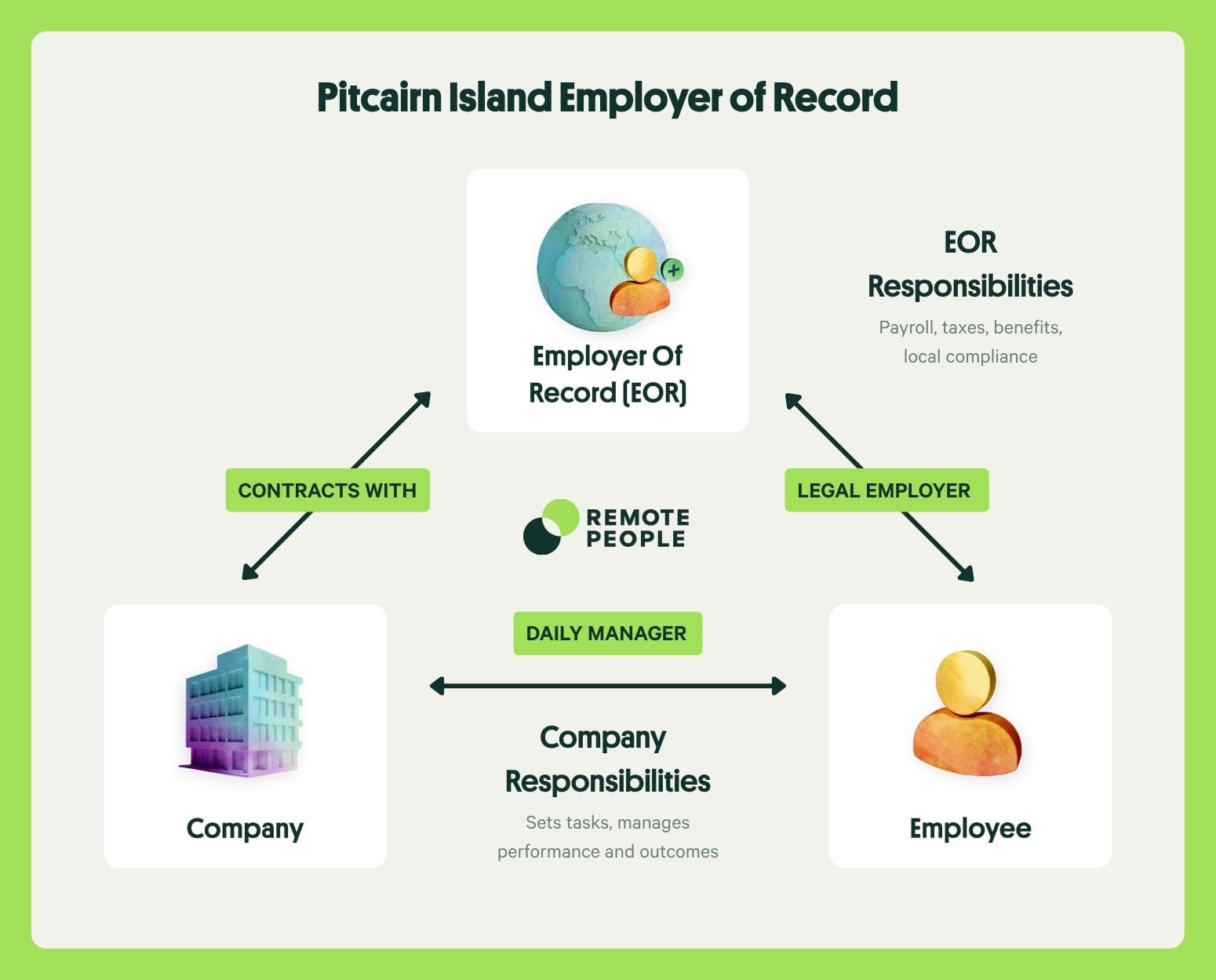
If you’d like to learn more about how Employer of Record (EOR) services work, read our What Is an Employer of Record (EOR)? guide for a complete overview of the model, its benefits, and when to use it.
If you’re comparing providers, our Best Employer of Record (EOR) Providers guide reviews the leading platforms to help you choose the right solution for your business.
Employment Laws in Pitcairn Island
Pitcairn Island is a British Overseas Territory, administered by a Governor who is also the British High Commissioner to New Zealand. Its legal system is built from Orders in Council made by the UK Privy Council, local Ordinances enacted by the Governor in consultation with the Island Council, and the general principles of English common law as they stood at the relevant reception date and as developed since.
The foundation document is the Pitcairn Constitution Order 2010, which sets out the structure of government, the role of the Governor, the Island Council, and a fundamental rights chapter that mirrors the European Convention on Human Rights. The Constitution does not itself regulate private employment, but its fundamental rights chapter, particularly the protection against discrimination and the protection of private and family life, sits above any contractual arrangement.
Below the Constitution, the Revised Laws of Pitcairn are organised into numbered Chapters. For employment-adjacent questions, the most relevant ordinances are:
- Immigration Ordinance 2014 (Cap 12), which controls who may enter and remain on Pitcairn Island and is the starting point for any foreign hire.
- Right of Abode Ordinance 2010 (Cap 43), which defines who is entitled to live on Pitcairn Island as of right.
- Social Welfare Benefits Ordinance 2014 (Cap 22), which is the closest local equivalent to a social security framework and covers old age, disability, and hardship benefits administered by the Government of the Pitcairn Islands.
- Trade Unions and Trade Disputes Ordinance (Cap 23), which regulates the formation of unions and the settlement of collective disputes but does not set individual employment minima.
- Judicature (Courts) Ordinance, which confirms the application of English common law, the doctrines of equity, and statutes of general application, subject to local modification.
There is no dedicated Employment Ordinance, Labour Code, or Minimum Wage Ordinance on the PacLII alphabetical list of revised Pitcairn laws or on the Government of the Pitcairn Islands’ official laws page. That is not an oversight. The Island Council has simply never needed to pass one because of the size and structure of the workforce.
Employer and employee contributions: not applicable on Pitcairn
The standard EOR guide at this point includes tables showing the employer’s and employee’s payroll contribution rates. For Pitcairn Island, those tables are not applicable. Pitcairn does not operate a national pension scheme funded by payroll contributions, does not levy income tax on residents, and does not run a statutory health insurance scheme funded by wage deductions. Social welfare benefits under Cap 22 are paid out of general Government revenues, primarily philatelic sales, customs duties, honey sales, and UK grant-in-aid, rather than from employer or employee payroll contributions. There is therefore no meaningful employer payroll-tax table to reproduce here, and any figure stating otherwise should be treated with scepticism unless it cites a specific Pitcairn ordinance.
Income tax: not applicable
Pitcairn Island does not impose a personal income tax on its residents. Successive editions of the Revised Laws contain a Revenue Ordinance that deals principally with customs duties, licensing fees, and the collection of Government revenue, but there is no Income Tax Act in the sense used in New Zealand, the United Kingdom, or Australia. Residents are not required to file an annual income tax return in Pitcairn, and there is no PAYE system comparable to New Zealand’s or the UK’s.
A very small number of third-party commentators list a “flat 10 percent” rate for Pitcairn. Our review of the revised Pitcairn laws on PacLII and on the official Government of the Pitcairn Islands laws portal did not identify any ordinance in force that imposes such a rate on employment income. We therefore do not reproduce a tax brackets table for Pitcairn Island, and we recommend that any company relying on a specific Pitcairn tax figure obtain written confirmation from the Office of the Governor before including it in a contract.
Working hours, overtime, and minimum wage
There is no statutory maximum working week, no statutory overtime premium, and no statutory minimum wage that applies across private employment on Pitcairn Island. In practice, the Government of the Pitcairn Islands is the largest local employer and publishes its own rates of pay and working-time arrangements for public works, island maintenance, medical services, and administration, typically expressed in New Zealand dollars per hour. Those public-sector rates are set by the Island Council and the Governor, not by a generally applicable wage law.
For any private engagement, the hours, rest periods, and overtime treatment are whatever the contract says. If you are using an EOR-style structure where the worker is actually resident in another country, the working-time rules of that country of residence will control.
Anti-discrimination and fundamental rights
The Pitcairn Constitution Order 2010, sections 22 and 23, prohibits discrimination on grounds including race, colour, sex, disability, language, religion, political or other opinion, national or social origin, age, or birth. These provisions apply vertically to the Government and, through the general law, inform the interpretation of private contracts. Any employment contract executed for work in Pitcairn should therefore mirror standard non-discrimination clauses.
Work Permits and Settlement in Pitcairn Island
Most EOR guides have a chapter on work permits. Pitcairn Island does not issue work permits in the way Australia, New Zealand, the UK, or the EU member states do. There is no points-based system, no temporary skilled worker route, and no employer-sponsored visa class.
Instead, the Immigration Ordinance 2014 (Cap 12), together with the Right of Abode Ordinance 2010 (Cap 43) and the published settlement policy of the Government of the Pitcairn Islands, controls who may enter and remain on the island. The categories broadly fall into three groups.
The first group is people who already have the right of abode under Cap 43. This mainly covers Pitcairners by descent and their immediate family members. People in this category do not need any settlement permission to live and work on the island.
The second group is dependants and spouses of people with the right of abode. They may apply for settlement on a family basis, subject to the usual checks on character, background, and ability to integrate into a community of under fifty people.
The third group is prospective settlers with no family connection to Pitcairn. The Government of the Pitcairn Islands operates a settlement scheme that has been described by the Governor’s Office as available only in exceptional circumstances. Applicants must demonstrate financial self-sufficiency, relevant skills of value to the community, good character, and the physical and mental capacity to live on a remote island with limited medical infrastructure. Applications are reviewed by the Immigration Division and, for substantive decisions, by the Governor.
Short-term visitors do not receive work permits. A landing fee is payable, and tourists are typically limited to stays of up to fourteen days without specific permission for longer. Remote workers wanting to “try out” life on Pitcairn must apply under the settlement process if they wish to remain beyond the standard visitor allowance.
Because there is no conventional work-permit pipeline, an EOR cannot sponsor a work visa into Pitcairn Island on your behalf. If your candidate is not already a Pitcairner by descent or by family connection, the realistic path is the settlement process directly with the Government, which is slow, heavily scrutinised, and far removed from the standard EOR timelines of a few weeks.
Payroll, Taxes, and Social Security
The previous sections established that Pitcairn Island does not impose income tax on employment earnings and does not operate a payroll-based social security scheme. That means there is no monthly PAYE filing, no employer national insurance return, no pension remittance, and no statutory health levy to process for work physically performed on Pitcairn.
For any EOR-style arrangement, the practical payroll picture looks like this:
- Gross-to-net calculation: net pay equals gross pay, subject only to any voluntary deductions the worker has authorised, such as charitable contributions or private insurance premiums.
- Currency: the New Zealand dollar (NZD) is the de facto currency of Pitcairn Island. US dollar contracts are also common for remote roles.
- Pay cycle: monthly or fortnightly, at the parties’ election. The Government of the Pitcairn Islands pays its own staff on a fortnightly basis.
- Local filings: none, other than customs declarations on imported goods and any business-licensing obligations applicable to a commercial operator physically present on the island.
- Social security: Pitcairn residents who reach the qualifying age receive old-age benefits under the Social Welfare Benefits Ordinance 2014 (Cap 22), funded out of general revenue. Private employers are not required to contribute, but may choose to offer a supplementary retirement arrangement through a New Zealand or UK pension provider.
Where the worker is physically located outside Pitcairn, the payroll rules of the country of actual residence apply instead. This is one of the main reasons EOR providers typically route Pitcairn-connected engagements through the worker’s country of residence, usually New Zealand.
Cost of Hiring Through an EOR in Pitcairn Island
A standard country guide would show a detailed employer-cost breakdown at this point. For Pitcairn Island, the calculation is unusually clean precisely because the statutory on-costs are absent. For a hypothetical gross salary of NZD 60,000 per year paid to a worker resident on Pitcairn, the employer cost stack looks like:
- Gross salary: NZD 60,000
- Employer payroll taxes: not applicable
- Mandatory pension contributions: not applicable
- Mandatory health insurance contributions: not applicable
- Workplace accident insurance: not a standalone statutory levy on Pitcairn
- Private medical cover (recommended, optional): variable
- EOR service fee (estimate): NZD 7,200 to NZD 12,000
Total employer cost: approximately NZD 67,200 to NZD 72,000 before any privately provided benefits.
The EOR service fee range above is indicative only. Because no provider currently operates a Pitcairn-registered entity, any “EOR in Pitcairn” quote you receive in practice will be for an engagement structured through the worker’s country of residence, typically New Zealand, and will carry that country’s statutory on-costs. For a genuinely Pitcairn-based worker, the realistic cost gap between employment and contracting is small, because neither model triggers local payroll taxes.
Start hiring in Pitcairn Island
Let RemotePeople handle payroll, compliance, and HR administration in China so you can focus on building your team.
Employee Benefits in Pitcairn Island
Pitcairn Island has no Leave Ordinance, no Parental Leave Ordinance, and no Sick Leave Ordinance. Statutory leave in the sense used in most jurisdictions does not exist. The Government of the Pitcairn Islands offers its own staff a package of annual leave, sick leave, and compassionate leave, set out in internal Public Service terms and conditions, but those terms do not bind private employers or remote-work arrangements.
For a private EOR-style engagement, the workable approach is to draft leave entitlements directly into the employment contract and benchmark them against a sensible reference jurisdiction. New Zealand’s Holidays Act 2003 and Parental Leave and Employment Protection Act 1987 provide the most natural reference points, because the Pitcairn community is closely tied to New Zealand and most returning Pitcairners are familiar with New Zealand norms.
A reasonable contractual benefits package for a Pitcairn-connected remote worker in 2026 typically includes:
- Annual leave: 20 to 28 working days per year, accruing pro rata.
- Public holidays: the 9 Pitcairn public holidays listed below, paid.
- Sick leave: 10 to 15 working days per year, with medical certification for absences over three days.
- Parental leave: aligned to the New Zealand 26-week paid parental leave standard, either employer-funded or topped up above any government benefit.
- Bereavement and compassionate leave: 3 to 5 working days per event.
- Private medical insurance: strongly recommended, covering both Pitcairn medical services and evacuation to New Zealand or French Polynesia.
None of these items are statutory on Pitcairn. They are contractual. That gives the parties flexibility, but it also means the worker has no minimum floor to fall back on if the contract is silent, which is a strong argument for drafting the package carefully.
Termination and Severance in Pitcairn Island
There is no statutory notice period, no statutory severance formula, and no unfair-dismissal regime of general application on Pitcairn Island. The framework is whatever the contract says, read in light of English common-law principles of wrongful dismissal and the general duty of mutual trust and confidence.
That means the standard EOR tables showing minimum notice by length of service and severance by length of service do not apply. We do not reproduce them here because any numbers we printed would be fabricated rather than sourced from a Pitcairn statute.
In practice, a well-drafted Pitcairn-connected employment contract will specify:
- A notice period for each party, commonly four to twelve weeks depending on seniority.
- Grounds on which summary dismissal is permitted without notice, typically gross misconduct as understood at English common law.
- A severance or redundancy payment formula, if any, set by agreement rather than by statute.
- A governing law and jurisdiction clause, normally English law or New Zealand law, with a forum-selection clause pointing to the courts of England and Wales, New Zealand, or the Pitcairn Islands Supreme Court depending on the parties’ preference.
- A dispute-resolution ladder that typically begins with internal discussion and escalates to mediation and then litigation or arbitration.
For any termination that is carried out while the worker is physically in a third country, the mandatory employment-protection rules of that country may apply even if the contract chooses English or New Zealand law, because most jurisdictions treat local employment protections as overriding mandatory rules.
EOR vs Contractor vs Local Entity in Pitcairn Island
When companies compare engagement models for a Pitcairn-connected worker, the practical trade-offs look like this:
A direct contractor arrangement under English-law principles is by far the most common structure. It is fast to set up, generates a single invoice per month in NZD or USD, and creates no local filing obligation on the company. The main risk is misclassification, but because Pitcairn does not operate a statutory employment test, the misclassification risk bites in the worker’s country of actual residence, not in Pitcairn itself.
An Employer of Record arrangement, in the classic sense of a local registered entity employing the worker on your behalf, is not currently available with a Pitcairn-registered entity. Providers that list Pitcairn on their coverage maps are in practice offering either contractor engagement or employment through a New Zealand entity. If the worker spends meaningful time in New Zealand, a New Zealand EOR is the cleanest solution and brings the worker under the Holidays Act, KiwiSaver, and PAYE.
Setting up a local entity on Pitcairn is theoretically possible under the Companies Ordinance but is rarely done in practice for remote employment purposes. The administrative overhead and the absence of a commercial registry geared to foreign investors make it uneconomic for a team of one or two people.
For almost every real-world hiring scenario we see on Pitcairn, the decision tree is: is the worker physically on Pitcairn or in New Zealand today? If on Pitcairn, a direct contractor agreement under English law is the default. If in New Zealand, a New Zealand EOR is the cleanest route. If neither, the EOR sits in the worker’s country of actual residence.
Public Holidays in Pitcairn Island (2026)
Pitcairn Island observes nine public holidays each year. The list below reflects the 2026 calendar as published by the Government of the Pitcairn Islands and cross-checked against independent holiday databases.
Pitcairn Island public holidays · 2026 | ||
Date | Day | Holiday |
|---|---|---|
1 January 2026 | Thursday | New Year’s Day |
23 January 2026 | Friday | Bounty Day |
3 April 2026 | Friday | Good Friday |
6 April 2026 | Monday | Easter Monday |
25 April 2026 | Saturday | ANZAC Day |
13 June 2026 | Saturday | King’s Birthday |
2 July 2026 | Thursday | Pitcairn Day |
25 December 2026 | Friday | Christmas Day |
26 December 2026 | Saturday | Boxing Day |
| Source: Government of the Pitcairn Islands; movable feasts verified against the Western Christian calendar. King’s Birthday falls on the second Saturday in June. | ||
Bounty Day (23 January) commemorates the burning of HMAV Bounty in Bounty Bay in 1790 and is the single most important local public holiday. Pitcairn Day (2 July) marks the date the island was sighted by Philip Carteret in 1767 and is also observed, in some years, over the adjacent weekend. ANZAC Day follows the New Zealand and Australian practice.
Getting Started: Hiring in Pitcairn Island with RemotePeople
If you need to engage a worker connected to Pitcairn Island, the practical sequence we recommend is:
- Confirm where the worker will physically sit. This single question drives everything downstream. A worker physically on Pitcairn is a very different problem from a worker in Auckland who happens to be Pitcairn-born.
- Check the worker’s immigration status. Right of abode under Cap 43, family settlement under Cap 12, or third-country settlement each have different constraints and timelines.
- Choose an engagement model. For a worker physically on Pitcairn, a direct contractor agreement is almost always the right answer. For a worker in New Zealand, a New Zealand EOR is the cleanest route. For a worker anywhere else, use an EOR in the country of actual residence.
- Draft the contract carefully. Because so few matters are regulated by Pitcairn statute, the contract does more work here than in any mainstream jurisdiction. Pay particular attention to notice, termination, leave, benefits, governing law, and dispute resolution.
- Set up payroll in the right currency. NZD is the default on Pitcairn. USD is acceptable for remote arrangements but should be documented with a clear conversion mechanism.
- Plan for remoteness. Internet connectivity, shipping, medical evacuation, and timezone overlap all need to be considered up front rather than discovered two weeks into the engagement.
RemotePeople operates across every British Overseas Territory and every Pacific jurisdiction where a live EOR arrangement is realistic, and we work with Pitcairn-connected engagements through our New Zealand and UK structures. If you would like us to assess your specific scenario, book a call with our team and we will walk through the options and the likely timeline in detail.
Frequently Asked Questions
No provider currently maintains a Pitcairn-registered local entity dedicated to EOR services. Global providers that list Pitcairn on their coverage maps deliver the service either through contractor agreements or through employment entities in New Zealand, the United Kingdom, or the worker's country of actual residence. RemotePeople structures Pitcairn-connected engagements through its New Zealand and UK operations.
No. Pitcairn Island does not levy a personal income tax on employment earnings. There is no PAYE system and no annual income tax return. Customs duties, licensing fees, and other Government revenue are governed by separate ordinances and do not function as wage withholding taxes.
There is no statutory minimum wage on Pitcairn Island. The Government of the Pitcairn Islands sets its own rates for public-sector and island-service work in NZD per hour, but those rates do not bind private employers. Contractual remuneration is negotiated directly between the parties.
Pitcairn Island observes nine public holidays each year: New Year's Day, Bounty Day, Good Friday, Easter Monday, ANZAC Day, King's Birthday, Pitcairn Day, Christmas Day, and Boxing Day. Bounty Day on 23 January is the most significant local holiday.
No. Pitcairn Island does not operate an employer-sponsored work-permit system. Entry and settlement are governed by the Immigration Ordinance 2014 (Cap 12) and the Right of Abode Ordinance 2010 (Cap 43), with third-country applicants assessed under a settlement scheme that the Governor's Office describes as available only in exceptional circumstances.
English law or New Zealand law are the two most common choices. English law provides the most developed body of common-law principles on employment and contract, while New Zealand law is the most natural fit where the worker spends meaningful time in New Zealand or where the Government of the Pitcairn Islands is based through the Governor's Office in Wellington.
No. There is no national pension scheme, statutory health insurance scheme, or employment insurance scheme funded by employer payroll contributions on Pitcairn Island. Social welfare benefits under the Social Welfare Benefits Ordinance 2014 (Cap 22) are paid from general Government revenue.
The New Zealand dollar (NZD) is the de facto currency of Pitcairn Island and is the default choice. US dollar contracts are also common for remote engagements and should include a clear FX conversion mechanism to avoid disputes.
Employer of Record in
Employer of Record in
Employer of Record in
Employer of Record in
Employer of Record in
Employer of Record in
Employer of Record in
Employer of Record in