
 Recruit
Employer of Record in Kansas
-
 Drew Donnelly
- Published
- September 22, 2026
Kansas employment law includes mandatory paid leave, no state income tax, and labor rules, and a Kansas EOR handles payroll and full state compliance with no local entity needed.
Hire in Kansas — book a free 30-minute demo
Tell us what you need. You'll get a tailored, transparent proposal within 24 hours, plus a free call to walk through it.
Tell us about your company
So we can match you with a specialist who knows your market — and unlock volume pricing tiers.
* All fields are required.
Where and when are you hiring?
Tell us the geography and timing and we'll quote each country line by line, with onboarding timelines.
* All fields are required.
Help us beat your current setup
We'll benchmark your current deal and send a line-by-line proposal in 24 hours — showing exactly where we cut cost, time, or risk. After you submit, you can book a call to walk through it together.
* All fields are required.
Thanks! Your proposal is on its way.
Expect a tailored, line-by-line proposal in your inbox within 24 hours. In the meantime…
Want to walk through it together?
Book a free 30-minute call with one of our specialists. We'll explain every line, answer your questions, and tailor the proposal further if you need.
No obligation. Pick a time that works for you.








- Hire in Kansas — book a free 30-minute demo
- Tell us about your company
- Where and when are you hiring?
- Help us beat your current setup
- Thanks! Your proposal is on its way.
- Kansas Employer of Record
- What Is the Difference Between a Kansas Employer of Record and PEO?
- How Does a Kansas Employer of Record Work?
- How Labor Laws Affect Hiring in Kansas?
- Payroll Taxes and Employer Cost in Kansas
- Employee Classification Rules in Kansas
- What Makes Hiring in Kansas Unique?
- What Are the Benefits of a Kansas Employer of Record?
- What Are the Downsides of a Kansas EOR?
- How to Choose a Kansas Employer of Record?
- Engage a Kansas Employer of Record with RemotePeople
- Related EOR Destinations

Let RemotePeople handle payroll, compliance, and HR admin worldwide so you can focus on building your team.
According to the latest Federal Reserve Beige Book, Kansas is experiencing a slight but meaningful uptick in economic activity. That’s driven largely by gains in service sector sales and manufacturing orders.
The economy here is defined by aviation, agriculture, and advanced manufacturing. These are industries that are currently hungry for skilled labor. For a business looking to expand, the cost environment is favorable, and the regulatory climate leans distinctly toward the business-friendly side.
We’ll share how to hire in Kansas to avoid misclassification and minimize HR challenges. You’ll see that partnering with an Employer of Record is the best way to get started.
Kansas Employer of Record
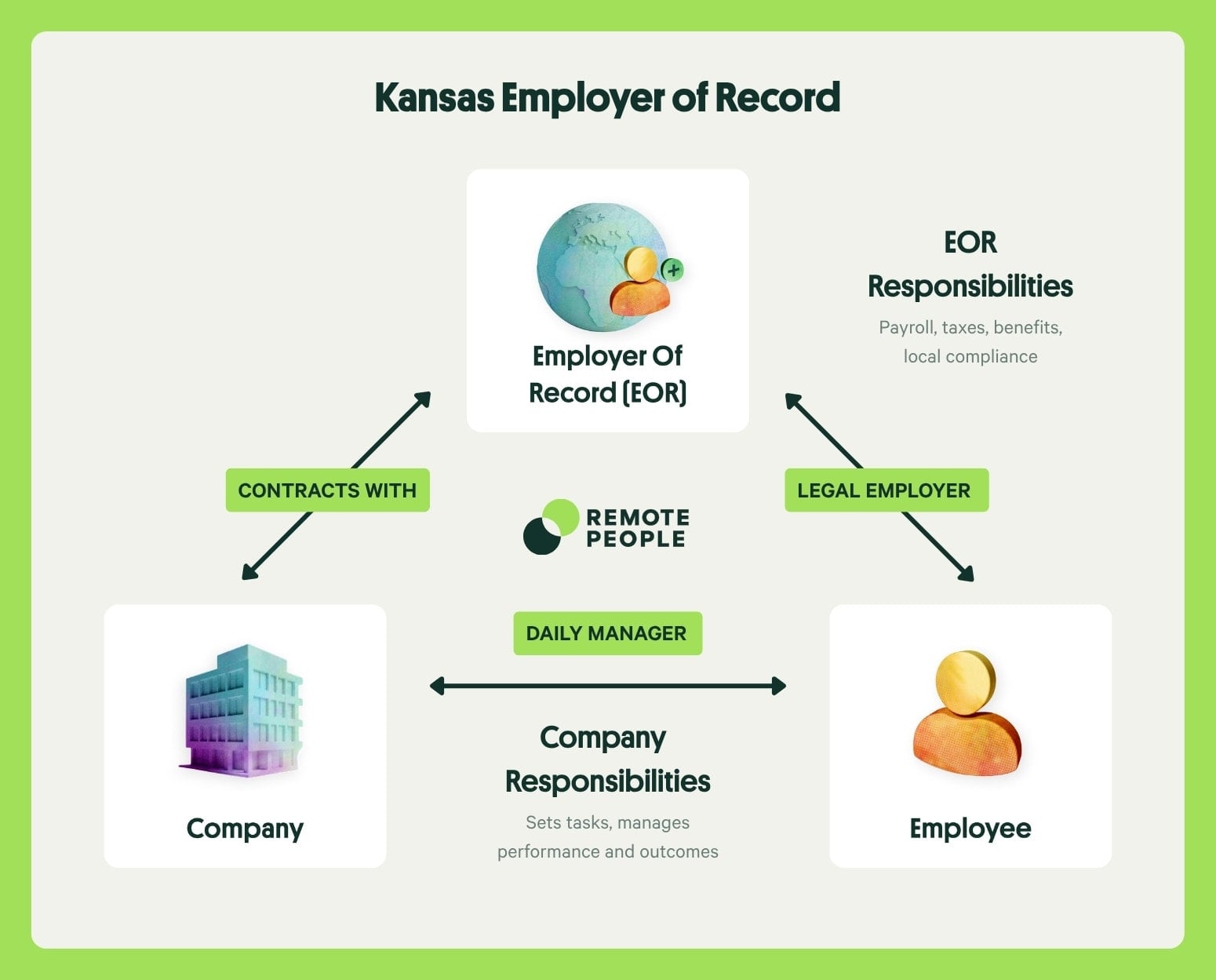
A Kansas Employer of Record is a third-party organization that serves as the official employer for your workers within the state. While the EOR manages all the administrative responsibilities and compliance tasks, your company retains full control over the day-to-day work and strategic direction.
What is an EOR can help explain how this employment model works in more detail.
Here are the primary functions that an EOR can handle:
- State tax registration because the EOR registers your business with the Kansas Department of Revenue for state income tax withholding. It also sets up accounts with the Kansas Department of Labor for unemployment insurance tax and reporting obligations prior to processing any payroll.
- Employment contract generation where the EOR drafts legally sound offer letters and employment agreements. These documents incorporate Kansas-specific requirements. This includes necessary at-will employment language and any provisions related to wage payment laws under the Kansas Wage Payment Act.
- Payroll processing and tax withholding by calculating gross wages, withholding federal income tax, and managing FICA contributions. They also remit the employer’s portion of Social Security and Medicare taxes. Meanwhile, they accurately handle Kansas state income tax withholdings and remit them to the proper authorities.
- Quarterly wage and tax filings to prepare and submit quarterly contribution reports to the Kansas Department of Labor. They also ensure all state withholding tax returns are filed with the Kansas Department of Revenue before the applicable deadlines.
- Worker compensation administration, as the EOR secures workers compensation insurance coverage for all Kansas-based employees. They also manage the processing of any workplace injury claims and handle all necessary reporting to the state’s insurance regulators.
What Is the Difference Between a Kansas Employer of Record and PEO?
At first glance, a PEO and EOR service offer similar services, but there are key differences. We’ll share what they are to help you choose the right one for your hiring needs in Kansas.
PEO
A Professional Employer Organization (PEO) operates on a co-employment model. This means your company must already have a registered legal entity in Kansas. Therefore, you and the PEO share employer responsibilities. They handle HR, benefits, and compliance, but your entity remains on the hook legally.
The PEO aggregates your employees into their larger pool to get you better benefits rates. This is a fantastic solution for domestic companies that are already established in the state and looking to scale their HR infrastructure without building an internal department.
EOR
Conversely, an EOR is the legal employer. You do not need a legal entity in Kansas since the EOR is your entity. This model is typically deployed by international companies or out-of-state businesses hiring employees in Kansas without setting up a local shop.
The positioning advantage here means the EOR assumes all legal employment liability. If a compliance issue arises regarding overtime pay or worker classification, the liability rests with the EOR, not your core business. It’s a risk absorption mechanism that a PEO cannot offer.
Here’s a table outlining the main differences at a glance:
Aspect | PEO | EOR |
|---|---|---|
Legal Entity Required | Yes, your company must be registered in Kansas. | No, EOR uses its own entity |
Employment Liability | Shared (co-employment) | Assumed entirely by EOR. |
Best For | Domestic companies with existing Kansas presence. | International companies or out-of-state businesses testing market. |
Compliance Responsibility | Your company retains ultimate liability. | EOR bears compliance risk. |
Speed to Hire | Slower (requires entity first). | Immediate |
Start hiring with a Kansas EOR
Let us handle the complexities of hiring, compliance, and payroll in Kansas while you focus on growing your team.
- Hire employees in Kansas with a Kansas EOR
- No local entity is needed
- Pricing starts at USD 199 per employee
- RemotePeople can also help you find the best talent in Kansas
How Does a Kansas Employer of Record Work?
Compliant Employment Contract
The EOR drafts an employment contract specifically tailored to meet Kansas standards while reflecting your operational needs. This agreement establishes the terms of employment while ensuring compliance with state statutes. That includes salary, reporting structure, and role expectations.
Crucially, it reinforces Kansas’s at-will employment system, preventing accidental creation of implied contracts that could later invite legal headaches. The employee signs with the EOR, not your company, yet their loyalty and daily work remain entirely yours. Overall, this single document shifts the liability foundation while keeping your brand front and center.
Payroll Setup with Correct State Registrations
The EOR handles the essential task of registering with the Kansas Department of Revenue for withholding tax purposes. Simultaneously, they secure your unemployment insurance account through the Kansas Department of Labor.
These registrations generate the state tax IDs required to legally pay employees in Kansas. Without them, you’re unable to hire employees. The EOR deals with these agency relationships, so you don’t have to spend weeks on hold or deciphering application instructions. When payday arrives, the infrastructure is already humming in the background.
Tax Withholding and Remittance
The EOR calculates federal withholdings, which include Social Security up to the 2026 wage base of $184,500, Medicare, and federal income tax. That’s alongside the Kansas progressive state income tax with rates ranging from 3.10% to 5.70%.
Furthermore, they handle the electronic funds transfers and file the required returns with precision. For employers with 25 or more staff, electronic filing is mandated. The EOR ensures this happens without fail, remitting taxes by deadlines you never have to track. Your employees receive accurate paychecks, and the tax authorities receive their due. You simply approve the payroll run and move on.
Benefits Administration
Attracting top talent in Kansas means offering more than a competitive salary. The EOR leverages its aggregated workforce to provide benefits packages that rival those of established corporate giants.
For example, health insurance, dental coverage, and retirement plans become accessible to your small Kansas outpost. That’s without the volume requirements that typically exclude growing businesses.
Additionally, the EOR handles enrollment, carrier communications, and compliance with federal benefits laws. Your employees feel valued and supported, which translates to loyalty and productivity.
Ongoing Compliance Management
In Kansas, bills like HB 2597 threaten to introduce paid sick leave mandates, while HB 2602 seeks to clarify independent contractor rules. The EOR monitors these developments on your behalf.
When laws change, your employment practices adjust automatically. This means no panicked emails and no scrambling for legal counsel. The EOR updates policies, communicates changes, and ensures your Kansas operations remain compliant through shifting regulatory tides.
This continuous vigilance protects you from the slow creep of non-compliance that catches many DIY employers off guard. Your focus stays on growth while the EOR manages the ever-moving target of employment law.
How Labor Laws Affect Hiring in Kansas?
Minimum Wage & Overtime
Kansas adheres to the federal minimum wage standard of $7.25 per hour. For tipped employees, the rate holds at $2.13 per hour, provided that tips bring the employee up to the standard minimum wage.
Where Kansas diverges from the federal norm is in overtime. While federal law kicks in after 40 hours, the Kansas Wage and Hour Laws stipulate that overtime for employees not covered by the FLSA is due after 46 hours in a workweek. This is a critical distinction for small businesses or specific exempt classifications that might fall solely under state purview.
Income Tax
Kansas collects state income tax through a progressive rate structure that demands attention. For 2026, single filers and heads of household pay 5.2% on income up to $23,000, with amounts above that threshold taxed at 5.58%. Then, married couples filing jointly enjoy a doubled threshold, which is 5.2% up to $46,000, then 5.58% beyond that.
Employers bear the responsibility of withholding these amounts from employee paychecks and remitting them to the Kansas Department of Revenue. The state also offers a personal exemption deduction of $9,160 per qualifying filer, reducing the income subject to tax.
State Unemployment Insurance (SUI)
Kansas transformed its unemployment insurance system in recent years. Starting in 2026, the SUI wage base climbs from a static $14,000 to a dynamic figure tied to the statewide average annual wage.
New employers outside construction enjoy a reduced rate of 1.75%, while construction newcomers pay 5.55%. Established employers see rates ranging from 0% to 6.65%, depending on their experience rating. Furthermore, the state now mandates electronic filing for all employers with 25 or more employees.
Paid Leave
Kansas currently stands as a holdout against paid leave mandates. Private employers face no state requirement to provide:
- Paid or unpaid sick leave
- Vacation time
- Holiday pay
However, the legislative approach is shifting since a bill introduced in January 2026 proposes establishing a right to paid sick leave with minimum accrual and usage rules. Similarly, another bill seeks to create the Kansas Paid Sick Time Act, setting employer obligations for earned sick time. Smart employers monitor these bills closely, as passage would fundamentally alter workforce cost structures.
Workers' Compensation
Workers compensation coverage is mandatory for all employees and corporate officers in Kansas. Unlike states with monopolistic state funds, Kansas permits employers to purchase coverage from private insurance carriers. This goes a long way toward fostering competitive premium pricing.
The maximum weekly benefit rate for injured workers increased to $869 for the period of July 1st, 2025 through June 30th, 2026. Mileage reimbursement for medical travel now sits at $0.70 per mile.
Termination and Final Pay
Kansas operates under at-will employment. This means either the employer or the employee can terminate the relationship at any time. This includes for any reason (that isn’t illegal discrimination or retaliation), or for no reason at all. However, “at-will” does not mean without rules regarding the final paycheck.
Under the Kansas Wage Payment Act, final pay must be delivered to the terminated employee by the next regular payday. If an employee quits without notice, the employer still has until the next regular payday to settle up.
Regarding accrued Paid Time Off (PTO), Kansas law states that payout is dependent entirely on the employer’s written policy. If your handbook says “use it or lose it,” you are legally in the clear, provided you have made that policy clear. Note that failure to adhere to these deadlines can trigger wage penalties, turning a simple goodbye into a costly legal affair.
Payroll Taxes and Employer Cost in Kansas
Building a team in Kansas requires a clear-eyed view of the tax burden. It isn’t just about the salary you offer, but about the cost of employment.
Federal payroll taxes include the employer share of Social Security (6.2% up to the $184,500 wage base) and Medicare (1.45% on all wages).
Then you add the Kansas-specific obligations, which are state income tax withholding (which is the employee’s money, but you are the collector) and the SUI contributions. Also, workers compensation premiums vary by industry risk, but they are a line item in the budget.
Example Cost Breakdown
Consider a salaried employee in Kansas earning $75,000 per year:
Cost Component | Calculation Basis | Annual Amount | Percentage of Salary |
|---|---|---|---|
Base Salary | Employee earnings | $75,000.00 | 100% |
Social Security | 6.2% up to $184,500 wage base | $4,650.00 | 6.2% |
Medicare | 1.45% of total wages | $1,087.50 | 1.45% |
State Unemployment Insurance | 1.75% on first $15,171 | $265.49 | 0.35% |
Workers Compensation (Estimate) | Varies by industry risk classification | $750.00 | 1.0% |
Total Employer Burden | Sum of all employer costs | $6,752.99 | 9.0% |
Total Annual Cost Per Employee | Salary + Burden | $81,752.99 |
Social Security and Medicare contributions form the bulk of the burden, while SUI and workers comp add smaller but necessary layers. This 9% estimated overhead transforms a $75,000 salary into an $81,753 annual investment. It underscores why accurate budgeting separates smart expansion from costly surprises.
Employee Classification Rules in Kansas
Calling someone an independent contractor when they function as an employee is a fast track to penalties. Kansas courts and agencies typically apply a multi-factor test, often looking at the level of control the business exerts over the worker.
Here are the key questions:
- Is the worker free from your control?
- Do they have their own business?
- Are they doing your work, on your schedule, with your tools?
Kansas is currently seeing legislative movement in this space. A bill aims to clarify that voluntary contributions to portable benefit plans (like a 401(k) or insurance) do not automatically turn an independent contractor into an employee.
This is a step toward gig-economy clarity, but the baseline rules remain strict. Penalties for misclassification can include back taxes, fines, and liability for overtime wages. This is a prime example of why an EOR is a valuable partner. They take on the classification risk, ensuring that the person you hired is classified correctly.
What Makes Hiring in Kansas Unique?
What makes hiring in Kansas unique is its compelling duality since it’s a state where aerospace manufacturing giants like Airbus and Spirit AeroSystems coexist. Also, there is a surging healthcare sector that currently leads all job openings.
The workforce here is anchored by practical skills where customer service tops the list, followed by inventory management and welding. It reflects an economy built on moving goods and caring for people.
Furthermore, the labor force participation rate sits at a strong 67.5%, which ranks 8th nationally. This suggests workers are engaged but selective. Finally, the regulatory climate leans business-friendly, where the Kansas Chamber is actively pushing for reform and fighting paid leave mandates.
What Are the Benefits of a Kansas Employer of Record?
Here is what the EOR model delivers for businesses expanding into Kansas:
- No entity setup, thereby skipping the months of paperwork and legal fees required to register with the Kansas Secretary of State. You gain immediate hiring capacity without establishing a formal business presence. This preserves capital for actual growth activities rather than administrative compliance.
- Faster onboarding helps you turn a candidate into a paid and productive employee in days rather than weeks. The EOR infrastructure eliminates waiting periods for tax ID issuance and state registrations. Overall, it lets you capture top talent before competitors finish their paperwork.
- Centralized compliance supports the handling of federal tax filings, Kansas withholding returns, SUI rate management, and labor law postings. Hence, you avoid the administrative chaos of tracking multiple filing deadlines across different agencies with varying requirements.
- Reduced legal risk because the EOR assumes liability for wage claims, overtime violations, and worker misclassification. This shifts employment-related legal exposure away from your core business, protecting your balance sheet from compliance mistakes.
- Scalable across multiple states since you use the same infrastructure to hire in Kansas this month and expand into Missouri or Nebraska next quarter. The model grows with you, eliminating the need to build state-specific compliance expertise internally.
What Are the Downsides of a Kansas EOR?
There is a service fee, typically a percentage of payroll, which can make it feel more expensive than processing payroll yourself. Furthermore, you surrender a degree of direct control over the payroll lever. That’s because you cannot simply log into a bank account and run an off-cycle check without the EOR’s involvement. However, this loss of control is not accurate in many cases.
Additionally, the administrative burden of DIY compliance is a significant time sink. This includes tracking the shifting SUI wage base, filing the KW-3 reconciliation forms, and defending against a potential misclassification audit.
The EOR’s fee essentially buys insurance against that headache, proving far more efficient (and cheaper) than cleaning up a compliance mess after the fact.
How to Choose a Kansas Employer of Record?
Here’s a table to help you choose the ideal Kansas Employer of Record for your business:
Transparent Pricing
Clear upfront fees with no hidden charges for setup or termination. Prevents budget surprises and maintains trust in the partnership.
Direct EOR Structure
A provider that serves as the actual legal employer, not a broker. Eliminates liability gaps and ensures direct compliance accountability.
US Multi-State Expertise
Proven experience across multiple states, including Kansas regulations. Enables seamless expansion beyond Kansas without requalifying vendors.
Dedicated Support
Named contact in US time zones, not an anonymous ticket system. Guarantees a human response when payroll emergencies arise.
Compliance Track Record
Verifiable audit history, proper insurance, and client references. Your compliance safety depends entirely on their track record.
Engage a Kansas Employer of Record with RemotePeople
Expanding into Kansas shouldn’t feel like dealing with complicated tax forms and labor statutes. At RemotePeople, we combine local expertise with global infrastructure to make your entry into Kansas seamless.
Whether you are recruiting engineering talent for the aviation sector or building a remote sales hub, we act as your trusted partner. We’ll handle the payroll, compliance, and legal liabilities while you focus on the performance.
Furthermore, we ensure your hiring is compliant with the latest 2026 tax updates and prepared for upcoming legislative shifts like the proposed paid sick leave mandates.
Do you want to hire the best Employer of Record in Kansas? Then contact us to get started with a proposal.
Employer of Record in
Employer of Record in
Employer of Record in
Employer of Record in
Employer of Record in
Employer of Record in
Employer of Record in
Employer of Record in