
 Recruit
Employer of Record (EOR) in Algeria
-
 Drew Donnelly
- Published
- September 27, 2026
Hire employees in Algeria without setting up a local entity. RemotePeople handles payroll, contracts, tax compliance, and benefits – so you can build your Algeria team in days, not months.
Hire in Algeria — book a free 30-minute demo
Tell us what you need. You'll get a tailored, transparent proposal within 24 hours, plus a free call to walk through it.
Tell us about your company
So we can match you with a specialist who knows your market — and unlock volume pricing tiers.
* All fields are required.
Where and when are you hiring?
Tell us the geography and timing and we'll quote each country line by line, with onboarding timelines.
* All fields are required.
Help us beat your current setup
We'll benchmark your current deal and send a line-by-line proposal in 24 hours — showing exactly where we cut cost, time, or risk. After you submit, you can book a call to walk through it together.
* All fields are required.
Thanks! Your proposal is on its way.
Expect a tailored, line-by-line proposal in your inbox within 24 hours. In the meantime…
Want to walk through it together?
Book a free 30-minute call with one of our specialists. We'll explain every line, answer your questions, and tailor the proposal further if you need.
No obligation. Pick a time that works for you.








- Hire in Algeria — book a free 30-minute demo
- Tell us about your company
- Where and when are you hiring?
- Help us beat your current setup
- Thanks! Your proposal is on its way.
- How an Employer of Record Works in Algeria
- Employment Laws and Regulations in Algeria
- Work Permits and Visas in Algeria
- Payroll, Taxes, and Social Security in Algeria
- Cost of Hiring Through an EOR in Algeria
- Benefits of Using an EOR in Algeria
- Termination and Offboarding in Algeria
- EOR vs. Other Hiring Models in Algeria
- Public Holidays in Algeria
- How to Get Started with an EOR in Algeria
- Where companies hiring in Algeria expand next
- Frequently Asked Questions
- Related EOR Destinations
Start hiring in Algeria
Let RemotePeople handle payroll, compliance, and HR admin worldwide so you can focus on building your team.

Algeria offers real opportunities for businesses expanding into North Africa’s largest market. The country has a growing skilled workforce, a strategic location, and improving infrastructure for doing business. If you want to hire in Algeria without setting up your own legal entity, an employer of record (EOR) is a practical solution. An EOR becomes your official local employer, handling employment compliance, payroll, taxes, and all regulatory requirements. This guide walks you through hiring in Algeria via an EOR in 2026: employment law, work permits, payroll, and how EOR compares to other hiring options.
How an Employer of Record Works in Algeria
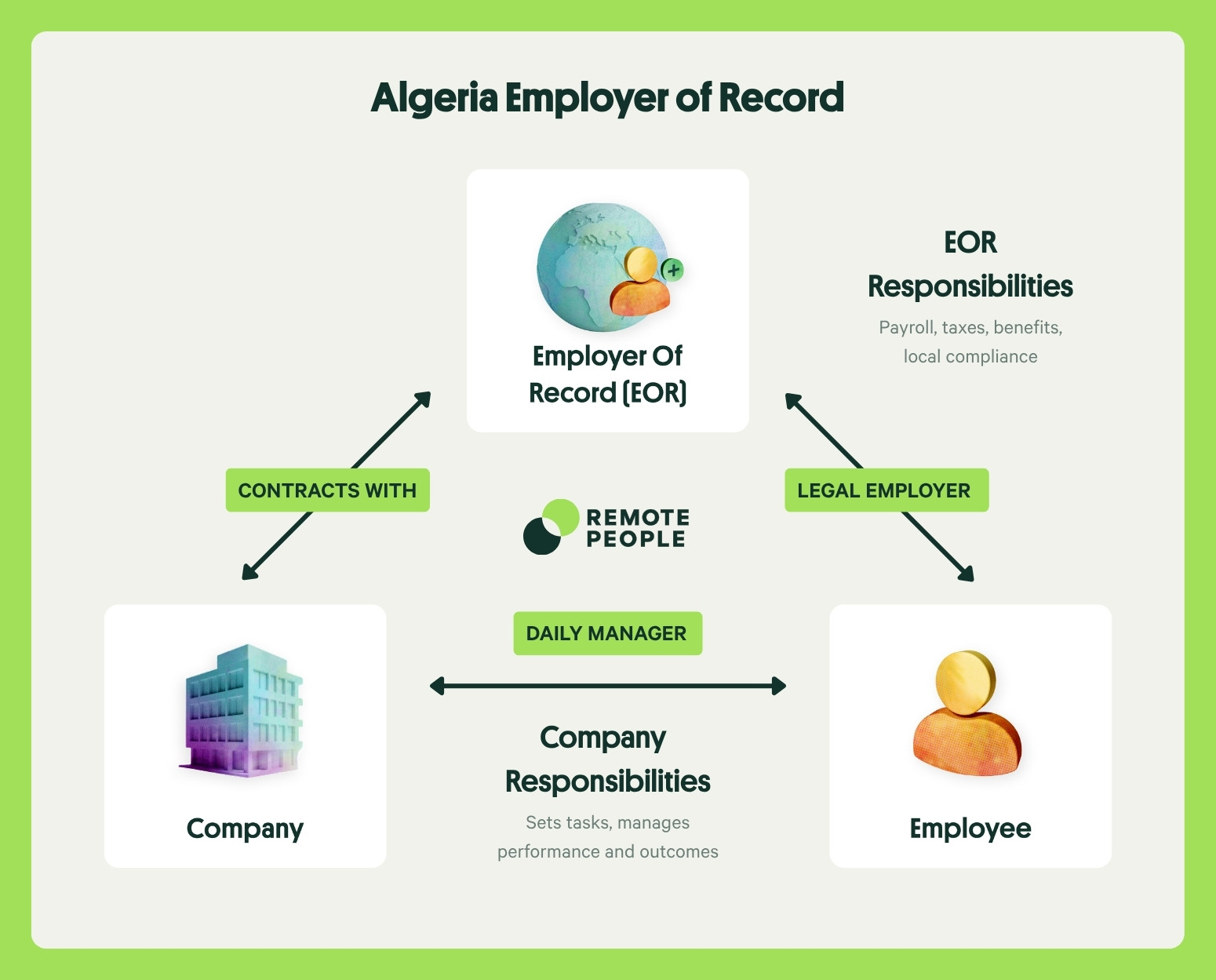
If you’d like to learn more about how Employer of Record (EOR) services work, read our What Is an Employer of Record (EOR)? guide for a complete overview of the model, its benefits, and when to use it.
If you’re comparing providers, our Best Employer of Record (EOR) Providers guide reviews the leading platforms to help you choose the right solution for your business.
Who Uses an EOR in Algeria?
Companies at every stage use EOR services in Algeria. The most common scenario is market testing. You want to hire a few employees before committing to a full legal entity, which takes 3–6 months and costs $15,000–$30,000 to set up. For teams of 1–15 people, the overhead of incorporating simply does not make financial sense. Companies that need to move fast also turn to an EOR because onboarding takes 1–2 weeks rather than months. Organizations hiring foreign nationals benefit from built-in support navigating Algeria’s APT work permit process, which takes 45–60 days on its own. And for any company, offloading compliance to a local legal employer reduces exposure to labor law, payroll, and social security risks.
Typical Onboarding Timeline
After engaging an EOR in Algeria, the process moves quickly. Here is what the timeline looks like:
- First, sign the EOR agreement and provide your new hire’s personal information, job description, and compensation details. This takes 1–2 days.
- Next, the EOR drafts a compliant employment contract under Algerian labour law, reviews it with you, and sends it to the employee for signature. This typically takes 2–3 days.
- From there, social security and tax registration follows, with the EOR enrolling the employee in CNAS, CNR, and CNAC and setting up income tax withholding. Expect 3–7 days depending on agency processing times.
- Payroll setup and benefits enrollment runs in parallel where possible, adding another 2–3 days to configure payment schedules and mandatory benefit programs.
- On day one, the employee receives their signed contract, onboarding materials, and starts working under your direction.
Most EOR providers can onboard an employee in Algeria within 1–2 weeks. If you are hiring foreign workers, add 45–60 days for the APT work permit application, but this runs alongside other steps. Full permit approval usually comes within 60–90 days.
Hire in Algeria
A 26% employer contribution rate, a growing skilled workforce, and strategic access to North African and Mediterranean markets make Algeria a compelling destination for international hiring.
We handle employment contracts, payroll, tax withholding, and full Algeria compliance.
No local entity needed. Your team can start in days.
Employment Laws and Regulations in Algeria
Employment Contracts
Employment agreements in Algeria must be in writing and comply with Labour Law 90-11. The contract should state the job title, duties, salary, location, start date, contract type (permanent or fixed-term), and probation period. Contracts can be written in Arabic or French. Both parties keep a signed copy. Any major changes to the terms need a written amendment signed by both sides.
Working Hours and Overtime
The standard full-time workweek in Algeria is 40 hours, typically arranged as 8 hours per day over 5 days. Employees cannot work more than 40 hours per week without compensation for overtime. Overtime compensation is calculated at 150% of the regular hourly rate for standard overtime and 200% for work on public holidays. Weekly overtime is capped at 8 hours. Keep records of overtime hours and ensure rest between shifts.
Minimum Wage
The national minimum wage in Algeria is approximately $180 per month, effective January 1, 2026, following an increase from the prior year rate of $150. This minimum applies to all full-time employees regardless of sector or industry. Any employment contract that specifies a salary below the statutory minimum is void; the minimum wage prevails by law.
Probation Period
New employees typically start with a 6-month probation period, renewable once for a total of 12 months. Engineers, managers, and other specialized professionals may have a longer probation of up to 12 months, also renewable once. During probation, either side can end the relationship with just 7 days notice and without stating a reason, though the employer still pays earned wages. Once probation ends, full termination rules apply.
Leave Entitlements
Annual Leave
All employees in Algeria are entitled to statutory annual leave. The standard entitlement is 30 calendar days (2.5 days per month of service) for employees in standard regions, and 40 calendar days for those working in designated southern provinces. Leave accrues monthly and may be carried forward to the following year, though excessive carryover may be subject to employer review. Employers typically schedule leave by mutual agreement with employees. Upon termination, any unused accrued leave must be paid out at the employee’s regular rate.
Sick Leave
Employees get paid sick leave for illness or injury. For the first 15 days, they receive 50% of their regular salary. From day 16 onward, the social security fund (CNAS) covers full pay. A doctor’s note is typically needed for absences over 3 consecutive days. If they’re medically unable to work and have documentation, sick leave is unlimited.
Maternity Leave
Female employees get maternity protection. They have 14 weeks (98 days) of leave, fully paid: 6 weeks before delivery and 8 weeks after. The employee needs to notify the employer in writing with medical proof of the due date. The employer must keep the same job (or an equivalent one) open and continue benefits. When she returns, she cannot be demoted or treated unfavorably.
Paternity Leave
Male employees get 3 days of paid paternity leave, to be taken within 30 days of the child’s birth. A birth certificate is needed to claim it.
Other Statutory Leave
Additional leave is provided for specific situations: 3 days for bereavement (spouse, parent, or child), 3 days for marriage, and up to 30 days once in a career for the Hajj pilgrimage. All these leaves are fully paid unless negotiated otherwise in the contract.
Algeria statutory leave entitlements · Per Labour Law 90-11 | ||
Leave Type | Duration | Eligibility & Notes |
|---|---|---|
Annual leave | 30 calendar days (2.5 days/month); 40 days in southern provinces | All employees; accrues monthly; unused leave paid out on termination |
Sick leave | Days 1–15: 50% salary; Day 16+: 100% salary (CNAS covers) | Medical certificate required after 3 consecutive days; unlimited if documented |
Maternity leave | 14 weeks (98 days) total: 6 weeks before delivery + 8 weeks after | 100% paid by employer; job protection; must notify with medical proof |
Paternity leave | 3 days | 100% paid; must be taken within 30 days of child’s birth; requires birth certificate |
Bereavement leave | 3 days | Death of spouse, parent, or child; 100% paid |
Marriage leave | 3 days | Employee’s own wedding; 100% paid; requires marriage certificate copy |
Pilgrimage (Hajj) | Up to 30 days | Once per career; 100% paid; requires Hajj permit documentation |
Source: WIPO Lex Algeria Labour Law 90-11 and Ministry of Labor | ||
Statutory Employee Benefits
Employers in Algeria must provide several mandatory employee benefits beyond base salary. These are funded through the employer and employee social security contributions detailed in the Payroll section below.
All employees are covered by the national health insurance system through CNAS, which funds medical care, hospitalization, and prescription coverage for the employee and their dependents. Employers also contribute 11% of gross salary toward retirement pensions through CNR. Employees can claim benefits at age 60 (men) or 55 (women) after at least 15 years of contributions.
Unemployment insurance through CNAC provides a safety net for workers who are laid off or terminated (not for misconduct), paying up to $135 per month for up to 36 months. Employers pay a separate 1.25% of gross salary for work accident and occupational illness coverage, which handles medical treatment, temporary disability pay, and permanent disability compensation. Family allowances round out the package, providing supplementary payments for employees with dependent children to support education and childcare costs.
Private health insurance and supplementary pension plans are not mandatory in Algeria but some employers offer them as additional benefits to attract talent. An EOR handles all statutory registrations and makes sure contributions are calculated and paid correctly.
Recent Regulatory Updates (2026)
Several employment changes came into effect at the start of 2026. The minimum wage jumped from $150 to $180 per month, and unemployment benefits increased from $113 to $135 per month. Social security rates stayed the same. Update your payroll systems for the new minimum wage and let affected employees know about any salary adjustments.
Work Permits and Visas in Algeria
Work Permit Requirements
Who Needs a Work Permit
All foreign workers in Algeria need a work permit called an APT (Autorisation Provisoire de Travail), regardless of skill or job type. Algerian citizens don’t need one. Working without a valid APT breaks the law and creates serious penalties for both employer and employee.
Eligibility and Required Documents
To get an APT, you must show that you genuinely need the foreign worker and that no qualified Algerian can fill the role (a labor market test). Required documents include:
- Completed APT application form, available from the Ministry of Labor
- Letter from the employer explaining the business need and describing the role
- Job description and required qualifications
- Proof that recruitment efforts were made to find an Algerian candidate (job postings, recruitment records)
- Employee’s passport and birth certificate (certified copies)
- Educational and professional qualifications documentation (diplomas, certifications)
- Medical examination results (tuberculosis and general health screening)
- Employment contract signed by both parties
- Proof of employer registration and business license
Processing Time and Validity
APT applications usually take 45–60 days for the Ministry of Labor to review and approve. Once approved, permits are valid for 2 years and can be renewed. The permit is specific to one employer and role. If the employee changes employers, you need a new application. Processing may take longer during busy periods or if more documents are requested. An EOR handles this entire process, working directly with the authorities.
Renewal Process
Start renewal at least 30 days before the permit expires. The renewal process is similar to the original application and takes 30–45 days. Submit a renewal request with the updated contract, proof of employment, and confirmation that you still need the worker. Employees can keep working on the existing permit during renewal if you file on time.
Common Visa Types for Foreign Workers
Foreign workers entering Algeria need a visa first. Common work visa types are:
- Long-stay work visa: Issued for durations up to 1 year, renewable, and tied to employment with a specific employer. This is the primary visa for formal employment.
- Temporary work visa: Issued for short-term projects or assignments up to 90 days. Does not require the full APT process but still requires employer sponsorship.
- Investor visa: Available to business owners and entrepreneurs establishing operations in Algeria, typically valid for 1–3 years.
- Student visa: Issued to students enrolled in Algerian educational institutions; does not permit employment unless authorized by the Ministry of Education and Labor.
Apply for visas through Algerian embassies or consulates in the home country. Processing usually takes 5–15 business days. The employee applies for the visa first; once approved, the APT work permit process starts.
How an EOR Handles Work Permits
An EOR takes full charge of work permits. It submits the APT application, provides all documentation to the Ministry of Labor, tracks progress, and follows up if more information is needed. The EOR also makes sure the employee understands visa rules and aligns visa approval with the employment start date. Once approved, the EOR keeps the documents and starts renewal before expiration.
Payroll, Taxes, and Social Security in Algeria
Employer Contributions
Employers in Algeria must pay substantial social security contributions for each worker. These fund health insurance, retirement, unemployment, and work accident insurance. You calculate contributions as a percentage of gross salary and pay them monthly to the social security funds. The total is roughly 26% of gross salary.
Algeria employer social security contributions · 2026 rates | ||
Contribution | Rate | Notes |
|---|---|---|
CNAS (health, sickness, maternity, family) | 12.5% | Covers medical care, sick pay (16+ days), maternity benefits, family allowances |
CNR (retirement) | 11% | Employer contribution toward employee’s retirement pension |
Early retirement insurance | 0.25% | Supports early retirement benefits if applicable |
CNAC (unemployment insurance) | 1% | Funds unemployment benefits for laid-off or terminated workers |
Work accident insurance | 1.25% | Covers workplace injury, disability, and occupational illness |
Professional training tax | 1% | Annual tax on total payroll; funds vocational training programs |
Apprenticeship tax | 1% | Annual tax on total payroll; supports apprenticeship programs |
Total employer burden | 28% | Social security 26% (CNAS 12.5% + CNR 11% + early retirement 0.25% + CNAC 1% + accident 1.25%) + payroll taxes 2% (training 1% + apprenticeship 1%) |
Employee Contributions
Employees bear their own mandatory social security contributions, deducted from gross salary before income tax. The total employee contribution is approximately 9% of gross salary and covers participation in all the same social security schemes as employer contributions. These deductions are remitted to the social security authorities on the employee’s behalf.
Algeria employee payroll deductions · 2026 monthly withholdings | ||
Deduction | Rate | Notes |
|---|---|---|
CNAS (health & family) | 1.5% | Deducted from gross salary; covers health and family benefits |
CNR (retirement) | 6.75% | Deducted from gross salary; accrues toward employee’s pension |
Early retirement insurance | 0.25% | Deducted from gross salary; optional early retirement fund |
CNAC (unemployment) | 0.5% | Deducted from gross salary; covers unemployment insurance |
Total employee deductions | 9% | CNAS (1.5%) + CNR (6.75%) + Early retirement (0.25%) + CNAC (0.5%) |
Income tax (IRG) | 0–35% (progressive) | Withheld after social security deductions; based on tax brackets below |
Income Tax
Algeria levies a progressive personal income tax (Impôt sur le Revenu Global, or IRG) on employment income. The tax is calculated on the employee’s annual taxable income (gross salary minus social security contributions). Tax brackets are applied on an annual basis, though employers typically withhold on a monthly basis using an estimate.
Algeria income tax brackets · 2026 | |
Annual Taxable Income (USD) | Tax Calculation |
|---|---|
$0 – $1,800 | 0% (exempt) |
$1,801 – $3,600 | 23% on amount above $1,800 |
$3,601 – $7,200 | $415 + 27% on amount above $3,600 |
$7,201 – $14,400 | $1,390 + 30% on amount above $7,200 |
$14,401 – $28,900 | $3,555 + 33% on amount above $14,400 |
$28,901+ | $8,340 + 35% on amount above $28,900 |
Payroll Cycle
Most employers in Algeria process payroll on a monthly basis, with salary payments due by the last business day of the month or within a few days thereafter. Payment must be made by bank transfer or check; cash payments are legally possible but uncommon for formal employment. Employers must provide each employee with a detailed payslip showing gross salary, all deductions (social security and income tax), net pay, and year-to-date totals. An EOR manages the entire global payroll process for your Algeria team, ensuring timely and accurate payments without requiring a local finance department.
13th Month Salary and Bonus Pay
Algeria does not mandate a 13th month salary or year-end bonus. However, many employers voluntarily provide these as part of their compensation structure or collective bargaining agreements. If an employer chooses to provide discretionary bonuses, the structure, timing, and conditions must be documented in writing. Any bonus paid is subject to the same social security contributions and income tax as regular salary.
Cost of Hiring Through an EOR in Algeria
EOR Service Fees
EOR service fees in Algeria typically range from $300 to $600 per employee per month, depending on the complexity of the role, the EOR provider, and the scope of services included. This fee covers payroll processing, tax filing, social security administration, leave tracking, and basic HR compliance. Additional services such as onboarding consulting, benefits administration, or enhanced reporting may incur additional charges. Fee structures may vary based on whether you hire 1 employee or 10, with potential discounts for larger teams.
Total Employment Cost Breakdown
The true cost of employing someone through an EOR includes the employee’s gross salary plus all employer contributions. The following example illustrates the full cost for a single employee in Algeria:
Algeria employer cost example · $750/month gross · 2026 | ||
Employer Cost | Amount (USD) | % of Gross |
|---|---|---|
Employee gross salary | $750 | 100% |
CNAS employer (12.5%) | $94 | 12.5% |
CNR employer (11%) | $83 | 11% |
Early retirement employer (0.25%) | $2 | 0.25% |
CNAC employer (1%) | $8 | 1% |
Work accident insurance (1.25%) | $9 | 1.25% |
Training tax (1% annual) | $8 | 1% |
Apprenticeship tax (1% annual) | $8 | 1% |
EOR service fee (est. $400/month) | $400 | Flat fee |
Total monthly cost | $1,362 | 128% + EOR fee |
Source: PwC Tax Summaries and Algeria Ministry of Labor | ||
An employee earning $750 per month gross costs the employer about $962 in salary and contributions, a 28% markup above gross. On top of that, the EOR service fee runs $300–$600 per employee per month. When hiring in Algeria, budget for total costs of roughly 1.28 times the gross salary plus the EOR fee. All USD amounts are approximate conversions at $1 = 133 DZD (April 2026 rate).
Ready to expand your team in Algeria? An EOR handles the entire process and makes sure you stay compliant from the start. Contact our team for a free consultation on Algerian hiring costs and timelines.
Benefits of Using an EOR in Algeria
Using an EOR to hire in Algeria has concrete advantages over setting up your own entity. The most immediate is speed: you can onboard employees in 1–2 weeks instead of the 3–6 months needed to register a local entity, open bank accounts, and complete all regulatory filings. That speed comes with full compliance from day one, because the EOR is a licensed Algerian employer that stays current with Labour Law 90-11, social security rules, and tax regulations.
The financial case is straightforward. Entity setup in Algeria runs $15,000–$30,000 upfront plus $10,000–$20,000 per year in maintenance. EOR fees run $300–$600 per employee per month with no hidden overhead. You also get accurate payroll. The EOR calculates all employer contributions (26%), employee deductions (9%), and income tax withholding using current rates, with payslips, filings, and payments handled on time every month.
For foreign hires, the EOR manages the full APT work permit application with the Ministry of Labor, tracks progress, and handles renewals before expiration. Compliance liability for employment law, termination procedures, and social security sits with the EOR, not with your company. And if your plans change, you can scale up or wind down without the fixed costs of a local office or the complexity of dissolving an entity.
Termination and Offboarding in Algeria
Notice Periods
Notice periods in Algeria depend on the position level: general staff get 1 month, supervisors and managers get 3 months, and executives get 6 months. Notice starts when the employee receives written notification and runs through the final day. Either party can terminate with notice, except during probation (where shorter notice applies) or for serious misconduct (where immediate termination is possible).
Severance Pay
Calculation Method
Severance is based on length of service: 1 month of salary per year of service, using the average salary from the highest-earning 3-year period. An employee with 5 years of service gets 5 months of average salary. Employees need at least 2 years of service to qualify; those let go in the first 2 years receive nothing.
Caps and Exceptions
The maximum is 15 months of salary, regardless of how long the employee worked. Severance isn’t due for serious misconduct (theft, violence, insubordination), resignation, or retirement. Even in misconduct cases, the worker gets final wages through the last day and any unused leave.
Grounds for Termination
You can terminate an employee for legitimate business reasons (restructuring, redundancy, role elimination), poor performance, contract breach, or serious misconduct. Document all terminations in writing and follow notice period rules unless it’s serious misconduct. Give the employee a written explanation of why, a final payslip with all accrued salary and leave payouts, and any severance owed.
EOR vs. Other Hiring Models in Algeria
EOR vs. Setting Up a Local Entity
A common question is whether to use an EOR or set up your own legal entity in Algeria. The choice depends on team size, long-term plans, and your strategy.
Algeria EOR vs local entity comparison · Setup time, cost, risk and best-fit | ||
Comparison | Employer of Record | Own Local Entity |
|---|---|---|
Setup time | 1–2 weeks | 3–6 months (business registration, tax ID, bank account) |
Upfront cost | $0 (covered in monthly fees) | $15,000–$30,000 (registration, legal, audit, initial working capital) |
Ongoing cost | $300–$600/employee/month | $10,000–$20,000/year (office, utilities, accounting, compliance staff) |
Local partner required | No (EOR is the local entity) | Yes (foreign companies may need local sponsors in certain sectors) |
Social insurance registration | Handled by EOR | You register and manage directly |
Payroll & tax filing | Handled by EOR | You manage in-house or hire local accountant |
Best for team size | 1–15 employees | 15+ employees; long-term commitment |
Scale down / exit | Easy, no entity to unwind | Costly and time-consuming; legal dissolution required |
Government contracts | Not eligible (EOR is third-party employer) | Eligible (if you are the direct entity) |
Source: Algeria Ministry of Labor and World Bank | ||
For most companies entering Algeria for the first time, an EOR is the faster and cheaper option. You avoid months of registration, legal fees, and the ongoing burden of managing Algerian compliance yourself. The breakeven point is usually around 15 employees: below that, an EOR saves money; above that, a local entity starts to make financial sense.
The main limitation is government contracts. Algeria often requires a locally registered entity to bid on public tenders. If government work is part of your strategy, you may need to set up an entity eventually. Many companies use an EOR to enter the market first and then establish an entity once their team is large enough to justify the investment.
EOR vs. Hiring Independent Contractors
Some companies consider independent contractors in Algeria instead of employees to save money and reduce complexity. However, the risk of misclassification means hiring independent contractors is only appropriate in some cases, such as short-term project work, specialized consulting, or roles with genuine autonomy over schedule and methods.
Algeria EOR vs independent contractors · Compliance, cost, and risk | ||
Comparison | EOR (Full-Time Employee) | Independent Contractor |
|---|---|---|
Legal relationship | Employee of the EOR under employment contract | Self-employed; independent business relationship |
Compliance risk | Low; EOR makes sure full labor law compliance | High; misclassification risk if work resembles employment |
Payroll & tax | EOR withholds taxes, pays social security, files all returns | Contractor self-files taxes; you issue invoice-based payments |
Benefits & leave | Statutory annual leave, sick leave, maternity, public holiday pay | No entitlement; contractor bears all risk and responsibility |
IP protection | Stronger; employment contract assigns IP by default | Weaker; requires explicit written IP assignment clause |
Termination | Subject to notice periods and severance requirements | Contract terms govern; typically more flexible |
Best for | Long-term core team roles, full-time responsibilities | Short-term projects, specialized tasks, temporary support |
Cost structure | Salary + 26% employer contributions + EOR fee | Hourly/project fee (typically higher gross, lower total cost) |
Algerian authorities watch contractor relationships closely. If the work looks like employment (full-time, managed control, regular hours, company tools), they may reclassify the worker as an employee and bill you for back taxes, contributions, and penalties. To use contractors safely, make the relationship genuinely project-based, time-limited, and independent.
If you need someone working full-time on core business tasks with set hours and reporting structure, an EOR employee is the compliant choice. Reserve contractors for genuinely independent specialists working on defined projects with their own tools and schedules. When in doubt, the EOR route is safer in Algeria.
EOR vs. PEO
A Professional Employer Organization (PEO) is different from an EOR, though people confuse them. With a PEO, you already have a legal entity and the PEO co-employs your workers. You stay the primary legal employer; the PEO handles HR and payroll. Algeria doesn’t have formal PEO regulations, and most EOR providers there don’t require you to have a local entity.
Algeria EOR vs PEO comparison · Legal employer, liability, and setup | ||
Comparison | Employer of Record (EOR) | PEO |
|---|---|---|
Legal employer | EOR is the legal employer | Co-employment; you remain primary legal employer |
Local entity required | No; EOR is the local entity | Yes; you must have your own registered entity in Algeria |
Best for | Companies without a local entity; market entry; testing | Companies that already have a local entity |
Compliance liability | EOR assumes compliance responsibility; you are protected | Shared liability between you and the PEO |
Setup time | 1–2 weeks | Weeks to months (depends on your entity setup first) |
Control over HR policies | EOR manages within local law framework; limited customization | More direct control; PEO advises on policy design |
Typical use case | Market entry, small remote teams, scaling test markets | Established local operations needing HR outsourcing |
Source: Algeria Ministry of Labor and World Bank | ||
For most companies entering Algeria without an existing entity, an EOR is the simpler, faster, and cheaper option. If you already have an Algerian subsidiary and want to outsource HR, a PEO-like service might work.
Algeria does not have formal PEO legislation, so co-employment arrangements operate in a grey area. Most international HR providers offering services in Algeria operate as EORs rather than PEOs. If you are evaluating both models, the key question is whether you already have a registered entity in Algeria. If yes, a PEO-style arrangement can handle payroll and HR while you retain direct employment control. If no, the EOR is your only compliant option without setting one up.
Public Holidays in Algeria
Algeria has fixed holidays (same date each year) and moveable holidays (Islamic calendar, so they shift annually). In 2026, there are 10 public holidays. When a holiday falls on a weekend, the following Monday is usually a day off. Workers on public holidays get 200% of their normal pay.
Algeria public holidays · 2026 calendar year | ||
Date | Holiday | Type |
|---|---|---|
January 1 | New Year’s Day | Fixed |
January 12 | Yennayer (Berber New Year) | Fixed |
February 22 | Day of Fraternity and Cohesion | Fixed |
March 20–22 (est.) | Eid al-Fitr (3 days) | Moveable (Islamic) |
May 27–28 (est.) | Eid al-Adha (2 days) | Moveable (Islamic) |
June 16 (est.) | Islamic New Year (Awal Muharram) | Moveable (Islamic) |
June 26 (est.) | Ashura | Moveable (Islamic) |
July 5 | Independence Day | Fixed |
August 25 (est.) | Mawlid (Prophet’s Birthday) | Moveable (Islamic) |
November 1 | Anniversary of the Revolution | Fixed |
Public holidays impact payroll in two ways. First, workers don’t work but get paid in full. Budget for public holiday pay each month. Second, if someone works on a holiday, they get 200% pay plus a day off (or extra pay instead). An EOR automatically includes public holidays in payroll and makes sure correct holiday compensation.
How to Get Started with an EOR in Algeria
Expanding into Algeria via an EOR is straightforward. Here are the steps:
- First, define your hiring needs. Determine the number of employees, job titles, required qualifications, and desired start dates. If hiring foreign nationals, verify visa and work permit eligibility early.
- Next, select an EOR partner. Research EOR providers with experience in Algeria. Verify they understand local labour law, manage work permits, and offer transparent pricing. Request references from existing clients.
- Then, initiate the onboarding process. Provide the EOR with employee information, job descriptions, and employment terms. The EOR drafts the employment contract compliant with Algerian law and handles all regulatory registrations.
- If hiring foreign workers, arrange work permits if hiring foreign workers. The EOR coordinates the APT application with the Ministry of Labor. Provide required documentation (passport, diplomas, medical exam) and plan for 45–60 day processing.
- Finally, set up payroll and benefits. The EOR configures payroll systems, calculates deductions, enrolls employees in social security, and establishes the payment schedule. Review the payroll setup for accuracy before the first payment.
Once you finish these steps, employees are ready to work with full legal protection and compliance. Your EOR partner handles all ongoing compliance, payroll, leave, and filings.
Ready to hire in Algeria? Check our EOR pricing or contact us for a free consultation on hiring in Algeria, including cost estimates and timelines for your situation.
Where companies hiring in Algeria expand next
Teams hiring in Algeria often extend across the Maghreb and into Mediterranean Europe, where shared language and long-standing talent flows overlap. Teams frequently add operations in Tunisia for overlapping Maghreb hiring dynamics; Morocco often follows for the Maghreb-region French-Arabic talent pool; hiring in Egypt is a common next step, offering deep Arabic-fluent workforce overlap; and an EOR partner in France rounds out the regional footprint with deep French-language talent overlap.
Frequently Asked Questions
EOR services in Algeria typically cost between $300 and $600 per employee per month as a flat service fee. On top of that, you pay the employee’s gross salary plus mandatory employer contributions (26% for social security). For a $750/month gross salary, total employer cost including contributions runs about $955–$975 monthly, plus the EOR fee. The exact amount depends on your EOR provider and the employee’s role.
An EOR can onboard someone in 1–2 weeks (contracts, payroll, enrollment). If they’re a foreign national, add 45–60 days for the work permit. Overall, plan on 2–8 weeks depending on whether a permit is needed.
Yes. With a good EOR partner, you’re covered. The EOR is the legal employer and takes full responsibility for Labour Law 90-11, social security, taxes, and regulations. You’re protected from compliance risk.
Yes. A good EOR handles the full work permit (APT) process: gathering documents, working with the Ministry of Labor, tracking approvals. It also advises on visa types and timing to align approval with employment start.
The employment contract defines IP ownership. Standard practice in Algeria assigns all work-related IP created during employment to the client company (you), not the EOR. The EOR makes sure the contract has proper IP assignment language so all intellectual property flows directly to your business.
Yes, but follow Algerian rules. Give general staff 1 month notice, supervisors 3 months, executives 6 months. After 2 years, workers get severance of 1 month per year (max 15 months). The EOR handles all termination rules and final payments.
An EOR sets up formal employment, so the worker becomes an employee. If you need independent contractors instead, RemotePeople also offers a contractor management solution that handles compliant contractor payments, contracts, and classification risk in Algeria. This is important because Algerian authorities actively watch for misclassification, so using a managed contractor service protects you from back taxes and penalties.
A good EOR watches for regulatory changes and updates systems automatically. When Algeria raised the minimum wage from $150 to $180 per month in January 2026, EORs updated client payroll immediately. That’s part of what you’re paying for.
Employer social security contributions in Algeria total approximately 26% of gross salary. This breaks down into 12.5% for CNAS (health insurance and social security), 11% for CNR (retirement pension), 1.5% for unemployment insurance (CNAC), and 1% for work accident insurance. These contributions are mandatory for every employee and must be remitted monthly to the relevant social security funds. An EOR calculates and pays these contributions on your behalf as part of the monthly payroll cycle.
No. An employer of record (EOR) allows you to hire employees in Algeria without establishing a local legal entity. The EOR acts as the official employer on paper, handling employment contracts, payroll, tax withholding, and social security registration. You manage the employee’s day-to-day work. Setting up a local entity in Algeria costs $15,000–$30,000 and takes 3–6 months, so an EOR is the faster and more cost-effective option for teams of 1–15 people.
The best EOR for Algeria depends on your team size, budget, and the level of support you need. Key factors to compare include monthly per-employee pricing (typically $300–$600), onboarding speed, local legal expertise, and whether the provider has a direct entity in Algeria or uses a sub-partner. RemotePeople’s EOR comparison covers the top providers with transparent pricing and compliance details for Algeria specifically.
Employer of Record in
Employer of Record in
Employer of Record in
Employer of Record in
Employer of Record in
Employer of Record in
Employer of Record in
Employer of Record in