
 Recruit
Employer of Record in Morocco
-
 Drew Donnelly
- Published
- September 22, 2026
RemotePeople’s employer of record in Morocco lets you hire employees in Morocco with CNSS compliance. We handle CNSS registration, family allocation contributions of 6.40%, social allocation contributions of 8.60%, and mandatory medical care contributions of 4.11%.
Hire in Morocco — book a free 30-minute demo
Tell us what you need. You'll get a tailored, transparent proposal within 24 hours, plus a free call to walk through it.
Tell us about your company
So we can match you with a specialist who knows your market — and unlock volume pricing tiers.
* All fields are required.
Where and when are you hiring?
Tell us the geography and timing and we'll quote each country line by line, with onboarding timelines.
* All fields are required.
Help us beat your current setup
We'll benchmark your current deal and send a line-by-line proposal in 24 hours — showing exactly where we cut cost, time, or risk. After you submit, you can book a call to walk through it together.
* All fields are required.
Thanks! Your proposal is on its way.
Expect a tailored, line-by-line proposal in your inbox within 24 hours. In the meantime…
Want to walk through it together?
Book a free 30-minute call with one of our specialists. We'll explain every line, answer your questions, and tailor the proposal further if you need.
No obligation. Pick a time that works for you.








- Hire in Morocco — book a free 30-minute demo
- Tell us about your company
- Where and when are you hiring?
- Help us beat your current setup
- Thanks! Your proposal is on its way.
- How an Employer of Record Works in Morocco
- Employment Laws and Regulations in Morocco
- Work Permits and Visas in Morocco
- Payroll, Taxes, and Social Security in Morocco
- Cost of Hiring Through an EOR in Morocco
- Benefits of Using an EOR in Morocco
- Termination and Offboarding in Morocco
- EOR vs. Other Hiring Models in Morocco
- Public Holidays in Morocco
- How to Get Started with an EOR in Morocco
- Where companies hiring in Morocco expand next
- Frequently Asked Questions
- Related EOR Destinations

Start hiring in Morocco
Let RemotePeople handle payroll, compliance, and HR admin worldwide so you can focus on building your team.

Morocco sits at the crossroads of Europe, Africa, and the Arab world, with free-trade agreements covering roughly 55 countries and a workforce concentrated around Casablanca, Rabat, Tangier, and Marrakech. The legal minimum wage (SMIG) increased by 5% on 1 January 2026 to MAD 17.92 per hour, or about MAD 3,422.72 per month (around $372 at current rates), under the 2022 tripartite social agreement. For companies looking to hire employees in Morocco, the compliance layer is dense: Labour Code Law 65-99, Caisse Nationale de Sécurité Sociale (CNSS) registrations, Impôt sur le Revenu withholding, and work permits validated by ANAPEC. An employer of record in Morocco takes on those obligations as the legal employer of your staff, so you can hire, pay, and manage a Moroccan team without setting up a local entity.
This guide walks through how an employer of record in Morocco works, what Law 65-99 requires in 2026, what hiring through an EOR actually costs, and how the model compares with incorporating your own Moroccan entity, hiring independent contractors, or partnering with a PEO. Every figure is verified against the Labour Code, the 2025 Finance Act, CNSS schedules, and the 2026 SMIG decree.
How an Employer of Record Works in Morocco
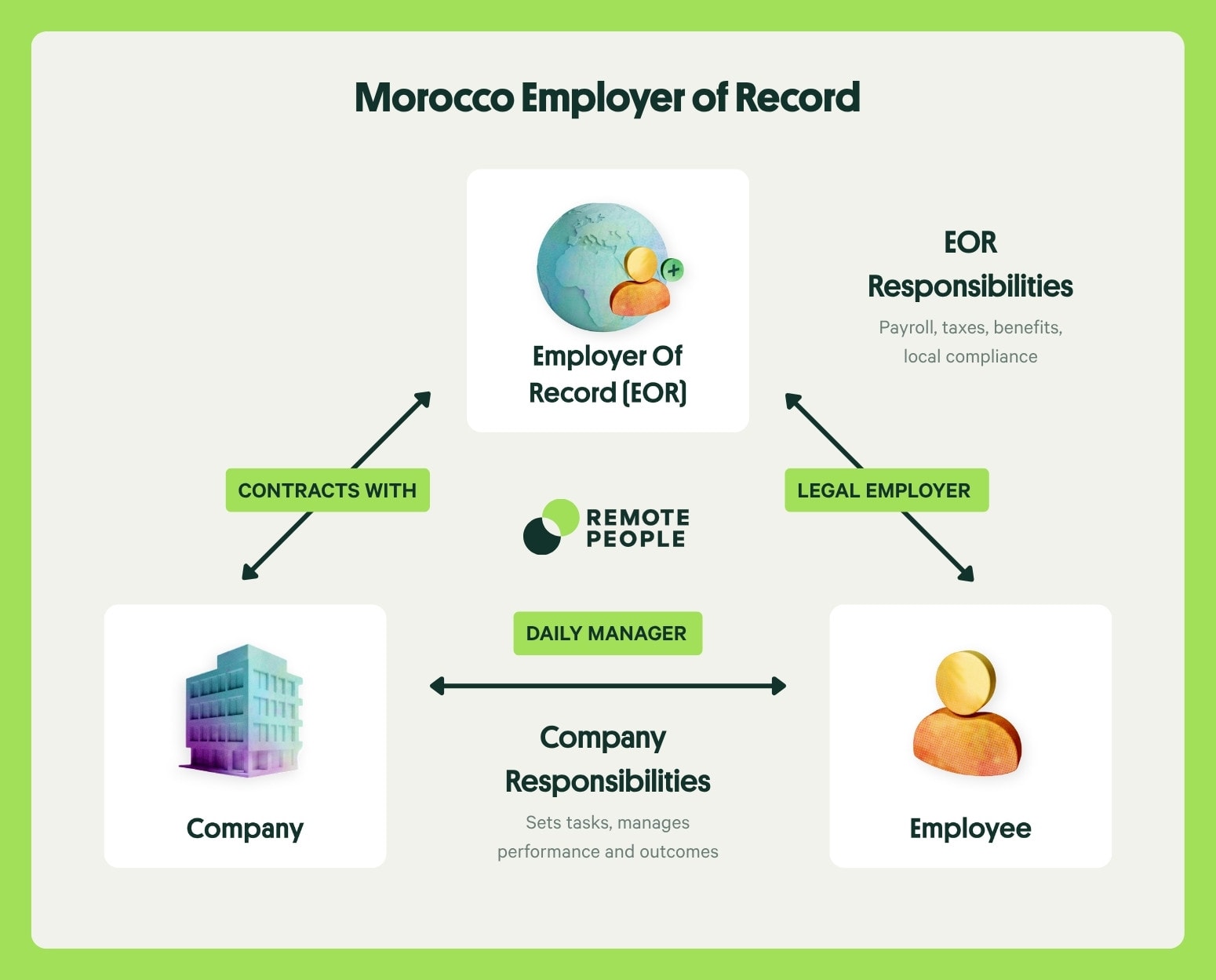
If you’d like to learn more about how Employer of Record (EOR) services work, read our What Is an Employer of Record (EOR)? guide for a complete overview of the model, its benefits, and when to use it.
If you’re comparing providers, our Best Employer of Record (EOR) Providers guide reviews the leading platforms to help you choose the right solution for your business.
Who Uses an EOR in Morocco?
An employer of record in Morocco is typically used by companies that want a compliant hire without committing to the setup and ongoing cost of a Moroccan SARL or branch office. Common scenarios include:
- Market entry testing: a company hiring its first one to three employees in Morocco to validate demand before committing to an entity. The EOR lets you pilot for twelve to twenty-four months and scale down with no dissolution cost.
- Small distributed teams: organisations expanding into North Africa that want five to fifteen employees across Casablanca, Rabat, or Tangier without the MAD 100,000+ capital requirement and registration timeline of a local company.
- Speed-sensitive hires: situations where a priority candidate needs to start within weeks rather than the three-to-six months it typically takes to incorporate, register with CNSS, and open a Moroccan bank account.
- Foreign-national hires: where the employee needs a work permit and contract visa. The EOR, as a Moroccan legal employer, can sponsor the ANAPEC filing and the visa de travail stamp without requiring the client to set up a local subsidiary.
Companies that already operate a Moroccan subsidiary, or that plan to grow past fifteen local employees, will usually find that their own entity makes more sense. The EOR model is purpose-built for small, distributed, or pilot-stage hiring.
Typical Onboarding Timeline
Most EOR providers can onboard an employee in Morocco within one to two weeks when no work permit is required. The stages are sequential but short:
- First, sign the EOR service agreement and share the employee’s details, proposed salary, role, and start date (one to two days).
- Second, the EOR drafts a compliant Labour Code contract in French or Arabic and sends it for employer and employee signature (two to three days).
- Third, CNSS registration (Article 5 of Dahir 1-72-184) and income tax identification run in parallel, along with bank account collection (three to seven days).
- Fourth, payroll is configured, AMO and supplementary benefits are enrolled, and the employee is onboarded into your systems (two to three days).
- Fifth, the employee begins work on the agreed start date.
Timelines extend when a work permit is required (add four to eight weeks for ANAPEC certification and the Ministry of Labour visa), when documents must be legalised at a Moroccan consulate, or when the role is regulated (medical, legal, or engineering professions require licence validation).
Hire in Morocco
A 5% SMIG increase, 21.09% capped CNSS contributions, and a multilingual workforce of French, Arabic, and English speakers across Casablanca, Rabat, and Tangier make Morocco a strong gateway into North Africa.
We handle employment contracts, monthly payroll, CNSS and IR withholding, and full Labour Code 65-99 compliance.
No local entity needed. Your Moroccan team can start in days.
Employment Laws and Regulations in Morocco
Employment Contracts
Employment relationships in Morocco are governed by Law 65-99 (the Labour Code), promulgated by Dahir 1-03-194 of 11 September 2003. The Ministry of Economic Inclusion, Small Business, Employment, and Skills is the primary regulator, and CNSS administers social security. Written contracts are strongly recommended and must be drafted in French or Arabic. Article 18 allows either indefinite (CDI) or fixed-term (CDD) contracts, with CDDs restricted to defined temporary situations such as replacing an absent employee, seasonal work, or project-based roles whose end date is known in advance.
Every contract should specify the job title, salary, probation period, place of work, working hours, and start date. Contracts must be lodged with the Ministry of Labour when the employee is a foreign national (Article 516). Part-time work is permitted provided weekly hours do not exceed 75% of the full-time equivalent.
Working Hours and Overtime
The standard working week in Morocco is 44 hours for non-agricultural sectors (or 2,288 hours per year), and 48 hours per week for agriculture, both set by Articles 184 and 185 of Law 65-99. Daily working time cannot exceed ten hours, and employees are entitled to a weekly rest day of at least 24 consecutive hours. Managerial staff and positions of trust (cadres de direction) may be exempt from the strict hour limits under Article 187, but remain entitled to annual leave and public holidays. Overtime is regulated by Articles 196 to 204 and governed by Decree 2-04-570 of 29 December 2004.
Overtime and Premium Pay Rates
Morocco overtime and premium pay rates · Per Labour Code Law 65-99 | |||
Hour Type | Rate Multiplier | Weekly/Daily Cap | Notes |
|---|---|---|---|
Weekday overtime, daytime (06:00–21:00) | +25% | Max 80 hours per year without inspectorate approval | Beyond the 44-hour weekly base; Article 201 of Law 65-99 |
Weekday overtime, night (21:00–06:00) | +50% | Subject to health and safety rules (Article 172) | Higher premium recognises night-work disruption |
Weekly rest day or public holiday, daytime | +50% | Rest must otherwise be deferred by Article 205 | Applies to the legal public-holiday list (Article 217) |
Weekly rest day or public holiday, night | +100% | Double pay replaces the base rate | Night hours on a Sunday or scheduled holiday |
Agricultural overtime | +25% to +50% | Applied against 48-hour base | Agriculture uses a longer base week under Article 184 |
Annual overtime is capped at 80 hours per year unless the employer obtains written authorisation from the labour inspectorate (Article 196). Overtime premiums are calculated on the base hourly rate excluding the seniority bonus, and the premium must appear as a separate line on the monthly pay slip so CNSS and IR are computed correctly on the full amount.
Minimum Wage
The statutory minimum wage (SMIG, Salaire Minimum Interprofessionnel Garanti) for non-agricultural sectors is MAD 17.92 per hour, equivalent to MAD 3,422.72 per month for the standard 191-hour work month (about $372 at current rates), effective 1 January 2026. This reflects the second 5% increase under the 2022 tripartite social agreement, following the first 5% rise in 2023. The agricultural minimum wage (SMAG) rises to MAD 97.44 per day from 1 April 2026. Sectoral collective agreements, particularly in banking, automotive, and telecommunications, set higher floors. Our minimum wage in Morocco guide covers sector variations and effective dates in detail.
Probation Period
Under Article 14 of Law 65-99, the maximum probation period for an indefinite (CDI) contract is three months for executives and assimilated staff, one and a half months for non-executive employees, and fifteen days for manual workers. Probation can be renewed once, doubling the maximum duration. For fixed-term (CDD) contracts the probation cap is one day per week up to a maximum of two weeks for contracts shorter than six months, and one month for contracts of six months or more. Either party may end the contract during probation without notice or indemnity (Article 13), though eight days’ notice is required once the probation has run for more than one week. Our probation period in Morocco guide covers the renewal mechanics and category rules.
Leave Entitlements
Morocco’s statutory leave framework sits in Articles 231 to 274 of the Labour Code. Annual leave, sick leave, maternity leave, paternity leave, and family event leave are all codified, with maternity and paternity funded by CNSS and most other leave paid by the employer.
Annual Leave
Under Article 231, employees accrue 1.5 working days of paid annual leave per month of service, giving 18 working days per year (equivalent to 21 calendar days when Sundays are included). Entitlement increases by 1.5 days for every five years of continuous service, capped at 30 working days. Leave accrues during the probation period and during paid sick leave. Article 241 requires the employer to schedule at least twelve consecutive working days of leave, and accrued but untaken leave can be carried over by agreement or paid out at termination.
Sick Leave
Sick leave is governed by Articles 271 to 274. An employee must notify the employer within 48 hours and supply a medical certificate for absences of more than four days. Paid sick leave beyond that period is funded by CNSS short-term benefits (indemnités journalières de maladie) at 66.7% of the reference daily wage from the fourth day, subject to 54 working days of contributions in the prior ten months. Employers commonly top up the first four days at full pay. An absence of more than 180 consecutive days, or 180 non-consecutive days over a 365-day period, can be treated as grounds for termination under Article 272 (with severance).
Maternity Leave
Maternity leave is 14 consecutive weeks under Article 152, split as seven weeks before and seven weeks after the expected birth date. CNSS pays the indemnité journalière de maternité at 100% of the average wage over the six months preceding the leave, subject to 54 days of contributions in the prior ten months. The employee’s position is protected, and she may extend unpaid leave by up to 12 additional months. Article 153 prohibits dismissal during pregnancy and for 14 weeks after childbirth.
Paternity Leave
Under Article 269, fathers are entitled to three consecutive calendar days of paid paternity leave, to be taken within one month of the child’s birth. CNSS reimburses the amount at 100% of the reference daily wage, so the leave is cost-neutral to the employer.
Other Statutory Leave
Article 274 lists paid family event leave in addition to annual and sick leave:
- Marriage of the employee: four days.
- Marriage of a child or stepchild: two days.
- Death of spouse, child, parent, or parent-in-law: three days.
- Death of a sibling, grandparent, or grandchild: two days.
- Circumcision or surgery for spouse or dependent child: two days.
- Hajj pilgrimage: unpaid, once during an employee’s career, after five years of service.
Under the Labour Code Law 65-99, the table below summarises every statutory leave entitlement for Moroccan employees. The single most important takeaway for employers is that annual leave accrues from the first month of service, not after a qualifying period, so an EOR must start tracking the 1.5-days-per-month accrual from day one.
Morocco statutory leave entitlements · Per Labour Code Law 65-99 | ||
Leave Type | Duration | Eligibility & Notes |
|---|---|---|
Annual leave | 18 working days (1.5 days/month) | +1.5 days per 5 years of service, capped at 30 days; employer-paid (Article 231) |
Sick leave | Up to 180 days per year | Employer pays first 4 days; CNSS 66.7% from day 4 after 54 days of contributions (Articles 271-274) |
Maternity leave | 14 weeks (7 + 7) | CNSS pays 100% of average 6-month wage; employee may extend unpaid leave up to 12 months (Article 152) |
Paternity leave | 3 days | CNSS-funded at 100%; must be used within 1 month of birth (Article 269) |
Marriage leave | 4 days (self), 2 days (child) | Employer-paid family event leave (Article 274) |
Bereavement leave | 2-3 days | 3 days for spouse, child, parent; 2 days for sibling or grandparent (Article 274) |
Hajj pilgrimage | Up to 30 days, unpaid | Once in career, after 5 years of service (Article 274) |
Public holidays | 13+ paid days per year | Fixed national and moveable Islamic holidays (Article 217) |
Statutory Employee Benefits
Beyond paid leave, Morocco requires employers to provide several mandatory benefits funded through CNSS contributions and collective agreements:
- AMO (Assurance Maladie Obligatoire): mandatory health insurance administered by CNSS, with a combined 6.37% contribution (4.11% employer, 2.26% employee) giving access to the public and affiliated-private care network.
- Retirement pension: long-term CNSS benefits fund the statutory retirement pension (vieillesse), with a combined 11.89% contribution (7.93% employer, 3.96% employee) up to the MAD 6,000 monthly wage ceiling.
- Family allowances (allocations familiales): 6.40% employer contribution on uncapped salary, entitling employees with children to MAD 300 per month for each of the first three children and MAD 36 per month for children four to six.
- Seniority bonus (prime d’ancienneté): Article 350 of Law 65-99 mandates a seniority supplement of 5% after 2 years, 10% after 5 years, 15% after 12 years, 20% after 20 years, and 25% after 25 years, calculated on base salary.
- Work accident insurance: employers must carry a private work accident and occupational disease policy under Law 18-12, with premiums typically 1% to 2% of payroll depending on risk category.
- Vocational training tax (taxe de formation professionnelle): 1.60% employer contribution collected by CNSS and transferred to the Office de la Formation Professionnelle et de la Promotion du Travail (OFPPT).
Voluntary benefits such as supplementary retirement schemes, private group health top-ups, and meal vouchers (tickets restaurant) are common in medium and large employers but are not legally required. See our employee benefits in Morocco guide for a fuller breakdown. Exact contribution rates appear in Table 1 and Table 2.
Recent Regulatory Updates (2026)
Morocco’s employment framework has moved quickly in the past 18 months. The 2025 Finance Act overhauled personal income tax with effect from 1 January 2025, raising the first tax-exempt bracket from MAD 30,000 to MAD 40,000, cutting the lower brackets by up to 50%, and lowering the top marginal rate from 38% to 37% (BDO Morocco tax alert). The family dependant allowance was raised from MAD 360 to MAD 500 per dependant per year, capped at six dependants.
On 1 January 2026 the non-agricultural minimum wage rose 5% to MAD 17.92 per hour. On 1 April 2026 the agricultural minimum wage rises 5% to MAD 97.44 per day. Parliament is also debating a comprehensive Labour Code reform project, following the social dialogue agreement of April 2024, which would standardise notice periods, tighten CDD renewal limits, and revise the severance indemnity schedule. No reform had been enacted as of April 2026.
From 1 January 2026 pension and annuity income paid under basic regimes is fully exempt from income tax (PwC Morocco individual tax summary), completing the transition that applied a 50% exemption in 2025. The measure affects former employees rather than active payroll but is relevant for retention conversations with senior staff approaching retirement.
Work Permits and Visas in Morocco
Work Permit Requirements
Who Needs a Work Permit
Every foreign national working in Morocco for more than three months needs a work contract visa (visa de travail) stamped by the Ministry of Labour, plus a residence permit (carte de séjour) obtained within the first three months of arrival. Exemptions apply to Tunisian, Algerian, and Senegalese citizens under bilateral agreements, and to senior managers of companies holding Casablanca Finance City (CFC) status who benefit from a simplified track. EU, US, UK, and Canadian nationals do not need an entry visa for stays under 90 days but still need a work permit to take up employment (ICLG Corporate Immigration Morocco).
Eligibility and Required Documents
Employers must first secure an ANAPEC attestation confirming no qualified Moroccan national is available for the role, except for positions listed in the exemption catalogue (company directors, high-skilled technical roles, and the bilateral-treaty nationalities above). The dossier filed with the Ministry of Labour includes the employment contract signed by both parties, the ANAPEC attestation, the employee’s passport, qualification certificates (legalised and translated), a medical certificate, a criminal record extract from the home country, and proof of accommodation. The employer attaches its commercial register (registre de commerce) and CNSS number.
Processing Time and Validity
Standard processing time is four to eight weeks once a complete dossier reaches the Ministry of Labour, with ANAPEC pre-screening taking an additional two to three weeks. The work contract visa is initially granted for the contract duration, up to one year, and the carte de séjour matches that validity. CFC-status employers, holders of a fast-track Investment Committee approval, or accredited export-oriented free-zone companies can see timelines compressed to three to six weeks.
Renewal Process
Renewals must be filed with the Ministry of Labour at least one month before the existing permit expires. The carte de séjour is separately renewed at the prefecture where the employee resides. An employee may continue to work while a renewal is pending, provided the filing is made before the expiry date. Fresh ANAPEC attestation is required for most roles unless the employee qualifies for one of the exemption categories.
Common Visa Types for Foreign Workers
Morocco’s immigration framework is administered jointly by the Ministry of the Interior (entry visas, residency) and the Ministry of Labour (work permits). An EOR can sponsor each of the employment-related categories below because it is a registered Moroccan employer. Passport tourist or family-reunification visas do not authorise employment and are outside EOR scope.
Morocco work visa types for foreign workers · 2026 | ||||
Visa Type | Duration | Best For | Leads to APT? | Processing |
|---|---|---|---|---|
Long-term work contract visa | 1 year renewable | Standard full-time employment | Yes, after 3 renewals | 4-8 weeks |
Short-term mission visa | Up to 3 months | Technical missions, secondments, training | No | 2-4 weeks |
Intra-company transfer | 1-3 years | Managers and specialists moving within a group | Yes, after 3 years | 4-6 weeks (ANAPEC-exempt) |
Casablanca Finance City permit | Matches contract | Regional HQ, financial, and service roles at CFC-accredited firms | Yes | 3-6 weeks (fast-track) |
Investor or entrepreneur visa | 1 year renewable | Foreign founders with approved investment plans | Yes | 6-10 weeks via Investment Committee |
Other visa categories do not authorise paid employment and therefore fall outside EOR sponsorship:
- Tourist visa: up to 90 days, no employment rights.
- Student visa: tied to a Moroccan institution, limited part-time work permitted only during study breaks.
- Family reunification visa: accompanying spouse or dependents; separate work permit required if the spouse wishes to work.
- Retirement residency: for non-employed applicants with sufficient income; no labour market access.
How an EOR Handles Work Permits
As the Moroccan legal employer, the EOR owns every employer-side step of the work permit process. It files the ANAPEC attestation (or the exemption request for bilateral-treaty nationals, CFC firms, and listed roles), lodges the employment contract at the Ministry of Labour, and tracks the visa de travail stamp. The employee is responsible for in-person steps that cannot be delegated: the criminal record extract from their home country, the medical examination with an approved Moroccan physician, and the carte de séjour application at their local prefecture.
Work permit sponsorship extends the onboarding window referenced in H3 1.4 by four to eight weeks. RemotePeople’s Morocco EOR covers every employment-linked category in the table above, including CFC and intra-company transfer routes. Nationalities exempt from ANAPEC pre-certification move noticeably faster through the process.
Payroll, Taxes, and Social Security in Morocco
Employer Contributions
CNSS operates the social security system under Dahir 1-72-184, and contributions are filed monthly via the damancom.ma portal. Employer contributions total 21.09% of gross salary, with two branches capped at MAD 6,000 per month and three branches uncapped. The vocational training tax is remitted to CNSS and transferred to OFPPT.
Morocco employer social security contributions · 2026 rates | ||
Contribution | Rate | Notes |
|---|---|---|
Family allowances (allocations familiales) | 6.40% | Uncapped; funds family benefits for dependent children |
Short-term social benefits (sickness, maternity) | 1.05% | Capped at MAD 6,000 monthly salary |
Long-term social benefits (pension, disability, survivors) | 7.93% | Capped at MAD 6,000 monthly salary |
AMO mandatory health insurance | 4.11% | Uncapped; includes 1.85% solidarity contribution |
Vocational training tax (OFPPT) | 1.60% | Uncapped; funds national vocational training programmes |
Total employer CNSS | 21.09% | Capped portion applies only up to MAD 6,000 |
Employee Contributions
Employees contribute 6.74% of gross salary to CNSS, withheld by the employer and remitted monthly alongside the employer share. Two of the three branches are capped at MAD 6,000 per month, mirroring the employer ceilings. AMO is uncapped.
Morocco employee payroll deductions · 2026 monthly withholdings | ||
Deduction | Rate | Notes |
|---|---|---|
Short-term social benefits | 0.52% | Capped at MAD 6,000 monthly salary |
Long-term social benefits (pension) | 3.96% | Capped at MAD 6,000 monthly salary |
AMO mandatory health insurance | 2.26% | Uncapped |
Income tax (IR) | 0-37% | Progressive scale, withheld by employer under Article 73 CGI |
Total employee CNSS | 6.74% | Excludes IR, which varies with bracket |
Income Tax
Morocco levies progressive personal income tax (Impôt sur le Revenu, IR) under Article 73 of the Code Général des Impôts. The 2025 Finance Act rewrote the schedule: the tax-exempt first bracket rose from MAD 30,000 to MAD 40,000, the lower brackets received rate cuts of up to 50%, and the top marginal rate dropped from 38% to 37%. Employees also benefit from a 25% professional expenses allowance (capped at MAD 35,000 per year) and a MAD 500 per dependant deduction (capped at six dependants). The schedule below applies from 1 January 2025 and remains in force for 2026.
Morocco income tax brackets · 2026 | |
Annual Taxable Income (MAD) | Tax Calculation |
|---|---|
Up to MAD 40,000 | Exempt (0%) |
MAD 40,001 to MAD 60,000 | 10% on the excess over MAD 40,000 |
MAD 60,001 to MAD 80,000 | 20% minus MAD 6,000 deduction |
MAD 80,001 to MAD 100,000 | 30% minus MAD 14,000 deduction |
MAD 100,001 to MAD 180,000 | 34% minus MAD 18,000 deduction |
Over MAD 180,000 | 37% minus MAD 23,400 deduction |
Payroll Cycle
Moroccan payroll runs monthly, with salaries paid by bank transfer by the end of the month or within five working days of month-end. Cash payment is legal but uncommon in the formal sector above the SMIG threshold. Employers must produce a bulletin de paie each month showing gross salary, each CNSS line, IR withheld, net pay, and cumulative year-to-date figures. The CNSS declaration and employer contribution payment are due by the 10th of the following month via damancom.ma. Monthly IR remittance (the Prélèvement à la Source) follows the same deadline with a payment to the Direction Générale des Impôts. Annual IR return is filed by 28 February of the following year.
13th Month Salary and Bonus Pay
Morocco does not mandate a 13th month salary. The Labour Code is silent on year-end bonuses, and private-sector practice varies by industry. Banking, telecommunications, and many manufacturing collective agreements pay a 13th-month salary in December; white-collar roles at multinationals often receive a performance-based bonus of one to two months’ salary. Where a 13th month has been paid consistently it can become a customary right (droit acquis) that the employer cannot unilaterally remove. Unlike the 13th-month debate, the seniority bonus (prime d’ancienneté) is mandatory under Article 350, adding 5% at two years of service, 10% at five, 15% at twelve, 20% at twenty, and 25% at twenty-five years of continuous service with the same employer.
Cost of Hiring Through an EOR in Morocco
EOR Service Fees
RemotePeople’s EOR fee in Morocco sits in the $300 to $600 per employee per month band, depending on salary size, benefits complexity, and whether a work permit is sponsored. The fee covers employment contracting, monthly payroll and dirham disbursement, CNSS declarations via damancom.ma, IR withholding, AMO registration, leave tracking, statutory reporting, and compliance monitoring against Law 65-99. Supplementary health insurance, 13th-month bonuses, or specialist equity vesting administration may carry additional add-on charges, but are quoted transparently before onboarding.
Total Employment Cost Breakdown
The table below models the total monthly employer cost in Morocco for a mid-level hire on a USD 2,000 gross monthly salary (approximately MAD 18,400 at April 2026 rates), showing each CNSS contribution, the EOR fee, and the fully loaded cost. The short-term and long-term CNSS branches are capped at MAD 6,000 monthly salary, which is why those line items come in well below their headline rates on higher salaries.
Morocco employer cost example · USD 2,000 gross · 2026 | ||
Employer Cost | Amount (USD) | % of Gross |
|---|---|---|
Gross salary | $2,000.00 | 100.00% |
Family allowances (6.40% uncapped) | $128.00 | 6.40% |
Short-term benefits (1.05% on MAD 6,000 cap) | $6.85 | 0.34% |
Long-term benefits (7.93% on MAD 6,000 cap) | $51.72 | 2.59% |
AMO health insurance (4.11% uncapped) | $82.20 | 4.11% |
Vocational training tax (1.60% uncapped) | $32.00 | 1.60% |
EOR service fee (est.) | $499.00 | 24.95% |
Total monthly cost | $2,799.77 | 140.00% |
Exchange rate: 1 USD ≈ MAD 9.20 (April 2026). Work accident insurance premium (approximately 1%) is quoted separately on a per-client basis.
The fully loaded employer cost sits around 15% above gross once the EOR fee is excluded, reflecting Morocco’s salary-cap design. Without capping, the 21.09% employer CNSS total would apply against the full salary; instead, higher earners’ effective employer rate drops because only AMO, family allowances, and the training tax scale linearly.
Ready to hire in Morocco? Get started with RemotePeople, we handle employment contracts, payroll, CNSS declarations, income tax withholding, and full Labour Code 65-99 compliance. No local entity needed.
Benefits of Using an EOR in Morocco
The EOR model in Morocco solves the practical obstacles to hiring in a market with a Latin civil-law system, a French/Arabic language environment, and active CNSS oversight. Companies choose an EOR because it compresses the timeline, removes the fixed cost of incorporation, and pushes the compliance risk onto a specialised provider:
- Speed to market: an EOR in Morocco can onboard a compliant employee in one to two weeks, compared to three to six months to register a Moroccan SARL, open a bank account, and register with CNSS.
- Compliance assurance: the EOR tracks Law 65-99 changes, the 2026 SMIG rise, the 2025 Finance Act tax scale, and the CNSS contribution schedule on your behalf, with the legal employer carrying primary liability.
- Cost efficiency vs entity: entity setup in Morocco involves approximately MAD 20,000 to MAD 50,000 in registration, notary, and legal fees plus a MAD 100,000 minimum share capital and ongoing compliance overhead; an EOR avoids all of that with a flat per-employee monthly fee.
- Local expertise: RemotePeople’s in-country payroll team handles bulletins de paie in French or Arabic, damancom filings, and Ministry of Labour interactions that would otherwise need a local HR and finance function.
- Flexibility to scale: adding a second or third Moroccan employee is a standard onboarding; removing one is a termination with statutory severance. No entity wind-down or bank account closure is required.
- Risk mitigation: misclassification, under-declared CNSS, or missed IR remittances can trigger back contributions, penalties, and late-payment interest at 3% per month. The EOR absorbs that exposure.
- Employee experience: employees get a compliant Moroccan contract, CNSS and AMO registration, accurate dirham payroll, and access to RemotePeople’s HR support team for day-to-day questions.
Ready to evaluate the EOR model for your Morocco hire? Talk to our team to map the specific timeline, cost, and compliance setup for your first employee.
Termination and Offboarding in Morocco
Notice Periods
Under Article 43 of Law 65-99 and Decree 2-04-469 of 29 December 2004, notice is required for any termination of an indefinite (CDI) contract outside gross misconduct. Either party can initiate notice, and pay in lieu of notice equal to the employee’s salary for the notice period is permitted under Article 51. Duration depends on professional category and tenure.
Morocco statutory notice periods by position level · Per Labour Code Law 65-99 | |||
Position Level | Notice Period | During Probation | Notes |
|---|---|---|---|
Executives and assimilated, less than 1 year | 1 month | None (or 8 days after 1 week) | Cadres and assimilés under Decree 2-04-469 |
Executives and assimilated, 1 to 5 years | 2 months | Not applicable | Cumulative continuous service |
Executives and assimilated, more than 5 years | 3 months | Not applicable | Maximum notice tier |
Employees and workers, less than 1 year | 8 days | None (or 8 days after 1 week) | Non-managerial staff |
Employees and workers, 1 to 5 years | 1 month | Not applicable | Non-managerial staff |
Employees and workers, more than 5 years | 2 months | Not applicable | Maximum non-managerial notice |
Notice is waived entirely in cases of gross misconduct (faute grave) listed in Article 39, such as theft, violence, or prolonged unjustified absence. Fixed-term contracts generally run to their term; early termination without cause triggers damages equal to the remaining contract value. Collective agreements may grant longer notice than the statutory floor.
Severance Pay
Severance (indemnité de licenciement) is owed under Article 53 of Law 65-99 to any employee on an indefinite contract who has at least six months of continuous service and is dismissed without gross misconduct. The formula is expressed in hours of salary per year of service and paid on termination. The reference hourly rate is the gross monthly salary divided by 191, covering base salary, the seniority bonus, and all regular bonuses.
Morocco severance pay schedule by years of service · Per Labour Code Law 65-99 | |||
Years of Service | Severance Amount | Base Salary | Notes |
|---|---|---|---|
1 year | 96 hours (approx. 0.5 months) | Gross monthly salary ÷ 191 × 96 | Tier: first 5 years |
3 years | 288 hours (approx. 1.5 months) | 96 hours × 3 | Tier: first 5 years |
5 years | 480 hours (approx. 2.5 months) | 96 hours × 5 | End of tier 1 |
10 years | 1,200 hours (approx. 6.3 months) | (96 × 5) + (144 × 5) | Second tier: 144 hours/year for years 6-10 |
15 years | 2,160 hours (approx. 11.3 months) | (96 × 5) + (144 × 5) + (192 × 5) | Third tier: 192 hours/year for years 11-15 |
20 years | 3,360 hours (approx. 17.6 months) | Adds 240 hours/year for years 16-20 | Fourth tier: 240 hours/year beyond 15 |
Calculation Method
The severance indemnity formula awards 96 hours of salary per year of service for each of the first five years, 144 hours for years six to ten, 192 hours for years eleven to fifteen, and 240 hours for every year beyond fifteen. The reference hourly rate is the gross monthly salary divided by 191 standard hours. Reference salary includes base pay, the seniority bonus, regular attendance and performance premiums, and any other permanent bonuses. Only reimbursement of expenses (transport allowances, meal vouchers when offered as expense reimbursements, and work-tool allowances) is excluded. Table 13 above shows worked examples so payroll teams can verify their calculations against the statutory minima.
Caps and Exceptions
There is no statutory cap on severance itself, but damages for unfair dismissal (licenciement abusif) are capped at 36 months of salary under Article 41 of Law 65-99. Employees dismissed for gross misconduct lose entitlement to severance, notice pay, and damages; only unpaid salary and untaken vacation pay remain due. Employees on fixed-term contracts are not entitled to Article 53 severance but may claim damages for the remaining term if the contract is broken early without cause. Employees with under six months of service are also excluded from severance, although untaken annual leave still crystallises at termination.
Grounds for Termination
Morocco recognises three lawful termination paths. Mutual agreement (rupture à l’amiable) is commonly documented with a departure agreement and a settlement. Dismissal with cause requires documented grounds under Article 39 (gross misconduct) or economic justification under Article 66 (collective redundancy, which requires prior authorisation from the provincial governor for redundancies affecting 10+ employees in firms of 50+). Dismissal without cause is available but exposes the employer to damages under Article 41, capped at one and a half months’ salary per year of service up to 36 months. Protected categories (pregnant employees for 14 weeks post-birth, union representatives, and employees on sick leave) require additional procedural steps, including prior labour inspectorate approval.
EOR vs. Other Hiring Models in Morocco
EOR vs. Setting Up a Local Entity
Morocco EOR vs local entity comparison · Setup time, cost, risk and best-fit | ||
Comparison | Employer of Record | Moroccan Entity (SARL) |
|---|---|---|
Setup time | 1-2 weeks | 3-6 months |
Upfront cost | $0 | $5,000-$15,000 including MAD 100,000 minimum capital deposit |
Ongoing cost | $300-$600/employee/month | $15,000-$30,000/year in accounting, legal, and registered office fees |
Local partner required | No (EOR is the local entity) | No for SARL, but a local manager or service provider is typical |
Social insurance registration | Handled by EOR via CNSS | You manage CNSS and AMO filings |
Payroll & tax filing | Handled by EOR via damancom.ma | You manage it (or outsource to a local payroll firm) |
Best for team size | 1-15 employees | 15+ employees |
Scale down / exit | Easy, no entity to unwind | Costly, legal dissolution and CNSS deregistration required |
Government contracts | Not eligible | Eligible (requires local entity) |
A Moroccan SARL is the default vehicle for entity-based hiring. Setup involves reserving a commercial name (Certificat Négatif), depositing the minimum share capital (MAD 100,000, though de-facto reduced to MAD 10,000 for smaller SARLs), notarising the articles of association, registering with the commercial court, obtaining a tax identification number, and enrolling with CNSS and AMO. Ongoing compliance carries the full weight of corporate income tax (IS, 12.5% to 35%), VAT filings, payroll tax, and annual statutory audits above MAD 50 million in turnover.
For pilot-stage hiring (one to three employees) or regional expansion (up to fifteen employees), the EOR model is typically faster, cheaper, and lower-risk. Once Morocco becomes a permanent headcount location with more than fifteen staff, or if the company needs to bid on public sector contracts, incorporating a SARL or an SA starts to make financial sense.
EOR vs. Hiring Independent Contractors
Morocco EOR vs independent contractors · Compliance, cost, and risk | ||
Comparison | EOR (Full-Time Employee) | Independent Contractor |
|---|---|---|
Legal relationship | Employee of the EOR | Self-employed, no employment relationship |
Compliance risk | Low, EOR ensures local labour law compliance | Moderate, misclassification risk if relationship resembles employment |
Payroll & tax | EOR handles withholding, CNSS, and IR filings | Contractor invoices you, handles own IR and CPU professional tax |
Benefits & leave | Statutory benefits, paid leave, CNSS, AMO | No entitlement to employee benefits |
IP protection | Stronger, employment contract assigns IP by default | Weaker, requires explicit IP assignment clause |
Termination | Subject to Article 43 notice and Article 53 severance | Contract can be ended per agreement terms |
Best for | Long-term, core team roles | Short-term projects, specialised tasks |
Cost structure | Salary + employer CNSS + EOR fee | Contractor fee (typically higher gross, lower total cost) |
Misclassification exposure in Morocco is real but narrower than in many OECD markets. Article 6 of Law 65-99 defines an employment relationship by four factors: subordination (instructions and supervision), integration into the employer’s organisation, an agreed remuneration, and the performance of personal service. If all four elements are present, labour courts will reclassify the relationship as an employment contract regardless of how the parties labelled it. Consequences include back CNSS contributions with a 3% monthly late penalty, unpaid IR and PAYE withholding, back-dated leave, and severance owed from the original start date.
The contractor model is appropriate for short, clearly scoped projects (design briefs, legal opinions, one-off translations, software consulting) delivered by registered Moroccan auto-entrepreneurs or patentés who serve multiple clients. For ongoing, integrated work where the person looks, functions, and reports like a Moroccan employee, the EOR route removes the classification question entirely. RemotePeople’s contractor management service at RemotePeople’s contractor hiring solution handles onboarding, invoicing, and compliant payments for contractor engagements.
EOR vs. PEO (Professional Employer Organization)
Morocco EOR vs PEO comparison · Legal employer, liability, and setup | ||
Comparison | Employer of Record (EOR) | PEO |
|---|---|---|
Legal employer | EOR is the legal employer | You remain the legal employer (co-employment) |
Local entity required | No, the EOR is the local entity | Yes, you must have a Moroccan entity |
Best for | Companies without a local entity | Companies that already have a Moroccan entity |
Compliance liability | EOR assumes compliance responsibility | Shared liability between you and the PEO |
Setup time | 1-2 weeks | Depends on existing entity setup (weeks to months) |
Control over HR policies | EOR manages within Labour Code framework | More direct control, PEO advises |
Typical use case | Market entry, small remote teams, testing new markets | Established local operations needing HR outsourcing |
Morocco does not recognise a formal co-employment PEO framework in the same statutory way as the United States. A Moroccan provider that calls itself a PEO is typically offering payroll outsourcing or HR administration, leaving the client company as the sole legal employer registered with CNSS. That distinction matters: the EOR model transfers the employment relationship; the PEO model keeps it with the client while delegating administrative tasks.
If a company already operates a Moroccan SARL with registered CNSS employer status, a PEO-style outsourcer can be useful for payroll, AMO enrolment, and HR helpdesk work, paired with local counsel for labour law questions. If there is no Moroccan entity, the EOR is the only compliant way to hire employees without incorporating.
Public Holidays in Morocco
Morocco observes a mix of fixed national holidays set by royal decree and moveable Islamic holidays whose dates depend on lunar observation. Article 217 of Law 65-99 entitles every employee to paid leave on the official public holidays listed below; work performed on those days triggers the holiday premium set out in Table 10.
Morocco public holidays · 2026 calendar year | ||
Date | Holiday | Type |
|---|---|---|
1 January 2026 | New Year’s Day | National |
11 January 2026 | Anniversary of the Independence Manifesto | National |
14 January 2026 | Amazigh New Year (Yennayer) | National |
20-21 March 2026 | Eid al-Fitr | Islamic (moveable) |
1 May 2026 | Labour Day | National |
27-28 May 2026 | Eid al-Adha | Islamic (moveable) |
17 June 2026 | Islamic New Year (Hijra) | Islamic (moveable) |
30 July 2026 | Feast of the Throne | National |
14 August 2026 | Anniversary of the Recovery of Oued Ed-Dahab | National |
20 August 2026 | Anniversary of the Revolution of the King and the People | National |
21 August 2026 | Youth Day (King’s Birthday) | National |
25 August 2026 | Mawlid al-Nabi (Prophet’s Birthday) | Islamic (moveable) |
6 November 2026 | Anniversary of the Green March | National |
18 November 2026 | Independence Day | National |
Islamic dates shift each year with the lunar calendar; the Ministry of Islamic Affairs confirms Eid al-Fitr and Eid al-Adha a day or two in advance. When a holiday falls on a weekly rest day, employers are not required to grant a substitute day off but many collective agreements do. Employees who work on any of these days are entitled to the Table 10 premium.
How to Get Started with an EOR in Morocco
Hiring through an EOR in Morocco usually runs through five short stages from first conversation to the employee’s first payroll run:
- First, map the role and the compensation: share the job description, proposed gross salary in dirhams or USD, location, start date, and benefits profile. The EOR calculates the fully loaded cost, flags any work permit requirement, and quotes the monthly fee.
- Second, sign the EOR service agreement: the service contract defines fees, liability, IP ownership, data processing, and termination. Most providers can turn it around in one to two business days.
- Third, finalise the employment contract: the EOR drafts a French or Arabic contract compliant with Law 65-99, with probation, notice, seniority bonus, and benefit clauses. You and the employee review and sign.
- Fourth, complete CNSS, AMO, and bank setup: the EOR registers the employee with CNSS within eight days, enrols them in AMO, and collects banking details for dirham payroll.
- Fifth, run the first payroll: the employee starts work, the EOR processes the first month’s payroll, withholds IR, remits CNSS, and issues the bulletin de paie. Ongoing administration continues monthly.
Ready to hire in Morocco without the entity? Talk to RemotePeople for a full cost model, timeline, and contract template for your first Moroccan employee.
Where companies hiring in Morocco expand next
Teams hiring in Morocco often extend across the Maghreb and into Mediterranean Europe, where shared language and long-standing talent flows overlap. Many companies add Algeria first, drawing on aligned Maghreb workforce profiles. A team in Spain follows as aligned Iberian workforce norms, while operations in France offers the Francophone talent corridor. Tunisia is often the fourth step, valued for overlapping Maghreb hiring dynamics.
Frequently Asked Questions
EOR services in Morocco typically cost between $300 and $600 per employee per month, depending on salary size, benefits, and whether a work permit is sponsored. That flat USD fee covers employment contracting, monthly payroll in dirhams, CNSS declarations via damancom.ma, IR withholding, AMO enrolment, and statutory reporting to the Ministry of Labour. On top of the service fee, the fully loaded employer cost adds roughly 15% in CNSS contributions and the vocational training tax on a typical salary, because the short-term and long-term CNSS branches are capped at MAD 6,000 per month (Upsilon Consulting CNSS 2026).
Onboarding typically takes one to two weeks for a Moroccan national who does not need a work permit, covering contract drafting under Law 65-99, CNSS registration within eight days of hire (CNSS), AMO enrolment, and payroll setup. Foreign-national hires requiring the ANAPEC attestation and work contract visa add four to eight weeks of processing at the Ministry of Labour. Casablanca Finance City-accredited firms and intra-company transfer candidates move faster because they are exempt from ANAPEC certification.
The highest-exposure risks are misclassifying an employee as a contractor, under-declaring CNSS, missing the tenth-of-the-month CNSS payment deadline, and dismissing without following Article 43 notice and Article 53 severance. Penalties include 3% monthly late-payment interest on unpaid CNSS, back contributions plus interest for reclassified contractors, and damages of up to 36 months' salary for unfair dismissal (Labour Code Law 65-99, WIPO Lex). An EOR assumes primary compliance responsibility by acting as the legal employer.
Under the standard EOR service agreement, intellectual property created by the employee during the course of employment is assigned to the client company (you), not the EOR. Moroccan copyright law (Law 2-00 on Copyright and Related Rights) allows work-for-hire assignment so long as the employment contract includes an IP clause, which is standard in every RemotePeople contract. For patentable inventions made in the course of employment, Article 17 of Law 17-97 on Industrial Property grants ownership to the client company once the assignment clause is present (Law 17-97 on Industrial Property, WIPO Lex).
Yes. The EOR acts as the Moroccan legal employer for visa and work permit purposes, sponsors the ANAPEC attestation where required, files the employment contract with the Ministry of Labour, and tracks the visa de travail stamp and carte de séjour. Processing adds four to eight weeks to the onboarding timeline. Casablanca Finance City-accredited firms, bilateral-treaty nationals (Tunisian, Algerian, Senegalese), and intra-company transfers benefit from faster exempt tracks (ICLG Corporate Immigration Morocco).
The non-agricultural minimum wage (SMIG) is MAD 17.92 per hour, or roughly MAD 3,422.72 per month for a standard 191-hour work month, effective 1 January 2026 under the 2022 tripartite social agreement. The agricultural SMAG rises to MAD 97.44 per day from 1 April 2026. Collective agreements in banking, automotive, and telecommunications sectors typically set higher floor wages (minimum wage in Morocco guide).
No. Morocco's Labour Code does not require a 13th month salary; it is a voluntary benefit and practice varies by industry. Banking, telecommunications, and some multinational employers pay a 13th-month bonus in December, often codified in collective agreements. What is mandatory under Article 350 of Law 65-99 is the seniority bonus (prime d'ancienneté), which adds 5% after two years, 10% after five, 15% after twelve, 20% after twenty, and 25% after twenty-five years of continuous service (Labour Code Law 65-99, WIPO Lex).
Severance (indemnité de licenciement) under Article 53 of Law 65-99 is owed to any employee on an indefinite contract with at least six months' service who is dismissed without gross misconduct. The formula is 96 hours of salary per year of service for the first five years, 144 hours per year for years six to ten, 192 hours for years eleven to fifteen, and 240 hours for every year beyond fifteen. The hourly rate equals the gross monthly salary divided by 191, including base pay, the seniority bonus, and regular premiums (Morocco severance calculation guide).
Employer of Record in
Employer of Record in
Employer of Record in
Employer of Record in
Employer of Record in
Employer of Record in
Employer of Record in
Employer of Record in