
 Recruit
Employer of Record (EOR) in the Gambia
-
 Drew Donnelly
- Published
- September 21, 2026
Gambia’s labor law includes social security contributions and mandatory employment protections, and a Gambian EOR handles payroll, taxes, and compliance for you with no local entity needed.
Hire in Gambia — book a free 30-minute demo
Tell us what you need. You'll get a tailored, transparent proposal within 24 hours, plus a free call to walk through it.
Tell us about your company
So we can match you with a specialist who knows your market — and unlock volume pricing tiers.
* All fields are required.
Where and when are you hiring?
Tell us the geography and timing and we'll quote each country line by line, with onboarding timelines.
* All fields are required.
Help us beat your current setup
We'll benchmark your current deal and send a line-by-line proposal in 24 hours — showing exactly where we cut cost, time, or risk. After you submit, you can book a call to walk through it together.
* All fields are required.
Thanks! Your proposal is on its way.
Expect a tailored, line-by-line proposal in your inbox within 24 hours. In the meantime…
Want to walk through it together?
Book a free 30-minute call with one of our specialists. We'll explain every line, answer your questions, and tailor the proposal further if you need.
No obligation. Pick a time that works for you.








- Hire in Gambia — book a free 30-minute demo
- Tell us about your company
- Where and when are you hiring?
- Help us beat your current setup
- Thanks! Your proposal is on its way.
- How an Employer of Record Works in Gambia
- Hire in Gambia
- Employment Laws and Regulations in Gambia
- Work Permits and Visas in Gambia
- Payroll, Taxes, and Social Security in Gambia
- Cost of Hiring Through an EOR in Gambia
- Benefits of Using an EOR in Gambia
- Termination and Offboarding in Gambia
- EOR vs. Other Hiring Models in Gambia
- Public Holidays in Gambia
- How to Get Started with an EOR in Gambia
- Where companies hiring in the Gambia expand next
- Frequently Asked Questions
- Related EOR Destinations

Start hiring in Gambia
Let RemotePeople handle payroll, compliance, and HR admin worldwide so you can focus on building your team.

Gambia has some of the lowest employment costs in West Africa, a young English-speaking workforce, and a services sector that keeps drawing international employers. For companies looking to hire employees in Gambia without registering a local entity, an employer of record in Gambia is the fastest compliant route in. The EOR becomes the legal employer on your behalf, running payroll, withholding tax, registering staff with social security, and staying on top of the Labour Act 2023, while you keep day-to-day control of your team. This guide walks through everything involved in using an EOR in Gambia: employment law, payroll and taxes, work permits, costs, termination rules, and how to get started. All figures reflect 2026 rates in approximate USD (1 USD = 70 GMD).
How an Employer of Record Works in Gambia
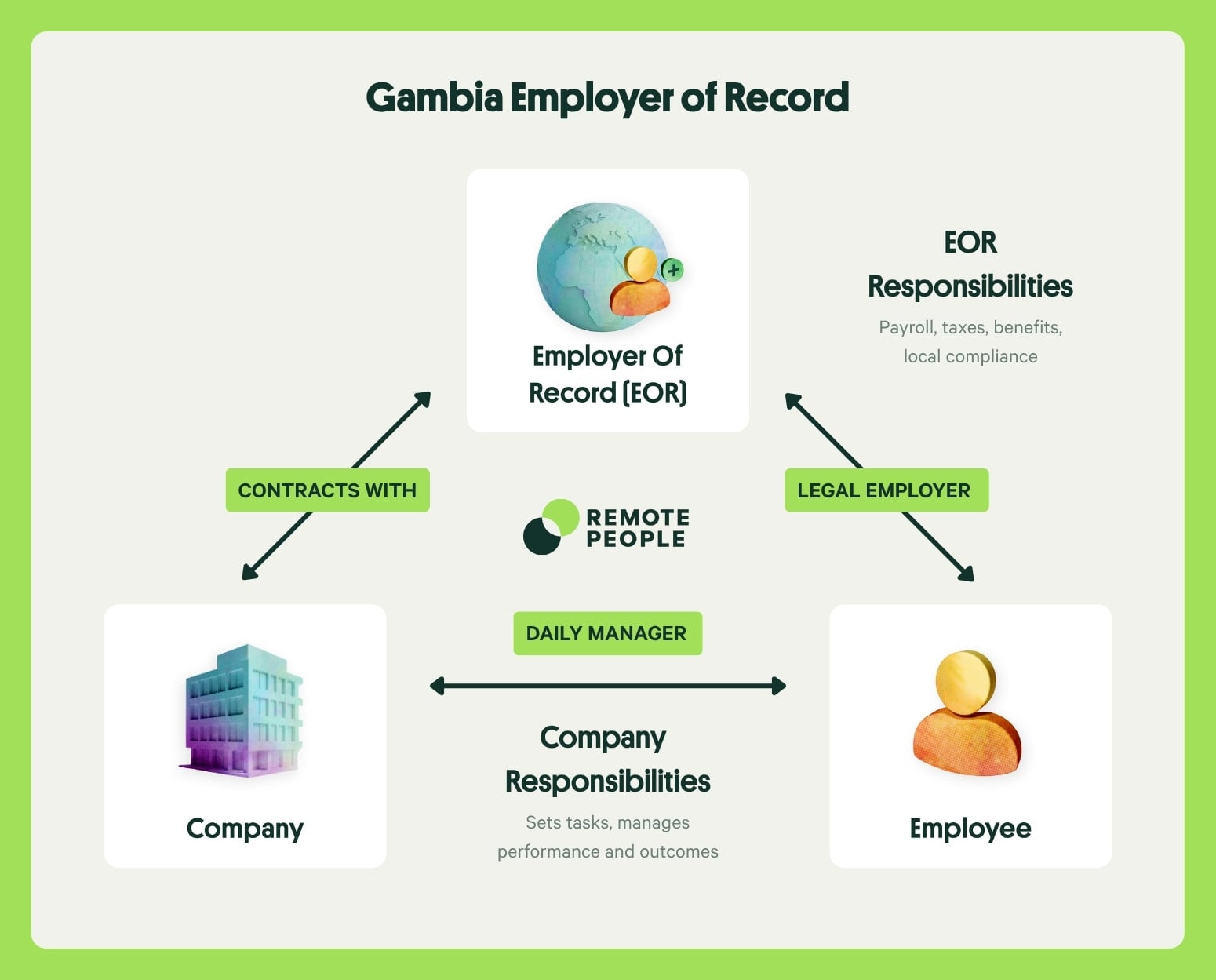
If you’d like to learn more about how Employer of Record (EOR) services work, read our What Is an Employer of Record (EOR)? guide for a complete overview of the model, its benefits, and when to use it.
If you’re comparing providers, our Best Employer of Record (EOR) Providers guide reviews the leading platforms to help you choose the right solution for your business.
Who Uses an EOR in Gambia?
Companies of all sizes use an employer of record to enter the Gambian market. The model works best for businesses that want to move fast or test a new market before committing to a full legal presence.
- Market testing: A company exploring the Gambian market can hire one or two team members through an EOR to evaluate local talent, operating costs, and demand before deciding whether to incorporate a local entity.
- Small distributed teams: Organizations building remote teams across multiple African countries use an EOR in Gambia to hire without the overhead of setting up and maintaining a separate legal entity for each country.
- Fast onboarding: When a position needs to be filled quickly, an EOR can onboard an employee in Gambia within one to two weeks, compared to the months it takes to register a company locally.
- Work permit sponsorship: Companies hiring foreign nationals for roles in Gambia use an EOR to sponsor the required Type B or Type C residential permits through the Gambia Immigration Department, since the EOR already holds a local legal presence.
The EOR model makes particular sense in Gambia, where employer registration touches multiple government agencies and compliance requirements that foreign companies rarely encounter elsewhere.
Typical Onboarding Timeline
Onboarding through an EOR in Gambia follows a set process. Each step has a defined timeframe, though work permit requirements can push the total duration out.
- First, sign the EOR agreement and provide employee details: 1 to 2 days. The client company and EOR finalize terms, and the EOR collects the new hire’s personal and employment information.
- Second, draft and review the employment contract: 2 to 3 days. The EOR prepares a locally compliant contract. The employee receives the required 48 hours to review it before signing.
- Third, register with SSHFC and the GRA: 3 to 7 days. The EOR registers the employee for social security (NPF) and sets up PAYE income tax withholding.
- Fourth, configure payroll and benefits: 2 to 3 days. The EOR adds the employee to the payroll system, enrolls them in statutory benefits, and confirms the payment schedule.
- Fifth, complete onboarding and first day: 1 day. The employee starts work with all compliance and administrative setup complete.
Most EOR providers can onboard an employee in Gambia within 1 to 2 weeks. If the employee is a foreign national requiring a work permit, the process can extend by 3 to 6 weeks while the Gambia Immigration Department processes the residential permit application.
Hire in Gambia
RemotePeople makes it easy to hire, pay, and manage employees in Gambia without setting up a local entity. We handle payroll, tax compliance, social security registration, and employment contracts so you can focus on growing your team.
Employment Laws and Regulations in Gambia
Employment Contracts
All employment relationships in Gambia are governed by the Labour Act 2023 (MOTIE), which replaced portions of the earlier Labour Act 2007. The Department of Labour, operating under the Ministry of Trade, Industry, Regional Integration and Employment (MOTIE), is the primary regulatory authority.
Written employment contracts are mandatory for all employees except those engaged on a casual or temporary basis. If an employer fails to provide a written contract, the employee can still enforce the employment relationship, but the employer cannot. Contracts must specify the employee’s salary, working hours, duties, job classification, duration, and any special terms. Both fixed-term and indefinite contracts are permitted, with indefinite contracts being standard for permanent positions. English is the official language of Gambia and the standard language for employment contracts.
Working Hours and Overtime
The standard workweek in Gambia is 48 hours, typically arranged as 8 hours per day over 6 days. Many employers, particularly in the services sector, voluntarily operate a 40-hour, 5-day workweek. Employees are entitled to a minimum daily rest period of 11 consecutive hours between workdays and a meal break of at least 60 minutes when working more than 5 consecutive hours. Every employee must receive at least 24 consecutive hours of weekly rest. The Labour Act 2023 establishes these working time provisions and mandates overtime compensation for hours exceeding the standard workweek.
Gambia overtime and premium pay rates · Per Labour Act 2023 | |||
Hour Type | Rate Multiplier | Weekly/Daily Cap | Notes |
|---|---|---|---|
Weekday overtime (beyond 8 hrs/day or 48 hrs/week) | 1.5x | 12 hrs/week | Standard overtime rate for hours exceeding the normal workday or workweek. |
Night work | 1.5x | 8 hrs/shift | Applies to work between 10:00 p.m. and 7:00 a.m. |
Weekly rest day work | 2.0x | 8 hrs | Compensation for work on the designated weekly rest day |
Sunday work | 2.0x | 8 hrs | Same rate as weekly rest day; applies when Sunday is not the designated rest day |
Public holiday work | 2.5x | 8 hrs | Highest premium rate; applies to all 14 gazetted public holidays |
Overtime is permitted only in exceptional or urgent circumstances and is not intended as a regular arrangement. Collective agreements and Joint Industrial Council agreements may set higher overtime rates than the statutory minimums. Managerial staff are generally exempt from overtime provisions. The maximum weekly working time, including overtime, should not exceed 60 hours.
Minimum Wage
The statutory minimum wage in Gambia is approximately $0.71 per day (GMD 50), set under the Minimum Wages and Control of Employment Act in 2015. This translates to roughly $18.50 per month based on 26 working days. The rate has not been updated since 2015, making it one of the lowest statutory minimums in West Africa. The Gambian government relaunched minimum wage discussions in 2025, but no new rate had been enacted as of early 2026 (Minimum-Wage.org). There are no sector-specific minimum wage variations; a single national rate applies across all industries.
Probation Period
Probation periods in Gambia vary by the employee’s skill level. Skilled employees may serve a probation period of up to 12 months. Semi-skilled employees are limited to a maximum of 6 months, while unskilled employees have a 3-month cap. During probation, either party can terminate the employment relationship without notice. Core statutory protections, including health and safety rules and anti-discrimination provisions, still apply during the probationary period. Once probation ends successfully, the employee moves to full permanent status with standard notice period requirements (Labour Act 2023, MOTIE).
Leave Entitlements
The Labour Act 2023 sets out every statutory leave entitlement in Gambia. Every employer operating here, including an EOR, must provide these minimums. The entitlements cover annual leave, sick leave, maternity and paternity leave, and several categories of special leave.
Annual Leave
Every employee in Gambia is entitled to 21 working days of paid annual leave after completing 12 months of continuous service. Leave accrues proportionally each month of employment, so employees who leave before completing a full year receive pro-rated leave. Annual leave accrues during the probationary period based on the months worked. The Labour Act does not specify a maximum carryover period, so employers typically address carryover through the employment contract or company policy (Labour Act 2023, MOTIE).
Sick Leave
Employees are entitled to 14 days of paid sick leave per year. Sick leave pay must be at least equal to the employee’s regular pay, including any regular overtime and bonuses. The employer is responsible for paying sick leave during this statutory entitlement period. A medical certificate from a recognized physician is required for absences exceeding 3 consecutive days (Labour Act 2023, MOTIE).
Maternity Leave
Female employees in Gambia are entitled to 6 months (approximately 26 weeks) of maternity leave under the Women’s Act. This is one of the most generous maternity leave provisions in West Africa. The leave is paid, though the exact percentage of salary is not specified in publicly available sources and may be defined by the employment contract or collective agreement. The employer funds maternity leave. An employer cannot dismiss an employee during maternity leave. Female employees are also entitled to time off during working hours for prenatal care upon presenting a medical certificate. Nursing mothers are entitled to either two 30-minute nursing breaks or one 60-minute break per day during working hours. Mothers of children under 8 months are exempt from overtime requirements (Labour Act 2023, MOTIE).
Paternity Leave
Male employees are entitled to 10 working days of paid paternity leave following the birth of a child. The leave must be taken within 6 months of the child’s birth. This entitlement applies to biological fathers and is paid at the employee’s regular rate (Labour Act 2023, MOTIE).
Other Statutory Leave
The Labour Act 2023 and related legislation provide for additional categories of leave in specific circumstances. These entitlements are separate from annual leave and sick leave.
- Bereavement leave: Not specified as a statutory entitlement in the Labour Act. Employers typically provide bereavement leave through the employment contract or company policy.
- Marriage leave: Not specified as a statutory entitlement. May be addressed through collective agreements or individual contracts.
- Study leave: Not specified as a statutory entitlement. Some employers offer study leave as a voluntary benefit, particularly in the public sector.
- Nursing breaks: Female employees nursing unweaned children are entitled to either two 30-minute breaks or one 60-minute break per day during working hours. This is a statutory right under the Women’s Act.
Gambia statutory leave entitlements · Per Labour Act 2023 | ||
Leave Type | Duration | Eligibility & Notes |
|---|---|---|
Annual leave | 21 working days | After 12 months of continuous service; accrues monthly on a pro-rata basis |
Sick leave | 14 days | Paid at regular rate; medical certificate required after 3 days |
Maternity leave | 6 months | Paid; employer-funded; job protection during leave; medical certificate required |
Paternity leave | 10 working days | Paid; must be taken within 6 months of birth |
Nursing breaks | 2 x 30 min or 1 x 60 min daily | For mothers nursing unweaned children; during working hours |
Public holidays | 14 days per year | Paid; see public holidays table for the full 2026 calendar |
Weekly rest | 24 consecutive hours | Mandatory minimum weekly rest period for all employees |
Source: Labour Act 2023 (MOTIE) and ISSA Country Profile: Gambia | ||
Statutory Employee Benefits
Beyond leave and social security contributions, employers in Gambia must provide several other mandatory benefits. These are required by law or by standing regulatory rules.
- Pension (National Provident Fund): All employees must be enrolled in the NPF administered by the SSHFC. The employer contributes 10% of basic salary and the employee contributes 5%. Upon retirement at age 60, the employee receives a lump sum comprising both contributions plus accrued interest. Employees aged 60 and older are exempt from contributions.
- Industrial injuries compensation: Employers contribute 1% of gross salary to the Industrial Injuries Compensation Fund (IICF), which provides medical expense coverage, wage replacement during incapacity, and compensation for permanent disability or death resulting from workplace injuries or occupational diseases.
- Health insurance: Gambia does not mandate universal employer-provided health insurance. The public healthcare system provides basic coverage, but many employers voluntarily offer supplementary private health insurance as a benefit to attract and retain talent.
- Overtime protections: Employees are entitled to premium pay rates for overtime, rest day, and public holiday work as specified in the Labour Act. This is not optional; employers must pay the statutory minimums.
- Working time protections: The Labour Act establishes maximum working hours, mandatory rest periods, and meal break entitlements. Employers cannot contract around these statutory minimums.
Transport allowances, meal allowances, and housing allowances are common supplementary benefits in Gambia but are not legally required. The exact rates for pension and industrial injuries contributions are detailed in the employer and employee contribution tables in the payroll section of this guide.
Recent Regulatory Updates (2026)
The biggest recent change to Gambia’s employment rules was the Labour Act 2023, which received presidential assent in June 2023. The new law replaced portions of the Labour Act 2007 and introduced several structural changes, including the creation of the Labour Advisory Board (for coordination between workers, employers, and government) and the Expatriate Quota Allocation Board (for managing foreign worker allocations). The 2023 Act also extended coverage to domestic workers, who were previously excluded from the 2007 legislation (MOTIE).
On wages, the statutory minimum of approximately $0.71 per day has remained unchanged since 2015. The government initiated a minimum wage review process in 2025, but no new rate has been enacted. Separately, the government announced significant civil service wage increases effective January 2025, raising the lowest grade basic salary and increasing transport and housing allowances. These increases apply only to government employees and do not affect the private sector minimum wage.
Social security contribution rates administered by the SSHFC have remained stable through 2025 and into 2026, with no announced changes to NPF or IICF rates. Income tax brackets were updated effective January 1, 2025, with the personal income tax-free threshold increased to GMD 36,000 per year (approximately $515) (GRA).
Work Permits and Visas in Gambia
Work Permit Requirements
Who Needs a Work Permit
All non-Gambian nationals engaging in gainful employment in Gambia must obtain a residential permit that authorizes work. Citizens of ECOWAS member states (including Nigeria, Ghana, Senegal, and 12 other West African nations) may work in Gambia for up to 90 days without a permit under the ECOWAS Free Movement Protocol. Beyond 90 days, ECOWAS citizens must obtain a Type B or Type C residential permit. Non-ECOWAS nationals require a permit before starting any work. The Gambia Immigration Department (GID) administers all residential and work permits.
Eligibility and Required Documents
To qualify for a work permit in Gambia, the foreign national must possess specialized skills or qualifications that are not readily available in the local workforce. The employer must demonstrate that no suitable Gambian candidate is available for the role. Required documents include a valid passport with at least 6 months of remaining validity, 4 to 6 recent passport-sized photographs, a signed employment contract specifying the job role, salary, duration, and terms, copies of educational and professional qualifications, a current CV, the employer’s valid business registration certificate, tax identification and clearance from the GRA, social security registration proof from the SSHFC, and a signed Immigration Responsibility Form from the host employer.
Processing Time and Validity
Standard processing for a Gambian work permit takes 3 to 6 weeks, though timelines can extend depending on application volume and complexity. All residential permits are valid for one year from the date of issue. Factors that may extend processing include incomplete documentation, high application volumes during peak hiring periods, and the need for additional background verification.
Renewal Process
Renewal applications must be submitted at least 60 days before the current permit expires. The renewal package requires updated compliance documents, confirmation that the employee is still needed in the role, and potentially refreshed police and medical clearances. Employees can generally continue working while their renewal application is being processed, provided it was submitted on time.
Common Visa Types for Foreign Workers
The Gambia Immigration Department issues three main categories of residential permits. The type required depends on the applicant’s nationality, employment status, and the nature of their work. An EOR can sponsor Type B and Type C permits through its local legal presence.
Gambia work visa types for foreign workers · 2026 | ||||
Visa Type | Duration | Best For | Leads to Long-Term Residency? | Processing |
|---|---|---|---|---|
Type B (Non-ECOWAS) | 1 year (renewable) | Skilled workers, professionals, and business persons from non-ECOWAS countries | Yes, through consecutive renewals | 3 to 6 weeks |
Type B (ECOWAS) | 1 year (renewable) | ECOWAS citizens in skilled employment or business beyond 90 days | Yes, through consecutive renewals | 3 to 6 weeks |
Type C | 1 year (renewable) | Unskilled workers from ECOWAS states and small traders | Yes, through consecutive renewals | 3 to 6 weeks |
Business/Investor Permit | 1 year (renewable) | Investors and entrepreneurs establishing a business in Gambia | Yes | Approximately 5 working days (in-country, post-approval) |
Source: Gambia Immigration Department and Cliffe Dekker Hofmeyr | ||||
The following visa types do not authorize employment in Gambia:
- Type A residential permit: Issued to students, retirees, and persons of independent means. No gainful employment is permitted.
- Tourist visa: Short-term entry for tourism purposes. Employment is prohibited.
- Transit visa: For travelers passing through Gambia en route to another country. Employment is prohibited.
How an EOR Handles Work Permits
An EOR in Gambia acts as the sponsoring employer for work permit applications. The EOR prepares and submits the application to the Gambia Immigration Department, provides the required employer documentation (business registration, tax clearance, SSHFC registration, Immigration Responsibility Form), and tracks the application through to approval. The employee is responsible for providing personal documents such as their passport, photographs, qualifications, and CV.
When a work permit is required, the onboarding timeline described in the section above extends by 3 to 6 weeks. The EOR can begin setting up the employment contract and payroll registration in parallel with the permit application, so the employee can start work as soon as the permit is issued. Employers should also budget for the annual expatriate quota tax: approximately $143 (GMD 10,000) for ECOWAS nationals and $714 (GMD 50,000) for non-ECOWAS nationals, payable annually.
Payroll, Taxes, and Social Security in Gambia
Employer Contributions
Employers in Gambia are required to make contributions to two social security funds administered by the SSHFC. The total mandatory employer contribution rate is approximately 11% of the employee’s salary.
Gambia employer social security contributions · 2026 rates | ||
Contribution | Rate | Notes |
|---|---|---|
National Provident Fund (NPF) | 10% | Calculated on basic salary; administered by SSHFC; employees aged 60+ are exempt |
Industrial Injuries Compensation Fund (IICF) | 1% | Calculated on gross salary; covers workplace injuries and occupational diseases |
Total Employer Contributions | 11% | Combined mandatory employer cost above gross salary |
Employee Contributions
Employees in Gambia contribute to social security through deductions from their salary. The total mandatory employee deduction rate is approximately 6% of salary.
Gambia employee payroll deductions · 2026 monthly withholdings | ||
Deduction | Rate | Notes |
|---|---|---|
National Provident Fund (NPF) | 5% | Deducted from basic salary; employees aged 60+ are exempt |
Industrial Injuries Compensation Fund (IICF) | 1% | Deducted from gross salary; covers employee share of workplace injury insurance |
Total Employee Deductions | 6% | Combined mandatory deductions from employee salary |
Income Tax
Gambia applies a progressive Pay As You Earn (PAYE) system to employment income. Employers are required to withhold income tax from employee salaries each month and remit it to the GRA by the 15th of the following month. The tax-free threshold was increased to GMD 36,000 per year (approximately $515) effective January 1, 2025 (GRA). The following brackets apply to annual taxable employment income.
Gambia income tax brackets · 2026 | |
Bracket (Annual Income, GMD) | Tax Calculation |
|---|---|
GMD 0 to GMD 36,000 | 0% (tax-free threshold) |
GMD 36,000 to GMD 46,000 | 5% on income above GMD 36,000 |
GMD 46,000 to GMD 56,000 | 10% on income above GMD 46,000 |
GMD 56,000 to GMD 66,000 | 15% on income above GMD 56,000 |
GMD 66,000 to GMD 76,000 | 20% on income above GMD 66,000 |
Above GMD 76,000 | 25% on income above GMD 76,000 |
Source: Gambia Revenue Authority and Trading Economics | |
Payroll Cycle
The standard payroll frequency in Gambia is monthly. Salaries are typically paid by bank transfer in Gambian dalasi (GMD). Employers are required to provide employees with a pay slip showing gross salary, all deductions (PAYE, NPF, IICF), and net pay. PAYE income tax must be remitted to the GRA by the 15th of the month following the pay period. Social security contributions to the SSHFC are also due monthly. Employers must maintain accurate payroll records and make them available for inspection by the Department of Labour.
13th Month Salary and Bonus Pay
There is no statutory requirement for a 13th month salary in Gambia. Employers are not legally obligated to pay an additional month’s salary at year-end or at any other point during the year. Some employers, particularly in the banking and financial services sectors, voluntarily offer a 13th month payment or annual performance bonus as a retention and recruitment tool. When offered, the terms (calculation method, payment timing, pro-rata rules for mid-year joiners) are defined by the employment contract or company policy, not by law. There is no mandatory 14th month salary, vacation bonus, or profit-sharing requirement in Gambia.
Cost of Hiring Through an EOR in Gambia
EOR Service Fees
EOR providers serving Gambia typically charge a flat monthly fee per employee, ranging from $300 to $600 per month. This fee covers payroll processing, tax withholding and filing, social security registration and contributions, employment contract management, statutory benefits administration, and ongoing compliance monitoring. Some providers may offer volume discounts for companies hiring multiple employees. The flat-fee model is standard for Gambia; percentage-of-salary models are less common for this market.
Total Employment Cost Breakdown
The table below shows a worked example of the total employer cost for hiring one employee through an EOR in Gambia at a gross monthly salary of $500. All amounts are approximate USD based on an exchange rate of 1 USD = 70 GMD. Employer contributions in Gambia total approximately 11% above gross salary, making it one of the most cost-effective hiring markets in West Africa.
Gambia employer cost example · $500 gross · 2026 | ||
Employer Cost | Amount (USD) | % of Gross |
|---|---|---|
Gross monthly salary | $500 | 100% |
NPF employer contribution (10%) | $50 | 10% |
IICF employer contribution (1%) | $5 | 1% |
EOR service fee (estimated) | $400 | 80% |
Total Monthly Employer Cost | $955 | 191% |
Ready to hire in Gambia? Get started with RemotePeople. We handle employment contracts, payroll, tax withholding, and full Gambia compliance. No local entity needed.
Benefits of Using an EOR in Gambia
An employer of record in Gambia gives companies a compliant, affordable way into the market without forming a local entity. Here is why the model works well for Gambia specifically.
- Speed to market: An EOR can onboard employees in Gambia within 1 to 2 weeks. Compare that to 6 to 8 weeks for incorporating a local entity. You can start operating, serving clients, or testing the market almost immediately.
- Full compliance: Gambia’s employment rules span the Labour Act 2023, SSHFC regulations, GRA tax requirements, and immigration rules. An EOR tracks all of these and takes on the compliance risk, which means fewer surprises from the Department of Labour.
- Cost efficiency: Incorporating in Gambia costs an incorporation fee of 6% of share capital (minimum of roughly $143), plus ongoing accounting and admin overhead. For teams of 1 to 15 employees, the EOR’s flat monthly fee comes in well below the cost of running a standalone entity.
- Local expertise: The distinction between NPF and Federated Pension Scheme contributions, ECOWAS work permit exemptions, and the Women’s Act maternity provisions all require local knowledge. An EOR brings that expertise as part of its standard service.
- Flexibility to scale: You can add or reduce headcount in Gambia without the fixed costs of an entity. If a market test does not deliver, the EOR handles offboarding and final settlements without a costly legal dissolution.
- Risk mitigation: Because the EOR is the legal employer, it bears direct responsibility for payroll accuracy, tax compliance, and social security registration. That shields the client company from direct liability for employment law violations.
- Employee experience: Employees hired through an EOR get the same statutory protections as any locally employed worker in Gambia, including paid leave, social security enrollment, and workplace protections under the Labour Act 2023. That helps with retention and employer reputation.
For companies evaluating their options, contact RemotePeople for a tailored assessment of whether an EOR is the right fit for your Gambia hiring plans.
Termination and Offboarding in Gambia
Notice Periods
Notice periods in Gambia are determined by the employee’s payment frequency and, in cases of redundancy, by the nature of the termination. The Labour Act 2023 requires written notice specifying the date of issue, termination date, and the reason for termination. Notice can be paid in lieu at the employer’s discretion. During the notice period, the employee remains entitled to all regular salary and benefits.
Gambia statutory notice periods by position level · Per Labour Act 2023 | |||
Position Level | Notice Period | During Probation | Notes |
|---|---|---|---|
Daily-paid workers | 1 day | None required | Calendar day |
Weekly-paid employees | 1 week | None required | Calendar week |
Fortnightly-paid (under 6 years) | 1 fortnight | None required | 14 calendar days |
Fortnightly-paid (6+ years) | 1 month | None required | Increased notice for long-tenured fortnightly workers |
Monthly-paid staff | 1 month | None required | Calendar month |
Redundancy (economic/organizational) | 6 months | N/A | Minimum notice for redundancy due to economic, organizational, climatic, or technical reasons |
In cases of just-cause dismissal for serious misconduct (theft, fraud, gross insubordination, willful damage to employer property), the employer may terminate without notice. Mutual agreement between employer and employee can also result in termination with terms agreed by both parties. Fixed-term contracts require 14 days’ notice if terminated before the agreed end date.
Severance Pay
Severance pay in Gambia is governed by the Labour Act 2023 and is mandatory in most termination scenarios. Employees whose contracts expire or are terminated are entitled to severance, except in cases of resignation, dismissal for serious misconduct, or gross negligence. The calculation method depends on the reason for termination. The general formula provides 2 months of basic pay for each year worked when the termination is due to redundancy, employer insolvency, business closure, or business transfer (Labour Act 2023, MOTIE).
Gambia severance pay schedule by years of service · Per Labour Act 2023 | |||
Years of Service | Severance Amount | Base Salary | Notes |
|---|---|---|---|
1 year | 2 months’ pay | Gross monthly basic salary | Applies to redundancy, insolvency, closure, or transfer |
3 years | 6 months’ pay | Gross monthly basic salary | 2 months per year x 3 years |
5 years | 10 months’ pay | Gross monthly basic salary | 2 months per year x 5 years |
10 years | 20 months’ pay | Gross monthly basic salary | 2 months per year x 10 years |
Contract expiry or early termination | 25% of total basic pay earned | Total basic pay during contract | Alternative formula for fixed-term contracts |
Calculation Method
For indefinite contracts terminated due to redundancy, employer insolvency, business closure, or business transfer, severance is calculated at 2 months of gross monthly basic salary for each completed year of service. The base salary for this calculation is the employee’s gross monthly basic pay at the time of termination. For fixed-term contracts that expire at the agreed end date or are terminated early, severance is calculated as 25% of the total basic pay earned during the contract period. In cases of employee death during employment, the employee’s dependents are entitled to the equivalent of 2 months’ basic pay per year worked.
Caps and Exceptions
Severance is not owed when the employee resigns voluntarily, when termination is for serious misconduct (theft, fraud, gross insubordination, willful damage to property), or when the employee is dismissed for gross negligence. There is no statutory cap on the total severance amount; the formula applies without an upper limit based on the employee’s tenure. Collective bargaining agreements may provide for higher severance amounts than the statutory minimum. When an employee has been enrolled in the SSHFC’s pension scheme, retirement benefits from the scheme may offset a portion of the severance obligation in some circumstances (Labour Act 2023, MOTIE).
Grounds for Termination
Gambian law distinguishes between termination for just cause and termination without cause. Just cause (summary dismissal without notice) applies in cases of theft, fraud, serious insubordination, willful damage to employer property, and gross misconduct. The employer must provide a written statement of the reason and give the employee an opportunity to respond before carrying out the dismissal.
Termination without cause requires the standard notice periods set out in the table above and triggers severance obligations when the employee has at least 2 years of service. Protected categories under the Labour Act 2023 include race, colour, national origin, sex, religion, political opinion, union membership, pregnancy, and disability. Dismissal on any of these grounds is considered unfair. Employees who believe they have been unfairly dismissed can file a complaint with the Labour Commissioner, who may investigate and mediate. Unresolved disputes are referred to the Industrial Tribunal.
EOR vs. Other Hiring Models in Gambia
EOR vs. Setting Up a Local Entity
Companies expanding into Gambia can either set up their own legal entity or use an EOR. The table below compares the two approaches across cost, timeline, and compliance burden. For teams under 15 employees, the EOR route is typically faster and more cost-effective.
Gambia EOR vs local entity comparison · Setup time, cost, risk and best-fit | ||
Comparison | Employer of Record | Own Entity |
|---|---|---|
Setup time | 1 to 2 weeks | 6 to 8 weeks |
Upfront cost | $0 | $2,000 to $5,000 |
Ongoing cost | $300 to $600/employee/month | $5,000 to $10,000/year maintenance |
Local partner required | No (EOR is the local entity) | No |
Social insurance registration | Handled by EOR | You manage it |
Payroll and tax filing | Handled by EOR | You manage it (or outsource) |
Best for team size | 1 to 15 employees | 15+ employees |
Scale down or exit | Easy, no entity to unwind | Costly, legal dissolution required |
Government contracts | Not eligible | Eligible (requires local entity) |
Source: MOTIE Gambia and ISSA Country Profile: Gambia | ||
Incorporating a local entity in Gambia involves registering with the Registrar of Companies, obtaining a tax identification number from the GRA, registering with the SSHFC, and securing any required business licenses. The incorporation fee is 6% of share capital with a minimum of approximately $143. The total process typically takes 6 to 8 weeks. For companies hiring fewer than 15 employees, the cost and administrative burden of maintaining a local entity usually exceeds the total cost of using an EOR.
The EOR model becomes less cost-effective as team size grows beyond 15 employees, at which point the per-employee EOR fee starts to exceed the amortized cost of running a local entity. Companies planning to bid on Gambian government contracts also need a local entity, since EOR-employed staff do not satisfy local entity requirements for government procurement.
EOR vs. Hiring Independent Contractors
Choosing between an EOR and an independent contractor arrangement depends on the nature and duration of the role. The Labour Act 2023 looks at the substance of the working relationship, not the contract label, when determining employment status.
Gambia EOR vs independent contractors · Compliance, cost, and risk | ||
Comparison | EOR (Full-Time Employee) | Independent Contractor |
|---|---|---|
Legal relationship | Employee of the EOR | Self-employed, no employment relationship |
Compliance risk | Low, EOR ensures local labor law compliance | High, misclassification risk if relationship resembles employment |
Payroll and tax | EOR handles withholding, contributions, filings | Contractor invoices you; they handle their own taxes |
Benefits and leave | Statutory benefits, paid leave, social security | No entitlement to employee benefits |
IP protection | Stronger, employment contract assigns IP by default | Weaker, requires explicit IP assignment clause |
Termination | Subject to local notice periods and severance | Contract can be ended per agreement terms |
Best for | Long-term, core team roles | Short-term projects, specialized tasks |
Cost structure | Salary + employer contributions + EOR fee | Contractor fee (typically higher gross, lower total cost) |
Source: Labour Act 2023 (MOTIE) and ISSA Country Profile: Gambia | ||
Contractor misclassification is a real risk in Gambia. The Labour Act 2023 looks at the substance of the working relationship, not the contract label. If a contractor works fixed hours, uses employer-provided equipment, reports to a manager, and has no other clients, the Department of Labour can reclassify the relationship as employment. That means back payment of social security contributions, tax penalties, and an obligation to provide all statutory benefits retroactively.
For long-term, core team roles, hiring through an EOR provides stronger compliance protection and IP assignment. For genuinely short-term, project-based work where the contractor operates independently and serves multiple clients, a contractor arrangement is appropriate. RemotePeople also offers contractor management services for companies that need a compliant contractor engagement framework.
EOR vs. PEO (Professional Employer Organization)
The key difference between an EOR and a PEO is who holds the legal employer role. This distinction determines whether you need a local entity in Gambia and who carries compliance liability.
Gambia EOR vs PEO comparison · Legal employer, liability, and setup | ||
Comparison | Employer of Record (EOR) | PEO |
|---|---|---|
Legal employer | EOR is the legal employer | You remain the legal employer (co-employment) |
Local entity required | No, the EOR is the local entity | Yes, you must have your own entity in Gambia |
Best for | Companies without a local entity | Companies that already have a local entity |
Compliance liability | EOR assumes compliance responsibility | Shared liability between you and the PEO |
Setup time | 1 to 2 weeks | Depends on your entity setup (weeks to months) |
Control over HR policies | EOR manages within local law framework | More direct control, PEO advises |
Typical use case | Market entry, small remote teams, testing new markets | Established local operations needing HR outsourcing |
Source: Labour Act 2023 (MOTIE) and ISSA Country Profile: Gambia | ||
The core difference between an EOR and a PEO comes down to who is the legal employer. With an EOR, the EOR holds that role, so the client company does not need a local entity. With a PEO, the client company stays the legal employer in a co-employment setup, which means it must already have an entity in Gambia.
Gambia does not have a formal PEO licensing or regulatory framework. PEO services operate within the general employment law framework. For companies without a local presence in Gambia, an EOR is the only viable option. For companies that already have a Gambian entity and want to outsource HR administration, a PEO or HR outsourcing arrangement may be more appropriate.
Public Holidays in Gambia
Gambia observes 14 public holidays per year. Several of these are Islamic holidays based on the lunar calendar, so their dates shift annually and are confirmed by the Supreme Islamic Council through an official announcement. Employees required to work on a public holiday are entitled to compensation at 2.5 times their regular rate.
Gambia public holidays · 2026 calendar year | ||
Date | Holiday | Type |
|---|---|---|
January 1 | New Year’s Day | Fixed |
February 18 | Independence Day | Fixed |
March 16 | Lailat al-Qadr (Night of Power) | Islamic (movable) |
March 20 | Eid al-Fitr / Koriteh (Day 1) | Islamic (movable) |
March 21 | Eid al-Fitr / Koriteh (Day 2) | Islamic (movable) |
April 3 | Good Friday | Christian (movable) |
April 6 | Easter Monday | Christian (movable) |
May 1 | Labour Day | Fixed |
May 25 | Africa Day | Fixed |
May 27 | Eid al-Adha / Tobaski (Day 1) | Islamic (movable) |
May 28 | Eid al-Adha / Tobaski (Day 2) | Islamic (movable) |
August 15 | Assumption of Mary | Fixed |
August 26 | Mawlid al-Nabi (Prophet’s Birthday) | Islamic (movable) |
December 25 | Christmas Day | Fixed |
Source: timeanddate.com and Office of The President, Gambia | ||
Islamic holiday dates are approximate and subject to confirmation by the Supreme Islamic Council based on moon sighting. Both Eid al-Fitr (Koriteh) and Eid al-Adha (Tobaski) are observed as two-day public holidays. If a public holiday falls on a weekend, the following Monday is typically declared a public holiday. Employers should account for these holidays in payroll scheduling and project timelines, particularly during the Ramadan period when working hours and productivity patterns may shift.
How to Get Started with an EOR in Gambia
Setting up an EOR arrangement in Gambia is a short process. These steps cover what happens from initial inquiry to a fully onboarded employee.
- First, assess your hiring needs: Determine the number of employees you plan to hire in Gambia, the roles and salary ranges, whether any candidates are foreign nationals requiring work permits, and the expected duration of the engagement. This information helps the EOR provider scope the service and provide accurate pricing.
- Second, select an EOR provider: Evaluate providers based on their local presence in Gambia, experience with the SSHFC and GRA, ability to sponsor work permits through the Gambia Immigration Department, and pricing transparency. Confirm the provider’s registered entity status in Gambia.
- Third, sign the EOR agreement and share employee details: The EOR agreement defines the service scope, fees, compliance responsibilities, and termination terms. You provide the employee’s personal information, agreed salary, role description, and any special terms.
- Fourth, the EOR onboards the employee: The EOR drafts the employment contract, registers the employee with the SSHFC and GRA, configures payroll, and enrolls them in statutory benefits. If a work permit is needed, the application is submitted in parallel.
- Fifth, the employee starts work: Once all registrations are complete (and the work permit is approved, if applicable), the employee begins work. You manage the day-to-day role; the EOR manages payroll, tax, and compliance on an ongoing basis.
Ready to hire in Gambia? Contact RemotePeople to get started. We handle employment contracts, payroll, tax withholding, social security, and full Gambia compliance, so your team can be operational in days, not months.
Where companies hiring in the Gambia expand next
Companies building West African operations commonly expand across the ECOWAS bloc and neighboring Francophone and Anglophone markets. Many companies add operations in Nigeria first, drawing on overlapping West African workforce dynamics. Ghana follows as shared West African labor and language overlap, while hiring in Ivory Coast offers aligned West African hiring norms. An EOR partner in Cameroon is often the fourth step, valued for the regional West African talent footprint.
Frequently Asked Questions
EOR services in Gambia typically cost between $300 and $600 per employee per month as a flat fee. This covers payroll processing, tax withholding, social security registration, benefits administration, and compliance management. On top of the service fee, employers cover the employee's gross salary plus mandatory employer contributions of approximately 11% (10% NPF and 1% IICF).
Most EOR providers can onboard an employee in Gambia within 1 to 2 weeks, assuming the employee does not require a work permit. If the employee is a foreign national needing a residential permit from the Gambia Immigration Department, the total onboarding timeline extends to 4 to 8 weeks.
Contractor arrangements are appropriate for short-term, project-based work where the worker operates independently. For long-term roles where the worker has fixed hours, uses your equipment, and reports to your team, an EOR-based employment arrangement is the compliant approach. RemotePeople offers contractor management services through its contractor solutions for companies that need a compliant contractor framework in Gambia.
Yes. Because the EOR is the legal employer in Gambia, employees receive all statutory benefits required by the Labour Act 2023, including 21 days of paid annual leave, 14 days of sick leave, maternity leave (6 months), paternity leave (10 working days), social security enrollment (NPF), and industrial injuries coverage (IICF).
Intellectual property created during employment is assigned to the client company (you), not the EOR. The EOR's employment contract includes standard IP assignment clauses that transfer all work product and intellectual property rights to the client company. The EOR has no claim to the IP.
Yes. Because the EOR holds a registered legal entity in Gambia, it can act as the sponsoring employer for work permit applications to the Gambia Immigration Department. The EOR handles the application process, submits employer documentation, and tracks the permit through to approval. The annual expatriate quota tax (approximately $143 for ECOWAS nationals or $714 for non-ECOWAS nationals) is an additional cost.
Termination follows Gambia's Labour Act 2023. Notice periods depend on the employee's payment frequency: 1 day for daily-paid workers, 1 week for weekly-paid, and 1 month for monthly-paid staff. Redundancy requires 6 months' notice. Severance pay is generally calculated at 2 months of basic pay per year worked for redundancy and similar terminations. The EOR manages the entire offboarding process, including final pay calculations and compliance documentation.
No. There is no statutory requirement for a 13th month salary or any additional mandatory bonus in Gambia. Some employers offer an annual bonus voluntarily as a retention tool, but it is not required by law.
Employer of Record in
Employer of Record in
Employer of Record in
Employer of Record in
Employer of Record in
Employer of Record in
Employer of Record in
Employer of Record in




