
 Recruit
Employer of Record (EOR) in Jordan
-
 Drew Donnelly
- Published
- September 22, 2026
An Employer of Record (EOR) in Jordan is a Jordanian-registered company that hires employees on your behalf, managing Social Security Corporation (SSC) contributions, income tax withholding, work permits, and Jordanian Labour Law compliance. A Jordan EOR lets you hire local or expat staff in 2–3 weeks without opening an LLC or branch.
Hire in Jordan — book a free 30-minute demo
Tell us what you need. You'll get a tailored, transparent proposal within 24 hours, plus a free call to walk through it.
Tell us about your company
So we can match you with a specialist who knows your market — and unlock volume pricing tiers.
* All fields are required.
Where and when are you hiring?
Tell us the geography and timing and we'll quote each country line by line, with onboarding timelines.
* All fields are required.
Help us beat your current setup
We'll benchmark your current deal and send a line-by-line proposal in 24 hours — showing exactly where we cut cost, time, or risk. After you submit, you can book a call to walk through it together.
* All fields are required.
Thanks! Your proposal is on its way.
Expect a tailored, line-by-line proposal in your inbox within 24 hours. In the meantime…
Want to walk through it together?
Book a free 30-minute call with one of our specialists. We'll explain every line, answer your questions, and tailor the proposal further if you need.
No obligation. Pick a time that works for you.








- Hire in Jordan — book a free 30-minute demo
- Tell us about your company
- Where and when are you hiring?
- Help us beat your current setup
- Thanks! Your proposal is on its way.
- How an Employer of Record Works in Jordan
-
Employment Laws and Regulations for Employer of Record Services in Jordan
- Employment Contracts in Employer of Record Services
- Working Hours and Overtime for Employer of Record
- Minimum Wage Under Employer of Record Services
- Probation Period in Employer of Record Hiring
- Leave Entitlements Managed by Employer of Record
- Statutory Employee Benefits in Employer of Record Model
- Recent Regulatory Updates (2026)
- Work Permits and Visas in Jordan
- Payroll, Taxes, and Social Security in Jordan
- Cost of Hiring Through an EOR in Jordan
- Benefits of Using an EOR in Jordan
- Termination and Offboarding in Jordan
- EOR vs Other Hiring Models in Jordan
- Public Holidays in Jordan
- How to Get Started with an EOR in Jordan
- Where companies hiring in Jordan expand next
- Frequently Asked Questions
- Related EOR Destinations

Start hiring in Jordan
Let RemotePeople handle payroll, compliance, and HR admin worldwide so you can focus on building your team.

Jordan offers strategic access to the MENA region, a skilled workforce, and growing market opportunities for businesses seeking to expand internationally. Using an employer of record in Jordan allows companies to hire employees efficiently, navigating employment law, social security registration, and payroll compliance requires substantial local expertise and ongoing administrative overhead. An employer of record in Jordan provides a turnkey solution, handling all employment responsibilities while you focus on building your team. With a mandatory minimum wage of JOD 290 (Jordan Ministry of Labour) per month and complex social security contribution requirements, partnering with an employer of record simplifies hiring, ensures regulatory compliance, and reduces legal risk. This guide covers everything you need to know about using an employer of record to hire in Jordan in 2026.
How an Employer of Record Works in Jordan
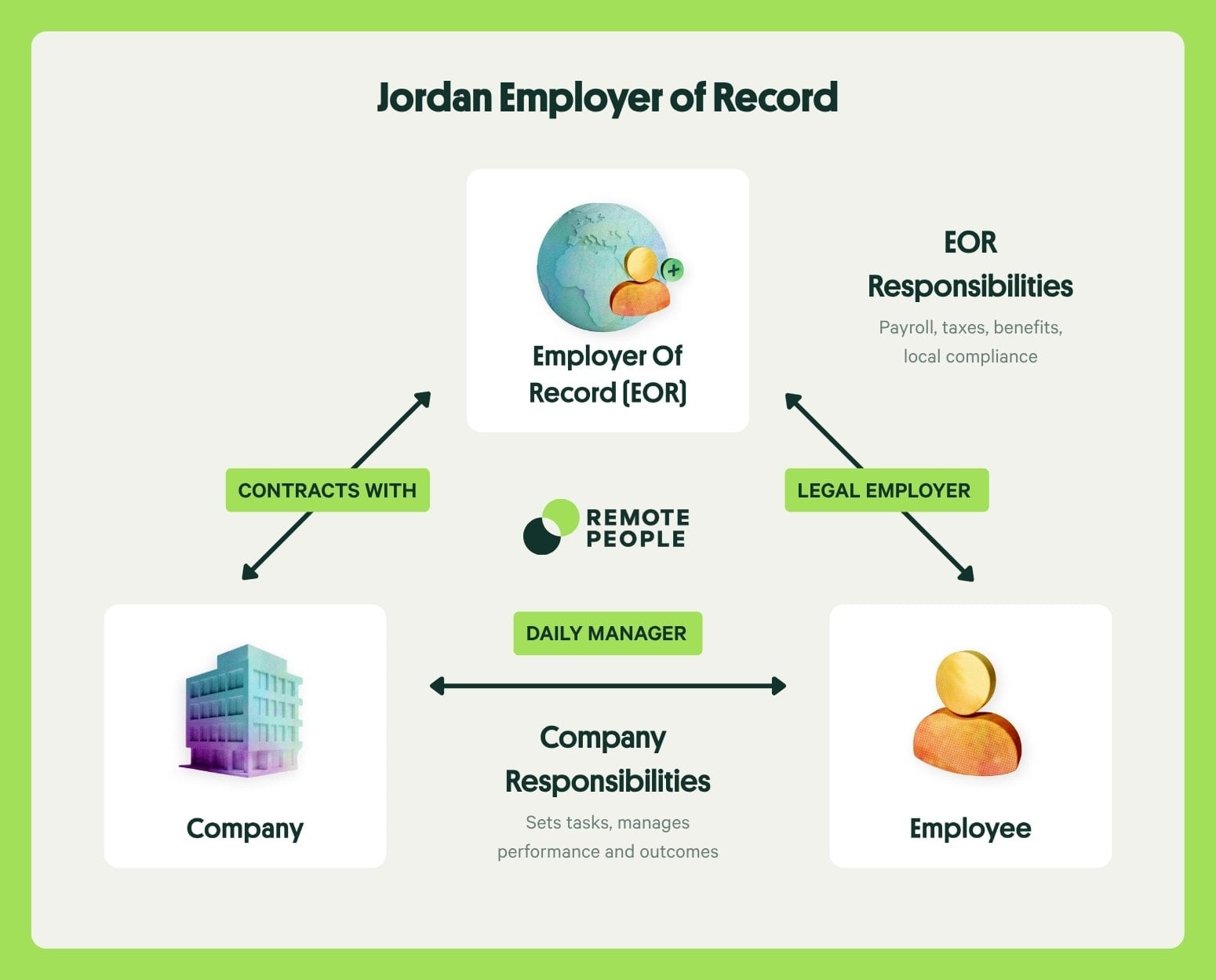
Using an employer of record service is the fastest way for international companies to hire in Jordan. An EOR lets you build a compliant workforce in Jordan without establishing a legal entity. Whether you’re launching operations, scaling your team, or testing a new market, an employer of record acts as your official employer of record, handling all employment liabilities while you retain full control over day-to-day management. Understanding how an employer of record in Jordan operates will help you make an informed decision about your hiring strategy.
If you’d like to learn more about how Employer of Record (EOR) services work, read our What Is an Employer of Record (EOR)? guide for a complete overview of the model, its benefits, and when to use it.
If you’re comparing providers, our Best Employer of Record (EOR) Providers guide reviews the leading platforms to help you choose the right solution for your business.
Who Uses an Employer of Record in Jordan?
Employer of record services in Jordan serve a diverse range of business needs. Organizations across sectors and sizes benefit from the EOR model. Here are the primary scenarios:
Large companies establishing operations in Jordan often use an EOR during the initial phase to hire staff and test the market before committing to a full local entity. This approach saves months of setup time and significant legal costs.
Early-stage businesses scaling internationally use an EOR to hire engineers, customer support staff, or sales representatives in Jordan without the overhead of entity formation.
Tech firms seeking to tap Jordan’s skilled developer and IT professional base use an EOR to hire remote team members quickly and compliantly.
Companies needing customer service, accounting, HR, or administrative support often hire through an EOR in Jordan to access qualified talent at competitive rates.
Regardless of your industry or company size, working with an employer of record in Jordan eliminates the complexity of direct employment while maintaining full control over your team and operations. Learn more about hiring in Jordan and how it fits into your international expansion strategy.
Typical Onboarding Timeline
Setting up employees in Jordan through an employer of record is faster than establishing a local subsidiary, but requires careful attention to statutory requirements. Here’s a typical timeline for onboarding:
First, you select your candidate and extend an offer. The EOR prepares the employment contract in Arabic and English within 1–2 business days.
Second, the candidate reviews and signs the employment contract. The EOR collects all required documentation including identification, tax registration, and bank details. This typically takes 2–3 days.
Third, the EOR submits SSC registration documents and obtains the employee’s SSC number. The employee is registered for health insurance and all mandatory social security branches. Registration takes 3–5 business days.
Fourth, for foreign nationals, the EOR submits work permit applications to the Ministry of Labour and Immigration Department. Processing takes 4–8 weeks depending on nationality and document completeness.
Fifth, once all registrations are complete, the EOR finalizes payroll setup, confirms salary, benefits, and deductions, and the employee begins work on the agreed start date.
Note that work permit timelines vary based on Ministry of Labour processing capacity and the completeness of the application. International hires may take 2–3 weeks total, while Jordanian nationals can typically begin work within 10–12 days.
Ready to build your team in Jordan with an employer of record? RemotePeople’s EOR services simplify hiring and eliminate legal complexity so you can focus on growth.
Hire in Jordan
Ready to build your team in Jordan? RemotePeople handles employment contracts, payroll, tax compliance, and social security so you can focus on growing your business.
Employment Laws and Regulations for Employer of Record Services in Jordan
Jordan’s employment legal framework is primarily governed by Labour Law No. 8 of 1996 and its amendments, supplemented by Social Security Law, tax regulations, and sectoral decrees. Understanding these key legal requirements is essential when hiring employees in Jordan. An EOR in Jordan manages compliance with all these regulations, but it helps to understand the major legal obligations and employee protections that apply.
Employment Contracts in Employer of Record Services
Under Jordanian law, employment relationships are governed by written or oral agreements, but written contracts are strongly recommended and, in practice, required by most employers and the SSC. Article 15 of Labour Law No. 8 of 1996 mandates that employment contracts in Jordan must be documented in writing and, where the employee does not speak Arabic, a copy must be provided in the employee’s native language. However, the contract must also include an Arabic version for legal purposes.
Employment contracts in Jordan must specify the job title, place of work, start date, salary, benefits, working hours, and any applicable conditions. Fixed-term contracts are common and may not exceed three years (WIPO Lex); they may be renewed but remain fixed-term unless converted to indefinite contracts by mutual agreement.
An EOR drafts all contracts in full compliance with Article 15 requirements, ensures proper Arabic documentation, and obtains both employer and employee signatures. The employer of record retains contracts on file and provides copies to the SSC during registration.
Working Hours and Overtime for Employer of Record
Article 56 of the Labour Law sets the standard working week at 48 hours (WIPO Lex Jordan Labour Law), typically structured as 8 hours per day across six days. Rest periods of at least one hour must be provided during the working day, and these periods are not counted as working time. Employees are entitled to one full rest day (WIPO Lex) per week, usually Friday.
In an employer of record arrangement, overtime is permitted when business needs require it and must be compensated at premium rates established by law. The following table outlines Jordan’s statutory overtime rates and caps:
Jordan overtime and premium pay rates · Per Labour Law No. 8 of 1996 |
|||
Hour Type |
Rate Multiplier |
Weekly/Daily Cap |
Notes |
|---|---|---|---|
Regular Weekday Overtime (Article 59) | 125% of hourly rate | 4 hours per day; 30 days per year | Any work beyond standard 8 hours on regular working days |
Night Work Overtime | 125% of hourly rate | Subject to daily and annual caps | Work performed between 10 PM and 6 AM typically qualifies for premium |
Friday or Rest Day Work | 150% of hourly rate | No cap; calculated per day worked | Highest compensation tier; Friday is the statutory weekly rest day |
Public Holiday Work | 150% of hourly rate | No cap; calculated per day worked | Work on designated national holidays (e.g., Independence Day, Islamic holidays) |
Source: WIPO Lex and PwC Jordan Employment Tax Guide | |||
Jordanian labour law imposes strict overtime limits to protect employee welfare. Overtime is capped at a maximum of 4 hours per day and 30 days per calendar year, except in cases of public emergency or essential services. Employers must maintain accurate records of all overtime, and compensation must be paid in the same month worked or carried forward with employee consent. An EOR ensures all overtime is properly calculated, recorded, and paid in compliance with these statutory caps.
Minimum Wage Under Employer of Record Services
Jordan’s legal minimum wage is JOD 290 per month, effective January 1, 2025, as established by the government’s annual wage decree. This rate applies to all private sector employees and represents a significant increase from the previous minimum. A notable exception applies to the garment sector, which operates under a special minimum wage agreement of JOD 230 per month.
The minimum wage applies to all working hours within the standard 48-hour week and isn’t subject to deductions beyond those mandated by law (such as income tax and mandatory SSC contributions). Any employment contract paying less than the legal minimum wage is void, and employees are entitled to claim the difference retroactively. An EOR ensures all payroll complies with the current minimum wage and adjusts compensation whenever legal minimums change.
Probation Period in Employer of Record Hiring
Article 35 of the Labour Law permits employment probation period (WIPO Lex)s of up to three months in Jordan. During probation, either employer or employee may terminate the employment relationship without notice or severance compensation, provided the probation clause is clearly stated in the employment contract. After probation concludes, standard notice periods and severance rules apply.
Employees on probation retain most employment rights including minimum wage protection, working hours limits, and statutory leave entitlements. However, the simplified termination process during probation allows both parties to assess fit before committing to a longer-term arrangement. An EOR ensures probation is properly documented in the employment contract and tracked systematically to prevent disputes.
Leave Entitlements Managed by Employer of Record
Jordanian law provides comprehensive leave entitlements covering annual leave, sick leave, maternity leave, paternity leave, and various statutory leaves. These entitlements are mandatory and may not be waived by agreement. The following subsections detail each category.
Annual Leave
Article 66 of the Labour Law establishes minimum annual leave of 14 days for employees with less than five years of service, and 21 days for employees with five or more years of service. Leave may be taken in continuous blocks or divided as agreed between employer and employee. Unused annual leave accrues and must be paid out at regular salary upon termination of employment.
Sick Leave
Article 67 provides 14 days of fully paid sick leave per year, in addition to extended sick leave provisions. Sick leave doesn’t require proof for the first three consecutive days; thereafter, a medical certificate is required. Extended sick leave beyond 14 days (up to 14 additional days) may be granted at the employer’s discretion, typically at 50% of salary. Sick leave isn’t forfeited upon resignation and is paid out if unused.
Maternity Leave
Article 70 of the Labour Law grants 90 days of maternity leave, amended in 2024 to extend the period from the previous 60 days. Employees with SSC registration receive fully paid maternity leave covered by the Social Security Corporation, ensuring no salary reduction. After returning from maternity leave, mothers are entitled to one hour of nursing leave per day for up to 12 months. Maternity leave applies to biological mothers and, in some cases, adoptive mothers under regulations.
Paternity Leave
As amended in 2019, Article 70 grants three days of paid paternity leave to fathers upon the birth of a child. This leave must be taken within a specified period following the child’s birth. Paternity leave is in addition to other statutory leave entitlements and does not reduce other leave allowances.
Other Statutory Leave
Additional statutory leave provisions in Jordan include Hajj leave (14 days once per lifetime under Article 66/A), marriage leave (3 days under Article 66/B), bereavement leave (3 days for death of immediate family), and study leave (14 days per year for continuing education). These leaves are paid and, in most cases, do not reduce annual leave entitlements.
The following table summarizes all statutory leave entitlements and their key eligibility requirements:
Jordan statutory leave entitlements · Per Labour Law No. 8 of 1996 |
||
Leave Type |
Duration |
Eligibility and Notes |
|---|---|---|
Annual Leave (Article 66) | 14 days (< 5 years service) or 21 days (5+ years service) | Applies to all employees. Accrues annually and carries forward. Full payout on termination. |
Sick Leave (Article 67) | 14 days paid + up to 14 days extended | Full 14 days require no proof for first 3 consecutive days. Medical certificate required thereafter. Extended leave at employer discretion, usually 50% pay. |
Maternity Leave (Article 70, amended 2024) | 90 days (amended from 60 days) | Fully paid for SSC-registered employees. Plus 1 hour nursing leave per day for 12 months post-return. Applies to biological and adoptive mothers. |
Paternity Leave (Article 70, amended 2019) | 3 days paid | Available to fathers upon child birth. Must be taken within specified timeframe. Does not reduce other entitlements. |
Hajj Leave (Article 66/A) | 14 days once per lifetime | Paid leave for eligible Muslim employees performing Hajj pilgrimage. Takes precedence over other leave during the Hajj season. |
Marriage Leave (Article 66/B) | 3 days paid | Granted to employee upon marriage. Must be documented with marriage certificate. Does not reduce annual leave. |
Bereavement Leave | 3 days paid | Granted upon death of immediate family member (spouse, parent, child). May be extended by employer discretion. |
Study Leave | 14 days per year | For continuing education or professional development. May require proof of enrollment. Terms negotiable with employer. |
Source: WIPO Lex and PwC Jordan Employment Standards | ||
Statutory Employee Benefits in Employer of Record Model
Beyond salary and leave, Jordanian law requires employers to provide or contribute to several mandatory employee benefits. These benefits are integrated into the payroll and social security system. Here are the core statutory benefits:
All employees registered with the Social Security Corporation receive mandatory health insurance coverage, funded through employer and employee SSC contributions. This covers medical treatment, hospitalization, and prescribed medications.
The SSC administers a contributory pension and disability insurance program. Employees contribute approximately 6.5% and employers 11% of gross salary toward old age, disability, and death insurance benefits.
Employers contribute to mandatory work injury insurance through the SSC, which covers medical treatment, temporary disability payments, and permanent disability compensation for workplace accidents and occupational diseases.
SSC maternity insurance covers the cost of 90 days maternity leave for eligible employees, funded through employer contributions of 0.75% of gross salary.
Since 2013, Jordan operates a mandatory unemployment insurance scheme called Taameen. Employees and employers both contribute, providing eligible workers with income support during periods of involuntary unemployment.
An EOR ensures all statutory benefits are properly registered, contributions are calculated and deducted correctly, and claims are filed on behalf of employees when necessary. For details on contribution rates and payroll integration, see the payroll and tax section of this guide.
Recent Regulatory Updates (2026)
Jordan’s employment and social security regulations continue to evolve. Recent changes impacting employers include the following:
The legal minimum wage rose to JOD 290 per month, effective January 1, 2025, a significant increase from the previous JOD 260. This affects all employment contracts and payroll calculations.
Maternity leave was extended from 60 to 90 days, bringing Jordan into alignment with international standards and increasing employer obligations for leave administration and SSC contributions.
Recent amendments to SSC legislation refined contribution rates, expanded coverage for certain categories of workers, and introduced new reporting requirements for employers.
Amendments to Article 29 of the Labour Law strengthen penalties for sexual harassment in the workplace and require employers to establish internal complaint mechanisms and investigation procedures.
Recent amendments expanded protections for vulnerable workers, including enhanced termination safeguards for pregnant employees and workers with disabilities.
An employer of record in Jordan stays current with all regulatory changes and automatically applies updates to contracts, payroll, and compliance procedures. This ensures your workforce remains fully compliant as laws evolve.
Work Permits and Visas in Jordan
Work Permit Requirements for Employer of Record
Who Needs a Work Permit
All foreign nationals seeking employment in Jordan must obtain a work permit before commencing work. The requirement applies regardless of job level, salary, or employment duration. Jordan does recognize bilateral agreements with several countries that may grant limited exemptions, but these are narrowly defined and uncommon. Even nationals of countries with trade agreements or other formal ties should verify their specific status with the Ministry of Labour (MoL) before employment begins.
The work permit requirement is strictly enforced. Employers hiring without proper permits face significant penalties, including fines, work stoppages, and potential criminal liability. Foreign workers without valid permits may face deportation and bans from re-entry.
Eligibility and Required Documents
To be eligible for a work permit in Jordan, foreign nationals must meet several baseline criteria and submit comprehensive documentation:
- Valid passport with at least 6 months remaining validity at the time of application
- Signed employment contract specifying job title, duties, duration, and salary
- Relevant professional qualifications, degrees, or certifications (attested by the originating country’s Ministry of Foreign Affairs)
- Police clearance certificate from the applicant’s country of origin or last residence
- Medical examination certificate (conducted by an approved clinic in Jordan, confirming fitness for work)
- Employer registration and good standing with the Ministry of Labour
- Proof of financial capacity to pay advertised salary
Documentation must be translated into Arabic by a certified translator if submitted in another language. All foreign documents must be attested by the home country’s Ministry of Foreign Affairs and then legalized by the Jordanian embassy or consulate in that country.
Processing Time and Validity
Work permit processing typically takes 4–8 weeks from submission of a complete application. Initial work permits are issued for a duration of 1 year. Processing time may extend if additional security checks are required, if documentation is incomplete, or during high-volume periods.
The permit remains valid only for the named employer. If a foreign employee changes employers, they must obtain a new work permit from the new employer.
Renewal Process
Work permits must be renewed before expiry. The renewal application should be submitted to the Ministry of Labour at least 30 days prior to the current permit’s expiration date. Renewal requires resubmission of key documents, including an updated employment contract, updated medical examination, and renewed police clearance (or confirmation of no issues). The employer must remain in good standing and maintain proof of financial capacity.
Renewal applications typically receive faster processing than initial applications, often completed within 2 to 3 weeks if all documentation is properly prepared.
Common Visa Types for Foreign Workers Under Employer of Record
Jordan issues several work visa categories, each designed for different employment scenarios. The most common types are shown in the table below:
Jordan work visa types for foreign workers · 2026 |
||||
Visa Type |
Initial Duration |
Best For |
Path to Residency |
Typical Processing |
|---|---|---|---|---|
Standard Work Permit |
1 year |
Most foreign employees in private sector |
Renewable; no automatic PR pathway |
4–8 weeks |
Resident Work Permit |
3 years |
Skilled expatriates in strategic roles |
Potential residency after 3–5 years |
6–10 weeks |
Temporary Work Permit |
1 year (renewable up to 3 years) |
Project-based or contractual roles |
No automatic PR pathway |
3–6 weeks |
ASEZ Permit |
1–3 years |
Employees in Aqaba Special Economic Zone |
Residency pathway available |
4–8 weeks |
Investor Permit |
3 years |
Foreign business owners and senior investors |
Residency eligible with sustained investment |
6–12 weeks |
Source: Jordan Ministry of Labour · Paul Hastings |
||||
Separate visa categories exist for other purposes, though they do not grant work authorization:
- Tourist visas – typically 30 or 60 days, non-renewable for work
- Student visas – issued to those enrolled in accredited institutions, work restrictions apply
- Transit visas – for short stays of less than 48 hours, no work permitted
How an Employer of Record Handles Work Permits
When hiring through an Employer of Record (EOR) in Jordan, the employer of record becomes the legal employer and is responsible for sponsoring the work permit application. The EOR’s role includes:
- Verifying the foreign national’s eligibility for a work permit
- Collecting required documentation from the employee
- Submitting the complete application package to the Ministry of Labour on behalf of the employer
- Following up on the application status and communicating timelines
- Paying all associated permit fees
- Managing permit renewal before expiry
The employee’s role is primarily to provide documentation, consent, and cooperation. They must supply valid identity documents, professional qualifications, police clearances, and undergo a medical examination. In most cases, the employee does not need to visit the Ministry office; the EOR handles submissions and correspondence.
However, employees should be aware of certain limitations. An EOR work permit is valid only with that specific employer of record employer. If the employee wishes to switch employers, a new work permit application is required, and the timeline resets. Additionally, Jordan does not offer a digital nomad or long-term independent visa, so remote workers or those without a defined employer within Jordan must use the standard work permit pathway tied to an employer.
Payroll, Taxes, and Social Security in Jordan
Employer Contributions in Employer of Record Services
Employers in Jordan are required to contribute to the national Social Security Corporation (SSC) on behalf of all employees. These contributions fund benefits including old age pension, work injury insurance, maternity protection, and unemployment benefits. The combined employer contribution rate is 14.25% of gross salary, with a monthly salary ceiling of JOD 3,668.
Jordan employer social security contributions · 2026 rates |
||
Contribution Type |
Rate (%) |
Notes |
|---|---|---|
Old Age, Disability & Death Insurance |
11.00% |
Funds retirement pensions and disability benefits |
Work Injury Insurance |
2.00% |
Covers occupational accidents and injuries |
Maternity Insurance |
0.75% |
Provides maternity allowances and benefits |
Unemployment Insurance |
0.50% |
Unemployment benefits and retraining programs |
Total Employer Contribution |
14.25% |
Applied to monthly salary up to JOD 3,668 |
Contributions are calculated on the actual monthly salary, but only up to the ceiling of JOD 3,668. For employees earning above this amount, contributions are capped at JOD 3,668 and are not applied to income beyond the ceiling.
Employee Contributions
Employees are required to contribute to the Social Security system as well. These contributions are deducted from the employee’s gross salary and are split between old age insurance and unemployment insurance. The combined employee contribution rate is 7.5% of gross salary, also subject to the JOD 3,668 monthly ceiling.
Jordan employee payroll deductions · 2026 monthly withholdings |
||
Deduction Type |
Rate (%) |
Notes |
|---|---|---|
Old Age, Disability & Death Insurance |
6.50% |
Employee share of retirement benefit funding |
Unemployment Insurance |
1.00% |
Employee share of unemployment coverage |
Total Employee Contribution |
7.50% (SSC) |
Applied to monthly salary up to JOD 3,668 |
The employer is responsible for withholding employee contributions from salary and remitting them to the SSC along with the employer’s portion. These contributions are separate from, and in addition to, income tax withholding.
Income Tax Management by Employer of Record
Jordan applies a progressive income tax system to resident individuals, with tax brackets based on annual taxable income. Personal exemptions and dependent allowances reduce taxable income before rate brackets are applied.
Jordan income tax brackets · 2026 |
|
Income Bracket (JOD) |
Tax Calculation |
|---|---|
0–5,000 |
5% of taxable income |
5,001–10,000 |
JOD 250 + 10% of income over JOD 5,000 |
10,001–15,000 |
JOD 750 + 15% of income over JOD 10,000 |
15,001–20,000 |
JOD 1,500 + 20% of income over JOD 15,000 |
20,001–1,000,000 |
JOD 2,500 + 25% of income over JOD 20,000 |
Above 1,000,000 |
JOD 247,500 + 30% of income over JOD 1,000,000 |
Additional: National Contribution Tax – 1% applied on taxable income above JOD 200,000 annually |
|
Personal Exemptions: JOD 9,000 for individual + JOD 9,000 per dependent (spouse, children under 18) |
|
The personal exemption of JOD 9,000 applies to all residents and is combined with spousal and dependent allowances. This significantly reduces the taxable income for many workers, particularly those with family responsibilities. The 1% national contribution is an additional tax layer that applies only to annual taxable income exceeding JOD 200,000.
Cost of Hiring Through an EOR in Jordan
When evaluating an EOR service in Jordan, understanding the cost structure is essential for budgeting and comparing options. employer of record costs typically include service fees, statutory contributions, and administrative expenses. Here is a breakdown of typical costs:
Jordan employer cost example · USD 3,000 gross · 2026 |
|
Cost Component |
Amount (USD) |
|---|---|
Employee Gross Salary |
3,000 |
Employer SSC Contributions (14.25%) |
427.50 |
EOR Service Fee (per-employee monthly) |
299–599 |
Total Monthly Employer Cost |
3,726.50–4,026.50 |
Source: Jordan Social Security Corporation · PwC Jordan Tax Summaries Note: Costs shown are examples. Actual fees vary by employer of record provider and service level. Additional costs may include visa fees, work permit processing, and one-time onboarding fees. Employee gross salary shown is example only; adjust based on actual compensation. |
|
EOR pricing in Jordan varies based on several factors, including the number of employees hired, the scope of services required, and the complexity of compliance needs. Organizations hiring large teams may benefit from volume-based pricing, while smaller headcounts may have higher per-employee fees. Service scope also influences cost: whether you require only basic payroll processing or comprehensive compliance support including work permit management and statutory reporting. Regulatory complexity is another key pricing variable; hiring only Jordanian nationals typically involves lower compliance overhead than managing international workforces with work permit requirements. Jordan’s relatively straightforward regulatory environment and mature social security infrastructure help keep employer of record costs competitive compared to other MENA region countries. Service providers can streamline registration, benefits administration, and tax compliance, reducing overhead and allowing for predictable, transparent pricing without hidden administrative charges. When comparing EOR providers, consider what is included in base fees and what incurs additional charges, as the total cost of ownership may vary significantly based on service comprehensiveness and provider operational efficiency.
Benefits of Using an EOR in Jordan
Employer of record services provide substantial advantages for companies hiring in Jordan. Key benefits include:
Launch operations in Jordan within weeks without establishing a legal entity. Avoid the cost, complexity, and delay of setting up a branch or subsidiary, which typically takes 3–6 months and requires significant capital investment.
Ensure 100% compliance with Jordanian labour law, social security requirements, tax regulations, and work permit rules. The EOR stays current with all regulatory changes and implements them automatically across your workforce.
Minimize legal and employment-related risk. The EOR holds the employer relationship and manages all statutory obligations, shielding your company from direct exposure to Jordanian employment claims, disputes, and penalties.
Avoid surprise costs and complex administrative overhead. EOR fees are transparent and all-inclusive, covering payroll, compliance, and benefits administration in a single predictable monthly cost.
Benefit from in-country expertise and established relationships with government agencies, tax authorities, and the Social Security Corporation. Your EOR team understands local norms, cultural practices, and regulatory nuances.
Employees receive professional payroll administration, benefit management, and support. The EOR provides a stable employment experience including on-time salary payments, proper SSC registration, and responsive HR support.
Easily hire additional employees in Jordan without administrative burden. The EOR provides a repeatable, scalable process for onboarding new hires quickly.
Start hiring confidently in Jordan today. RemotePeople’s EOR while you build your team. Onboard your first employee in as little as 48 hours.
Termination and Offboarding in Jordan
Notice Periods and Severance Requirements for Employer of Record
Jordan’s Labour Law No. 8 of 1996 establishes specific notice periods and severance obligations that apply when terminating employment. These requirements vary based on the reason for termination and the employee’s tenure. Understanding these obligations is critical to ensure compliance and avoid costly disputes.
Notice Periods by Employment Status
The following table outlines statutory notice period requirements under Jordanian law:
Jordan notice periods by position level · Per Labour Law No. 8 of 1996 |
||
Termination Scenario |
Notice Period (Days) |
Details |
|---|---|---|
Probation Period (Article 35) |
0 (no notice required) |
Either party may terminate during probation without notice or severance, provided probation clause is documented in contract |
Employee-Initiated Resignation |
30–90 days |
Negotiated in employment contract; 30 days is standard for lower-level employees, up to 90 days for senior positions |
Employer-Initiated Termination (without cause) |
30–90 days |
Employer must provide written notice; minimum 30 days for lower levels, up to 90 days for senior/managerial roles |
Termination for Gross Misconduct |
0 (immediate) |
For serious infractions (theft, violence, willful insubordination); must be documented and subject to appeal |
Redundancy or Restructuring |
30–60 days |
Notice period applies; employer must demonstrate business justification and follow fair process |
Source: WIPO Lex · PwC Jordan Tax Summaries |
||
Severance Pay Requirements
In addition to notice periods, Jordan’s Labour Law mandates severance payments upon termination. Severance is calculated based on years of service and final salary:
Jordan severance pay schedule by years of service · Per Labour Law No. 8 of 1996 |
|
Years of Service |
Severance Payment |
|---|---|
Less than 1 year |
No severance (except if dismissed without cause) |
1 to 5 years |
Half month’s salary for each year of service |
5 to 10 years |
1 month’s salary for each year of service |
Over 10 years |
1.5 months’ salary for each year of service |
Source: WIPO Lex · PwC Jordan Tax Summaries |
|
Severance is calculated on the employee’s final month’s salary at the time of termination. For example, an employee with 7 years of service earning JOD 1,000 per month would receive 7 months of severance (1 × 7 = 7 months). Severance must be paid in addition to any accrued and unused annual leave payout.
Final Settlement Obligations
Upon termination, employers must comply with specific final settlement requirements:
- Accrued Leave Payout: Pay out all unused annual leave at the employee’s regular salary rate. Sick leave and statutory leave are generally not paid out unless otherwise agreed.
- Final Salary Payment: Pay all earned wages for the notice period (or the full notice period if employee is released immediately).
- Bonus and Commission: If applicable, include any earned bonuses or commissions earned up to the termination date.
- Separation Certificate: Provide an official separation certificate detailing the employment period, position, and final salary. This is required for the employee to access severance and benefits.
- SSC Notification: Notify the Social Security Corporation of the termination and ensure all final contributions are paid and the account is settled.
- Final Tax Settlement: Ensure final income tax withholding is calculated correctly and all withheld taxes are remitted to the tax authority.
An EOR manages the entire termination and final settlement process, ensuring all payments are accurate and all statutory notifications are completed on time.
EOR vs Other Hiring Models in Jordan
How Employer of Record Services Compare to Local Entity (Branch or Subsidiary) Establishment
Many companies considering hiring in Jordan face the choice between using an EOR or establishing a local legal entity. The following comparison outlines key differences:
Jordan EOR vs local entity comparison · Setup time, cost, risk and best-fit |
||
Criteria |
EOR Service |
Local Entity (Branch/Subsidiary) |
|---|---|---|
Setup Time |
2–4 weeks |
8–12 weeks (legal registration, tax setup, bank account) |
Setup Cost |
Minimal (onboarding fees only) |
High ($5,000–$15,000 in legal, accounting, and administrative fees) |
Ongoing Compliance |
EOR handles all compliance |
Your company’s responsibility; requires in-country expertise |
Regulatory Risk |
Low (EOR bears responsibility) |
High (company is directly liable) |
Scalability |
Unlimited hiring with minimal overhead |
Can scale, but requires expanded local management |
Cost per Employee |
$75–$150/month service fee + SSC contributions |
Lower per-employee cost after accounting setup, but high fixed costs |
Best For |
Market testing, rapid scaling, limited headcount, long-term flexibility |
Large operations (20+ employees), long-term commitment, high control needs |
Employer of Record vs Independent Contractors
Another common question is whether to hire through an EOR or engage independent contractors. This comparison illustrates the key trade-offs:
Jordan EOR vs independent contractors · Compliance, cost, and risk |
||
Criteria |
EOR Employee |
Independent Contractor |
|---|---|---|
Employment Status |
Full employee with all legal protections |
Self-employed; minimal legal relationship |
Compliance Burden |
High (EOR handles all) |
Lower, but misclassification risk if worker is actually an employee |
Cost Structure |
Fixed salary + SSC contributions + EOR fee |
Variable (contract-based); may include invoicing overhead |
Statutory Benefits |
Required (health, SSC, maternity, unemployment) |
Contractor responsibility; no benefits required |
Control and Direction |
Can provide detailed direction and supervision |
Limited control; contractor sets own methods |
Legal Risk |
Low (compliant employment relationship) |
High (misclassification penalties can be severe) |
Best For |
Full-time, ongoing roles requiring close management and compliance |
One-off projects, specialized expertise, genuine independent work |
Source: WIPO Lex |
||
If you need flexibility to work with both employees and contractors, our contractor management solutions provide compliance oversight for independent worker arrangements alongside traditional employment.
EOR vs PEO (Professional Employer Organization)
While less common for international hiring, some organizations confuse EOR with PEO services. Here is how they differ:
Jordan EOR vs PEO comparison · Legal employer, liability, and setup |
||
Criteria |
EOR (Employer of Record) |
PEO (Professional Employer Organization) |
|---|---|---|
Legal Employer Status |
EOR is the sole legal employer |
Co-employment; both entities share employer status |
Liability |
EOR holds full employment liability |
Shared liability (can create compliance complexity) |
Best Use Case |
International expansion without local entity |
Domestic (domestic co-employment is less relevant internationally) |
Typical Availability |
Available globally for most countries |
Primarily US-based; limited international options |
Source: PwC Tax Summaries |
||
Public Holidays in Jordan
Understanding public holidays in Jordan is important for payroll, leave administration, and workforce planning. Employees are entitled to public holidays as paid time off, and work performed on public holidays typically qualifies for premium pay (as outlined in the overtime section).
Jordan observes the following public holidays in 2026:
Jordan public holidays · 2026 calendar year |
||
Holiday Name |
Date(s) in 2026 |
Notes |
|---|---|---|
New Year’s Day |
January 1 |
Fixed; national holiday |
Isra and Mi’raj |
January 13 |
Islamic holiday (may vary by lunar calendar) |
Good Friday |
April 10 |
Optional for Christian employees; varies by year |
Easter Monday |
April 13 |
Optional for Christian employees; varies by year |
Labour Day |
May 1 |
Fixed; national holiday |
Eid al-Fitr |
April 1–2 |
Islamic holiday (dates vary by lunar calendar; usually 3 days in Jordan) |
Eid al-Adha |
June 8–9 |
Islamic holiday (dates vary by lunar calendar; usually 4 days in Jordan) |
Islamic New Year |
June 25 |
Islamic holiday (dates vary by lunar calendar) |
Prophet Muhammad’s Birthday |
August 31 |
Islamic holiday; optional for some employers |
Independence Day |
May 25 |
Fixed; national holiday celebrating Jordan’s independence in 1946 |
King Abdullah II’s Birthday |
January 30 |
Fixed; national holiday |
Army Day |
June 10 |
Optional; some private employers may observe |
Source: Jordan Ministry of Labour · WIPO Lex Jordan Labour Law Note: Islamic holiday dates vary based on lunar calendar and official government announcement. Employers should confirm exact dates each year with government sources. Christian employees may be entitled to observe Good Friday and Easter Monday, but this varies by employer and agreement. |
||
How to Get Started with an EOR in Jordan
Getting started with an EOR in Jordan is straightforward. Here are the typical steps:
First, determine the number of employees you plan to hire, their roles, expected salaries, and start timeline.
Second, research EOR providers operating in Jordan, verify their local expertise, compliance record, and customer support quality.
Third, provide the EOR with your company information, employee details, and hiring timeline. The employer of record will prepare contracts and documentation.
Fourth, ensure your candidate(s) have required documents ready: passport, qualifications, police clearance (for foreign nationals), and medical examination.
Fifth, the EOR drafts and executes employment contracts, registers employees with SSC and tax authorities, and begins payroll setup.
Sixth, for foreign employees, the EOR submits work permit applications and manages the approval process.
Seventh, once all registrations are complete, the EOR begins payroll processing and benefit administration.
Finally, the EOR handles payroll, compliance, leave tracking, and statutory reporting throughout the employment relationship.
Ready to move forward? Contact RemotePeople’s team to discuss your Jordan hiring needs and receive a customized proposal within 24 hours.
Where companies hiring in Jordan expand next
Employers with teams in Jordan often extend across the Levant and into nearby Gulf markets, where Arabic fluency and business ties create natural overlap. After building a team in Jordan, employers often look to the United Arab Emirates for a common Arabic-speaking candidate base, then hiring in Saudi Arabia for a shared Arabic-speaking talent pool. An EOR partner in Lebanon follows with aligned Levant hiring dynamics, and Israel typically closes the regional footprint via the regional Levant talent corridor.
Frequently Asked Questions
An EOR is the legal employer and manages all employment administration, including contracts, payroll, taxes, benefits, and compliance. A staffing agency typically recruits and supplies workers but may not carry full employer liability. With an employer of record, your company has direct control over the employee and day-to-day management, while the EOR handles legal and administrative obligations. With staffing agencies, the agency often retains management control.
Yes, absolutely. An EOR in Jordan hires both Jordanian citizens and foreign nationals. The primary difference is that Jordanian nationals do not require work permits, which simplifies and accelerates the hiring timeline. Foreign nationals must obtain work permits through the Ministry of Labour, which the employer of record arranges and manages.
For Jordanian nationals, the entire process typically takes 10–14 days from candidate offer to first payroll. For foreign nationals, hiring takes 2–3 weeks total due to work permit processing. The work permit itself usually takes 4–8 weeks, but employees can often begin work during permit processing in most cases (Jordan Ministry of Labour).
Foreign nationals can be hired through an EOR provided they obtain a valid work permit. Jordan’s labour law requires work permits for all foreign employees; there are no blanket exemptions based on nationality, though a small number of bilateral agreements may apply (WIPO Lex). The hiring process is the same regardless of the employee’s home country. Ensure the work permit is approved before the employee begins work.
While contractors may appear less expensive initially, there are significant compliance risks in Jordan. Misclassifying an employee as a contractor can result in severe penalties, back-tax liability, and legal exposure. If the worker is integrated into your organization, works full-time, or receives your direction, they must be classified as an employee. An EOR provides a compliant, cost-effective alternative to direct employment without the legal risks of contractor misclassification. If you do need to engage genuine contractors, RemotePeople's contractor solutions provide compliance oversight and payment processing in Jordan.
Reputable EOR providers maintain compliance bonds and insurance to protect against business disruption. However, you should verify that your chosen employer of record is financially stable and carries appropriate professional liability insurance. In the unlikely event of provider failure, employees remain protected under Jordanian labour law, and you can transition to a different EOR or establish your own entity with minimal disruption.
Most EORs focus on payroll, compliance, and statutory obligations. Some offer expanded HR services such as employee handbook creation, policy development, and guidance on employee relations issues. Confirm with your EOR what support they provide beyond core payroll and compliance.
The legal minimum wage is a floor, not a ceiling. You can pay significantly more for skilled roles, senior positions, or to attract top talent. The minimum wage of JOD 290 per month was set effective January 1, 2025 (Jordan Ministry of Labour). Market rates in Jordan vary by industry, experience, and location. For technical roles, marketing, management, and specialized functions, market salaries often range from JOD 800–3,000+ per month, well above the minimum wage.
The EOR withholds employee income taxes and social security contributions from salaries and remits them to the relevant authorities. Employer SSC contributions (14.25%) are also handled by the employer of record and included in the total cost of employment (Social Security Corporation). You pay the EOR, and they manage all tax compliance and remittances. Your company isn’t directly responsible for any tax filings related to these employees.
Employer of Record in
Employer of Record in
Employer of Record in
Employer of Record in
Employer of Record in
Employer of Record in
Employer of Record in
Employer of Record in