
 Recruit
Employer of Record in Montserrat
-
 Drew Donnelly
- Published
- September 22, 2026
Montserrat’s Labour Code includes mandatory Montserrat Social Security Fund contributions, statutory leave entitlements, and severance pay rules, and a Montserrat EOR ensures full compliance with no local entity needed.
Hire in Montserrat — book a free 30-minute demo
Tell us what you need. You'll get a tailored, transparent proposal within 24 hours, plus a free call to walk through it.
Tell us about your company
So we can match you with a specialist who knows your market — and unlock volume pricing tiers.
* All fields are required.
Where and when are you hiring?
Tell us the geography and timing and we'll quote each country line by line, with onboarding timelines.
* All fields are required.
Help us beat your current setup
We'll benchmark your current deal and send a line-by-line proposal in 24 hours — showing exactly where we cut cost, time, or risk. After you submit, you can book a call to walk through it together.
* All fields are required.
Thanks! Your proposal is on its way.
Expect a tailored, line-by-line proposal in your inbox within 24 hours. In the meantime…
Want to walk through it together?
Book a free 30-minute call with one of our specialists. We'll explain every line, answer your questions, and tailor the proposal further if you need.
No obligation. Pick a time that works for you.








- Hire in Montserrat — book a free 30-minute demo
- Tell us about your company
- Where and when are you hiring?
- Help us beat your current setup
- Thanks! Your proposal is on its way.
- How an Employer of Record Works in Montserrat
- Hire in Montserrat
- Employment Laws and Regulations in Montserrat
- Work Permits and Visas in Montserrat
- Payroll, Taxes, and Social Security in Montserrat
- Cost of Hiring Through an EOR in Montserrat
- Benefits of Using an EOR in Montserrat
- Termination and Offboarding in Montserrat
- EOR vs. Other Hiring Models in Montserrat
- Public Holidays in Montserrat
- How to Get Started with an EOR in Montserrat
- Where companies hiring in Montserrat expand next
- Frequently Asked Questions
- Related EOR Destinations

Start hiring in Montserrat
Let RemotePeople handle payroll, compliance, and HR admin worldwide so you can focus on building your team.

Montserrat offers access to a small but highly skilled English-speaking Caribbean workforce operating under a familiar common-law legal framework and a stable Eastern Caribbean Dollar pegged to the US Dollar at XCD 2.70 = USD 1.00. For companies looking to hire employees in Montserrat, the practical obstacles are not wage levels or language, but the administrative overhead of registering a local entity, navigating the Labour Code 2012, registering with the Montserrat Social Security Fund, and meeting Inland Revenue obligations for a single hire. An employer of record in Montserrat removes that overhead by acting as the legal employer of your workers on the island while you direct their day-to-day work, making it possible to put someone on payroll within one to two weeks rather than the months a company formation would take.
This guide covers every statutory figure a hiring team needs, including the Montserrat Social Security Fund rates that took effect on 1 January 2026, the income tax brackets in force since the Income and Corporation Tax (Amendment) Act 2024, and the notice and severance schedules set out in the Labour Code 2012. All figures are cited to the government gazette or the official social security and inland revenue sources so you can verify each number independently.
How an Employer of Record Works in Montserrat
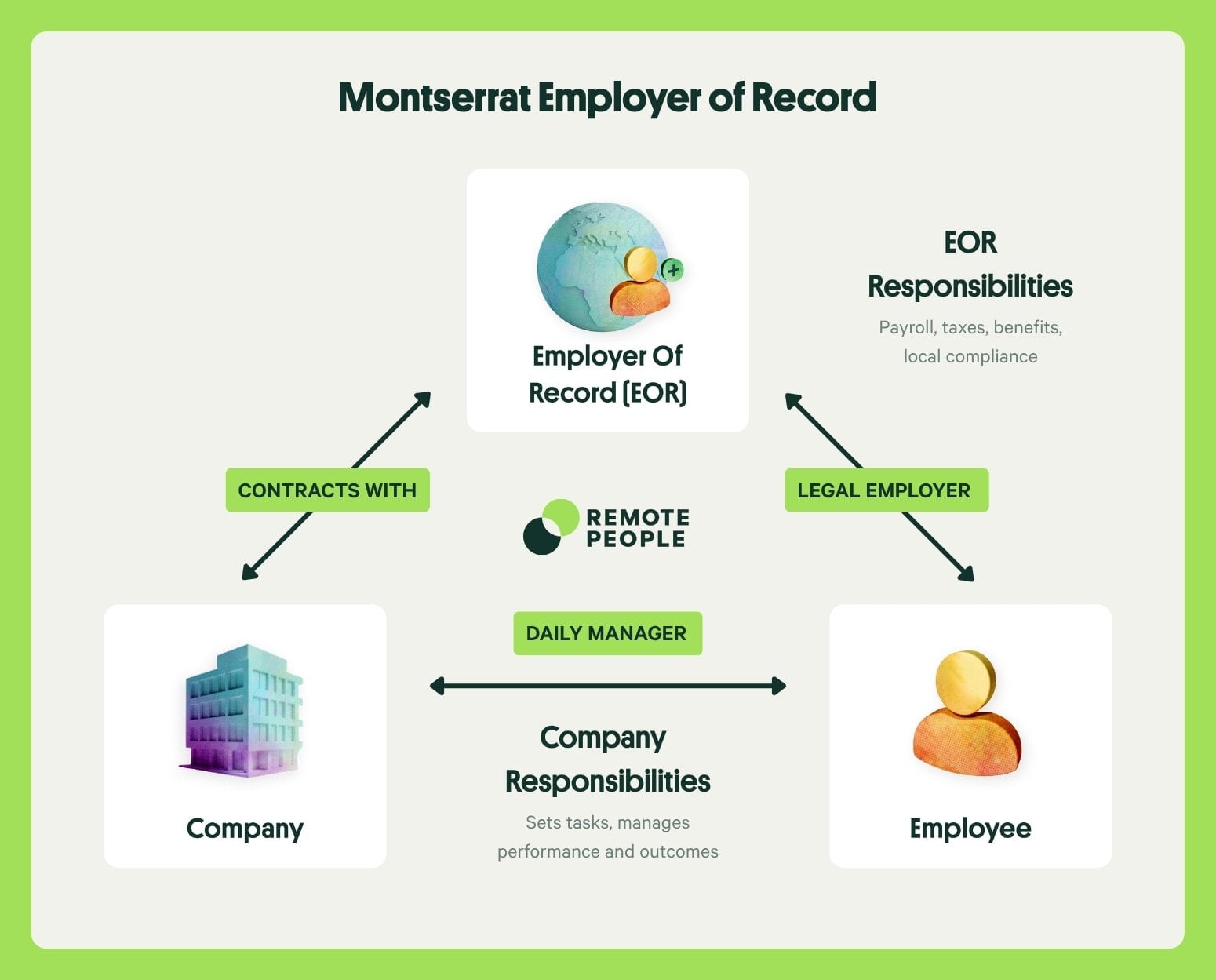
If you’d like to learn more about how Employer of Record (EOR) services work, read our What Is an Employer of Record (EOR)? guide for a complete overview of the model, its benefits, and when to use it.
If you’re comparing providers, our Best Employer of Record (EOR) Providers guide reviews the leading platforms to help you choose the right solution for your business.
Who Uses an EOR in Montserrat?
The smallest British Overseas Territory in the Caribbean attracts a specific type of hiring need. Companies that use an employer of record in Montserrat are usually not planning to open a branch on the island, but still need a legally compliant way to engage one or more workers there.
The EOR model suits companies that want to test the Montserrat market with one or two hires before committing to a long-term local presence, small distributed teams where a headcount of one to ten people rarely justifies the XCD registration and corporate tax filings of a local company, and organisations that have already identified a candidate and want to shorten time-to-hire from months to weeks. It also fits employers hiring CARICOM or non-CARICOM nationals who need a work permit or a CARICOM Skilled National Certificate, since the EOR manages the immigration paperwork with the Ministry of Labour rather than leaving it to the client.
The common thread is that the client company wants the person to start work on the island without waiting for a corporate registration and without carrying ongoing compliance risk themselves.
Typical Onboarding Timeline
An EOR engagement in Montserrat typically follows a predictable sequence. Because Montserrat’s administrative footprint is small, the main variable is whether a work permit is needed. A summary timeline for a worker who does not need a permit is below.
A standard Montserrat EOR onboarding takes between nine and sixteen business days end-to-end. The first one to two days cover the master services agreement and collecting passport, bank, and qualification details from the new hire. Two to three days are spent drafting a Labour Code 2012-compliant written contract and agreeing the terms with the candidate. Registration with the Montserrat Social Security Fund and the Inland Revenue Department takes a further three to seven days. Another two to three days are needed to add the employee to payroll and enrol them in any supplementary benefits, with the final day reserved for issuing credentials and completing induction.
Most EOR providers can onboard an employee in Montserrat within one to two weeks. Work permit applications for non-CARICOM nationals extend this by four to eight weeks depending on Ministry of Labour processing. Background checks and overseas document legalisation can add a further week.
Hire in Montserrat
Hire full-time employees in Montserrat without setting up a local entity. RemotePeople handles Labour Code 2012 compliance, MSSF contributions, PAYE filings, and payroll end-to-end.
Employment Laws and Regulations in Montserrat
Employment Contracts
Employment in Montserrat is governed primarily by the Labour Code 2012 (Chapter 6.04), administered by the Department of Labour under the Ministry of Labour. The Code sets the statutory floor on hours, leave, notice, severance, maternity protection, and workplace standards. Written contracts are required for continuous engagements of more than three months, and the contract must identify the parties, the position, the base rate of pay, the start date, and any probationary period. Contracts may be fixed-term or indefinite, and fixed-term contracts that are renewed past the Labour Code’s specified thresholds convert into indefinite engagements by operation of law. English is the working language and the default contract language.
Working Hours and Overtime
Montserrat’s standard working week is 40 hours, set by reference to the overtime threshold in Section 36 of the Labour Code 2012, which requires premium pay once an employee works more than 8 hours in a day or more than 40 hours in a week. Rest intervals are regulated by Section 35, which restricts continuous work to no more than five hours before a meal break. Overtime cannot be forced on an employee, and the premium provisions do not apply to salaried managerial and supervisory employees whose terms are fixed at a level that already compensates them for additional hours (Labour Code, Section 36(4)).
Montserrat overtime and premium pay rates · Per Labour Code 2012 | |||
Hour Type | Rate Multiplier | Trigger | Notes |
|---|---|---|---|
Weekday overtime | 1.5× | Above 8 hrs/day or 40 hrs/week | Section 36(1); applies to hourly-paid staff |
Public holiday work | 2.0× | Any hour worked on a gazetted holiday | Section 36(1); double time for all hours |
Forced overtime | Not permitted | N/A | Section 36(2); overtime is voluntary |
Managerial / supervisory | Exempt | Salaried roles with adequate compensation | Section 36(4); standard exemption |
Source: Labour Code 2012, Section 36 (Government of Montserrat) and ICLG Employment Guide | |||
The Labour Code does not set an annual cap on overtime hours, but the requirement that overtime be voluntary acts as a practical ceiling. Premium pay is based on the employee’s basic rate, which excludes discretionary bonuses and non-cash allowances. Because Montserrat does not mandate a 13th month salary, overtime does not interact with any year-end statutory bonus calculation.
Minimum Wage
Montserrat does not have a statutory minimum wage in force. The Labour Advisory Board recommended a rate of XCD 12.50 per hour in 2024, which would translate to approximately XCD 500 per 40-hour week or XCD 26,000 per year, but the recommendation has not been enacted into law and no Statutory Rule or Order has been gazetted. Wages in practice are set by individual agreement, with informal reference points around XCD 8.00 per hour for entry-level work. Employers are still required to meet the Labour Code’s notice, leave, and overtime obligations regardless of the headline wage agreed (Montserrat Focus).
Probation Period
The Labour Code 2012 allows a probationary period during which either party can end the contract on 24 hours’ notice for any valid and fair reason (Section 63(2)). In practice, probation is three months for most positions and up to six months for supervisory or specialist roles, set by the written contract. Statutory leave accruals, including sick leave under Section 52 and maternity leave under Section 53, only begin after 13 weeks of continuous service, which effectively aligns the end of probation with the start of paid leave eligibility (Labour Code 2012, Sections 52 and 63).
Leave Entitlements
Montserrat’s statutory leave framework sits in Part VI of the Labour Code 2012 and is supplemented by the maternity benefit payable from the Montserrat Social Security Fund. Entitlements are expressed in weeks or days and are pegged to length of continuous service. Where the Social Security Act provides a benefit, the employer’s wage obligation is reduced by the amount the employee receives from the Fund so there is no duplication of payment (Labour Code, Sections 52(2) and 53(2)).
Annual Leave
Under Section 51 of the Labour Code 2012, an employee with less than 10 years of continuous service is entitled to a minimum of 2 weeks of paid holiday leave per calendar year. Employees with 10 to 20 years of service receive 3 weeks, and those with 20 years or more receive 4 weeks. Accrual is calculated at 1/65th of basic wages earned in the preceding 13 weeks for part-time or piece-work employees, and unused leave can be accumulated up to 20 days with the employer’s agreement (Section 51(7)). Any balance unpaid at termination must be settled (Section 51(6)).
Sick Leave
Section 52 of the Labour Code 2012 grants 24 days of paid sick leave per year to an employee with at least 13 weeks of continuous service. Payment is made at the normal wage rate less any sickness benefit payable by the Montserrat Social Security Fund, so the employer effectively tops up whatever MSSF pays. A registered medical practitioner’s certificate is required for any absence of more than two consecutive days.
Maternity Leave
Under Section 53 of the Labour Code 2012, a female employee with 12 months of continuous service is entitled to three months of paid maternity leave. The employer pays the normal rate of wages less the maternity benefit payable by the Montserrat Social Security Fund, which effectively splits the cost of the three months between the MSSF and the employer. Section 54 prohibits the employer from giving notice of dismissal while the employee is on maternity leave.
Paternity Leave
Section 53(3) of the Labour Code 2012 provides that the husband or de facto spouse of an employee who takes maternity leave may, on application, be granted paternity leave up to the same duration as the mother’s entitlement. The payment terms mirror the maternity provisions (normal wages less any Social Security benefit). The provision is unusually generous compared with other Caribbean jurisdictions where paternity leave is typically one to two weeks.
Other Statutory Leave
The Labour Code 2012 does not set explicit statutory floors for bereavement, marriage, study, or jury duty leave. These are commonly granted by contract or collective agreement, typically at three to five days per event for bereavement and at the employer’s discretion for other compassionate absences. Court attendance as a juror or witness is treated as authorised absence without loss of pay in line with customary practice in Montserrat.
The leave entitlements above are summarised in the table below. All durations and conditions reference the Labour Code 2012, which is the single source of statutory leave rules in Montserrat, with maternity pay cost-shared between the employer and the Montserrat Social Security Fund. The headline figure to note is that annual leave ramps up with tenure (2, 3, then 4 weeks), but sick leave at 24 days paid per year is a flat entitlement available to every employee once 13 weeks of service is complete.
Montserrat statutory leave entitlements · Per Labour Code 2012 | ||
Leave Type | Duration | Eligibility & Notes |
|---|---|---|
Annual leave (under 10 yrs) | 2 weeks paid | Section 51; accrued per calendar year; up to 20 days may be accumulated with employer agreement |
Annual leave (10–20 yrs) | 3 weeks paid | Section 51; tenure-based step-up |
Annual leave (20+ yrs) | 4 weeks paid | Section 51; maximum statutory entitlement |
Sick leave | 24 days paid | Section 52; 13 weeks of service; medical certificate for absence over 2 consecutive days; employer pays normal wages less MSSF benefit |
Maternity leave | 3 months paid | Section 53; 12 months of continuous service; employer pays normal wages less MSSF maternity benefit |
Paternity leave | Up to 3 months paid | Section 53(3); husband or de facto spouse of employee on maternity leave; same payment terms |
Public holidays | 11 days | Gazetted; double-time rate for work performed under Section 36(1) |
Source: Labour Code 2012 (Government of Montserrat) and MSSF Employee Benefits | ||
Statutory Employee Benefits
Beyond leave, the main statutory employee benefit in Montserrat is membership of the Montserrat Social Security Fund, which funds sickness, maternity, disability, survivorship, and retirement benefits. There is no separate national health insurance scheme and no mandatory private health cover, although some employers add private cover to their packages because Montserrat’s healthcare referral system often directs patients to Antigua, Barbados, or Martinique for specialist treatment. The main statutory benefit items are summarised below.
- Montserrat Social Security Fund (MSSF): Covers sickness, maternity, employment injury, invalidity, retirement (age benefit from 60), and survivorship benefits. Funded by employer (8%) and employee (7%) contributions on insurable earnings up to the monthly ceiling.
- Sickness benefit: Paid by MSSF for up to 26 weeks of incapacity at 60% of average insurable earnings, with the employer topping up to normal wages for the first 24 days of each year under Section 52 of the Labour Code.
- Maternity benefit: Paid by MSSF for up to 13 weeks at 60% of average insurable earnings, with the employer topping up to normal wages under Section 53 of the Labour Code.
- Employment injury benefit: Paid by MSSF for medical expenses and disability arising from workplace accidents and occupational disease.
- Age and invalidity pension: Paid from MSSF based on contributions, typically accessible from age 60 (age benefit) or earlier on medical certification of permanent incapacity.
- Private health insurance: Not mandatory. Many professional employers add a private plan because Montserrat’s tertiary care options are limited on-island.
The exact MSSF contribution rates and ceiling for 2026 are set out in the payroll section below, together with the income tax bands that apply to the employee’s gross pay.
Recent Regulatory Updates (2026)
The most significant recent change is the step-up in Montserrat Social Security Fund contribution rates that took effect on 1 January 2026. Under the contribution schedule published by the Fund, the employee rate moved to 7% and the employer rate to 8% of insurable earnings, giving a combined 15% on pay up to the monthly insurable earnings ceiling of XCD 4,000 (MSSF 2026 Monthly Rate Tables). This is the second step in a multi-year plan to raise contributions toward actuarially adequate levels, and is the single biggest change to payroll cost in Montserrat since 2024.
On the tax side, the Income and Corporation Tax (Amendment) Act 2024 remains in force and raised the personal income tax allowance to XCD 18,000 per year and introduced a five-tier progressive schedule with a top marginal rate of 40%. A separate 2025 budget measure reinstated a tax-free child allowance of XCD 1,500 per qualifying child for up to three children (Tax Amendment Bill 2024). No minimum wage has been enacted as of April 2026, despite the 2024 recommendation from the Labour Advisory Board for XCD 12.50 per hour.
Work Permits and Visas in Montserrat
Work Permit Requirements
Who Needs a Work Permit
Every foreign national other than a CARICOM Skilled National working in Montserrat for more than 30 days requires a work permit issued by the Department of Labour and Immigration under the Ministry of Labour. CARICOM nationals holding a Skilled National Certificate issued by their home state can work without a standard permit, subject to registration on arrival. Montserrat participates only partially in the CARICOM Single Market and Economy and the full free movement of labour provisions do not apply.
Eligibility and Required Documents
Employers must demonstrate that the position cannot be readily filled by a Montserratian or an existing CARICOM resident. Typical application documents include a valid passport, an employment contract with the sponsoring employer, educational and professional qualifications, a police certificate from the applicant’s country of habitual residence, a medical certificate, and proof of accommodation on the island. The employer also submits a letter describing the role, the salary, and the efforts made to recruit locally. Fees are payable in Eastern Caribbean Dollars and vary by nationality, with concessional rates for CARICOM nationals.
Processing Time and Validity
Standard work permits are typically issued for 12 months at a time and can be renewed. Processing time depends on documentation completeness and security checks, and ranges from 4 to 8 weeks for straightforward cases. Expedited handling is not generally available. Employees should not take up duties until the permit is granted, although the Ministry of Labour can authorise a short grace period for urgent starts.
Renewal Process
Renewal applications should be filed at least 30 days before the existing permit expires. The employer confirms continued need for the role, provides an updated employment contract, and re-files medical and police documents if the previous certificates are older than 12 months. Employees whose renewals are pending may continue to work on the existing permit until a decision is issued, provided the renewal application was filed on time.
Common Visa Types for Foreign Workers
Montserrat’s work permit framework is administered by the Department of Labour and Immigration with policy oversight from the Ministry of Labour. The permit categories are narrower than in larger Caribbean markets because the island has a small labour market and does not operate a formal investor visa or digital nomad programme. An employer of record in Montserrat can sponsor standard work permits and coordinate CARICOM Skilled National registrations, but dependant and student entry requires a separate application directly to Immigration.
Montserrat work visa types for foreign workers · 2026 | ||||
Visa Type | Duration | Best For | Leads to APT? | Processing |
|---|---|---|---|---|
Standard Work Permit | 12 months, renewable | Non-CARICOM foreign hires in roles that cannot be filled locally | Yes (after 5+ years residence) | 4–8 weeks |
CARICOM Skilled National Certificate | Open-ended | CARICOM nationals with recognised qualifications | Yes | 4–6 weeks (certificate issued in home state) |
Intra-company Transfer | Up to 12 months, renewable | Employees of a foreign parent being posted to a Montserrat branch | Possible | 4–8 weeks |
Remote Work / Relocation Visa | Not available | No dedicated digital nomad programme in Montserrat as of 2026 | N/A | N/A |
Source: CARICOM Secretariat and Labour Code 2012 (Government of Montserrat) | ||||
Tourist entries allow most nationalities visa-free stays but do not permit paid employment. Student entries are administered directly by Immigration and are not compatible with full-time work. Transit stops under the Immigration Act likewise do not permit employment.
How an EOR Handles Work Permits
An employer of record in Montserrat takes lead responsibility for the work permit application, including preparing the employer letter, compiling the supporting documents, paying the Department of Labour fees, and tracking the application. The employee’s role is to supply personal documents (passport, qualifications, police certificate, medical certificate) and attend any in-person interview or biometric capture. Where the hire requires a work permit, the onboarding timeline described earlier extends by the 4–8 weeks the Ministry of Labour typically needs to issue a decision.
Payroll, Taxes, and Social Security in Montserrat
Employer Contributions
Mandatory private health insurance
Montserrat employer social security contributions · 2026 rates | ||
Contribution | Rate | Notes |
|---|---|---|
Montserrat Social Security Fund (employer share) | 8.00% | On insurable earnings up to the XCD 4,000 monthly ceiling; covers sickness, maternity, invalidity, age, and employment injury benefits |
Employment injury component (included) | Included in 8% | Funded within the employer MSSF rate; no separate workplace accident levy |
Not required | Montserrat does not mandate private cover; public healthcare is funded via general taxation | |
Total employer cost over gross | 8.00% | Up to the XCD 4,000 monthly insurable earnings ceiling; capped above that level |
Source: MSSF 2026 Rate Tables and MSSF Contribution Guide | ||
Employee Contributions
Montserrat employee payroll deductions · 2026 monthly withholdings | ||
Deduction | Rate | Notes |
|---|---|---|
Montserrat Social Security Fund (employee share) | 7.00% | Withheld monthly on insurable earnings up to the XCD 4,000 ceiling |
PAYE income tax | 0–40% | Progressive; see tax bracket table below; personal allowance of XCD 18,000 per year |
Total employee deductions | 7% + PAYE | MSSF capped at the XCD 4,000 monthly insurable ceiling; PAYE applies without a ceiling on gross income |
Source: MSSF 2026 Rate Tables and Tax Amendment Bill 2024 | ||
Income Tax
Montserrat’s personal income tax is levied under the Income and Corporation Tax Act, as amended by the Income and Corporation Tax (Amendment) Act 2024, which took effect from 1 January 2024. Taxpayers receive a personal allowance of XCD 18,000 per year, after which five progressive bands apply up to a top rate of 40% on chargeable income above XCD 150,000. Severance pay is not treated as income for tax purposes (Labour Code, Section 75(5)). Tax is withheld by the employer at source (PAYE) and filed with the Inland Revenue Department in monthly returns.
Montserrat income tax brackets · 2026 | |
Annual Chargeable Income (XCD) | Tax Calculation |
|---|---|
0 – 18,000 | Nil (personal allowance) |
18,001 – 25,000 | 5% on the next XCD 7,000 |
25,001 – 35,000 | 20% on the next XCD 10,000 |
35,001 – 45,000 | 25% on the next XCD 10,000 |
45,001 – 150,000 | 30% on the next XCD 105,000 |
150,001 and above | 40% on the balance |
Source: Tax Amendment Schedule 2 and Orbitax – Allowance Increase | |
Payroll Cycle
Montserrat employers typically pay monthly, with payment by bank transfer to an Eastern Caribbean Dollar account at a local bank. Pay slips must identify the gross pay, PAYE withheld, MSSF employee contribution, and the net amount. Employer returns to the Inland Revenue Department and the Montserrat Social Security Fund are due monthly, with PAYE payable by the 15th of the following month and MSSF contributions by the 14th. Late filings attract interest and, in persistent cases, penalties under the Income and Corporation Tax Act. Pay can be denominated in XCD or USD by agreement, but MSSF insurable earnings and PAYE are computed in XCD regardless of the pay currency.
13th Month Salary and Bonus Pay
A 13th month salary is not mandatory in Montserrat. Neither the Labour Code 2012 nor the Income and Corporation Tax Act requires an annual bonus, a Christmas bonus, or a vacation bonus. End-of-year bonuses are discretionary and, where paid, are treated as chargeable income in the month of payment for PAYE purposes. Some employers offer a one-month discretionary bonus at year-end to stay competitive with Caribbean markets where 13th month is customary, but the practice is not legally required and the quantum is entirely at the employer’s discretion.
Cost of Hiring Through an EOR in Montserrat
EOR Service Fees
EOR service fees in Montserrat typically run between USD 300 and USD 600 per employee per month, and usually cover the employment contract, monthly payroll processing, PAYE and MSSF filings, statutory leave tracking, and basic compliance advice. Fees at the higher end of the range reflect inclusive work permit management, while the lower end generally applies to straightforward hires of CARICOM nationals or Montserratians who do not need immigration sponsorship. Additional costs such as private health insurance, professional indemnity, or expatriate allowances are passed through at cost.
Total Employment Cost Breakdown
The cost example below models a USD 3,000 gross monthly salary paid to an employee in Montserrat in 2026. Because the Montserrat Social Security Fund employer contribution is capped at the XCD 4,000 monthly insurable earnings ceiling (equivalent to roughly USD 1,481 at XCD 2.70 per USD), the employer social security cost above that salary level is fixed at USD 119 per month rather than scaling with gross pay. The result is a low statutory on-cost compared with most Caribbean and Latin American markets.
Montserrat employer cost example · USD 3,000 gross · 2026 | ||
Employer Cost | Amount (USD) | % of Gross |
|---|---|---|
Gross salary | $3,000.00 | 100.00% |
Employer MSSF contribution (8% of XCD 4,000 cap) | $118.52 | 3.95% |
EOR service fee (flat, est.) | $500.00 | 16.67% |
Total employer cost | $3,618.52 | 120.62% |
Source: MSSF 2026 Rate Tables and RemotePeople – Pricing | ||
Figures converted at XCD 2.70 = USD 1.00, the long-standing peg of the Eastern Caribbean Dollar to the US Dollar.
Ready to hire in Montserrat? Get started with RemotePeople and we handle employment contracts, payroll, tax withholding, and full Montserrat compliance. No local entity needed. Contact us for a quote.
Benefits of Using an EOR in Montserrat
Montserrat is a small market with a specialist administrative footprint, so the advantages of using an employer of record are more pronounced here than in larger Caribbean economies. The island’s tax and social security system is manageable but unfamiliar to most foreign hiring teams, and the absence of a dedicated digital nomad visa means that most non-CARICOM hires need a work permit through the Ministry of Labour. The benefits below apply across the typical one-to-ten headcount profile.
The first benefit is speed — an EOR can onboard a Montserrat hire in one to two weeks versus the several months that company incorporation, MSSF registration, and Inland Revenue set-up would take for a new employer. The second is compliance: the EOR applies the Labour Code 2012 notice, leave, and severance rules, files PAYE returns with the Inland Revenue Department, and remits MSSF contributions on time, removing client-side exposure to penalties for misfiled or late returns. The third is cost. Running a local company in Montserrat carries corporate tax, audit, and annual return costs that rarely make sense for a headcount under 15, whereas an EOR arrangement lets the client pay only the monthly fee and the statutory on-costs.
Local expertise is a fourth advantage — Montserrat’s small size means most mainstream legal and accounting firms do not maintain a dedicated island practice, and an EOR brings built-in knowledge of the gazetted holiday calendar, the MSSF insurable earnings ceiling, and the Income and Corporation Tax Act. Scalable flexibility lets the client wind down the engagement within the Labour Code notice periods if business needs change, without having to dissolve a Montserrat company. Risk mitigation matters too: misclassifying a worker as a contractor when the relationship is really employment triggers back-dated PAYE, MSSF, and potentially penal interest under the Income and Corporation Tax Act, and the EOR removes that exposure by classifying the worker as a full employee from day one. The final benefit is employee experience — the worker receives a written contract, a compliant pay slip, full MSSF registration, and access to the statutory benefits framework, which is a materially better candidate experience than an ad-hoc freelance arrangement.
The result is that the client company gets a fully compliant Montserrat hire with none of the overhead of setting up on the island. Talk to RemotePeople to discuss how an EOR engagement would work for a specific role.
Termination and Offboarding in Montserrat
Notice Periods
Notice obligations in Montserrat are set by Section 63 of the Labour Code 2012. An employer wishing to terminate an employment contract outside a case of summary dismissal must give notice that increases with length of continuous service, starting at one week for employees with 13 weeks to two years of service and rising to eight weeks for those with 15 or more years. During probation or for engagements lasting less than three months, the notice period is 24 hours for any valid and fair reason. Notice can be paid in lieu where the parties agree, which is the usual practice for office-based roles.
Montserrat statutory notice periods by tenure · Per Labour Code 2012 | |||
Length of Continuous Service | Notice Period | During Probation | Notes |
|---|---|---|---|
Less than 13 weeks or probationary | 24 hours | 24 hours | Section 63(2); any valid and fair reason |
13 weeks to less than 2 years | 1 week | N/A (post-probation) | Section 63(1)(a); calendar weeks |
2 to less than 5 years | 2 weeks | N/A | Section 63(1)(b) |
5 to less than 10 years | 4 weeks | N/A | Section 63(1)(c) |
10 to less than 15 years | 6 weeks | N/A | Section 63(1)(d) |
15 years or more | 8 weeks | N/A | Section 63(1)(e); statutory maximum |
Source: Labour Code 2012, Section 63 (Government of Montserrat) and ICLG Employment Guide | |||
Exceptions apply for summary dismissal (immediate dismissal without notice for serious misconduct), mutual agreement (where both parties consent to end the contract on agreed terms), and fixed-term contracts that run to their scheduled end date without needing notice. The Labour Code also entitles employees to give notice, and the periods work symmetrically; an employee resigning from a position of five years or more must give at least four weeks’ notice unless the employer waives it.
Severance Pay
Severance (termed “redundancy payment” in the Labour Code) is owed when the employment contract is terminated on grounds of redundancy, set out in Section 75 of the Labour Code 2012. Employees who have completed at least one year of service qualify, with payment calculated as a multiple of weekly basic pay per year of completed service. The rate scales with tenure, from two weeks per year for those with one to five years up to three and a half weeks per year for employees with 15 years or more. The weekly rate is the highest weekly basic rate of pay the employee earned during their time with the employer, and the payment is exempt from income tax under Section 75(5).
Montserrat severance pay schedule by years of service · Per Labour Code 2012 | |||
Years of Service | Severance Amount | Base Salary | Notes |
|---|---|---|---|
1 to less than 5 years | 2 weeks per year of service | Highest weekly basic pay | Section 75(1)(a); 3 years = 6 weeks |
5 to less than 10 years | 2.5 weeks per year of service | Highest weekly basic pay | Section 75(1)(b); 7 years = 17.5 weeks |
10 to less than 15 years | 3 weeks per year of service | Highest weekly basic pay | Section 75(1)(c); 12 years = 36 weeks |
15 years or more | 3.5 weeks per year of service | Highest weekly basic pay | Section 75(1)(d); 20 years = 70 weeks |
Source: Labour Code 2012, Section 75 (Government of Montserrat) and ICLG Employment Guide | |||
Calculation Method
The Labour Code 2012 pegs severance to the highest weekly basic rate of pay the employee earned during their time with the employer, multiplied by the per-year factor in the table above and the number of completed years of service. Bonuses, overtime, and allowances are excluded from the base salary definition. Part-time and piece-work employees must have worked at least four consecutive years with the same or a predecessor employer to qualify (Section 75(3)). A worked example: an employee on XCD 800 per week who is made redundant after seven years would receive 7 × 2.5 = 17.5 weeks at XCD 800, giving XCD 14,000, which is tax-exempt under Section 75(5).
Caps and Exceptions
The Labour Code 2012 does not set a monetary cap on severance, but the per-year multiplier tops out at 3.5 weeks once 15 years’ service is reached, which acts as an effective ceiling on the rate of accrual. Severance is not payable where the employee is dismissed for serious misconduct justifying summary dismissal, where the employee resigns voluntarily without redundancy, or where the fixed-term contract runs to its scheduled end. If an employer fails to pay, the employee can apply to the Labour Tribunal for an assessment and award under Section 75(6).
Grounds for Termination
Grounds for lawful termination in Montserrat fall into three broad categories: termination with notice (for performance, capability, or business reasons); redundancy (triggering the Section 75 severance schedule); and summary dismissal for serious misconduct such as gross negligence, theft, or wilful breach of contract. Pregnant employees on maternity leave are protected from dismissal notice by Section 54. Fixed-term contracts end automatically at expiry, though repeated renewals can convert them into indefinite engagements. Labour Tribunal claims for unfair dismissal can be made where the employee considers the dismissal not to have been for a valid and fair reason.
EOR vs. Other Hiring Models in Montserrat
EOR vs. Setting Up a Local Entity
Montserrat EOR vs local entity comparison · Setup time, cost, risk and best-fit | ||
Comparison | Employer of Record | Own Entity |
|---|---|---|
Setup time | 1–2 weeks | 2–4 months |
Upfront cost | $0 | $3,000–$8,000 |
Ongoing cost | $300–$600/employee/month | $5,000–$15,000/year maintenance |
Local partner required | No (EOR is the local entity) | No, but a registered agent is required |
Social insurance registration | Handled by EOR | You manage it |
Payroll and tax filing | Handled by EOR | You manage it (or outsource) |
Best for team size | 1–15 employees | 15+ employees |
Scale down or exit | Easy (no entity to unwind) | Costly (legal dissolution required) |
Government contracts | Not eligible | Eligible (requires local entity) |
Source: GOM Business Services and RemotePeople – Pricing | ||
For most foreign hiring teams, the EOR route is the cost-effective choice in Montserrat below about 15 headcount. A local company carries corporate tax, annual return, and audit obligations that are rarely justified by the payroll of one or two staff, and dissolving a Montserrat company takes longer than winding down an EOR engagement.
A local entity becomes the right call when the client intends to bid for Montserrat government contracts, hold land or regulated licences locally, or grow past the point at which per-employee EOR fees outstrip in-house payroll overheads. In practice, that threshold is around 15 employees, although capital-intensive operations can tip the economics earlier.
EOR vs. Hiring Independent Contractors
Montserrat EOR vs independent contractors · Compliance, cost, and risk | ||
Comparison | EOR (Full-Time Employee) | Independent Contractor |
|---|---|---|
Legal relationship | Employee of the EOR | Self-employed, no employment relationship |
Compliance risk | Low; EOR ensures Labour Code 2012 compliance | Misclassification possible if the relationship resembles employment |
Payroll and tax | EOR handles PAYE, MSSF, and filings | Contractor invoices you; handles own tax and MSSF |
Benefits and leave | Statutory benefits, paid leave, MSSF | No entitlement to employee benefits |
IP protection | Stronger; employment contract assigns IP by default | Weaker; requires explicit IP assignment clause |
Termination | Subject to Section 63 notice and Section 75 severance | Contract can be ended per agreement terms |
Best for | Long-term, core team roles | Short-term projects, specialised tasks |
Cost structure | Salary + 8% MSSF + EOR fee | Contractor fee (typically higher gross, lower on-cost) |
Source: Labour Code 2012 (Government of Montserrat) and MSSF Coverage Guide | ||
Montserrat follows Commonwealth common-law principles in determining whether a person is an employee or a contractor, looking at the degree of control, the provision of tools, the integration into the business, the mutuality of obligation, and the right of substitution. A person who works full-time under direction, uses the client’s equipment, and receives a fixed monthly fee with no substitution right is likely to be characterised as an employee regardless of the label on the contract. Misclassification can trigger back-dated PAYE and MSSF contributions (with penal interest), along with liability for unpaid statutory leave and potential severance. For repeat or long-term engagements, the EOR route removes the classification risk. Where short-term project work is the actual need, RemotePeople’s contractor management solution provides a compliant alternative without creating an employment relationship.
EOR vs. PEO (Professional Employer Organization)
Montserrat EOR vs PEO comparison · Legal employer, liability, and setup | ||
Comparison | Employer of Record (EOR) | PEO |
|---|---|---|
Legal employer | EOR is the legal employer | You remain the legal employer (co-employment) |
Local entity required | No; the EOR is the local entity | Yes; you must have your own entity in Montserrat |
Best for | Companies without a local entity | Companies that already have a local entity |
Compliance liability | EOR assumes compliance responsibility | Shared liability between you and the PEO |
Setup time | 1–2 weeks | Depends on your entity setup (weeks to months) |
Control over HR policies | EOR manages within local law framework | More direct control, PEO advises |
Typical use case | Market entry, small remote teams, testing new markets | Established local operations needing HR outsourcing |
Source: Labour Code 2012 (Government of Montserrat) and MSSF – Employer Registration | ||
Montserrat does not operate a statutory PEO licensing regime and the term is not defined in local law. In practice, a foreign company that already has a Montserrat entity can outsource HR, payroll, and compliance administration to a local services firm without changing who the legal employer is, and that is the closest equivalent to a PEO on the island. Because most small foreign teams do not have a Montserrat entity to start with, the EOR route is the practical choice.
The key differentiator is therefore legal employment. Under an EOR, the EOR is the legal employer and assumes the Labour Code 2012 obligations directly. Under a PEO-style arrangement, the client’s Montserrat company remains the legal employer and the PEO only administers payroll, MSSF filings, and leave records on the client’s behalf.
Public Holidays in Montserrat
Montserrat public holidays · 2026 calendar year | ||
Date | Holiday | Type |
|---|---|---|
Thursday, 1 January | New Year’s Day | Public holiday |
Tuesday, 17 March | St. Patrick’s Day | Public holiday (Montserrat national day) |
Friday, 3 April | Good Friday | Public holiday (proclaimed by SRO 11 of 2026) |
Monday, 6 April | Easter Monday | Public holiday |
Monday, 4 May | Labour Day | Public holiday |
Monday, 25 May | Whit Monday | Public holiday |
Monday, 15 June | King’s Birthday Holiday | Public holiday (date set annually by proclamation) |
Monday, 3 August | Emancipation Day | Public holiday |
Friday, 25 December | Christmas Day | Public holiday |
Saturday, 26 December | Boxing Day | Public holiday |
Monday, 28 December | Day off for Boxing Day | Substitute holiday (Boxing Day falls on Saturday) |
Thursday, 31 December | Festival Day | Public holiday (Christmas Festival closing day) |
Source: SRO 11 of 2026 – Good Friday (Government of Montserrat) and timeanddate.com holidays | ||
Work performed on a gazetted public holiday attracts double-time pay under Section 36(1) of the Labour Code 2012, so payroll in holiday-heavy months (April and December) often carries a premium cost. The December run of three holidays (Christmas Day, Boxing Day, and Festival Day on 31 December) means that many employers close operations for the final week of the year. St. Patrick’s Day on 17 March is a national day in Montserrat and is observed across all sectors.
How to Get Started with an EOR in Montserrat
Getting started usually follows five stages. First, scope the role and budget by confirming the job description, required start date, whether the candidate is Montserratian or CARICOM or needs a work permit, and the target gross pay in XCD or USD — hiring into Montserrat with RemotePeople begins with a short discovery call to establish these variables. Second, sign the EOR services agreement: RemotePeople issues a master services agreement covering the scope of work, monthly fee, statutory on-costs, and liability framework, and execution is typically same-day once terms are agreed.
Third, finalise the employment contract — RemotePeople drafts a Labour Code 2012-compliant written contract in English with the agreed probation period, notice terms, and benefits package, sends it to the candidate, and countersigns once accepted. Fourth, register with MSSF and Inland Revenue; RemotePeople registers the employee with the Montserrat Social Security Fund and the Inland Revenue Department, opens the PAYE record, and files any required work permit application within three to seven days. Fifth, run the first payroll and activate benefits: first-month payroll runs on schedule, MSSF contributions are remitted by the 14th of the following month, PAYE is filed by the 15th, and any supplementary benefits are activated as the employee begins work.
RemotePeople handles every step above as part of the standard Montserrat EOR engagement. Contact our team to scope an engagement or price a specific hire.
Where companies hiring in Montserrat expand next
Employers with operations in Montserrat often extend across the Caribbean and nearby US-adjacent markets. After building a team in Montserrat, employers often look to Barbados for CARICOM-wide workforce portability, then a team in Antigua and Barbuda for shared Caribbean labor and trade norms. Operations in Dominica follows with CARICOM mobility and shared Caribbean business practices, and Saint Kitts and Nevis typically closes the regional footprint via aligned CARICOM employment frameworks.
Frequently Asked Questions
EOR services in Montserrat typically cost between $300 and $600 per employee per month as a flat service fee. On top of that, the employer pays the 8% Montserrat Social Security Fund contribution on insurable earnings up to the XCD 4,000 monthly ceiling (equivalent to roughly USD 119 per month on a USD 3,000 gross salary). Because there is no mandatory private health insurance and no 13th month salary, the total employer statutory on-cost in Montserrat is among the lowest in the Caribbean. See the MSSF 2026 rate tables for the full contribution schedule.
For a Montserratian or CARICOM Skilled National, the full onboarding (contract, MSSF registration, PAYE set-up, and first pay) takes one to two weeks. For a non-CARICOM hire who needs a work permit from the Department of Labour and Immigration, add four to eight weeks for Ministry of Labour processing. The Labour Code 2012 probation period typically runs for three months from the start date, so a full engagement reaches its first tenure milestone at 13 weeks, when sick leave entitlement under Section 52 begins.
Personal income tax in Montserrat is progressive. The first XCD 18,000 of chargeable income is covered by the personal allowance. Above that, the rates are 5% from XCD 18,001 to XCD 25,000, 20% from XCD 25,001 to XCD 35,000, 25% from XCD 35,001 to XCD 45,000, 30% from XCD 45,001 to XCD 150,000, and 40% on chargeable income above XCD 150,000. These rates have applied since 1 January 2024 under the Income and Corporation Tax (Amendment) Act 2024 (Tax Amendment Bill 2024).
No. Neither the Labour Code 2012 nor the Income and Corporation Tax Act mandates a 13th month salary, a Christmas bonus, or a vacation bonus in Montserrat. End-of-year bonuses are purely discretionary. Where they are paid, they are added to chargeable income in the month of payment and taxed at the applicable PAYE bands.
Under the Labour Code 2012, employees are entitled to 2 weeks of paid annual leave for the first 10 years of service, rising to 3 weeks from 10 to 20 years and 4 weeks thereafter (Section 51). Sick leave is 24 days per year after 13 weeks of continuous service (Section 52). Maternity leave is 3 months after 12 months of service (Section 53), paid by the employer at the normal wage rate less the MSSF maternity benefit. Paternity leave of up to 3 months is available to the spouse of the mother on application (Section 53(3)).
The intellectual property created by the employee during the course of employment is assigned to the client company (you), not the EOR. The RemotePeople employment contract contains an express IP assignment clause in favour of the client so that all work product, inventions, and copyright flow to you automatically. This is materially stronger than a typical contractor arrangement, where IP only transfers to the client if the contractor signs a specific assignment clause at the start of each engagement.
Yes. An employer of record registered in Montserrat can act as the sponsoring employer on a standard work permit application to the Department of Labour and Immigration. The EOR files the employer letter, pays the government fees, and tracks the application. Processing generally takes four to eight weeks. CARICOM nationals with a Skilled National Certificate do not need a separate work permit and can start work once registration on arrival is complete.
Montserrat does not have a statutory minimum wage in force in 2026. The Labour Advisory Board recommended a rate of XCD 12.50 per hour in 2024, but the recommendation has not been enacted. Wages are set by individual agreement, subject to the Labour Code 2012 overtime, leave, and notice floor obligations. Most EOR hires in Montserrat sit well above the XCD 3.20 prior floor, often in the XCD 3,000 to 6,000 per month range for professional roles.
Employer of Record in
Employer of Record in
Employer of Record in
Employer of Record in
Employer of Record in
Employer of Record in
Employer of Record in
Employer of Record in