
 Recruit
Employer of Record in Saint Kitts and Nevis
-
 Drew Donnelly
- Published
- September 22, 2026
RemotePeople’s employer of record in Saint Kitts and Nevis lets you hire employees in Saint Kitts and Nevis with simplified social security management. We handle National Insurance Corporation contributions, Severance Payment Contributions, and employment injury contributions.
Hire in Saint Kitts and Nevis — book a free 30-minute demo
Tell us what you need. You'll get a tailored, transparent proposal within 24 hours, plus a free call to walk through it.
Tell us about your company
So we can match you with a specialist who knows your market — and unlock volume pricing tiers.
* All fields are required.
Where and when are you hiring?
Tell us the geography and timing and we'll quote each country line by line, with onboarding timelines.
* All fields are required.
Help us beat your current setup
We'll benchmark your current deal and send a line-by-line proposal in 24 hours — showing exactly where we cut cost, time, or risk. After you submit, you can book a call to walk through it together.
* All fields are required.
Thanks! Your proposal is on its way.
Expect a tailored, line-by-line proposal in your inbox within 24 hours. In the meantime…
Want to walk through it together?
Book a free 30-minute call with one of our specialists. We'll explain every line, answer your questions, and tailor the proposal further if you need.
No obligation. Pick a time that works for you.








- Hire in Saint Kitts and Nevis — book a free 30-minute demo
- Tell us about your company
- Where and when are you hiring?
- Help us beat your current setup
- Thanks! Your proposal is on its way.
- How to Hire Employees in Saint Kitts and Nevis
- Saint Kitts and Nevis EOR vs Legal Entity in Saint Kitts and Nevis
- Using an Employer of Record in Saint Kitts and Nevis
- How Much Does a Saint Kitts and Nevis EOR Cost?
- Employment and Labor Laws in Saint Kitts and Nevis
- Payroll and Employment Taxes in Saint Kitts and Nevis
- Work Permits and Visas in Saint Kitts and Nevis
- Time Off and Leave in Saint Kitts and Nevis
- Employee Benefits in Saint Kitts and Nevis
- Terminations and Severance in Saint Kitts and Nevis
- Expand into Saint Kitts and Nevis Easily with RemotePeople’s Employer of Record (EOR) Solution
- Where companies hiring in Saint Kitts and Nevis expand next
- Related EOR Destinations

Start hiring in Saint Kitts and Nevis
Let RemotePeople handle payroll, compliance, and HR admin worldwide so you can focus on building your team.

Saint Kitts and Nevis is a twin-island nation with great rainforests and sandy beaches. As a member of the Eastern Caribbean Currency Union (ECCU), St. Kitts and Nevis benefits from a stable currency, the Eastern Caribbean Dollar (XCD), which is pegged to the US dollar at 2.70:1. Its official language is English and Basseterre serves as the country’s main economic hub.
However, understanding the local employment laws, payroll systems, and corporate setup requirements can be a burden. That’s where an Employer of Record (EOR) comes in. It’s the simplest, most compliant way to hire in St. Kitts and Nevis without the administrative commitment.
The standard workweek is 40 hours, with a minimum wage of EC$12.50 per hour (EC$500 per week). Employees are entitled to 14 days of annual leave and around 12 public holidays. There is no personal income tax, and employer contributions include 6% social security, plus additional levies such as Housing and Social Development Levy (HSDL) and severance.
With RemotePeople’s Employer of Record services, you can onboard top talent in St. Kitts and Nevis quickly and by the book, starting from just $199 per month.
How to Hire Employees in Saint Kitts and Nevis
When you hire in St. Kitts and Nevis, you generally have three paths.
Setting Up a Local Entity
To employ staff directly, a company must incorporate in SKN. This process (through the Federal or Nevis Registrar) typically takes less than two weeks. Steps include reserving a company name, preparing an MoA/AoA, appointing a local agent, and filing with the Registrar (FSRC).
Fees include government registration charges (often several thousand USD total, including agent fees) and ongoing maintenance. Companies must register with the tax authorities and the National Insurance (social security) board. Setting up locally gives full control but involves time, paperwork, and legal costs.
Working with an Employer of Record (EOR)
Businesses that value speed and simplicity partner with an Employer of Record. An EOR like RemotePeople already has a legal entity in St. Kitts and Nevis, allowing you to bypass the entire company setup process.
The EOR handles all local HR and compliance, including contracts, payroll, taxes, social contributions, employee benefits, and terminations, while you manage day-to-day work. You can onboard new hires in days, not weeks or months, to set up an entity, which is much faster and cheaper than registering a company.
Hiring Independent Contractors
Hiring independent contractors is a flexible and cost-effective option, especially for short-term or project-specific work. However, this path carries an employee misclassification risk. If the authorities determine that a contractor’s working relationship is identical to a full-time employee’s, your company can face severe penalties.
RemotePeople makes hiring international contractors easy. We help companies create service agreements that fit local rules, so you don’t have to worry about misclassifying anyone. Our service ensures contractors get paid on time and in their local currency.
If you’d like to learn more about how Employer of Record (EOR) services work, read our What Is an Employer of Record (EOR)? guide for a complete overview of the model, its benefits, and when to use it.
If you’re comparing providers, our Best Employer of Record (EOR) Providers guide reviews the leading platforms to help you choose the right solution for your business.
Saint Kitts and Nevis EOR vs Legal Entity in Saint Kitts and Nevis
Choosing between an EOR and setting up your legal entity impacts your budget, risk exposure, and ability to move quickly in a new market. Setting up a legal entity in SKN involves government fees, local agent fees, and compliance costs. Forming your business takes longer, and ongoing costs include annual filings, accounting, and minimum taxes.
Using an EOR requires no local entity and no corporate maintenance. You simply pay a one-time setup fee and a monthly per-employee fee. There is minimal initial delay, and you can onboard staff immediately. A full comparison between both pathways:
| Setting Up a Local Entity | Using an Employer of Record (EOR) | |
|---|---|---|
| Cost | High (Capital deposit, legal fees, ongoing admin) | Low (Monthly per-employee fee) |
| Timeline | Slow (Weeks to months) | Fast (1–2 working days) |
| Compliance Risk | High (Managed entirely in-house) | Low (Transferred to EOR) |
| Flexibility | Low (Complex setup and dissolution) | High (Easy to scale team up or down) |
Using an Employer of Record in Saint Kitts and Nevis
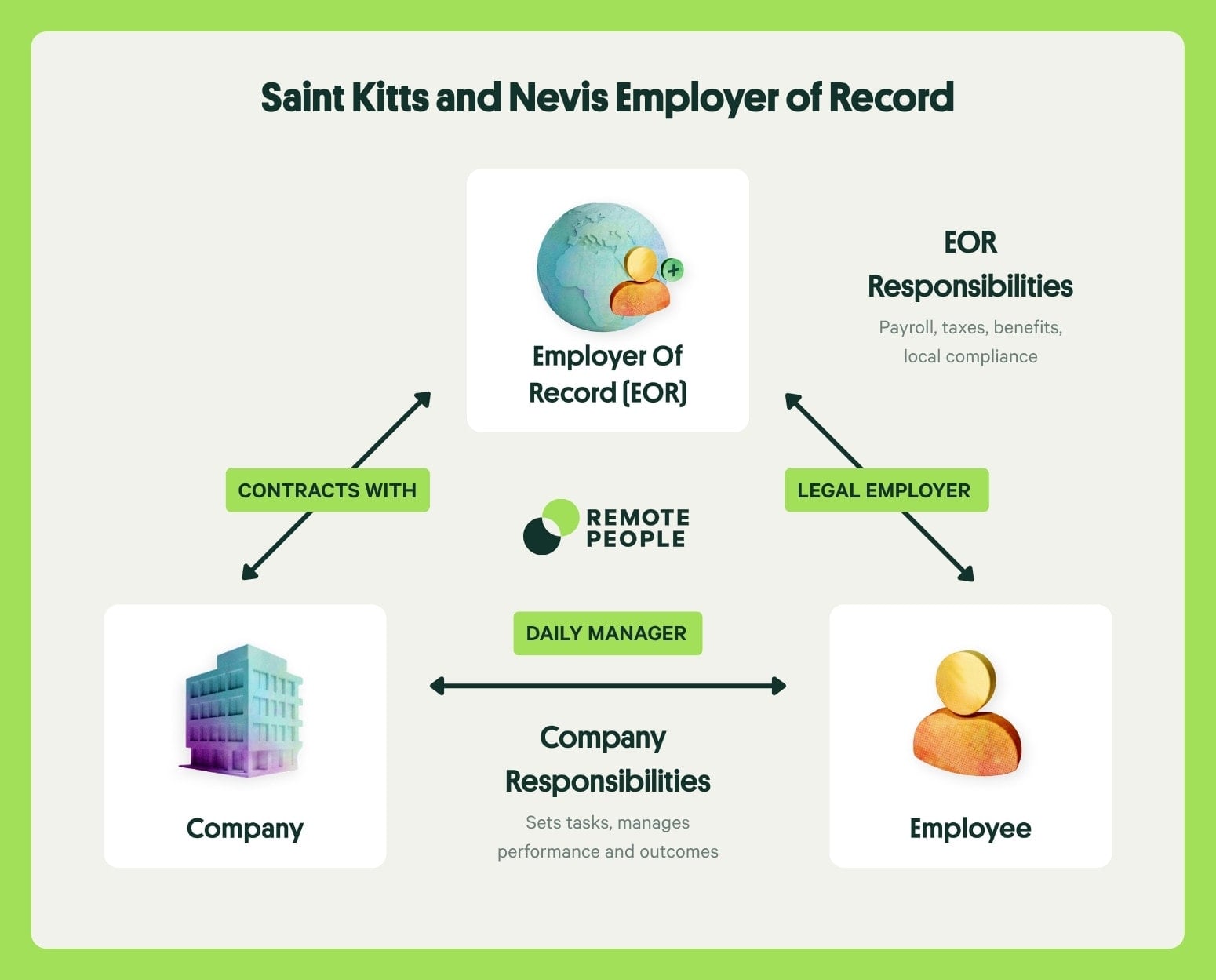
Key duties of an EOR in detail include:
- Prepares compliant contracts (specifying names, role, duties, salary, hours, leave, and notice terms) and issues them in writing to each employee.
- Running payroll, calculating gross wages, withholding/remitting taxes & contributions, and issuing payslips.
- Registering employees with the National Insurance Scheme (pension/social security) and enrolling them in mandated benefits.
- Tracking accrued leave (annual, sick, maternity, etc.), approving leave per legal entitlements, and paying any leave pay.
- Filing all necessary returns (monthly payroll returns, year-end reconciliations, etc.) and maintaining records (employment history, tax filings) for the legal retention period.
- Calculating any due notice pay or severance, issuing final payouts, and deregistering the employee from local schemes.
How Much Does a Saint Kitts and Nevis EOR Cost?
RemotePeople’s full-service EOR plans start at USD 199 per employee per month with no hidden fees. These fees cover the core EOR services listed above. Optional add-ons include private health insurance, specialized HR support, or immigration assistance.
Hire in Saint Kitts and Nevis
A dual-island Caribbean federation with Social Security Board contributions and St. Kitts and Nevis employment regulations.
We handle employment contracts, payroll, social contributions, and full Kittitian compliance.
No local entity needed. Your team can start in days.
Employment and Labor Laws in Saint Kitts and Nevis
The key governing acts include the Protection of Employment Act, the Labour (Minimum Wage) Act, and the Holidays with Pay Act.
Key Contract Requirements
Employment agreements must be in writing to be legally enforceable. These contracts must clearly outline all terms, including the employee’s job title and responsibilities, remuneration details, standard working hours, leave entitlements, and the procedures and notice periods for termination.
Working Hours
The standard workweek is defined as 40 hours, typically structured as an eight-hour day, five days a week.
Overtime
Any work performed beyond the standard 40-hour workweek is overtime and must be compensated at a premium rate. The regulations are specific:
- Work on regular weekdays is paid at 1.5 times the employee’s normal hourly rate
- Work performed on Sundays, public holidays, or designated weekly rest days must be paid at double (2 times) the normal rate
Social Security Contribution
Social security in Saint Kitts and Nevis is administered by the Social Security Board and applies to employees aged 16 to 62. Both employers and employees are required to contribute to the system. Employees contribute 5% of their wages, while employers contribute 5% plus an additional 1% for employment injury coverage, for a total employer contribution of 6%.
Contributions are calculated on insurable earnings (subject to a ceiling) and must be remitted monthly. Employers are required to register with the Social Security Board upon hiring employees. The system provides a range of benefits, including age (pension), sickness, maternity, employment injury, invalidity, and survivor benefits.
Probation Periods
The probation period cannot exceed three months for most jobs. For household employment, the maximum is four weeks. During probation, an employer can terminate the contract without notice unless the employment agreement itself specifies a notice period.
Payroll and Employment Taxes in Saint Kitts and Nevis
Payroll Cycle
Payroll is typically processed monthly. Salaries are paid in Eastern Caribbean Dollars (XCD), and employees must receive a pay stub with deductions shown.
Minimum Wage
The national minimum wage in Saint Kitts and Nevis is set at EC$12.50 per hour (EC$500 per week based on a 40-hour workweek), effective July 1, 2025. This reflects an increase from the previous rate of EC$10.75 per hour and applies uniformly across all industries on both islands.
Employer Tax Contributions
The EOR must remit several statutory contributions on your behalf.
| Contribution | Employer Rate | Earnings Base |
|---|---|---|
| Social Security | 5% | On monthly earnings up to EC$6,500 |
| Employment Injury | 1% | On monthly earnings up to EC$6,500 |
| Severance Payment Fund | 1% | On total employee earnings (uncapped) |
| Housing & Social Development Levy (HSDL) | 3% | On total employee earnings (uncapped) |
While the employer contribution of 1% supports severance payments, employers may still be responsible for any additional severance obligations beyond what the fund covers, depending on the applicable terms and conditions.
Employee Payroll Contributions
Employees also contribute to the social safety net through payroll deductions:
| Contribution | Employee Rate | Earnings Base |
|---|---|---|
| Social Security | 5% | On monthly earnings up to EC$6,500 |
| Housing & Social Development Levy (HSDL) |
3.5% (up to EC$6,500) 10% (EC$6,500–8,000) 12% (above EC$8,000) |
On total employee earnings (uncapped) |
As of July 2025, a legislative amendment to the Housing and Social Development Levy Act exempts employees earning up to EC$520 per week (including the EC$500 minimum wage) from HSDL deductions, reducing the tax burden on low-income workers.
Income Tax
To reiterate, one of the biggest draws of hiring in the Federation: there is zero personal income tax.
Pension System
SKN’s National Insurance Scheme (NIS) covers pensions, sickness, maternity, etc. An employee becomes eligible to receive a state old-age pension upon reaching 62 years, provided they have made at least 500 weekly contributions (equivalent to about 10 years).
For workers aged 16–62, employees contribute 5% of wages and employers contribute 5% to social security plus 1% for employment injury coverage for a total of 6&.
Tax Compliance and Payroll Reporting
All employer and employee contributions must be calculated and remitted to the Inland Revenue Department (IRD) and the Social Security Board by the 15th day of the month following the payroll month.
The IRD is modernizing its tax administration with a new online portal called SMARTS, signaling a move towards stricter digital filing and enforcement.
Bonus Payments
There is no statutory requirement for bonus salary payment in SKN. Such bonuses are discretionary or based on company policy.
Work Permits and Visas in Saint Kitts and Nevis
A mandatory step in the work permit process is the labor market test. The employer must first advertise the job opening locally, maybe in a national newspaper, for at least three consecutive weeks.
Once the labor market test is complete, the employer can submit the formal application to the Department of Labour. The application package must include:
- A completed application form
- A valid police record from the applicant’s country of residence
- A medical certificate, which must include a Mantoux skin test for tuberculosis
- Passport-sized photos and a copy of the applicant’s valid passport
- The formal job offer or employment contract
The standard processing time for a work permit is approximately two to four weeks after submitting all documents. A work permit valid for seven months to one year costs of EC$2,500 (approximately USD 925) and must be renewed annually. Nationals of CARICOM member states may benefit from the CARICOM Single Market and Economy (CSME), which allows free movement for certain categories of skilled workers.
Time Off and Leave in Saint Kitts and Nevis
Employees in St. Kitts and Nevis are entitled to several types of statutory leave. Managing these correctly is a key compliance task for any employer:
Mandatory Leave Entitlements
Employees in Saint Kitts and Nevis are entitled to a minimum of 14 days of paid annual leave after completing one year of continuous service. This entitlement is provided under national labour legislation and applies to full-time employees.
Annual leave is granted in addition to Sundays and public holidays, meaning these days are not counted as part of the 14-day entitlement. The leave is typically taken as a continuous period, although it may be split into multiple periods if agreed between the employer and employee, in line with labour law provisions.
Maternity Leave
Female employees who meet Social Security eligibility requirements—specifically at least 39 weeks of insurance and 20 contributions within that period—are entitled to maternity benefits for up to 13 weeks. The Social Security Board pays 65% of average weekly insurable earnings. The leave must include at least 2 weeks before the birth and 6 weeks after.
Beyond the 13 weeks, an additional sick leave extension (up to 3 more months) is allowed for pregnancy-related complications. Social Security pays a portion of this leave; the employer must top it up to the same rate if the government benefit is insufficient.
By law, it is unlawful to terminate an employee during pregnancy or maternity leave except for gross misconduct.
Paternity Leave
St. Kitts and Nevis law does not provide for statutory paternity leave.
Sick Leave
If an employee is sick for more than three consecutive days, they must obtain a medical certificate. After this three-day unpaid waiting period, they can claim a sickness benefit from the Social Security Board, which pays 65% of their average weekly wages for up to 26 weeks.
Public Holidays
Public holidays vary each year based on the official government calendar. For 2026, St. Kitts and Nevis observe 12 public holidays:
- New Year’s Day (January 1)
- Carnival Day (January 2)
- Good Friday (April 3)
- Easter Monday (April 6)
- Labor Day (May 4)
- Whit Monday (May 25)
- Emancipation Day (August 3)
- Culturama Day (August 4)
- National Heroes’ Day (September 16)
- Independence Day (September 19)
- Christmas Day (December 25)
- Boxing Day (December 26)
Employee Benefits in Saint Kitts and Nevis
The foundation of the benefits system is the national Social Security scheme. Through the mandatory employer and employee contributions, all employees are entitled to:
- Age Pension (Retirement)
- Sickness and Maternity Benefits
- Employment Injury Benefits
- Invalidity and Survivor’s Benefits
- A Funeral Grant
Competitive employers, especially those hiring for professional or high-skilled roles, almost always offer benefits beyond the legal minimums. These can include: private health insurance, performance bonuses, allowances, more leave days, etc.
A major advantage is that, because there is no personal income tax, the value of these benefits-in-kind is not taxable for the employee.
Terminations and Severance in Saint Kitts and Nevis
Ending an employment relationship in St. Kitts and Nevis is highly regulated by the Protection of Employment Act. Employers must follow strict procedures to ensure termination is fair and lawful, and failure to do so can lead to legal challenges.
Ending an Employment Contract
An employer may terminate for cause (e.g., serious misconduct) or operational reasons (redundancy). Fair procedure is expected, but not formally codified; in practice, repeated warnings are given for poor performance before dismissal.
Notice Periods
The statutory notice depends on tenure. During probation, termination can occur without notice (unless otherwise agreed). If the employer fails to give notice, they must pay wages in place of notice. The employee may also give notice (same duration as they would receive) if resigning.
For Weekly Paid Employees:
| Length of Continuous Service | Notice Period |
|---|---|
| 3 months – less than 1 year | 1 week |
| 1 year – less than 3 years | 2 weeks |
| 3 years – less than 5 years | 3 weeks |
| 5 years – less than 7 years | 4 weeks |
| 7 years – less than 10 years | 5 weeks |
| 10 years – less than 15 years | 6 weeks |
| 15 years and over | 10 weeks |
For Monthly-Paid Employees:
| Length of Continuous Service | Notice Period |
|---|---|
| 3 months – less than 5 years | 1 month |
| 5 years – less than 10 years | 2 months |
| 10 years and over | 3 months |
Severance Pay
Under the Protection of Employment Act, employees dismissed (except for serious misconduct) are entitled to severance. The formula is:
| Years of Service | Severance Pay |
|---|---|
| Up to 5 years | 2 weeks’ pay per year of service |
| 5–10 years | 3 weeks’ pay per year of service |
| Beyond 10 years | 4 weeks’ pay per year of service, working backward from the termination date |
Under the Protection of Employment Act, employees dismissed (except for serious misconduct) are entitled to severance. The formula is:
A half-year or more of service counts as a full year, up to a maximum payment of 52 weeks’ wages.
For example, an employee with 8 years’ service would get (5 years×2 + 3 years×3) = 19 weeks’ pay).
The RemotePeople free Global Payroll Calculator helps you estimate payroll costs. Our tool is customized to calculate payroll for 150 countries. All you have to do is input the figures.
Expand into Saint Kitts and Nevis Easily with RemotePeople’s Employer of Record (EOR) Solution
St. Kitts and Nevis offers a tax-friendly environment, a small talent pool, and large pockets of opportunity to fill. But its employment laws still need expertise to stay compliant. Partnering with an Employer of Record like RemotePeople is the smartest way to unlock this potential without getting tangled in the boring work.
By working with us, you gain:
- Speed: Forget the weeks and months of setting up a legal entity. With RemotePeople, you can onboard your first employee in St. Kitts and Nevis in a matter of days.
- Cost-Efficiency: Avoid the high, unpredictable costs of incorporation, legal fees, and accounting services. Our transparent, flat-fee model gives you complete budget certainty.
- Total Compliance: Our local experts live and breathe St. Kitts and Nevis employment law. We handle everything from contracts and payroll to taxes and terminations, protecting you from the significant risks of non-compliance.
- A Competitive Edge: We help you do more than just comply. We provide the local insights needed to build attractive benefits packages that will make you stand out as a top employer in the market.
Start hiring in Saint Kitts and Nevis in days. EOR from $199/month — zero income tax, compliant contracts, NIS registration, and full payroll compliance. No entity needed. Talk to our Caribbean hiring experts today.
Where companies hiring in Saint Kitts and Nevis expand next
Employers with operations in Saint Kitts and Nevis often extend across the Caribbean and nearby US-adjacent markets. Most teams start with hiring in the Dominican Republic — CARICOM-wide workforce portability. An EOR partner in Jamaica typically follows, with shared Caribbean labor and trade norms. The Bahamas is a natural addition for CARICOM mobility and shared Caribbean business practices, and a team in Trinidad and Tobago completes the regional picture with aligned CARICOM employment frameworks.
Yes. An EOR can act as the local employer and sponsor work permits on behalf of foreign hires, including handling the labor market test, application submission, and renewals.
Yes. Employers can offer supplementary benefits such as private health insurance, bonuses, or allowances to remain competitive in the talent market.
Disputes are typically handled through the Department of Labour. Employers must follow proper procedures to avoid claims of unfair dismissal or labor violations.
Certain industries may have additional regulations (e.g., hospitality or domestic work), and employers should ensure compliance with sector-specific rules.
A reputable EOR continuously monitors legal and regulatory changes and updates employment practices, payroll, and contracts to remain compliant without requiring action from the client.
Salary adjustments and promotions are managed through contract amendments, which the EOR prepares and formalizes in compliance with local labor laws.
Employer of Record in
Employer of Record in
Employer of Record in
Employer of Record in
Employer of Record in
Employer of Record in
Employer of Record in
Employer of Record in




