
 Recruit
Employer of Record in Niger
-
 Drew Donnelly
- Published
- September 22, 2026
RemotePeople’s employer of record in Niger lets you hire employees in Niger with complete statutory compliance. We handle National Social Security Fund contributions of 6.25% from employers and 5.25% from employees, old-age pensions, disability coverage, and work injury protection.
Hire in Niger — book a free 30-minute demo
Tell us what you need. You'll get a tailored, transparent proposal within 24 hours, plus a free call to walk through it.
Tell us about your company
So we can match you with a specialist who knows your market — and unlock volume pricing tiers.
* All fields are required.
Where and when are you hiring?
Tell us the geography and timing and we'll quote each country line by line, with onboarding timelines.
* All fields are required.
Help us beat your current setup
We'll benchmark your current deal and send a line-by-line proposal in 24 hours — showing exactly where we cut cost, time, or risk. After you submit, you can book a call to walk through it together.
* All fields are required.
Thanks! Your proposal is on its way.
Expect a tailored, line-by-line proposal in your inbox within 24 hours. In the meantime…
Want to walk through it together?
Book a free 30-minute call with one of our specialists. We'll explain every line, answer your questions, and tailor the proposal further if you need.
No obligation. Pick a time that works for you.








- Hire in Niger — book a free 30-minute demo
- Tell us about your company
- Where and when are you hiring?
- Help us beat your current setup
- Thanks! Your proposal is on its way.
- How an Employer of Record Works in Niger
- Employment Laws and Regulations in Niger
- Work Permits and Visas in Niger
- Payroll, Taxes, and Social Security in Niger
- Cost of Hiring Through an EOR in Niger
- Benefits of Using an EOR in Niger
- Termination and Offboarding in Niger
- EOR vs. Other Hiring Models in Niger
- Public Holidays in Niger
- How to Get Started with an EOR in Niger
- Where companies hiring in Niger expand next
- Frequently Asked Questions
- Related EOR Destinations

Start hiring in Niger
Let RemotePeople handle payroll, compliance, and HR admin worldwide so you can focus on building your team.

Niger offers one of the most cost-effective labour markets in West Africa, with a minimum wage of XOF 42,000 per month (about $70) effective 1 January 2026 and a young, French-speaking workforce concentrated in Niamey, Maradi, and Zinder. For companies looking to hire employees in Niger, the challenge is the local regulatory stack: the 2012 Labour Code, CNSS social security registration, the ITS payroll income tax, and a work-permit process that runs through the Ministère du Travail, de l’Emploi et de la Protection Sociale. An employer of record in Niger takes on those obligations as the legal employer of your staff, so you can hire, pay, and manage a team without incorporating a local entity.
This guide walks through how an employer of record in Niger works, what the Labour Code requires in 2026, what hiring through an EOR actually costs, and how the model compares with incorporating your own entity, hiring contractors, or partnering with a PEO. All figures are verified against the Labour Code, the 2017 implementing Decree, CNSS contribution schedules, and the current ITS tax brackets published by the Direction Générale des Impôts.
How an Employer of Record Works in Niger
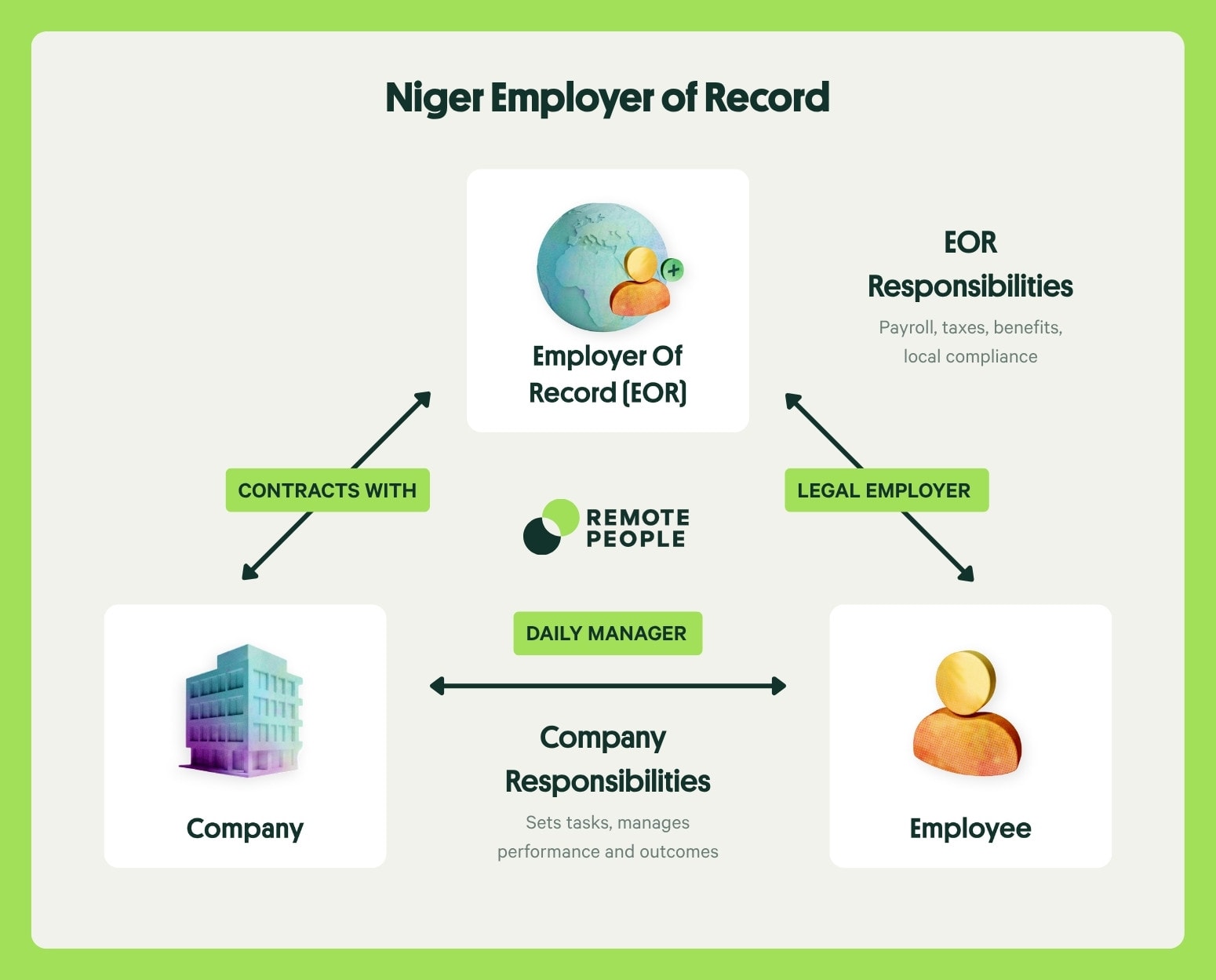
If you’d like to learn more about how Employer of Record (EOR) services work, read our What Is an Employer of Record (EOR)? guide for a complete overview of the model, its benefits, and when to use it.
If you’re comparing providers, our Best Employer of Record (EOR) Providers guide reviews the leading platforms to help you choose the right solution for your business.
Who Uses an EOR in Niger?
An employer of record in Niger is typically used by companies that want a compliant hire without committing to a full entity setup. The use cases cluster around speed, scale, and the practical realities of hiring in a francophone Sahel market where local company registration and CNSS enrolment can easily take two to three months.
- Testing the market: Companies evaluating the uranium, telecoms, NGO, or renewable-energy sectors in Niger often need a single project manager or country lead before committing to a full incorporation.
- Hiring a small team without entity overhead: Any business expecting one to fifteen employees in Niger will find the EOR option faster and less expensive than registering a Société à Responsabilité Limitée and maintaining annual statutory filings.
- Onboarding quickly: An EOR can deliver a signed Labour Code contract, CNSS registration, and a first payroll inside two weeks, whereas self-managed entity setup plus first payroll typically takes eight to twelve weeks.
- Hiring foreign nationals who need work permits: Because the EOR is already a registered Nigerien employer, it can act as the sponsor for the autorisation d’embauche and residency permit, removing the need to set up a local legal entity purely to support one expatriate hire.
The model also suits international development contractors, donor-funded projects, and extractive-sector operators who run short, milestone-based engagements in Niger and cannot justify a permanent legal footprint for each contract.
Typical Onboarding Timeline
Most EOR providers can onboard an employee in Niger within one to two weeks when no work permit is required. The stages run sequentially but each step is short:
- EOR agreement and employee details (1–2 days): Sign the service agreement and share the hire’s role, salary, start date, and dependants for the family allowance calculation.
- Employment contract drafting and review (2–3 days): The EOR produces a French-language contract referencing the Labour Code category, the relevant collective agreement, and the agreed probation period, then routes it for employer and employee signature.
- CNSS and tax registration (3–7 days): The EOR assigns a CNSS matricule, registers the employee for ITS withholding with the Direction Générale des Impôts, and collects bank account details in the local XOF account.
- Payroll setup and benefits enrolment (2–3 days): Monthly payroll, statutory CNSS family allowances, and any supplementary health cover are configured, and the first pay slip template is validated.
- Employee onboarding and first day (1 day): The employee begins work on the agreed date, with the EOR on standby for any compliance or payroll queries.
Factors that extend the timeline include work-permit applications for non-Nigerien nationals (add 4–8 weeks for Ministry of Labour review), document legalisation at a Nigerien embassy abroad, and regulated professions such as medicine or law, where the national order must register the hire before the contract can start.
Hire in Niger
Low CFA-franc payroll costs, a stable currency pegged to the euro, a straightforward 19.40% employer tax burden, and a growing pool of French-speaking professionals in Niamey make Niger an attractive market for early West Africa expansion.
We handle employment contracts, payroll, tax withholding, and full Niger compliance.
No local entity needed. Your team can start in days.
Employment Laws and Regulations in Niger
Employment Contracts
Employment relationships in Niger are governed by Loi n° 2012-45 du 25 septembre 2012, the current Labour Code, together with its 2017 implementing regulation Décret n° 2017-682/PRN/MET/PS. The Ministère du Travail, de l’Emploi et de la Protection Sociale is the primary regulator, CNSS administers social security, and the Direction Générale des Impôts handles payroll tax. Written contracts are mandatory for fixed-term agreements and for any indefinite contract used to employ a foreign national.
Contracts are written in French and may be fixed-term (contrat à durée déterminée, CDD) or indefinite (contrat à durée indéterminée, CDI). A CDD is limited to two years including one renewal, after which the relationship converts automatically to a CDI. Every contract must specify the professional category, the reference collective agreement, salary, probation period, place of work, and start date, and the employer must keep the contract on file for labour inspectorate review.
Working Hours and Overtime
The standard workweek in Niger is 40 hours, typically spread over five days in non-agricultural sectors. The Labour Code caps the legal workday at eight hours and requires a minimum of 12 consecutive rest hours between shifts and at least one full rest day per week, usually Sunday. Managerial and senior technical staff whose duties exceed standard oversight may be exempt from overtime premiums under the collective agreement, but they remain covered by the weekly-rest and annual-leave provisions.
Niger overtime and premium pay rates · Per Code du travail (Loi 2012-45) · 2026 | |||
Hour Type | Rate Multiplier | Weekly or Daily Cap | Notes |
|---|---|---|---|
Standard week | 100% (base rate) | 40 hours per week | Eight hours per day over five days is the norm in non-agricultural sectors |
Day overtime, hours 41 to 48 | +10% (110%) | First 8 hours beyond 40 | Per Décret 2017-682, daytime weekday overtime |
Day overtime, beyond 48 hours | +35% (135%) | Maximum 8 OT hours per week | Applies to hours worked beyond the 48th weekday hour |
Night work (21:00–05:00) | +50% (150%) | Night hours only | Night premium applies in addition to any OT multiplier |
Weekly rest day (Sunday) | +50% (150%) | Per recalled day | Applies when the employee is recalled on the weekly rest day |
Public holiday work | +100% (200%) | Per holiday worked | Doubled pay for hours worked on a statutory public holiday |
Overtime hours are capped at 8 per week for most employees and must be authorised in advance by the labour inspector when the cap is exceeded. Overtime premiums form part of taxable salary and enter the base for ITS and CNSS contributions, but they are not counted toward the 13th-month or end-of-year gratification when the collective agreement excludes variable pay from the bonus base.
Minimum Wage
Niger increased the guaranteed inter-professional minimum wage (SMIG) to XOF 42,000 per month effective 1 January 2026, up from the long-standing XOF 30,047 floor that had been in place since 2012. The CNSS minimum contribution base was realigned to the new SMIG in the same reform, meaning no employer may pay social security contributions on a base below XOF 42,000 even if the employee’s actual salary is lower. Sectoral collective agreements set higher minimums for specific categories; for example, banking, telecoms, and mining CCAs can exceed the SMIG by 40–80% depending on the role.
Probation Period
Probation (période d’essai) is permitted under the Labour Code and is typically set at three months, extendable once by written agreement for a further equal period when the role justifies a longer trial. Hourly and daily-paid workers usually have a shorter probation, capped at 8 days for hourly roles and one month for monthly-paid technicians, while engineers, managers, and senior executives may agree to up to six months in total. Either party may terminate during probation without notice or compensation unless the contract provides otherwise.
Leave Entitlements
Niger’s statutory leave framework sits inside the 2012 Labour Code and the Convention Collective Interprofessionnelle, with CNSS paying the cash benefit for maternity and work-injury absences. Annual leave accrues from the first day of employment, sick leave pay depends on seniority, and the family-event leave catalogue is more generous than in many comparable markets.
Annual Leave
Employees accrue 2.5 working days of paid annual leave for each full month of service, which equals 30 calendar days (or 22 working days) per complete year. Accrual begins on the hire date rather than after probation, so an employee who leaves before a full year is entitled to pro-rata leave pay. Unused leave may be carried over by written agreement, and mothers receive additional leave of one day per child under the age of 14.
Sick Leave
An employee on certified sick leave retains their salary for a period that depends on seniority under the collective agreement, typically full pay for the first month for workers with at least one year of service and half pay for the following two months. A medical certificate from an approved practitioner is required within 72 hours, and the employer may request a counter-examination. Extended illness benefits are paid by CNSS under the work-injury and occupational-disease branch when the incapacity is work-related.
Maternity Leave
Maternity leave is 14 weeks in total, split into 6 weeks before the expected delivery date and 8 weeks after the birth. Pay is 100% of the reference salary, financed half by CNSS daily maternity indemnity and half by the employer under the Convention Collective Interprofessionnelle. The employee’s job is protected during the leave, and any dismissal notified during the maternity period is null unless based on gross misconduct unrelated to the pregnancy.
Paternity Leave
Fathers are entitled to three days of paid leave on the birth of a child under the family-event provisions of the Labour Code. The three days are paid by the employer at full salary and must be taken within fifteen days of the birth. Collective agreements in the banking and telecoms sectors sometimes extend this to five days.
Other Statutory Leave
The Labour Code recognises several short family-event absences in addition to the core leave types:
- Marriage of the employee: 3 days of paid leave.
- Marriage of a child: 1 day of paid leave.
- Death of a spouse, child, or parent: 3 days of paid leave.
- Death of a sibling, grandparent, or parent-in-law: 1 day of paid leave.
- Religious pilgrimage (Hajj): Unpaid leave of up to 30 days, once per career, subject to employer authorisation.
- Trade union duties: Paid time off for elected representatives, within the limits set by the collective agreement.
Under the 2012 Labour Code, statutory leave entitlements accrue from day one of employment and sit alongside the CNSS-funded maternity and work-injury cash benefits. The table below summarises each category, with the most important takeaway being that annual leave accrues continuously from the hire date, so any employee leaving before the end of a 12-month cycle is owed pro-rata leave pay at exit.
Niger statutory leave entitlements · Per Code du travail (Loi 2012-45) | ||
Leave Type | Duration | Eligibility and Notes |
|---|---|---|
Annual leave | 2.5 working days per month (30 calendar days per year) | Accrues from day one; paid at full salary; extra day per child under 14 for mothers |
Sick leave | Up to 6 months (category-dependent) | Full pay in the first month, then half pay; medical certificate required; CNSS covers work-related illness |
Maternity leave | 14 weeks (6 pre-natal + 8 post-natal) | 100% of salary; 50% CNSS daily indemnity + 50% employer; job protected |
Paternity leave | 3 days | Paid by employer; must be taken within 15 days of the birth |
Marriage leave | 3 days | Paid by employer; 1 day for the marriage of a child |
Bereavement leave | 1–3 days | 3 days for spouse, child or parent; 1 day for sibling, grandparent or in-law |
Hajj pilgrimage leave | Up to 30 days, unpaid | Once per career; subject to employer authorisation and operational feasibility |
Trade union leave | As set by the collective agreement | Paid time off for elected representatives to attend statutory meetings |
Statutory Employee Benefits
Beyond paid leave and CNSS contributions, Niger imposes a short list of mandatory benefits that every employer must provide, whether hiring directly or through an EOR. The detailed contribution rates are covered in the payroll and tax tables in Section 4, so this section focuses on what the employer is obliged to provide rather than the amounts.
- Pension and survivors’ cover: CNSS pension contributions are mandatory for all private-sector employees, funding old-age pensions, invalidity, and survivors’ benefits.
- Family allowances: The employer’s CNSS contribution includes the family-allowance branch, which pays a monthly benefit to employees with dependent children under 14 (or 18 if still in school).
- Work-injury and occupational-disease cover: All employers pay a work-injury contribution to CNSS, which funds medical care and daily indemnity for work-related accidents and illnesses, with no employee contribution.
- Occupational medical check-up: Every employee must undergo a pre-employment medical exam and an annual check-up through an approved occupational health service, at the employer’s expense.
- Transport and meal allowances: Not statutorily required at the national level, but most sectoral collective agreements (banking, telecoms, mining) impose a monthly transport allowance and, for sites outside Niamey, a canteen or meal subsidy.
- Supplementary health insurance: Not mandatory, but increasingly standard market practice in Niamey for professional roles, typically funded by the employer with optional family extension.
Recent Regulatory Updates 2026
The most significant recent change is the SMIG increase to XOF 42,000 per month effective 1 January 2026, the first major revision since the 2012 reform. The CNSS minimum contribution base was realigned to the new SMIG in the same package, so employers can no longer compute social security contributions on any base lower than XOF 42,000, even where an employee is paid below the minimum wage for part-time work.
On the tax side, the Director General of Taxes confirmed that the ITS scale remained unchanged in the 2026 Finance Law, restoring the scale that has applied for more than ten years and that was the product of a consensus between government and workers’ representatives. The 2026 budget therefore leaves employee take-home pay unaffected at every salary level, and the employer ITS-withholding obligations run on the same bracket structure as in 2025.
On the regional side, Niger formally left the Economic Community of West African States (ECOWAS) on 29 January 2025 together with Mali and Burkina Faso, and joined the Alliance of Sahel States (Alliance des États du Sahel, AES) on 6 July 2024. The three AES members have preserved visa-free movement for their own nationals under transitional arrangements, so citizens of Mali and Burkina Faso continue to travel to Niger without a visa; citizens of other ECOWAS states now require standard entry formalities.
Work Permits and Visas in Niger
Work Permit Requirements
Who Needs a Work Permit
Any foreign national who will hold an employment contract in Niger must obtain a work permit (autorisation d’embauche) from the Ministère du Travail, de l’Emploi et de la Protection Sociale before starting work. Nationals of Mali and Burkina Faso benefit from the Alliance of Sahel States’ transitional free-movement arrangements and can enter and reside without a visa, but any formal employment contract still requires the autorisation d’embauche to be filed. Short-term business visitors not holding a Nigerien employment contract are exempt.
Eligibility and Required Documents
The employer submits the application on behalf of the employee, and the dossier must demonstrate that no local candidate is available for the role. Standard documents include a completed employer request form, a signed Labour Code contract, the employer’s registration certificate (RCCM), the foreign national’s passport and visa, a police clearance, an apostilled copy of the employee’s highest qualification, a medical certificate, and evidence of the job vacancy having been posted through the Agence Nationale pour la Promotion de l’Emploi (ANPE).
Processing Time and Validity
Processing typically runs four to eight weeks once the complete dossier reaches the Ministry, though mining and oil-sector hires under a signed mining convention usually move faster under dedicated project channels. The initial permit is granted for up to two years and is tied to the sponsoring employer and the specific role; any change of role or employer requires a new application. Delays most often come from incomplete labour-market-test documentation or outdated qualification legalisation.
Renewal Process
Renewal applications should be filed at least 60 days before the existing permit expires, using an updated dossier that includes the current contract, the most recent CNSS and ITS declarations, and a renewed medical certificate. The employee can continue working during the review period when the renewal is filed in good time, but if the permit expires before the new one is issued, work must pause until the renewal is granted.
Common Visa Types for Foreign Workers
Niger issues work-related visas and permits through the Ministère de l’Intérieur (for entry visas) and the Ministère du Travail (for work authorisations). The EOR can sponsor most employment-based categories because it is a registered Nigerien employer, but investor and self-employment routes require direct incorporation. The table below summarises the routes most relevant to corporate hires.
Niger work visa types for foreign workers · 2026 | ||||
Visa Type | Duration | Best For | Leads to APT? | Processing |
|---|---|---|---|---|
Standard work permit (autorisation d’embauche) | Up to 2 years, renewable | Employees on local or international contracts | Yes, after 3 years of continuous residence | 4–8 weeks |
Intra-company transfer | Up to 2 years | Managers, specialists, and trainees transferred from a foreign parent | Yes, subject to role continuity | 4–6 weeks |
Investor / entrepreneur visa | 2 years, renewable | Founders and shareholders with a registered Nigerien company | Yes | 6–10 weeks |
Mining and oil sector permit | Linked to mining convention term | Expatriate staff on a signed mining or petroleum convention | Yes, subject to convention | 2–4 weeks |
AES intra-community mobility | Aligned with contract | Nationals of Mali and Burkina Faso working in Niger | Yes, under AES framework | 2–4 weeks for autorisation d’embauche |
Other visa categories do not permit employment:
- Tourist visa: Valid up to 90 days; does not permit any paid activity.
- Business visitor visa: Short stays for meetings, site visits, or training, but no employment contract may be signed or paid in Niger.
- Student visa: Issued to enrolled students, with limited part-time work allowed only under specific permission.
- Transit visa: Up to 72 hours, strictly for onward travel.
How an EOR Handles Work Permits
The EOR acts as the sponsoring local employer, which is the pivotal requirement for the autorisation d’embauche. In practice the EOR files the ANPE labour-market test, assembles the dossier, submits it to the Ministère du Travail, and follows up until the permit is granted. The employee is responsible for obtaining the entry visa at a Nigerien embassy, providing legalised qualifications, and attending the occupational medical exam once in Niger. A work permit typically adds 4–8 weeks to the onboarding timeline referenced in Section 1.4, so plans involving a foreign hire should budget 2–3 months end-to-end. EOR sponsorship is available for the standard work permit, the intra-company transfer, and the AES mobility route, but does not extend to the investor route, which requires a Nigerien company owned by the applicant.
Payroll, Taxes, and Social Security in Niger
Employer Contributions
Niger’s employer-side payroll charges are split between CNSS social security and the separate apprenticeship tax (Taxe d’Apprentissage et de Formation, or TAP) paid to the tax authority. The CNSS rate is built from three branches – pension, family allowance, and work injury – and is applied to gross salary, capped at XOF 500,000 per month for the pension branch only.
Niger employer social security contributions · 2026 rates | ||
Contribution | Rate | Notes |
|---|---|---|
CNSS old-age pension | 6.25% | Capped at XOF 500,000 per month (XOF 6,000,000 annual ceiling) |
CNSS family allowances | 8.40% | Uncapped base; funds monthly child allowances via CNSS |
CNSS work-injury and occupational disease | 1.75% | Minimum rate; can rise to 5.00% for high-risk sectors under CNSS classification |
Apprenticeship tax (TAP) | 3.00% | Paid to Direction Générale des Impôts with the monthly ITS declaration |
Total employer burden | 19.40% | Standard-risk sectors; higher in mining and construction |
Employee Contributions
On the employee side, the only social security deduction is the 5.25% CNSS pension contribution, withheld by the employer at source and remitted with the monthly CNSS declaration. ITS income tax is also withheld monthly under the pay-as-you-earn mechanism based on the progressive scale published by the Direction Générale des Impôts.
Niger employee payroll deductions · 2026 monthly withholdings | ||
Deduction | Rate | Notes |
|---|---|---|
CNSS old-age pension | 5.25% | Capped at XOF 500,000 per month; funds the retirement, invalidity, and survivors’ benefits |
ITS income tax | 0% – 35% (progressive) | Withheld by the employer; family quotient applies based on dependants |
Total employee withholding | 5.25% + ITS | Varies with salary and household size |
Income Tax
Niger’s Impôt sur les Traitements et Salaires (ITS) is a progressive income tax on employment income, levied at five annual bracket rates from 0% to 35%. The scale is codified in the Code Général des Impôts and is applied after deduction of the employee’s CNSS pension contribution. A family quotient reduces the taxable base for employees supporting a spouse and dependent children, with the net tax adjusted downward by one part per dependant up to a statutory cap.
Niger income tax brackets · 2026 | |
Annual Taxable Income (XOF) | ITS Rate |
|---|---|
0 – 300,000 | 0% |
300,001 – 600,000 | 1% |
600,001 – 1,200,000 | 7% |
1,200,001 – 2,400,000 | 21% |
Above 2,400,000 | 35% |
Payroll Cycle
Private-sector payroll runs monthly in Niger, with salaries paid into a local XOF bank account by the last working day of the month or within the first five days of the following month under most collective agreements. Cash payments are discouraged and, above specific thresholds, prohibited under anti-money-laundering rules, so the EOR always pays through a commercial bank or a regulated mobile-money operator. Every pay slip must carry the employer’s CNSS and RCCM numbers, the employee matricule, the gross-to-net breakdown, and the ITS withholding. Monthly ITS and CNSS declarations are due by the 15th of the following month, and the annual ITS return that reconciles all employee withholdings is filed by 30 April each year.
13th Month Salary and Bonus Pay
A 13th-month salary is not mandatory under Niger’s 2012 Labour Code, so the general rule is that any end-of-year gratification is governed by the applicable collective agreement or the individual employment contract. Several sectoral agreements, notably in banking, telecoms, and mining, do include a mandatory annual bonus, typically equal to one month of base salary and paid in December with the November payroll. When a 13th-month bonus is paid under a collective agreement or contract, it forms part of taxable salary, enters the ITS base, and is subject to both employer and employee CNSS contributions up to the annual ceiling. Pro-rata rules apply for mid-year joiners and leavers, with most agreements using months of service divided by twelve as the accrual formula.
Cost of Hiring Through an EOR in Niger
EOR Service Fees
EOR service fees in Niger typically run $300 to $600 per employee per month, depending on salary level, benefits complexity, and whether a work permit is required. The fee covers the full compliance stack: contract drafting under the Labour Code, monthly payroll in XOF, ITS and CNSS filings, family allowance administration, leave and absence tracking, statutory benefits coordination, and termination paperwork when the employee leaves. Work-permit sponsorship and legalisation costs are usually billed as one-off pass-throughs on top of the monthly fee.
Total Employment Cost Breakdown
The table below walks through a representative cost stack for a mid-level professional hire in Niger on a USD 2,500 per month gross salary. All figures are shown in USD for cross-market comparison, using an indicative exchange rate of 1 USD ≈ XOF 600. Employer contributions are applied on the pre-conversion XOF gross under Nigerien rules and restated here in USD; the underlying CNSS pension contribution is capped at the XOF 500,000 (about USD 833) monthly ceiling for the pension branch.
Niger employer cost example · USD 2,500 gross · 2026 | ||
Employer Cost | Amount (USD) | % of Gross |
|---|---|---|
Gross monthly salary | $2,500.00 | 100.00% |
CNSS pension (employer, 6.25%, capped) | $52.08 | 2.08% |
CNSS family allowances (employer, 8.40%) | $210.00 | 8.40% |
CNSS work injury (employer, 1.75%) | $43.75 | 1.75% |
Apprenticeship tax (TAP, 3.00%) | $75.00 | 3.00% |
EOR service fee (mid-range) | $450.00 | 18.00% |
Total employer cost | $3,330.83 | 133.23% |
Indicative exchange rate: 1 USD ≈ XOF 600. Sources: CLEISS – Niger social security regime · Direction Générale des Impôts | ||
Ready to hire in Niger? Get started with RemotePeople – we handle employment contracts, payroll, tax withholding, and full Niger compliance. No local entity needed. Contact our team for a costed quote.
Benefits of Using an EOR in Niger
Hiring through an EOR gives you a compliant, locally-employed team without the time and capital sink of incorporating a Nigerien entity. The advantages are clustered around four levers: speed to market, regulatory certainty, lower fixed cost, and the ability to retract without legal dissolution if the project ends.
- Speed to market: An EOR can deliver a signed Labour Code contract, CNSS registration, and a first XOF payroll within 1–2 weeks, versus the 8–12 weeks typically needed to register a Nigerien SARL, open a corporate bank account, and complete CNSS enrolment from scratch.
- Compliance assurance: The EOR is responsible for monthly ITS withholding, CNSS returns, the 3% apprenticeship tax, annual leave tracking, family allowance claims, and termination paperwork, eliminating the risk of inspection fines from the labour inspectorate or DGI.
- Cost efficiency versus a local entity: Maintaining a Nigerien legal entity typically costs $15,000–$30,000 per year in accounting, statutory filings, and local representation, before any salary is paid. An EOR converts that fixed overhead into a variable $300–$600 per-employee monthly fee.
- Local expertise: Niger’s collective agreements (banking, telecoms, mining) and the Alliance of Sahel States transitional framework require operator-level familiarity that global EORs provide as part of the service, rather than as separate consulting spend.
- Flexibility to scale up or down: If a project ends, an EOR contract can be closed with statutory notice and severance, with no legal dissolution, no DGI tax clearance, and no CNSS account wind-down for the parent company.
- Risk mitigation: The EOR assumes employer liability for labour disputes, misclassification claims, and unpaid contribution assessments, so the client retains commercial control without carrying the direct employment risk in Niger.
- Employee experience: Staff receive a compliant French-language contract, XOF-denominated salary, CNSS cover, and a local HR point of contact, all of which improve retention compared with the opaque “contractor” arrangements that many foreign employers still use.
Taken together, the model lets a global employer test or scale operations in Niger with a predictable monthly cost and no entity-level legal exposure.
Termination and Offboarding in Niger
Notice Periods
Niger’s Labour Code (Articles 83 and following) and the Convention Collective Interprofessionnelle require advance written notice – or payment in lieu – before any employer-initiated dismissal that is not based on gross misconduct. The notice period depends on the employee’s professional category rather than pure tenure, with the shortest period reserved for hourly and daily-paid workers and the longest reserved for engineers, managers, and senior executives.
Niger statutory notice periods by position level · Per Code du travail (Loi 2012-45) | |||
Position Level | Notice Period | During Probation | Notes |
|---|---|---|---|
Hourly and daily-paid workers | 8 days | None | Calendar days; applies regardless of tenure |
Monthly-paid employees, technicians (non-supervisory) | 1 month | None | Calendar month; doubled for employees with 10+ years of service in some CCAs |
Supervisors and foremen (agents de maîtrise) | 2 months | None | Calendar months; set by the Convention Collective Interprofessionnelle |
Engineers, managers, senior executives (cadres) | 3 months | None | Calendar months; applies to all indefinite-contract executives |
Notice can be paid in lieu, in which case the employer owes the full notice-period salary plus any leave and 13th-month amounts that would have accrued. Termination without notice is only available in cases of gross misconduct, expiry of a fixed-term contract, or mutual agreement recorded in a written rupture conventionnelle. Fixed-term contracts terminated before their end date generally require the employer to pay the balance of the salary that would have been earned through the contract’s natural expiry.
Severance Pay
Niger’s 2012 Labour Code does not itself prescribe a severance formula; instead, severance (indemnité de licenciement) is governed by the Convention Collective Interprofessionnelle. An employee is entitled to severance when they have completed at least one year of continuous service and are not dismissed for gross misconduct. The formula is a fraction of the average monthly salary for each year of service, with the fraction rising as tenure increases.
Niger severance pay schedule by years of service · Per Convention Collective Interprofessionnelle | |||
Years of Service | Severance Amount | Base Salary | Notes |
|---|---|---|---|
1 year | 20% of average monthly salary × 1 = 0.20 months (6 days) | Average of the last 12 months, including bonuses | Minimum eligibility; no entitlement below 1 year |
5 years | 20% × 5 = 1.0 month of salary | Average of the last 12 months, including bonuses | The 20% rate applies for the first 5 years of service |
10 years | (20% × 5) + (30% × 5) = 2.5 months (75 days) | Average of the last 12 months, including bonuses | 30% rate applies for years 6 through 10 |
15 years | (20% × 5) + (30% × 5) + (35% × 5) = 4.25 months | Average of the last 12 months, including bonuses | 35% rate applies for years 11+ |
20 years | (20% × 5) + (30% × 5) + (35% × 10) = 6.0 months | Average of the last 12 months, including bonuses | Example upper-tenure calculation |
Calculation Method
Severance is calculated on the average gross monthly salary of the twelve months preceding the dismissal, including fixed allowances and any 13th-month payments received during that window. Overtime and occasional bonuses are usually excluded unless the collective agreement specifies otherwise. The formula stacks the three tiers rather than applying the top rate to all years: worked examples in Table 13 show how the 20%, 30%, and 35% rates combine across tenure blocks.
Caps and Exceptions
The Convention Collective Interprofessionnelle does not impose an absolute cap on severance, so long-tenure employees can accumulate substantial amounts at the 35% rate. Severance is not owed in cases of gross misconduct (faute lourde) substantiated before the labour inspector, expiry of a fixed-term contract at its natural end date, or resignation by the employee. Separate rules apply to economic redundancies, which require prior notification to the labour inspectorate and may trigger additional compensation under a social plan.
Grounds for Termination
Employer-initiated dismissals must be based on a real and serious cause (motif réel et sérieux), which the Labour Code splits into personal grounds (underperformance, misconduct) and economic grounds (restructuring, redundancy). Personal dismissals require a preliminary interview at which the employee can be assisted by a colleague or union representative, a written termination letter stating the grounds, and payment of notice (or pay in lieu) and severance unless gross misconduct is established. Economic dismissals add a consultation duty with employee representatives and, for collective redundancies, notification to the labour inspectorate. Certain categories – pregnant employees, employee representatives, and those on work-injury leave – enjoy enhanced protection against dismissal during the relevant period.
EOR vs. Other Hiring Models in Niger
EOR vs. Setting Up a Local Entity
Incorporating a Nigerien entity (typically a Société à Responsabilité Limitée, SARL) gives you full operational control and makes you eligible for government contracts, but it comes with 8–12 weeks of setup, statutory capital, ongoing audit and filing costs, and the need to maintain CNSS and DGI accounts in good standing. An EOR gives you a fully compliant hire in 1–2 weeks with zero upfront capital.
Niger EOR vs local entity comparison · Setup time, cost, risk and best-fit | ||
Comparison | Employer of Record (FASTER) | Own Entity |
|---|---|---|
Setup time | 1–2 weeks | 8–12 weeks |
Upfront cost | $0 | $5,000–$15,000 (incorporation, statutory capital, bank setup) |
Ongoing cost | $300–$600 per employee per month | $15,000–$30,000 per year in accounting, audit and filings |
Local partner required | No (EOR is the local entity) | No, but a resident director is commonly used |
Social insurance registration | Handled by EOR | You manage CNSS, DGI and labour-inspectorate accounts |
Payroll and tax filing | Handled by EOR | You manage it (or outsource to a local provider) |
Best for team size | 1–15 employees | 15+ employees |
Scale down / exit | Easy – no entity to unwind | Costly – SARL dissolution, DGI tax clearance, CNSS wind-down |
Government contracts | Not eligible | Eligible (requires local entity) |
The economic crossover usually comes around the 15-employee mark. Below that, the fixed annual overhead of a Nigerien entity exceeds the cumulative EOR fee; above that, incorporation pays back through per-head economies of scale and the ability to bid for government and mining-sector contracts. For most international businesses testing the Nigerien market or hiring a single country manager, the EOR is the faster, cheaper, and lower-risk route.
EOR vs. Hiring Independent Contractors
Hiring local talent as independent contractors is a common shortcut, but Niger’s labour inspectorate applies a substance-over-form test that looks at subordination, integration into the employer’s organisation, and economic dependence. If those factors point to an employment relationship, the contractor is reclassified as an employee with retroactive effect.
Niger EOR vs independent contractors · Compliance, cost, and risk | ||
Comparison | EOR (Full-Time Employee) | Independent Contractor |
|---|---|---|
Legal relationship | Employee of the EOR | Self-employed, no employment relationship |
Compliance risk | Low – EOR ensures Labour Code, CNSS and ITS compliance | High – misclassification triggers back contributions, penalties, and reinstatement |
Payroll and tax | EOR handles ITS withholding, CNSS, TAP, and filings | Contractor invoices you; they handle their own BIC/IRF tax |
Benefits and leave | Statutory annual leave, maternity, family allowances, CNSS | No entitlement to employee benefits |
IP protection | Stronger – employment contract assigns IP by default | Weaker – requires explicit IP assignment clause |
Termination | Subject to notice periods and CCA severance | Contract can be ended per agreement terms |
Best for | Long-term, core team roles | Short-term projects, specialised tasks |
Cost structure | Salary + employer contributions + EOR fee | Contractor fee (higher gross, lower total cost) |
Misclassification in Niger exposes the hiring company to back-payment of CNSS contributions with penalties, back-ITS with late-payment surcharges, and a potential order from the labour inspectorate to regularise the relationship as an employment contract dating from the first day of engagement. In practice, any ongoing, full-time, exclusive relationship with a single Nigerien contractor is better structured through an EOR than as a contractor arrangement; contractor-of-record services should be reserved for genuinely independent, project-based work.
EOR vs. PEO (Professional Employer Organization)
EOR and PEO models look similar from the outside but have different legal foundations. An EOR becomes the legal employer in Niger, so you do not need a local entity. A PEO operates under a co-employment model, which requires you to already have a Nigerien entity that remains the legal employer while the PEO handles HR administration.
Niger EOR vs PEO comparison · Legal employer, liability, and setup | ||
Comparison | Employer of Record (EOR) | PEO |
|---|---|---|
Legal employer | EOR is the legal employer | You remain the legal employer (co-employment) |
Local entity required | No – the EOR is the local entity | Yes – you must have your own entity in Niger |
Best for | Companies without a local entity | Companies that already have a Nigerien SARL or SA |
Compliance liability | EOR assumes compliance responsibility | Shared liability between you and the PEO |
Setup time | 1–2 weeks | Depends on your entity setup (8–12 weeks minimum) |
Control over HR policies | EOR manages within Nigerien labour law | More direct control, PEO advises |
Typical use case | Market entry, small remote teams, testing new markets | Established local operations needing HR outsourcing |
Sources: Code du travail (Loi 2012-45) · eRegulations Niger | ||
Niger does not have a dedicated statutory framework for co-employment, so any PEO-style arrangement functions as a payroll outsourcing contract layered on top of a pre-existing Nigerien company. That means a PEO is only a viable option after you have completed the entity-setup process described in Section 8.1. For any company that has not yet incorporated, the EOR route avoids the PEO prerequisite entirely and delivers the same day-to-day HR outsourcing with a shorter setup.
Public Holidays in Niger
Niger public holidays · 2026 calendar year | ||
Date | Holiday | Type |
|---|---|---|
1 January 2026 | New Year’s Day | Public |
20 March 2026 | Eid al-Fitr (Aïd el-Fitr) | Religious (Islamic) |
6 April 2026 | Easter Monday | Religious (Christian) |
24 April 2026 | Concord Day | Public (national) |
1 May 2026 | Labour Day | Public |
27 May 2026 | Eid al-Adha (Tabaski) | Religious (Islamic) |
17 June 2026 | Islamic New Year | Religious (Islamic) |
3 August 2026 | Independence Day | Public (national) |
26 August 2026 | Mawlid (Prophet’s Birthday) | Religious (Islamic) |
18 December 2026 | Republic Day (Proclamation of the Republic) | Public (national) |
25 December 2026 | Christmas Day | Religious (Christian) |
Islamic holidays (Eid al-Fitr, Eid al-Adha, Islamic New Year, and Mawlid) fall on dates that depend on the lunar calendar and the official moon sighting, so the dates above may shift by one day once the national authority confirms them. When a public holiday falls on a weekly rest day, most collective agreements compensate with a substitute day off or overtime pay at 200% if the employee is recalled. For payroll planning, holidays that fall on working days are paid at the employee’s normal salary without reduction, and any work performed on a holiday triggers the 200% premium set out in the overtime table in Section 2.2.
How to Get Started with an EOR in Niger
Launching an EOR-based hire in Niger typically runs through five short stages. Each one is handled by the EOR provider, but the hiring company drives the decisions on role, salary, and benefits.
- Step 1 – Define the role and package: Decide the job title, Labour Code professional category, gross monthly salary in XOF, benefits (transport allowance, private health cover), and start date. The EOR will align the offer with the applicable collective agreement and the SMIG floor.
- Step 2 – Sign the EOR service agreement: Review and sign the master service agreement with the EOR, which sets the monthly fee, pass-through costs, and the scope of compliance services.
- Step 3 – Onboard the employee: The EOR drafts the French-language employment contract, collects onboarding documents, and registers the employee with CNSS and the Direction Générale des Impôts.
- Step 4 – Run compliant payroll: Monthly XOF payroll, ITS withholding, CNSS contributions, and the 3% apprenticeship tax are processed and filed by the EOR, with a pay slip delivered to the employee and a consolidated invoice to the client.
- Step 5 – Scale or offboard as needed: Add more hires on the same contract or offboard cleanly at the end of a project, with notice, severance, and final pay handled by the EOR under the Labour Code and collective agreement.
Ready to hire in Niger? Get started with RemotePeople – we handle employment contracts, payroll, tax withholding, CNSS compliance, and work permits, so you can build your Nigerien team without incorporating a local entity. Talk to our team for a same-week quote.
Where companies hiring in Niger expand next
Companies building West African operations commonly expand across the ECOWAS bloc and neighboring Francophone and Anglophone markets. Most teams start with Nigeria — aligned West African hiring norms. A team in Ghana typically follows, with the regional West African talent footprint. Operations in Ivory Coast is a natural addition for overlapping West African workforce dynamics, and Cameroon completes the regional picture with shared West African labor and language overlap.
Frequently Asked Questions
The EOR service fee in Niger typically runs $300–$600 per employee per month, depending on salary level and benefits complexity. On top of the EOR fee, the employer pays CNSS contributions (16.40% total across pension, family allowances, and work injury, with the pension branch capped at XOF 500,000 per month) and the 3% apprenticeship tax (TAP), which together add roughly 19.40% to gross salary. For a USD 2,500 gross hire, total monthly employer cost lands around USD 3,330 including the EOR fee.
Most EOR providers can onboard an employee in Niger within 1–2 weeks when no work permit is required. If the hire is a foreign national who needs an autorisation d'embauche from the Ministère du Travail, add 4–8 weeks for permit processing, so budget 2–3 months end-to-end for expat hires.
Yes. An EOR operates as a registered Nigerien employer under the 2012 Labour Code (Loi 2012-45), signs compliant French-language contracts, withholds ITS income tax for the Direction Générale des Impôts, and files CNSS contributions monthly. There is no specific EOR licensing regime, but the EOR must be registered as a standard Nigerien employer with RCCM, CNSS, and DGI accounts in good standing.
Yes, the EOR can sponsor the standard autorisation d'embauche, intra-company transfers, and the AES intra-community mobility route for Malian and Burkinabè nationals. Investor and self-employment visas require a Nigerien company owned by the applicant and cannot be sponsored by an EOR.
The EOR manages notice periods (8 days to 3 months based on category), severance under the Convention Collective Interprofessionnelle (20% of average salary for years 1–5, 30% for years 6–10, 35% for years 11+), and the labour-inspectorate formalities required for economic redundancies. The EOR also issues the work certificate, final pay slip, and CNSS exit declaration within the statutory window.
Yes. Employees receive 30 calendar days of annual leave per year, 14 weeks of maternity leave at full pay (half CNSS, half employer), sick leave at full pay for the first month, family-event leave (marriage, bereavement), CNSS pension, family allowances, and work-injury cover. Optional employer-sponsored benefits such as private health insurance can be added on top.
No. A 13th-month salary is not required by the 2012 Labour Code. However, several sectoral collective agreements – notably in banking, telecoms, and mining – do mandate an end-of-year gratification equal to one month of base salary, paid in December. When paid under a collective agreement or contract, the 13th month is taxable and subject to CNSS contributions.
Niger uses the West African CFA franc (XOF, symbol FCFA), which is pegged to the euro at 1 EUR = 655.957 XOF. All payroll runs in XOF and is paid into a local Nigerien bank account or a regulated mobile-money wallet. The EOR invoices the client in USD or EUR and handles the XOF conversion internally.
Employer of Record in
Employer of Record in
Employer of Record in
Employer of Record in
Employer of Record in
Employer of Record in
Employer of Record in
Employer of Record in