
 Recruit
Employer of Record (EOR) in Guam
-
 Drew Donnelly
- Published
- September 21, 2026
Guam’s employment law includes FLSA minimum wage protections, the Guam Employment Relations Act, and federal FMLA requirements, and a Guam EOR handles payroll and full labor compliance with no local entity needed.
Hire in Guam — book a free 30-minute demo
Tell us what you need. You'll get a tailored, transparent proposal within 24 hours, plus a free call to walk through it.
Tell us about your company
So we can match you with a specialist who knows your market — and unlock volume pricing tiers.
* All fields are required.
Where and when are you hiring?
Tell us the geography and timing and we'll quote each country line by line, with onboarding timelines.
* All fields are required.
Help us beat your current setup
We'll benchmark your current deal and send a line-by-line proposal in 24 hours — showing exactly where we cut cost, time, or risk. After you submit, you can book a call to walk through it together.
* All fields are required.
Thanks! Your proposal is on its way.
Expect a tailored, line-by-line proposal in your inbox within 24 hours. In the meantime…
Want to walk through it together?
Book a free 30-minute call with one of our specialists. We'll explain every line, answer your questions, and tailor the proposal further if you need.
No obligation. Pick a time that works for you.








- Hire in Guam — book a free 30-minute demo
- Tell us about your company
- Where and when are you hiring?
- Help us beat your current setup
- Thanks! Your proposal is on its way.
- How an Employer of Record Works in Guam
- Start hiring in Guam
- Employment Laws and Regulations in Guam
- Work Permits and Visas in Guam
- Payroll, Taxes, and Social Security in Guam
- Cost of Hiring Through an EOR in Guam
- Benefits of Using an EOR in Guam
- Termination and Offboarding in Guam
- EOR vs. Other Hiring Models in Guam
- Public Holidays in Guam
- How to Get Started with an EOR in Guam
- Where companies hiring in Guam expand next
- Frequently Asked Questions
- Related EOR Destinations

Start hiring in Guam
Let RemotePeople handle payroll, compliance, and HR admin worldwide so you can focus on building your team.

Guam sits at the crossroads of the Pacific, with US legal protections, a bilingual workforce, and proximity to major Asian markets. For companies looking to hire employees in Guam without setting up a local entity, an employer of record is the fastest way to get someone on payroll compliantly. An employer of record in Guam becomes the legal employer on paper. It handles payroll, files taxes with the Guam Department of Revenue and Taxation, registers employees for Social Security, and keeps everything in line with Title 22 of the Guam Code Annotated. You keep full control over the employee’s day-to-day work. The EOR handles the rest, which means no incorporating on the island, no months of setup, and no unnecessary registration costs.
How an Employer of Record Works in Guam
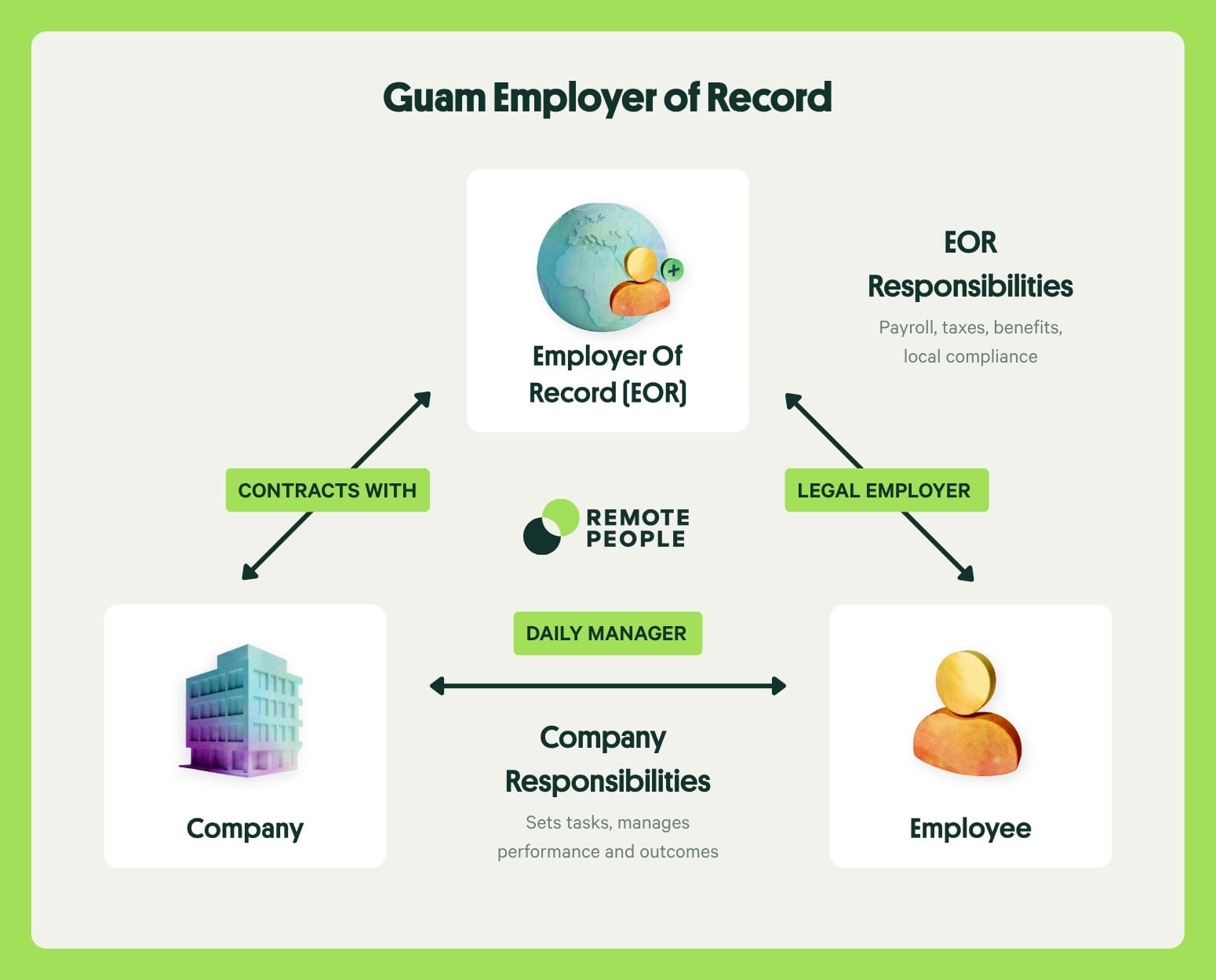
If you’d like to learn more about how Employer of Record (EOR) services work, read our What Is an Employer of Record (EOR)? guide for a complete overview of the model, its benefits, and when to use it.
If you’re comparing providers, our Best Employer of Record (EOR) Providers guide reviews the leading platforms to help you choose the right solution for your business.
Who Uses an EOR in Guam?
The EOR model works for companies of all sizes. Whether you are testing the waters with one hire or building a dedicated team, the appeal is the same: compliant employment in Guam without the cost and hassle of setting up a local presence.
Companies testing the Guam market use an EOR to hire one or two employees before committing to entity setup. Startups expanding into Guam rely on the EOR to avoid the cost and time of incorporation while they scale. Enterprises with existing operations use it to add headcount in Guam without opening a new subsidiary, and project-based teams use it when they need workers on the island for a defined period without long-term entity obligations.
In each case, the company gets a legal, payroll-compliant employee in Guam without taking on entity overhead.
Typical Onboarding Timeline
Most EOR providers can onboard an employee in Guam within one to two weeks. The timeline breaks down as follows:
- First, EOR agreement and employee details: The client company and EOR sign a service agreement, and the client provides the new hire’s personal information, role details, and compensation terms. This takes one to two days.
- Second, employment contract drafting and review: The EOR prepares a Guam-compliant employment contract and shares it with both the client and the employee for review. This takes two to three days.
- Third, Social Security and tax registration: The EOR registers the employee with the Social Security Administration and sets up income tax withholding with the Guam Department of Revenue and Taxation. This takes three to five days.
- Fourth, payroll setup and benefits enrollment: The EOR configures the employee in its payroll system, enrolls them in workers’ compensation coverage, and sets up any additional benefits. This takes two to three days.
- Fifth, employee onboarding and first day: The employee begins work. The EOR provides orientation on pay schedules, leave policies, and reporting procedures. This takes one day.
Work permit applications extend this timeline significantly. An H-1B petition for Guam typically adds 60 to 120 days, while H-2B temporary labor certifications through the Guam Department of Labor can take a similar period depending on recruitment requirements and USCIS processing times.
Start hiring in Guam
RemotePeople handles payroll, taxes, benefits, and compliance in Guam so you can focus on your business. No entity registration required.
Employment Laws and Regulations in Guam
Employment Contracts
Guam employment is governed primarily by Title 22 of the Guam Code Annotated (22 GCA), with the Guam Department of Labor serving as the primary regulatory authority. Guam follows the at-will employment doctrine, meaning either party can end the employment relationship at any time for any lawful reason (22 GCA Chapter 3). Written employment contracts are not strictly required for at-will positions, but they are strongly recommended and standard practice when hiring through an EOR. Both fixed-term and indefinite contracts are recognized under Guam law. Employment contracts should specify compensation, working hours, leave entitlements, termination provisions, and any non-disclosure or intellectual property assignment clauses.
Working Hours and Overtime
The standard workweek in Guam is 40 hours, consistent with the US Fair Labor Standards Act (FLSA) which applies to the territory. Standard business hours are typically 8:00 AM to 5:00 PM, Monday through Friday. Employees who work more than 40 hours in a workweek are entitled to overtime pay at 1.5 times their regular hourly rate under 22 GCA Chapter 3 (Guam DOL FLSA Handbook). Overtime is calculated on a weekly basis, not daily.
Guam overtime and premium pay rates · 2026 | |||
Hour Type | Rate Multiplier | Weekly/Daily Cap | Notes |
|---|---|---|---|
Standard overtime (over 40 hrs/week) | 1.5x | No statutory cap | Per FLSA and 22 GCA Chapter 3 |
Sunday work | 2.0x | All hours worked | Double time for Sunday shifts per Guam practice |
Public holiday work | 2.0x | All hours worked | Double time for work on Guam territorial holidays |
Night shift differential | Employer-set premium | Varies | No fixed statutory rate; premium commonly offered |
Source: Guam DOL FLSA Handbook and US DOL Fact Sheet #23 | |||
Certain employees are exempt from overtime requirements, including bona fide executive, administrative, and professional employees who meet the salary threshold and duties tests under the FLSA. There is no statutory cap on total overtime hours per week or month in Guam, but employers must track and compensate all overtime hours worked.
Minimum Wage
The current minimum wage in Guam is $9.25 per hour, effective since March 1, 2021, under Guam Public Law 36-1 (Federal Reserve Economic Data). This rate is codified in 22 GCA §3105. As of 2026, no increase has been enacted, although Bill 4-38 was introduced in January 2026 to tie Guam’s minimum wage to the Consumer Price Index with annual adjustments. The bill has not yet passed into law. Guam’s minimum wage is higher than the US federal minimum wage of $7.25 per hour, and the territorial rate applies to all covered employees regardless of sector.
Probation Period
Guam law does not prescribe a statutory probation period for private-sector employees. Because employment is at-will, employers can terminate employees at any point for any lawful reason, whether during or after an informal probation period. In practice, most Guam employers establish a 90-day probationary period through the employment contract, during which performance is evaluated before confirming the employee in their role. The EOR typically includes probation terms in the employment agreement, specifying the duration and any differences in notice or benefits during this period.
Leave Entitlements
Guam’s leave framework combines local territorial statutes with applicable US federal laws. The Guam Family and Medical Leave Act (GFMLA) provides broader coverage than the federal FMLA, applying to employers with 20 or more employees (compared to 50 under the federal law). Below is a breakdown of each statutory leave type.
Annual Leave
Guam law does not mandate paid annual leave for private-sector employees. Vacation leave is at the employer’s discretion, and terms are set in the employment contract or company policy. Once an employer offers vacation leave, it becomes a contractual obligation and must be honored according to the stated terms. Government of Guam employees accrue approximately four hours per biweekly pay period (about 13 days annually), and many private employers follow a similar practice voluntarily.
Sick Leave
There is no general statutory requirement for private employers in Guam to provide paid sick leave. Sick leave policies are determined by the employer and documented in the employment contract or employee handbook. The Guam Family and Medical Leave Act provides unpaid job-protected leave of up to 12 weeks for serious health conditions, available to employees who have worked more than 12 months and completed at least 1,000 hours in the preceding 12 months (Guam DOL FMLA Poster). Employers must continue health insurance coverage during GFMLA leave.
Maternity Leave
Female employees in permanent positions are entitled to 20 days of statutory maternity leave for childbirth or for adopting a child aged five or younger. This entitlement is provided under Guam territorial law and is separate from GFMLA leave. Eligible employees may also take up to 12 weeks of unpaid, job-protected leave under the GFMLA for pregnancy, childbirth, or to bond with a newborn. Employers must restore the employee to the same or an equivalent position upon return (Guam DOL).
Paternity Leave
Male employees in permanent positions are entitled to 20 days of statutory paternity leave when becoming fathers or adopting a child aged five or younger. This matches the maternity leave entitlement. Fathers may also take up to 12 weeks of unpaid GFMLA leave to bond with a newborn or newly adopted child, subject to the same eligibility requirements of 12 months of service and 1,000 hours worked.
Other Statutory Leave
Guam law provides several additional leave entitlements beyond annual, sick, and parental leave:
Additional leave entitlements include bereavement leave, which is typically three to five days for the death of an immediate family member, though this is set by employer policy rather than statute. Jury duty leave is provided with job protection under federal law, and Guam courts generally require employers to release employees for jury service. Military leave follows the Uniformed Services Employment and Reemployment Rights Act (USERRA), providing job-protected leave for military service with full reinstatement rights upon return.
Guam statutory leave entitlements · Per 22 GCA and GFMLA | ||
Leave Type | Duration | Eligibility and Notes |
|---|---|---|
Annual leave | Not mandated | At employer’s discretion; once offered, becomes contractual obligation |
Sick leave | Not mandated | At employer’s discretion; GFMLA provides 12 weeks unpaid for serious health conditions |
Maternity leave | 20 days | Permanent employees; plus up to 12 weeks unpaid GFMLA leave |
Paternity leave | 20 days | Permanent employees; plus up to 12 weeks unpaid GFMLA leave |
Bereavement leave | Up to 14 days | Under GFMLA; for death of close family member |
Jury duty leave | As needed | Paid; employer cannot penalize employee for serving |
Voting leave | 2 hours | Paid; on Election Day during polling hours |
GFMLA leave | 12 weeks | Unpaid, job-protected; employers with 20+ employees; 12 months and 1,000 hours eligibility |
Military leave | Per USERRA | Job-protected; government employees get 15 paid days per fiscal year |
Source: Guam DOL FMLA and 22 GCA Division 1 | ||
Statutory Employee Benefits
Beyond leave entitlements and social security contributions, Guam employers have several mandatory benefit obligations. A full breakdown of employee benefits in Guam covers both statutory and voluntary benefits. The requirements below reflect Guam’s status as a US territory with its own local regulations layered on top of applicable federal laws.
Workers’ compensation insurance is required for all employers under 22 GCA Chapter 9, covering medical expenses and wage replacement for work-related injuries and illnesses. Social Security and Medicare contributions are mandatory, with the employer paying 6.2% for Social Security (OASDI) and 1.45% for Medicare (HI) on each employee’s wages. Health insurance is not mandatory in Guam because the ACA employer mandate does not apply to US territories, but many employers offer group health plans to remain competitive. Retirement benefits are not required by law for private-sector employers in Guam, though voluntary 401(k) or similar plans are common among larger employers.
Exact contribution rates for employer Social Security and Medicare are detailed in the payroll and taxes section below. Workers’ compensation premium rates vary by industry classification, payroll amounts, and the employer’s claims history.
Recent Regulatory Updates (2026)
As of 2026, Guam’s core employment framework remains stable, with no major legislative reforms enacted since the minimum wage increase to $9.25 per hour under Public Law 36-1 in March 2021. The most notable pending development is Bill 4-38, introduced in January 2026 by Senator Joe S. San Agustin, which would tie Guam’s minimum wage to the Consumer Price Index with annual adjustments effective each March 1 (Marianas Business Journal). The bill has not yet been enacted. The Pregnant Workers Fairness Act (Public Law 36-118), effective November 9, 2023, continues to provide expanded protections for pregnant employees in Guam, requiring employers to provide reasonable accommodations for pregnancy-related conditions.
Work Permits and Visas in Guam
Work Permit Requirements
Who Needs a Work Permit
Because Guam is a US unincorporated territory, US immigration law applies in full. US citizens and US nationals can live and work in Guam without any permit or visa. Lawful permanent residents (green card holders) also have unrestricted work authorization. Foreign nationals require a valid work visa or employment authorization document to work in Guam, just as they would on the US mainland. The Guam-CNMI Visa Waiver Program allows nationals from certain countries to visit Guam for up to 45 days, but this program explicitly prohibits employment (USCIS GB Classification).
Eligibility and Required Documents
Eligibility requirements depend on the visa category. For an H-1B specialty occupation visa, the employer must demonstrate that the position requires a bachelor’s degree or equivalent in a specific field, and the foreign worker must hold the qualifying credential. For an H-2B temporary non-agricultural worker visa, the employer must obtain a temporary labor certification from the Guam Department of Labor (not the US DOL) and demonstrate that no qualified US workers are available. Required documents typically include a valid passport, the employment offer letter, Form I-129 petition, educational credentials, and any applicable labor certifications.
Processing Time and Validity
H-1B petitions for Guam-based positions typically take 60 to 120 days from filing to approval. A key advantage is that Guam employers are exempt from the national H-1B annual cap under the Consolidated Natural Resources Act (Public Law 110-229), with this exemption extended through December 31, 2029 (Berardi Immigration Law). H-1B visas are initially valid for three years, extendable to six years. H-2B temporary worker visas are issued for the period of the temporary labor certification, typically up to one year with extensions available.
Renewal Process
H-1B renewals require the employer to file a new Form I-129 petition with USCIS before the current authorization expires. The Guam H-1B cap exemption applies to renewals as well as initial petitions. H-2B renewals require a new temporary labor certification from the Guam Department of Labor and a new I-129 petition. Employees can generally continue working during the renewal process if the extension petition is filed before the current status expires, under the automatic extension provisions of 8 CFR 274a.12(b)(20).
Common Visa Types for Foreign Workers
Guam’s visa framework follows US immigration law, administered by USCIS and the US Department of State. The Guam Department of Labor handles the local temporary labor certification process for H-2B petitions. An EOR in Guam can sponsor employees under most work visa categories, with the H-1B cap exemption being a significant advantage over mainland US employers.
Guam work visa types for foreign workers · 2026 | ||||
Visa Type | Duration | Best For | Leads to APT? | Processing |
|---|---|---|---|---|
H-1B (Specialty Occupation) | 3 years, up to 6 | Professionals with bachelor’s degree in specialty field | Yes | 60–120 days; cap-exempt for Guam |
H-2B (Temporary Non-Agricultural) | Up to 1 year | Temporary or seasonal non-agricultural positions | No | 60–120 days; requires Guam DOL labor cert |
L-1A (Intracompany Transfer – Manager) | 3 years, up to 7 | Managers or executives transferring from related foreign office | Yes | 60–90 days |
L-1B (Intracompany Transfer – Specialized Knowledge) | 3 years, up to 5 | Employees with specialized company knowledge | Yes | 60–90 days |
E-2 (Treaty Investor) | 2 years, renewable | Investors from treaty countries making substantial investment in Guam | No | 30–90 days |
Source: USCIS Working in the US and Guam Department of Labor | ||||
The following visa categories do not authorize employment in Guam:
The GB visa waiver allows nationals from designated countries to enter Guam for up to 45 days without a US visa, though this does not permit employment. The H-1B specialty occupation visa is the primary route for skilled foreign workers, and Guam benefits from a cap exemption under Public Law 110-229, meaning there is no annual lottery for Guam-based H-1B petitions. The H-2B temporary non-agricultural worker visa covers seasonal or temporary roles. The CW-1 visa applies specifically to CNMI transitional workers and is not available for Guam positions. Each visa category carries its own processing timeline, typically ranging from 60 to 120 days for the full petition and adjudication cycle.
How an EOR Handles Work Permits
An EOR in Guam acts as the petitioning employer for work visa applications. For H-1B petitions, the EOR files Form I-129 with USCIS and takes advantage of the Guam cap exemption under Public Law 110-229, which means there is no lottery or annual numerical limit. For H-2B petitions, the EOR coordinates with the Guam Department of Labor’s Alien Labor Processing and Certification Division to obtain the required temporary labor certification before filing with USCIS. The employee is responsible for attending the visa interview at a US consulate (if outside the US) and providing personal documents such as passport, educational credentials, and medical examination results. Work permit applications add 60 to 120 days to the standard onboarding timeline described in the section above. One limitation: certain government contracts in Guam may require the employer to hold a local business license, which the EOR typically maintains.
Payroll, Taxes, and Social Security in Guam
Employer Contributions
Guam employers are subject to US federal payroll taxes, including Social Security (OASDI) and Medicare contributions. A distinctive feature of Guam’s system is that employers are not subject to the Federal Unemployment Tax Act (FUTA), and Guam does not have a territorial unemployment insurance program (US DOL Report).
Guam employer social security contributions · 2026 rates | ||
Contribution | Rate | Notes |
|---|---|---|
Social Security (OASDI) | 6.2% | On wages up to $184,500 (2026 wage base) |
Medicare (HI) | 1.45% | No wage cap; applies to all wages |
Federal unemployment (FUTA) | N/A | Guam employers are not subject to FUTA |
Territorial unemployment insurance | N/A | Guam has no unemployment insurance program |
Workers’ compensation | Varies | Mandatory; rates set by insurer based on industry and payroll |
Total (excluding workers’ comp) | 7.65% | Social Security + Medicare combined |
Employee Contributions
Employees in Guam pay their share of FICA taxes, which are withheld by the employer from each paycheck. Guam territorial income tax is also withheld, using the same rates and brackets as the US federal income tax code.
Guam employee payroll deductions · 2026 monthly withholdings | ||
Deduction | Rate | Notes |
|---|---|---|
Social Security (OASDI) | 6.2% | On wages up to $184,500 (2026 wage base) |
Medicare (HI) | 1.45% | No wage cap |
Additional Medicare Tax | 0.9% | On wages exceeding $200,000 (single filers) |
Guam territorial income tax | 10%–37% | Mirrors US federal brackets; filed with Guam DRTC |
Total FICA (employee share) | 7.65% | Social Security + Medicare (before additional Medicare) |
Source: Social Security Administration and IRS Form W-2GU | ||
Income Tax
Guam does not impose a separate territorial income tax. Instead, under Section 31 of the Organic Act of Guam (1950), the US federal income tax code applies in Guam with “Guam” substituted for “the United States.” Residents of Guam file their income tax returns with the Guam Department of Revenue and Taxation rather than the IRS, and all revenue stays in Guam’s territorial treasury (Tax Foundation).
Guam income tax brackets · 2026 | |
Bracket (Single Filers) | Tax Calculation |
|---|---|
$0 – $12,400 | 10% of taxable income |
$12,401 – $50,050 | $1,240 + 12% of amount over $12,400 |
$50,051 – $94,000 | $5,758 + 22% of amount over $50,050 |
$94,001 – $197,900 | $15,427 + 24% of amount over $94,000 |
$197,901 – $408,500 | $40,363 + 32% of amount over $197,900 |
$408,501 – $612,350 | $107,755 + 35% of amount over $408,500 |
Over $612,350 | $179,103 + 37% of amount over $612,350 |
Source: Tax Foundation 2026 Brackets and Guam DRTC | |
Payroll Cycle
Most employers in Guam pay wages on a biweekly or semi-monthly cycle. Under 22 GCA §3201, wages must be paid within seven days after the end of the pay period. Payment is typically made by direct bank transfer to the employee’s Guam bank account. All wages are denominated in USD. Employers must provide pay stubs showing gross wages, all deductions (Social Security, Medicare, Guam income tax), and net pay. Employers file Form W-2GU with the Guam Department of Revenue and Taxation annually, and employers with 10 or more information returns must file electronically. Quarterly wage reports are also submitted to SWICA (the State Wage Information Collection Agency maintained by the Guam DRTC).
13th Month Salary and Bonus Pay
The 13th month salary is not mandatory in Guam. As a US territory, Guam follows US employment standards where bonus pay is entirely at the employer’s discretion. There is no statutory requirement for a 13th or 14th month payment, Christmas bonus, or profit-sharing arrangement. Employers may offer year-end bonuses, performance bonuses, or other variable compensation as part of their compensation packages, but these are contractual rather than statutory obligations. When offered, bonus payments are subject to the same FICA and Guam income tax withholding as regular wages.
Cost of Hiring Through an EOR in Guam
EOR Service Fees
EOR service fees in Guam typically range from $300 to $600 per employee per month. This flat monthly fee covers employment contract administration, payroll processing, tax withholding and filing (including Form W-2GU), Social Security and Medicare remittance, workers’ compensation management, leave tracking, and ongoing compliance with Guam territorial labor laws. Some providers charge additional fees for work permit sponsorship, benefits administration, or one-time onboarding setup. The fee does not include the employee’s salary, employer payroll taxes, or workers’ compensation insurance premiums, which are passed through at cost.
Total Employment Cost Breakdown
The following example shows the total monthly cost of employing one person in Guam at a gross salary of $5,000 per month ($60,000 annually). Guam’s employer cost structure is straightforward because the only mandatory payroll contributions are Social Security and Medicare, and there is no unemployment insurance tax.
Guam employer cost example · $5,000 gross · 2026 | ||
Employer Cost | Amount (USD) | % of Gross |
|---|---|---|
Gross monthly salary | $5,000 | 100.0% |
Social Security (OASDI) – 6.2% | $310 | 6.2% |
Medicare (HI) – 1.45% | $73 | 1.45% |
Workers’ compensation (estimated) | $50 | 1.0% |
EOR service fee | $450 | 9.0% |
Total monthly cost | $5,883 | 117.7% |
All in, hiring one person in Guam through an EOR costs about 17.7% above the gross salary. That is well below what you would pay in most international markets. The reason: Guam has no unemployment insurance, no mandatory housing or education funds, and no 13th month salary. Your main cost drivers are FICA (7.65% combined) and the EOR service fee itself.
Ready to hire in Guam? Get started with RemotePeople. We handle employment contracts, payroll, tax withholding, and full Guam compliance, with no local entity needed. Contact us today to discuss your Guam hiring needs.
Benefits of Using an EOR in Guam
The case for using an EOR in Guam comes down to speed, cost, and simplicity. Guam’s regulatory environment layers US federal law on top of territorial statutes, which makes compliance more involved than most companies expect. An EOR absorbs that complexity.
Speed to market is the most immediate advantage. An EOR can onboard employees in Guam within one to two weeks, compared to two to three months for entity incorporation. Compliance assurance removes the burden of tracking Guam-specific regulations, including FICA filing, Form W-2GU requirements, workers’ compensation under 22 GCA Chapter 9, and territorial tax obligations.
Cost efficiency matters for small teams. The EOR’s flat monthly fee eliminates the fixed overhead of maintaining a Guam entity, including annual business license renewals, registered agent fees, and ongoing filing requirements. Payroll expertise ensures accurate calculations across federal and territorial tax layers, reducing the risk of penalties from the IRS or Guam DRTC. Flexibility allows companies to scale their Guam workforce up or down without the legal and financial burden of dissolving an entity.
Companies that want to build a team in Guam without the complexity of a local setup can get started with RemotePeople in days.
Termination and Offboarding in Guam
Notice Periods
Guam follows the at-will employment doctrine, which means neither employers nor employees are required by statute to provide advance notice before terminating the employment relationship. Either party can end employment at any time for any lawful reason. However, the federal Worker Adjustment and Retraining Notification (WARN) Act applies to Guam employers with 100 or more full-time employees, requiring 60 days’ advance written notice before a mass layoff or plant closing (US DOL WARN Act).
Guam statutory notice periods by position level · Per 22 GCA at-will doctrine | |||
Position Level | Notice Period | During Probation | Notes |
|---|---|---|---|
All private-sector employees | None required | None required | At-will employment; either party may terminate at any time |
Employees under contract | Per contract terms | Per contract terms | Contractual notice requirements override at-will default |
Managerial staff | None required | None required | Common practice: 2–4 weeks courtesy notice |
Mass layoff (WARN Act) | 60 calendar days | N/A | Applies to employers with 100+ full-time employees |
Source: 22 GCA Division 1 and US DOL WARN Act | |||
While Guam law does not require notice, employment contracts negotiated through an EOR typically include mutual notice provisions (commonly two to four weeks) as a matter of best practice. Employers may also offer pay in lieu of notice. Fixed-term contracts expire at the end of their term without the need for notice, unless the contract specifies otherwise.
Severance Pay
Guam law does not mandate severance pay for private-sector employees. Because employment is at-will, employers have no statutory obligation to provide severance upon termination, regardless of the employee’s tenure or the reason for separation. Severance is only required if it is specified in an employment contract, required by a collective bargaining agreement, or otherwise negotiated as part of a separation package.
Guam severance pay schedule by years of service · Per at-will doctrine | |||
Years of Service | Severance Amount | Base Salary | Notes |
|---|---|---|---|
1 year | $0 (not required) | N/A | Voluntary; per contract or negotiation only |
3 years | $0 (not required) | N/A | Common practice: 1–2 weeks per year if offered |
5 years | $0 (not required) | N/A | Contractual severance plans may scale with tenure |
10 years | $0 (not required) | N/A | Some employers offer enhanced packages for long-tenured staff |
Source: 22 GCA Division 1 and US Department of Labor WHD | |||
Calculation Method
Because severance is not statutory in Guam, there is no mandated calculation formula. When employers do offer severance, the most common approach is one to two weeks of base salary per year of service. The base salary used is typically the employee’s most recent gross monthly salary, excluding bonuses and overtime. EOR-managed employment contracts in Guam often include a severance clause that specifies the formula and any caps, providing clarity for both parties upfront.
Caps and Exceptions
There are no statutory caps on severance in Guam because there is no statutory severance requirement. Contractual severance agreements may include caps set by the employer. Employees terminated for cause (such as theft, fraud, or gross misconduct documented by the employer) are typically excluded from any voluntary severance benefits. Employees terminated during a probationary period are also generally not eligible for severance under most employer policies. The WARN Act does not require severance pay, but employees who do not receive the required 60 days’ notice may be entitled to back pay and benefits for up to 60 days.
Grounds for Termination
Under Guam’s at-will doctrine, employers can terminate employees for any reason that is not prohibited by law. Prohibited grounds include discrimination based on race, sex (including gender identity and expression), age (40 and older), religion, color, national origin, ancestry, disability, medical condition, marital status, sexual orientation, and honorably discharged veteran or military status under 22 GCA §5101, §5203, and §3302-3303 (Guam Employment Relations Act). The Pregnant Workers Fairness Act (Public Law 36-118) adds pregnancy as a protected category. Retaliation against employees who file complaints, participate in investigations, or exercise their legal rights (such as filing workers’ compensation claims or taking GFMLA leave) is also prohibited. Employees who believe they have been wrongfully terminated can file complaints with the Guam Department of Labor’s Fair Employment Practices Division or with the US Equal Employment Opportunity Commission (EEOC).
EOR vs. Other Hiring Models in Guam
EOR vs. Setting Up a Local Entity
The table below compares the two main paths for hiring in Guam: using an EOR versus incorporating your own entity. For most companies hiring fewer than 15 to 20 employees, the EOR model is faster, cheaper, and carries less administrative burden.
Guam EOR vs local entity comparison · Setup time, cost, risk and best-fit | ||
Comparison | Employer of Record | Own Entity |
|---|---|---|
Setup time | 1–2 weeks | 2–3 months |
Upfront cost | $0 (service fee only) | $5,000–$15,000+ (incorporation, licenses, legal fees) |
Ongoing cost | $300–$600/employee/month | $2,000+/month (admin, compliance, registered agent) |
Local partner required | No | Yes (registered agent, local directors may be required) |
Social insurance registration | EOR handles SSA and DRTC registration | Company registers directly with SSA and Guam DRTC |
Payroll and tax filing | EOR files W-2GU, SWICA reports, FICA | Company files directly or hires payroll provider |
Best for team size | 1–20 employees | 20+ employees with long-term commitment |
Scale down or exit | Terminate EOR agreement; no entity to dissolve | Must dissolve entity, file final returns, settle obligations |
Government contracts | May face restrictions; some contracts require local entity | Full eligibility for Guam government contracts |
Source: RemotePeople EOR Solutions and Guam Department of Labor | ||
For small teams in Guam, the EOR wins on both speed and cost. Most companies find the breakeven point, where running your own entity starts to make more financial sense, sits around 15 to 20 employees. Below that threshold, the math favors the EOR.
Setting up an entity in Guam requires obtaining a Guam business license from the Department of Revenue and Taxation, registering with the IRS for an Employer Identification Number (EIN), establishing payroll accounts, and securing workers’ compensation insurance. Each step involves lead time, fees, and ongoing annual filing requirements.
An EOR eliminates all of these steps. The client company signs one agreement, provides employee details, and the EOR handles every registration and compliance obligation. The tradeoff is less direct control over employment administration and potential limitations on government contract eligibility.
EOR vs. Hiring Independent Contractors
Choosing between an EOR employee and an independent contractor in Guam depends on how the worker operates. The IRS common-law test and Guam Department of Labor classification rules under 22 GCA determine which model is legally appropriate.
Guam EOR vs independent contractors · Compliance, cost, and risk | ||
Comparison | EOR (Full-Time Employee) | Independent Contractor |
|---|---|---|
Legal relationship | Employer-employee under 22 GCA | Client-contractor under service agreement |
Compliance risk | Low; EOR manages all obligations | High; misclassification risk under IRS and Guam DOL tests |
Payroll and tax | EOR withholds FICA, income tax, files W-2GU | Contractor handles own taxes; company files Form 1099 |
Benefits and leave | Full statutory entitlements (GFMLA, workers’ comp, maternity/paternity) | None; contractors are not entitled to employee benefits |
IP protection | Work product assigned to client company via employment contract | Requires explicit IP assignment clause in contractor agreement |
Termination | At-will with anti-discrimination protections | Per contract terms; no employment protections apply |
Best for | Ongoing, core roles with defined schedules and supervision | Project-based, specialized work with independent control |
Cost structure | Salary + 7.65% FICA + workers’ comp + EOR fee | Agreed rate; no employer taxes or benefits |
Source: IRS Worker Classification and Guam Department of Labor | ||
Misclassifying an employee as an independent contractor in Guam carries significant consequences. The IRS applies the common-law test, examining behavioral control, financial control, and the type of relationship to determine worker classification. The Guam Department of Labor also enforces classification rules under 22 GCA. Penalties for misclassification can include back payment of all FICA taxes (both the employer and employee shares), back payment of workers’ compensation premiums, interest, and potential penalties of up to $50 per unfiled W-2GU form.
The contractor model is only appropriate in cases where the worker genuinely operates an independent business, controls how and when the work is performed, provides their own tools, serves multiple clients, and bears their own profit-and-loss risk. For ongoing, supervised roles, the EOR model is the compliant path. Companies that need to engage contractors in Guam can use RemotePeople’s contractor management solution to ensure proper classification and documentation.
EOR vs. PEO (Professional Employer Organization)
An EOR and a PEO serve different purposes and suit different stages of market entry. The key difference is whether your company already has a legal entity in Guam.
Guam EOR vs PEO comparison · Legal employer, liability, and setup | ||
Comparison | Employer of Record (EOR) | PEO |
|---|---|---|
Legal employer | EOR is the sole legal employer | Co-employment; PEO shares employer responsibilities |
Local entity required | No | Yes; client must have a Guam entity |
Best for | Companies without a Guam entity | Companies with an existing Guam entity needing HR outsourcing |
Compliance liability | EOR assumes primary compliance liability | Shared between PEO and client company |
Setup time | 1–2 weeks | 2–4 weeks (requires existing entity) |
Control over HR policies | EOR sets compliant policies; client guides day-to-day work | Client retains more HR policy control |
Typical use case | Market entry, remote hiring, small Guam team | HR outsourcing for established Guam operations |
Source: RemotePeople EOR Solutions and Global PEO Services | ||
The core distinction is simple: an EOR does not require you to have any legal presence in Guam, while a PEO assumes you already have one. If you are expanding into Guam for the first time, the EOR is the only model that eliminates the entity requirement entirely.
Guam does not have a formal PEO licensing or regulatory framework. PEO services operate under general business and employment law provisions in 22 GCA, and some national PEO providers restrict or limit their services in US territories. This makes the EOR model a more reliable option for companies that need a turnkey employment solution in Guam without navigating the uncertainty of PEO availability on the island.
For companies that already have a Guam entity but want to outsource payroll, benefits administration, and HR compliance, a PEO can reduce administrative burden while allowing the company to retain more direct control over employment policies and practices.
Public Holidays in Guam
Guam observes 12 public holidays in 2026, combining US federal holidays with unique territorial observances. Employers must account for these when planning payroll cycles and project timelines.
Guam public holidays · 2026 calendar year | ||
Date | Holiday | Type |
|---|---|---|
January 1 | New Year’s Day | Federal and territorial |
January 19 | Martin Luther King Jr. Day | Federal and territorial |
March 2 | Guam History and Chamorro Heritage Day | Territorial |
May 25 | Memorial Day | Federal and territorial |
July 3 (observed) | Independence Day | Federal and territorial |
July 21 | Liberation Day | Territorial |
September 7 | Labor Day | Federal and territorial |
November 2 | All Souls’ Day | Territorial |
November 11 | Veterans Day | Federal and territorial |
November 26 | Thanksgiving Day | Federal and territorial |
December 8 | Santa Marian Kamalen Day (Lady of Camarin Day) | Territorial |
December 25 | Christmas Day | Federal and territorial |
Guam observes 12 public holidays in 2026, combining US federal holidays with unique territorial observances. Liberation Day (July 21) commemorates the 1944 liberation of Guam during World War II and is the most significant local holiday on the island. Guam History and Chamorro Heritage Day (first Monday in March) celebrates the island’s indigenous Chamorro culture. Santa Marian Kamalen Day (December 8) honors the patron saint of Guam. When a holiday falls on a Saturday, the preceding Friday is observed; when it falls on a Sunday, the following Monday is observed. Employees who work on public holidays are entitled to double time (2x their regular rate) under Guam practice. Employers should account for these holidays when planning payroll cycles and project timelines, particularly around Liberation Day in July and the holiday cluster from late November through late December.
How to Get Started with an EOR in Guam
Getting started with an EOR in Guam takes less time than most companies expect. From initial inquiry to a fully onboarded employee, the process typically wraps up within one to two weeks.
- First, define the role and compensation: Determine the position, responsibilities, working hours, and salary for your Guam hire. Research Guam’s minimum wage ($9.25 per hour) and local market rates to ensure your offer is competitive. Decide on any additional benefits you want to offer beyond the statutory minimums.
- Second, select an EOR provider: Choose an EOR with established operations in Guam and demonstrated experience with the territory’s unique regulatory environment, including Form W-2GU filing, SWICA reporting, the Guam H-1B cap exemption, and workers’ compensation requirements under 22 GCA Chapter 9. RemotePeople provides full EOR services in Guam with transparent pricing.
- Third, sign the EOR agreement and share employee details: Execute a service agreement with the EOR and provide the new hire’s personal information, role description, compensation package, and start date. The EOR uses this to draft a compliant employment contract.
- Fourth, review and execute the employment contract: The EOR prepares a Guam-compliant employment contract covering compensation, working hours, leave entitlements, termination provisions, and any intellectual property assignment clauses. Both the client and the employee review and sign the agreement.
- Fifth, onboard and begin payroll: The EOR completes all registrations (Social Security Administration, Guam DRTC, workers’ compensation carrier), sets up payroll, and onboards the employee. The employee begins work on the agreed start date, with payroll running on the established cycle.
Ready to hire in Guam? RemotePeople handles every aspect of employment, from contracts and payroll to tax compliance and benefits administration. No local entity needed, and your team can start in days. Get started now.
Where companies hiring in Guam expand next
Companies operating in Guam often extend across the Asia-Pacific, drawing on English-speaking talent and aligned business culture. Many companies add operations in Australia first, drawing on aligned Pacific workforce norms. New Zealand follows as shared Pacific business rhythm, while hiring in Fiji offers the regional Pacific talent footprint. An EOR partner in Papua New Guinea is often the fourth step, valued for Pacific-region proximity and English-first hiring.
Frequently Asked Questions
EOR services in Guam typically cost between $300 and $600 per employee per month as a flat fee. This covers employment contracts, payroll processing, tax withholding and Form W-2GU filing, Social Security and Medicare remittance, workers’ compensation management, and ongoing compliance with Guam labor laws. The employee’s salary, employer FICA contributions (7.65%), and workers’ compensation premiums are additional costs passed through at actual amounts.
Most EOR providers can onboard an employee in Guam within one to two weeks from the date the service agreement is signed. This covers contract drafting, Social Security registration, tax setup with the Guam Department of Revenue and Taxation, and payroll configuration. If the hire requires a work visa (such as an H-1B or H-2B), the process extends by 60 to 120 days for petition filing and USCIS adjudication.
Guam employment is governed by a combination of US federal law and local territorial statutes. The Fair Labor Standards Act (FLSA) sets baseline standards for minimum wage and overtime. Title 22 of the Guam Code Annotated (22 GCA) contains Guam’s labor standards, including wage payment timing, anti-discrimination protections, and workers’ compensation requirements. The Guam Family and Medical Leave Act (GFMLA) applies to employers with 20 or more employees, providing 12 weeks of unpaid, job-protected leave.
Intellectual property created during employment is assigned to the client company (you), not the EOR. The EOR includes standard IP assignment clauses in the employment contract, ensuring that all work product, inventions, and creative output produced by the employee within the scope of their employment belong to your company. The EOR’s role as legal employer does not transfer IP ownership to the EOR.
Employees hired through an EOR in Guam receive a professional employment contract, timely payroll in USD via direct deposit, proper tax documentation (Form W-2GU), workers’ compensation coverage, and any additional benefits the client company chooses to offer. The employee’s day-to-day work is directed by the client company, not the EOR. From the employee’s perspective, the arrangement functions like being employed by any established company on the island.
An EOR is specifically for full-time employment, not contractor engagement. For companies that need to engage independent contractors in Guam, RemotePeople offers a dedicated contractor management solution that handles proper classification, contract documentation, and compliant payment processing. Misclassifying employees as contractors in Guam carries penalties including back FICA taxes, workers’ compensation premiums, and fines.
Mandatory employee benefits in Guam include workers’ compensation insurance (required for all employers under 22 GCA Chapter 9), Social Security and Medicare contributions (6.2% and 1.45% employer share), 20 days of maternity and paternity leave for permanent employees, and job-protected leave under the Guam Family and Medical Leave Act for eligible employees. Health insurance is not mandatory (the ACA employer mandate does not apply in Guam), and there is no required 13th month salary or pension contribution for private-sector employees. An EOR in Guam manages all mandatory benefits and can administer additional voluntary benefits such as health insurance and retirement plans.
Yes. An EOR in Guam can sponsor foreign national employees for work visas, including H-1B specialty occupation visas and H-2B temporary non-agricultural worker visas. Guam employers benefit from a significant advantage: the H-1B cap exemption under Public Law 110-229 (extended through December 31, 2029), which means there is no annual lottery or numerical limit for H-1B petitions filed for Guam-based positions. The EOR handles all petition filing with USCIS and coordinates with the Guam Department of Labor for any required labor certifications.
Employer of Record in
Employer of Record in
Employer of Record in
Employer of Record in
Employer of Record in
Employer of Record in
Employer of Record in
Employer of Record in