
 Recruit
Employer of Record in Oregon
-
 Drew Donnelly
- Published
- September 22, 2026
Oregon’s labor law includes paid family leave, mandatory sick leave, and strict wage transparency rules, and an Oregon EOR handles payroll and full state compliance with no local entity needed.
Hire in Oregon — book a free 30-minute demo
Tell us what you need. You'll get a tailored, transparent proposal within 24 hours, plus a free call to walk through it.
Tell us about your company
So we can match you with a specialist who knows your market — and unlock volume pricing tiers.
* All fields are required.
Where and when are you hiring?
Tell us the geography and timing and we'll quote each country line by line, with onboarding timelines.
* All fields are required.
Help us beat your current setup
We'll benchmark your current deal and send a line-by-line proposal in 24 hours — showing exactly where we cut cost, time, or risk. After you submit, you can book a call to walk through it together.
* All fields are required.
Thanks! Your proposal is on its way.
Expect a tailored, line-by-line proposal in your inbox within 24 hours. In the meantime…
Want to walk through it together?
Book a free 30-minute call with one of our specialists. We'll explain every line, answer your questions, and tailor the proposal further if you need.
No obligation. Pick a time that works for you.








- Hire in Oregon — book a free 30-minute demo
- Tell us about your company
- Where and when are you hiring?
- Help us beat your current setup
- Thanks! Your proposal is on its way.
- Oregon Employer of Record
- What Is the Difference Between an Oregon Employer of Record and an Oregon PEO?
- How Does an Oregon Employer of Record Work?
- How Labor Laws Affect Hiring in Oregon?
- Payroll Taxes and Employer Cost in Oregon
- Employee Classification Rules in Oregon
- What Makes Hiring in Oregon Unique?
- What Are the Benefits of an Oregon Employer of Record?
- What Are the Downsides of an Oregon EOR?
- How to Choose an Oregon Employer of Record?
- Engage an Oregon Employer of Record with RemotePeople
- Related EOR Destinations

Let RemotePeople handle payroll, compliance, and HR admin worldwide so you can focus on building your team.
Key Takeaways
- Oregon has a diverse industry mix that includes agriculture and natural resource extraction, manufacturing, and tech.
- This state is highly regulated, and penalties for non-compliance with employment laws are high.
- Employers have to pay more in payroll taxes in Oregon than in most other states.
- Working with Oregon EORs helps employers from abroad stay compliant and provide top-quality HR services.
The northwest state of Oregon is mid-sized, hosting a population of 4.273 million people. However, the state’s economy has grown substantially in the past two decades, reaching over $331 billion by the end of 2024, an increase of nearly 250%. Unsurprisingly, Oregon’s labor force has also been steadily increasing, reaching 2.237 workers at the end of 2025. In recent years, these increases have been led by the business and professional services, manufacturing, mining and logging, and private healthcare and education industries. Construction, biosciences, green technology, and IT are also some of the fastest-growing industries in Oregon, and many major outdoor apparel brands and software companies are centered in the state capital, Portland.
While it has a lot going for it, Oregon is ranked as only the 39th-best state for doing business. This state features a relatively high level of regulation, and employer costs are higher than the national average. This means that it can be very challenging to hire employees in Oregon and manage their HR needs in full compliance with state laws. By working with an EOR, however, your business can hire employees quickly, provide them with top-level HR services, and stay compliant and penalty-free while getting the most out of your Oregon workers.
Oregon Employer of Record
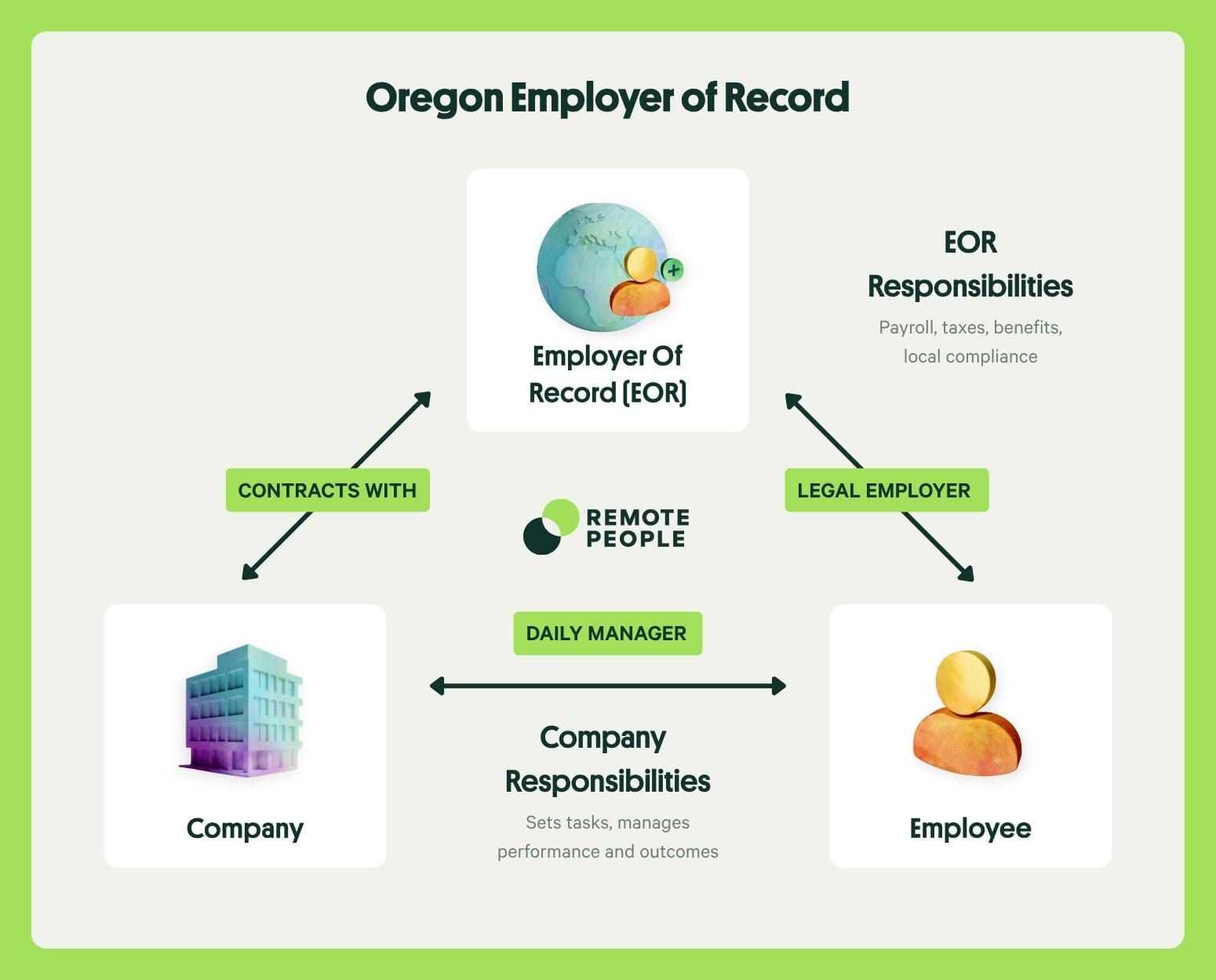
If you already own a business entity in Oregon or plan to register one, you won’t require the services of an EOR, or Employer of Record. The primary role of this kind of service provider is to hire employees in Oregon on your behalf, which allows you to avoid spending the time and resources required to register a business in the state. Instead, the EOR signs contracts with your employees directly, becoming their legal employer while hiring them to work for you.
What is an EOR can help explain how this employment model works in more detail.
In doing so, your EOR partner takes on the liability for your workers and manages compliance with all applicable state and federal employment laws. However, EORs do more than simply act as legal employers. They also provide complete HR services for the workers in question. In particular, they take on the tricky tasks of managing payroll and paying your workers. They also administer both their state and federally mandated benefits, and any additional benefits you choose to offer. Most EORs also manage your workers’ paid time off (PTO) entitlements as well as a host of other supplementary services.
EORs employ experts in HR, law, and taxes in Oregon to direct their services and, in some cases, provide direct consultations with their clients. More often, however, they use online, cloud-based platforms to provide their services. These platforms help to increase the speed and accuracy of administration by automating payroll and benefits administration. They may also offer a range of tools and features to help employers handle employee engagement, talent management, performance management, expense management, and other integral HR functions. Employees usually receive access to their accounts on these platforms, which helps them keep track of their pay and benefits.
While your EOR partner manages hiring, HR, and compliance, you still share some responsibilities as a worksite employer. For example, you’ll still need to manage your employees’ schedules and daily tasks, as well as keep track of their attendance and hours worked. However, a partnership with an EOR allows you to enter the market quickly and focus on your core business activities while the EOR handles administration for your Oregon workers.
What Is the Difference Between an Oregon Employer of Record and an Oregon PEO?
Employers of Record are similar to another type of service provider, the PEO or Professional Employer Organization. PEOs have operated in the US for decades and provide many of the same services that EORs do. However, there are significant differences between an Oregon EOR and an Oregon PEO that make them suited to different types of clients, including:
PEO
- PEOs co-employ workers, which means that they share employer responsibilities with their clients, who are the main employers.
- Instead of hiring workers directly, PEOs work with clients who already own entities and can legally hire their own workers in Oregon.
- PEOs help clients who own companies in Oregon or elsewhere in the US to manage their employees’ needs.
EOR
- EORs sign contracts with workers directly, which means their clients don’t have to own entities to hire in Oregon.
- They take on liability for the workers and the responsibility for compliance with state and federal laws.
- EORs generally work with employers looking to hire Oregon workers from abroad, helping them do so quickly and compliantly.
Start hiring with an Oregon EOR
Let us handle the complexities of hiring, compliance, and payroll in Oregon while you focus on growing your team.
- Hire employees in Oregon with an Oregon EOR
- No local entity is needed
- Pricing starts at USD 199 per employee
- RemotePeople can also help you find the best talent in Oregon
How Does an Oregon Employer of Record Work?
When you work with an EOR in Oregon, it will take on your employees, handle all of their HR concerns, and monitor compliance for you. Here’s how partnering with an Employer of Record works in detail:
Compliant Employment Contract
If you have little hiring experience in Oregon, you’re probably not in tune with the salary and benefits expectations of local employees. EORs, however, have experience in this state and can recommend salary bands and benefits packages that will attract top talent to your vacancies. They normally also help you negotiate these terms with your selected candidates, then build them into the legally compliant contracts they generate. Your EOR will enter into each contract directly with your employees, manage signatures, and store them for future reference.
Payroll Setup with Correct State Registrations
Once a worker’s contract is signed, they’ll need to be onboarded to both your organization and the EOR. You’ll typically need to provide them with training, orientation, and access to data and tools. At the same time, your EOR will handle most administrative tasks. It will collect their salary, tax, and benefits information to add them to your payroll and set up their automatic calculations for earnings and deductions. It will also collect their banking details to arrange their salary payments. Crucially, the EOR will also register them with the necessary tax and social program authorities at both the federal and state levels to ensure that they can work for you legally.
Tax Withholding and Remittance
Because it processes payroll for you, your EOR will also calculate employee income taxes and withhold these funds from their paychecks. It remits federal income taxes to the IRS and state income taxes to the Oregon Department of Revenue regularly, and sends wage reports to these bodies as required. The EOR also issues tax forms, including W-2s for employees and 1099s for independent contractors.
Benefits Administration
Your employees must be registered with mandatory federal benefits programs that include Medicare, Social Security, and FUTA (Federal Unemployment Tax Act) benefits. They may also have to be covered by state benefit programs that include the state unemployment insurance (SUI), workers’ compensation, Paid Leave Oregon (PLO), and the Oregon Family Leave Act (OFLA). As part of payroll, your EOR will calculate the contributions you and your employees need to make, collect these funds, and remit them to the appropriate programs. If you want to incentivize your employees with additional benefits like health insurance or retirement savings plans, your EOR can normally provide links to provider plans and administer these supplementary benefits for you.
Ongoing Compliance Management
EORs employ legal and tax experts who help to direct their services. These experts monitor changes in state and federal laws and standards, and help you adjust your contracts and benefits in response. EORs report to the authorities for you, assess employee status, and design contacts to keep you compliant at all times.
Recruitment
While many EORs leave recruitment to outside agencies, some give you support for finding the skilled people you need for your business. A few EORs in Oregon offer active recruitment services, consulting with you and then searching out top-quality candidates to fill your positions. Other EORs provide you with platform tools that help you perform your own recruitment function more effectively.
How Labor Laws Affect Hiring in Oregon?
Before you choose to hire in Oregon, you should be aware of the employment and tax laws that will affect your employment relationships in this state. Important rules to know about include:
Minimum Wage & Overtime
Oregon’s workers benefit from minimum wage levels that are roughly double the federal minimum of $7.25/hour. The standard minimum wage in the state is $15.05/hour, though workers in rural counties can be paid as low as $14.05/hour. In Portland, however, the minimum wage is $16.30 in 2026. These wages also protect tipped workers, since tip credits are not allowed in the state.
Employees in Oregon work standard 40-hour workweeks, and any additional hours are considered overtime. In the manufacturing industry, workers must be paid premium pay for any hours worked over ten hours/day, and these employees can only work 13 hours in a 24-hour period. For other workers, overtime hours are unlimited, but workers must be paid “time-and-a-half”, or 150% of their normal wages. However, following the federal FLSA (Fair Labor Standards Act), overtime premiums do not apply to executive, administrative, or professional workers who earn more than $648/week.
Income Tax
In addition to federal income tax, employees in Oregon also have to pay state income tax on all of their earnings. The tax rates in this state range from 4.8% to 9.9% for the 2025 tax year, depending on the employee’s total income, and taxes are payable to the Oregon DOR.
State Unemployment Insurance (SUI)
If workers lose their jobs through no fault of their own, and worked for their employer for 500 hours and/or made at least $1000 a year in the past four years, they are normally eligible for state unemployment insurance (SUI) benefits. This Oregon state program is funded through employer contributions, which range from 0.9% to 5.4% on wages up to $56,700, depending on their experience. New employers pay 2.4%.
If employers pay their contributions on time and accurately, they receive a 5.4% credit on their FUTA taxes, meaning they only have to pay contributions of 0.6% on each employee’s first $7,000 in wages.
Paid Leave
While many states don’t require employers to provide paid leave, Oregon mandates it through its Paid Leave Oregon (PLO) program. The funding for this program comes from both employees and employers and represents 1% of each worker’s earnings up to a cap of $184,500. Employees pay 60% of this rate (0.6% of earnings) while employers with 25+ employees pay 40% (0.4% of payroll). Smaller employers don’t need to pay the employer contribution. This program funds wage replacement for employees who need to take sick, family, or safe leave.
The Oregon Family Leave Act also requires employers with 25 or more employees to offer unpaid leave of up to 12 weeks to workers who’ve worked at least 25 hours/week for the six months preceding a claim. This leave can be used for bereavement, military deployment, pregnancy, or care for sick children. While employers don’t need to pay employees or contribute to this program, they have to protect their workers’ right to return to their jobs after taking leave.
Workers’ Compensation
It’s legally mandated that nearly all employers in Oregon carry workers’ compensation insurance to fund care and wage replacement for their ill or injured employees, and to protect themselves from lawsuits. While rates vary according to the levels of hazards in different industries, employers pay just 0.89% of payroll for insurance, on average.
Termination and Final Pay
Like most states in the union, Oregon follows an “at-will” employment model. This means that employers can dismiss workers at any time without just cause. Not only do they not have to provide employees with reasons for their dismissals, but employers also don’t have to provide them with notice or severance pay. Likewise, employees can resign at any time without giving reasons or providing their employers with notice. Customarily, however, both sides usually try to provide at least two weeks’ notice as a professional courtesy.
While this is the normal state of employment in Oregon, collective agreements or clauses in individual contracts can include notice periods and/or severance pay, and these are legally binding. Employers are also restricted from terminating employees for discriminatory reasons, retaliating against whistle-blowers, and terminating workers for legal behaviors outside of work. Employees who are fired or laid off, or leave their employers by mutual consent, must be paid their final paychecks on the next business day. If they resign, giving 48 hours’ notice, they must be paid on their last day of employment, or within five business days if notice is not given. A final paycheck must include all salary, bonus, overtime, and vacation pay the employee is owed.
Payroll Taxes and Employer Cost in Oregon
Oregon has higher living and housing costs than the national average, and salaries in the state are also slightly higher than average for the US. However, employers need to budget for more than just salaries when hiring workers, as payroll costs can also be significant. In Oregon, these costs include:
| Category | Cost |
|---|---|
| Federal payroll taxes | 1.45% Medicare contribution, 6.2% Social Security contribution to a maximum of $184,500, 0.6% FUTA tax on their first $7,000 of earnings. |
| SUI contributions | 0.9% and 5.4% of the employee’s first $56,700 of earnings. |
| Workers’ compensation premiums | 0.89% of payroll, on average. |
| PLO contributions | 0.4% for employers with 50+ employees. |
| Mandatory health insurance contributions | Around $6,700/employee/year for employers with 50+ employees. |
Example Cost Breakdown
The following example shows the employer burden for a professional employee earning $75,000 per year in Oregon. It is based on a typical clerical employee and assumes a low risk for workers’ compensation.
Assuming the worker has a $75,000 salary, the employer would pay:
| Category | Cost |
|---|---|
| Medicare | $1,087.50 |
| Social Security | $4,650 |
| FUTA | $450 |
| SUI | $675 – 4,050 |
| Workers’ compensation | $667.50 |
| PLO | $300 |
| Health insurance | $6,700 |
| TOTAL | $14,530 – $17,905 |
Estimated employer burden range: 19.37 – 23.87%
Employee Classification Rules in Oregon
In all US states, employers need to be careful not to classify workers as independent contractors if, legally, they should actually be treated as employees. Since employees are entitled to many protections and benefits that contractors are not, employers can be held liable for misclassifying them and face strict penalties. To see if workers can legally be classified as contractors, Oregon follows strict tests.
First, it follows IRS guidelines and a 20-factor test, which helps determine how much control the employer has over the worker. This right-to-control test determines whether the employer controls the worker’s hours, sequence of work, full-time hours, availability to other employers, right to terminate their work without liability, and more.
Oregon state courts also consider an economic realities test to determine if the worker’s work is an essential part of the employer’s business, has opportunities for profits and losses, has a permanent relationship with the employer, and other factors.
If courts find that workers were treated as contractors but should have been classified as employees instead, they can impose serious penalties on their employers. These employers risk having to pay fines, back taxes, and interest, as well as minimum wage and overtime pay if these were not provided. When you work with an EOR, it should help protect you from misclassifying your workers by performing tests of its own to ensure that your classifications are all correct.
What Makes Hiring in Oregon Unique?
Every state is different, and Oregon’s unique combination of pros and cons helps it stand out as a place for business. The state’s economy has grown well in recent decades and is expected to expand steadily in the near future. This state’s diverse economy includes an industry mix that ranges from natural resources and agriculture to manufacturing and IT, with Portland standing out as a major tech center in the state and the country. It’s also more affordable than the nearby and similarly tech-focused Seattle. Workers in this state are increasingly well-educated, with around 38% of residents over 25 holding Bachelor’s degrees.
However, setting up a business in the state can be costly. Oregon’s two-tier corporate income tax (6.6%, then 7.6% on excess over $1 million in income) is combined with a 0.57% corporate activity tax on gross receipts, making this one of the highest-taxed states in America. While salaries can be lower than in competing centers, payroll costs in Oregon are relatively high. Regulation is also moderately strict, with penalties that can seriously affect smaller businesses.
While you can find excellent workers in this state, managing a business here can be expensive.
What Are the Benefits of an Oregon Employer of Record?
As an alternative to setting up shop in Oregon, many employers from abroad choose to partner with EORs to hire local workers. By doing so, they can obtain the following advantages:
- Ensured compliance using the EOR’s legal expertise.
- Contract support, with salary and benefits benchmarking.
- Onboarding workers in just days.
- The ability to instantly expand hiring to other states and countries through the same EOR service provider.
- No need to waste time, energy, and resources on entity setup.
What Are the Downsides of an Oregon EOR?
Every choice comes with both positives and negatives, and there are some downsides you’ll need to consider before choosing to hire through an Oregon EOR, including:
- EOR services fees that can add up when you hire large teams of employees over long durations.
- Communication challenges and decreased direct control over employees as HR is handled through a third party.
How to Choose an Oregon Employer of Record?
With many EOR providers operating in Oregon, narrowing down the right partner can be challenging. Look for a provider that covers all the services your business needs, including supplementary benefits and recruitment support, offers transparent and reasonable pricing, has proven multi-state expertise across the US, provides accessible and dedicated account support, and carries a solid compliance track record in Oregon specifically.
Engage an Oregon Employer of Record with RemotePeople
In today’s economy, Oregon workers are highly desirable, and working with an EOR can be the most efficient way of getting them on your team. EORs handle compliance and HR, so you can stay focused on the core activities of your business. To get started with an experienced and professional EOR service provider in Oregon, contact RemotePeople today.
Employer of Record in
Employer of Record in
Employer of Record in
Employer of Record in
Employer of Record in
Employer of Record in
Employer of Record in
Employer of Record in