Recruit
Employer of Record in Uganda
-
 Drew Donnelly
- Published
- July 26, 2026
RemotePeople’s employer of record in Uganda lets you hire employees in Uganda with NSSF expertise. We handle National Social Security Fund contributions at 10 percent employer share, Employment Act compliance, and URA payroll management.
Hire in Uganda — book a free 30-minute demo
No sales call required. Free 30-minute expert call if you want one.
Tell us about your company
So we can match you with a specialist who knows your market — and unlock volume pricing tiers.
* All fields are required.
Where and when are you hiring?
Tell us the geography and timing and we'll quote each country line by line, with onboarding timelines.
* All fields are required.
Help us beat your current setup
We'll benchmark your current deal and send a line-by-line proposal in 24 hours — showing exactly where we cut cost, time, or risk. After you submit, you can book a call to walk through it together.
* All fields are required.
Thanks! Your proposal is on its way.
Expect a tailored, line-by-line proposal in your inbox within 24 hours. In the meantime…
Want to walk through it together?
Book a free 30-minute call with one of our specialists. We'll explain every line, answer your questions, and tailor the proposal further if you need.
No obligation. Pick a time that works for you.








- Hire in Uganda — book a free 30-minute demo
- Tell us about your company
- Where and when are you hiring?
- Help us beat your current setup
- Thanks! Your proposal is on its way.
- How an Employer of Record Works in Uganda
- Employment Laws and Regulations in Uganda
- Work Permits and Visas in Uganda
- Payroll, Taxes, and Social Security in Uganda
- Cost of Hiring Through an EOR in Uganda
- Benefits of Using an EOR in Uganda
- Termination and Offboarding in Uganda
- EOR vs. Other Hiring Models in Uganda
- Public Holidays in Uganda
- How to Get Started with an EOR in Uganda
- Where companies hiring in Uganda expand next
- Related EOR Destinations

Start hiring in Uganda
Let RemotePeople handle payroll, compliance, and HR admin worldwide so you can focus on building your team.

An employer of record (EOR) in Uganda lets foreign companies hire Ugandan employees legally without setting up a local entity, typically for $299 to $599 per employee per month. The EOR becomes the legal employer of record on paper, handling Ugandan employment contracts, PAYE income tax, 10% NSSF employer contributions, statutory leave, work permits, and terminations under the Employment Act 2006 and the Employment (Amendment) Act 2022, while the foreign company keeps day-to-day management of the work itself. This guide covers Uganda’s employment laws, payroll taxes, leave entitlements, work permits, termination rules, and the full cost of hiring through an EOR in 2026.
How an Employer of Record Works in Uganda
What Is an EOR?
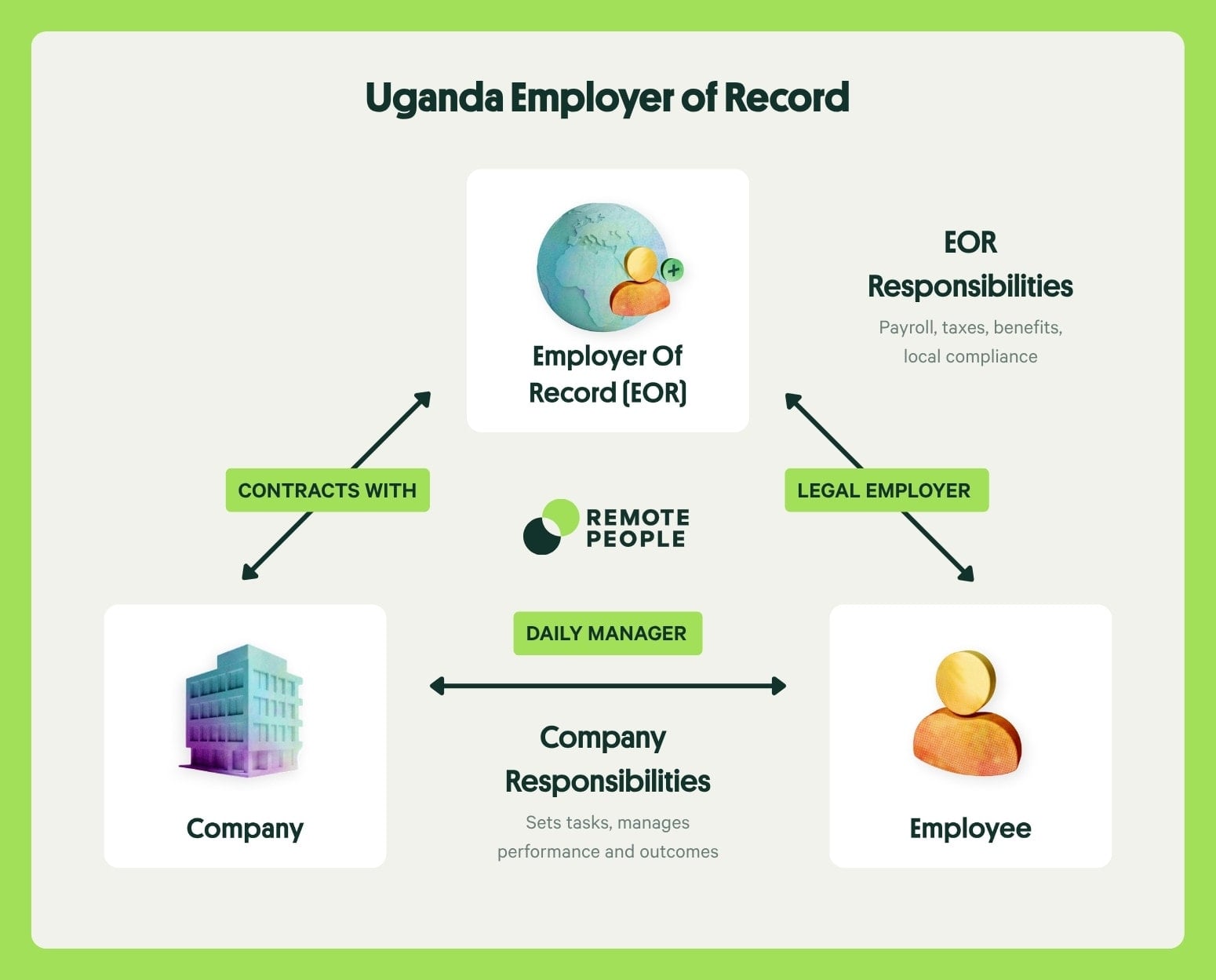
Who Uses an EOR in Uganda?
An EOR lets you hire employees in Uganda without setting up a local company. Common use cases include:
- Market testing: Companies exploring the Ugandan market can hire a small team through an EOR to validate demand before committing to a full entity registration with the Uganda Registration Services Bureau, which typically takes 2 to 3 months and costs several thousand US dollars in registration, legal, and tax set-up fees.
- Small remote teams: Businesses that need 1 to 15 employees in Uganda generally find that a per-employee EOR fee is far cheaper than maintaining a local subsidiary, which carries fixed annual audit, tax, and compliance costs regardless of headcount.
- Fast onboarding: When a company needs to bring a Ugandan hire on board within 1 to 2 weeks, an EOR can execute a compliant employment contract and begin payroll processing immediately, compared to the months required for incorporation and URA registration.
- Foreign national hiring: Companies hiring non-Ugandan workers who require work permits benefit from the EOR’s ability to act as the local sponsor and manage immigration filings with the Directorate of Citizenship and Immigration Control.
The flexibility to scale headcount up or down without unwinding a legal entity makes an EOR particularly useful for project-based engagements, regional expansions across East Africa, and companies in early-stage growth.
Typical Onboarding Timeline
Most EOR providers can onboard an employee in Uganda within 1 to 2 weeks. The sequence is:
First, the EOR agreement is signed and employee details are submitted, which typically takes 1 to 2 days. Second, the employment contract is drafted in line with the Employment Act 2006 and signed by both parties over 2 to 3 days. Third, the employee is registered with NSSF and URA, usually completed in 2 to 3 days. Fourth, payroll is set up and the first pay cycle is prepared over 1 to 2 days. Fifth, the employee goes live on payroll from their agreed start date.
If the hire is a foreign national requiring a work permit, the timeline extends by 4 to 8 weeks for processing at the Directorate of Citizenship and Immigration Control. Security vetting, document legalisation, and background checks are the most common causes of delay.
Hire in Uganda
The Pearl of Africa with NSSF contributions, Ugandan Employment Act, and an emerging Kampala tech scene.
We handle employment contracts, payroll, social contributions, and full Ugandan compliance.
No local entity needed. Your team can start in days.
Employment Laws and Regulations in Uganda
Employment Contracts
Employment in Uganda is governed primarily by the Employment Act 2006, administered by the Ministry of Gender, Labour and Social Development. A written contract is required for any engagement of six months or longer, or for work outside the employee’s ordinary place of residence (Section 25 of the Act). The contract must be provided within twelve weeks of the start of employment and must include the parties’ names, the date of commencement, job title and duties, place of work, hours of work, wage rate and payment intervals, leave entitlements, notice provisions, and the contract duration (indefinite, fixed-term, or task-based). Contracts are typically drafted in English, which is Uganda’s official language. Indefinite contracts are the default and continue until terminated by proper notice. Fixed-term and task contracts end automatically at the agreed date or completion of the task, though repeated renewals can give rise to an expectation of permanence.
Working Hours and Overtime
Standard working hours in Uganda are capped at 8 hours per day and 48 hours per week under Section 53 of the Employment Act 2006. Employers and employees may agree on a longer workweek provided the average over any three-week period does not exceed 48 hours per week. Every worker is entitled to a daily rest break and at least 24 consecutive hours of rest per seven-day period. Overtime is permitted but must be compensated at a premium, and any work on a gazetted public holiday attracts a double-time rate.
Uganda overtime and premium pay rates · Per Employment Act 2006 | |||
Hour Type | Rate Multiplier | Weekly/Daily Cap | Notes |
|---|---|---|---|
Weekday overtime | 1.5x normal hourly rate | Beyond 48 hours/week | Applies to hours exceeding the statutory 8/day or 48/week |
Public holiday work | 2x normal hourly rate | No statutory cap | Per Section 53(5) of the Employment Act 2006 |
Weekly rest day work | 1.5x normal hourly rate | No statutory cap | Employee still entitled to a substitute 24-hour rest period |
Night shift (regular, non-overtime) | No statutory premium | 48 hours/week | Collective agreements or contracts may provide a shift allowance |
Managerial and confidential staff | Exempt from overtime | Not applicable | Exemption must be stated in the contract and reflect genuine authority |
Source: Employment Act 2006 (ULII) and PwC Uganda Tax Summary | |||
Overtime pay is calculated on the employee’s basic hourly rate, which is derived from the contractual monthly wage divided by the monthly hours worked. There is no statutory monthly cap on overtime hours, but employers must respect the weekly rest-day entitlement and the 48-hour weekly average. Managers and employees in positions of trust may be exempted from overtime provisions, though this exemption must be stated in the contract and must reflect actual authority over other staff, not merely a senior title. Uganda does not mandate a 13th month salary, so overtime does not feed into any end-of-year bonus formula.
Minimum Wage
Uganda’s statutory minimum wage is set at UGX 6,000 per month by the Minimum Wages Advisory Boards and Wages Councils Act (Cap 164) and related Statutory Instruments. This figure has not been adjusted since 1984 and is universally considered obsolete. Parliament passed a new Minimum Wage Bill in 2019, but it did not receive presidential assent. In practice, wages in Uganda are market-determined, with minimum wage benchmarks in Uganda set by employer associations, collective bargaining agreements in specific sectors, and the informal Kampala market floor. For EOR hires, monthly gross salaries for office-based professional roles typically start around UGX 1,000,000 to UGX 1,500,000 and rise with experience. Employers must also respect sector-specific wage schedules where they exist, such as for security guards, hotel workers, and public service categories.
Probation Period
A probation contract under Section 67 of the Employment Act 2006 may last up to six months. The parties may, by written agreement, extend probation once by a further six months, making the maximum probation period twelve months where an extension is agreed. During probation either party may terminate the contract by giving at least 14 days’ written notice, or by paying 14 days’ wages in lieu of notice. Severance allowance does not accrue during the probationary period, and continuous service for leave and severance purposes is counted from the end of probation where a probation contract is used.
Leave Entitlements
Uganda’s Employment Act 2006 sets a statutory floor for annual, sick, maternity, paternity, and public holiday leave. Each category has its own accrual rules, pay treatment, and documentation requirements. Employers may offer more generous terms through employment contracts or collective agreements.
Annual Leave
Every employee is entitled to at least 21 working days of paid annual leave per year (Section 54 of the Employment Act 2006). Entitlement accrues at 1.75 working days per month of continuous service and is paid at the employee’s normal wage rate. Leave must be taken in the 24 months following accrual and may not be commuted to cash while employment continues, except on termination where accrued but untaken leave is paid out.
Sick Leave
After one month of continuous service, an employee is entitled to sick leave on full pay for up to one month. If illness continues beyond that, the employer may terminate the contract by giving the notice required under the Act. A medical certificate from a registered medical practitioner is required to claim sick pay (Section 55). The employer bears the full cost of sick pay; there is no separate sickness benefit reimbursement from NSSF for short-term illness.
Maternity Leave
Female employees are entitled to 60 working days of maternity leave, of which at least four weeks must be taken immediately after delivery (Section 56 of the Employment Act 2006). Maternity leave is paid at the employee’s full wage rate by the employer; there is no state reimbursement. An employer may not terminate an employee’s contract on the grounds of pregnancy or because she is on maternity leave. The employee must give at least seven days’ notice of intention to return to work, and is entitled to return to her former job or a reasonably suitable alternative at the same pay.
Paternity Leave
Male employees are entitled to 4 working days of paternity leave on the birth of a child or the miscarriage of the employee’s lawful wife (Section 57 of the Employment Act 2006). Paternity leave is paid at the employee’s full wage rate by the employer. There is no minimum service requirement.
Other Statutory Leave
The Act does not separately mandate bereavement, marriage, or study leave, although most Ugandan employers grant a few days of compassionate leave on the death of a close relative as a matter of practice. Employees are entitled to paid time off on all gazetted public holidays under the Public Holidays Act. Employees called up for jury service, trade union duties, or to give evidence in court are entitled to unpaid leave and may not be disciplined for the absence. Any additional leave categories (study, volunteer, sabbatical) are typically handled through company policy or collective bargaining agreements.
Under the Employment Act 2006, Uganda’s leave framework covers five core categories of statutory leave plus gazetted public holidays. The table below summarises each entitlement, including duration, pay treatment, and eligibility conditions. The most notable feature is that both maternity leave and sick leave are employer-funded in full, with no NSSF reimbursement for short-term absences.
Uganda statutory leave entitlements · Per Employment Act 2006 | ||
Leave Type | Duration | Eligibility & Notes |
|---|---|---|
Annual leave | 21 working days per year | Accrues at 1.75 days/month; full pay; cashable only at termination |
Sick leave | Up to 1 month | After 1 month of service; full pay; medical certificate required |
Maternity leave | 60 working days | Full pay; employer-funded; at least 4 weeks post-delivery; no minimum service |
Paternity leave | 4 working days | Full pay; employer-funded; on birth of a child or miscarriage; no minimum service |
Public holiday leave | 14 gazetted days in 2026 | Paid day off; work on a public holiday attracts double time |
Compassionate / bereavement leave | Not statutory | Commonly 3 to 5 days at employer discretion or per CBA |
Jury duty / witness leave | Duration of summons | Unpaid; no disciplinary action permitted for the absence |
Source: Employment Act 2006 (ULII) and PwC Uganda Tax Summary | ||
Statutory Employee Benefits
Beyond leave and income tax, Ugandan employers must provide a narrow set of mandatory benefits tied to social security, workplace safety, and occupational injury. The statutory stack is lighter than in many neighbouring economies, which shifts some benefit expectations onto the private insurance market:
The National Social Security Fund requires every employer with five or more employees to register and remit a 10% employer and 5% employee contribution on gross wages each month, with monthly returns filed on the NSSF online portal. Workers’ compensation sits outside NSSF and is met through a private insurance policy under the Workers’ Compensation Act 2000, with premiums typically between 0.5% and 2% of payroll depending on occupational risk.
Occupational safety and health falls under the Occupational Safety and Health Act 2006 and the Department of Occupational Safety and Health, requiring risk assessments, workplace safety committees for larger workplaces, and reporting of serious accidents. Medical insurance is not statutory but is standard in professional roles in Kampala, with mid-tier plans from providers such as IAA, UAP, Prudential, and Sanlam costing USD 300 to USD 800 per employee per year. Group life cover is typically a small add-on, often around 1% of annual salary, and is increasingly expected for senior hires.
See the contribution tables in Section 4 below for the exact NSSF rates, thresholds, and filing deadlines that apply to every payroll cycle.
Recent Regulatory Updates (2026)
Uganda’s 2022 Employment (Amendment) Act introduced a statutory severance allowance payable at the rate of one month’s wages per completed year of service, replacing the open-ended discretion that had applied under the original 2006 Act. The amendment also clarified probation rules and strengthened protection against termination during maternity leave. For 2026, the Ministry of Gender, Labour and Social Development has continued its review of the Minimum Wage Bill, but no new minimum wage has been gazetted and the 1984 figure of UGX 6,000 remains the only statutory floor (PwC Uganda Tax Summary).
On the tax side, the Uganda Revenue Authority maintains the current PAYE bracket structure unchanged from financial year 2023/24, with a top marginal rate of 40% on monthly income above UGX 10,000,000 after the first UGX 10,000,000 is taxed at 30%. The Data Protection and Privacy Act 2019 and its 2021 regulations remain in force and impose specific obligations on employers acting as data controllers for employee personal data, including registration with the Personal Data Protection Office. Employers hiring foreign nationals should also note ongoing digitisation of work permit applications through the Directorate of Citizenship and Immigration Control’s e-immigration portal, which has shortened typical processing windows for most work permit classes.
Work Permits and Visas in Uganda
Work Permit Requirements
Who Needs a Work Permit
All non-Ugandan nationals must hold a valid work permit before taking up paid employment in Uganda, regardless of nationality. East African Community citizens from Kenya, Tanzania, Rwanda, Burundi, and South Sudan benefit from simplified procedures under the EAC Common Market Protocol but still require a work permit category that matches their role. Spouses of Ugandan citizens and holders of dependant passes may apply for a Special Pass permitting employment while their formal work permit is processed.
Eligibility and Required Documents
Applications are submitted to the Directorate of Citizenship and Immigration Control and typically require a passport valid for at least 12 months, a signed employment contract with the Ugandan employer or EOR, academic and professional qualifications, a curriculum vitae, a recent medical report, a Uganda Police Interpol clearance, a yellow fever vaccination certificate, and recent passport photographs. Employers must demonstrate that the role cannot reasonably be filled by a qualified Ugandan, which usually requires evidence of advertisement and interview processes.
Processing Time and Validity
Standard processing times range from 4 to 8 weeks from the date of submission, though straightforward applications through the Directorate of Citizenship and Immigration Control e-immigration portal can resolve more quickly. Work permits are generally issued for one or two years initially, with Class G investors typically receiving three-year permits. A Special Pass of up to three months may be issued while a full permit is processed, giving the foreign hire lawful status to start work earlier.
Renewal Process
Renewals should be filed at least 30 days before expiry. The renewal application requires the same documents as the initial permit plus tax clearance from the URA showing PAYE compliance for the period of the prior permit. Employees may continue working during a renewal that was filed on time; late filings can require a Special Pass to bridge the gap and may attract penalties.
Common Visa Types for Foreign Workers
Work permits in Uganda are organised by classes A through G. The class is determined by the purpose of the stay, not by the nationality of the applicant. The Directorate of Citizenship and Immigration Control issues permits and an EOR can sponsor most classes where the underlying role is a standard employment relationship rather than an investment or religious mission.
Uganda work visa types for foreign workers · 2026 | ||||
Visa Type | Duration | Best For | Leads to APT? | Processing |
|---|---|---|---|---|
Class A (Government officials) | Term of assignment | Diplomats, government-appointed personnel | No | Handled via diplomatic channels |
Class B (Agriculture / mining) | Up to 2 years, renewable | Investors in agriculture, forestry, or mining | Yes, after 10 years | 4 to 8 weeks |
Class D (Business / trade) | Up to 2 years, renewable | Foreign investors and business owners | Yes, after 10 years | 4 to 8 weeks |
Class F (Manufacturing) | Up to 2 years, renewable | Foreign investors in manufacturing | Yes, after 10 years | 4 to 8 weeks |
Class G1 (Employees) | Up to 2 years, renewable | Foreign employees of private companies and NGOs | Yes, after 10 years | 4 to 8 weeks |
Class G2 (Missionaries / NGO) | Up to 2 years, renewable | Missionary and NGO staff | Yes, after 10 years | 4 to 8 weeks |
Special Pass | Up to 3 months | Bridging pass while full permit is processed | No | 1 to 3 weeks |
Tourist, transit, and student visas do not permit paid employment. Foreign nationals holding those visas must exit and re-enter under a work permit class before starting paid work. The following categories are explicitly non-work:
- Tourist visa: Up to 90 days, no employment permitted.
- Business visa: Short-term visits only; suitable for meetings but not paid work.
- Student pass: For full-time study; limited vacation work only with Ministry of Internal Affairs approval.
- Dependant pass: For spouses and minor children of permit holders; requires a separate Special Pass or work permit to engage in paid employment.
How an EOR Handles Work Permits
An EOR in Uganda acts as the local employer of record and therefore the sponsor on the work permit application. The EOR prepares the employer-side documents (company certificate of registration, URA tax clearance, letter of support, and justification that the role requires a foreign hire) and files the application through the e-immigration portal. The employee supplies the personal documents listed above. Because work permits extend the onboarding timeline by 4 to 8 weeks, the EOR typically applies for a Special Pass in parallel so that the employee can begin work lawfully within 2 to 3 weeks of contract signing. An EOR can sponsor Class G1 (employee) permits, which cover the majority of foreign professional hires, but cannot sponsor investor classes (B, D, F) where the permit is tied to the foreign national’s personal investment rather than employment.
Payroll, Taxes, and Social Security in Uganda
Employer Contributions
Ugandan employers fund a single statutory social security contribution, the National Social Security Fund, plus compulsory workers’ compensation insurance purchased from a commercial insurer. The table below lists the only statutory employer cost levied on gross wages. Workers’ compensation premiums are separately quoted by the underwriter and vary by risk class.
Uganda employer social security contributions · 2026 rates | ||
Component | Rate | Notes |
|---|---|---|
National Social Security Fund (NSSF) | 10% of gross monthly wages | Mandatory for employers with 5+ employees; remitted by 15th of following month |
Workers’ compensation insurance | Commercial premium (typically 0.5% to 2%) | Per Workers’ Compensation Act 2000; purchased from a licensed Ugandan insurer |
Total statutory employer cost | ≈ 10% to 12% of gross wages | NSSF 10% plus variable workers’ compensation premium |
Source: NSSF Uganda and PwC Uganda Tax Summary | ||
Employee Contributions
Ugandan employees fund their share of the National Social Security Fund and, where applicable, pay the Local Service Tax levied by their municipality. PAYE income tax is covered separately in the next section. The table below summarises the deductions the employer must withhold every month on behalf of the employee.
Uganda employee payroll deductions · 2026 monthly withholdings | ||
Withholding | Rate | Notes |
|---|---|---|
NSSF employee share | 5% of gross monthly wages | Withheld and remitted with employer 10% share |
PAYE income tax | Progressive (0% to 40%) | See brackets in next table; remitted to URA by 15th of following month |
Local Service Tax (LST) | UGX 5,000 to UGX 100,000 per year | Tiered by monthly wage; withheld in instalments between July and December |
Total employee withholdings | NSSF 5% + PAYE (progressive) + LST | LST is capped at UGX 100,000 per annum regardless of earnings |
Source: Uganda Revenue Authority and NSSF Uganda | ||
Income Tax
Individual income tax in Uganda is collected through the Pay As You Earn (PAYE) system administered by the Uganda Revenue Authority under the Income Tax Act Cap 340. Resident individuals are taxed on a progressive scale that applies to each calendar month of chargeable income, and employers are required to deduct the tax at source. Non-residents are taxed on their Uganda-source income at a flat 15% rate on monthly income up to UGX 335,000 and on the same progressive rates above that threshold.
Uganda income tax brackets · 2026 | |
Monthly chargeable income (UGX) | Tax calculation |
|---|---|
0 – 235,000 | Nil |
235,001 – 335,000 | 10% of the amount exceeding UGX 235,000 |
335,001 – 410,000 | UGX 10,000 plus 20% of the amount exceeding UGX 335,000 |
410,001 – 10,000,000 | UGX 25,000 plus 30% of the amount exceeding UGX 410,000 |
Above 10,000,000 | UGX 2,902,000 plus 40% of the amount exceeding UGX 10,000,000 |
Payroll Cycle
Uganda’s standard payroll cycle is monthly, with wages paid in arrears and in Ugandan shillings. The Employment Act 2006 requires that wages be paid at intervals not exceeding one month unless expressly agreed in the contract, and directly to the employee by bank transfer or mobile money. Each employee must receive an itemised pay statement showing gross wages, each statutory deduction, and net pay. PAYE and NSSF must both be remitted by the 15th of the following month; late payment attracts interest and penalties. Annual PAYE returns to the URA are due by 30 September each year for the previous financial year ending 30 June.
13th Month Salary and Bonus Pay
Uganda does not mandate a 13th month salary or any equivalent annual bonus. The Employment Act 2006 is silent on end-of-year bonuses, and there is no statutory vacation allowance. Any bonus or incentive scheme is a matter of contract and company policy. Where a contractual bonus exists, it is fully taxable under PAYE in the month it is paid. Long-service payments, commissions, and discretionary bonuses are likewise treated as employment income subject to full PAYE and NSSF withholding.
Cost of Hiring Through an EOR in Uganda
EOR Service Fees
Most reputable EOR providers charge between $299 and $599 per employee per month for Uganda, either as a flat monthly fee or as a percentage of gross payroll. Flat-fee models are usually the clearer option for budgeting because they decouple the EOR cost from salary levels. The fee typically covers employment contracts, payroll processing, PAYE and NSSF filing, payslip issuance, benefits administration, leave tracking, and ongoing labour-law support. Work permit applications, background checks, and supplementary benefits are usually charged separately as pass-through costs.
Total Employment Cost Breakdown
The example below shows the fully loaded cost of employing a Ugandan professional at a gross monthly salary of USD 2,000. Figures are converted at an exchange rate of 1 USD ≈ 3,800 UGX as of April 2026. The example assumes an employer with five or more employees, triggering the mandatory NSSF obligation, and a workers’ compensation premium at the midpoint of typical rates.
Uganda employer cost example · USD 2,000 gross · 2026 | ||
Line Item | Amount (USD) | % of Gross |
|---|---|---|
Gross monthly salary | $2,000.00 | 100.00% |
NSSF employer contribution (10%) | $200.00 | 10.00% |
Workers’ compensation insurance (≈1%) | $20.00 | 1.00% |
EOR service fee (flat monthly) | $399.00 | 19.95% |
Total employer cost | $2,619.00 | 130.95% |
Source: NSSF Uganda and PwC Uganda Tax Summary | ||
PAYE is withheld from the employee’s gross salary rather than added on top, so it is reflected in the employee’s net pay but not in the employer’s total cost. The employee’s net take-home in this example, after NSSF and PAYE at the 30% and 40% marginal rates, would be approximately USD 1,140, with the balance flowing to the URA and NSSF.
Ready to hire in Uganda? Get started with RemotePeople, a Ugandan employer of record service that handles employment contracts, payroll, PAYE and NSSF filings, and full Ugandan compliance. No local entity required.
Benefits of Using an EOR in Uganda
Foreign employers turn to an EOR in Uganda because it solves the two hardest problems of cross-border hiring at once, namely regulatory compliance and speed to market. Setting up a Uganda subsidiary involves company registration with the Uganda Registration Services Bureau, URA tax registration, NSSF enrolment, and, for many sectors, industry licensing; the same outcome through an EOR can be achieved in under two weeks. The specific benefits include:
An EOR can have an employee onboarded in 1 to 2 weeks, compared to 2 to 6 months to incorporate and operationalise a new Ugandan subsidiary, and it ensures full alignment with the Employment Act 2006, the Income Tax Act, NSSF rules, and data-protection obligations so that the foreign client does not have to track every Industrial Court ruling or regulatory amendment. For small teams of one to ten employees, using an EOR avoids the fixed overhead of a local entity, including registration fees, directors, company secretary, audited accounts, and URA tax filings, which typically adds USD 15,000 to USD 30,000 per year before salaries.
An EOR absorbs employment liability, including wrongful dismissal claims, NSSF audits, and PAYE disputes, keeping those risks off the foreign parent’s balance sheet. It also handles the Class G1 work permit process end to end for foreign hires, coordinating with the Directorate of Citizenship and Immigration Control, and keeps contracts, policies, and payroll aligned with Ugandan norms around leave, overtime, terminal benefits, and private medical insurance. When hiring plans change, the EOR can scale from one employee to twenty without any change in legal structure, and can offboard within the statutory notice period, which suits project-based or growth-stage teams in particular.
For most foreign companies hiring one to fifteen employees in Uganda, these advantages make an EOR the clearly cheaper and faster route than setting up a local entity or trying to run a compliant payroll from abroad.
Termination and Offboarding in Uganda
Notice Periods
Statutory notice in Uganda is set by Section 58 of the Employment Act 2006 and scales with the employee’s length of continuous service. Notice applies equally to employer-initiated and employee-initiated terminations, and may be paid in lieu at the employer’s discretion. The statutory floor may be improved by contract or collective bargaining agreement but not reduced.
Uganda statutory notice periods by position level · Per Employment Act 2006 | |||
Length of service | Notice period | During probation | Notes |
|---|---|---|---|
Less than 6 months | Not less than 2 weeks | 14 days under Section 67 | Probation and short service: 14 days; calendar days |
6 months to less than 1 year | 1 month | Not applicable | Calendar months |
1 year to less than 5 years | 2 months | Not applicable | Calendar months; applies to indefinite contracts |
5 years to less than 10 years | 2 months | Not applicable | Calendar months |
10 years or more | 3 months | Not applicable | Calendar months |
Source: Employment Act 2006 (ULII) and PwC Uganda Tax Summary | |||
Summary dismissal without notice is permitted only for gross misconduct after a fair hearing, in line with Sections 69 and 66 of the Act. Termination by mutual agreement, expiry of a fixed-term contract, and expiry of a task contract do not require a notice period, although the employee remains entitled to any accrued leave pay and severance where applicable. Employers who dismiss unfairly expose themselves to Industrial Court reinstatement orders and compensation of up to 12 months’ wages.
Severance Pay
Severance allowance is mandatory under Sections 87 to 89 of the Employment Act 2006, as amended by the Employment (Amendment) Act 2022. An employee with at least six months of continuous service is entitled to severance where the employer terminates the contract for any reason other than gross misconduct, or where termination results from the death or insolvency of the employer. The 2022 amendment set the severance rate at one month of wages for every completed year of service, providing a clear statutory floor that replaced earlier ministerial discretion.
Uganda severance pay schedule by years of service · Per Employment Act 2006 | |||
Years of service | Severance amount | Base salary | Notes |
|---|---|---|---|
Less than 6 months | Nil | Not applicable | No severance entitlement; employee still receives accrued leave pay |
1 year | 1 month of wages | Last gross monthly wage | Includes basic wage and regular allowances |
3 years | 3 months of wages | Last gross monthly wage | Pro-rata for completed months of the partial final year |
5 years | 5 months of wages | Last gross monthly wage | Paid within 30 days of termination |
10 years | 10 months of wages | Last gross monthly wage | No statutory cap on total severance |
Source: Employment Act 2006 (ULII) and PwC Uganda Tax Summary | |||
Calculation Method
The statutory formula is one month of the employee’s last gross wages for each completed year of service, calculated on the cash wage including regular allowances such as housing, transport, and any guaranteed bonuses (see Table 13 for worked examples). Partial years are pro-rated on a monthly basis. Discretionary bonuses, overtime, and one-off payments are excluded from the base unless paid regularly enough to form part of the ordinary wage. The NSSF employer contribution is not itself part of the severance base.
Caps and Exceptions
There is no statutory maximum on severance, which is unusual in the East African region. Severance is not payable where the employee resigns without good cause, is summarily dismissed for gross misconduct following a fair hearing, or reaches retirement age where the contract provides for retirement as the trigger. Fixed-term and task contracts do not attract severance at their natural expiry, unless the employer terminates the contract early without cause. Severance payments are treated as employment income and are fully subject to PAYE, though some genuine long-service payments may qualify for modest tax relief under Income Tax Act Section 19.
Grounds for Termination
Termination in Uganda must be for a valid reason and follow a fair procedure. Section 66 of the Employment Act requires the employer to inform the employee of the reason, to allow the employee to be heard, and, where applicable, to permit representation by a fellow employee or union official. Valid reasons include poor performance, gross misconduct, redundancy, operational requirements, and incapacity. Termination that is discriminatory, retaliatory for whistleblowing, or linked to pregnancy, trade union activity, or maternity leave is automatically unfair. Employees who believe they have been unfairly dismissed may file a complaint with a labour officer and, on appeal, with the Industrial Court, which can award reinstatement, re-engagement, or compensation of up to 12 months’ wages.
EOR vs. Other Hiring Models in Uganda
EOR vs. Setting Up a Local Entity
For companies hiring more than fifteen employees in Uganda, or entering government tenders and regulated sectors, a local subsidiary is usually necessary. For smaller teams, the EOR route is faster, cheaper, and far easier to unwind if plans change. The comparison below captures the main decision factors.
Uganda EOR vs local entity comparison · Setup time, cost, risk and best-fit | ||
Factor | Employer of Record | Own Entity |
|---|---|---|
Setup time | 1 to 2 weeks | 2 to 3 months |
Upfront cost | $0 | $5,000 to $15,000 (URSB, legal, tax set-up) |
Ongoing cost | $299 to $599 per employee per month | $10,000 to $25,000 per year in audit, accounting, and compliance |
Local partner required | No (EOR is the local entity) | No, but local resident director often required in practice |
Social insurance registration | Handled by EOR | You manage NSSF, URA, URSB, and sector licences |
Payroll and tax filing | Handled by EOR | You manage it (or outsource to a local payroll provider) |
Best for team size | 1 to 15 employees | 15+ employees |
Scale down or exit | Easy; no entity to unwind | Costly; URSB deregistration, URA tax clearance, NSSF closure |
Government contracts | Not eligible | Eligible (requires local entity and tax clearance) |
A local entity makes sense when Ugandan operations are mature, when the business plans to bid for public-sector contracts, or when the company wants direct signage, licensing, and banking relationships in its own name. An EOR fits early-stage expansion, testing product-market fit in East Africa, and situations where legal and operational risk must sit with a specialist rather than with the foreign headquarters. A hybrid model is common, with an EOR bridging the first 12 to 18 months while the entity registration proceeds in parallel, then employees being migrated once the entity is fully operational and tax-registered.
EOR vs. Hiring Independent Contractors
Hiring Ugandan contractors can look cheaper on paper because there are no NSSF, PAYE, or leave obligations for a true independent contractor. In practice, Ugandan tax and labour law uses a substance-over-form test that looks at control, integration, tools, and economic dependence. A wrongly classified contractor can trigger URA PAYE reassessments, NSSF arrears, severance, and Industrial Court claims.
Uganda EOR vs independent contractors · Compliance, cost, and risk | ||
Factor | EOR (Full-Time Employee) | Independent Contractor |
|---|---|---|
Legal relationship | Employee of the EOR | Self-employed; no employment relationship |
Compliance risk | Low; EOR ensures Employment Act 2006 compliance | High; misclassification risk under URA and Industrial Court tests |
Payroll and tax | EOR withholds PAYE, NSSF, and LST | Contractor invoices and handles own income tax and VAT |
Benefits and leave | Statutory leave, NSSF, medical cover | No entitlement to employee benefits |
IP protection | Stronger; employment contract assigns IP by default | Weaker; requires an explicit written IP assignment clause |
Termination | Subject to statutory notice and severance | Contract can be ended per the agreement terms |
Best for | Long-term core team roles | Short-term projects and specialised tasks |
Cost structure | Salary + employer contributions + EOR fee | Contractor fee (often higher gross, lower total cost) |
Source: Employment Act 2006 (ULII) and Uganda Revenue Authority | ||
Misclassification is a real and growing risk in Uganda. The Industrial Court has consistently reclassified long-term contractors as employees when the facts show control over working hours, integration into a team, and economic dependence on a single client. A reclassification generates back-dated PAYE, NSSF arrears with penalties, accrued leave, and potential severance. For roles that are full-time, ongoing, and integrated into the company’s operations, the EOR route is the safer structure. True contractor engagements should be limited to project-based, outcome-based work with genuine autonomy over how and when the work is done. If you need contractors rather than employees, RemotePeople offers a compliant contractor of record option that keeps the relationship correctly classified.
EOR vs. PEO (Professional Employer Organization)
A Professional Employer Organization, or PEO, is an HR outsourcing model built around a co-employment relationship. In Uganda, PEO is not a separately regulated concept and PEO-style services are offered by HR consultancies to companies that already operate a local entity. An EOR, by contrast, becomes the legal employer itself and removes the need for a Ugandan subsidiary.
Uganda EOR vs PEO comparison · Legal employer, liability, and setup | ||
Factor | Employer of Record (EOR) | PEO |
|---|---|---|
Legal employer | EOR is the legal employer | You remain the legal employer (co-employment) |
Local entity required | No, the EOR is the local entity | Yes; you must have your own entity in Uganda |
Best for | Companies without a Ugandan entity | Companies that already have a Ugandan entity |
Compliance liability | EOR assumes compliance responsibility | Shared liability between you and the PEO |
Setup time | 1 to 2 weeks | Depends on your entity setup (weeks to months) |
Control over HR policies | EOR manages within Ugandan law framework | More direct control; PEO advises |
Typical use case | Market entry, small remote teams, testing new markets | Established Ugandan operations needing HR outsourcing |
The key practical difference is the legal employer. Because there is no dedicated PEO statute in Uganda, a co-employment model does not provide the clean risk transfer that a PEO offers in jurisdictions like the United States. For foreign companies without a subsidiary in Uganda, an EOR is almost always the correct starting point; a PEO only makes sense once a local entity already exists and the business wants to outsource HR administration rather than the legal employer role.
Public Holidays in Uganda
Uganda observes fourteen gazetted public holidays in 2026 under the Public Holidays Act. When a public holiday falls on a Sunday, the following Monday is typically treated as the public holiday for the purposes of employment. Work performed on a gazetted holiday attracts a double-time rate under Section 53(5) of the Employment Act 2006.
Uganda public holidays · 2026 calendar year | ||
Date | Holiday | Type |
|---|---|---|
1 January 2026 | New Year’s Day | Public |
26 January 2026 | NRM Liberation Day | National |
16 February 2026 | Archbishop Janani Luwum Day | National |
8 March 2026 | International Women’s Day | National |
20 March 2026 | Eid al-Fitr (subject to moon sighting) | Religious (Islamic) |
3 April 2026 | Good Friday | Religious (Christian) |
6 April 2026 | Easter Monday | Religious (Christian) |
1 May 2026 | Labour Day | Public |
27 May 2026 | Eid al-Adha (subject to moon sighting) | Religious (Islamic) |
3 June 2026 | Martyrs’ Day | Religious |
9 June 2026 | National Heroes Day | National |
9 October 2026 | Independence Day | National |
25 December 2026 | Christmas Day | Religious (Christian) |
26 December 2026 | Boxing Day | Religious (Christian) |
Source: timeanddate.com and Public Holidays Act, Cap 255 (ULII) | ||
Eid al-Fitr and Eid al-Adha dates are confirmed by moon sighting and may shift by one day from the indicative dates above. Payroll schedules should account for the clustering of Easter, Martyrs’ Day, and Heroes Day in the April to June window, which can compress monthly production outputs for teams with standard working-week contracts. Employees on shift work and in continuous-process operations who work through a gazetted holiday must be paid at double the normal hourly rate and given a substitute rest day within the same payroll cycle.
How to Get Started with an EOR in Uganda
Getting started with a Ugandan EOR is a structured process that, in most cases, can be completed within 10 working days from first contact to first payslip:
First, define the role and compensation. Confirm the job title, duties, target gross monthly salary in UGX or USD, any allowances (transport, airtime, medical), and the start date. The EOR will benchmark the package against Kampala and upcountry market rates and flag any Employment Act 2006 issues at this stage. Second, sign the EOR service agreement. The foreign company and the EOR execute a master services agreement covering fees, scope, data protection (aligned with Uganda’s Data Protection and Privacy Act 2019), and termination terms, typically completed in 1 to 2 business days.
Third, complete employee onboarding and contracts. The EOR drafts a Ugandan-law employment contract, collects KYC documents, tax identification details, and NSSF membership number, and runs any background checks required, with the employee signing the contract usually within 2 to 3 business days. Fourth, the EOR files the statutory registrations with the Uganda Revenue Authority, NSSF, and the relevant local authority for Local Service Tax, and enrols the employee in any private medical insurance scheme offered as part of the package. Fifth, the employee goes live on payroll, the first payroll cycle runs at month-end, and PAYE and NSSF filings are submitted by the 15th of the following month, with ongoing support covering monthly payslips, annual PAYE returns, leave tracking, benefits administration, and any amendments or terminations that arise.
Ready to hire in Uganda? Talk to RemotePeople about your Uganda hiring plans. We handle contracts, payroll, PAYE and NSSF filings, and full Ugandan compliance so you can focus on running the business, not the bureaucracy.
Where companies hiring in Uganda expand next
Hiring in Uganda frequently leads to recruitment across East Africa’s English-speaking cluster and the wider Indian Ocean corridor. Common expansion paths include hiring in Ethiopia (aligned East African English-first hiring profile) and an EOR partner in Kenya (shared East African workforce norms). Teams scaling further usually add Tanzania for overlapping East African talent profile, with a team in Rwanda extending coverage through the regional East African talent pool.
Frequently Asked Questions About EOR in Uganda
EOR service fees for Uganda typically range from $299 to $599 per employee per month. On top of that, the employer funds a 10% NSSF contribution on gross wages (NSSF Uganda) and a workers' compensation insurance premium of roughly 0.5% to 2% of payroll. PAYE and the 5% NSSF employee share are withheld from the employee's gross salary per the Uganda Revenue Authority schedules.
A Ugandan citizen or resident can typically be onboarded in 1 to 2 weeks, covering contract drafting, NSSF and URA registration, and payroll setup under the Employment Act 2006 (ULII). For foreign nationals who need a work permit, the full process extends to 6 to 10 weeks via the Directorate of Citizenship and Immigration Control, although a Special Pass can allow the employee to start work within 2 to 3 weeks.
Yes. Following the Employment (Amendment) Act 2022 (ULII), severance pay in Uganda is set at one month of wages per completed year of service for employees with at least six months of continuous service, where the employer initiates termination for any reason other than gross misconduct. There is no statutory cap under the Employment Act 2006 (ULII).
No. The Employment Act 2006 (ULII) does not mandate a 13th month salary or any equivalent bonus. Any bonus scheme is voluntary and governed by the employment contract or company policy, and any bonus paid is fully subject to PAYE (Uganda Revenue Authority) and NSSF (NSSF Uganda).
Yes, for Class G1 (employee) work permits. The EOR acts as the local sponsor, prepares employer-side documents, and files the application through the Directorate of Citizenship and Immigration Control. Investor classes (B, D, F) are tied to a specific personal investment and cannot be sponsored by an EOR per Directorate of Citizenship and Immigration Control policy.
An EOR employs the worker under a Ugandan employment contract per the Employment Act 2006 (ULII), withholds PAYE and NSSF, and provides statutory leave and severance. A contractor is self-employed and handles their own taxes through the Uganda Revenue Authority. The risk with contractors is misclassification; Uganda's Industrial Court regularly reclassifies long-term contractors as employees, with back-dated PAYE, NSSF arrears, and accrued leave as the consequence. For project-based work with genuine autonomy, RemotePeople offers a compliant contractor of record option that manages the agreement, invoicing, and classification risk.
Intellectual property created by an employee in the course of their employment is assigned by default to the employer under Ugandan law per the Employment Act 2006 (ULII). In an EOR arrangement, the EOR's employment contract includes a full IP assignment clause and the EOR simultaneously assigns all IP to the client company (you) under the master services agreement, giving the client company (you) full ownership of work product, not the EOR.
The EOR service agreement can be terminated on the notice period agreed in the master services agreement, typically 30 to 60 days. If employees are to be retained, they can be migrated to a new local entity, to another EOR, or offboarded with statutory notice and severance per the Employment Act 2006 (ULII) and Employment (Amendment) Act 2022 (ULII). Because the EOR is the legal employer, there is no subsidiary to dissolve and no Uganda Revenue Authority or URSB deregistration to manage.
No. You do not need a Ugandan entity to hire employees in Uganda if you use an EOR. The EOR is already registered with Uganda Registration Services Bureau and Uganda Revenue Authority and acts as the legal employer on the contract, payroll, and statutory filings, so the foreign company can hire Ugandan employees within 1 to 2 weeks. Setting up your own subsidiary (private limited company) takes 2 to 6 months and costs USD 15,000 to USD 30,000 per year in ongoing compliance overhead, so the EOR route is usually more efficient for teams of 1 to 10 employees.
Employers in Uganda contribute 10% of each employee's gross monthly wages to the NSSF Uganda, with an additional 5% withheld from the employee's salary for a combined 15% NSSF contribution. Contributions are mandatory for all employers with 5 or more employees under the NSSF Act, and returns must be filed by the 15th of the following month. On top of NSSF, employers fund a workers' compensation insurance premium of approximately 0.5% to 2% of payroll per the PwC Uganda Tax Summary.
Uganda's statutory minimum wage is UGX 6,000 per month, set by the Minimum Wages Advisory Boards and Wages Councils Act 1957 and unchanged since 1984, although the Minimum Wage Bill 2019 that would raise it has yet to be signed into law. In practice, market-clearing wages for entry-level roles in Kampala are well above this floor, typically UGX 350,000 to UGX 600,000 per month for general staff. The Employment Act 2006 (ULII) also requires payment of statutory allowances where applicable. See the Uganda minimum wage guide for role-specific benchmarks.
PAYE in Uganda is progressive, with a tax-free threshold of UGX 235,000 per month and a top marginal rate of 40% on monthly income above UGX 10,000,000 per the Uganda Revenue Authority. Employers withhold PAYE from gross salary each month and remit it to the Uganda Revenue Authority by the 15th of the following month, along with the monthly PAYE return. The brackets are: 0% up to UGX 235,000, 10% on UGX 235,001 to 335,000, UGX 10,000 + 20% on UGX 335,001 to 410,000, UGX 25,000 + 30% on UGX 410,001 to 10,000,000, and UGX 2,902,000 + 40% above UGX 10,000,000.
Employer of Record in
Employer of Record in
Employer of Record in
Employer of Record in
Employer of Record in
Employer of Record in
Employer of Record in
Employer of Record in