
 Recruit
Employer of Record (EOR) in Kyrgyzstan
-
 Drew Donnelly
- Published
- September 22, 2026
RemotePeople’s employer of record in Kyrgyzstan lets you hire employees in Kyrgyzstan with reduced contribution rates. We handle 2.25% mandatory social security contributions, 0.25% health fund fees, and 15% pension contributions.
Hire in Kyrgyzstan — book a free 30-minute demo
Tell us what you need. You'll get a tailored, transparent proposal within 24 hours, plus a free call to walk through it.
Tell us about your company
So we can match you with a specialist who knows your market — and unlock volume pricing tiers.
* All fields are required.
Where and when are you hiring?
Tell us the geography and timing and we'll quote each country line by line, with onboarding timelines.
* All fields are required.
Help us beat your current setup
We'll benchmark your current deal and send a line-by-line proposal in 24 hours — showing exactly where we cut cost, time, or risk. After you submit, you can book a call to walk through it together.
* All fields are required.
Thanks! Your proposal is on its way.
Expect a tailored, line-by-line proposal in your inbox within 24 hours. In the meantime…
Want to walk through it together?
Book a free 30-minute call with one of our specialists. We'll explain every line, answer your questions, and tailor the proposal further if you need.
No obligation. Pick a time that works for you.








- Hire in Kyrgyzstan — book a free 30-minute demo
- Tell us about your company
- Where and when are you hiring?
- Help us beat your current setup
- Thanks! Your proposal is on its way.
- How an Employer of Record Works in Kyrgyzstan
- Employment Laws and Regulations in Kyrgyzstan
- Work Permits and Visas in Kyrgyzstan
- Payroll, Taxes, and Social Security in Kyrgyzstan
- Cost of Hiring Through an EOR in Kyrgyzstan
- Benefits of Using an EOR in Kyrgyzstan
- Termination and Offboarding in Kyrgyzstan
- EOR vs. Other Hiring Models in Kyrgyzstan
- Public Holidays in Kyrgyzstan
- How to Get Started with an EOR in Kyrgyzstan
- Frequently Asked Questions
- Related EOR Destinations

Start hiring in Kyrgyzstan
Let RemotePeople handle payroll, compliance, and HR admin worldwide so you can focus on building your team.

Kyrgyzstan’s economy expanded 13.1% in the first quarter of 2025, positioning the country as an increasingly attractive hub for remote hiring across Central Asia. An employer of record in Kyrgyzstan allows you to hire local staff without establishing a legal entity, streamlining compliance and payroll management. The Kyrgyz government enacted a new Labour Code effective January 28, 2025, which introduces electronic employment contracts, formal remote work provisions, and digital labour books that modernize hiring practices.
Using an EOR in Kyrgyzstan means your company remains operationally in control while a local partner handles employment registration, tax filing, and benefit administration. This is valuable for startups and mid-size firms entering Central Asia for the first time. The updated regulatory framework reduces administrative friction and creates clearer rules for international employers.
Here’s how EORs function in Kyrgyzstan, the current employment law landscape, work permit requirements, and what to expect when hiring your first team member. You’ll find specific tax rates, leave entitlements, overtime rules, and the revised minimum wage that took effect January 1, 2026.
How an Employer of Record Works in Kyrgyzstan
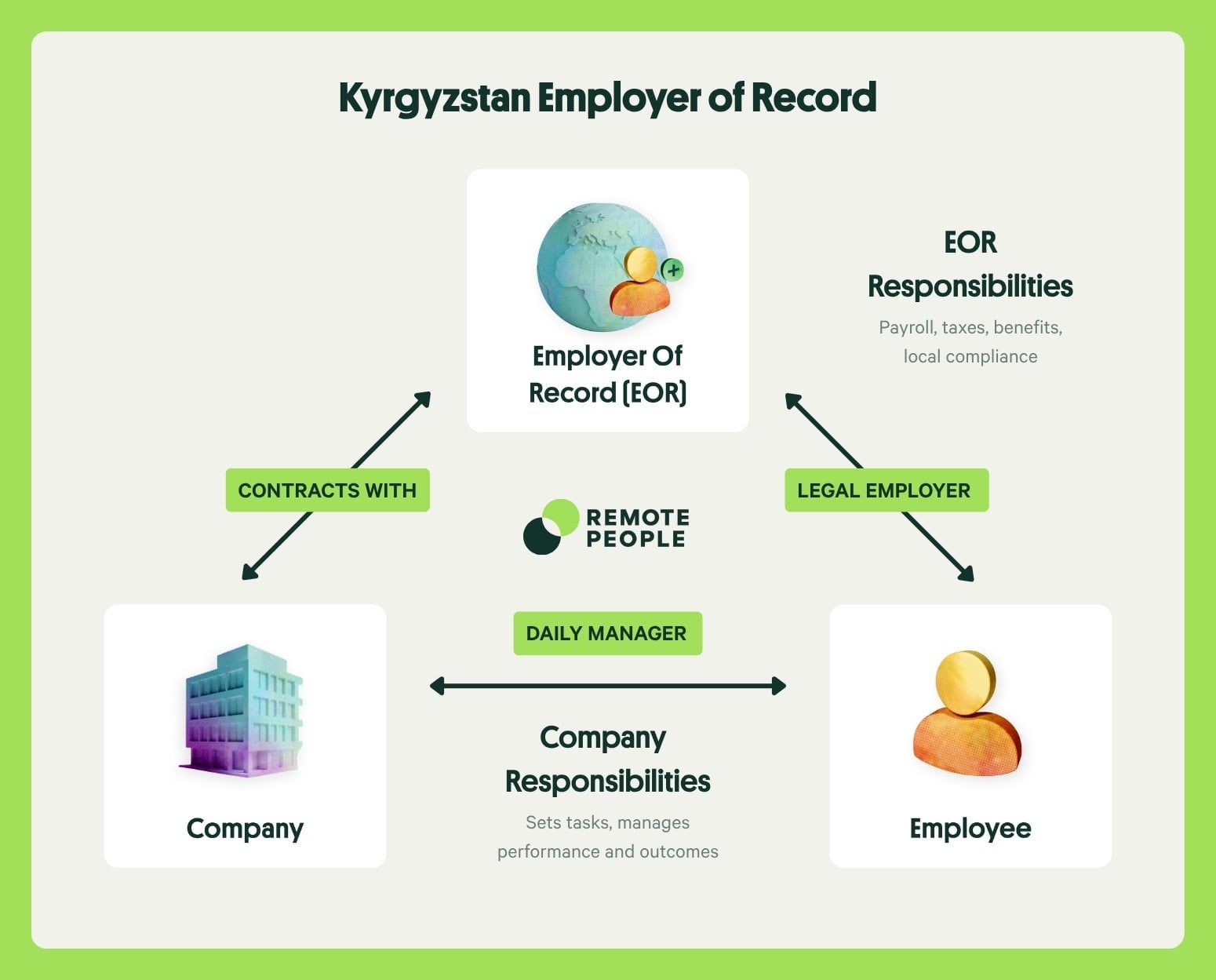
Who Uses an EOR in Kyrgyzstan?
EORs serve companies at every growth stage. Early-stage startups use them to hire their first remote operations manager or customer support representative without incorporating locally. Scaling firms bring on regional teams across Kyrgyzstan while maintaining a lean headquarters presence. Large enterprises deploy EORs to staff satellite offices or test new markets with minimal upfront investment. Professional service firms hire Kyrgyz consultants and project managers for specific client engagements, paying only for the hours worked. Companies also use EORs to expand payroll capacity during seasonal demand spikes without permanent headcount growth.
Any organization that needs Kyrgyz employees but lacks in-country infrastructure benefits from an EOR model. The approach is particularly popular among remote-first companies, software firms, and service providers that value speed and flexibility.
Typical Onboarding Timeline
Onboarding a single employee through an EOR typically requires one to two weeks. The EOR collects employment details (name, role, salary, start date) and drafts an electronic employment contract, which the employee signs digitally. Once signed, the EOR registers the employee with the Social Fund and begins payroll deductions in the following month. Bank account verification and initial tax filings follow in parallel.
Work permit processing extends this timeline by two to four weeks. If you are hiring a foreign national, the EOR files the work permit application through the Single Permit portal (evisa.e-gov.kg), requiring the candidate to submit a valid passport, medical examination results, and formal employment contract. The permit authority typically responds within 2-4 weeks. Plan for the candidate’s start date accordingly, or arrange a provisional employment contract and pre-hire orientation period while the permit is under review.
Hire in Kyrgyzstan
A flat 10% income tax, 2.25% employer social contributions, and a rapidly growing bilingual workforce make Kyrgyzstan one of Central Asia’s most cost-effective hiring destinations.
We handle employment contracts, payroll, tax withholding, and full Kyrgyzstan compliance.
No local entity needed. Your team can start in days.
Employment Laws and Regulations in Kyrgyzstan
Employment Contracts
The Kyrgyz Labour Code, signed into law in January 2025/a>, requires all employment relationships to be documented in a written contract. Contracts must be in Kyrgyz language and must detail the employee’s salary, job duties, working hours, annual leave entitlement, and social insurance arrangements. The new Code explicitly permits electronic contracts, eliminating the previous requirement for wet-ink signatures and dramatically simplifying onboarding for remote workers.
Contracts can be fixed-term (valid for up to five years) or indefinite. If a fixed-term contract expires and the employee continues working without a new agreement, the relationship automatically converts to indefinite tenure, granting the employee stronger job security and notice period protections. This conversion rule encourages employers to explicitly renew or terminate before expiration, preventing accidental indefinite employment.
Working Hours and Overtime
The standard workweek in Kyrgyzstan is 40 hours, spread across five eight-hour days. Overtime is compensated at premium rates: 150% of the regular hourly rate for the first two hours of overtime on any single day, and 200% of the regular rate for all additional hours beyond the second. The Labour Code caps daily overtime at four hours over two consecutive days, and annual overtime cannot exceed 120 hours.
Night work (22:00 to 06:00) earns a 150% premium and is conducted in seven-hour shifts instead of the standard eight. Work on weekly rest days or public holidays is compensated at 200% of regular pay, though employers may offer a compensatory day off in lieu of extra pay if the employee agrees.
Kyrgyzstan overtime and premium pay rates · Per Labour Code of the Kyrgyz Republic 2025 | |||
Hour Type | Rate Multiplier | Weekly/Daily Cap | Notes |
|---|---|---|---|
Standard weekday overtime (first 2 hours) | 150% of regular pay | 2 hours per day | Requires employee consent |
Weekday overtime (hours 3+) | 200% of regular pay | 4 hours over 2 consecutive days | Total cannot exceed 120 hours/year |
Night work (22:00â06:00) | 150% of regular pay | 8 hours per shift | Reduced to 7-hour shift |
Weekly rest day work | 200% of regular pay | Full day | Compensatory day off alternative |
Public holiday work | 200% of regular pay | Full day | Compensatory day off alternative |
Minimum Wage
Kyrgyzstan’s minimum wage increased to KGS 3,280 per month as of January 1, 2026, up from KGS 2,460 in 2025 â a 33% increase. This statutory floor applies to all employees regardless of contract type or tenure. Employers must ensure no worker earns less than this monthly amount for a standard 40-hour week, though salaries above this threshold are common in competitive labour markets.
Probation Period
New employees in Kyrgyzstan may be subject to a probation period of up to three months, during which either party can terminate the relationship with just three calendar days’ notice and without cause. Senior positions â including managers, department deputies, chief accountants, and branch heads â are entitled to a longer probation period of up to six months. Probation is prohibited for first-time workers entering their specialty immediately after completing vocational education, and for employees transferring between different geographical locations within the company.
Probation periods are optional and must be stated in the employment contract before the employee starts work. If omitted, the employee is treated as having indefinite tenure from day one. During probation, accrued leave is paid in full upon termination, and the employee receives the same statutory entitlements (health insurance, pension contributions, leave) as permanent staff.
Leave Entitlements
Annual Leave
Every employee in Kyrgyzstan is entitled to a minimum of 28 calendar days of annual leave per year, provided they have completed 11 months of continuous service. At least 14 of those days must be taken consecutively in a single block. Unused leave can be carried forward into the following year only if both the employee and employer agree in writing; otherwise, accrued vacation must be taken or forfeited annually. Accrual of leave rights begins immediately upon hire, even during any probation period.
Sick Leave
Sick leave is fully paid through the Kyrgyz Social Fund. The first ten working days of absence are reimbursed at a percentage of the employee’s average daily wage, based on tenure: 60% for those with fewer than five years of service, 80% for those with 5â7 years, and 100% for those with eight or more years. After ten working days, the Social Fund pays a fixed daily rate regardless of the employee’s salary history. A medical certificate (ÑпÑавка) is required to document sick leave, provided by a doctor or clinic.
Maternity Leave
Maternity leave totals 126 calendar days: 70 days before the expected birth date and 56 days after delivery. In cases of complications during pregnancy or childbirth, leave is extended to 140 calendar days. Multiple births (twins, triplets, etc.) qualify for 180 calendar days. The employer pays 100% of the employee’s average daily earnings for the first ten calendar days; from day 11 onward, the Social Fund pays a standardized daily rate. The employee’s job and position are fully protected during maternity leave, and she may not be dismissed or have her pay reduced due to pregnancy or leave.
Paternity Leave
Paternity leave in Kyrgyzstan is 14 calendar days and is unpaid. Unlike maternity leave, paternity leave is not an automatic statutory right; it requires the father’s explicit request and the employer’s approval. The Labour Code does not mandate that employers grant paternity leave, leaving it to individual negotiation or collective agreements. When granted, the 14 days must be taken in a continuous block.
Other Statutory Leave
Child care leave is available to either parent and permits unpaid absence from work for up to 36 months while maintaining job protection. Additional leave for bereavement (3â7 calendar days), marriage (3 calendar days), and other personal events follow collective agreements or employer discretion. These entitlements vary by industry and employer policy.
Below is a summary of Kyrgyzstan’s main statutory leave categories:
Kyrgyzstan statutory leave entitlements · Per Labour Code of the Kyrgyz Republic 2025 | ||
Leave Type | Duration | Eligibility & Notes |
|---|---|---|
Annual leave | 28 calendar days | After 11 months continuous service; at least 14 days must be consecutive |
Sick leave | Up to full recovery | Medical certificate required; 60â100% pay based on tenure for first 10 days |
Maternity leave | 126 calendar days | 70 days pre-birth, 56 post-birth; employer pays first 10 days at 100% |
Paternity leave | 14 calendar days | Unpaid; requires employer approval |
Child care leave | Up to 36 months | Unpaid; available to either parent; job protected |
Bereavement leave | 3â7 calendar days | Per collective agreement or employer policy |
Marriage leave | 3 calendar days | Per collective agreement |
Source: CIS Legislation â Labour Code and GRATA International | ||
statutory employee benefits
Kyrgyzstan mandates that all employers provide health insurance through the Social Fund and make mandatory pension contributions. The employer contributes 0.25% of payroll to a dedicated health fund, Beyond the standard Social Fund rate. There is no mandatory private life insurance, disability insurance, or occupational accident insurance separate from the Social Fund system. Meal allowances, transport subsidies, and housing assistance are not statutory requirements, though employers may offer them as part of compensation packages to attract talent.
Detailed contribution rates and benefit administration are covered in later sections. Social insurance contributions, both employer and employee portions, flow to the Social Fund and are deducted from gross salary before the final net payment.
Recent Regulatory Updates (2026)
The new Labour Code effective January 28, 2025, introduced several innovations: electronic contracts are now legally binding, eliminating manual signature requirements; remote work is formally recognized with specific provisions for flexible arrangements; and digital labour books (ÑлекÑÑÐ¾Ð½Ð½Ð°Ñ ÑÑÑÐ´Ð¾Ð²Ð°Ñ ÐºÐ½Ð¸Ð¶ÐºÐ°) replace paper records, improving record-keeping transparency. Non-cash salary payments became mandatory on October 1, 2024, requiring employers to transfer wages to employee bank accounts rather than issuing cash. The minimum wage jumped to KGS 3,280 on January 1, 2026, reflecting inflation and wage growth. The Single Permit system, launched January 1, 2025, unified work visa and work permit processing for foreign nationals, reducing bureaucratic delays and standardizing documentation requirements across all sectors.
Work Permits and Visas in Kyrgyzstan
Work Permit Requirements
Who Needs a Work Permit
All foreign nationals employed in Kyrgyzstan must obtain a work permit unless they hold citizenship of another EAEU (Eurasian Economic Union) member state, in which case they may have preferential access or exemptions. Citizens of Russia, Belarus, Kazakhstan, and Armenia, as EAEU members, may enjoy simplified or exempted processing. The Single Permit system/a>, consolidates work visa and work permit applications into one simplified process through the e-Visa portal (evisa.e-gov.kg), reducing redundant paperwork and cutting processing times.
Eligibility and Required Documents
To apply for a work permit, the foreign national must have a valid passport with at least six months of validity remaining, a signed employment contract (now in electronic form), proof of professional qualifications or credentials relevant to the role, and a recent medical examination (including HIV and tuberculosis screening) conducted at an authorized clinic. A police certificate or background clearance confirming no serious criminal convictions is also required. The sponsoring employer (or the EOR acting on your behalf) files the complete application through the Single Permit portal, along with evidence that no qualified Kyrgyz citizen is available for the position.
Processing Time and Validity
Work permits for managers and specialists are issued for one year and are renewable annually. Qualified workers in designated shortage occupations may receive permits valid for up to two years. The initial work visa (W1) is granted for 90 days, allowing the employee to enter and begin work; once the work permit is formally approved, the visa is automatically extended to match the permit’s validity period (12â24 months). Processing typically takes 2â4 weeks from the date of complete application submission. Delays occur if documentation is incomplete or the authority requires additional clarification.
Renewal Process
Work permit renewal must be initiated before the current permit expires. The employee and employer submit an updated application through the same evisa.e-gov.kg portal, including a renewed employment contract and any updated documentation (medical exams, background checks). Renewals are often processed faster than initial applications, typically within 1â3 weeks, as the authority already has the candidate’s background information on file.
Common Visa Types for Foreign Workers
Kyrgyzstan’s Single Permit system, introduced January 1, 2025, replaced the previous fragmented visa regime with a unified work authorization framework. The reform simplified employer compliance and reduced processing delays. Below are the primary visa categories available to foreign employees:
Kyrgyzstan work visa types for foreign workers · 2026 | ||||
Visa Type | Duration | Best For | Leads to APT? | Processing |
|---|---|---|---|---|
W1 Employment Visa (Single Permit) | 1â2 years | Full-time foreign employees | Yes | 2â4 weeks |
W2 Special Employment Visa | Up to 90 days | Short-term specialists exempt from standard permit | No | 1â2 weeks |
Intra-Company Transfer | 1 year, renewable | Managers and specialists transferred within a multinational | Yes | 3â4 weeks |
Investor/Entrepreneur Visa | 1â3 years | Business owners and investors in Kyrgyz enterprises | Yes | 4â6 weeks |
How an EOR Handles Work Permits
When you hire a foreign national through an EOR, the EOR acts as your legal sponsor and manages the entire work permit application process. The EOR registers as the official employer with the Kyrgyz authorities, files the work permit application through the Single Permit portal, and coordinates with the migration and labour authorities on your behalf. Your company need not hold a local business license or office to sponsor the employee; the EOR’s registration satisfies all legal requirements.
The hiring process requires the candidate to submit a valid passport, signed employment contract, medical examination results, and any professional certifications. The EOR prepares and bundles this documentation, submits it to the authorities, and tracks the application status. You receive regular updates on processing progress. Once approved, the work permit is issued within 2â4 weeks, at which point the employee may formally begin work. The EOR also manages all renewals and compliance thereafter, notifying you of expiration dates and handling reapplication paperwork automatically.
Payroll, Taxes, and Social Security in Kyrgyzstan
Kyrgyzstan operates a straightforward payroll and tax system with a flat 10% personal income tax rate and low employer social contributions. The country transitioned to mandatory electronic payroll processing in October 2024, requiring all employers to issue digital pay slips and file taxes via bank transfer. Understanding these requirements is essential for compliance and accurate cost forecasting.
Employer Contributions
Kyrgyzstan’s employer social contributions total 2.25% of gross salary, well below rates in many neighboring countries. These contributions fund the country’s social insurance and health systems. Employers must remit contributions monthly by the 20th of the following month to the Social Fund.
Kyrgyzstan employer social security contributions · 2026 rates | ||
Contribution | Rate | Notes |
|---|---|---|
Compulsory social insurance | 2.00% | Pension and social insurance fund |
Health fund | 0.25% | Mandatory employee health insurance |
Total employer contributions | 2.25% | Of gross salary |
Employee Contributions
Employees in Kyrgyzstan face total deductions of 20% from gross salary, including social insurance, personal pension contributions, and income tax. These deductions are withheld by the employer each pay period and remitted to the relevant government funds. The 10% flat income tax simplifies payroll processing and provides predictability for employees.
Kyrgyzstan employee payroll deductions · 2026 monthly withholdings | ||
Deduction | Rate | Notes |
|---|---|---|
Social insurance and NDC | 8.00% | Notional defined contribution for pension |
Individual pension account | 2.00% | Mandatory individual retirement savings |
Personal income tax (PIT) | 10.00% | Flat rate on taxable income |
Total employee deductions | 20.00% | Of gross salary |
Source: U.S. Social Security Administration and KG Account | ||
Income Tax
Kyrgyzstan applies a flat 10% personal income tax rate across all income brackets with no progressive taxation. A non-taxable minimum deduction exists per the Tax Code, which exempts a portion of monthly income from taxation. This simplified structure reduces compliance complexity for both employers and employees.
Kyrgyzstan income tax brackets · 2026 | |
Bracket | Tax Calculation |
|---|---|
All taxable income | 10% flat rate |
Source: KG Account and GSL â Kyrgyzstan Taxation | |
Payroll Cycle
Payroll in Kyrgyzstan runs on a monthly basis with payment mandatory by bank transfer since October 2024. Employers must issue digital pay slips detailing gross salary, all deductions, and net amount paid. Tax filings are due by the 20th of the following month, and social fund contributions must be submitted simultaneously with payroll.
13th Month Salary and Bonus Pay
Kyrgyzstan does not require a 13th month salary or statutory year-end bonus. Some employers voluntarily offer bonuses tied to performance or year-end results. Any discretionary bonuses remain subject to the standard 10% personal income tax and social contributions if included in taxable gross salary.
Cost of Hiring Through an EOR in Kyrgyzstan
Hiring through an EOR in Kyrgyzstan is cost-effective compared to establishing a local entity. EOR service fees typically range from $300 to $600 per employee per month, covering payroll administration, tax filing, benefits management, and compliance with the 2025 Labour Code. When combined with employer social contributions, total monthly employment costs remain transparent and predictable.
EOR Service Fees
EOR providers in Kyrgyzstan charge flat monthly fees ranging from $300 to $600 per employee. This fee covers payroll processing, tax and social contribution withholding and remittance, monthly pay slip generation, compliance with labour law, benefits administration, and ongoing HR support. The fee structure provides budget certainty and eliminates surprises.
Total Employment Cost Breakdown
Using a typical example of USD $3,000 gross monthly salary, the table below illustrates the full cost structure for employers. Employer contributions represent a modest additional expense beyond the base salary, while the EOR service fee accounts for the administrative value provided. Total cost to the employer reaches approximately 118.9% of gross salary when all components are included.
Kyrgyzstan employer cost example · USD $3,000 gross · 2026 | ||
Employer Cost | Amount (USD) | % of Gross |
|---|---|---|
Gross monthly salary | $3,000 | 100.0% |
Social insurance (employer) | $60 | 2.0% |
Health fund (employer) | $8 | 0.25% |
EOR service fee (est.) | $499 | 16.6% |
Total employer cost | $3,567 | 118.9% |
Figures converted at 1 USD â 89.2 KGS, April 2026.
Ready to hire in Kyrgyzstan? Get started with RemotePeople and simplify your global payroll.
Benefits of Using an EOR in Kyrgyzstan
An EOR eliminates the complexity of navigating Kyrgyzstan’s 2025 Labour Code while providing local expertise and compliance assurance. Whether you’re expanding into the region or testing a new market, an EOR accelerates your entry timeline and reduces operational risk. Here are the key advantages of this hiring model:
An EOR gets you into the Kyrgyzstan market fast. Onboarding takes 1–2 weeks with zero entity setup, so you skip the 3–6 month registration process entirely. The EOR handles full Labour Code compliance, managing contracts, payroll withholding, social fund contributions, and tax filings under the 2025 Labour Code.
Payroll runs on time every month. The EOR calculates gross-to-net, withholds employee deductions (8% social insurance, 2% pension, 10% PIT), remits employer contributions (2.25%), and files all statutory reports by the 20th of each month. Your team gets paid in Kyrgyzstani som through local banking channels.
Scaling is simple in both directions. You can add new hires across Kyrgyzstan without additional infrastructure, and if you need to reduce headcount, the EOR manages termination procedures, notice periods, and severance calculations per the Labour Code. There is no entity to dissolve if you exit.
For foreign hires, the EOR sponsors the Single Permit through the e-Visa portal (evisa.e-gov.kg), handling the full immigration process. IP protection is built into every employment contract, with work product rights assigned to your company by default under Kyrgyzstan’s Civil Code.
Termination and Offboarding in Kyrgyzstan
The 2025 Labour Code of the Kyrgyz Republic introduced significant changes to termination procedures, notice periods, and severance requirements. Improper termination can trigger claims for wrongful dismissal, back pay, and penalties. An EOR ensures strict compliance with statutory notice periods, severance calculations, and protections for pregnant women, parents on child care leave, and other covered categories.
Notice Periods
Kyrgyzstan distinguishes notice requirements by employment type and contract status. Standard indefinite-term employees require one month written notice, while probationary employees may be dismissed with just three calendar days notice. Seasonal and temporary workers also require three calendar days notice. The 2025 Labour Code reinforced these timelines and requires written notice in all cases.
Kyrgyzstan statutory notice periods by position level · Per Labour Code of the Kyrgyz Republic 2025 | |||
Position Level | Notice Period | During Probation | Notes |
|---|---|---|---|
Standard employees (indefinite contract) | 1 month | 3 calendar days | Written notice required |
Seasonal/temporary employees | 3 calendar days | 3 calendar days | Written notice required |
Employee resignation | 2 weeks (14 days) | 3 calendar days | Employee-initiated |
Senior management | 1 month | 3 calendar days | Includes directors, deputies, chief accountants |
Collective dismissal | 2 months | N/A | Mass layoff rules apply |
Source: CIS Legislation and GRATA International | |||
Severance Pay
Severance is mandatory in Kyrgyzstan for employer-initiated termination without just cause. The amount depends on the reason for termination: redundancy, relocation refusal, or military service calls all trigger severance of one to two months’ average wages. Severance is calculated based on the average monthly wage over the last three months of employment, including base salary and regular bonuses.
Kyrgyzstan severance pay schedule by years of service · Per Labour Code of the Kyrgyz Republic 2025 | |||
Termination Reason | Severance Amount | Base Calculation | Notes |
|---|---|---|---|
Liquidation/redundancy | 2 months’ average wages | Average of last 3 months | Mandatory for employer-initiated redundancy |
Relocation refusal | 1 month’s average wages | Average of last 3 months | Employee refused transfer to new locality |
Military service | 1 month’s average wages | Average of last 3 months | Called to military or civil service |
Just cause dismissal | None | N/A | Serious misconduct or failure to perform |
Source: CIS Legislation and GRATA International | |||
Calculation Method
Severance is calculated on the average monthly gross wage over the three months immediately preceding termination. This average includes base salary and regular bonuses, calculated at the point of termination. The employer withholds employee deductions and remits the net severance to the departing employee as part of the final payment.
Caps and Exceptions
Kyrgyzstan imposes no statutory cap on severance pay. However, employees dismissed for just cause (serious misconduct, willful failure to perform duties, or unauthorized absence exceeding five consecutive days) receive no severance. Probationary employees similarly receive no severance, only three days’ notice. Fixed-term contract employees who complete their term naturally with no renewal receive no severance or notice.
Grounds for Termination
Valid termination grounds in Kyrgyzstan include just cause (serious misconduct, failure to perform duties) and non-cause reasons (redundancy, relocation refusal, military service, mutual agreement). The Labour Code protects pregnant women and parents on child care leave from termination except in cases of company liquidation. Any termination must be documented with written notice, and employees have the right to review termination papers and request copies.
EOR vs. Other Hiring Models in Kyrgyzstan
Several hiring models exist for entering the Kyrgyzstan market, each with distinct trade-offs in cost, liability, setup time, and control. An EOR provides the fastest, lowest-risk entry point for companies testing the market or hiring small remote teams. Local entity registration, PEOs, and contractor models suit different business stages and risk profiles. Understanding these options helps you select the right approach for your hiring timeline and scale.
EOR vs. Setting Up a Local Entity
Establishing a local legal entity in Kyrgyzstan requires 3â6 months, capital investment of $5,000â$15,000, and ongoing compliance overhead. An EOR bypasses these barriers, onboarding employees within 1â2 weeks at zero setup cost. The EOR serves as the legal employer, assuming all statutory compliance and social security registration responsibilities. Local entities become cost-effective only when you employ 15+ people or require government contracts, which mandate a registered local business presence.
Kyrgyzstan EOR vs local entity comparison · Setup time, cost, risk and best-fit | ||
Comparison | Employer of Record | Own Entity |
|---|---|---|
Setup time | 1â2 weeks | 3â6 months |
Upfront cost | $0 | $5,000â$15,000 |
Ongoing cost | $300â$600/employee/month | $8,000â$20,000/year maintenance |
Local partner required | No (EOR is the local entity) | Yes (local director/registered agent) |
Social insurance registration | Handled by EOR | You manage it |
Payroll & tax filing | Handled by EOR | You manage it (or outsource) |
Best for team size | 1â15 employees | 15+ employees |
Scale down / exit | Easy, no entity to unwind | Costly, legal dissolution required |
Government contracts | Not eligible | Eligible (requires local entity) |
Source: RemotePeople and RemotePeople Pricing | ||
An EOR is optimal for market testing, startup expansion, and small distributed teams because it removes the financial and administrative burden of entity registration. You retain the flexibility to pivot, scale quickly, or exit without unwinding a local company. As your Kyrgyzstan team grows beyond 15 people or if you secure government contracts, the economics shift in favor of establishing your own entity to reduce per-employee costs and access government procurement opportunities.
The transition from EOR to your own entity is also possible. Once you establish a local company, some EOR providers facilitate the handover of employees and contracts, ensuring zero disruption during the switch. This staged approach allows you to test the market with zero upfront risk, then commit to a local presence only when business growth justifies it.
EOR vs. Hiring Independent Contractors
Independent contractors provide flexibility for short-term projects and specialized work, but misclassification carries significant legal risk in Kyrgyzstan. If the working relationship resembles employment â fixed hours, employer-provided tools, single long-term client, ongoing management â authorities may reclassify the contractor as an employee and hold the company liable for back payroll taxes, social contributions, and penalties. An EOR eliminates this risk by establishing a clear employment relationship backed by a signed contract and statutory benefits.
Kyrgyzstan EOR vs independent contractors · Compliance, cost, and risk | ||
Comparison | EOR (Full-Time Employee) | Independent Contractor |
|---|---|---|
Legal relationship | Employee of the EOR | Self-employed, no employment relationship |
Compliance risk | Low, EOR ensures local labor law compliance | High, misclassification risk if relationship resembles employment |
Payroll & tax | EOR handles withholding, contributions, filings | Contractor invoices you; they handle their own taxes |
Benefits & leave | Statutory benefits, paid leave, social security | No entitlement to employee benefits |
IP protection | Stronger, employment contract assigns IP by default | Weaker, requires explicit IP assignment clause |
Termination | Subject to local notice periods and severance | Contract can be ended per agreement terms |
Best for | Long-term, core team roles | Short-term projects, specialized tasks |
Cost structure | Salary + employer contributions + EOR fee | Contractor fee (typically higher gross, lower total cost) |
Source: RemotePeople and RemotePeople Contractors | ||
Contractors work best for time-bound consulting, technical projects, or supplementary roles where the engagement is clearly temporary and project-scoped. Kyrgyz labour authorities scrutinize long-term contractor relationships closely; engaging the same person full-time for an extended period invites reclassification claims. If you need ongoing support staff, an EOR employee provides legal certainty and protects your company from enforcement action.
Intellectual property also factors heavily into this decision. Employment contracts with an EOR automatically assign work product IP to your company by default under Kyrgyzstan’s Civil Code. Contractor relationships require explicit IP assignment language in the engagement agreement and remain vulnerable to disputes. For roles involving proprietary software, creative work, or strategic development, an EOR employee relationship provides stronger protection.
EOR vs. PEO
A Professional Employer Organization (PEO) is a co-employment model where you maintain a local legal entity and the PEO provides HR and payroll services. Kyrgyzstan has no formal PEO regulatory framework, so arrangements function as payroll and HR outsourcing services rather than true co-employment. An EOR remains the simpler choice for companies without an existing local presence, while a PEO suits companies that already operate a Kyrgyzstan subsidiary and want to delegate HR administration.
Kyrgyzstan EOR vs PEO comparison · Legal employer, liability, and setup | ||
Comparison | Employer of Record (EOR) | PEO |
|---|---|---|
Legal employer | EOR is the legal employer | You remain the legal employer (co-employment) |
Local entity required | No, the EOR is the local entity | Yes, you must have your own entity in Kyrgyzstan |
Best for | Companies without a local entity | Companies that already have a local entity |
Compliance liability | EOR assumes compliance responsibility | Shared liability between you and the PEO |
Setup time | 1â2 weeks | Depends on your entity setup (weeks to months) |
Control over HR policies | EOR manages within local law framework | More direct control, PEO advises |
Typical use case | Market entry, small remote teams, testing new markets | Established local operations needing HR outsourcing |
Source: RemotePeople and RemotePeople Pricing | ||
If your company already operates a Kyrgyzstan subsidiary and wants to offload payroll and HR administration, a PEO or HR outsourcing service remains an option. However, the shared liability model means both you and the service provider remain exposed to compliance failures. You retain legal employment responsibility and risk, whereas an EOR transfers that liability entirely to the provider.
For new market entrants, the EOR model is superior because it eliminates the complexity of establishing and maintaining a local entity while providing full compliance assurance. The clear delineation of responsibility â the EOR is the employer â simplifies liability and allows your company to focus on business growth rather than local employment administration.
Public Holidays in Kyrgyzstan
Kyrgyzstan observes 13 statutory public holidays spread across the calendar year. Several holidays fall within extended periods, such as the New Year week (January 1â7) and the May holidays block (May 1â9), which impact payroll cycles and scheduling. Employees working on public holidays are entitled to time-off-in-lieu or bonus compensation, depending on company policy and collective agreements.
Kyrgyzstan public holidays · 2026 calendar year | ||
Date | Holiday | Type |
|---|---|---|
January 1 | New Year’s Day | Fixed |
January 7 | Orthodox Christmas | Fixed |
February 23 | Defender of the Fatherland Day | Fixed |
March 8 | International Women’s Day | Fixed |
March 20 | Orozo Ait (Eid al-Fitr) | Movable |
March 21 | Nooruz (Spring New Year) | Fixed |
April 7 | People’s April Revolution Day | Fixed |
May 1 | Labour Day | Fixed |
May 5 | Constitution Day | Fixed |
May 9 | Victory Day | Fixed |
May 27 | Kurman Ait (Eid al-Adha) | Movable |
August 31 | Independence Day | Fixed |
November 7 | Days of History and Memory of Ancestors | Fixed |
Source: timeanddate.com and Caspian Post | ||
The New Year period (January 1â7) and the May holidays (May 1â9) represent extended closures during which most government and private offices shut down. Two Islamic holidays â Orozo Ait (Eid al-Fitr) and Kurman Ait (Eid al-Adha) â vary each year based on the lunar calendar and must be confirmed annually with your EOR or HR provider. Employees absent on public holidays are paid their regular wage, and no work is expected unless the employee consents or the company operates under a modified schedule approved by management.
How to Get Started with an EOR in Kyrgyzstan
Onboarding employees through an EOR in Kyrgyzstan is straightforward and typically completes within 1â2 weeks. The process involves providing employee details, signing the EOR master services agreement, and the EOR handling contract creation, payroll setup, and statutory registration. Follow these five steps to begin hiring:
- First: Identify and contact an EOR provider experienced in Kyrgyzstan employment law. Confirm their pricing, service scope, and support availability.
- Second: Prepare employee information including full name, date of birth, passport or identification number, banking details, and role description.
- Third: Sign the EOR master services agreement, which outlines fee structure, liability, data protection, and service terms.
- Fourth: The EOR drafts and presents an employment contract in Kyrgyz and English, detailing salary, benefits, probation period (if any), and termination terms per the 2025 Labour Code.
- Fifth: Collect the employee’s signed contract, complete social security registration, initiate first payroll, and issue the digital pay slip via the new electronic system.
If a foreign employee requires a work permit, the EOR (as the local employer) can sponsor a Single Permit through the e-Visa portal (evisa.e-gov.kg). The Single Permit system, launched in January 2025, replaced separate work visa and work permit applications, streamlining the process to 2â4 weeks. Contact RemotePeople today to discuss your Kyrgyzstan hiring needs and begin your first hire.
Frequently Asked Questions
EOR services typically cost $300–$600 per employee per month as a flat fee. With employer contributions at 2.25%, total cost on a $3,000 USD gross salary is approximately $3,567 per month, or 118.9% of gross salary.
Most EOR providers onboard employees within 1–2 weeks. If a work permit is needed for a foreign employee, add 2–4 weeks for the Single Permit application via the e-Visa portal.
Employers contribute 2.25% of gross salary to the Social Fund: 2% for social insurance and pension (notional defined contribution), and 0.25% for health insurance. These contributions are mandatory and remitted monthly by the 20th of the following month.
Yes. The EOR, as the legal employer, can sponsor the Single Permit through the e-Visa portal (evisa.e-gov.kg). The Single Permit system, launched January 2025, replaced the previous separate work visa and work permit process, streamlining applications.
The minimum wage is KGS 3,280 per month as of January 1, 2026, up from KGS 2,460 in 2025. All employee compensation must meet or exceed this statutory floor.
The EOR handles all termination procedures per the Labour Code: one-month written notice for standard employees, three calendar days during probation, and severance of two months’ average wages for redundancy. The EOR ensures compliance with protected categories and documentation requirements.
Yes, but misclassification carries risk. If the working relationship resembles employment, Kyrgyz authorities may reclassify the contractor as an employee. RemotePeople’s contractor management solution helps manage this compliantly.
The employment contract typically assigns IP rights to the client company (you), not the EOR. Kyrgyzstan’s IP framework, governed by the Civil Code and the Law on Copyright, supports contractual IP assignment to the client company by default.
Employer of Record in
Employer of Record in
Employer of Record in
Employer of Record in
Employer of Record in
Employer of Record in
Employer of Record in
Employer of Record in