
 Recruit
Employer of Record (EOR) in Lesotho
-
 Drew Donnelly
- Published
- September 22, 2026
RemotePeople’s employer of record in Lesotho lets you hire employees in Lesotho with streamlined compliance. We handle PAYE withholding, Workmen’s Compensation Act requirements for workplace injury insurance, and mandatory leave entitlements including 12 working days annual leave.
Hire in Lesotho — book a free 30-minute demo
Tell us what you need. You'll get a tailored, transparent proposal within 24 hours, plus a free call to walk through it.
Tell us about your company
So we can match you with a specialist who knows your market — and unlock volume pricing tiers.
* All fields are required.
Where and when are you hiring?
Tell us the geography and timing and we'll quote each country line by line, with onboarding timelines.
* All fields are required.
Help us beat your current setup
We'll benchmark your current deal and send a line-by-line proposal in 24 hours — showing exactly where we cut cost, time, or risk. After you submit, you can book a call to walk through it together.
* All fields are required.
Thanks! Your proposal is on its way.
Expect a tailored, line-by-line proposal in your inbox within 24 hours. In the meantime…
Want to walk through it together?
Book a free 30-minute call with one of our specialists. We'll explain every line, answer your questions, and tailor the proposal further if you need.
No obligation. Pick a time that works for you.








- Hire in Lesotho — book a free 30-minute demo
- Tell us about your company
- Where and when are you hiring?
- Help us beat your current setup
- Thanks! Your proposal is on its way.
- How an Employer of Record Works in Lesotho
- Employment Laws and Regulations in Lesotho
- Work Permits and Visas in Lesotho
- Payroll, Taxes, and Social Security in Lesotho
- Cost of Hiring Through an EOR in Lesotho
- Benefits of Using an EOR in Lesotho
- Termination and Offboarding in Lesotho
- EOR vs. Other Hiring Models in Lesotho
- Public Holidays in Lesotho
- How to Get Started with an EOR in Lesotho
- Where companies hiring in Lesotho expand next
- Frequently Asked Questions
- Related EOR Destinations

Start hiring in Lesotho
Let RemotePeople handle payroll, compliance, and HR admin worldwide so you can focus on building your team.

An employer of record in Lesotho lets companies hire local employees legally without opening a local subsidiary, taking full responsibility for the employment contract, payroll, PAYE withholding, and compliance with the Labour Act No. 3 of 2024 (effective 2 April 2024). The total monthly cost of hiring in Lesotho through an EOR typically runs about 19–20% above gross salary, covering the EOR service fee (around $499 per employee, per month), Workers’ Compensation (about 2%), and the 1% Skills Development Levy.
Using an EOR cuts onboarding from the three to six months needed to register a local entity with the Lesotho Revenue Services down to one to two weeks, and keeps you compliant with every statutory obligation, including 12 working days of annual leave, maternity leave, paid public holidays, and Workmen’s Compensation Act coverage. This guide covers the employment law framework, work permits, payroll taxes, benefits, termination rules, and the full cost of hiring in Lesotho.
How an Employer of Record Works in Lesotho
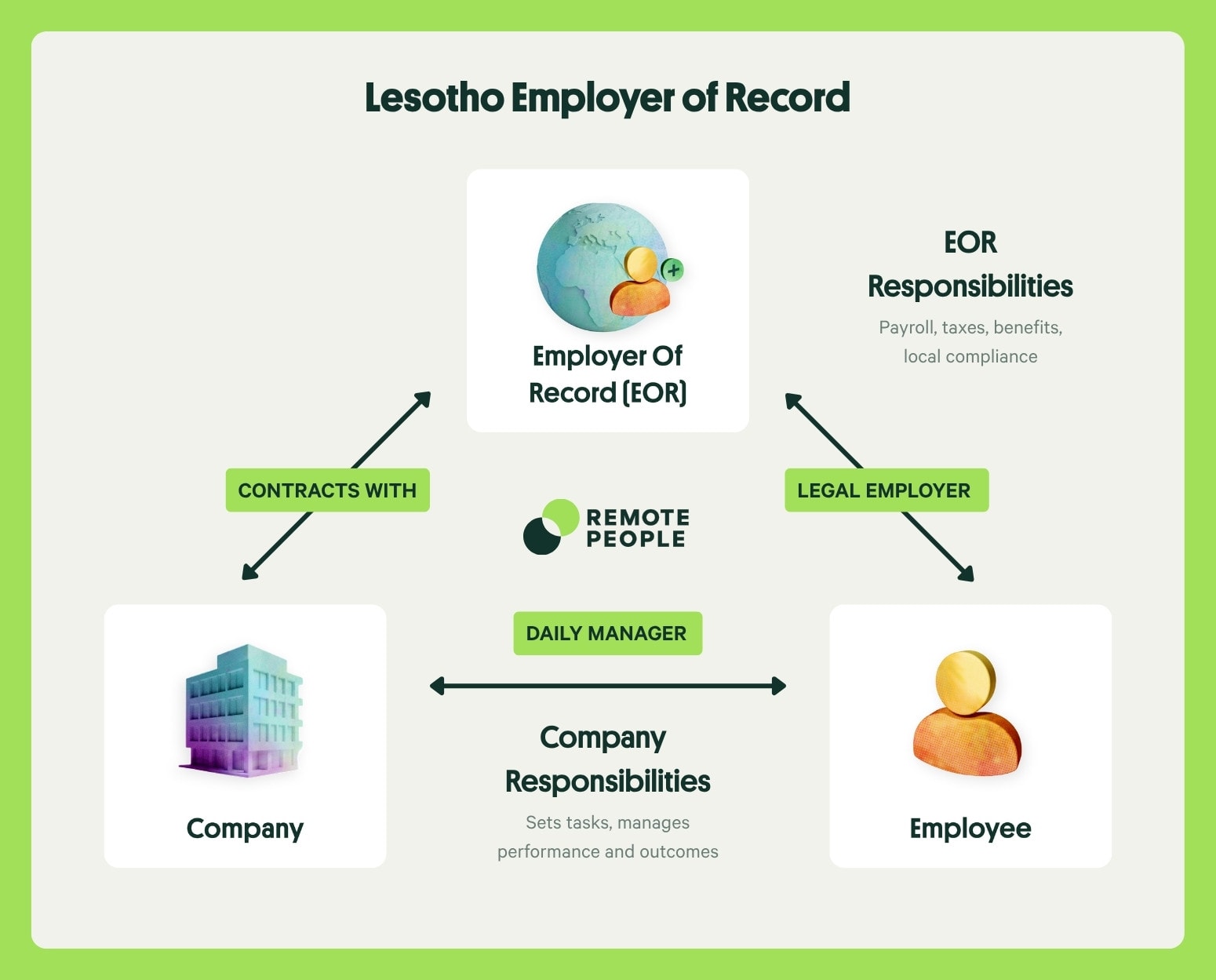
If you’d like to learn more about how Employer of Record (EOR) services work, read our What Is an Employer of Record (EOR)? guide for a complete overview of the model, its benefits, and when to use it.
If you’re comparing providers, our Best Employer of Record (EOR) Providers guide reviews the leading platforms to help you choose the right solution for your business.
Who Uses an EOR in Lesotho?
Companies use EOR services in Lesotho at different stages of growth and for different purposes.
Startups and small companies entering Lesotho use EOR services when they lack the resources to establish payroll infrastructure and legal compliance teams from scratch. The EOR provides immediate operational capacity without months of entity setup. Project-based hiring is another common use case, where companies engage Lesotho-based employees for fixed-term assignments without committing to permanent local operations.
Companies seeking specialized talent in Lesotho’s growing sectors, particularly textiles, agriculture, and diamond mining, rely on EOR services to hire quickly while the EOR manages local employment law requirements. Organizations that already operate in the region but have no registered Lesotho entity also use EOR arrangements to extend their workforce across the border without duplicating corporate infrastructure.
Whether you’re entering Lesotho for the first time or scaling an existing team, an EOR handles the compliance work and operational details so you can focus on building your business.
Typical Onboarding Timeline
Work permit processing is the main factor affecting how quickly you can hire through an EOR in Lesotho. Here’s what the timeline typically looks like:
- Day 1–2: Initial Setup and Documentation – You provide the employee’s details, qualifications, and job description. The EOR prepares employment contract drafts and begins compiling work permit application materials.
- Day 3–5: Contract Execution and Work Permit Submission – The employment contract is finalized and signed by both the EOR and the employee. The EOR submits the work permit application to the Department of Immigration and Passport Services.
- Day 6–12: Work Permit Processing – Immigration processes the application, typically requiring 5–7 business days. The EOR monitors progress and requests any additional information from authorities.
- Day 13–14: Approval and System Setup – Upon work permit approval, the EOR enrolls the employee in payroll, tax systems, and benefits administration. The employee is ready to commence work on or shortly after day 14.
- Note on Work Permits: For foreign nationals without SADC citizenship, work permit processing extends the timeline by 1–2 weeks. SADC nationals may experience expedited approval, potentially reducing total onboarding to 5–7 days.
Hire in Lesotho
Competitive employer costs of 2–4% of payroll, a growing talent pool in textiles, agriculture, and services, straightforward PAYE tax system, and proximity to South Africa make Lesotho an attractive base for Southern African operations.
We handle employment contracts, payroll, tax withholding, and full Lesotho compliance.
No local entity needed. Your team can start in days.
Employment Laws and Regulations in Lesotho
Employment Contracts
The Labour Act No. 3 of 2024 governs employment contracts in Lesotho, replacing the 1992 Labour Code Order since April 2, 2024. While written contracts aren’t legally required, they’re strongly recommended to clarify rights, responsibilities, and how disputes will be handled. You can offer fixed-term contracts (with an end date) or indefinite contracts (no set end date). Fixed-term agreements need a legitimate business reason and must be transparent about whether they might lead to permanent positions.
The Labour Act 2024 doesn’t require contracts to be in a specific language, though most Lesotho employers use English with some Sesotho. Your contracts should clearly lay out the job title, pay, working hours, probation terms, leave entitlements, and what counts as grounds for termination. This clarity protects both you and the employee.
Working Hours and Overtime
In Lesotho, the standard work week is 45 hours, usually across five days at 9 hours per day. Employees get at least 1 hour rest after every 5 consecutive work hours. The Labour Act No. 3 of 2024 sets these limits and requires overtime pay for any hours beyond the standard 45 per week.
Lesotho overtime pay rates | |||
Hour Type | Rate Multiplier | Weekly/Daily Cap | Notes |
|---|---|---|---|
Weekday Overtime (Beyond 45 hrs/week) | 1.25x regular rate | No statutory cap per week; employer discretion applies | Rates apply to hours worked on Monday–Friday beyond the standard 45-hour week. |
Night Work (18:00–06:00) | Average 1.15–1.25x per hour worked | Maximum 8 hours per day; 40 hours per week recommended | Employees working primarily between 18:00 and 06:00 receive enhanced compensation; legislation encourages limits to protect health. |
Weekly Rest Day Work (Typically Sunday) | 2.0x regular rate | Employer must provide compensatory rest day within 7 days | Work on the designated weekly rest day (usually Sunday) is compensated at double rate or employee receives equivalent paid day off. |
Public Holiday Work | 2.0x regular rate | No statutory limit per year | Lesotho recognizes 14 public holidays annually. Work on these dates is compensated at double rate plus day off or additional payment. |
Sunday Work (Non-Rest Day) | 1.5x regular rate | No statutory limit | Where Sunday is not the designated rest day, work on Sunday receives a 50% premium over the regular rate. |
Source: Labour Act No. 3 of 2024 (LesLII) and WIPO Lex | |||
Some sectors or roles can get exemptions from standard overtime rules if there’s a clear operational need and proper documentation. Whatever approach you take, keep detailed overtime records and give employees either compensatory rest time or overtime pay consistently. This prevents disputes and keeps you compliant with the Labour Act 2024.
Minimum Wage
The Ministry of Employment and Labour Relations sets sector-specific minimum wage schedules for Lesotho. As of January 2026, the general minimum wage is M2,242 per month. But rates differ by industry based on cost-of-living and productivity needs:
- Manufacturing Sector: M2,724–M3,041 per month, depending on factory classification and production category.
- Construction Sector: M3,226–M5,664 per month, differentiated by skill level (general labor, semi-skilled, skilled trades).
- Domestic Work: M872–M912 per month, among the lowest rates due to informal employment patterns.
- Wholesale and Retail: M2,480–M2,890 per month, depending on enterprise size and location.
These rates took effect in January 2026 following a 5% increase announced in April 2025 via Legal Notice No. 62 of 2025. Check which schedule applies to your sector and make sure all employees meet the minimum wage for their role. Non-compliance can mean penalties and claims for back wages.
Probation Period
Probation in Lesotho can last up to 4 months under the Labour Act 2024. Going beyond that requires written approval from the Labour Commissioner and a clear reason (like ongoing training needs). During probation, either you or the employee can end the relationship with just 1 week’s notice. No severance is due during probation, though the employee gets accrued wages and leave.
Once probation ends, the employee automatically becomes permanent, which kicks in full statutory protections, longer notice periods, and severance rights. This approach protects employees from staying in limbo while giving you time to see if they’re a good fit.
Leave Entitlements
The Labour Act No. 3 of 2024 sets up comprehensive leave protections for health, family time, and employee well-being. These are statutory rights that can’t be waived or forfeited, except for accrued leave when someone leaves. Here are the main types:
Annual Leave
Employees get 12 working days of vacation per year, accrued at 1 day per month. You can carry over up to 18 days to the next year; anything more is lost at year-end unless you agree otherwise. Employees must take at least 6 consecutive days off each year, and the rest can be taken in smaller chunks whenever it works. Annual leave pays the regular rate.
Sick Leave
After 6 months of work, employees can take paid sick leave. They get 12 days of fully paid sick leave per year, plus an additional 24 days at half-pay, for a total of up to 36 days annually. You can require a medical certificate after 2 days of consecutive absence or whenever you reasonably need one. Unused sick leave doesn’t roll over and isn’t paid when the employee leaves.
Maternity Leave
Women get 14 weeks of maternity leave: 7 weeks before their due date and 7 weeks after. How much is paid depends on the industry. In textiles and apparel, 6 weeks are paid. In other sectors, 12 weeks are paid if the employee has been with you at least a year. If she hasn’t hit the eligibility threshold, the 14 weeks are unpaid. Stillbirth qualifies for 3 weeks of paid leave. These rules are in Labour Act 2024, Section 191.
Paternity Leave
Lesotho doesn’t have statutory paternity leave. But employees adopting a child can take 14 days of unpaid adoption leave to handle the legal and administrative work.
Other Statutory Leave
Employees get 5 days of paid bereavement leave when an immediate family member dies (spouse, child, parent, or sibling). You can offer study leave if you choose, so employees can pursue further education. The country observes 14 public holidays per year, all paid. If someone works a public holiday, they either get paid at double rate or get a day off later.
The Labour Act No. 3 of 2024 pulls together all leave rules with clear calculations and eligibility. Here’s a summary of the main leave types and what you need to track:
Lesotho statutory leave entitlements | ||
Leave Type | Duration | Eligibility & Notes |
|---|---|---|
Annual Leave | 12 working days per year; max 18 days accrued | Accrues 1 day per month. Minimum 6 consecutive days must be taken annually. Paid at regular rate. Excess accrual forfeited at year-end. |
Sick Leave – Fully Paid | 12 days per year | Available after 6 months of service. Medical certificate required after 2 consecutive days. Non-cumulative. |
Sick Leave – Half-Paid | 24 days per year | Available after 6 months of service, following exhaustion of fully paid entitlement. Half of regular pay. Non-cumulative. |
Maternity Leave | 14 weeks (7 pre + 7 post); or until 6 months post-delivery | Textile sector: 6 weeks paid. Other sectors: 12 weeks paid if 1+ year service; otherwise unpaid. Stillbirth: 3 weeks paid. |
Paternity & Adoption Leave | 14 days (unpaid) | No statutory paternity leave. Adoption leave available for legal/administrative arrangements. Available to primary caregiver only. |
Bereavement Leave | 5 days (paid) | Granted for death of immediate family member (spouse, child, parent, sibling). Employer may require documentation. |
Study Leave | Duration by agreement | Not statutory; granted at employer discretion for further education or professional development. Terms negotiable. |
Source: Labour Act No. 3 of 2024 (LesLII) and WIPO Lex | ||
Statutory Employee Benefits
You’re required to offer certain benefits in Lesotho, and you have the option to provide others.
Workers’ Compensation Insurance is mandatory for all employers with one or more employees. The employer-funded contribution ranges from 1–3% of payroll depending on industry risk classification. Coverage protects employees injured or made ill by work, providing medical treatment, disability payments, and survivor benefits through the Lesotho Social Security Administration.
Employees may opt into approved pension schemes with contributions from both employer and employee. Employer contributions up to 20% of salary may be tax-deductible, and employee contributions reduce taxable income. No statutory employer obligation exists for health insurance, but voluntary private plans are common for higher-earning staff given limited public coverage. Lesotho does not currently operate a statutory unemployment insurance scheme; employees separated from employment receive severance (if eligible) but no ongoing state unemployment benefits.
Recent Regulatory Updates (2026)
The Labour Act No. 3 of 2024 brought major changes starting April 2, 2024, updating employment law that had remained essentially the same since 1992. Key changes include extending maternity leave from 12 to 14 weeks for most sectors, allowing more flexibility in how you schedule working hours, and giving the Labour Commissioner stronger enforcement powers.
In April 2025, the country raised both the general and sector-specific minimum wages by 5% to account for inflation and rising costs. Keep an eye on announcements from the Ministry of Employment and Labour Relations and the Lesotho News Agency for wage updates, which can happen quarterly or annually. Missing minimum wage increases can lead to penalties and back-wage claims.
Workers’ Compensation Insurance is required for all employers and covers medical expenses, rehabilitation, and income replacement for work-related injuries and illnesses. Contribution rates typically range from 1% to 3% of payroll, depending on the industry risk classification assigned to your business.
Beyond the mandatory requirements, many employers in Lesotho offer voluntary pension contributions to attract and retain talent. Private health insurance is increasingly common as a supplementary benefit, particularly for skilled roles where candidates expect coverage beyond the public healthcare system. Lesotho does not currently operate a formal unemployment insurance fund, though employers may offer voluntary severance packages that serve a similar protective function.
These rates took effect in January 2026 following a 5% increase announced in April 2025 via Legal Notice No. 62 of 2025. Check which schedule applies to your sector and make sure all employees meet the minimum wage for their role. Non-compliance can mean penalties and claims for back wages.
Probation Period
Probation in Lesotho can last up to 4 months under the Labour Act 2024. Going beyond that requires written approval from the Labour Commissioner and a clear reason (like ongoing training needs). During probation, either you or the employee can end the relationship with just 1 week’s notice. No severance is due during probation, though the employee gets accrued wages and leave.
Once probation ends, the employee automatically becomes permanent, which kicks in full statutory protections, longer notice periods, and severance rights. This approach protects employees from staying in limbo while giving you time to see if they’re a good fit.
Leave Entitlements
The Labour Act No. 3 of 2024 sets up comprehensive leave protections for health, family time, and employee well-being. These are statutory rights that can’t be waived or forfeited, except for accrued leave when someone leaves. Here are the main types:
Annual Leave
Employees get 12 working days of vacation per year, accrued at 1 day per month. You can carry over up to 18 days to the next year; anything more is lost at year-end unless you agree otherwise. Employees must take at least 6 consecutive days off each year, and the rest can be taken in smaller chunks whenever it works. Annual leave pays the regular rate.
Sick Leave
After 6 months of work, employees can take paid sick leave. They get 12 days of fully paid sick leave per year, plus an additional 24 days at half-pay, for a total of up to 36 days annually. You can require a medical certificate after 2 days of consecutive absence or whenever you reasonably need one. Unused sick leave doesn’t roll over and isn’t paid when the employee leaves.
Maternity Leave
Women get 14 weeks of maternity leave: 7 weeks before their due date and 7 weeks after. How much is paid depends on the industry. In textiles and apparel, 6 weeks are paid. In other sectors, 12 weeks are paid if the employee has been with you at least a year. If she hasn’t hit the eligibility threshold, the 14 weeks are unpaid. Stillbirth qualifies for 3 weeks of paid leave. These rules are in Labour Act 2024, Section 191.
Paternity Leave
Lesotho doesn’t have statutory paternity leave. But employees adopting a child can take 14 days of unpaid adoption leave to handle the legal and administrative work.
Other Statutory Leave
Employees get 5 days of paid bereavement leave when an immediate family member dies (spouse, child, parent, or sibling). You can offer study leave if you choose, so employees can pursue further education. The country observes 14 public holidays per year, all paid. If someone works a public holiday, they either get paid at double rate or get a day off later.
The Labour Act No. 3 of 2024 pulls together all leave rules with clear calculations and eligibility. Here’s a summary of the main leave types and what you need to track:
Lesotho additional leave entitlements | ||
Leave Type | Duration | Eligibility & Notes |
|---|---|---|
Annual Leave | 12 working days per year; max 18 days accrued | Accrues 1 day per month. Minimum 6 consecutive days must be taken annually. Paid at regular rate. Excess accrual forfeited at year-end. |
Sick Leave – Fully Paid | 12 days per year | Available after 6 months of service. Medical certificate required after 2 consecutive days. Non-cumulative. |
Sick Leave – Half-Paid | 24 days per year | Available after 6 months of service, following exhaustion of fully paid entitlement. Half of regular pay. Non-cumulative. |
Maternity Leave | 14 weeks (7 pre + 7 post); or until 6 months post-delivery | Textile sector: 6 weeks paid. Other sectors: 12 weeks paid if 1+ year service; otherwise unpaid. Stillbirth: 3 weeks paid. |
Paternity & Adoption Leave | 14 days (unpaid) | No statutory paternity leave. Adoption leave available for legal/administrative arrangements. Available to primary caregiver only. |
Bereavement Leave | 5 days (paid) | Granted for death of immediate family member (spouse, child, parent, sibling). Employer may require documentation. |
Study Leave | Duration by agreement | Not statutory; granted at employer discretion for further education or professional development. Terms negotiable. |
Source: Labour Act No. 3 of 2024 (LesLII) and WIPO Lex | ||
Statutory Employee Benefits
You’re required to offer certain benefits in Lesotho, and you have the option to provide others:
Workers’ Compensation Insurance is mandatory for all employers with one or more employees. The employer-funded contribution ranges from 1–3% of payroll depending on industry risk classification. Coverage protects employees injured or made ill by work and provides medical treatment, rehabilitation, and income replacement.
Beyond mandatory contributions, many employers offer voluntary pension contributions to attract talent in competitive sectors. Private health insurance is increasingly common as a supplementary benefit, particularly for skilled roles. Lesotho does not operate a formal unemployment insurance fund, so employers may provide voluntary severance packages or notice-period extensions that serve a similar protective function.
Recent Regulatory Updates (2026)
The Labour Act No. 3 of 2024 brought major changes starting April 2, 2024, updating employment law that had remained essentially the same since 1992. Key changes include extending maternity leave from 12 to 14 weeks for most sectors, allowing more flexibility in how you schedule working hours, and giving the Labour Commissioner stronger enforcement powers.
In April 2025, the country raised both the general and sector-specific minimum wages by 5% to account for inflation and rising costs. Keep an eye on announcements from the Ministry of Employment and Labour Relations and the Lesotho News Agency for wage updates, which can happen quarterly or annually. Missing minimum wage increases can lead to penalties and back-wage claims.
Work Permits and Visas in Lesotho
Work Permit Requirements
Who Needs a Work Permit
Any foreign national who wants to work in Lesotho must get a work permit from the Department of Immigration and Passport Services. SADC citizens (including those from South Africa and Botswana) might get a faster process, but they still need authorization. Without a valid permit, foreign workers can’t legally work and risk being deported if caught.
Eligibility and Required Documents
Work permit applicants need to show they have skills, qualifications, or experience that Lesotho needs or that local workers don’t easily have. You’ll need a valid passport (usually good for 12+ months), an employment contract, professional credentials relevant to the job, a police clearance from the applicant’s home country, and a medical report (including HIV/AIDS testing) from an approved medical provider. The application costs M2,800 per person.
Processing Time and Validity
Most work permit applications are processed in about 2 weeks, though busy periods or requests for more information can stretch it to 3–4 weeks. Once approved, a permit is good for up to 2 years. You can renew it before it expires, and employees can usually keep working while you’re processing the renewal if you submit on time and nothing major in their job has changed.
Renewal Process
Start the renewal process 4–8 weeks before the permit expires. You’ll need an updated employment contract, a fresh medical exam, and proof that the employee is still working and following the law. Most renewals go through in 2 weeks if all paperwork is complete. The employee can keep working during renewal if you file on time, but they shouldn’t travel outside Lesotho without a valid permit or special travel authorization.
Common Visa Types for Foreign Workers
The Department of Immigration offers several types of work authorization for foreign nationals. The standard work permit is most common and is for regular salaried employees with contracts. Each visa type has its own eligibility requirements, processing speed, and rules about what kind of work you can do and for how long.
Lesotho work visa and permit types | ||||
Visa Type | Duration | Best For | Leads to Permanent Residency? | Processing Time |
|---|---|---|---|---|
Standard Work Permit | Up to 2 years (renewable) | Salaried employees with employment contracts; permanent or long-term roles. | Potentially; repeated renewals may support permanent residency applications after 5+ years continuous residence. | 10–14 business days |
Temporary Work Permit | Up to 6 months (non-renewable) | Short-term projects, consultancies, or contract roles with defined end dates. | No; must exit or convert to standard permit before expiry. | 5–10 business days |
Specialized Skills Visa | Up to 2 years (renewable) | Professionals with rare or critical skills (engineering, ICT, healthcare, senior management). | Possibly; demonstrates in-demand expertise supporting permanent residency eligibility. | 14–21 business days |
Self-Employed/Contractor Visa | Up to 2 years (renewable) | Independent consultants, freelancers, or business owners establishing operations in Lesotho. | Potentially; long-term business establishment may support permanent residency. | 14–21 business days |
Student/Internship Pass | Duration of course or internship (typically 1–2 years) | Students enrolled at Lesotho institutions or interns on approved educational placements. | No; employment prohibited after pass expiry unless converted to work permit. | 10–14 business days |
- Tourist and Visitor Visas Do Not Permit Employment: Foreign nationals arriving on tourist or general visitor visas (typically valid for 30–90 days) are expressly prohibited from undertaking any form of paid work, including remote work for foreign employers. Violation is grounds for immediate deportation and future visa denial.
- Student Visas Are Restrictive: Students on educational visas may undertake approved internships or work-study programs as part of curriculum requirements, but unauthorized employment is prohibited and may result in visa cancellation and deportation.
How an EOR Handles Work Permits
An EOR provider in Lesotho takes the headache out of work permits by acting as the sponsoring employer and handling the entire application process for you and your employees. The EOR prepares all paperwork, submits applications to the Department of Immigration, tracks progress, and keeps you and the employee updated. This hands-on management prevents delays and keeps deadlines clear.
The EOR also pays the M2,800 fee and arranges medical exams with approved providers, so your employee doesn’t have to figure out Lesotho’s healthcare system alone. After approval, the EOR keeps the permit file organized, schedules renewals before they expire, and makes sure the employee stays legally authorized to work. You keep full control of what the employee does; the EOR just handles admin and compliance. Work permits add 1–2 weeks to onboarding for foreign nationals, though SADC citizens often get faster approval.
Payroll, Taxes, and Social Security in Lesotho
Lesotho is relatively light on employer obligations compared to other African countries. You won’t find mandatory pension or health insurance contributions. What you do need is to register with Revenue Services Lesotho (RSL) and follow the Labour Act No. 3 of 2024 for payroll and taxes. This straightforward setup makes Lesotho appealing for international hiring, even though you still have to meet your statutory contribution obligations.
Employer Contributions
Lesotho employers cover two main statutory contributions: Workers’ Compensation Insurance and the Skills Development Levy. Both are percentages of your monthly payroll and get paid separately from employee salaries. Workers’ Compensation varies by industry risk (1–3%), while the Skills Development Levy is a flat 1%.
Lesotho employer statutory contributions | ||
Contribution | Rate | Notes |
|---|---|---|
Workers’ Compensation Insurance | 1–3% | Risk-based by industry; mining, construction higher |
Skills Development Levy | 1% | Applies to payroll exceeding M500,000 annually |
Total Employer Contribution | 2–4% | Combined monthly obligation |
Source: Revenue Services Lesotho and PwC Worldwide Tax Summaries | ||
Workers’ Compensation covers employee injuries, illnesses, and disabilities from work and applies to all employers. The Skills Development Levy funds vocational training but only applies if you’re paying out over M500,000 annually in payroll. Both are tax-deductible business expenses and get filed monthly or quarterly depending on your size.
Employee Deductions
Employees pay PAYE income tax as the main statutory deduction. Unlike many places, Lesotho doesn’t require employee contributions for social security. Instead, you can offer voluntary pension plans that let employees put up to 20% of gross salary aside with tax advantages. Every deduction shows clearly on the pay slip.
Lesotho employee payroll deductions | ||
Deduction | Rate | Notes |
|---|---|---|
PAYE Income Tax | 20–30% | Tiered by income bracket; progressive rates |
Voluntary Pension Contribution | Up to 20% | Optional; reduces taxable income |
Employee Statutory Deductions | PAYE + optional | No mandatory social security from employee |
Source: Revenue Services Lesotho and PwC Worldwide Tax Summaries | ||
PAYE is calculated on an individual basis and remitted to Revenue Services Lesotho by the 15th of the following month. Voluntary pension contributions are deducted pre-tax and can significantly reduce an employee’s taxable income, making them an attractive benefit for higher-earning staff. Employees receive a detailed pay slip each month itemizing gross salary, all deductions, and net pay received.
Income Tax
Lesotho uses a progressive tax system with two brackets starting April 1, 2025. The first M74,040 per year (roughly M6,170 per month) is taxed at 20%. Anything above that is taxed at 30%. Everyone gets a personal tax credit of M11,640 annually (M970 monthly) that lowers what they owe, which effectively pushes up when the higher rate kicks in.
Lesotho income tax brackets | |
Income Bracket | Tax Calculation |
|---|---|
M0 to M74,040 per annum | 20% of income in bracket |
Above M74,040 per annum | 30% of income above M74,040 |
Personal Tax Credit | M11,640 per annum (M970/month) – reduces total tax |
Effective from | 1 April 2025 |
Source: Revenue Services Lesotho and PwC Worldwide Tax Summaries | |
Take an employee making M6,170 monthly. Before the credit, they’d owe about M1,234 in tax per year, which drops to just M263 after the credit, an effective rate of 3.5%. An employee earning M10,000 monthly would pay about M3,600 before credit, or around M2,720 after. These examples show how Lesotho’s progressive system works and how meaningful the personal credit is for lower to middle-income earners.
Payroll Cycle
Payroll runs monthly with direct bank transfers to employee accounts in Lesotho Loti (LSL). Every employee gets a detailed pay slip showing their gross pay, all deductions (PAYE, pension, and other contributions), and net pay, provided by payday. You send PAYE taxes collected during the month to Revenue Services Lesotho by the 15th of the next month.
Keep payroll records for at least three years and have them ready if RSL asks. You’re responsible for calculating PAYE correctly, applying the personal credit, and paying contributions on time. An EOR takes care of payroll, taxes, and filings, so you don’t have to worry about it.
13th Month Salary and Bonus Pay
A 13th month payment or annual bonus is not required under the Labour Act No. 3 of 2024. But many private sector employers, especially in professional services, finance, and manufacturing, offer them as part of their compensation to boost retention and motivation. These payments are taxed like regular salary.
If you offer a 13th month payment or bonus, make sure it’s clearly spelled out in the employment contract or your pay policy to avoid misunderstandings. They’re usually a percentage of annual salary or based on performance. If you’ve been offering them consistently, employees will expect them to continue unless you formally change the policy and tell them in advance.
Cost of Hiring Through an EOR in Lesotho
An EOR in Lesotho eliminates the need for a local legal entity, which saves money and complexity. Your total cost includes the employee’s salary, your statutory contributions, and the EOR fee (usually $300–$600 USD per employee per month). Let’s break down the cost structure with a real example.
EOR Service Fees
EOR fees in Lesotho typically run $300–$600 USD per employee per month. The price depends on your service provider, how complex the employment is, and how many people you’re hiring. The fee covers registration, payroll, calculating and sending statutory contributions, tax withholding and filing, preparing contracts, and ongoing HR support. Most charge a flat monthly rate, though some offer discounts for larger teams or long-term commitments.
The fee doesn’t cover the employee’s salary, optional benefits (pension, health insurance), or one-off costs like background checks or visa sponsorship. Before you sign up, make sure you know what’s included in the quote. RemotePeople, for example, covers the core compliance, payroll, and tax filing, with extras like contractor management or specialized HR available for additional fees.
Total Employment Cost Breakdown
Your total monthly cost for an EOR hire in Lesotho is the gross salary plus your statutory contributions plus the EOR fee. Here’s what that looks like with a typical example:
Lesotho employer cost example | ||
Employer Cost | Amount (USD) | % of Gross |
|---|---|---|
Gross Monthly Salary | $3,000 | 100% |
Workers’ Compensation Insurance (~2%) | $60 | 2.0% |
Skills Development Levy (1%) | $30 | 1.0% |
EOR Service Fee (estimated) | $499 | 16.6% |
Total Monthly Cost to Employer | $3,589 | ~19.6% above gross salary |
Source: Revenue Services Lesotho and PwC Worldwide Tax Summaries | ||
Exchange Rate Note: This example uses 1 USD ≈ 18.5 Lesotho Loti (LSL), but actual costs will shift with the exchange rate. Salaries and contributions in Lesotho are paid in LSL; these USD amounts are just for planning.
In this example, you’re spending $3,589 per month total: $3,000 salary, $90 in statutory contributions (2% workers’ comp + 1% SDL), and a $499 EOR fee. The employee takes home $3,000 gross, minus PAYE tax withheld, which nets around $2,400–$2,550 depending on their income and use of the personal credit. The EOR fee of roughly 16.6% above gross is competitive with other African countries and covers the admin and compliance work required under Lesotho’s employment and tax laws.
Ready to hire in Lesotho? RemotePeople makes it straightforward with seamless EOR hiring, full compliance, and expert local support. Contact the team to discuss your needs and get a quote tailored to your situation.
Benefits of Using an EOR in Lesotho
The EOR model beats establishing a local entity, especially if you’re new to Lesotho or have a small team. An EOR takes care of employment, payroll, taxes, and compliance, so you can focus on growing the business while staying out of legal trouble. Here are the main reasons to use an EOR in Lesotho.
The most immediate advantage is speed. An EOR in Lesotho can onboard new employees within one to two weeks, compared to three to six months for entity incorporation. This fast timeline lets you respond to market opportunities and staff projects without delays caused by corporate registration.
Full tax and payroll compliance is built into the service. The EOR calculates PAYE, remits Workers’ Compensation and Skills Development Levy contributions, and files all returns with Revenue Services Lesotho on schedule. This eliminates the risk of penalties from late filings or miscalculated contributions, which is particularly valuable for companies unfamiliar with Lesotho’s tax calendar.
From a cost perspective, an EOR removes the overhead of maintaining a local legal entity, registered office, and in-house compliance team. You pay a predictable monthly fee per employee instead of absorbing fixed costs. The EOR’s local employment expertise also helps with employee retention, since contracts, benefits, and HR processes are handled according to local expectations rather than imposed from a foreign headquarters. As your Lesotho team grows or contracts, the EOR scales with you without requiring structural changes to your corporate presence.
An EOR works best for companies entering Lesotho, launching new products or services with distributed teams, or expanding without the overhead of managing a full corporate structure. Whether you’re hiring one person or building a team of 10–15, an EOR gives you the legal cover, compliance confidence, and local know-how you need to win in Lesotho.
Termination and Offboarding in Lesotho
The Labour Act No. 3 of 2024 sets strict rules for firing and offboarding employees. It requires specific notice periods, severance payments, and fair procedures. Skip these rules and you risk unfair dismissal claims, court orders to rehire, or damages. Here’s what you need to know about terminating employment in Lesotho.
Notice Periods
Notice periods depend on how long someone has worked for you and apply whether you or the employee are ending things. The Labour Act sets minimums that give employees time to find another job while keeping employers from losing productivity for too long. Give notice in writing and be clear about when the termination takes effect.
Lesotho notice period requirements | |||
Length of Employment | Notice Period | Minimum Duration | Notes |
|---|---|---|---|
Less than 6 months | 7 days | 1 week | Minimal notice for short-tenure employees |
6 months to 1 year | 14 days | 1 week | Two-week notice standard |
1 to 10 years | 1 month | N/A | One calendar month notice required |
10 years or more | 3 months | N/A | Three calendar months for long-service employees |
Probationary Period | 1 week | Applies during trial period | Shortest notice applies regardless of job level |
Source: Labour Act No. 3 of 2024 (LesLII) and WIPO Lex | |||
Notice starts when you deliver the written notice and runs until the termination date. You can put an employee on paid leave (garden leave) during the notice period if the contract allows it. You can also have them keep working, or pay them in lieu of notice (a lump sum for the wages they would have earned).
Probationary employees get a one-week notice period no matter the role or industry, since probation is meant to be a quick trial period. Once probation ends (usually 3–6 months), the standard notice rules kick in based on how long they’ve worked for you.
Severance Pay
Severance is mandatory when you terminate an employee. It’s two weeks’ pay for each year of service, but only if the employee has worked for you at least one year and wasn’t fired for misconduct or didn’t quit voluntarily. You calculate it using their wage rate at the time of termination.
Lesotho severance pay schedule | |||
Years of Continuous Service | Severance Entitlement | Maximum Cap | Notes |
|---|---|---|---|
1 year | M2,308 | M5,000/month | Two weeks’ wages (M1,154 weekly) |
3 years | M6,923 | M5,000/month | Six weeks’ wages (M1,154 weekly) |
5 years | M11,538 | M5,000/month | Ten weeks’ wages (M1,154 weekly) |
10 years | M23,077 | M5,000/month | Twenty weeks’ wages (M1,154 weekly) |
Source: Labour Act No. 3 of 2024 (LesLII) and WIPO Lex | |||
Calculation Method
Multiply the employee’s normal weekly pay by 2 weeks for each year of service. Normal remuneration means base salary plus regular allowances or bonuses that are part of regular pay, but not irregular or discretionary payments. Use the wage rate at termination.
For example, an employee earning M5,000 per month (M1,154 per week) who works for you 5 years would get M2,308 per year × 5 = M11,538 in severance. Pay this by their last day of work or shortly after, and show it separately on their final pay slip or severance document.
Caps and Exceptions
The Labour Minister could set a severance cap, but none exists yet. Severance isn’t due if an employee quits, is fired for misconduct, or is still on probation. If someone is fired for cause (theft, insubordination, gross negligence), they lose severance. Same goes for anyone who quits before hitting one year of service.
If the employment contract has a severance clause that’s better than the legal minimum, that clause applies. But if the contract says less than the legal minimum, it’s void and unenforceable. Severance isn’t taxed under PAYE and is paid on top of any unused annual leave the employee has accrued.
Grounds for Termination
The Labour Act No. 3 of 2024 says you can fire someone for three reasons: lack of capacity (bad performance or can’t do the job), misconduct (breaking rules or the contract), or operational need (redundancy, restructuring, or economic pressure). Any other reason is unfair and opens you to legal trouble.
Capacity terminations need proof of poor performance, prior warnings, and a real chance to improve. Misconduct firings need a formal hearing, evidence, and a chance for the employee to respond. Operational terminations must be for real business reasons, applied equally, and have discussion with affected employees.
The law protects certain groups: pregnant women, employees on maternity leave, those exercising statutory rights (like joining a union or complaining about conditions), people of particular religions, and those from particular ethnic or social backgrounds. Firing a protected person because of who they are is automatically unfair and can lead to reinstatement or big damages awards.
EOR vs. Other Hiring Models in Lesotho
If you want to hire in Lesotho, you have three main choices: use an EOR, set up a local company, or hire contractors. Each has pros, cons, and different regulatory demands. Let’s compare them so you can pick the right approach for your situation.
EOR vs. Setting Up a Local Entity
An EOR provides the fastest, lowest-cost entry into the Lesotho market, while a local entity offers scalability, eligibility for government contracts, and longer-term cost efficiency for larger teams. The table below compares key dimensions of these two approaches.
EOR vs. entity setup in Lesotho | ||
Comparison Factor | EOR | Own Entity |
|---|---|---|
Setup Time | 1–2 weeks | 3–6 months |
Upfront Cost | Minimal (EOR fee only) | $5,000–$15,000 (registration, accounting, legal) |
Ongoing Monthly Cost per Employee | $300–$600 (EOR fee included) | $8,000–$15,000/year overhead (accounting, compliance, management) |
Local Partner / Entity | Not required (EOR is employer) | Yes, you own and control |
Social Insurance & Contributions | EOR handles all remittance | You manage and remit |
Payroll & Tax Compliance | EOR handles all calculations and filings | You or hired accountant manage |
Best For | 1–15 employees; rapid market entry | 15+ employees; long-term operations or government contracts |
Scale Down or Exit | Easy, minimal cost; scale at will | Costly and complex; formal dissolution and asset liquidation required |
Eligibility for Government Contracts | Not eligible as non-resident entity | Eligible with local registration and tax clearance |
Source: Revenue Services Lesotho and World Bank Doing Business | ||
An EOR works best if you’re testing a new market, hiring fewer than 15 people, or want to get going fast without setting up a local company. The EOR handles everything, so you don’t need local board members, accounting staff, or corporate governance headaches. Costs are clear and per-person, making it easy to budget as you hire more people.
A local company makes sense once you’re hiring 15+ people or plan to stay in Lesotho more than three years. Setup and ongoing costs are higher, but per-person costs drop with scale. Plus, you can bid on government contracts, make long-term partnerships, and establish a real local footprint. And you get more control over operations, your brand, and decisions.
Many companies start with an EOR to test the market, then switch to a local company once things take off. RemotePeople can help with both and advise on when to make the switch for your situation.
EOR vs. Hiring Independent Contractors
Some employers hire contractors to skip payroll overhead and employment law requirements. But misclassifying an employee as a contractor opens you to serious legal and financial risk in Lesotho. Here’s how EOR employment differs from contractor work:
EOR vs. independent contractors in Lesotho | ||
Comparison Factor | EOR | Independent Contractor |
|---|---|---|
Legal Relationship | Employment contract; ongoing obligation | Service agreement; project or engagement basis |
Compliance Risk | Low; EOR ensures statutory compliance | High; misclassification can trigger tax and labour penalties |
Payroll & Tax | EOR withholds PAYE, remits contributions | Contractor responsible for own tax; no withholding |
Benefits & Leave | Annual leave, sick leave, maternity protected by law | No statutory benefits; all terms contractual |
IP Ownership | Employer owns work product by default | Contractor retains unless assignment in contract |
Termination | Notice period and severance required by law | Per contract; typically simpler but limited default protections |
Best For | Permanent or long-term roles; core team members | Project-based work, niche expertise, short-term needs |
Cost Structure | Predictable monthly cost including overhead | Variable; can be lower but includes contractor’s tax burden |
Lesotho authorities check the actual facts to classify workers: If someone depends financially on you, works only for you, uses your equipment and systems, and takes direction from you, that’s employment no matter what the contract says. Getting this wrong means back taxes, unpaid contributions, penalties, and claims for wages and severance.
Contractors work for specific projects – website redesigns, market research, specialized consulting – where they’re independent, control how and when they work, and serve multiple clients. But if someone works regularly under your direction using your stuff for your business, they’re an employee even if you call them a contractor.
RemotePeople handles both EOR employment and contractor setups. For project work that needs flexibility and cost control, RemotePeople structures compliant contractor deals with insurance, tax handling, and proper paperwork. For ongoing roles, an EOR relationship is safer and protects everyone involved.
EOR vs. Professional Employer Organization (PEO)
A PEO works like an EOR but typically in places where the PEO has its own legal entity and shares employment. In Lesotho, PEOs aren’t common and most international employers use EORs instead. Here’s the difference:
EOR vs. PEO in Lesotho | ||
Comparison Factor | EOR | PEO |
|---|---|---|
Legal Employer Status | EOR is the sole legal employer | Shared co-employment; both PEO and client are employers |
Local Entity Required | Not required; EOR operates as local entity | Typically yes; PEO maintains licensed local presence |
Best For | International expansion; minimal local operations needed | Domestic multi-branch operations within single country |
Compliance Liability | EOR assumes all employment law liability | Shared; PEO and client both retain responsibility |
Setup Time | 1–2 weeks | 2–4 weeks (requires PEO registration and authorization) |
Control Over HR Policies | Client retains control; EOR implements | Shared control; PEO enforces minimum standards |
Typical Use Case | Hiring abroad without local infrastructure | Consolidating HR for multiple domestic locations |
Lesotho does not have a formal PEO regulatory framework comparable to countries like India or the Philippines. The EOR model is standard for international employers in Lesotho because the EOR provider serves as the direct legal employer, bearing full responsibility for compliance, tax withholding, and statutory payments. This simplifies the relationship and eliminates ambiguity about who is responsible for employment law compliance.
In contrast, PEOs are more common in countries where the PEO is a licensed entity with established co-employment relationships recognized by labour authorities. Since Lesotho’s labour law centres on the concept of a single, identifiable employer, the EOR structure is more aligned with local legal norms and provides clearer accountability for both the employer and the employee.
Public Holidays in Lesotho
Lesotho has 11 public holidays a year that mix national, religious, and commemorative days. Employees get paid time off for all of them. If work is required on a public holiday, you either give a day off later or pay a premium (usually 1.5x or 2x pay). Here are all the public holidays for 2026:
Lesotho public holidays 2026 | ||
Date (2026) | Holiday | Type |
|---|---|---|
Thursday, 1 January | New Year’s Day | National |
Wednesday, 11 March | Moshoeshoe I Day | National |
Friday, 3 April | Good Friday | Religious |
Monday, 6 April | Easter Monday | Religious |
Friday, 1 May | Workers’ Day | International |
Thursday, 14 May | Ascension Day | Religious |
Monday, 25 May | Africa Day | Continental |
Friday, 17 July | King’s Birthday | National |
Sunday, 4 October | Independence Day | National |
Friday, 25 December | Christmas Day | Religious |
Saturday, 26 December | Boxing Day | Religious |
Source: Government of Lesotho and timeanddate.com | ||
If a public holiday lands on a weekend (like Independence Day on Sunday, October 4, 2026), you and the employee can agree to observe it on a different day or give compensatory leave. If an employee works a public holiday because of business needs, you either give them a day off the following week or pay the holiday premium in the contract.
For payroll, public holidays are paid at the regular rate unless the contract says otherwise. If the employee actually works, overtime or premium pay kicks in. An EOR automatically tracks holidays and handles payroll correctly, so disputes stay off the table and you stay compliant with Lesotho labor standards.
How to Get Started with an EOR in Lesotho
Getting started with an EOR in Lesotho is straightforward. Here’s a step-by-step guide to hiring your first employee:
- First, assess your hiring needs and budget. Determine how many employees you plan to hire, their roles, required salary ranges, and start date timeline. Gather job descriptions, role responsibilities, and any specific qualifications or certifications required. This information helps an EOR provider prepare accurate quotes and employment contracts tailored to your roles.
- Second, contact an EOR provider and request a detailed quote. Provide employee count, salary information, and your growth timeline. The EOR will calculate all statutory contributions, present the all-in monthly cost, and explain what services and support are included. Ask about onboarding timelines, contract customization, and ongoing HR support.
- Third, review and finalize the employment contract. The EOR will prepare a contract compliant with the Labour Act No. 3 of 2024, covering job title, duties, salary, benefits, notice periods, and termination conditions. You may request amendments to reflect company policies or role-specific requirements. Once finalized, both you and the employee sign the contract.
- Fourth, complete employee onboarding and tax registration. Provide the EOR with the employee’s personal information, banking details, tax identification, and any additional documentation required for payroll setup. The EOR registers the employee with Revenue Services Lesotho and sets up payroll processing. Most employees are ready to start work within one to two weeks.
- Fifth, launch operations and manage ongoing support. On the employee’s start date, ensure access to tools, systems, and workspace. The EOR handles all monthly payroll processing, tax withholding, statutory contribution remittance, and compliance reporting. You receive regular payroll summaries and can contact the EOR with questions about benefits, termination procedures, or employment law concerns.
Ready to expand your team in Lesotho? RemotePeople makes international hiring simple, compliant, and fast. Contact the team to discuss your needs, get a quote, and start building your Lesotho team.
Where companies hiring in Lesotho expand next
Employers with staff in Lesotho often extend across Southern Africa, drawing on shared SADC labor frameworks and cross-border mobility. After building a team in Lesotho, employers often look to a team in Zambia for shared SADC workforce mobility, then operations in Zimbabwe for aligned SADC labor rules. Botswana follows with SADC-wide hiring and compliance parity, and hiring in South Africa typically closes the regional footprint via SADC labor framework alignment.
Frequently Asked Questions
Employer of Record in
Employer of Record in
Employer of Record in
Employer of Record in
Employer of Record in
Employer of Record in
Employer of Record in
Employer of Record in