Employment Laws and Regulations in Madagascar
Employment Contracts
Employment relationships in Madagascar are governed by Loi n° 2024-014 du 14 août 2024 portant Code du travail, which replaced the long-standing Loi 2003-044 and took effect in late 2024. The Ministère de la Fonction Publique, du Travail, de la Réforme de l’Administration du Travail et des Lois Sociales (MFPTLS) is the primary regulator, and CNaPS administers private-sector pensions. Written contracts are required for all formal employment relationships, and the working languages for employment documentation are French and Malagasy, with a parallel English version permitted and common for foreign hires.
Contracts can be indefinite (CDI), fixed-term (CDD), part-time, seasonal, or project-based. Under Loi 2024-014, an employment contract is presumed indefinite unless the parties expressly agree otherwise in writing, and a CDD cannot exceed two years in total including renewals. The 2024 Code also formally recognises portage salarial (umbrella employment) for the first time, which gives EOR-style arrangements a clear legal footing in Malagasy law. Every contract must specify the job title, salary, place of work, working hours, probation period (if any), start date, and professional category under the applicable sectoral collective agreement. Analysis of the new code is available from John W Ffooks & Co, the leading Malagasy business law firm.
Working Hours and Overtime
The standard workweek in Madagascar is 40 hours for non-agricultural workers and 2,200 hours per year for agricultural workers, confirmed by Loi 2024-014. The legal workday is eight hours, and employees are entitled to at least 24 consecutive hours of weekly rest, usually taken on Sunday. Night work runs from 10 PM to 5 AM and attracts a higher rate. Overtime is permitted only after authorisation from the Labour Inspectorate and is capped in practice at 20 hours per week.
Overtime pay is set by Decree 68-172 as maintained under the 2024 Code. The first 8 overtime hours per week are paid at 130% of the normal hourly rate, hours beyond that at 150%, and work performed on a Sunday, public holiday, or between 10 PM and 5 AM carries additional premiums.
Minimum Wage
Madagascar raised the SMIG (Salaire Minimum Interprofessionnel Garanti) to MGA 300,000 per month for non-agricultural workers from 1 March 2026, up from MGA 262,680 per month. The increase was announced by Decree 2024-794 after tripartite negotiations between the government, employer federations, and trade unions. A separate SMA (Salaire Minimum Agricole) applies to agricultural workers at a slightly lower rate. Sectoral collective agreements fix higher minima for specific professional categories, so the MGA 300,000 figure is a national floor rather than the typical market wage. See our minimum wage in Madagascar guide for the latest sectoral thresholds.
Probation Period
The maximum probation period under Loi 2024-014 depends on the professional category. For labourers and semi-skilled workers probation is capped at 8 days; for skilled and qualified workers at 1 month; for supervisors and technicians at 3 months; and for engineers, executives, and senior managers at 6 months. Probation must be agreed in writing and can be renewed once for the same maximum duration. During probation either party may terminate without notice, subject to the 2024 Code’s good-faith requirements. See our probation period in Madagascar guide for further detail.
Leave Entitlements
Loi 2024-014 sets statutory minimums for annual leave, sick leave, maternity leave, paternity leave, and other family-related absences. Most entitlements accrue from the first day of employment, and the 2024 Code strengthened maternity protections and introduced statutory paternity leave for the first time.
Annual Leave
Employees are entitled to 2.5 working days of paid annual leave per month of actual service, totalling 30 working days (5 weeks) per year. Workers aged under 18 and mothers of children under six accrue additional days under Loi 2024-014. Annual leave may be postponed by agreement or operational need, but must normally be taken within the 12 months following the reference period. Pay during leave is at the employee’s normal rate plus any regular allowances.
Sick Leave
Loi 2024-014 grants employees paid sick leave contingent on producing a medical certificate. The employer pays full wages for the first six months of a continuous absence, and job protection continues for a further six months during which the contract is suspended without pay. After 12 months of continuous sick leave, the employer may terminate the contract on grounds of prolonged incapacity, subject to Labour Inspectorate authorisation. Workplace accidents and occupational diseases are covered separately under the CNaPS occupational injury branch.
Maternity Leave
Female employees are entitled to 14 weeks of maternity leave under Loi 2024-014 (an increase from 12 weeks under the old 2003 Code), split between prenatal and postnatal periods. Pay is funded 50% by the employer and 50% by CNaPS, and the employee receives her full salary during leave. The employee retains her position, and she may not be dismissed during pregnancy, maternity leave, or the 14 weeks following her return to work. Breastfeeding breaks of one hour per day are granted for the first 15 months after return.
Paternity Leave
The 2024 Labour Code introduced statutory paternity leave for the first time in Malagasy private-sector law. Male employees are entitled to 10 working days of fully paid paternity leave following the birth of a child, to be taken within the first months after birth. This is separate from annual leave and is paid by the employer at the employee’s normal rate.
Other Leave
Family-event leave (congé pour événements familiaux) is granted for marriage (typically 5 days for the employee’s own marriage), the birth of a child (3 days, separate from the new paternity entitlement), the death of a close family member (typically 3 days for a spouse, child, or parent), and for the employee’s own medical examinations. Bereavement and marriage leave durations are fixed in practice by sectoral collective agreements where one applies. Family-related leave is paid in full.
Statutory Employee Benefits
Madagascar’s statutory benefit package for private-sector employees is built on three pillars: CNaPS pension, OSTIE occupational health, and the FMFP training levy. The Caisse Nationale de Prévoyance Sociale administers old-age, disability, survivor, family-allowance, and occupational-injury benefits for private-sector workers. OSTIE (Organisation Sanitaire Tananarivienne Inter-Entreprises) and equivalent regional services provide mandatory occupational medicine, primary care, and emergency coverage. The FMFP (Fonds Malgache de Formation Professionnelle) funds vocational training and continuing education. Combined contributions total 20% of gross salary (19% employer plus 1% employee), before the IRSA income tax withholding. See our employee benefits in Madagascar guide for the full statutory package.
There is no separate compulsory national health insurance scheme on top of OSTIE. Private health insurance, transport allowances, meal subsidies, and the customary 13th month bonus are widely offered as supplementary benefits, particularly in banking, mining, outsourcing, and international NGO roles. Family allowances are paid directly by CNaPS to workers with children under the age of 14 (or 21 if in full-time education) at a fixed monthly amount per child.
Recent Regulatory Updates (2026)
The most significant employment-related change over the past year was the SMIG increase to MGA 300,000 per month from 1 March 2026, which also raised the social-security contribution ceiling to MGA 2,400,000 (eight times SMIG). The 2026 Finance Act introduced a new 25% top IRSA bracket on monthly taxable income above MGA 4,000,000, adding a sixth progressive band on top of the existing 0%–20% schedule. Loi 2024-014 itself, enacted on 14 August 2024, continues to drive secondary regulation: implementing decrees on working hours, remote work, and OHS standards are being published in stages through 2026, and the Labour Inspectorate has tightened enforcement on written contracts, probation documentation, and CNaPS monthly declarations.
Work Permits and Visas in Madagascar
Work Permit Requirements
Who Needs a Work Permit
Every foreign national who is not a Malagasy citizen needs authorization to work in Madagascar. Madagascar operates a dual-permit system: a Permis de Travail issued by the Ministère de la Fonction Publique, du Travail, de la Réforme de l’Administration du Travail et des Lois Sociales (MFPTLS), plus a Transformable Long-Stay Visa issued by the Ministère de l’Intérieur. Both documents are mandatory, and either alone is insufficient for legal employment. Foreign labour must supplement, not supplant, the domestic workforce, and the Ministry will refuse permits where the role can be filled by a qualified Malagasy national.
Eligibility and Required Documents
To qualify, the employer must demonstrate that the position requires specialized skills not readily available on the Malagasy labour market. The standard dossier includes a valid passport with at least six months remaining validity, a signed employment contract compliant with Loi 2024-014, original and notarised academic and professional certificates, a criminal record extract from the home country (legalised by a Malagasy embassy or consulate), a recent medical certificate, passport photographs, and proof of payment of application fees. The employer must be registered with the MFPTLS to sponsor foreign workers.
Processing Time and Validity
The Ministry of Labour typically issues a decision within 6 to 12 weeks of receiving a complete dossier, depending on the complexity of the role and seasonal workload. The work permit is generally valid for two years and is renewable. The long-stay visa is processed in parallel by the Ministry of Interior and adds a further 2 to 4 weeks before the employee can lawfully reside and work in Madagascar.
Renewal Process
Renewals must be filed before the existing permit expires, with an updated employment contract, an updated medical certificate, and evidence of continued contribution to CNaPS and IRSA. Late filings can trigger fines and, in serious cases, refusal of renewal. Employees should not continue working on an expired permit, and an EOR will typically file renewals at least 60 days before expiry.
Common Visa Types for Foreign Workers
How an EOR Handles Work Permits
An employer of record in Madagascar can sponsor the work permit directly because it is already a registered Malagasy employer with a CNaPS number, an NIF (Numéro d’Identification Fiscale), and an active sponsorship file at the Ministère du Travail. The EOR prepares the employer justification letter, collects the employee’s documents (passport, diplomas, medical certificate, criminal record), and submits the dossier to the MFPTLS. The employee is responsible for ensuring document authenticity and obtaining any required apostilles or embassy legalisations.
Because the work permit and long-stay visa process adds 8 to 16 weeks to the timeline, onboarding for a foreign hire through an EOR typically lands at 2 to 4 months from contract signature rather than the 1 to 2 weeks required for a Malagasy national. The EOR also handles biennial renewals so the permit never lapses and the employee can continue working without interruption.
Payroll, Taxes, and Social Security in Madagascar
Employer Contributions
Employers in Madagascar carry a mid-range statutory burden compared with other African jurisdictions, totalling 19% of gross salary. The main component is CNaPS at 13%, which funds old-age, disability, survivor, and family-allowance pensions. Occupational health via OSTIE (or an approved regional service) adds 5%, and the FMFP training levy adds 1%. CNaPS and OSTIE contributions are capped at eight times the SMIG (MGA 2,400,000 per month from 1 March 2026), so contributions plateau above that ceiling. All three funds are remitted by the 15th of the month following payroll, and late filing triggers interest and penalties under CNaPS enforcement rules.
Employee Contributions
Employees in Madagascar contribute 2% of gross salary in social charges: 1% to CNaPS pension and 1% to OSTIE. Both are withheld by the employer and remitted monthly alongside the employer shares. Social security contributions are deductible from taxable income before IRSA is calculated, which slightly lowers the effective tax burden for most employees.
Income Tax
Madagascar applies a progressive personal income tax (Impôt sur les Revenus Salariaux et Assimilés, or IRSA) on employment income, withheld monthly by the employer and remitted to the Direction Générale des Impôts. The 2026 Finance Act introduced a new 25% top bracket on monthly taxable income above MGA 4,000,000, creating a six-band schedule that starts at 0% below MGA 350,000 and a minimum IRSA of MGA 3,000 for any salary above the exemption threshold. See our payroll tax in Madagascar guide for worked monthly examples.
USD equivalents are converted at an approximate April 2026 rate of $1 = MGA 4,500; actual withholding is calculated and remitted in ariary. Because Malagasy salaries in ariary terms span a wide spread, senior professional and managerial roles commonly fall into the 20% and new 25% top brackets, while entry-level workers earning the SMIG of MGA 300,000 remain fully exempt.
Payroll Cycle
Payroll in Madagascar is run monthly, with salaries paid in ariary by bank transfer or mobile money. Employers must issue a detailed bulletin de paie showing gross pay, CNaPS and OSTIE deductions, IRSA withheld, and net pay, in line with Loi 2024-014 requirements. The bulletin must be preserved for at least 10 years and provided to the Labour Inspectorate on request.
CNaPS and OSTIE contributions, the FMFP levy, and IRSA withholding are remitted monthly. The DMFP (Déclaration Mensuelle des Salaires) return is due by the 15th of the month following payroll. Annual reconciliation returns (état 2031 for IRSA, état annuel CNaPS, and OSTIE yearly filing) are filed at year-end against monthly payments already made.
13th Month Salary and Bonus Pay
A 13th month salary is not formally mandated by Loi 2024-014 but is customary practice in the overwhelming majority of Malagasy employers. Many sectoral collective agreements, particularly in banking, telecoms, textiles, and outsourcing, treat a 13th month bonus as a contractual obligation even though the Labour Code itself does not impose it. It is typically paid before Christmas and is equal to one month of normal salary. Where a 13th month is paid, it is treated as employment income and is subject to IRSA withholding under the normal monthly bracket structure applied to the month in which it is paid. The timing and amount are left to the employer’s discretion or to the terms of any applicable collective bargaining agreement.
Cost of Hiring Through an EOR in Madagascar
EOR Service Fees
Employer of record services in Madagascar typically cost between $199 and $599 per employee per month, quoted as a flat fee in USD. RemotePeople starts at $199 per employee per month. The fee covers the employment contract, monthly payroll, CNaPS and OSTIE registration and remittance, IRSA withholding, bulletin de paie production, benefits administration, compliance updates, and HR support. Provider pricing depends on the complexity of the role, whether a work permit is required, and the size of the payroll. See RemotePeople pricing for current rates.
Total Employment Cost Breakdown
The table below illustrates the total employer cost for a mid-level Malagasy hire on a $500 gross monthly salary (about MGA 2,250,000 per month at the April 2026 exchange rate, which is within the MGA 2,400,000 CNaPS/OSTIE ceiling). All amounts are shown in USD.
On a $500 gross salary, the combined 19% employer social burden adds $95, and the EOR service fee adds $399. Total employer cost comes to $994 per month, which is about 98.8% above gross pay. This places Madagascar in the mid-range of African EOR markets: less expensive in absolute terms than Morocco or South Africa, and comparable to Senegal or Côte d’Ivoire on a percentage basis. All USD amounts are approximate conversions at $1 = MGA 4,500 (April 2026 rate); actual contributions are calculated and remitted in ariary.
Ready to hire in Madagascar? Get started with RemotePeople and we handle employment contracts, CNaPS and OSTIE registration, IRSA withholding, and full Madagascar compliance under Loi n° 2024-014. No local entity required.
Benefits of Using an EOR in Madagascar
The strongest reason companies choose an employer of record in Madagascar is speed to market. Setting up a Société à Responsabilité Limitée (SARL) in Antananarivo typically takes two to three months once you include name reservation at the Economic Development Board of Madagascar (EDBM), capital deposit, commercial registration at the Registre du Commerce et des Sociétés, tax identification (NIF) at the Direction Générale des Impôts, and CNaPS enrolment. An EOR skips all of that: a compliant Malagasy hire is live within 1 to 2 weeks, which matters when a project, client contract, or expansion timeline is already running.
Compliance is the second reason. Loi 2024-014 is a freshly reformed Labour Code, and secondary decrees are being issued on a rolling basis through 2026. The Labour Inspectorate has tightened enforcement on written contracts, CNaPS monthly declarations, and OSTIE affiliation. Late CNaPS filings trigger interest and penalties, and dual permits for foreign hires must be renewed on a strict biennial schedule. A specialist EOR absorbs that risk: it tracks regulatory updates, files on time, and indemnifies you against payroll mistakes. For companies running a single Malagasy hire without a dedicated in-country HR manager, this is often cheaper than the first late filing penalty alone.
Beyond speed and compliance, an EOR offers predictable monthly costs in USD, ready-made access to statutory benefits, the ability to scale up or down without dissolving an entity, and local expertise on French- and Malagasy-language contracts, sector-specific collective agreements, and the practical realities of working with Malagasy banks, the DGI, CNaPS, and OSTIE. Those advantages compound across the first year and are the reason international NGOs, mining contractors, BPO operators, and Indian Ocean expansion teams increasingly default to the EOR model when entering Madagascar.
Termination and Offboarding in Madagascar
Notice Periods
Statutory notice periods in Madagascar depend on the employee’s professional category and length of service under Loi 2024-014. Unskilled and semi-skilled workers receive 8 days’ notice; skilled and qualified workers receive 1 month; supervisors and technicians receive 2 months; and engineers, executives, and senior managers receive 3 months. Notice periods increase with tenure for the two upper categories, reaching a maximum of 6 months for senior managers with long service. A separate extended notice applies to terminations resulting from workforce reduction or redundancy. If the employer fails to give the required notice, the employee is entitled to wages in lieu for the full notice period.
Severance Pay
Calculation Method
Severance pay (indemnité de licenciement) is owed to an employee whose contract is terminated on grounds other than serious misconduct, provided the employee has completed at least one year of continuous service. Under Loi 2024-014, the formula for economic redundancy is 10 days’ wages for each full year of service, capped at 6 months’ wages in total. Dismissal for personal reasons (not misconduct) follows a similar base formula with additional compensation possible if the Labour Inspectorate finds the termination unjustified. Severance is calculated on the average gross monthly wage over the last 12 months of service, including bonuses and regular allowances.
Caps and Exceptions
The 6-month cap applies to all economic-dismissal severance calculations. Termination during probation (the employee’s first 8 days to 6 months depending on category) does not trigger severance. Termination for serious misconduct (faute lourde) – for example, theft, gross dishonesty, or repeated unjustified absence – also excludes severance entirely. Employees terminated for health-related incapacity after 12 months of sick leave are entitled to a reduced severance payment. Unjustified dismissal found by the labour court can trigger additional damages on top of statutory severance.
Grounds for Termination
Loi 2024-014 distinguishes three categories of termination. First, termination with notice for valid personal reasons connected to the worker’s conduct or capacity (such as poor performance, repeated minor misconduct, or loss of medical capacity). Second, termination on economic grounds such as workforce reduction, restructuring, or business closure, which requires Labour Inspectorate authorisation and triggers the 10-days-per-year economic severance formula. Third, summary dismissal for serious misconduct (faute lourde) without notice or severance. Each category has specific procedural requirements: the 2024 Code imposes a prior written warning, an interview with the employee, and a formal written dismissal letter stating the reason. An employer that bypasses these steps risks an unjustified-dismissal claim before the labour court (Tribunal du Travail), which can order reinstatement or substantial damages in addition to statutory severance.
EOR vs. Other Hiring Models in Madagascar
EOR vs. Setting Up a Local Entity
An EOR is fastest and cheapest for entering Madagascar with a small team. You avoid months of legal setup, capital deposits, and ongoing compliance overhead. The EOR hands off all payroll, CNaPS, OSTIE, and IRSA reporting to a specialist, removing the risk of costly filing mistakes during the first year of operation.
If you plan to hire 15 or more employees, build a long-term presence in Antananarivo or one of the export-processing zones, or bid on government contracts, incorporating your own Malagasy SARL becomes worthwhile. The upfront costs and setup time pay off over time because you own the entity, you can bid for government work, and you gain full control over policies and operations without paying ongoing EOR fees per employee.
EOR vs. Hiring Independent Contractors
An EOR is the right model for ongoing team roles where you need compliance protection and statutory benefits. The trade-off is that you pay full employment costs (salary plus 19% employer contributions plus the EOR fee) and the relationship is governed by the Labour Code rather than by a commercial agreement.
Independent contractors are only appropriate in some cases, such as short-term, project-based work where the contractor has genuine autonomy and controls how the work is delivered. Loi 2024-014 introduced a stricter test for misclassification, and a contractor relationship that looks and operates like employment (regular hours, direct supervision, ongoing work, exclusive use of company tools) can be reclassified by the Tribunal du Travail, which would trigger back-pay, CNaPS and OSTIE arrears, and full employment status. For longer-term or core work, an EOR is the cleaner option. RemotePeople also offers a contractor management solution for genuinely independent work. See our contractor solution for details.
EOR vs. PEO (Professional Employer Organization)
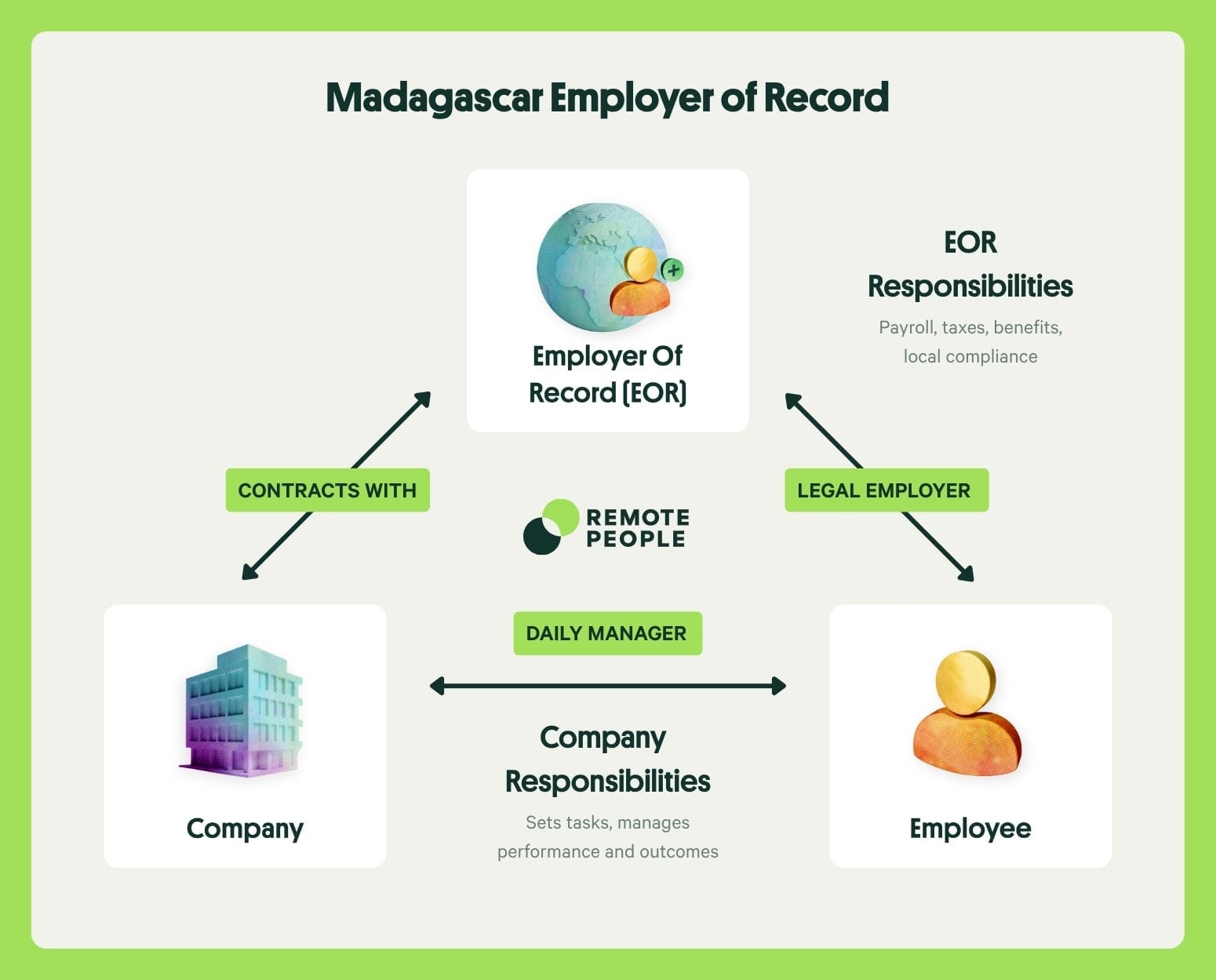
An EOR and a PEO are different tools for different situations. An EOR is the right answer if you do not yet have a Malagasy entity and want to hire quickly without incorporation. The EOR becomes your legal employer, takes the compliance risk, and handles everything end-to-end. The portage salarial mechanism now formally codified by Loi 2024-014 provides a clean legal basis for the EOR model in Madagascar.
A PEO is the right answer if you already have your own Malagasy SARL and want to outsource payroll and HR administration while keeping legal control. Madagascar does not have a dedicated PEO regulatory framework, so PEO arrangements in practice are structured as outsourced payroll and HR services where you remain the legal employer. If you have an existing entity and want to hire someone, a PEO can manage payroll and benefits administration, but you still carry legal and compliance liability. Choose an EOR if you need to hire before you have an entity; choose a PEO or outsourced payroll service if you already have one.
Public Holidays in Madagascar
Madagascar observes 15 gazetted public holidays in 2026, a mix of national anniversaries, Christian feast days, and the two main Islamic holidays. Work performed on a public holiday attracts a 200% premium under Loi 2024-014, in addition to the day itself being a paid rest day. The exact dates for Islamic holidays (Eid al-Fitr and Eid al-Adha) are determined each year based on lunar sightings and may shift by one or two days, and the Council of Ministers occasionally grants a “pont” (bridge day) when a public holiday falls on a Thursday or Tuesday. Employers should confirm the official 2026 calendar with the MFPTLS before publishing internal holiday schedules.
How to Get Started with an EOR in Madagascar
- First, assess your hiring needs. Determine how many employees you plan to hire, whether any require work permits, and your timeline for onboarding. An EOR is ideal for 1–15 employees and situations where speed is critical.
- Second, choose an EOR partner and sign the service agreement. Provide employee details (name, role, salary in ariary or USD, start date, qualifications). Most providers can confirm pricing and timeline within 1–2 business days.
- Third, work with the EOR to prepare employment contracts. The EOR will draft a compliant French-language contract under Loi n° 2024-014, which you and the employee review and sign.
- Fourth, register the employee with CNaPS, OSTIE, and the tax authority. The EOR enrols the employee with the Caisse Nationale de Prévoyance Sociale, affiliates them with OSTIE, obtains the NIF, and opens the payroll account. This typically takes 3–7 days.
- Fifth, conduct the employee onboarding. Set up systems access, training schedules, and team introductions. The employee can begin work once payroll is configured and bank account details are confirmed.
Ready to hire in Madagascar? Get started with RemotePeople and let us handle the complexity of Madagascar’s Loi 2024-014 Labour Code, CNaPS pension, OSTIE health coverage, and IRSA income tax compliance. We will have your team onboarded and compliant within 1–2 weeks.
Where companies hiring in Madagascar expand next
Hiring in Madagascar frequently leads to recruitment across East Africa’s English-speaking cluster and the wider Indian Ocean corridor. Many companies add a team in Kenya first, drawing on the regional East African talent pool. Operations in Uganda follows as aligned East African English-first hiring profile, while Tanzania offers shared East African workforce norms. Hiring in Rwanda is often the fourth step, valued for overlapping East African talent profile.

 Recruit