
 Recruit
Employer of Record in Micronesia
-
 Drew Donnelly
- Published
- September 22, 2026
RemotePeople’s employer of record in Micronesia lets you hire employees in Micronesia without complex statutory setup. We handle mandatory Social Security contributions of 7.5% from employers and 7.5% from employees, with an annual wage cap of $10,000 per employee.
Hire in Micronesia — book a free 30-minute demo
Tell us what you need. You'll get a tailored, transparent proposal within 24 hours, plus a free call to walk through it.
Tell us about your company
So we can match you with a specialist who knows your market — and unlock volume pricing tiers.
* All fields are required.
Where and when are you hiring?
Tell us the geography and timing and we'll quote each country line by line, with onboarding timelines.
* All fields are required.
Help us beat your current setup
We'll benchmark your current deal and send a line-by-line proposal in 24 hours — showing exactly where we cut cost, time, or risk. After you submit, you can book a call to walk through it together.
* All fields are required.
Thanks! Your proposal is on its way.
Expect a tailored, line-by-line proposal in your inbox within 24 hours. In the meantime…
Want to walk through it together?
Book a free 30-minute call with one of our specialists. We'll explain every line, answer your questions, and tailor the proposal further if you need.
No obligation. Pick a time that works for you.








- Hire in Micronesia — book a free 30-minute demo
- Tell us about your company
- Where and when are you hiring?
- Help us beat your current setup
- Thanks! Your proposal is on its way.
- How an Employer of Record Works in Micronesia
- Employment Laws and Regulations in Micronesia
- Work Permits and Visas in Micronesia
- Payroll, Taxes, and Social Security in Micronesia
- Cost of Hiring Through an EOR in Micronesia
- Benefits of Using an EOR in Micronesia
- Termination and Offboarding in Micronesia
- EOR vs. Other Hiring Models in Micronesia
- Public Holidays in Micronesia
- How to Get Started with an EOR in Micronesia
- Where companies hiring in Micronesia expand next
- Frequently Asked Questions
- Related EOR Destinations

Start hiring in Micronesia
Let RemotePeople handle payroll, compliance, and HR admin worldwide so you can focus on building your team.
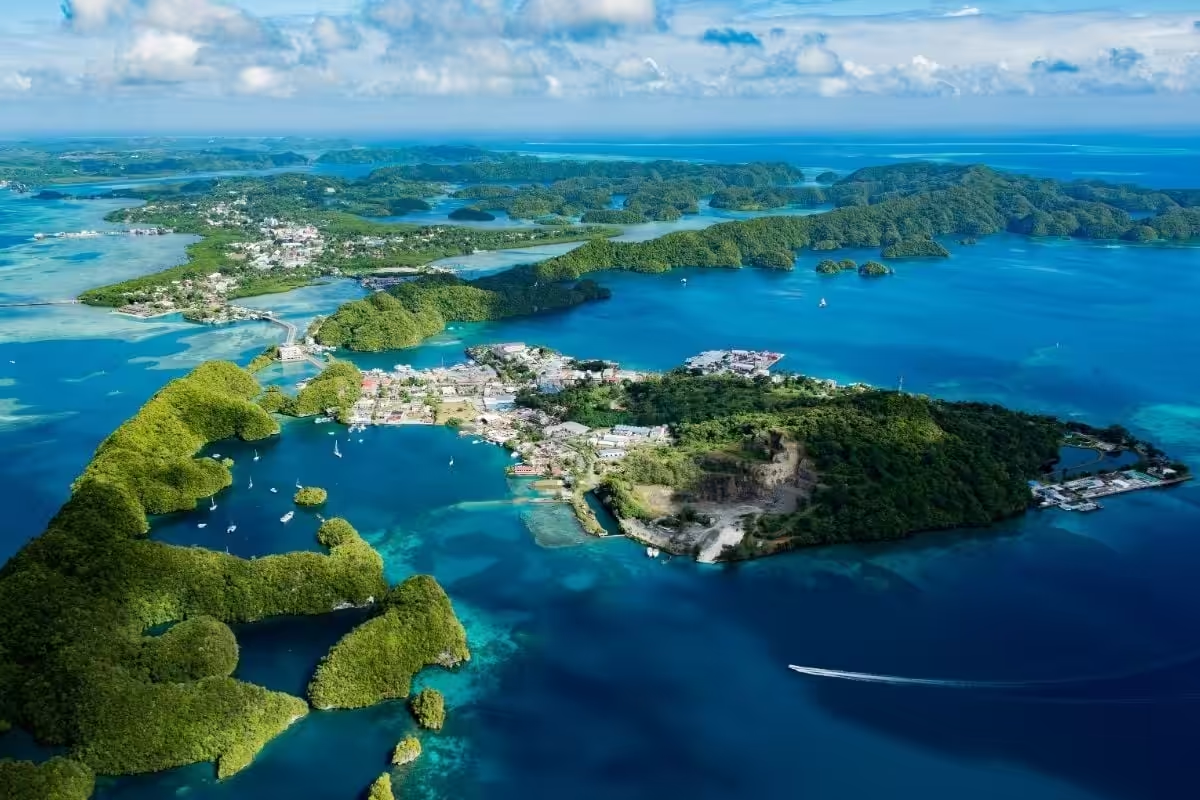
The Federated States of Micronesia (FSM) is a small, open economy that uses the U.S. dollar as its official currency and sits inside the Compact of Free Association with the United States. For companies looking to hire employees in Micronesia, the attraction is simple: a USD-based payroll, a bilingual workforce, and preferential access for U.S. citizens under COFA. The challenge is compliance. FSM spreads employment rules across national Title 51 (Labor), Title 52 (Public Service System), Title 53 (Social Security), Title 54 (Taxation), and Title 50 (Immigration), plus separate state codes in Pohnpei, Chuuk, Yap, and Kosrae.
An employer of record in Micronesia becomes the legal employer of your team on the ground, registers them with the FSM Social Security Administration, withholds the 6% and 10% wage tax bands, files quarterly returns, and sponsors entry permits for non-COFA foreign workers, so you can build a Micronesia team without registering a local corporation.
How an Employer of Record Works in Micronesia
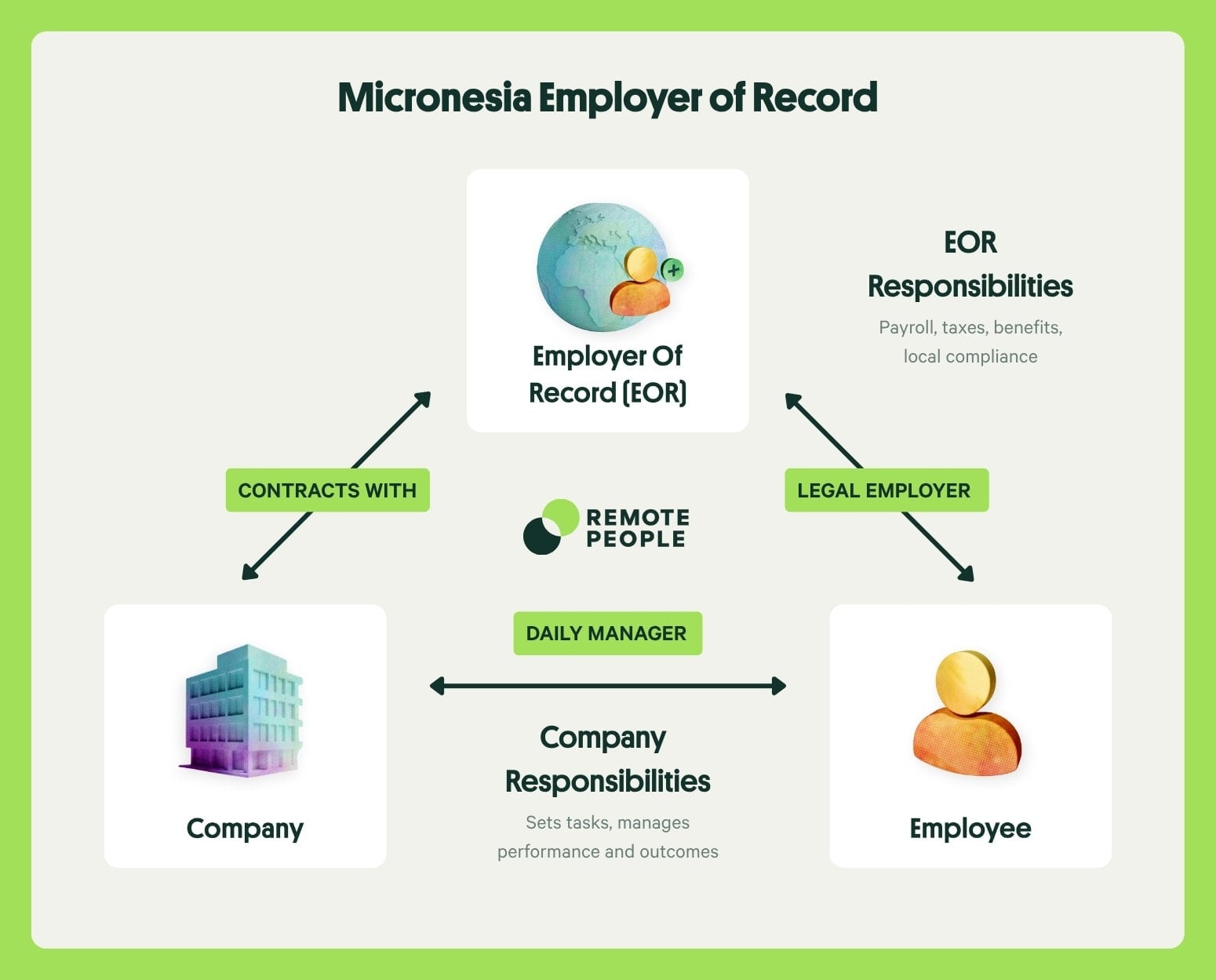
If you’d like to learn more about how Employer of Record (EOR) services work, read our What Is an Employer of Record (EOR)? guide for a complete overview of the model, its benefits, and when to use it.
If you’re comparing providers, our Best Employer of Record (EOR) Providers guide reviews the leading platforms to help you choose the right solution for your business.
Who Uses an EOR in Micronesia?
Because FSM’s employment framework is spread across national and state codes and many provisions default to what the employment contract says, EOR demand in Micronesia comes from companies that want one local legal entity handling everything. Common situations include:
- Testing the Micronesian market: A company expanding into the Pacific that wants a small team in Pohnpei or Kolonia for six to twelve months before committing to a registered FSM corporation.
- Small remote teams: Businesses hiring one to five employees in Micronesia for back-office, customer support, or technical roles, where the cost of incorporating and maintaining local filings outweighs the revenue.
- Fast onboarding of FSM nationals: Companies needing to put an FSM citizen on payroll quickly, with proper FSM Social Security enrollment and wage tax withholding from day one rather than treating them as a contractor.
- Hiring non-COFA foreign nationals: Employers that need to bring in a non-U.S., non-Compact-nation specialist and sponsor an Entry Permit under Title 50, without first registering a local corporation authorized to hire foreign workers.
- Government and donor-funded projects: Organizations executing short-term contracts tied to U.S. federal grants, Asian Development Bank programs, or Pacific regional initiatives that need FSM-resident staff on compliant employment terms.
In each case, the EOR absorbs the registration, filing, and advisory burden that would otherwise require the client to staff a full in-country HR and tax function.
Typical Onboarding Timeline
Most EOR providers can onboard an FSM-resident employee within one to two weeks, assuming the candidate is already in Micronesia and eligible to work. The steps below are sequential but several overlap in practice:
- EOR agreement and employee details: One to two business days to sign the client-EOR service agreement and collect the new hire’s passport, FSM SSA number, bank details, and signed offer.
- Employment contract drafting and review: Two to three days to issue the FSM-compliant contract, localize it to the state of employment, and incorporate client-specific benefits.
- FSM Social Security and wage tax registration: Three to seven days for the FSM Social Security Administration to assign or confirm the employee’s SSA number and for the EOR to set the employee up in the Department of Finance quarterly filing.
- Payroll and benefits setup: Two to three days to load the employee into the payroll system, set up USD direct deposit to a local or U.S. bank, and enroll them in any supplemental health or retirement plan the client offers.
- First day of work: One day to deliver the signed contract, equipment, and client orientation.
When a non-COFA foreign national is involved, the timeline extends by four to eight weeks for Entry Permit processing: a 30-day Employment Service vacancy advertisement is required before the application, plus police clearances, medical certification, and permit issuance ahead of arrival.
Hire in Micronesia
A remote Pacific federation with FSM Social Security, state-level employment rules, and unique compact-related regulations.
We handle employment contracts, payroll, social contributions, and full Micronesian compliance.
No local entity needed. Your team can start in days.
Employment Laws and Regulations in Micronesia
Employment Contracts
Employment in FSM is governed primarily by Title 51 of the FSM Code (Labor), which is focused on the Protection of Resident Workers Act and the Employment Service rather than a comprehensive private-sector labor code. Day-to-day employment terms (working hours, paid leave, notice, and severance) are set by the individual employment contract, the employer’s personnel handbook, and applicable state law. Written contracts are standard practice for both FSM citizens and non-citizens, and an Entry Permit application under Title 50 requires a signed contract as part of the documentation. Fixed-term and indefinite contracts are both used; fixed-term contracts are common for donor-funded project work, while indefinite contracts are standard for permanent hires. English is the working language of government and business and is the language used in virtually all written contracts, though Pohnpeian, Chuukese, Yapese, and Kosraean are also official languages.
Working Hours and Overtime
FSM does not have a comprehensive statutory working-hours or overtime law covering private-sector employment. The Protection of Resident Workers Act in Title 51 regulates non-resident employment but leaves standard hours, rest periods, and overtime multipliers to the employment contract. In practice, a 40-hour week over five days is the customary standard, mirroring the FSM Public Service System Regulations that apply to national government employees, which set office hours at 8:00 a.m. to 12:00 p.m. and 1:30 p.m. to 5:00 p.m. Monday to Friday. Because there is no statutory overtime multiplier, the rates below are the practical norms that most EOR providers and local employers apply in contracts; they should be written into every offer letter and employee handbook rather than assumed.
Micronesia overtime and premium pay rates · Per customary practice and FSM Public Service System Regulations |
|||
Hour Type |
Rate Multiplier |
Weekly/Daily Cap |
Notes |
|---|---|---|---|
Hours over 40/week (weekday) |
1.5x base hourly rate |
No statutory cap |
Customary rate; must be written into the employment contract. Public Service System pays overtime at 1.5x. |
Weekly rest day (Saturday/Sunday) |
1.5x base hourly rate |
No statutory cap |
Contractual. Some employers pay 2x for second rest day worked consecutively. |
Public holidays (Title 1 Ch. 6) |
2x base hourly rate (typical) |
Per holiday worked |
Public-sector employees receive the day off with pay; private-sector rate is contractual but 2x is standard. |
Night-shift premium |
Contractual (commonly 1.15x–1.25x) |
No statutory cap |
Not governed by statute. Negotiated in the employment contract or collective agreement. |
Managerial / supervisory |
Often exempt |
n/a |
Salaried management is typically excluded from overtime in the contract, consistent with U.S. FLSA-style exemptions. |
Because there is no statutory cap on overtime hours or a statutory minimum premium, the single most important compliance step is to document the overtime schedule in the written employment contract. Employers that want to follow U.S.-style norms should reference the Public Service System 1.5x rate for weekday overtime and state holiday pay explicitly. Overtime pay is included in the wage base for FSM Social Security up to the $3,000 quarterly cap and is treated as ordinary wages for the 6%/10% FSM wage tax.
Minimum Wage
FSM has no single national minimum wage for all employment. The national government sets its own rate for federal civil servants, and each of the four states can set its own rate for state government workers and, in Pohnpei’s case, for private-sector employment. The FSM national-government minimum wage for full-time national civil servants is USD 4.52 per hour (effective December 2024 under FSM Congressional action). State minimums vary:
- Pohnpei: USD 2.90/hour for state government workers; USD 1.75/hour statutory minimum for private-sector employment (the only state that sets a private-sector floor).
- Chuuk: USD 2.00/hour for state government workers; no private-sector statutory minimum.
- Yap: USD 3.24/hour for state government workers; no private-sector statutory minimum.
- Kosrae: USD 2.16/hour for state government workers; no private-sector statutory minimum.
Outside Pohnpei, private-sector wages default to what the employment contract sets, provided the rate is enough to satisfy Title 51 requirements for non-citizen employment. In practice, reputable employers use the national government scale or higher. Minimum wage has not been comprehensively revised since the mid-2010s outside the 2024 national civil-service adjustment, so EOR providers re-benchmark to prevailing market rates rather than the statutory floor (FSM Congress). For a detailed breakdown of state-by-state rates and how they apply to different job categories, see our Micronesia minimum wage guide.
Probation Period
FSM’s national labor code does not set a statutory probation period for private-sector employment. Probation is a matter of contract. The FSM Public Service System Regulations apply a one-year probationary period for new career-service national government employees, and this one-year benchmark is the most commonly referenced in private-sector contracts, though three- and six-month probation clauses are also widely used. During probation, either party may terminate without the contractual notice otherwise required, provided the probation clause in the written contract is clear. An EOR will typically align the probation clause with the client’s internal policy while keeping it within the three- to twelve-month range normal in FSM. For typical clause language and how the one-year civil-service benchmark applies in private contracts, see our Micronesia probation period guide.
Leave Entitlements
FSM’s statutory leave regime applies directly to national and state government employees. For private-sector employment, leave is largely contractual: the employer’s handbook and the individual contract set the entitlement. Most private employers and EOR providers in FSM benchmark to the FSM Public Service System Regulations in Title 52, because those are the only fully documented and enforceable standards.
Annual Leave
Under the FSM Public Service System Regulations, full-time permanent national government employees accrue annual leave at eight hours per pay period (approximately four weeks per year, or roughly 20 working days). Accrual begins from the first day of service, including during probation, and unused leave can be carried over subject to a cap. Private-sector employment contracts in FSM commonly match this benchmark, though two to three weeks is also common for smaller employers.
Sick Leave
The Public Service System Regulations provide full-time permanent national government employees with four hours of sick leave per pay period (approximately 13 working days per year), accrued from the first day of service, with unused sick leave carried forward without the cap that applies to annual leave. A medical certificate is typically required for absences of three or more consecutive days. Private-sector sick leave is contractual; many employers adopt the 13-day public-service benchmark, but some mirror U.S. private-sector norms of five to ten days per year.
Maternity Leave
There is no statute of general application that mandates paid maternity leave for private-sector employees in FSM. The Public Service System Regulations and individual agency policies provide maternity leave for national government employees, typically as a combination of annual leave, sick leave, and unpaid leave without pay. Private-sector contracts handled by an EOR usually provide six to twelve weeks of maternity leave, with the paid portion funded by the employer, following the benchmark in the FSM Employee Guide to Rights and Benefits issued by the Department of Personnel (FSM Department of Personnel). Job protection during pregnancy is not governed by a statutory framework and must be written into the contract.
Paternity Leave
FSM has no statutory paternity leave requirement. Public-sector paternity leave is generally drawn from accrued annual leave, and private-sector paternity leave is a matter of contract. EOR providers commonly offer a discretionary five working days of paid paternity leave, aligned with U.S. private-sector practice.
Other Statutory Leave
FSM recognizes several additional types of leave under the Public Service System Regulations, which are commonly adopted in private-sector contracts:
- Bereavement leave: Typically three to five days for the death of an immediate family member; contractual in the private sector.
- Compassionate leave: Short-term paid leave for limited-term appointees and certain family emergencies under the Public Service System Regulations.
- Court / jury duty leave: Paid leave for employees required to appear as witnesses or jurors in FSM courts.
- Military leave: Provided for FSM nationals serving in the U.S. armed forces under the Compact of Free Association.
- Educational leave: Unpaid or partially paid leave available to public-service employees pursuing approved study, at the agency’s discretion.
The table below summarises the leave framework that most EOR providers apply, blending the statutory public-service benchmark with standard private-sector contract terms. The key takeaway is that annual and sick leave accrue from day one of employment, including during probation, because the Public Service System benchmark sets no waiting period.
Micronesia statutory leave entitlements · Per FSM Public Service System Regulations and standard private-sector contracts |
||
Leave Type |
Duration |
Eligibility & Notes |
|---|---|---|
Annual leave |
~20 working days/year (8 hrs per pay period) |
Accrues from day one, including probation. Carryover subject to a cap set by the employer’s policy. |
Sick leave |
~13 working days/year (4 hrs per pay period) |
Accrues from day one. Medical certificate required for 3+ consecutive days. Unused balance carries over without cap. |
Maternity leave |
6–12 weeks (contractual) |
No national statute. Public-sector employees use a combination of annual, sick, and leave-without-pay. Private sector is contractual. |
Paternity leave |
Up to 5 working days (contractual) |
No statutory entitlement. Typically granted as discretionary paid leave in the employment contract. |
Bereavement leave |
3–5 working days |
Contractual. Typically limited to immediate family. |
Public holidays |
10+ paid days/year (national plus state) |
See Title 1 Chapter 6. Each state adds its own constitution day and local observances. |
Military / court / compassionate |
As required |
Governed by the Public Service System Regulations and typically mirrored in private-sector contracts. |
Statutory Employee Benefits
Beyond leave, the mandatory benefits landscape in FSM is narrower than most countries and is centered on the FSM Social Security Administration. An EOR ensures each of the following is in place:
- FSM Social Security contributions: 6% employer and 6% employee under Title 53 Chapter 9, funding old-age, disability, and survivor pensions. Registration with the FSM Social Security Administration is mandatory for every employee.
- Health insurance: FSM does not operate a universal statutory health insurance program. Health coverage is typically provided through the state-run Micronesia Health Insurance Plan or via employer-funded private plans. Offering supplemental private health cover is a strong retention tool and is commonly added to EOR contracts.
- Workers’ compensation: There is no single national workers’ compensation scheme. Employers typically carry private workers’ compensation insurance, and FSM Social Security pays disability and survivor benefits for work-related injuries meeting the statutory tests.
- Wage tax withholding: Employers are required to withhold the 6%/10% wage tax under Title 54 Chapter 2 and remit it quarterly. This is an employer compliance obligation, not a benefit, but failure to comply exposes the employer (and therefore the client of the EOR) to penalties.
- Public holiday pay: Employers observe the holidays listed in FSM Code Title 1 Chapter 6 plus any state-level holidays relevant to the employee’s work location, with paid time off standard for full-time employees.
Unlike many jurisdictions, FSM has no mandatory private pension beyond FSM Social Security, no statutory health-fund contribution, and no mandatory meal or transport allowance. All exact contribution rates are shown in the employer and employee contribution tables in the payroll section.
Recent Regulatory Updates (2026)
FSM’s employment framework has seen targeted rather than sweeping changes in the last 18 months. The most significant update is the December 2024 adjustment of the national-government minimum wage to USD 4.52 per hour, enacted through FSM Congressional action. The FSM Social Security contribution rate remains at 6% employer plus 6% employee, a level in place since July 1, 2000 under Title 53 Chapter 9, and the quarterly wage base cap of USD 3,000 per employer remains unchanged. The Wage and Salary Tax in Title 54 Chapter 2, with its 6% bracket up to USD 11,000 and 10% bracket above, has also held steady, though the FSM National Tax Reform Commission has periodically reviewed options for broader tax reform. At the state level, Pohnpei, Chuuk, Yap, and Kosrae continue to operate their own sales, excise, and hotel taxes, but none imposes a separate wage surtax on top of the national wage tax. Employers should watch for proposed amendments in the current FSM Congress and state legislatures (FSM Congress).
Work Permits and Visas in Micronesia
Work Permit Requirements
Who Needs a Work Permit
FSM citizens need no permit to work in their own country. U.S. citizens and nationals of the Republic of the Marshall Islands and the Republic of Palau (the “Compact” nations) enjoy special status under the Compact of Free Association: they generally need no Entry Permit for short or long residence and no work permit to accept employment in FSM, though they remain subject to immigration registration on arrival. All other foreign nationals, including citizens of the Philippines, China, Australia, Japan, and the EU, require an Entry Permit under Title 50 Chapter 1 of the FSM Code (Immigration Act) before taking up employment.
Eligibility and Required Documents
For non-Compact foreign nationals, the Entry Permit application requires the employer to first advertise the vacancy through the FSM Employment Service for at least 30 calendar days to give FSM citizens an opportunity to apply. If no qualified FSM citizen is available, the employer submits the permit application with the following supporting documents:
- Passport valid for at least six months beyond the intended period of stay
- Signed employment contract specifying position, duration, and compensation
- Police clearance from each country where the applicant has resided for six months or more in the past five years
- Medical certificate confirming fitness to work and freedom from communicable disease
- Evidence of the Employment Service advertisement and any applications received
- Permit fee paid in advance to the FSM Division of Immigration
Processing Time and Validity
Entry Permit processing typically takes four to eight weeks once a complete application is submitted. The initial permit is usually issued for the same duration as the employment contract, up to a statutory maximum, and the employee must have the permit in their possession on arrival in FSM. Delays most often come from missing police clearances, incomplete medical documentation, or gaps in the 30-day Employment Service advertisement.
Renewal Process
Renewal applications are filed through the FSM Division of Immigration before the current permit expires, typically at least 30 days in advance. Documentation includes an updated employment contract, current passport, and fresh medical certification. Employees with a valid and pending renewal may continue to work while the renewal is under review, provided the renewal was filed before the expiration date. The EOR coordinates renewals on behalf of the employee and the client.
Common Visa Types for Foreign Workers
FSM’s Division of Immigration is the sole authority issuing entry permits and resident status under Title 50. The permit catalog is narrower than many countries, reflecting FSM’s small economy: most working foreign nationals come in on an Entry Permit tied to an employer, and only Compact citizens can live and work long term with no employment-specific permit. An EOR registered in FSM can sponsor each of the permits in the table below for the client company’s employees.
Micronesia work visa types for foreign workers · 2026 |
||||
Visa Type |
Duration |
Best For |
Leads to APT? |
Processing |
|---|---|---|---|---|
Entry Permit (Employment) |
1–3 years, renewable |
Non-Compact foreign nationals hired by a FSM-based employer or EOR |
No |
4–8 weeks |
Short-term Visitor (≤30 days) |
Up to 30 days |
Business meetings, short-term assignments under 90 days that do not require a permit |
No |
On arrival |
Compact (COFA) status |
Indefinite, treaty-based |
Citizens of the U.S., Republic of the Marshall Islands, and Republic of Palau |
Yes (treaty-based residence) |
Registration on arrival |
Investor Entry Permit |
1–3 years, renewable |
Foreign investors with an approved Foreign Investment Permit from the relevant state |
Potential path via long residence |
6–10 weeks |
Missionary / Religious Worker Permit |
1 year, renewable |
Clergy and religious-mission staff |
No |
4–8 weeks |
The following non-employment permits exist in FSM’s immigration framework but do not authorise work:
- Tourist entry: For visits up to 30 days; no work rights attach.
- Student permit: For attendance at the College of Micronesia or approved programs; does not permit employment off-campus.
- Transit entry: For passengers in transit through FSM; no work rights.
How an EOR Handles Work Permits
The EOR is the legal employer on the Entry Permit application. It files the 30-day Employment Service advertisement, compiles the police clearance and medical certificate packets, pays the FSM Division of Immigration fees, and coordinates the visa issuance at the nearest FSM consulate or, for visa-waived nationalities, on arrival. The employee is responsible for providing identity documents, personal history, and signed declarations, and for attending any required medical examination. Because the Entry Permit application adds four to eight weeks before the employee can start, work-permit onboarding runs in parallel with contract preparation rather than after it (see the timeline in the How an EOR Works section). Compact citizens do not go through this process at all: they register on arrival and begin work immediately once the EOR has completed payroll and FSM Social Security registration.
Payroll, Taxes, and Social Security in Micronesia
Employer Contributions
Employer payroll burden in FSM is dominated by the FSM Social Security contribution. There is no separate unemployment insurance contribution, no statutory health-fund levy, and no mandatory training tax at the national level. The table below shows the single statutory employer contribution that applies to all employees. For a deeper explanation of how each payroll tax component interacts with gross salary, see our Micronesia payroll tax guide.
Micronesia employer social security contributions · 2026 rates |
||
Contribution |
Rate |
Notes |
|---|---|---|
FSM Social Security (old-age, disability, survivor) |
6.0% |
Applied on wages up to USD 3,000 per quarter per employer under Title 53 § 901. Effective since July 1, 2000. |
Total employer contribution |
6.0% |
Maximum employer contribution: USD 180 per quarter per employee (6% × USD 3,000). |
Employee Contributions
Employees pay the matching 6% FSM Social Security contribution plus the national wage tax under Title 54. State governments do not impose a separate wage surtax on top of the national wage tax, so the payroll deduction stack below is complete for most employees.
Micronesia employee payroll deductions · 2026 monthly withholdings |
||
Deduction |
Rate |
Notes |
|---|---|---|
FSM Social Security |
6.0% |
Applied on wages up to USD 3,000 per quarter under Title 53 § 902. Maximum quarterly deduction: USD 180. |
FSM Wage and Salary Tax |
6% on first USD 11,000 annual; 10% above |
Withheld each pay period under Title 54 Chapter 2. No state wage surtax applies. |
Total employee deduction |
~12% to ~16% depending on wage band |
Exact percentage depends on annual wage and the Title 54 bracket in which each dollar falls. |
Income Tax
FSM has a simple two-bracket Wage and Salary Tax under Title 54 Chapter 2, applied to wages earned in FSM. There is no separate capital-gains tax on employment income, no progressive state wage tax, and no national value-added tax feeding back into payroll. Thresholds are set in USD because FSM uses the U.S. dollar as its official currency.
Micronesia income tax brackets · 2026 |
|
Bracket (annual wages, USD) |
Tax Calculation |
|---|---|
USD 0 – USD 11,000 |
6% of wages in this band |
USD 11,001 and above |
USD 660 + 10% of wages over USD 11,000 |
Payroll Cycle
FSM payroll is paid in U.S. dollars, typically via direct deposit to a local bank (Bank of the FSM, Bank of Guam) or a U.S. bank account. Monthly and semi-monthly cycles are both common, with semi-monthly (the 15th and the last day of the month) mirroring FSM public-service practice. Pay slips must itemize gross wages, FSM Social Security deduction, FSM Wage Tax withheld, and net pay. Employers file quarterly FSM Wage and Salary Tax returns with the Department of Finance and Administration and quarterly FSM Social Security reports with the Social Security Administration; both are typically due within 30 days after quarter-end. An annual employee wage statement is issued to each worker.
13th Month Salary and Bonus Pay
FSM does not have a statutory 13th-month salary. Year-end bonuses, Christmas bonuses, and performance bonuses are entirely at the discretion of the employer and governed by the employment contract or company policy. Some donor-funded and government-adjacent employers pay a Christmas honorarium by tradition, but this is not a legal entitlement. Where bonuses are paid, they are treated as ordinary wages for both FSM Social Security contributions (up to the USD 3,000 per quarter wage base cap) and the FSM Wage and Salary Tax. There is no statutory profit-sharing or 14th-month salary requirement.
Cost of Hiring Through an EOR in Micronesia
EOR Service Fees
EOR service fees in Micronesia typically fall in the USD 300 to USD 600 per employee per month range, billed as a flat monthly service fee. Included in that fee is the drafting of the FSM-compliant employment contract, monthly USD payroll processing, quarterly FSM Wage and Salary Tax filing, quarterly FSM Social Security reporting, benefits administration, leave tracking, and ongoing HR advisory. Entry Permit sponsorship for non-Compact foreign nationals is usually billed separately as a one-time setup fee in the USD 1,000 to USD 2,500 range, plus any government permit fees.
Total Employment Cost Breakdown
The example below shows the total cost to the client of placing a USD 40,000 annual salary employee in FSM through an EOR. Because FSM uses the U.S. dollar, there is no exchange-rate conversion and every line item is in USD. The statutory employer burden in FSM is low compared with most countries: only the 6% FSM Social Security contribution applies, capped at the USD 3,000 per quarter wage base.
Micronesia employer cost example · USD 40,000 gross · 2026 |
||
Employer Cost |
Amount (USD) |
% of Gross |
|---|---|---|
Annual gross salary |
$40,000.00 |
100.00% |
FSM Social Security (6% on USD 3,000/quarter wage base, 4 quarters) |
$720.00 |
1.80% |
EOR service fee (est. $450/month × 12) |
$5,400.00 |
13.50% |
Total annual employer cost |
$46,120.00 |
115.30% |
Because the FSM Social Security contribution is capped at USD 180 per quarter per employee (USD 720 per year), the statutory employer burden as a percentage of salary falls as gross wages rise. At a USD 80,000 salary the statutory employer burden is 0.9% rather than 1.8%; at a USD 20,000 salary it is 3.6%. This is a marked contrast with most countries, where employer contributions apply across the full salary without a meaningful cap.
Ready to hire in Micronesia? Get started with RemotePeople. We handle employment contracts, payroll, tax withholding, and full FSM compliance. No local entity needed.
Benefits of Using an EOR in Micronesia
FSM is an attractive jurisdiction for small international teams because its economy is dollarized, workers generally speak English, and the statutory burden is light. The downside is that the compliance stack is spread across four separate titles of the FSM Code and four state governments, which makes direct setup disproportionately complex for small headcounts. An EOR collapses that complexity into a single contract:
- Speed to market: An EOR in Micronesia can have a FSM-resident employee on payroll in 1–2 weeks, compared with 2–4 months to register a local corporation, open a Micronesian bank account, and complete Department of Finance and FSM Social Security Administration registrations.
- Compliance assurance: The EOR is the legal employer and absorbs the risk of errors in Title 54 wage-tax withholding, Title 53 social security remittance, Title 51 resident-worker protections, and Title 50 immigration filings. Misfiling any of these is expensive and slow to correct in a jurisdiction with limited professional services infrastructure.
- Cost efficiency vs. local entity: For teams under 10 employees, a monthly EOR fee of USD 300–USD 600 per employee is far lower than the total cost of running a FSM corporation, which requires local directors, quarterly tax filings, annual corporate returns, and state-level business license renewal.
- Local expertise: An EOR brings knowledge of state-level variation (Pohnpei’s private-sector minimum wage, Yap’s state holidays, Chuuk’s immigration quirks) that a foreign HR team is unlikely to replicate without hiring in-country staff.
- Flexibility to scale up or down: The EOR relationship ends with a notice-period transition rather than a formal corporate dissolution, which is particularly valuable for donor-funded projects and fixed-term engagements where the client may not operate in FSM beyond the current contract.
- Risk mitigation: The EOR carries workers’ compensation cover, applies the correct FSM holiday schedule by employee location, and manages the Entry Permit process for non-Compact foreign nationals, reducing the risk of visa denial or late filing penalties.
- Employee experience: Employees receive itemized USD payslips, formal FSM Social Security enrollment, and access to the national pension system, which is a significant improvement over informal contractor arrangements and improves retention.
For most buyers, the decision point is not whether an EOR is cheaper than hiring informally; it is whether the compliance exposure of hiring informally (or as a mis-classified contractor) is acceptable. In FSM, the answer for any permanent or full-time role is almost always no.
Termination and Offboarding in Micronesia
Notice Periods
FSM does not set a statutory minimum notice period for private-sector termination. Notice is a matter of the employment contract, with typical contractual practice falling in the two-week to one-month range, and longer periods for senior and managerial roles. For FSM national government employees, the Public Service System Regulations set notice requirements linked to tenure and appointment type, and most private-sector EOR contracts benchmark to that schedule. Notice can generally be paid in lieu of service where the contract allows, and the employer and employee periods are usually mirrored.
Micronesia statutory notice periods by position level · Per contract benchmark and FSM Public Service System Regulations |
|||
Tenure / Position |
Notice Period |
During Probation |
Notes |
|---|---|---|---|
Less than 6 months |
2 weeks (contractual) |
None or 1 week |
No statutory floor. Sets the market benchmark for junior roles. |
6 months – 2 years |
2–4 weeks (contractual) |
n/a |
Standard range in EOR contracts for non-managerial staff. |
2 – 5 years |
1 month (contractual) |
n/a |
One month is the most common period once tenure exceeds two years. |
5+ years / Managerial |
1–3 months (contractual) |
n/a |
Longer periods are standard for senior and managerial roles; sometimes 90 days. |
Summary dismissal (just cause) |
None |
None |
Permitted for gross misconduct, theft, or similar breach documented in the contract. |
Exceptions to the contractual notice period include mutual agreement to a shorter period, summary dismissal for gross misconduct, and end-of-fixed-term contracts that expire automatically without notice. Employers should always document notice terms in the written contract because there is no statutory default to fall back on.
Severance Pay
FSM does not have a statutory severance-pay regime for private-sector employment. Severance is contractual, and many employment contracts simply provide paid notice or payment in lieu of notice at termination, with no additional severance. The Public Service System Regulations govern separation benefits for national government employees, including retirement-related payouts under the FSM Social Security system, but those do not flow through to the private sector. The table below shows the practical benchmark that most EOR providers apply when severance is offered contractually, expressed in weeks of base salary per year of service.
Micronesia severance pay schedule by years of service · Per contract benchmark (no statutory severance) |
|||
Years of Service |
Severance Amount |
Base Salary |
Notes |
|---|---|---|---|
1 year |
2 weeks’ base salary |
Gross monthly base wage |
Contractual benchmark. Many contracts pay none until 2+ years. |
3 years |
6 weeks’ base salary |
Gross monthly base wage |
2 weeks per year of service is the standard EOR benchmark. |
5 years |
10 weeks’ base salary |
Gross monthly base wage |
Contractual. Excludes annual bonus and overtime unless contract specifies. |
10 years |
20 weeks’ base salary |
Gross monthly base wage |
Contractual. Many contracts cap severance at 12 or 26 weeks regardless of tenure. |
Calculation Method
Where an employment contract provides severance, the typical formula is two weeks of gross base monthly wage per completed year of service, paid as a lump sum at termination. Base salary excludes overtime, discretionary bonuses, and allowances unless the contract expressly includes them. The worked examples in the severance table above apply the two-weeks-per-year benchmark for tenures of one, three, five, and ten years.
Caps and Exceptions
Because severance is contractual, caps are set by the contract and commonly fall between 12 and 26 weeks of base salary regardless of tenure. Typical exceptions where no severance is owed include termination for just cause (gross misconduct, theft, fraud, repeated insubordination), resignation by the employee, expiration of a fixed-term contract, and termination during the probation period. Employers should ensure the contract spells out both the cap and the exception list; without a written contract, disputes default to general contract principles in FSM courts.
Grounds for Termination
FSM law recognizes termination for just cause (e.g., gross misconduct, breach of contract, theft, repeated poor performance after documented warnings), termination without cause (usually requiring contractual notice), mutual agreement, expiration of a fixed-term contract, and redundancy. Protected categories include employees on maternity leave and those pursuing good-faith complaints about immigration or tax compliance. The EOR handles the written documentation, final pay calculation, FSM Social Security deregistration, and Entry Permit cancellation where applicable, and delivers the final payslip that settles accrued leave and any contractual severance.
EOR vs. Other Hiring Models in Micronesia
EOR vs. Setting Up a Local Entity
For most companies hiring fewer than 10 employees in FSM, an EOR wins on every metric that matters: time, cash outlay, ongoing compliance burden, and exit cost. Registering a FSM corporation requires local directors, a business license from the relevant state, a Foreign Investment Permit for most foreign-owned businesses, and ongoing quarterly filings with both the Department of Finance and the FSM Social Security Administration.
Micronesia EOR vs local entity comparison · Setup time, cost, risk and best-fit |
||
Comparison |
Employer of Record |
Own Entity |
|---|---|---|
Setup time |
1–2 weeks |
2–4 months |
Upfront cost |
$0 |
$5,000–$15,000 |
Ongoing cost |
$300–$600/employee/month |
$10,000–$25,000/year maintenance |
Local partner required |
No (EOR is the local entity) |
Yes (Foreign Investment Permit and local director typically required) |
Social insurance registration |
Handled by EOR |
You manage it |
Payroll and tax filing |
Handled by EOR |
You manage it (or outsource) |
Best for team size |
1–15 employees |
15+ employees |
Scale down / exit |
Easy: no entity to unwind |
Costly: legal dissolution required |
Government contracts |
Not eligible |
Eligible (requires local entity) |
The decisive factor for most buyers is the combination of setup time and exit cost. Two to four months before a new hire can be paid is rarely acceptable, and the legal dissolution process for an unused FSM corporation runs for several additional months. The EOR model eliminates both of these friction points and is the right choice for any engagement expected to last less than three years or involve fewer than fifteen hires.
EOR vs. Hiring Independent Contractors
Hiring a Micronesian worker as an independent contractor is sometimes appropriate for short-term, project-scoped work where the contractor uses their own tools, sets their own hours, and serves multiple clients. For any ongoing, full-time role the contractor model creates misclassification exposure: FSM courts and the Department of Finance can recharacterise a relationship as employment for wage-tax and social security purposes, triggering back contributions, interest, and penalties.
Micronesia EOR vs independent contractors · Compliance, cost, and risk |
||
Comparison |
EOR (Full-Time Employee) |
Independent Contractor |
|---|---|---|
Legal relationship |
Employee of the EOR |
Self-employed, no employment relationship |
Compliance risk |
Low: EOR ensures local labor law compliance |
Moderate: misclassification risk if the relationship resembles employment |
Payroll and tax |
EOR handles wage-tax withholding, FSM Social Security, and filings |
Contractor invoices you; they handle their own taxes |
Benefits and leave |
Statutory benefits, paid leave, FSM Social Security |
No entitlement to employee benefits |
IP protection |
Stronger: employment contract assigns IP to the client company (you) by default |
Weaker: requires explicit IP assignment clause |
Termination |
Subject to contractual notice and any agreed severance |
Contract can be ended per agreement terms |
Best for |
Long-term, core team roles |
Short-term projects, specialized tasks |
Cost structure |
Salary + FSM Social Security + EOR fee |
Contractor fee (often higher gross, lower total cost) |
Source: FSM Code Title 54 Chapter 2 and FSM Code Title 51 Labor |
||
Contractor classification in FSM is more permissive than in many countries, but the compliance cost of getting it wrong is real: the Department of Finance can assess unpaid wage tax and the FSM Social Security Administration can assess unpaid contributions with interest. For any role where the worker uses the client’s tools, follows the client’s hours, and works full-time for a single buyer, the EOR model is the appropriate structure. RemotePeople’s Micronesia contractor-of-record service is the right option for clearly project-scoped engagements.
EOR vs. PEO (Professional Employer Organization)
The Professional Employer Organization (PEO) model is common in the United States and depends on the client already operating its own U.S. entity. FSM does not have a formal PEO regulatory framework, but because the U.S. dollar is the official currency and many U.S. HR and payroll concepts carry over, U.S. PEOs occasionally support FSM-based staff of a U.S. parent. The practical distinction is simple: an EOR is the legal employer and does not require the client to have a FSM entity; a PEO is a co-employment arrangement that only works if the client already has its own legal entity to co-employ with.
Micronesia EOR vs PEO comparison · Legal employer, liability, and setup |
||
Comparison |
Employer of Record (EOR) |
PEO |
|---|---|---|
Legal employer |
EOR is the legal employer |
You remain the legal employer (co-employment) |
Local entity required |
No (EOR is the local entity) |
Yes, you must have your own entity in FSM |
Best for |
Companies without a local entity |
Companies that already have a local entity |
Compliance liability |
EOR assumes compliance responsibility |
Shared liability between you and the PEO |
Setup time |
1–2 weeks |
Depends on your entity setup (weeks to months) |
Control over HR policies |
EOR manages within local law framework |
More direct control, PEO advises |
Typical use case |
Market entry, small remote teams, testing new markets |
Established local operations needing HR outsourcing |
Source: FSM Code Title 51 Labor and FSM Code Title 53 Chapter 9 |
||
For a company entering FSM for the first time, the EOR is almost always the right structure because there is no local entity to co-employ with. PEO becomes a consideration only once the client has established a registered FSM corporation and wants to outsource day-to-day HR administration while retaining legal-employer status.
Public Holidays in Micronesia
FSM public holidays are codified in FSM Code Title 1 Chapter 6. When a holiday falls on a Saturday, it is observed the preceding Friday; when it falls on a Sunday, it is observed the following Monday. Each of the four states adds its own constitution day and local observances on top of the national list. Employers should calendar both the national holidays below and the state holidays relevant to each employee’s work location.
Micronesia public holidays · 2026 calendar year |
||
Date |
Holiday |
Type |
|---|---|---|
Jan 1 (Thu) |
New Year’s Day |
National |
Jan 11 (Sun, obs. Jan 12) |
Kosrae Constitution Day |
State (Kosrae) |
Mar 1 (Sun, obs. Mar 2) |
Yap Day |
State (Yap) |
Mar 31 (Tue) |
Micronesian Culture and Tradition Day |
National |
May 10 (Sun, obs. May 11) |
FSM Constitution Day |
National |
Sep 8 (Tue) |
Kosrae Liberation Day |
State (Kosrae) |
Sep 24 (Thu) |
Chuuk Liberation Day |
State (Chuuk) |
Oct 1 (Thu) |
Chuuk Constitution Day |
State (Chuuk) |
Oct 24 (Sat, obs. Oct 23) |
United Nations Day |
National |
Nov 3 (Tue) |
FSM Independence Day |
National |
Nov 8 (Sun, obs. Nov 9) |
Pohnpei Constitution Day |
State (Pohnpei) |
Nov 11 (Wed) |
Veterans of Foreign Wars Day |
National |
Dec 24 (Thu) |
Yap Constitution Day |
State (Yap) |
Dec 25 (Fri) |
Christmas Day |
National |
Public holidays affect payroll scheduling in two ways. First, holidays worked typically attract a contractual premium (commonly 2x base hourly rate), which an EOR will build into the monthly payroll run. Second, pay days that fall on a public holiday are advanced to the preceding business day under standard FSM payroll practice, so the monthly cycle calendar should be set at the start of the year and communicated to employees.
How to Get Started with an EOR in Micronesia
Setting up an FSM team through an EOR follows a predictable sequence. Each step below takes one to five business days, and several run in parallel.
- First, scope the hire: Define the role, salary in USD, work location (Pohnpei, Chuuk, Yap, or Kosrae), start date, and whether the candidate is a FSM citizen, a Compact citizen, or a non-Compact foreign national. This determines whether an Entry Permit is required.
- Second, sign the EOR service agreement: Execute the EOR service contract, which sets the monthly service fee, Entry Permit setup fee if applicable, and the scope of HR services. The EOR typically requires the first month of fees plus a deposit at signing.
- Third, issue the FSM employment contract: The EOR drafts the FSM-compliant contract in English, incorporates client-specific benefits and IP assignment clauses, and sends it to the employee for signature. The signed contract is the basis for FSM Social Security and wage-tax registration.
- Fourth, register payroll and sponsor immigration if needed: The EOR enrolls the employee with the FSM Social Security Administration, loads them into the payroll system, and sets up USD direct deposit. For non-Compact foreign nationals, the EOR files the Entry Permit application with the FSM Division of Immigration in parallel.
- Fifth, run the first payroll cycle: The employee starts work, the EOR issues the first itemized USD payslip on the next cycle, and quarterly FSM Wage Tax and FSM Social Security filings follow the standard calendar.
Contact RemotePeople to hire in Micronesia. We operate as your employer of record in Micronesia, run USD payroll, handle FSM Social Security, wage tax filings, and Entry Permit sponsorship, and have your team onboarded in one to two weeks.
Where companies hiring in Micronesia expand next
Companies operating in Micronesia often extend across the Asia-Pacific, drawing on English-speaking talent and aligned business culture. Common expansion paths include operations in New Zealand (the regional Pacific talent footprint) and Fiji (Pacific-region proximity and English-first hiring). Teams scaling further usually add hiring in Papua New Guinea for aligned Pacific workforce norms, with an EOR partner in Australia extending coverage through shared Pacific business rhythm.
Frequently Asked Questions
EOR services in Micronesia typically cost between USD 300 and USD 600 per employee per month as a flat service fee. That covers FSM-compliant contracts, USD payroll processing, FSM Social Security contributions (6% employer + 6% employee under Title 53 Chapter 9), Title 54 wage-tax withholding, benefits administration, and HR advisory. Entry Permit sponsorship for non-Compact foreign nationals is typically billed separately as a one-time setup fee.
For a FSM citizen or Compact citizen already in country, one to two weeks from signed EOR agreement to first day of work. For a non-Compact foreign national requiring an Entry Permit under FSM Code Title 50, add four to eight weeks for the immigration process, including the mandatory 30-day Employment Service vacancy advertisement.
Employer payroll burden is limited to the FSM Social Security contribution of 6% on wages up to USD 3,000 per quarter per employer, capped at USD 180 per quarter per employee. There is no separate national unemployment, health, or training tax at the national level, and no state-level wage surtax. The rates are set in FSM Code Title 53 Chapter 9.
Under FSM Code Title 54 Chapter 2, the Wage and Salary Tax is 6% on the first USD 11,000 of annual wages and 10% on amounts above USD 11,000. States do not impose a separate wage surtax on top of the national rate, so the effective tax stack for most employees is the 6% or 10% wage tax plus the 6% FSM Social Security contribution.
No. FSM does not have a statutory severance-pay regime for private-sector employment. Severance is a matter of contract, and many employment contracts do not provide for severance at all. The typical EOR benchmark is two weeks of base salary per year of service, capped at 12 to 26 weeks, where the contract elects to offer severance. See FSM Code Title 51.
No. Under the Compact of Free Association, U.S. citizens and nationals of the Republic of the Marshall Islands and the Republic of Palau enjoy special status in FSM and do not require an Entry Permit or work permit to take up employment. They register on arrival with FSM immigration and can begin work once their employer has completed FSM Social Security and payroll registration (USCIS).
You can, but it only works cleanly for genuinely project-scoped, short-term engagements where the contractor sets their own hours and uses their own tools. For full-time, ongoing roles the FSM Department of Finance and FSM Social Security Administration can recharacterise the relationship as employment, triggering back wage-tax and social security contributions with interest. RemotePeople's contractor management service is the right option for project-scoped engagements; for core team roles, use the EOR.
FSM recognises copyright and trademark protections, and IP created by an employee in the course of employment is typically assigned to the client company (you), not the EOR, by an express clause in the FSM employment contract. Because IP assignment relies on the contract rather than a broad work-for-hire statute, every EOR-drafted contract should include an explicit IP clause naming the client company as the owner of work product.
Employer of Record in
Employer of Record in
Employer of Record in
Employer of Record in
Employer of Record in
Employer of Record in
Employer of Record in
Employer of Record in