
 Recruit
Employer of Record in Saint Lucia
-
 Drew Donnelly
- Published
- September 22, 2026
RemotePeople’s employer of record in Saint Lucia lets you hire employees in Saint Lucia without establishing a local entity. We handle National Insurance Corporation contributions, Education Levy payments, and Training Levy contributions.
Hire in Saint Lucia — book a free 30-minute demo
Tell us what you need. You'll get a tailored, transparent proposal within 24 hours, plus a free call to walk through it.
Tell us about your company
So we can match you with a specialist who knows your market — and unlock volume pricing tiers.
* All fields are required.
Where and when are you hiring?
Tell us the geography and timing and we'll quote each country line by line, with onboarding timelines.
* All fields are required.
Help us beat your current setup
We'll benchmark your current deal and send a line-by-line proposal in 24 hours — showing exactly where we cut cost, time, or risk. After you submit, you can book a call to walk through it together.
* All fields are required.
Thanks! Your proposal is on its way.
Expect a tailored, line-by-line proposal in your inbox within 24 hours. In the meantime…
Want to walk through it together?
Book a free 30-minute call with one of our specialists. We'll explain every line, answer your questions, and tailor the proposal further if you need.
No obligation. Pick a time that works for you.








- Hire in Saint Lucia — book a free 30-minute demo
- Tell us about your company
- Where and when are you hiring?
- Help us beat your current setup
- Thanks! Your proposal is on its way.
- How to Hire Employees in Saint Lucia
- Saint Lucia EOR vs Legal Entity in Saint Lucia
- Using an Employer of Record in Saint Lucia
- How Much Does a Saint Lucia EOR Cost?
- Employment and Labor Laws in Saint Lucia
- Payroll and Employment Taxes in Saint Lucia
- Work Permits and Visas in Saint Lucia
- Time Off and Leave in Saint Lucia
- Employee Benefits in Saint Lucia
- Terminations and Severance in Saint Lucia
- Expand into Saint Lucia Easily with RemotePeople’s Employer of Record (EOR) Solution
- Where companies hiring in Saint Lucia expand next
- Frequently Asked Questions
- Related EOR Destinations

Start hiring in Saint Lucia
Let RemotePeople handle payroll, compliance, and HR admin worldwide so you can focus on building your team.

Saint Lucia is emerging as an attractive destination for international businesses looking to expand into the Caribbean. The island nation offers a stable political environment, a growing economy, and a strategic location that makes it well-suited for companies seeking access to both Caribbean and Latin American markets.
That said, international employers should be aware that Saint Lucia does not follow at-will employment principles. Terminating an employee requires a valid reason, and close attention to local compliance requirements is essential.
Saint Lucia uses the Eastern Caribbean Dollar (XCD), with its capital in Castries. English is the official language, with Kwéyòl widely spoken. The national minimum wage is EC$6.52 per hour (approximately EC$1,131 per month), and the standard workweek is 40 hours. Employees are entitled to 14 days of annual leave, and around 14 public holidays are observed each year. Social security contributions are split equally between employers and employees at 5% each. Income tax is applied on a progressive scale of 10% to 30% on taxable income above EC$18,400. Employer of Record (EOR) services in Saint Lucia typically start from $199 per month.
Whether you’re a startup looking to access Caribbean talent or an established enterprise, this guide covers everything you need to know about hiring in Saint Lucia through an EOR.
How to Hire Employees in Saint Lucia
There are three main options for hiring employees in Saint Lucia:
Setting Up a Local Entity
To establish a local entity in Saint Lucia, the company must be incorporated under Saint Lucian law. The incorporation process takes 4-8 weeks and involves registration with the Companies Registry, obtaining the necessary business licenses, and establishing a local office address.
Once established, you’ll be responsible for ongoing compliance requirements. While you’ll have full control over your operations, you’ll also need to independently manage payroll processing, employee benefits, and other compliance duties.
Working with an Employer of Record (EOR)
An Employer of Record service offers the fastest and most compliant way to hire employees in Saint Lucia without a local entity.
They act as the legal employer for your Saint Lucian team members and handle all employment responsibilities, including contracts, payroll, benefits, tax compliance, and regulatory requirements.
Hiring Independent Contractors
International employers can consider hiring independent contractors for project-based work or specialized services.
However, Saint Lucia has specific criteria that determine whether someone can legitimately be classified as a contractor or an employee. Employers must pay careful attention to these requirements to avoid the risk of misclassification.
You can partner with a Contractor of Record service to help ensure proper classification and handle all compliance requirements for legitimate contractor relationships.
If you’d like to learn more about how Employer of Record (EOR) services work, read our What Is an Employer of Record (EOR)? guide for a complete overview of the model, its benefits, and when to use it.
If you’re comparing providers, our Best Employer of Record (EOR) Providers guide reviews the leading platforms to help you choose the right solution for your business.
Saint Lucia EOR vs Legal Entity in Saint Lucia
Choosing between an EOR and establishing a local entity depends on your business needs, strategy, and long-term goals.
EOR services require no setup fees, and employers can have their first employee working within 3-5 business days. Unlike setting up a local entity that involves substantial upfront costs and a lengthy process, EORs reduce the total first-year cost for small to medium-sized teams.
With an EOR, all compliance responsibilities are handled by experienced professionals, so you don’t have to manage compliance as required by local companies.
EOR services offer exceptional flexibility. You can easily adjust team size based on business needs, and enter or exit the market without having to manage employment obligations during business fluctuations.
That’s why partnering with an EOR often reduces overall costs; it removes the need to spend on office space, utility bills, and legal advisory services.
Using an Employer of Record in Saint Lucia
An Employer of Record in Saint Lucia handles all employment and compliance responsibilities so you can fully focus on your core business objectives.
They act as your local employer, so you can recruit local talent without having to set up a local entity.
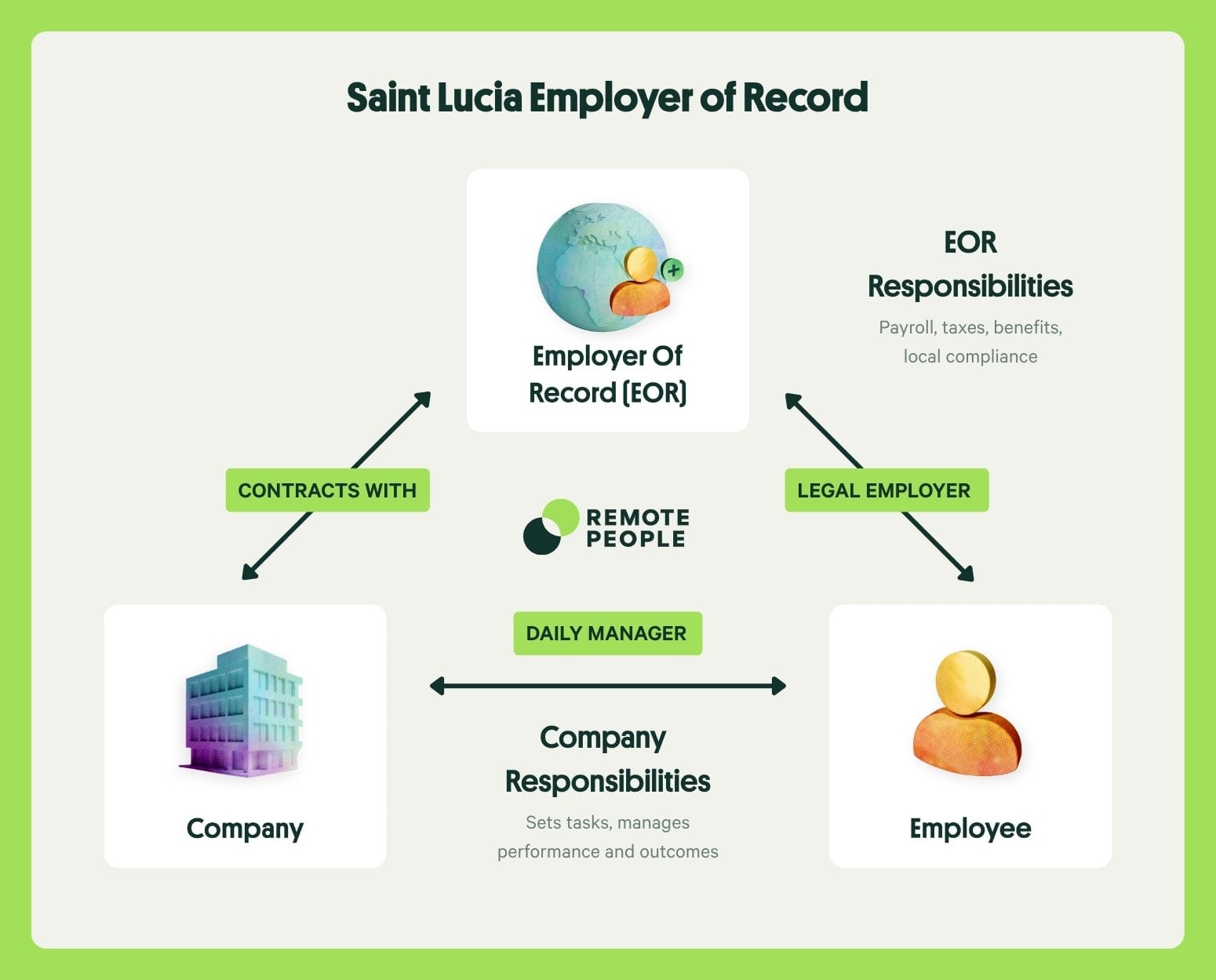
An Employer of Record in Saint Lucia handles the following responsibilities on your behalf:
- Employment contracts: They draft and maintain employment contracts that comply with Saint Lucian laws, including proper terms for working hours, compensation, benefits, and termination procedures.
- Payroll Processing: An EOR team handles all aspects of payroll. They calculate salaries, tax withholdings, and social security contributions and ensure timely payments to employees and government agencies.
- Tax Compliance: The EOR ensures accurate calculation and remittance of all employment-related taxes, including income tax withholdings, social security contributions, and other statutory deductions.
- Benefits Administration: EORs manage statutory benefits like vacation time, sick leave, and maternity/paternity leave, plus any additional benefits you choose to provide.
- Termination Management: When employment ends, EORs handle all aspects, including notice periods, final payments, severance calculations, and regulatory notifications.
How Much Does a Saint Lucia EOR Cost?
EOR pricing in Saint Lucia varies by provider. Some charge onboarding fees ranging from $500 to $2,000, plus monthly per-employee fees typically between $500 and $700. RemotePeople charges no onboarding fee, with monthly costs starting at $199 per employee, covering contract management, payroll processing, tax compliance, and basic benefits administration.
Many providers also offer optional add-ons such as dedicated HR support, insurance packages, equipment procurement, and tax reporting, available at an additional cost.
Compared to establishing a local entity independently, EOR services offer a more cost-effective and administratively efficient path to hiring in Saint Lucia, with faster setup and significantly lower financial risk.
Hire in Saint Lucia
An Eastern Caribbean island with NIC contributions, Saint Lucia Labour Code, and local statutory employment protections.
We handle employment contracts, payroll, social contributions, and full Saint Lucian compliance.
No local entity needed. Your team can start in days.
Employment and Labor Laws in Saint Lucia
For successful hiring and compliance in Saint Lucia, employers must adhere to the employment and labor laws. Here is a detailed breakdown of employment responsibilities every business owner needs to carry out when hiring in the country.
Key Contract Requirements
Employment contracts in Saint Lucia must clearly outline all terms and conditions of employment.
Written employment contracts are mandatory for all employment relationships exceeding one month. They must include job title and description, workplace location, start date, salary and payment terms, working hours, vacation entitlements, notice periods, and termination procedures.
Contracts must specify the nature of employment and comply with minimum wage requirements, but cannot contain terms less favorable than those required by law.
Fixed-term contracts are permitted but cannot be used to circumvent permanent employment rights.
Working Hours
Standard working hours in Saint Lucia are limited to 40 hours per week, which means five 8-hour work days. The normal working day cannot exceed 8 hours without overtime compensation.
Employees are entitled to at least one rest day per week, and work schedules must include appropriate rest periods, with at least 30 minutes for meals during shifts exceeding 5 hours.
Flexible working arrangements are common and acceptable, provided they meet total hour requirements and don’t conflict with business operations or client service needs.
Overtime
In Saint Lucia, work performed beyond the standard working hours (typically 40 hours per week) is considered overtime and must be compensated at a rate of at least 1.5 times the employee’s regular wage. Work performed on Sundays or public holidays must be paid at no less than twice the regular rate.
The law does not prescribe a specific premium rate for night work; any additional compensation for night shifts is generally determined by employer policy or collective agreement. Employers are expected to maintain accurate records of working hours to ensure compliance with overtime obligations.
Social Security Contribution
social security is managed by the National Insurance Corporation (NIC). Contributions are mandatory and shared equally, with 5% paid by the employer and 5% by the employee. Contributions are calculated on insurable earnings up to a statutory ceiling of EC$5,000 monthly or EC$60,000 annually, and earnings above this threshold are not subject to additional NIC contributions. As a result, both employer and employee contributions are effectively capped at this level.
Employers must deduct the employee’s share and remit total contributions monthly, with payments typically due by the 7th of the following month.
Probation Periods
Probationary periods in Saint Lucia are limited to 3-6 months for most positions. During probation, either party can terminate employment with shorter notice periods, usually one week.
The probationary period is intended for performance evaluation, not to deny basic employment rights. Even during probation, termination must be for legitimate reasons and cannot be discriminatory or retaliatory.
Payroll and Employment Taxes in Saint Lucia
Employers who wish to hire in Saint Lucia must implement the country’s payroll system. This includes base wages, statutory deductions, employer contributions, and various tax obligations.
Here’s a summary of requirements that must be met for compliance and accurate cost planning.
Payroll Cycle
Most employers in Saint Lucia process payroll monthly, but bi-weekly payment is also common and acceptable. Payment must be made within 7 days of the agreed pay period end.
Minimum Wage
Saint Lucia introduced a national minimum wage effective October 1, 2024, set at EC$6.52 per hour or EC$1,131 per month (approximately USD 419).
As of February 2026, this rate applies broadly to employees across the country, establishing a consistent minimum earnings standard. The introduction of this measure represents the country’s first unified wage floor, providing greater clarity and protection for workers and employers alike.
Employer Tax Contributions
In Saint Lucia, employer payroll obligations are simple and relatively low. The only mandatory employer contribution is to the National Insurance Corporation (NIC), where employers must pay 5% of each employee’s insurable earnings. There are no additional statutory payroll taxes, such as education or training levies.
Employers are also required to operate the Pay-As-You-Earn (PAYE) system by withholding income tax from employees’ salaries and remitting it to the government; however, this is an administrative responsibility and not an added cost to the employer.
Employee Payroll Contributions
Employees also make mandatory contributions:
- Social Security: Employees contribute 5% of their wages up to the maximum contributory ceiling, matching the employer contribution.
- Union Dues: Where applicable, union membership dues are deducted from wages according to collective agreements.
Income Tax
The first EC$18,400 of annual income is tax-free (personal allowance). Income above this threshold is taxed progressively as follows:
| Taxable Income (Above EC$18,400) | Rate |
|---|---|
| EC$18,401 – EC$28,400 | 10% |
| EC$28,401 – EC$38,400 | 15% |
| EC$38,401 – EC$48,400 | 20% |
| EC$48,401 and above | 30% |
Tax withholdings are calculated monthly based on annual income projections. Employees may need to file annual returns depending on their total income and withholding accuracy.
Pension System
Saint Lucia provides retirement, disability, and survivor benefits to employees in the company. However, both employers and employees must contribute 5% of wages up to the maximum contributory ceiling.
Bonus Payments
Bonus payments in Saint Lucia are not mandatory and are generally at the employer’s discretion. However, any promised bonuses become legally enforceable obligations that must be met by the employer.
Please note that all bonus payments are subject to the same tax withholdings and social security contributions as regular wages.
Tax Compliance and Payroll Reporting
Employers must file monthly payroll reports with the Inland Revenue Department and remit all withheld taxes by the 15th of the following month. Failure to meet the deadline may incur penalties and interest charges.
Employers must also provide employees with annual tax statements by January 31st following the tax year.
Work Permits and Visas in Saint Lucia
Foreign nationals wishing to work in Saint Lucia must obtain a valid work permit before commencing employment. The type of permit required depends on the nature and duration of the role.
- Critical Skills Employment Permit: For professionals in fields where local expertise is limited, such as healthcare, engineering, IT, and financial services. Permits are granted for one to two years and are renewable.
- General Employment Permit: For roles outside the critical skills category. Employers must demonstrate genuine efforts to recruit locally before applying. Processing takes six to ten weeks, and permits are typically valid for one year with the possibility of extension.
- Intra-Company Transfer Permit: For employees transferring between related companies or subsidiaries. Applicants must have been with the transferring company for at least six to twelve months. Permits are valid for six months to two years, depending on the purpose of the transfer.
Time Off and Leave in Saint Lucia
Mandatory Leave Entitlements
Employees are entitled to paid annual leave after completing one year of continuous service, with a minimum entitlement of 14 working days. This entitlement increases to 21 working days after five years of service. Vacation leave must be used within 6 months of entitlement, unless both the employer and employee agree to a different arrangement.
Maternity Leave
Female employees are entitled to 13 weeks of paid maternity leave, with at least 6 weeks required after childbirth. The leave can begin up to 6 weeks before the expected delivery date.
Employees are guaranteed job protection during maternity leave and cannot be terminated due to pregnancy or maternity leave usage.
Paternity Leave
Saint Lucia Labor Code does not provide a statutory entitlement to paternity leave. While maternity leave is clearly defined under the law, any paternity leave benefits are determined by employer policy or collective agreement rather than legislation.
Sick Leave
Employees are entitled to paid sick leave of 14 days(in a year) after completing three months of service. Employers can require employees to use designated healthcare providers for verification purposes.
Sick leave cannot be accumulated beyond the current year, and unused sick leave is not to be paid upon termination.
Public Holidays
Employers in Saint Lucia must grant leave for statutory public holidays defined by law, including any officially observed substitute days when holidays fall on weekends.
- New Year’s holidays (January 1 & 2)
- Independence Day (Feb 22)
- Good Friday (date varies)
- Easter Monday (date varies)
- Labor Day (May 1)
- Whit Monday (date varies)
- Corpus Christi (date varies)
- Emancipation Day (Aug 1)
- Thanksgiving Day (first Monday in October)
- National Day (Dec 13)
- Christmas Day (Dec 25)
- Boxing Day (Dec 26)
Bereavement and Jury Duty
Employees in Saint Lucia are entitled to paid bereavement leave for the death of immediate family members, typically 3-5 days depending on the relationship and circumstances.
Jury duty leave is mandatory when employees are called for jury service, and employers cannot penalize employees for fulfilling this civic duty.
Employee Benefits in Saint Lucia
Aside from the mandatory statutory benefits of working in Saint Lucia, employers can provide supplementary benefits to attract and retain talent.
Social Security coverage already provides retirement, disability, unemployment, and medical benefits funded through employer and employee contributions.
However, many employers still provide additional benefits like:
- Health insurance
- Life insurance
- Retirement plans
- Transportation allowance
- Housing allowance
This helps to create competitive compensation packages. Most employee benefits in Saint Lucia are subject to taxation as income, though some exceptions apply:
- Statutory benefits like social security and workers’ compensation are not taxable.
- Health insurance premiums provided by the employer may be tax-deductible for employers while remaining non-taxable to employees.
- Company vehicles may be subject to benefit-in-kind taxation.
- Professional development directly related to job requirements is tax-free.
Terminations and Severance in Saint Lucia
Ending an Employment Contract
Termination in Saint Lucia must be based on just cause. Valid grounds include serious misconduct, breach of contract, business restructuring, or persistent poor performance following adequate warnings and improvement opportunities. For performance-related dismissals, employers are expected to maintain thorough records covering the performance issues identified, disciplinary actions taken, improvement efforts made, and the business justification for the decision.
Notice Periods
Notice periods depend on the length of service and the position level of the employee:
| Length of Service | Minimum Notice Period |
|---|---|
| Less than 2 years of service | 2 weeks’ notice |
| 2–5 years of service | 4 weeks’ notice |
| 5–10 years of service | 6 weeks’ notice |
| More than 10 years of service | 8 weeks’ notice |
Senior management and executive positions may have longer notice periods specified in employment contracts, typically 3-6 months.
Severance Pay
Under Saint Lucia’s Labour Act, redundancy pay (often referred to as severance in practice) is based on the employee’s length of service and is calculated progressively:
| Length of Service | Severance Pay Entitlement |
|---|---|
| 1–3 years | 1 week’s pay per year of service |
| 4–7 years | 2 weeks’ pay per year of service |
| Over 7 years | 3 weeks’ pay per year of service |
This entitlement applies only where employment is terminated due to redundancy, such as business closure, restructuring, or economic conditions. Employees dismissed for misconduct or those who resign voluntarily are generally not entitled to redundancy pay.
Expand into Saint Lucia Easily with RemotePeople’s Employer of Record (EOR) Solution
Hiring in Saint Lucia offers real opportunity for businesses looking to expand into the Caribbean, but navigating local employment law, payroll requirements, and compliance obligations on your own can be challenging. An Employer of Record removes that burden entirely, giving you a compliant, efficient path to building a local team without the need to establish a local entity.
RemotePeople’s EOR service covers everything from contract management and payroll processing to tax filings and labor law compliance, so you can focus on running your business. For companies with US-based operations, we also offer PEO services to streamline HR and employment management closer to home.
Speak to our Caribbean hiring experts today and find out how RemotePeople can help you hire smarter in Saint Lucia.
Where companies hiring in Saint Lucia expand next
Employers with operations in Saint Lucia often extend across the Caribbean and nearby US-adjacent markets. Teams frequently add Jamaica for CARICOM-wide workforce portability; a team in the Bahamas often follows for shared Caribbean labor and trade norms; operations in Trinidad and Tobago is a common next step, offering CARICOM mobility and shared Caribbean business practices; and the Dominican Republic rounds out the regional footprint with aligned CARICOM employment frameworks.
Frequently Asked Questions
No, one of the key advantages of using an Employer of Record in Saint Lucia is that you do not need to open a local bank account. The EOR manages payroll, tax payments, and statutory contributions through its locally registered entity, simplifying financial operations for foreign companies.
Yes, many EOR providers offer optional services such as equipment procurement, distribution, and tracking. This is particularly useful for remote teams, ensuring employees have the tools they need while maintaining compliance with company policies.
Non-compete clauses may be enforceable in Saint Lucia if they are reasonable in scope, duration, and geographic limitation. Courts generally assess whether such clauses protect legitimate business interests without unfairly restricting the employee’s right to work.
Yes, part-time employment is allowed in Saint Lucia, and an EOR can facilitate compliant hiring. Employers must still ensure that part-time employees receive fair wages and benefits in proportion to their working hours.
Yes, most global EOR providers offer multi-country support, allowing companies to manage payroll, compliance, and employment across multiple jurisdictions through a single provider, ensuring consistency and efficiency.
There is no legal time limit on using an EOR in Saint Lucia. Companies can use EOR services indefinitely; however, businesses with long-term expansion plans or large teams may eventually consider establishing a local entity for operational control and cost efficiency.
Employer of Record in
Employer of Record in
Employer of Record in
Employer of Record in
Employer of Record in
Employer of Record in
Employer of Record in
Employer of Record in




