
 Recruit
Employer of Record in Sao Tome and Principe
-
 Drew Donnelly
- Published
- September 22, 2026
RemotePeople’s employer of record in Sao Tome and Principe lets you hire employees in Sao Tome and Principe with Portuguese civil law compliance. We handle INSS social security contributions at 12 percent, mandatory written employment contracts, and maternity leave administration.
Hire in Sao Tome and Principe — book a free 30-minute demo
Tell us what you need. You'll get a tailored, transparent proposal within 24 hours, plus a free call to walk through it.
Tell us about your company
So we can match you with a specialist who knows your market — and unlock volume pricing tiers.
* All fields are required.
Where and when are you hiring?
Tell us the geography and timing and we'll quote each country line by line, with onboarding timelines.
* All fields are required.
Help us beat your current setup
We'll benchmark your current deal and send a line-by-line proposal in 24 hours — showing exactly where we cut cost, time, or risk. After you submit, you can book a call to walk through it together.
* All fields are required.
Thanks! Your proposal is on its way.
Expect a tailored, line-by-line proposal in your inbox within 24 hours. In the meantime…
Want to walk through it together?
Book a free 30-minute call with one of our specialists. We'll explain every line, answer your questions, and tailor the proposal further if you need.
No obligation. Pick a time that works for you.








- Hire in Sao Tome and Principe — book a free 30-minute demo
- Tell us about your company
- Where and when are you hiring?
- Help us beat your current setup
- Thanks! Your proposal is on its way.
- How an Employer of Record Works in São Tomé and Príncipe
- Hire in São Tomé and Príncipe
- Employment Laws and Regulations in São Tomé and Príncipe
- Work Permits and Visas in São Tomé and Príncipe
- Payroll, Taxes, and Social Security in São Tomé and Príncipe
- Cost of Hiring Through an EOR in São Tomé and Príncipe
- Benefits of Using an EOR in São Tomé and Príncipe
- Termination and Offboarding in São Tomé and Príncipe
- EOR vs. Other Hiring Models in São Tomé and Príncipe
- Public Holidays in São Tomé and Príncipe
- How to Get Started with an EOR in São Tomé and Príncipe
- Where companies hiring in Sao Tome and Principe expand next
- Frequently Asked Questions
- Related EOR Destinations

Start hiring in Sao Tome and Principe
Let RemotePeople handle payroll, compliance, and HR admin worldwide so you can focus on building your team.

Hiring in São Tomé and Príncipe with an Employer of Record (EOR) lets your company add talent across this Central African island nation without registering a local entity. RemotePeople’s EOR service handles payroll, social security contributions to INSS, income tax withholding under the IRPS framework, and statutory compliance with Lei nº 6/2019 (the Labour Code), so you can onboard a first hire in days rather than months.
How an Employer of Record Works in São Tomé and Príncipe
An Employer of Record (EOR) in São Tomé and Príncipe acts as the official local employer for your international hires, taking on all compliance, payroll, and statutory duties while you retain day-to-day control over the work. This structure lets you hire talent across the islands of São Tomé and Príncipe without forming a local company, avoiding lengthy registration timelines with the Guichê Único para Empresas and ongoing statutory reporting obligations. EORs handle everything from Portuguese-language employment contracts to monthly filings with the Instituto Nacional de Segurança Social (INSS), allowing you to test the market or scale a small team quickly.
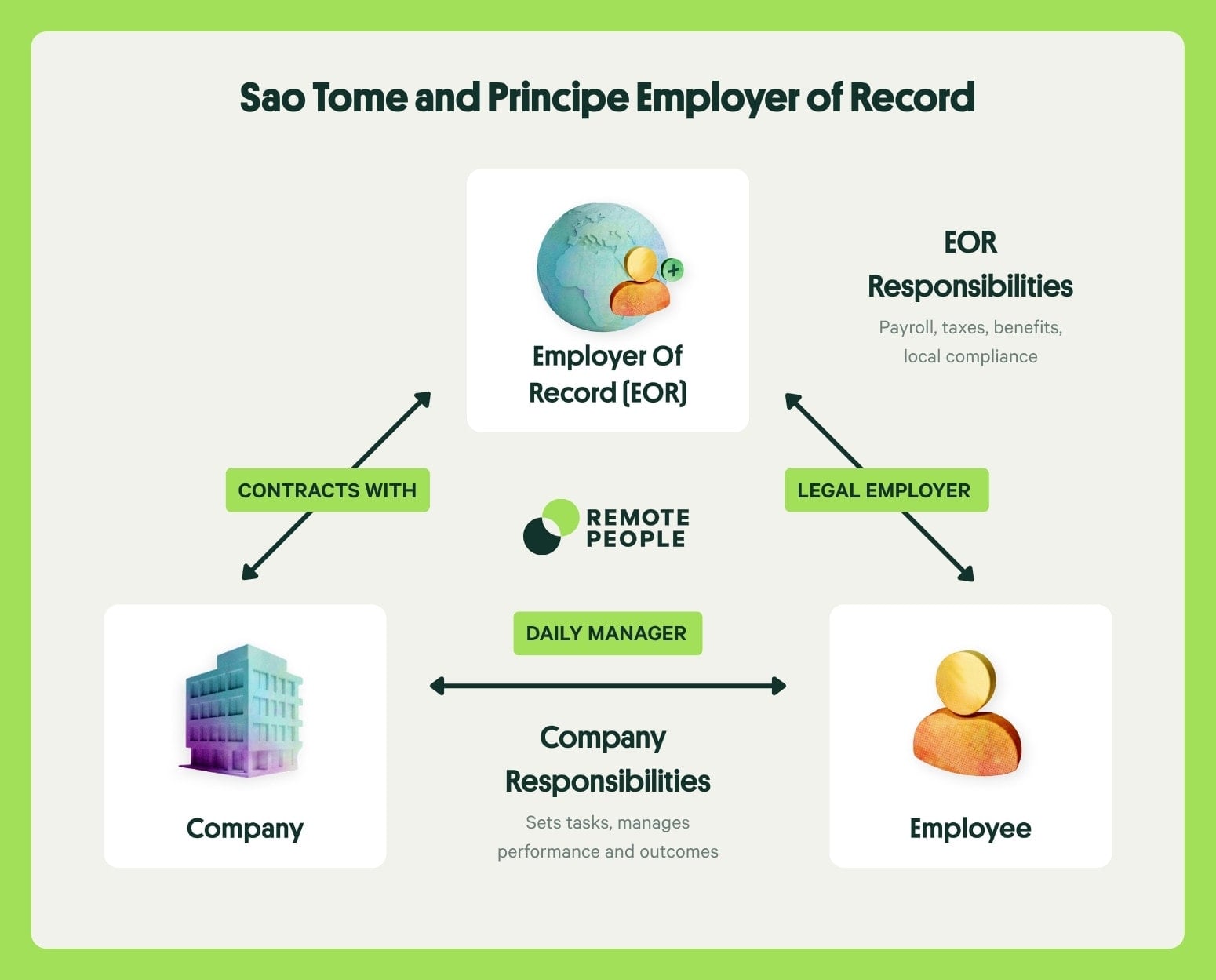
If you’d like to learn more about how Employer of Record (EOR) services work, read our What Is an Employer of Record (EOR)? guide for a complete overview of the model, its benefits, and when to use it.
If you’re comparing providers, our Best Employer of Record (EOR) Providers guide reviews the leading platforms to help you choose the right solution for your business.
Who Uses an Employer of Record in São Tomé and Príncipe?
Multinational firms, development organizations, and small to mid-sized companies use EORs to hire in São Tomé and Príncipe without creating a local subsidiary. Companies entering this market for the first time benefit from outsourced compliance, especially as the Labour Code took its modern form with Lei nº 6/2019 and INSS contribution rates increased to 14% total in January 2025. Sectors with active hiring needs include oil and gas services, tourism and hospitality, telecommunications, fisheries, cocoa and agriculture, and international development.
Companies testing the island market before full incorporation find an EOR dramatically more cost-effective than entity setup. Larger enterprises also use EORs for flexible staffing, adding specialist roles such as project managers or technical consultants without the overhead of establishing a permanent establishment.
Typical Onboarding Timeline
- First, you submit employee information, job description, and proposed salary. This takes 2-3 business days.
- Second, the EOR drafts the employment contract in Portuguese, then arranges employee sign-off. This takes 3-5 business days.
- Third, the EOR registers the employee with the Direcção dos Impostos for IRPS and with INSS for social security, and handles work permits for non-nationals. Registration typically takes 5-15 business days.
- Fourth, the first payroll cycle begins, with payment processed at month-end for the current month’s work. The employee receives their first salary in STN (Dobra) with all statutory deductions itemized.
- Fifth, the EOR provides a monthly dashboard with payroll summaries, deductions, and compliance status, and remains the point of contact for ongoing adjustments.
Hire in São Tomé and Príncipe
Ready to onboard talent in São Tomé and Príncipe? RemotePeople handles Portuguese-language contracts, IRPS and INSS compliance, and Labour Code adherence while you focus on your team. No local entity required.
Employment Laws and Regulations in São Tomé and Príncipe
São Tomé and Príncipe’s employment framework is anchored in Lei nº 6/2019 (the Labour Code), which entered into force on 10 July 2019 and replaced the 1992 Labour Act. The Code modernizes protections for employees, clarifies rules on fixed-term contracts, and updates overtime and termination procedures. Understanding these regulations matters for any company using an employer of record in São Tomé and Príncipe, as non-compliance can result in administrative fines issued by the Inspecção Geral do Trabalho and, in the most serious cases, reinstatement orders or compensatory damages.
Employment Contracts
The Labour Code requires employment contracts to be in writing for fixed-term, part-time, and foreign-worker arrangements, and strongly favours written form for all indefinite-term contracts. Contracts must specify job title, workplace, remuneration, working hours, and duration, and must be drafted in Portuguese, the sole official language of São Tomé and Príncipe. Oral contracts are technically permitted for indefinite-term roles but create evidentiary risks and are not recommended by labour inspectors.
Working Hours and Overtime
The standard workweek in São Tomé and Príncipe is 40 hours spread across five days, with a daily maximum of 8 hours and one full day of weekly rest, typically Sunday. Any work beyond these limits qualifies as overtime (trabalho suplementar) and must be compensated at a statutory premium set out in the Labour Code.
The Code sets overtime premiums at 25% over the regular hourly rate for the first additional hour, 50% for each subsequent hour on a working day, and 100% (double pay) for hours worked on weekly rest days or public holidays. Night work (between 8pm and 6am) carries its own premium when it forms a regular shift pattern.
São Tomé and Príncipe overtime premiums · 2026 | ||
Type of Overtime | Premium Over Hourly Rate | Notes |
|---|---|---|
First additional hour (weekday) | +25% | Applied to base hourly wage |
Subsequent hours (weekday) | +50% | Cumulative; per each additional hour |
Weekly rest day (Sunday) | +100% | Double pay; compensatory rest may apply |
Public holiday | +100% | Double pay in addition to normal holiday pay |
Night work (8pm – 6am) | +25% (typical) | Premium may be set by collective agreement |
Annual overtime cap | 200 hours/year | Subject to employee consent under Labour Code |
Minimum Wage
São Tomé and Príncipe’s national minimum wage stands at STN 3,000 per month (approximately $133 USD) as of October 2025, a 20% increase from the previous STN 2,500 rate. The minimum wage is set by Council of Ministers decree and applies to all private-sector workers. Public-sector minimum compensation is typically higher and set separately by the Ministry of Finance. Employers must ensure all salaries meet or exceed this threshold to remain compliant with the Labour Code.
Probation Period
Probation periods (período experimental) in São Tomé and Príncipe typically range from 30 to 60 days for most roles and can extend up to 180 days for skilled or managerial positions. During probation, either party may terminate the contract with minimal notice and without compensation, though the Labour Code still requires basic rights such as pay for hours worked, rest periods, and non-discrimination protections. The probation period must be set in writing at contract signing and cannot exceed the statutory maximum.
Leave Entitlements
Annual Leave
Employees in São Tomé and Príncipe accrue 22 working days of paid annual leave per year after completing a full year of service, rising proportionally from the first year based on months worked. Annual leave must generally be taken within the calendar year and cannot be replaced with additional pay except in specific circumstances set out in the Labour Code. The employer sets the leave calendar in consultation with the employee, typically published each January.
Sick Leave
Employees in São Tomé and Príncipe are entitled to paid sick leave upon presentation of a medical certificate. For the first three days of absence, the employer typically maintains 50% of the employee’s regular salary; from the fourth day onward, INSS social security pays a sickness benefit. Sick leave can extend up to 1,095 days (three years) in total for serious illness, after which a disability pension may be triggered.
Maternity Leave
Female employees are entitled to 14 weeks of paid maternity leave (licença de maternidade), typically split between pre-birth and post-birth periods. The benefit is paid by INSS at 100% of the employee’s reference wage, subject to contribution history requirements. Regional ISSA country profiles confirm this framework, which aligns with the minimum standards of ILO Convention 183 (maternity protection).
Paternity Leave
Male employees are entitled to a short period of paternity leave following the birth of a child, typically five working days, paid by the employer at 100% of regular salary. Paternity leave must be taken within the first 30 days after birth. Additional unpaid parental leave may be agreed between employer and employee for longer childcare periods.
Other Statutory Leave
Employees are entitled to short paid leave for family matters, including marriage (typically 5-11 days), death of a close relative (2-5 days depending on proximity), and blood donation. Military service obligations, study leave for recognized examinations, and trade-union duties are also protected under the Labour Code, with specific durations varying by circumstance. Religious observance is accommodated through flexible scheduling where feasible.
Leave Entitlements in São Tomé and Príncipe (2026) | |||
Leave Type | Duration | Compensation | Notes |
|---|---|---|---|
Annual Leave | 22 working days | 100% salary | Pro-rata in first year; taken in calendar year |
Sick Leave (First 3 days) | Up to 3 days | 50% salary (employer) | Requires medical certificate |
Sick Leave (Day 4+) | Up to 1,095 days total | INSS sickness benefit | Paid by social security |
Maternity Leave | 14 weeks | 100% via INSS | Pre- and post-birth split |
Paternity Leave | 5 working days | 100% salary (employer) | Within 30 days of birth |
Marriage Leave | 5-11 days | 100% salary | One-time entitlement |
Bereavement Leave | 2-5 days | 100% salary | Duration depends on relationship |
Study Leave | As required by law | Varies | For recognized examinations |
Statutory Employee Benefits
São Tomé and Príncipe requires employers to contribute to INSS, the national social security system, which provides old-age, disability, survivor, sickness, maternity, and work-injury benefits. As of January 2025, the employer contribution stands at 8% of gross monthly salary and the employee contribution at 6%, for a total of 14%. Health services in the islands are mainly delivered through the public system funded by general taxation, though many employers offer supplementary private health insurance for senior staff.
Pension benefits are administered entirely through INSS, with no separate occupational pension pillar. Employees qualify for old-age pension at retirement age, which is 62 for both men and women under the current rules, provided they meet minimum contribution history requirements. The INSS framework is funded through ongoing employer and employee contributions, and is regulated by the Instituto Nacional de Segurança Social under the Ministry of Labour.
Recent Regulatory Updates (2025-2026)
Two material regulatory shifts took effect in 2025 and affect payroll planning through 2026. First, the minimum wage rose by 20% to STN 3,000 per month in October 2025, the first increase in several years. Second, INSS social security contribution rates increased to the current 8% employer / 6% employee split starting January 2025, replacing the previous lower rates. In addition, São Tomé and Príncipe ratified ILO Conventions 102, 155, and 158 in June 2024, and these instruments entered into force in June 2025, strengthening standards on social security, occupational safety, and protection against unjustified dismissal.
Work Permits and Visas in São Tomé and Príncipe
Non-national employees hired through an employer of record in São Tomé and Príncipe require a work authorization and, in most cases, an accompanying residence visa. The process is coordinated between the Ministério do Trabalho (for the work authorization) and the Serviço de Migração e Fronteiras (for entry and residence). Processing times vary, typically four to eight weeks from complete submission.
Work Permit Requirements
Who Needs a Work Permit
All non-nationals of São Tomé and Príncipe require a work authorization before starting paid work in the country. Citizens of CPLP member states (Comunidade dos Países de Língua Portuguesa, including Portugal, Brazil, Angola, Mozambique, Cabo Verde, Guiné-Bissau, Timor-Leste, and Equatorial Guinea) benefit from simplified procedures under bilateral cooperation agreements but still require formal registration.
Eligibility and Required Documents
Employers need to provide a signed employment contract in Portuguese, a certified job description, proof of recruitment efforts demonstrating no qualified local candidate was available, and documentation supporting the applicant’s qualifications. The employee submits a valid passport (minimum six months validity), police clearance certificate, medical certificate, four recent passport photographs, and authenticated copies of educational or professional credentials. All foreign-language documents must be translated into Portuguese and legalized or apostilled.
Processing Time and Validity
Standard processing takes four to eight weeks from a complete submission, including background checks and inter-ministerial coordination. Once granted, the temporary work authorization is typically valid for up to one year and is tied to the sponsoring employer and position. Permanent authorizations may be issued for longer assignments with higher fees. Extensions require a renewed application filed before expiry of the current authorization.
Renewal Process
Renew the authorization by resubmitting current police clearance, medical certificate, and an updated employment contract before the existing permit expires. Start renewal at least 45-60 days before the permit expiration date. If an employee changes employers, the new employer must file a fresh application; work authorizations are not transferable between employers.
Common Visa Types
São Tomé and Príncipe common visas and work permits · 2026 | |||
Visa / Permit | Typical Validity | Work Allowed? | Government Fee |
|---|---|---|---|
Tourist Visa | 30 days | No | Varies by nationality |
Business Visa | 30-90 days | No (short meetings only) | Varies |
Temporary Work Authorization | Up to 1 year, renewable | Yes, with sponsor | ~STN 1,000 ($44) |
Permanent Work Authorization | Multi-year | Yes, with sponsor | ~STN 1,500 ($67) |
Residence Visa | 1-5 years | Only with work authorization | Varies |
CPLP Simplified Entry | Varies | With registration | Reduced |
USD approximations at $1 = STN 22.5 (April 2026). Source: VdA Legal Insight – São Tomé and Príncipe Labour Code and Comunidade dos Países de Língua Portuguesa – Mobility Agreements | |||
How an EOR Handles Work Permits
An EOR manages the entire work permit workflow, compiling documentation, preparing the required Portuguese translations, and submitting to the Ministério do Trabalho and Serviço de Migração e Fronteiras. The EOR tracks application status throughout processing and proactively initiates renewals at least 60 days before expiry to prevent any gap in authorization.
If an application is denied, the EOR advises on remedial options such as supplementary documentation or, where appropriate, an appeal. Authorization status is reflected in payroll and compliance records so that only properly authorized employees are processed on each monthly cycle.
Payroll, Taxes, and Social Security in São Tomé and Príncipe
São Tomé and Príncipe’s payroll system, managed by the employer of record on your behalf, combines employer and employee contributions to INSS, progressive IRPS income tax withholding, and statutory deductions under Lei nº 6/2019. The system operates on a monthly cycle with salaries paid in Dobra (STN). Understanding the contribution rates, tax brackets, and compliance obligations is important for accurate payroll management and employee communication.
Employer Contributions
Employers must contribute 8% of each employee’s gross salary to INSS, covering old-age, disability, survivor, sickness, maternity, and work-injury benefits. The 8% employer rate took effect in January 2025, replacing the previous lower rate. There is no industry-specific variation and no salary cap under the current framework, so the 8% contribution applies to the full gross monthly wage.
São Tomé and Príncipe Employer Contribution Rates (2026) | |||
Contribution Type | Rate | Calculation Basis | Annual Cost Example (USD) |
|---|---|---|---|
INSS (Social Security) | 8% | Gross monthly salary | $1,152 on $14,400 annual salary |
Work-Injury Insurance | Included in INSS | Gross monthly salary | Included above |
Total Employer Contribution | 8% | Gross monthly salary | $1,152 on $14,400 annual salary |
Employee Contributions
Employees contribute 6% of gross salary to INSS, deducted from each paycheck. They also pay personal income tax (IRPS, Imposto sobre o Rendimento das Pessoas Singulares) on a progressive monthly bracket structure. The employee’s net pay is calculated by subtracting INSS and IRPS from gross salary along with any voluntary deductions such as union dues or supplementary health insurance.
São Tomé and Príncipe Employee Deductions (2026) | |||
Deduction Type | Rate | Calculation Basis | Example (Monthly Salary $1,200) |
|---|---|---|---|
INSS (Social Security) | 6% | Gross salary | $72 |
IRPS (Income Tax) | Varies by bracket (0-25%) | Monthly income | $72-$180 depending on bracket |
Total Employee Deductions | 6% + IRPS | Gross salary + bracket | $144-$252 |
Income Tax
São Tomé and Príncipe operates a progressive IRPS (personal income tax) system with six monthly brackets. The tax is calculated on each month’s gross earnings independently, with no annual aggregation for routine salary income. Employees earning below the lowest threshold pay no income tax, while higher earners face marginal rates up to 25% on income above the top bracket. All rates below are published by the Direcção dos Impostos.
São Tomé and Príncipe IRPS Income Tax Brackets (2026) – Monthly | |||
Monthly Income (STN) | Monthly Income (USD) | Marginal Rate | Notes |
|---|---|---|---|
Up to 8,000 | Up to $356 | 0% | Exempt threshold |
8,001 – 15,000 | $356 – $667 | 10% | Applied to amount above STN 8,000 |
15,001 – 25,000 | $667 – $1,111 | 13% | Applied to amount above STN 15,000 |
25,001 – 50,000 | $1,111 – $2,222 | 15% | Applied to amount above STN 25,000 |
50,001 – 100,000 | $2,222 – $4,444 | 20% | Applied to amount above STN 50,000 |
Over 100,000 | Over $4,444 | 25% | Top marginal rate |
USD approximations at $1 = STN 22.5 (April 2026). Source: PwC Worldwide Tax Summaries – São Tomé and Príncipe Individual Taxes | |||
Tax calculations work progressively. For an employee earning STN 20,000 ($889) monthly, the first STN 8,000 is exempt, the next STN 7,000 is taxed at 10% (STN 700), and the remaining STN 5,000 is taxed at 13% (STN 650), producing a total monthly IRPS of STN 1,350 (approximately $60). Your employer of record handles all bracket calculations automatically and itemizes them on each payslip.
Payroll Cycle
Payroll in São Tomé and Príncipe runs monthly, with most employers paying on the last working day of the month or the first working day of the following month. Payments are typically made by bank transfer to the employee’s designated account in Dobra (STN); cash payments remain legal but are uncommon in formal employment. Your EOR handles full processing, ensuring accurate IRPS and INSS deductions and timely remittance to the authorities.
The payslip must itemize gross salary, INSS deduction, IRPS deduction, any other allowances or deductions, and net pay. Employers are required to retain payroll records for at least five years to support tax and social security audits. If employment ends mid-month, final pay must be processed within the statutory period set out in the Labour Code, typically with the next regular payroll run following separation.
13th Month Salary and Bonus Pay
Unlike some neighbouring Lusophone jurisdictions, São Tomé and Príncipe does not impose a statutory 13th or 14th month salary. Annual bonuses are a matter of contract or collective agreement, and many employers in the formal sector choose to pay a Christmas or year-end bonus equivalent to a portion or full month of salary, particularly for longer-tenured staff. Any bonus paid is subject to IRPS and INSS on the same basis as regular wages, and the employer’s payroll system handles withholding accordingly.
Cost of Hiring Through an EOR in São Tomé and Príncipe
EOR Service Fees
Employer of record service fees in São Tomé and Príncipe typically range from $400 to $700 per employee per month, reflecting the smaller market scale and specialized local expertise required. These fees cover contracting, payroll processing, IRPS and INSS filing, benefits administration, and compliance management. Pricing is usually a flat monthly cost rather than a percentage of salary, making budgeting predictable across headcount and compensation tiers.
Total Employment Cost Breakdown
The total cost of hiring through an EOR includes the gross salary, mandatory INSS contribution, and the EOR service fee. Understanding this breakdown helps finance teams budget accurately when planning a small São Tomé and Príncipe team.
São Tomé and Príncipe employer cost example · $1,200/month gross · 2026 | ||
Employer Cost | Amount (USD) | % of Gross |
|---|---|---|
Gross Salary | $1,200 | 100% |
INSS Social Security (8%) | $96 | 8% |
EOR Service Fee | $500 | 41.7% |
Total Monthly Cost | $1,796 | 149.7% |
USD amounts are approximate conversions at $1 = STN 22.5 (April 2026 rate). Source: RemotePeople EOR Pricing and PwC São Tomé and Príncipe Tax Summary | ||
Ready to simplify your hiring costs in São Tomé and Príncipe? Contact our team to receive a custom pricing proposal based on your team size and needs at https://remotepeople.com/contact/.
Benefits of Using an EOR in São Tomé and Príncipe
Hiring through an employer of record removes the friction of establishing a local legal entity while maintaining full employment compliance. Your organization gains immediate access to vetted talent in the islands without navigating company registration with the Guichê Único para Empresas, tax identification, and INSS registration, each of which adds weeks to a do-it-yourself setup.
An EOR handles all payroll calculations, IRPS and INSS filings, and benefit administration, reducing operational burden and letting your internal team focus on core business. You retain full control over hiring decisions, work assignments, and team management while the EOR manages the legal employment relationship with the local worker.
The flexibility to scale your team up or down without long-term commitments is especially valuable in a smaller market like São Tomé and Príncipe, where forecast uncertainty is higher and local entity wind-down carries its own regulatory costs. You can pilot the market, hire project-specific specialists, or adjust headcount without closing a local office.
Termination and Offboarding in São Tomé and Príncipe
Notice Periods
São Tomé and Príncipe’s Labour Code, which your employer of record applies on your behalf, sets different notice periods depending on the reason for termination and tenure. For ordinary termination of indefinite-term contracts initiated by the employer, notice typically ranges from 8 to 30 days depending on length of service, while employees who resign generally give 15 days’ notice. Fixed-term contracts require notice before non-renewal.
São Tomé and Príncipe notice periods · 2026 | ||
Scenario | Notice Required | Notes |
|---|---|---|
Employer termination (< 1 year) | 8 days | Indefinite-term contracts |
Employer termination (1-5 years) | 15 days | Increases with tenure |
Employer termination (> 5 years) | 30 days | Senior or long-tenured staff |
Employee resignation | 15 days minimum | Can be longer by contract |
Fixed-term non-renewal | 15 days before expiry | Required from employer |
Probation termination | Minimal or none | Depends on probation length |
Collective dismissal | 60 days + consultation | Requires worker representative dialogue |
The notice period runs from the date the other party receives written notice through the last working day. During notice, the employee remains employed at full wages and benefits unless lawfully suspended for cause.
Severance Pay
Calculation Method
Severance pay (compensação por cessação) in São Tomé and Príncipe is calculated primarily on length of service when a contract is terminated without just cause by the employer. The standard benchmark is one month’s base salary per year of service, with a minimum floor of three months’ salary for qualifying employees. Fractional years of service are calculated on a pro-rata basis. The calculation uses the employee’s last gross monthly salary at termination.
São Tomé and Príncipe severance entitlements · 2026 | ||
Years of Service | Severance (Months of Salary) | Notes |
|---|---|---|
Less than 1 year | Pro-rata, minimum 3 months | Applies for without-cause termination |
1-5 years | 1 month per year (min 3 months) | Based on last gross salary |
5-10 years | 1 month per year | Calculation continues at full rate |
Over 10 years | 1 month per year (may include uplift) | Senior roles may have contractual top-up |
Just-cause dismissal | None | Serious misconduct documented |
Voluntary resignation | None | Employee-initiated departure |
Termination during probation | None | Either party may end the contract |
Caps and Exceptions
No severance is required for termination during a valid probation period or for dismissal on just-cause grounds such as theft, gross misconduct, repeated unexcused absences, or violation of core contractual duties. Employees who voluntarily resign are not entitled to severance. Termination due to the employee’s serious misconduct may result in no severance pay, subject to documentation and, if disputed, review by the Inspecção Geral do Trabalho or labour courts.
Grounds for Termination
Employers may terminate employees for just cause (justa causa) including repeated failure to meet job requirements after documented warnings, serious breach of work rules, theft or fraud, or insubordination. Without-cause terminations are permitted but trigger both notice period and severance obligations. Following the 2024 ratification of ILO Convention 158 on termination of employment, São Tomé and Príncipe’s dismissal framework formally prohibits termination on discriminatory grounds including race, gender, political opinion, religion, age, or union membership.
EOR vs. Other Hiring Models in São Tomé and Príncipe
EOR vs. Setting Up a Local Entity
EOR versus establishing your own entity in São Tomé and Príncipe · 2026 | ||
Comparison | Employer of Record | Own Entity |
|---|---|---|
Setup Time | 1-3 weeks | 3-6 months |
Upfront Cost | $0 | $10,000-$30,000 |
Ongoing Cost (per employee) | $400-$700/month | $2,500-$6,000/month |
Local Partner Required | No | Often recommended |
INSS Registration | EOR handles | Company handles |
Payroll & Tax Filing | Included | Must hire locally |
Best for Team Size | 1-15 employees | 15+ employees |
Scale Down/Exit | Immediate | Months of wind-down |
Government Contracts | Limited eligibility | Full eligibility |
The EOR model delivers clear advantages for organizations testing the São Tomé and Príncipe market or maintaining small remote teams on the islands. Setup occurs within one to three weeks compared to three to six months for entity registration, and requires zero upfront capital, making this approach significantly more accessible than incorporating a local subsidiary.
Ongoing operational costs through an EOR remain predictable per employee, whereas a local entity requires hiring an accountant, HR manager, and legal advisor, typically totaling $2,500 to $6,000 monthly in overhead for even a minimal operation. For teams of 15 or fewer employees, the EOR cost advantage becomes even more pronounced, and most international companies never cross the threshold where entity economics pay off.
The flexibility to exit the market without regulatory filings or asset liquidation provides strong risk mitigation. Organizations anticipating rapid growth beyond 15 employees, or needing to compete for government tenders and natural-resource concessions, may eventually benefit from transitioning to a local entity.
EOR vs. Hiring Independent Contractors
EOR employment versus independent contractor engagement in São Tomé and Príncipe · 2026 | ||
Comparison | EOR (Full-Time Employee) | Independent Contractor |
|---|---|---|
Legal Relationship | Employer-employee | Self-employed service provider |
Compliance Risk | Low (EOR handles) | High (misclassification risk) |
Payroll & Tax | EOR withholds IRPS & INSS | Contractor handles own taxes |
Benefits & Leave | Annual leave, public holidays, sick leave | None (not entitled) |
IP Protection | Work product owned by employer | Contractor retains IP unless assigned |
Termination | Notice + severance applies | End contract per agreement |
Best for | Core team, long-term roles | Project work, specialized tasks |
Cost Structure | Predictable monthly cost | Variable (hourly / project) |
The choice between EOR employment and independent contractor engagement hinges on control, duration, and compliance tolerance. EOR provides the strongest legal foundation for ongoing work where you direct daily activities and expect deliverables within your internal processes. Contractors suit discrete projects, specialized expertise, and relationships where the individual maintains their own client base and methodology.
Misclassification is a real risk in São Tomé and Príncipe under the 2019 Labour Code. Inspecção Geral do Trabalho reviewers apply a substance-over-form test to contractor arrangements; if the relationship shows exclusivity, integration into the company’s organization, fixed working hours, or employment-like benefits, it can be reclassified as employment, exposing the principal to back-pay for leave, holidays, INSS, and IRPS. The EOR model eliminates this exposure by establishing a proper employment relationship from the start.
For teams needing long-term talent with investment in training and retention, EOR employment delivers superior stability and reduces turnover risk. Contractor arrangements work best for specialized, seasonal, or project-based engagements where fixed deliverables replace ongoing management.
EOR vs. PEO
EOR versus PEO models in São Tomé and Príncipe · 2026 | ||
Comparison | Employer of Record (EOR) | PEO |
|---|---|---|
Legal Employer | EOR company | PEO company (co-employment) |
Local Entity Required | No | Yes (client entity) |
Best for | Cross-border remote hiring | Expanding existing operations |
Compliance Liability | EOR assumes full liability | Shared between PEO and client |
Setup Time | 1-3 weeks | Months (entity + PEO contract) |
Control over HR Policies | Client sets policies | PEO-defined policies (limited customization) |
Typical Use Case | Start remote hiring immediately | Professionalize existing local HR |
São Tomé and Príncipe has no formal PEO framework or established co-employment structures, so true PEO services are not practically available in this market. The distinction matters primarily for organizations with an existing São Toméan subsidiary that might theoretically outsource HR administration, a relatively rare scenario for international companies at early stages.
For foreign organizations initiating São Tomé and Príncipe hiring, the EOR model is the superior choice on speed, cost, and compliance certainty. EOR assumes full legal employer liability, establishing clear accountability for regulatory compliance and reducing client exposure. You retain complete control over hiring, compensation, and work arrangements without PEO-imposed standard policies.
The EOR’s rapid deployment (one to three weeks) and absence of local entity requirements make it the practical default for cross-border hiring in the islands. PEO benefits would theoretically emerge only for organizations with existing São Toméan subsidiaries seeking HR professionalization, a scenario uncommon among early-stage remote hiring programs.
Public Holidays in São Tomé and Príncipe
São Tomé and Príncipe public holidays · 2026 | ||
Date | Holiday | Type |
|---|---|---|
January 1 | New Year’s Day | National |
January 4 | Day of King Amador | National |
February 3 | Martyrs’ Day (Batepá Massacre) | National |
May 1 | Labour Day | National |
July 12 | Independence Day | National |
September 6 | Armed Forces’ Day | National |
September 30 | Nationalization of the Roças | National |
December 21 | São Tomé Day | National |
December 25 | Christmas Day | Religious |
São Tomé and Príncipe observes nine public holidays annually. When a public holiday falls on a Saturday or Sunday, employers are not typically required to grant a substitute day, though the government occasionally decrees “pontes” (bridges) creating additional days off. Holiday pay is factored into payroll calculations; employees required to work on a public holiday are paid at double their regular hourly rate under the Labour Code. Your EOR provider automatically adjusts payroll to comply with these statutory requirements.
How to Get Started with an EOR in São Tomé and Príncipe
- First: Define your hiring needs by identifying the role, required skills, and desired start date. Clarify team size, expected growth, and whether you need ongoing support or project-based talent; this helps your EOR provider prepare accurate pricing and compliance documentation for São Tomé and Príncipe.
- Second: Partner with an EOR provider by reviewing capabilities, pricing, and specifically their São Tomé and Príncipe coverage. Confirm they handle IRPS and INSS, have Portuguese-language contracting, and have established channels with the Ministério do Trabalho for work authorization processing.
- Third: Complete your provider’s client onboarding, which typically involves KYC verification, job descriptions, and setting compensation ranges. This process usually completes within 1-2 weeks and requires minimal back-and-forth documentation.
- Fourth: Begin recruitment through your own networks or your EOR provider’s talent marketplace. Your EOR handles employment contract creation under Lei nº 6/2019, ensures compliance with Labour Code provisions, and establishes payroll processing from day one.
- Fifth: Onboard your first employee by providing work assignments, access credentials, and company policies. Your EOR provider manages the administrative setup including INSS enrollment and IRPS registration, allowing the employee to start work immediately.
Ready to hire your first team member in São Tomé and Príncipe? Our EOR experts guide you through every step of the hiring and onboarding process. Schedule a consultation today at https://remotepeople.com/contact/ to receive customized guidance for your São Tomé and Príncipe hiring strategy.
Where companies hiring in Sao Tome and Principe expand next
Teams operating in Sao Tome and Principe typically extend into neighboring Central African markets with overlapping regulatory and linguistic frameworks. Most teams start with the Democratic Republic of the Congo — shared Central African workforce dynamics. A team in the Republic of the Congo typically follows, with the regional Central African talent pool. Operations in Cameroon is a natural addition for overlapping Central African regulatory frameworks, and Gabon completes the regional picture with aligned Central African labor norms.
Frequently Asked Questions
EOR fees in São Tomé and Príncipe range from $400 to $700 per employee per month, charged as a flat monthly fee rather than a percentage of salary. This fee covers payroll processing, IRPS and INSS filings, benefits administration, and regulatory compliance. The specific cost depends on the provider's service level and any additional features like work visa support or specialized reporting.
Yes, independent contractor engagements are possible in São Tomé and Príncipe, but they carry real misclassification risk under Lei nº 6/2019 if the relationship resembles employment. Using a proper contractor platform designed for multi-country compliance helps structure the engagement correctly. Contractors suit project work or specialized expertise, while EOR employment provides better protection for ongoing roles.
Your client company owns all work product and intellectual property created by EOR employees as part of their regular job duties. This ownership is established through the Portuguese-language employment contract and applies automatically unless specific provisions assign IP to the employee. Your EOR provider ensures IP ownership clauses appear in every contract.
The typical timeline from contract signature to employee start date is 1 to 3 weeks for national hires, and 4 to 8 weeks where work authorization is required for a non-national. Initial setup with your EOR provider usually completes within 1-2 weeks, including KYC verification and contract preparation.
São Tomé and Príncipe's Labour Code (Lei nº 6/2019) governs employment relationships, requiring written contracts for fixed-term and foreign-worker arrangements, statutory benefits, notice periods, and severance pay. Your EOR provider handles all compliance requirements, but understanding the STN 3,000 minimum wage, 40-hour workweek, annual leave entitlement of 22 days, and termination procedures remains useful for planning.
Employers must provide 22 working days of annual leave, paid sick leave (with INSS paying from day four), 14 weeks of maternity leave via INSS, paternity leave, and INSS social security contributions at 8% of gross salary. Unlike Portugal and Angola, São Tomé and Príncipe does not mandate a 13th-month salary by law, though many employers pay a year-end bonus.
Termination requires written notice (typically 8-30 days depending on tenure) for indefinite-term contracts, and severance pay is mandatory for without-cause dismissals at roughly one month per year of service with a minimum floor. Your EOR provider manages the notice period, calculates severance obligations, and handles all regulatory notifications required by the Labour Code and Inspecção Geral do Trabalho to ensure compliant separation.
Employer of Record in
Employer of Record in
Democratic Republic of the Congo
Employer of Record in
Employer of Record in
Employer of Record in
Employer of Record in
Employer of Record in
Employer of Record in




